國立臺灣大學管理學院資訊管理學系 碩士論文
Department of Information Management College of Management
National Taiwan University Master Thesis
社交型語言學習系統之建置與分析
Development of a Social-Language Learning System
何鎮濠 Chan-Hou Ho
指導教授:莊裕澤 博士 Advisor: Yuh-Jzer Joung, Ph.D.
中華民國 106 年 8 月
August, 2017
論文摘要
本研究旨在為外語學習者建置一個以“社交”和“語言交換”為概念所開發 的外語學習系統。除了傳統式教學的外語學習方式之外,目前也流行著另一種以 兩人或以上擁有不同語言背景的外語學習者為組,互相教導對方自己母語而被稱 之為「語言交換」的互動式學習方法。該方法已被很多研究證明能對語言學習帶 來好處,但為了達到較好的學習效果需要學習者對想要學習的語言已經有一定程 度的掌控。本研究嘗試以強調“社交”與“互動”為出發點,以不一樣的角度來 實現語言交換,以此降低學習者的進入門檻並讓語言的學習過程變得更為有趣。
此系統可以讓初階的外語學習者也能用更輕鬆、更具社交性的方式與該外語的母 語人士進行互動,並在互動的過程中學習到他們想要學習的外語。由於該系統擁 有一個與現有語言學習市場不同的市場進入點,因此我們認為該系統具備了可以 發展成一種新的商業模式的可能性,而這一可能性也是本研究所想要探討的重要 價值所在。
關鍵字:語言學習、語言交換、社交學習、互動式學習、學習系統
Abstract
The goal of this research was to develop a language learning system which brings in the concept of “Social” and “Language Exchange” for foreign language learners.
Besides traditional language tutoring, language exchange is currently another popular way to learn foreign language where two or more learners joined together, teaching each other their native languages. Such learning model had been proved to have benefits for language learning. However, it requires learners to have a certain level of language and teaching skill in order to carry out this learning method effectively. In this research, we were taking a different approach to practice language exchange which focuses more on “Social” and “Interaction”. This approach was aimed to lower the entry barrier for new foreign language learners and to make the learning process more interesting. In precise, we had developed a system which allowed beginners to practice their foreign language skill through interacting with native speakers in a more socialable way. Such system had a different entry point to the current language learning market and might have the potential to develop into a new business model.
This was the main value that we were exploring in this research.
Keywords: Language Learning、Language Exchange、Social Learning、Interactive
Learning、Learning System
Content
Chapter 1 Introduction ... 1
1.1 Background & Motivation ...1
1.2 Objective and Scope ... 2
Chapter 2 Related Works ... 4
2.1 Social Learning Theory ... 4
2.2 Language Exchange (Tandem Language Learning) ... 6
2.3 E-Learning & M-Learning ... 9
2.4 Interactive Learning System ... 11
2.5 Summary ... 15
Chapter 3 System Design ... 16
3.1 Overview ... 16
3.2 System Design ... 16
Chapter 4 System Implementation ... 21
4.1 Overview ... 21
4.2 Implementation Guideline ... 21
Chapter 5 User Interface & Real Practice ... 26
5.1 UI Introduction ... 26
5.2 Real Practice ... 30
5.3 Improvement & Further Trial ... 35
5.4 Summary ... 45
Chapter 6 Conclusion ... 47
Reference ... 49
List of Figures
Figure 2.1.1 Bobo Doll Experiment ... 4
Figure 2.2.1 Adam & Hideo’s online survey... 8
Figure 2.4.1 Four dimensions of interactions in course ... 12
Figure 3.2.1 System Structure ... 16
Figure 5.1.1 UI of Registration Page ... 26
Figure 5.1.2 UI of Match Page ... 27
Figure 5.1.3 UI of Chat & Global Page ... 28
Figure 5.3.1 OS Distribution of User ... 38
Figure 5.3.2 Gender Distribution of User ... 39
Figure 5.3.3 Age Distribution of User ... 41
List of Tables
Table 5.2.1 Overall Statistics ... 31
Table 5.2.2 Top 10 Speaking Languages ... 31
Table 5.2.3 Top 10 Learning Languages ... 32
Table 5.3.1 Overall Statistics ... 36
Table 5.3.2 OS Distribution of User ... 39
Table 5.3.3 Gender Distribution of User ... 40
Table 5.3.4 Partner Distribution According to Gender ... 40
Table 5.3.5 Top 10 Speaking Languages by Gender ... 42
Table 5.3.6 Top 10 Learning Languages by Gender ... 42
Table 5.3.7 Top 10 Speaking Languages by Age ... 44
Table 5.3.8 Top 10 Learning Languages by Age ... 44
Chapter 1 Introduction
1.1 Background & Motivation
Over the past years, people have been paying more attention to their foreign language skill, no matter it is for self-interest, or is due to the need of communicating with foreigners, the need for foreign language learning has been obvious.
Although there are schools and training centers that provide formal language education, most of them focus more on comprehensive and composing skill training compared to communication skill, which is often more difficult and costly to deliver;
besides, learners have little chances to practice their oral skill with native speakers directly, thus they often find it difficult to communicate with native speakers when it comes to the need in real case.
One possible solution to this problem is to hire a native speaker as language tutor, but which is too costly indeed; that is why the concept of Language Exchange is being introduced in language learning.
Language exchange, also called Tandem Language Learning, is a method of language learning where two or more people partnered together and teach each other their own mother language; with language exchange, the learning cost can be reduced to a certain stance.
From my personal experience, communicating with native speaker is an effective way to learn foreign languages. As a foreign student from Macau, I was unable to speak Chinese when I first went to Taiwan for University. It was because my mother language was Cantonese and I had not learnt to speak Chinese before. Although I can read Chinese, as both Taiwan and Macau use Traditional Chinese for written language, it was hard for me to communicate with local people at the beginning. Fortunately, since I was living there, I had the chance to learn and practice Chinese with my Taiwanese friends and other local people around me every day. That was how I learned to speak Chinese and is why I believe that communicating with native speaker is an effective way to learn foreign languages.
However, finding a native speaker who is willing to do language exchange near us can usually be a hard problem. With the previous descriptions, here comes with the thought, “what if we can connect all these demand and supply (human resources) over the world, with the aid of Social and Mobile Network? Could this provide any positive value to language learning?” This is what this research aimed to explore.
1.2 Objective and Scope
The objective of this research is to develop a system which takes advantages of Social and Mobile Network, with the concept of Language Exchange and Social Learning, in order to minimize the starting and learning cost for learners, and to
generate other positive synergies during language learning. In specific, with this system, learners can:
- Meet native speakers and other learners from the globe online.
- Find language exchange partners easily with minimal effort.
- Practice learning language through direct communication with native speakers online.
- Practice learning language flexibly at anytime, anywhere.
- Propose any questions or problems met during learning.
- Receive answers or responses from native speakers.
- Share any related information or knowledge.
- Interact and chat with other foreign learners, - Build up friendships with foreigners.
Chapter 2 Related Works
Recall that this system will be bringing in the concept of Social Learning and Language Exchange, in this chapter we will further discuss about what and how these two concepts are playing an important role in language learning by showing related research and studies on these topics. We will also discuss other related topics that have a close relationship to language learning such as e-learning and m-learning, etc.
2.1 Social Learning Theory
Social Learning Theory [3, 4, 10, 13, 17] has been popular since the 1950s, in which Professor Bandura is considered to be the leading proponent. In Bandura’s research [3, 4], it is shown that people can learn from one another through observation, imitation and modeling. To illustrate this, Bandura used the well-known Bobo Doll Experiment that he had conducted before [2].
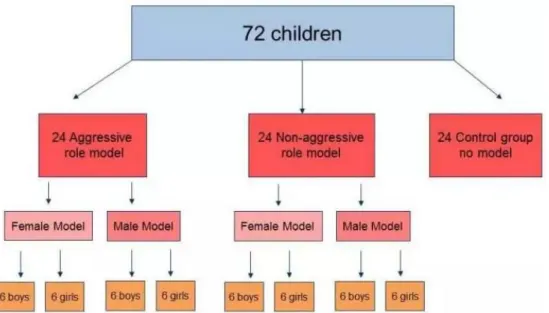
Fig. 2.1.1 Bobo Doll Experiment (http://www.simplypsychology.org/bobo-doll.html)
In this experiment, 72 pre-tested children with similar levels of aggression were categorized into 3 modeling groups as shown in Fig. 2.1.1, the Aggressive and Non-aggressive group were furtherly divided into two small groups of 12 children, with 6 boys and 6 girls in each small group respectively. One of the two small groups in the Aggressive group then watched a film of a boy, while the other group watched a girl, attacking a “Bobo Doll” aggressively; the two small groups in the Non-aggressive group, on the other hand, watched a boy and girl who played with the doll quietly, and the remaining Control group was given no model. The three groups of children were then observed to play with the “Bobo Doll” in separate rooms; the result showed that children in the Aggressive modeling group imitated far more aggressive responses compared to those in the Non-aggressive and Control groups. This result give evidence to the Social Learning Theory that people can learn social behavior through observing other people, and this study also has educational implication on language learning.
Consider how we were learning our first language when we were still a baby who could just managed to talk, we learned to say from what and how people around (e.g.
parents) directly taught us, while most of the time we learned by observing how they talked to others. Afterwards, we tried to speak in the manner of what we had learned through these two cases. The way we learn can actually be considered as a cycle of
‘Learning and Practicing’ - Learn through receiving and observing, then practice those
we received and observed. The consequence of this learning pattern is that we can speak with our first language fluently, though we received just little or even no formal education as studying in school.
In fact, Skinner (1957), Whitehurst & Valdez-Menchaca (1988) had taken Social Learning further on language development. They found that children would intimate words of different languages. Children repeated those words that were rewarded, praises and smiles from their parents, but not those words without rewards. This research showed that language learning is possible through social learning, given that there is enough incentive (reward from parents in this case).
2.2 Language Exchange (Tandem Language Learning)
Language Exchange has also been well discussed and educational value-proved through its long history. With reference to Language Exchange Journal (Calvert 1999) [7] , Language Exchange can be defined as a form of open learning whereby two people with different native languages work together in pairs in order to:
(1) Learn more about one another’s character and culture;
(2) Improve their language skills; and
(3) Exchange additional knowledge such as profession, etc.
For example, an American who wishes to learn French may join with a French who also wants to learn English, so that they can teach and learn from each other with
their native languages. In fact, language exchange is not limited to be exactly two people in pairs, sometimes it can also be a small group of three or more people.
There are many research [1, 6, 11, 16] showing that practicing language exchange can benefit language learning. Kessler and Roberts [11, 16] mentioned that peer feedback can often be more effective than teacher feedback. Adam and Hideo (2011) [1]
found that language learners can receive feedback from their partners immediately, which can help to correct earlier linguistic mistakes before habit is formed. Such behavior is called the “negotiation of meaning” [14] and is important especially in the early stage of learning a new language. Bower and Kawaguchi (2011) [6] also showed that negotiation of meaning often taken place during the communication between native and non-native speaker as they usually have different cultural backgrounds. It may cause resistance during communication though, it can, on the other hand, also be a catalyst for boosting relationship.
Adam and Hideo had also done a survey in 2009 [1]. They sent online survey invitations to English learners from the top two language exchange websites on Alexa.com, a subsidiary of Amazon.com which provides commercial traffic data. The top two language exchange websites were mylanguageexchange.com &
conversationexchange.com at that time. Two of the questions and the corresponding result are listed in Fig. 2.2.1.
Fig. 2.2.1 Adam & Hideo’s online survey [1]
The findings were interesting, when asked for “which is more important for language exchange”, 72% of the learners answered “Gaining communication experience with foreigners” while 28% of them selected “Learning English”; and the top reasons for finding a language exchange partner were “to interact with native speakers” and “to interact with people from different culture” (both reached a rate of 70%). This survey implies that learners doing language exchange is not only purposed for learning new languages, instead most of them actually wish to interact with people from different cultures. It would not be hard to understand if the reason for them to learn foreign languages is indeed to interact with people from those countries; and this would be an important factor that we need to consider when designing our system.
2.3 E-Learning & M-Learning
The occurrence of Internet has changed countless existing behaviors. Such as people doing language exchange needed to meet up face to face in the past, thus they usually need to find foreigners nearby; but now it can easily be achieved just by using online exchange services, which is also an example of E-Learning.
There are many definitions for E-Learning in different perspectives, here we are defining it in terms of “electronic” and “online” learning, and is referred to the use of all types of information technology, including electronic technology and multi-media, in service of learning or learning support [9].
E-Learning has been a hot topic and there are many research discussing about its pros and cons [5, 8, 12, 15, 20]. One of the benefits of E-Learning is cost saving as mentioned by Wheatley & Greer (1995) [20], learners do not need to travel and can plan their own schedules.
Bouhnik and Marcus (2006) [5] stated that E-Learning can have high degree of freedom: learners can express thoughts and ask questions without limitations, and can access online materials on their own election. Capper (2001) [8] also showed that E-Learning can encourage group collaboration, and discussions can stay more on-track.
In addition, one important benefit that language learning given by E-Learning is
the pooling of human resources. The lack of geographic limitation creates more opportunities that learners can interact and learn from native speakers directly, which can play an important role in learning as discussed previously in the Social Learning Theory and Language Exchange sections.
On the other hand, Marcus (2003) [15] ’s study also showed factors that learners dissatisfied with E-Learning; in summarize, they are:
- Lack of firm framework can encourage laziness - High level of self-discipline is required
- Lack of learning atmosphere
- Level of contact and discussion between students is minimized - Lack of direct interaction
This study has a similar and consistent result with many other studies that describe the cons of E-Learning. However, as Kearsley (2000) [12] mentioned, E-Learning has a unique social, interaction context, which is very different from that of traditional learning. It also appears that E-Learning together with interaction-related tools can positively influence the success and satisfaction of learners.
In advance to E-Learning, M-Learning has been proposed and widely discussed in the past few years. “M” stands for mobile, and M-Learning can be defined as the learning across multiple contexts, through social and content interactions, with the use
of personal electronic mobile devices. [21].
New mobile technologies, such as smart phones, PDAs and other hand-held mobile devices, have become one of the most important channels that we receive information. The rise of social network and cloud services, such as google, facebook, twitter, etc, also redefine the way we treat and learn from the information we received.
M-Learning has become a further advanced and portable way of learning.
Learners can complete the whole learning process anytime anywhere within a small mobile device, filled with self-tailored content; and the way of learning has also become more flexible and enjoyable.
2.4 Interactive Learning System
As mentioned in the previous section, in order to build a successful online language learning system, we should be taking advantages of E-Learning while minimizing its drawback at the same time, that is, to be interactive.
In 2006, Bouhnik and Marcus [5] proposed a model for virtual interactive courses.
Fig.2.4.1 shows the connection between the four dimensions of interactions in course.
Fig. 2.4.1 Four dimensions of interactions in course [5]
In this model, instructor is at the top of pyramid and parallel to his/her students.
Communication can be carried out between instructor-students, or student-student.
Besides, the pyramid is closely intertwined by content and system. It is because different types of interaction often take place on the same medium in E-Learning, such as the access to content via system, or group chatting and discussion around content between participants, etc. This model indicates the close relationship between the four dimensions of interaction and that they should be considered together.
In case of Language Exchange for online learning, we can consider each participant to be both instructor and student because both of them will be learning and teaching from each other. Thus the center pyramid would have an even closer relationship and interaction compared to the general E-Learning courses, while the remaining components stay similar.
In fact, there are many real practices implementing such similar interactive
learning systems. For example, there are many websites providing free online learning exchange services like mylanguageexchange.com & conversationexchange.com mentioned in 2.2. These websites allow learners to search for exchange partners through posting their own profiles and requirements, such as their supplying and demanding language, level of language skill, available time schedule, etc. Once there is another learner wishing to exchange with him/her, they can start exchanging via text messages. Some of the websites also provided advanced services (some of them are chargeable), such as language translation and real-time audio/video calls, which can be handy during communication.
TutorABC is a company mainly provides chargeable language tutoring online service. Unlike other language exchange websites, it focuses more on 1:1 (one to one) English tutoring, not exchange, and offers qualified tutors for learners. Though it is not free, learners can select their own desired tutors and time schedules, and the tutoring quality is relatively high.
HelloTalk is a more recent language exchange services that runs on smart phones.
It allows learners to find exchange partners and communicate via text/voice messages and internet phone calls on iOS and Android devices. There is one special rule for exchanging language – the exchange pair will need to start with using either one’s native language and switch to the other one’s language every 5 minutes, as the system
will record the time they talked or the amount of text they sent to ensure a fair exchange. HelloTalk also provides language translation, sentence correction, STT (Speech-to-Text) and TTS (Text-to-Speech) services. Free member can use limited number of times while there is no limit for premium account.
All the services above provide effective tools or platforms for learners to learn foreign languages in a 1:1 manner, though some of them are free and some charges for advanced services. The way of learning can be more interactive compared to that of traditional language schools, and is even more flexible when it is offering on mobile devices. These are what we can be taking advantage when building our system.
However, these services mainly focus on improving the language skill of learners.
Recalling the survey we discussed in section 2.2 and the survey result shown in Fig.
2.2.1, most of the learners actually concern more about the experience to interact with foreigners rather than improving their language skills, though the later one is also important. Therefore, we will be designing our system in a different approach, such that this system will not be designed for just improving the language skills of learners;
instead it will be focusing more on the experience and interaction between foreign learners. In other words, the social element will be playing a heavier role in this system, so that learners can experience a more enjoyable and interesting way to interact with foreigners, while learning and improving their foreign language skills at the same time.
2.5 Summary
Summarizing all we have discussed in this chapter, practicing Social Learning and Language Exchange can be beneficial to language learning, while taking advantage of E- and M-Learning can further benefits because of its cost saving and high flexibility property; besides, interaction plays an important role in the success of E-Learning, and that learners practicing language actually concern more about the experience to interact with foreigners rather than improving their language skills. All this factors are what we should be taking in consideration when building our learning system. In the next chapter, we will be discussing a more detailed design for this learning system.
Chapter 3 System Design
3.1 Overview
As mentioned in Chapter1 & 2, the objective of this system is to minimize the learning cost for language learners, including entry cost and costs during learning, and to provide a different learning method and environment for learners. With the integration of mobile and social network, learners can interact with native speakers overseas in a more enjoyable manner, while learning foreign language through social learning and language exchange at the same time.
3.2 System Design
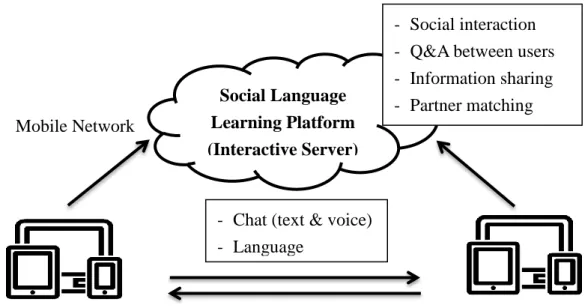
Fig. 3.2.1 System Structure
With this system, learners can ask for any language-related questions, such as problems during language learning, difficulties that faced in daily life, etc. Learners
Mobile Network
Social Language Learning Platform (Interactive Server)
Learner A (Client)
Learner B (Client) Peer interaction after
- Chat (text & voice) - Language
- Social interaction - Q&A between users - Information sharing - Partner matching
can also interact with the community by sharing information about language learning and their national culture. One can also view other learners’ profile, knowing which language they are speaking and learning, in case to find suitable partners for language exchange and/or meeting new friends through matching. Once both learners choose each other as language partner, they will become a match pair and will be able to start direct communication, so as language exchange, through voice and text messages.
In order to achieve the functionalities that listed above, and to enhance the overall system quality and learning environment, we will be spending more effort on the following three factors that directly influence the success of the system.
Openfire XMPP Server
Like most cloud service, server capability and scalability will determine the basic quality of the service. Since we are building a learning system that is oriented in social interaction and instant messaging service, Openfire XMPP Server would be an appropriate choice for us.
Extensible Messaging and Presence Protocol (XMPP) is an open standard communication protocol that designed for message-oriented application based on XML.
Many popular instant message services nowadays implement XMPP in their applications. The reason we choose Openfire as server is that it has a relatively mature implementation on XMPP compared to other XMPP Servers; its portable and
extensible design also allows self-developed plugin to be integrated in server, which is an important feature for system expandability.
Matching Algorithm
In this learning system, the matching function will play an important role as it directly influences whether learners will continue using this system or not. In order to make the matching process enjoyable and interesting, while keeping its efficiency and effectiveness, we apply the “Hi-Bye” selection style that used in dating services to this system. The phrase “Hi-Bye” refers to a single action to decide whether to select a date-mate candidate or not, where “Hi” represents “Yes” and “Bye” for “No”. Such matching style is common in current online dating services as it can let the matching process more attractive and exciting. Base on such matching style, we propose the following matching algorithm with specified rules.
Matching Algorithm:
(1) System randomly selects 10 candidates from the candidate pool to learners in each match round.
(2) Learner decides whether to partner with each candidate with a single action (Yes/no selection)
(3) System records all ‘Yes’ answer.
(4) Once there are two learners select a ‘Yes’ for each other, system will pair
them up and deliver a notification.
(5) Repeat from Step (1).
Rules:
(1) Learners from same country background will not be recommended to eliminate exchange between same language.
(2) Basic profile of candidates can be viewed, such as speaking and learning language, and recorded voice; to provide sufficient information for appropriate partner selection.
(3) Learners who have selected ‘Yes’ for a candidate will become a prioritized candidate when the corresponding candidate performs matching process.
(4) At least one prioritized candidate mentioned in (3), if exists, should be included in each match round.
Instant Push Notification
Push notification is an important method that we can keep contact with our learners as learners will not be using this system all day long. Therefore, whenever there is a match success or learners receive a message from his/her partner, server needs to notify learners via push notification in order for them to take responding actions, this is also an important and effective way to keep learners using this system.
Since we will be developing the client application on iOS and android based mobile
devices, which cover most of the mobile devices’ operating system, we will integrate our system with Apples’ APNS and Google’s GCM server for efficient instant push notification.
Chapter 4 System Implementation
4.1 Overview
In this chapter, we will discuss some of the details that we should pay attention while implementing this system. After that, we will have a view of the implemented system and the analytics of data that was collected in real practice.
4.2 Implementation Guideline
Server Side Implementation:
Before we go on, here is an overview of the main events that Server would need to handle:
- User authentication
- Client request (information access, match request, etc.) - Message delivery
- Push Notification - File upload & download
In native, an XMPP Server can satisfy the need for authentication and online message delivery with the help of a database. Although there is a built-in database in Openfire, an external database is recommended for higher scalability and portability, especially if the system structure is distributed. In this implementation, a MySQL database is used for better management and compatibility with self-developed plugins.
Though Openfire can handle online message delivery, it is not enough to fit the user behavior of mobile apps nowadays. Regarding that users will not always run a single app and keeps it opened. In other words, users are not always online; therefore an offline message delivery mechanism should be included for such condition.
For iOS and Android clients, Apple and Google provide APNS and GCM services to support third-party server push notification, where push servers can store those notifications to be pushed in pool and push them to target clients once they are online.
Making use to push services, we can add a message interceptor, in form of a plugin, to the Openfire server; Whenever there is a message delivery request, this interceptor can decide whether to deliver the message directly to client or through APNS and GCM push services, depending on the presence of the message receiver.
The advantage of using push notification for offline message delivery is that users can see messages from their exchange partners even if they are not using this app currently. This helps to keep conversations going on and can retain user in this app, but there is a limitation that APNS service only allows a payload size of maximum 256 bytes and GCM supports up to 4kb. Therefore offline messages exceed the limited size will not be forwarded by the push servers.
Besides text messages, there will be frequent transfer of image and audio files between our server and clients too. Therefore server will need another plugin to handle
it. There are many ways to handle file transfer; in this implementation, our server will store any uploaded files in file system and write the reference links to the files in database. The main advantage of this approach is that file system and database are managed separately, which can keep the system structure simple and is easier for management. Another advantage is that, for any file requests, server can respond with the corresponding download link rather than the file directly. Client can decide the timing to download the file or only launch a download where necessary. This can help reducing the amount of data flow and memory storage, which should be well controlled for mobile phone environment.
The handling of the remaining client requests, such as information retrieval and update, can be achieved by implementing similar plugins with the help of HTTP Request and SQL. Since these plugins are relatively straight forward and therefore we will not be discussing in details. This is all about the implementation guideline of server, and in the next part we will take a look at the client side.
Client Side Implementation:
For the client side, there are two criteria that we should always keep in mind while implementing a mobile application: one of them is network environment, and the other is memory space. Unlike PC environment, mobile phones usually work under a relatively unreliable network environment and the memory space is much smaller.
Therefore most mobile operating systems, such as iOS and Android, have corresponding control policy for mobile applications.
While an iOS application can be allocated up to 49% ~ 68% of the total memory according to the specification of the device and its OS version, the memory allocation of an Android application can be ranged from 5% of total memory before OS version 2.x to 25% after version 4.x by actual test [18, 19]. Base on the fact that users usually do not run only one single app at a time, an application will not always get the ideal available memory allocation. As a result, we should always not forget the concept of memory control and optimization while implementing a client application, especially if the application consists lots of images that would take up a bulk of memory space;
otherwise the application can be killed by the operating system once the application exceed the memory limit or when memory is insufficient.
If we go on, the remaining issue will be about network. For each mobile application, there is a “Main Thread” (or UI Thread) that keeps interacting with user, including the responses for users’ touch events and UI rendering. In order to improve user experience, any time-consuming and network process should be carried out in sub-threads to keep the Main Thread always ready for response. This is especially critical on Android system which has the ANR (Application Not Responding) mechanism. Whenever there is a “no response” to a user input within 5 seconds, or a
broadcast event is not finished within 10 seconds, an ANR dialog will be triggered to notice user that the app is not responding and the application can be shut down in result.
After discussing the implementation of the system, we will be taking an overview of the implemented client application and the result of a short period of real trial in the next chapter.
Chapter 5 User Interface & Real Practice
5.1 UI Introduction
Since there is no direct interaction between server and users, this section will be
introducing the main interfaces and features of the client application that users will frequently use.
Registration:
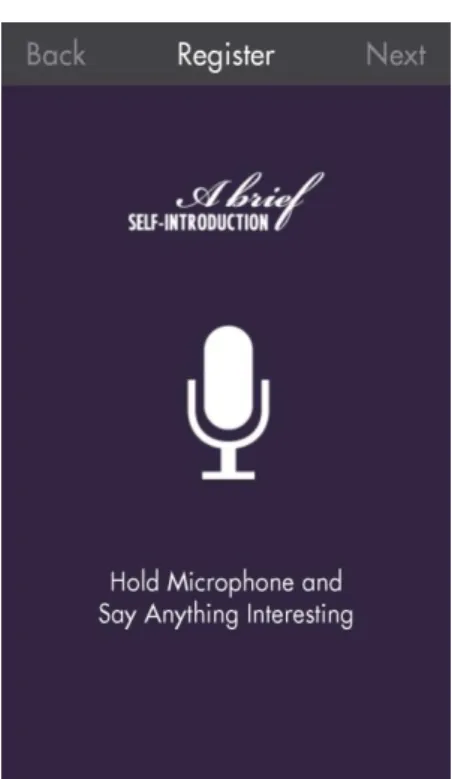
Fig. 5.1.1 UI of Registration Page
When registering an account, learners are required for their basic information as the filtering criteria during matching, especially which language they can speak and which language they wish to learn. Leaners are also asked to record a short interesting audio clip for attracting exchange partners.
Since we would like to keep the registration process quick and simple to give user
a better experience, users are only required to fill in the key information which is needed for matching exchange partners. The detail information is left in the profile page where users can edit any time after registration.
Matching:
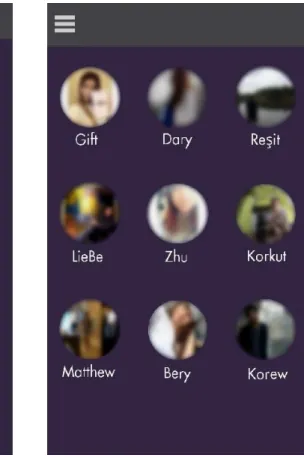
Fig. 5.1.2 UI of Match Page
In the Match page, leaners can choose their desired exchange partners by viewing other learners’ profile, including where they are from and which language they are wishing for exchange, listening to their voices and seeing a blurred photo of them; a clear photo is not used here in order to reduce the chance of selecting a partner by appearance judgment.
Recalling the matching algorithm proposed in Chapter 3, there are 10 exchange candidates in each match round and candidates who have already chosen this learner as partner will have a higher priority to be shown up. Once both learners have chosen each other as exchange partner, they will be paired up and will see each other in the partner list. Then the matched pair can start chatting and practicing language exchange with each other.
Practicing & Global Interaction:
Fig. 5.1.3 UI of Chat & Global Page
To practice language exchange, learners can chat with their exchange partners via text and voice messages. The reason of using voice message instead of real-time voice
chat is that non-real-time communication can benefit language learning. Comparing to real-time voice chat, voice message allows learners to replay what their partners have said and learners can have more time to prepare a reply. This can be more helpful in the sense of language learning, considering that learners have not yet mastered their learning language.
Usually a new matched pair will go through the phases of greeting, knowing and exchanging. Greeting is the beginning and warm-up phase of a communication.
Knowing phase is where the matched pair understands more about each other and negotiates the details of language exchange, such as their available time, the way of exchange, and any other requirements; usually this phase will decide whether this pair will move on to the exchange phase.
There are many ways to practice language exchange. The simplest way is to chat by using either of the exchange languages whenever a pair wants; another common way is to use time as a reference. The pair first decides a certain time period, e.g. 15 mins, and which language they will start with; both of them can only use the decided language to chat during that time period, then they will switch to the other language in the next time period and so on. This way of exchange makes sure that both learners have ensured time to learn their desired languages, which can be considered more
“fair”. However, this is not the only rule to exchange languages in this system. Instead,
we leave it free for learners to decide their desired way of exchange with their partners.
Besides, we do not provide any translation tool as we believe that exchange partner is the best translator for users. We prefer learners asking their partner for help in order to maximize the interaction between the matched pairs.
In the Global Wall page, every learner can publish posts. This public area allows learners to interact with other learners instead of just their partners. Learners can share any news and feelings, discuss and asking questions about language learning. Such interaction between learners can help to build up a good social learning atmosphere.
5.2 Real Practice
After implementing the whole system, the system was brought into practice for real testing, with both iOS and Android client application opened up on store for free.
We will first take a look at the statistics of the collected data, and then we will have a review of the result about system usage. These statistics are based on the data collected within 3 months (92 days) in total, with all users naturally download from Apple and Google store without marketing.
Table 5.2.1 Overall Statistics
Within these 3 months, 1212 users had installed this application and registered as members. On average, there were about 13 (1212/92) new users joining every day.
The total number of match pairs (learners A-B and B-A counted as one pair) was 4810.
Each user had nearly 4 partners (4810/1212) in average, showing that users tended to have more partners. It might because users felt that their existing partners were not suitable, or users actually just wanted to chat with more partners. However, since we do not know the contents of conversations between users due to privacy issue; we will need further studies to understand more about the incentive of users.
Categories Total Number
Users 1212
Match pairs 4810
Speaking Languages 43
Learning Languages 41
Speaking Language No. of users
Chinese 430
English 150
Japanese 143
Korean 121
Thai 62
Portuguese 46
Russian 44
Spanish 31
French 20
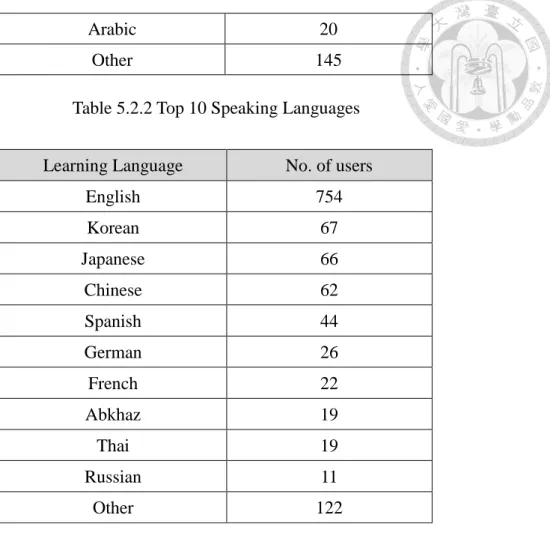
Table 5.2.2 Top 10 Speaking Languages
Table 5.2.3 Top 10 Learning Languages
As shown in Table 5.2.2 and Table 5.2.3, Chinese had the highest number of speakers among all mother languages, followed by English, Japanese and Korean, where the three languages had similar numbers of speakers. English had far more learners than the rest of languages; while Korean, Japanese, and Chinese ranked second to fourth with similar numbers of learners.
There were some interesting points in these rankings. Although Chinese and English had the most numbers of speakers, Japanese and Korean actually had a higher proportion of speakers considering the real populations of the two countries. Besides,
Arabic 20
Other 145
Learning Language No. of users
English 754
Korean 67
Japanese 66
Chinese 62
Spanish 44
German 26
French 22
Abkhaz 19
Thai 19
Russian 11
Other 122
the demand and supply of speaking and learning languages were imbalanced. For example, the supply of Chinese speakers was much higher than its demand. In contrast, about 62% (754/1212) of the learners looked for an English exchange, but there was only 12% (150/1212) of the total users who spoke English. This implied that every English speaker would need to pair up with 5 English learners in order to satisfy the need. Besides, the needs for German and Abkhaz did also exist, but there was hardly any supply. Lastly, there also tended to be more learners from Asian countries.
While collecting the previous data, we also received some feedbacks from our users. By summarizing those feedbacks, we came up with the following few points:
For match:
- While viewing others’ profile, listening to others’ voices was something interesting.
- Instead of using a clear photo, the use of blurred photo and audio was thought to be a good design; but there were also users requesting for clear photo.
- There were users asking for more fields for speaking and learning languages while editing profiles, because they could only select one language for speaking and one for learning currently.
- There were also users asking for more filtering criteria, such as filter by language, gender and age while matching.
- Some of the languages were hard to find a partner.
For chat:
- There were users suffering from the lack of chat contents while chatting with their partners, and there were users not knowing how to do language exchange.
- There were users asking for real-time voice chats.
- Besides doing language exchange, chatting with foreigners was also thought to be a good experience. Some users also thanked for making new foreign friends.
A possible reason why users would like the design of blurred photo and voice record might be caused by the curiosity to mystery. Since users could not see the clear photo of other users during matching, in order to get more information for judgment, users would tend to listen to their voice records, thus they might be attracted by some of the interesting records.
For some of the functional designs and additional functions requested by users, it is usually a tradeoff for satisfying different kinds of users and a consideration about system functionality and complexity. For example, when deciding the number of languages users can select as speaking and learning languages while filling their profiles, we were trying to keep the registration process simple and fast. However, as
the user base grows, having more languages as filtering criteria at the same time may become an essential function that our system should have; then we will need to make appropriate adjustment to the system. The same idea can be applied to the choice of using real-time voice chat and voice message.
There were also some discoveries that we had not thought of before doing this research. Besides doing language exchange, some of the users actually enjoyed chatting with other users for foreign friendship and gaining the experience of interacting with foreigners. This matched the result of the survey that Adam and Hideo had done when we were discussing in Chapter 2. This may also be a hint for the need of users besides learning foreign languages.
5.3 Improvement & Further Trial
In order to help new exchange pairs starting conversations fluently, we tried to add a little trick to the end of the matching process: whenever there is a match occurs,
our system will help either one of the match pair to send a greeting message, such as a
“Hi” or “Nice to meet you”, to his/her partner automatically. This trick is based on the
idea that users may not always chat with their new partners actively; but they may start a conversation with their new partners as a result of replying their greeting message.
This greeting message somehow works as a kickoff message to help starting a conversation between new matched pairs.
After doing some improvements on our system and which had become more stable, we tried to collect more data about system usage and user behavior. The following statistics were collected within one month (31 days in total) after the improvements:
Table 5.3.1 Overall Statistics
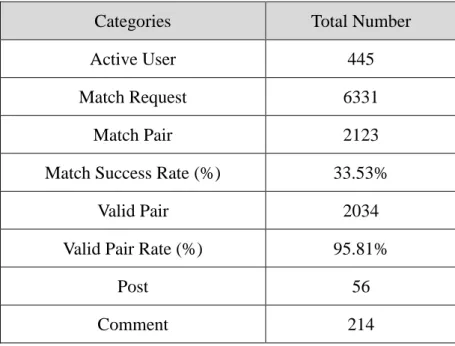
Within this month, 445 users had joined, with a total number of 6331 match requests sent and 2123 pairs matched (success rate of 33.53%). Comparing to the data collected before, the number of monthly active users remained similarly, but the number of match pairs had a noticeable increase (4810 pairs for 3 months to 2123 in this month). This is likely due to the changes in matching algorithm, where the number of prioritized candidates that shown up in each match round had been changed from at least 1 to 2. Notice that boosting the lower bound of prioritized candidates can increase
Categories Total Number
Active User 445
Match Request 6331
Match Pair 2123
Match Success Rate (%) 33.53%
Valid Pair 2034
Valid Pair Rate (%) 95.81%
Post 56
Comment 214
match rate from the above result, but an overhead boost may also result in poor user experience as the level of randomness is decreased, causing the matching process to be less interesting; therefore controlling the number of guaranteed prioritized candidates that shown up in each match round would be an important factor in balancing match rate and user experience.
The Valid Pair category is a variable that counts how many matched pairs have chatted to each other. It will only be counted 1 after both sides of a new matched pair have sent a message to their partner; thus the valid pair rate would be an effective benchmark that shows whether learners have actually chatted with their matched partners. Assuming that most of the learners only match up pairs for fun but never chat to their partners, this will cause a very low valid pair rate but that is not what we would favor. In other words, we would prefer a high valid pair rate as it indicates that most of the learners have indeed chatted with their partners. In this case, the result of 95.81%
in this system can be considered a satisfying valid pair rate. Such a high rate can be the contributions of the following three criteria: display of unread message, push notification, and the kickoff message described at the beginning of this session. The functions of displaying unread message and push notification play a key role in this system as these two functions ensure that learners have the greatest chance to notice
21.57%
78.43%
OS Distribution
Android iOS
incoming messages from their partners. The kickoff message, on the other hand, acts as a catalyst to help starting a conversation between new matched pairs.
The last two categories in Table 5.3.1 show the utilization of the Global Wall page.
This page was designed for learners to interact with other learners besides their partners. However, there were only 56 posts and 214 comments posted within this month. This low utilization rate indicates that learners prefer chatting with their partners more compared to interacting with other learners in the Global Wall page.
After reviewing the data about system usage, we would also like to have a look into users’ characteristics in order to understand more about our users. The following statistics are some of the interesting points that we discovered while reviewing users’
data.
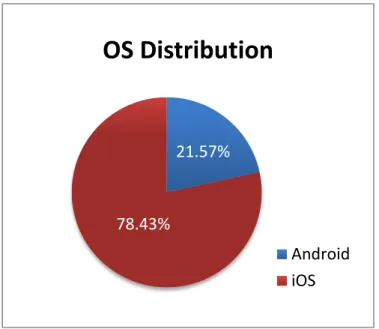
Fig. 5.3.1 OS Distribution of User
48.54%
51.46%
Gender Distribution
Male Female Table 5.3.2 OS Distribution of User
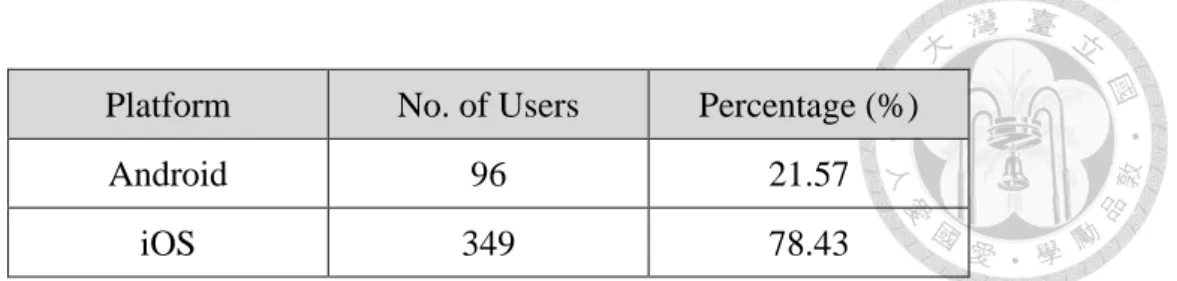
The first point is that most of our users are using an iOS device. Since we opened up our app for free on both Apple and Google Store, and we were using the same set of app introduction and preview images without any other promotions; we are curious about the population gap between iOS and Android users. One of the reasons may be caused by the difference in ranking and suggesting mechanism between Apple and Google Store; this affects the exposure of our application to users. Another possibility is that there are different numbers of similar applications provided in the two stores, which will also affect the choice of users. However, we will need further evidences in order to give a conclusion.
Fig. 5.3.2 Gender Distribution of User
Platform No. of Users Percentage (%)
Android 96 21.57
iOS 349 78.43
Table 5.3.3 Gender Distribution of User
Another interesting point is about the gender of users. Before reviewing the collected data, we were wondering if there would be a great difference between the proportion of male and female users. However, as Fig. 5.3.2 shown, the numbers of male and female users are quite similar; with female users have a percentage of about 3% more than that of male users. Thus we have no evidence to say that there is an obvious difference in the need for learning foreign language between male and female users.
In addition, we would like to know whether gender will be a factor that affects the choice of users while selecting a partner. To answer this question, we selected one side of all the 2123 match pairs that we have, recorded the gender of the user and saw whether his/her partner was male or female. The following table shows the result we collected:
Table 5.3.4 Partner Distribution According to Gender
Gender No. of Users Percentage (%)
Male 216 48.54
Female 229 51.46
Gender No. of Pairs
No. of Male Partner
Male Partner (%)
No. of Female Partner
Female Partner (%)
Male 1167 496 42.50 671 57.50
Female 956 464 48.54 492 51.46
0 20 40 60 80 100 120 140 160
< 20 20-24 25-29 30-34 35-39 >= 40
No. of Users
Age Interval
User Age Distribution
In the 1167 match pairs that have a male user, 42.5% of the user’s partner is male and 57.5% is female; while the remaining 956 pairs that have a female user, 48.54% of the user’s partner is male and 51.46% is female. This result shows that male users tend to have a female partner. On the other hand, the difference in percentage of male and female partner for female users is not strong enough to conclude that female users tend to have a male or female partner.
Besides gender, we would also like to know the age distribution of our users.
Fig.5.3.3 shows a right-tailed distribution of age, and we can see that most of our users are under 30 years old. In order words, this is the sector where the need for learning foreign languages is mainly concentrated in, and we should take users in this sector as our target user.
Fig. 5.3.3 Age Distribution of User
At last, we also summarized a ranking of the speaking and learning languages of users according to their gender and age respectively. The result is shown in the following tables, and some of the outstanding records are marked with an asterisk (*):
Table 5.3.5 Top 10 Speaking Languages by Gender Speaking
Language No. of users Percentage (%) Male (%) Female (%)
Chinese 143 32.13 28.24 35.81*
Korean 60 13.48 15.74* 11.35
English 51 11.46 11.57 11.35
Japanese 43 9.66 8.80 10.48
Thai 25 5.62 4.17 6.99
Portuguese 15 3.37 2.78 3.93
Spanish 14 3.15 4.63* 1.75
Russian 14 3.15 0.93 5.24*
Arabic 10 2.25 3.70* 0.87
French 8 1.8 2.31 1.31
Other 62 13.93 17.13 10.92
Total 445 100% 216 229
Learning
Language No. of users Percentage (%) Male (%) Female (%)
English 271 60.9 58.33 63.32*
Japanese 23 5.17 6.48* 3.93
Korean 19 4.27 3.24 5.24
Chinese 18 4.04 5.56* 2.62
Spanish 14 3.15 2.78 3.49
Abkhaz 9 2.02 3.24* 0.87
Thai 9 2.02 0.93 3.06*
German 8 1.8 2.31 1.31
French 8 1.8 1.39 2.18
Portuguese 6 1.35 0.93 1.75
Table 5.3.6 Top 10 Learning Languages by Gender
The overall result was quite similar to the ranking that is shown in Section 5.2, except Russian in the learning table, which had 3 learners, was replaced by Portuguese.
However, we should note that there might be errors in ranking due to the small user base.
An interesting thing that we observed was that there was a noticeable difference in the need and supply of some languages between male and female users. For example, male users had a higher proportion of Korean, Spanish and Arabic speakers, and female users had a higher proportion of Chinese and Russian speakers; while we had more male users learning Japanese, Chinese and Spanish, and more female users learning English and Thai. This phenomenon also occurred in the following tables where users were categorized by their age:
Other 60 13.48 14.81 12.23
Total 445 100% 216 229
Table 5.3.7 Top 10 Speaking Languages by Age
Table 5.3.8 Top 10 Learning Languages by Age Speaking
Language
No. of
users Percentage (%) < 20 (%) 20 – 29 (%) >= 30 (%)
Chinese 143 32.13 25.83 40.97* 19.39
Korean 60 13.48 13.33 14.54 11.22
English 51 11.46 10.00 11.89 12.24
Japanese 43 9.66 14.17* 7.93 8.16
Thai 25 5.62 5.83 4.85 7.14
Portuguese 15 3.37 5.83 3.08 1.02
Spanish 14 3.15 5.00 2.20 3.06
Russian 14 3.15 7.50* 1.32 2.04
Arabic 10 2.25 0.83 1.76 5.10*
French 8 1.8 1.67 2.20 1.02
Other 62 13.93 10.00 9.25 29.59*
Total 445 100% 120 227 98
Learning Language
No. of
users Percentage (%) < 20 (%) 20 – 29 (%) >= 30 (%)
English 271 60.9 64.17 63.44 51.02*
Japanese 23 5.17 6.67 4.41 5.10
Korean 19 4.27 3.33 5.73 2.04
Chinese 18 4.04 4.17 4.41 3.06
Spanish 14 3.15 3.33 2.20 5.10
Abkhaz 9 2.02 3.33 2.20 0.00*
Thai 9 2.02 0.83 1.76 4.08*
German 8 1.8 1.67 0.88 4.08*
French 8 1.8 0.83 1.76 3.06*
Portuguese 6 1.35 0.83 2.20 0.00*
Other 60 13.48 10.83 11.01 22.45*
Total 445 100% 120 227 98
We could see that different age category had a much higher or lower proportion of speakers and learners in some languages. There was a special case where users over 30 years old had a high proportion of speakers and learners for “Other” language. The actual numbers of users in the remaining languages were all less than 4, but the sum of those languages gave a high proportion in result.
Although the user base was not large enough to give strong evidence, the result of the above tables still showed the potential that there might be relations between the characteristics of users and the need and supply of languages. Yet, we would need further studies to give a conclusion.
5.4 Summary
In this chapter, we had brought our system into practice to collect real data, and we had also received some feedbacks from users. Then we made some improvements on our system and we had a review of the collected data. From those data, we observed some interesting results about the system usage and the characteristics of our users. We also saw the needs of users for learning foreign language and meeting foreign friends, and users were using our system to satisfy their needs.
After all, we can say that the working model of this system is indeed feasible.
Based on the needs of users and the solutions that our system supplies, there is the potential that our system can be developed into a valuable business model as it has a
different entry point to the existing market. However, there are still challenges that we will need to solve: besides the improvement of our system, satisfying the needs of users and balancing the need and supply of languages will also be key factors to success. Yet, we have already been running this service as a future work to see how this model performs; hopefully we can discuss more about it when we have any interesting discoveries to share.
Chapter 6 Conclusion
In this research, we proposed a social learning system that could help people to practice and improve their foreign language skill. We had first pointed out that people nowadays have different needs for learning foreign languages. Then we showed how the concept of “Social Learning” and “Language Exchange” could benefit language learning by discussing related research and experiments. Based on what we had discussed, we proposed a social learning system that took in the concept of “Social Learning” and “Language Exchange”, which aimed to help learners improve their foreign language skill in a more interesting and socialable way. In this system, learners could find native speakers in an easy and simple way. Leaners could improve their foreign language skill through chatting and interacting with native speakers directly, and by practicing language exchange with them. All these actions could be done online within a single mobile application, which minimized the learning cost for learners.
After implementing the whole system, we had also brought our system into real practice. Based on the data we had collected, we discussed about the pros and cons of our system: such as how the system was performing, whether the needs of users were being satisfied, what limitation our system had and how we could improve it. At last, after observing and understanding more about the characteristics and needs of our users, we proposed a more general potential business model that our system could be
developed into.
All in all, even though this system is not a perfect solution and there are many improvements that we can do, it still shows that it can benefit language learning and satisfy the needs of users. As this system and working model becomes more robust and well-developed; with the growth of user base, we may expect this model to generate more business value under a positive network effect, and we may have more interesting discoveries from this model.
Reference
[1] Adam, A., Hideo, K. (2011). “Whys and How’s of Language Exchange Meetings”
CALL-EJ, 12(2), p.1-10
[2] Bandura, A. (1961). “Bobo Doll Experiment”.
http://www.simplypsychology.org/bobo-doll.html
[3] Bandura, A. (1977). “Social Learning Theory”. Englewood Cliffs, NJ: Prentice Hall.
[4] Bandura, A. (1986). “Social Foundations of thought and action: A social cognitive theory”. Englewood Cliffs, NJ: Prentice-Hall.
[5] Bouhnik, D., Marcus, T. (2006). “Interaction in distance-learning courses”.
Journal of the American Society for Information Science and Technology, 57(3), p.299-305.
[6] Bower, J., Kawaguchi, S. (2011). “Negotiation of meaning and corrective feedback in Japanese/English e-Tandem”. Language Learning & Technology,
15(1), p.41-71.
[7] Calvert, M. (1999). “Tandem: a vehicle for language and intercultural learning” Language Learning Journal, 19, p.56-60.
[8] Capper, J. (2001). “E-learning growth and promise for the developing world”.
TechKnowLogia. May/June. Retrieved July 20, 2007.
[9] Djamshid, T., Markus, E., Kristin, N., Marc, R., Denny, V. (2004). “Is e-Learning the Solution for Individual Learning?”. Electronic Journal of e-Learning, 2(2),
p.273-280.
[10] Julian, B. Rotter. (1954). “Social learning and clinical psychology”. Englewood Cliffs, NJ: Prentice-Hall.
[11] Kessler, C. (1992). “Cooperative language learning”. NJ: Prentice-Hall
[12] Kearsley, G. (2000). “Online Education. Learning and teaching in cyberspace”.
Belmont, CA: Wadsworth.
[13] Klein, A. (2012). “Social Learning Theory”.
http://www.lsrhs.net/sites/kleina/files/2012/11/SocialLearningTheory.pdf
[14] Michael, L. (1996). “The role of the linguistics environment in second language acquisition”. Handbook of second language acquisition. San Diego: Academic
Press. p.413-468.
[15] Marcus, T. (2003). “Communication, technology and education – The role of the discussion group in asynchronic distance-learning courses as a beneficial factor
in the learning process”. Bar-Ilan University, Ramat Gan, Israel.
[16] Roberts, M. A. (1995). “Awareness and the efficiency of error correction In R.
Schmidt (Ed.)” Attention and awareness in foreign language learning , 9,
p.163-182. University of Hawaii, Hawaii.
[17] Skinner, B.F. (1963). “Science and human behavior”. New York: Appleton.
[18] StackOverflow. (2014). “Detect application heap size in Android”.
http://stackoverflow.com/questions/5887248
[19] StackOverflow. (2015). “iOS app maximum memory budget”.
http://stackoverflow.com/questions/5887248
[20] Wheatley, B., Greer, E. (1995). “Interactive television: a new delivery system for a traditional reading course”. Journal of Technology and Teacher Education,
3(4), p.340-350.
[21] Wikipedia. (2015). “M-Learning”.
https://en.wikipedia.org/wiki/M-learning.
![Fig. 2.4.1 Four dimensions of interactions in course [5]](https://thumb-ap.123doks.com/thumbv2/9libinfo/9608537.634076/18.892.266.606.140.378/fig-dimensions-interactions-course.webp)