行政院國家科學委員會專題研究計畫 成果報告
設計獎項、設計能耐與企業表現之研究:以台灣得獎廠商 為例 (I)
研究成果報告(精簡版)
計 畫 類 別 : 個別型
計 畫 編 號 : NSC 95-2221-E-011-213-
執 行 期 間 : 95 年 08 月 01 日至 96 年 11 月 30 日 執 行 單 位 : 國立臺灣科技大學工商業設計系
計 畫 主 持 人 : 宋同正
計畫參與人員: 碩士班研究生-兼任助理:張百佑、林永惟
報 告 附 件 : 出席國際會議研究心得報告及發表論文
處 理 方 式 : 本計畫涉及專利或其他智慧財產權,2 年後可公開查詢
中 華 民 國 96 年 11 月 30 日
行政院國家科學委員會補助專題研究計畫成果報告
※※※※※※※※※※※※※※※※※※※※※※※※※
※
※
設計獎項、設計能耐與企業表現之研究:以台灣得獎廠商為例 (I)※
※
※※※※※※※※※※※※※※※※※※※※※※※※※
計畫類別:■個別型計畫 □整合型計畫
計畫編號:NSC 95-2213-E-011-213 執行期間:95 年 8 月 1 日至 96 年 11 月 30 日
計畫主持人 :宋同正
計畫研究助理:張百佑 林永惟
執行單位:國立台灣科技大學工商業設計系
中 華 民 國 96 年 11 月 26 日
設計獎項、設計能耐與企業表現之研究:以台灣得獎廠商為例 (I)
計畫編號:NSC95-2221-E-011-213 執行期限:95年8月1日至96年10月30日 計畫主持人:宋同正 國立臺灣科技大學工商業設計系
一、摘要
「設計」已成為今日多數企業創造競爭優勢的 利 器 。 根 據 能 耐 為 基 礎 觀 念 (competence-based view, CBV),能耐 (competence) 是不同具價值資 源與獨特性能力的集合,更是企業主要持續競爭優 勢來源。由此推之,如何有效發展與運用設計能耐 (design competence) 便成為企業創造設計競爭優 勢的重要課題。儘管先前研究提及,設計獎項不僅 可成為一項企業有效創意管理的測量工具,對企業 表現亦具影響,惟設計能耐與設計獎項的關連性及 設計獎項與其衍生價值對企業表現的影響卻很少 被探討。
基此,研究第一年的主旨在了解受測得獎廠商 參加設計獎項競賽的動機與其對不同設計獎項的 價值看法。第一年,研究是採用立意取樣 (purposive sampling) 問卷調查方法。研究主要調查對象是 2004 至 2006 年間,至曾少得過三大國際知名設計 獎項 (G-mark、iF 或 reddot) 之一項的台灣廠商 (計 有69 家)。透過因素分析,研究共萃取出三個設計 獎項共同因素,分別為:「競爭價值 (competitive value)」、「本身價值 (symbolic value)」及「顧客價 格 (customer value)」。再進一步比較G-mark、iF 及 reddot 獎後發現:iF 獲得較高的獎項價值認知在「本 身價值」構面之 “高知名度 (strong reputation)” 項 目上,而 G-mark 則在同一構面中獲得較高之 “標 誌象徵吸引力 (emblematic attraction)”。另外,reddot 在「顧客價格」構面中則獲得較高的 “產品收藏性 (product collection)” 價值認知。然而,研究卻也發 現,針對「競爭價值」構面中之所有研究變項,受 測者對上述三種不同設計獎項的價值認知均沒有 顯著差異。由此可知,在現今設計獎項市場中,如 何提供給設計競賽參賽者更多具體且獨特的競爭 價值是未來設計獎項競賽主辦單位值得重視的議 題。最後,研究亦分別對設計競賽之主辦單位和參 賽者提出不同的建議。
1. 前言
對多數企業而言,「設計」已成為必須有
(must-have) 的競爭利器 (Peters, 2003)。在知識經 濟時代中,因無形資產常比有形資產對企業的成功 更具影響,故未來企業不能單靠在實體資產上的投 入來維持競爭力。在此情境下,「設計」更被企業 視為是能否有效傳遞企業價值與維持競爭優勢的 關鍵所在 (Olson et al., 1998)。先前研究 (Borja de Mozota, 2003; Gemser & Wijnberg, 2002; Roy, 1994) 清楚指出設計獎項不僅可成為一項企業有效創意 管理的測量工具,對企業的整體表現更會產生影 響。大體而言,除可提升企業聲譽與免費公開宣傳 (Gemser & Wijnberg, 2002; Polonsky & Waller, 1995) 外,獎項的獲得同時也代表著社會的認同與合法性 (Helgesen, 1994)。美國商業週刊 (Business Week) 指出經過多年專注於設計的投入,因獲得多項國際 知名設計獎項,促使韓國 Samsung 品牌已成為全 世界最有價值的品牌之一 (Rocks, 2005, p. 66)。從 上述案例中不難發現,設計獎項 (文中所謂「設計 獎項」意指產品設計類之設計獎項) 對企業競爭優 勢 (competitive advantage) 與表現 (performance) 的重要性自是不可言喻。
近年台灣產品設計能力頻獲許多國際知名設 計獎項 (例如 G-Mark、IDEA、iF 及 reddot) 的肯 定。以德國iF 產品設計獎競賽為例,2006 年台灣 廠商一舉拿下65 個獎項,遠遠超越日本與韓國,
總得獎數僅次於主辦國德國是全球第2 高,亞洲第 1 高,再度成功拓展華人產品設計界的全球影響 力。其中,BenQ 設計團隊拿下 13 項獎,總數排名
全球第3,僅次於韓國三星與荷蘭飛利浦;同時,
台灣設計公司大可意念 (Duck Image) 亦獲得 10 項,在設計公司中表現最為亮眼。雖上述成就清楚 顯示台灣設計實力已臻世界水準,但廠商真正參賽 動機?對設計獎項的價值認知 (perceived value)?
這些問題解答迄今仍模糊不清,且急待釐清。
過 往 學 者 (Bloch, 1995; Ulrich & Pearson, 1998) 主張,因設計的投入對企業表現有著相當程 度的影響,故未來有關兩者關係的議題探討應多予 鼓勵。基此,研究先依據過往文獻回顧發展出一衡 量設計獎項價值的工具,再針對台灣設計得獎廠商 進行問卷調查,以了解台灣設計得獎廠商參加設計
獎項競賽的動機與其對不同國際知名設計獎項的 價值認知。
2. 文獻探討
2.1 獎項價值與意義
Merriam-Webster’s (2003) 定 義 獎 項 為 : “a judgment or final decision; esp. for the decision of arbitrators in a case submitted to them” (p. 86)。事實 上,獎項評選或競賽有著許多不同的形式,很難找 出可含蓋各層面的單一定義。然而,Gemser &
Wijnberg (2002, p. 64) 提出獎項至少應包含有三 種不同角色或要件:1) 授予制度與獎勵之獎項提 供者;2) 得獎仲裁者及 3) 有得獎者。簡言之,合 乎上述三項要件的評選或競賽即可稱為獎項。另 外,獎項亦可視為是一種專業工作的成果表現,它 的主要功能在辨認及表揚特定領域中的佼佼者 (Helgesen, 1994)。就設計獎項而言,Gemser &
Wijnberg (2002, p. 64) 指出,獎項為某些產品或製 造者創造了合法性,且建立了競賽規則。因此,獎 項不僅能肯定個人,團體小組及企業組織的專業能 力表現,它更可區別出特定領域的佼佼者,甚至是 一種篩選標準或表揚系統。
至於獎項能提供何種的價值 (value)?West et al. (2003) 認為一般獎項具有:1) 領導趨勢之象 徵;2) 專業優良之識別;3) 專業評判之標準及 4) 社會可接受性之強化等價值。在競爭環境中,
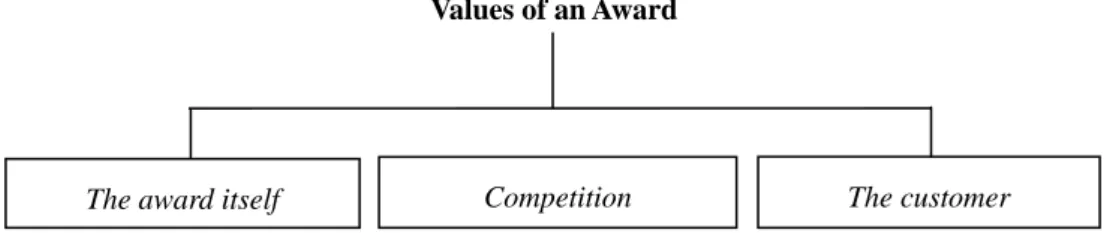
Gemser & Wijnberg (2002, p. 65) 提出獎項價值的 三種類型,例如獎項本身價值、競爭價值及顧客價 值,如圖1 所示。首先,一個獎項有價值的部分在 於其自身帶來重要的利益,例如獎金、特權、聲望 或激勵團隊士氣。其次,獎項可作為競爭者的標 識,例如獲得競爭優勢或抑止競爭者的模仿。針對 不同的競爭環境,獎項的取得是隱含有其競爭的價 值。因為得獎者會因得獎而被歸屬另一類的競爭群 體,故得獎的價值有時是在於它能區隔出某一特定 的競爭層次。譬如,倘若有一天你獲得諾貝爾獎,
你的競爭屬性即很容易被辨識出來。再者,因為獲 獎是屬一種公開行為,它所帶來另一項利益則是能 防制競爭者的模仿。相較於傳統法律性保護方法 (如專利),Gemser (1999) 指出有些公司願意採用
策 略 性 得 獎 方 式 來 確 保 其 設 計 創 新 (design innovation) 的有效投入。最後一種競爭價值的類 型則專注於價值認知,例如收藏性、獨特的品味或 特殊的使用性,致使終端顧客選購此獲獎產品或批 發商選擇此產品進貨。
2.2 設計獎項
一般而言,獎項 (award 或 prize) 有許多不同 種類,包括如文化獎 (cultural award)、表演獎 (performance award) [ 如 Oscar award] 、 品 質 獎 (quality award) [如Malcolm Baldrige national quality award]、廣告獎 (advertisement award)、建築獎 (architecture prize) [如Pritzker architecture prize] 及 設計獎 (design award) [如G-Mark、 IDEA (The Industrial Design Excellence Awards)、iF和reddot]
等。相較於G-Mark、iF、及 reddot等設計獎,因IDEA 獎較強調“工業設計”非“產品設計”且台灣廠商得 獎數較少,故研究將國際知名設計獎項探討範圍界 定為G-Mark、iF和reddot等三種。首先,G-Mark獎 在 1957 年由日本國際商業和工業研究院 (the Ministry of International Trade and Industry) 所設 立,其原始目的是對產業與設計提供教育與指導。
迄今,經由這個設計評價系統而獲獎的各國參與者 總計已超過 32,000 件。Walters (2006) 指出已 50 歲的G-Mark近年更致力於設計對社會與文化價值 影響的提升。其次,有 50 多年悠久歷史的iF獎,
它 每 年 定 期 由 德 國 漢 諾 威 國 際 論 壇 設 計 (International Forum Design, Hannover, Germany) 有限公司主辦,是全球公認最有影響力的設計大獎 之一。iF獎主要是以振興工業產品設計為目的,並 倡導設計理念的創新。最後,reddot獎是由歐洲最 具聲望的德國設計協會Design Zentrum Nordrhein Westfalen所設立,迄今亦有 50 多年歷史,是目前 國際上數一數二的重要設計競賽之一。reddot獎是 以參選產品的創新程度、設計美感、功能、市場性、
人體工學及環保等項目作為評選的重點,得獎作品 可陳列位於德國Essen及新加坡reddot設計博物館 (design museum)。
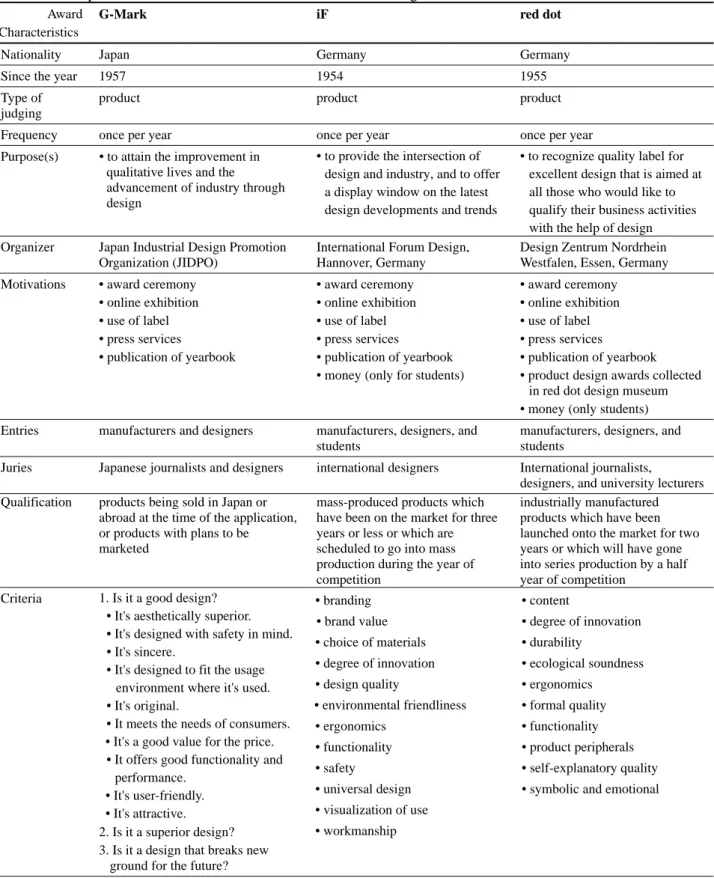
研究進一步比較日本G-Mark、德國 iF 及德國 reddot 等設計獎 (如表 1 所示) 發現, 三大獎項相 似處是每年皆舉辦一次,且允許即將 (未) 上市產 品參加。其他發現有:
獎項本身價值
獎項價值
競爭價值 顧客價值
圖1 獎項價值的三種類型
1) 獎項歷史:iF 與 reddot 最為悠久,其次為 G-Mark。
2) 競賽種類:reddot 最多 (11 類),G-Mark 最少 (5 類)。
3) 得獎獎勵:雖三大設計獎項皆提供有得獎作品 之線上展示,期刊廣告服務與獎項標誌使用 權,但reddot 特設有專屬博物館永久收藏得獎 作品;另外,G-Mark 則針對得獎作品有提供 商品化服務。
4) 參與對象:除製造商與設計師外,iF 與 reddot 另設有「設計概念獎」供一般學生參賽。
5) 評審委員:reddot 評審委員包括國際記者,設 計師與學術界教師;G-Mark 的評審委員有日 本記者與設計師;iF 評審委員則大都為國際知 名設計師。
6) 評審標準:雖不同獎項的評審標準不盡相同,
但似乎皆強調功能創新、美學、功能與環保。
7) 得獎費用:整體而言,reddot 的得獎費用高於 其他兩設計獎。
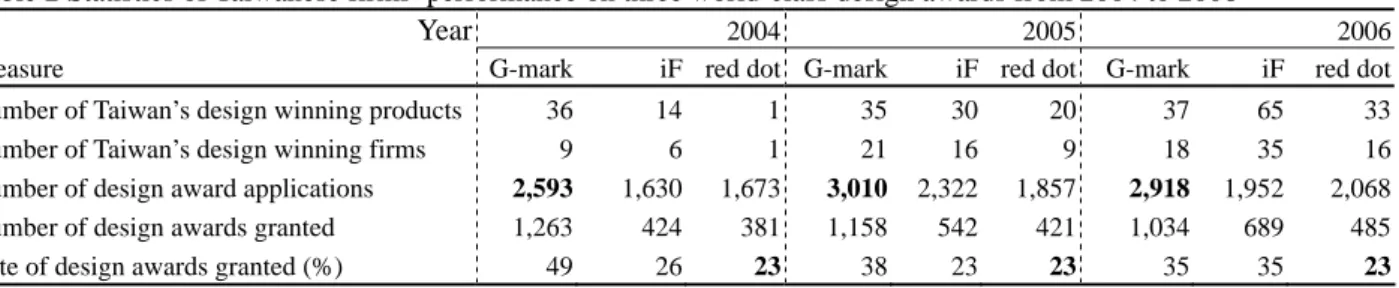
表2 為 2004-2006 年台灣廠商在國際三大知名設計 獎項的得獎名單與統計表。由表2 得知,近三年三 大設計獎項的平均參賽總件數以G-Mark 較多,iF 較少;若就近三年年平均獲獎比率而言,G-Mark 較高 (約 40%),而 reddot 則一直維持最低 (23%)。
表1 三大國際設計獎項之特徵比較 獎項
特徵
G-Mark iF reddot
舉辦國家 日本 德國 德國
創立年份 1957 1954 1955
評審類型 產品 產品 產品
舉辦週期 一年一次 一年一次 一年一次
舉辦目的 生活品質獲致改善並藉設計促進工
業 提供設計與工業之交流,並供予櫥
窗展示於最新設計發展與趨勢 提供品質認證標誌給欲藉此設計競 賽協助提升其商業活動的優良設計
舉辦單位 日本工業設計推廣協會 (JIDPO) 德國漢諾威國際論壇設計 德國伊森北威設計中心 獎勵方式 • 頒獎典禮
• 線上展覽
• 獲獎標誌使用
• 報導服務
• 年鑑出版
• 頒獎典禮
• 線上展覽
• 獲獎標誌使用
• 報導服務
• 年鑑出版
• 獎金 (僅供學生組)
• 頒獎典禮
• 線上展覽
• 獲獎標誌使用
• 報導服務
• 年鑑出版
• 獲獎產品 reddot 設計博物館收藏
• 獎金 (僅供學生組) 參賽對象 產品製造商或設計者 產品製造商或設計者及學生 產品製造商或設計者及學生
評審委員 日本記者與設計師 國際設計師 國際記者、設計師與學術界教師
參賽資格 申請期間於日本或海外銷售之產品
或即將上市之產品 上市三年內之大量生產產品或於競
賽年份內計畫大量生產之產品 上市兩年或競賽半年內即將系列生 產之工業製造產品
評審標準 1.是否為好的設計?
• 美感性
• 安全性
• 真實性
• 環境適性
• 原創性
• 需求適性
• 經濟價值性
• 功能使用性
• 通用性
• 吸引性
2.是否為較優的設計?
3.是否為具前瞻性的設計?
• 品牌
• 品牌價值
• 材質選擇
• 創新程度
• 設計品質
• 環境適性
• 人體工學
• 功能性
• 安全性
• 通用設計
• 使用視覺化
• 工藝
• 產品內容
• 創新度
• 耐久性
• 環保性
• 人體工學
• 外形品質
• 功能性
• 產品週邊
• 外顯品質
• 象徵性與情感性
報名費用 初選10,500 日圓 (= 63 歐元)* 115 歐元 (提早優惠) 190 歐元 (提早優惠)
線上展覽費用 NA 100 歐元 400歐元 (第一年)
年鑑刊登費用 13,650 日圓 (= 82 歐元)* 825 歐元 (1 頁) 1280歐元 (1頁) 註:NA: not applicable;* 1 日圓= 0.006 歐元 (2007/4/30)
表2 2004-2006 年台灣廠商於三大國際設計獎項獲獎統計
年份 2004 2005 2006
量數項目 G-mark iF reddot G-mark iF reddot G-mark iF reddot 台灣設計獲獎產品數
台灣設計獲獎廠商數 設計獎項參賽申請數 設計獎項獲獎數 設計獎項獲獎率 (%)
36 9 2,593 1,263 49
14 6 1,630 424 26
11 1,673 381 23
3521 3,010 1,158 38
3016 2,322 54223
209 1,857 421 23
37 18 2,918 1,034 35
65 35 1,952 689 35
3316 2,068 485 23
3. 研究方法
3.1 樣本
如 前 所 述 , 本 研 究 是 採 用 立 意 取 樣 (purposive sample) 方法,受測對象是 2004 至 2006 年間,至少曾得過一項三大國際知名設計獎項 (如 G-mark、iF 或 reddot) 的台灣廠商 (計有 69 家)。
首先,一份經研究前測修正後的完整問卷以電子郵 寄方式寄給上述得獎廠商之獲獎團隊的成員 (每 一廠商一人)。為獲得更高的回覆率,在第一次郵 寄約一至二星期後,研究另進行多次電話與電子郵 件催收,最後研究共計回收62 份之有效問卷。
3.2 研究工具
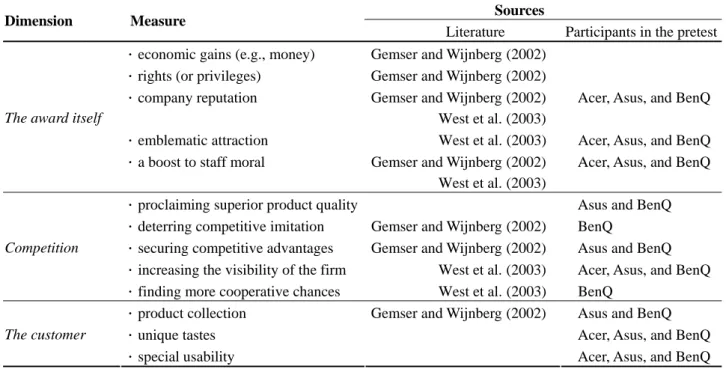
為探索三大不同國際設計獎項之價值認知差 異,本研究將先發展一設計獎項價值認知的測量方 式。一份工具與量表的發展在一個新研究領域是必 要 的 (Specter, 1992)。 以 先 前 研 究 為 發 展 基 礎 (Gemser and Wijnberg, 2002; West et al., 2003),研究 將 設 計 獎 項 的 價 區 分 成 獎 項 本 身 (the award itself)、競爭 (competition) 及顧客 (customer) 三大 概念構面。另外,一項前期測試 (含三家廠商) 用 來確定量測內容要項的明確性。然後,研究再根據 前測結果與建議進行微幅修正。最終設計獎項價值 認知的測量要項如表3 所示。
表3 本研究使用之設計獎項價值認知構面與測量要項 資料來源 構
面 測量要項
文獻 前測廠商
•經濟交換 (如獎金) Gemser and Wijnberg (2002)
•獎項權利 (或特權) Gemser and Wijnberg (2002)
•獎項知名度 Gemser and Wijnberg West et al. (2002)
(2003) A、B、C
•象徵標誌吸引力 West et al. (2003) A、B、C 獎
項 本 身 價
值 •激勵團隊士氣 Gemser and Wijnberg West et al. (2002)
(2003) A、B、C
•彰顯較優之產品品質 B、C
•抑止競爭者的模仿 Gemser and Wijnberg (2002) C
•保有競爭優勢 Gemser and Wijnberg (2002) B、C
•增加廠商能見度 West et al. (2003) A、B、C 競
爭 價值
•獲取更多合作機會 West et al. (2003) C
•產品收藏性 Gemser and Wijnberg (2002) B、C
•獨特的品味 A、B、C
顧 客
價值 •特殊的使用價值 A、B、C
註:研究應前測廠商請求,公司名稱以A、B、C 代號來表示。
4. 研究結果
首先,在所有62 位受測者中 (如表 4 所示),
44 位 (71.0%) 受測者表示自己背景專長是屬設計 領域。再者,多數受測者在得獎設計團隊中是擔任 設計師 (58.0%),其餘是公司負責人或主管。
表4 受測者類別
測量要項 受測者屬性 人數 百分比 (%) 設計相關 44 71.0 專業背景 非設計相關 18 29.0 設計師 36 58.0 設計部門主管 14 22.6 相關部門主管 6 9.7 設計獲獎團隊
中扮演角色
公司負責人 6 9.7
表5 中,研究初期發現,“展現企業設計實力”
(平均值=8. 97) 與 “提昇企業整體形象” (平均值
=8.69) 是受測廠商兩大參賽的主因。至於,前述 動機是否與受測廠商之企業組織發展目標一致,是 值得後續研究再進行確認。
表5 台灣設計獲獎廠商參加國際設計競賽之主要因素 測量要項 平均值a, b 標準差a 最大值 最小值 提昇企業整體形象 8.69 1.57 10 1 促進內部良性競爭 7.44 2.55 10 0 有益產品上市宣傳 8.39 1.36 10 5 展現企業設計實力 8.97 1.13 10 5 強化產品的競爭力 8.14 1.41 10 5 增加公司的知名度 8.33 1.80 10 0 註:a:使用李克尺度11 點量表 (0 表強烈不同意,10 表強烈不同意)。
b:6.0 (含) 以上表可接受的分數。
其次,針對表3 中 12 個設計獎項價值問項,
經主成份分析後,每一量測變項的平均因素負荷值 須大於0.5。研究結果共萃取出三個共同因素即「競 爭價值」、「本身價值」及「顧客價格」(如表 6 所示),其累積解釋變異量達 72.130 %。值得一提 的是,原先屬於表3 中「本身價值」構面的 “經濟 交換” 變項,因其因素負荷值低於 0.5,故被刪除。
此外,研究所萃取出的三因素構面之Cronbach's α 係數值皆高於 0.7,此顯示本量表所萃取的因素構 面具適當信度。
表6 設計獎項價值認知之因素分析
因素負荷值 測量要素 平均值 標準差 競爭
價值 獎項本 身價值 顧客
價值 保有競爭優勢 6.63 1.30 0.864 0.163 0.239 增加廠商能見度 7.05 1.24 0.864 0.085 0.141 抑止競爭者的模仿 5.90 1.88 0.833 0.202 0.060 彰顯較優之產品品質 5.60 1.55 0.820 0.150 -0.021 獲取更多合作機會 6.83 1.28 0.781 -0.031 0.226 象徵標誌吸引力 7.90 1.30 0.067 0.917 0.008 激勵團隊士氣 8.12 1.27 0.160 0.900 0.085 獎項高知名度 7.64 1.24 0.121 0.881 -0.037 獎項權利 7.07 1.38 0.109 0.750 0.102 獨特的品味 7.21 1.45 -0.022 -0.122 0.858 特殊的使用價值 7.38 1.63 0.384 0.280 0.623 產品收藏性 7.12 1.54 0.443 0.147 0.556
特徵值 4.953 2.513 1.189
解釋變異數比 32.242 26.687 13.201 累積變異數比 32.242 58.929 72.130 Cronbach’s α 0.901 0.871 0.713
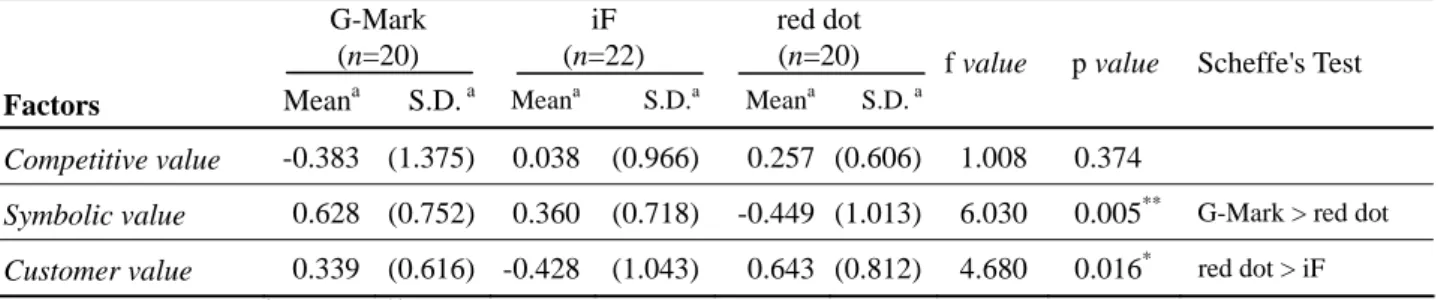
然後,為探索受測者對不同獎項 (含 iF、reddot 與G-mark 三者) 之獎項價值認知是否有顯著差異 存在,針對先前因素分析所得的各構面因素分數 值,研究進行單因子變異數分析,並經Scheffe 事 後多重比較發現 (如表 7 所示),G-mark 在「獎項
表7 三大知名設計獎項價值認知因素之平均值與標準差 G-Mark
(n=20) iF
(n=22) reddot (n=20) 因素 平均數a 標準差a 平均數a 標準差a 平均數a 標準差a
f 值 p 值 Scheffe's Test
競爭價值 -0.383 (1.375) 0.038 (0.966) 0.257 (0.606) 1.008 0.374
獎項本身價值 0.628 (0.752) 0.360 (0.718) -0.449 (1.013) 6.030 0.005** G-Mark > reddot 顧客價值 0.339 (0.616) -0.428 (1.043) 0.643 (0.812) 4.680 0.016* reddot > iF 註:a:因素值;* p < 0.05;** p < 0.01
本身價值」構面上的價值認知度明顯優於reddot,
但reddot 在「顧客價值」構面的價值認知度優於 iF。
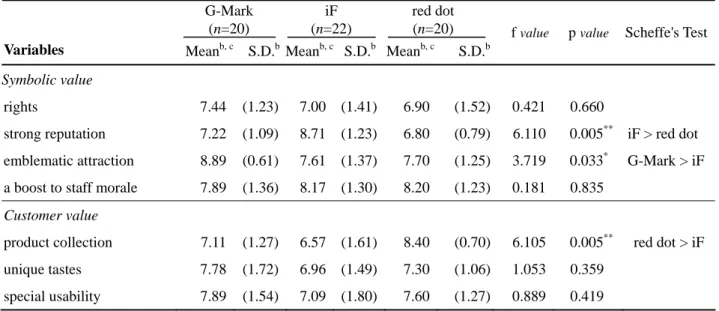
此外,為進一步了解三大知名設計獎項在「本身價 值」構面與「顧客價值」構面之獎項價值認知的差 異處,研究針對上述兩構面之各項量測項目進行單 因子變異數分析,並經 Scheffe 事後多重比較發 現,iF 獲得較高的獎項價值認知在「本身價值」構 面之 “高知名度 (strong reputation)” 項目上,而 G-mark 則在同一構面中獲得較高之 “標誌象徵吸 引力 (emblematic attraction)”。此外,在「顧客價 格」構面中,reddot 則獲得較高的 “產品收藏性 (product collection)” 價值認知。研究推論其可能原 因之一是,在德國與新加坡,reddot 有提供設計博 物館收藏其獲獎產品 (Zec, 2007)。
5. 結論
對多數國際設計競賽主辦單位而言,當設計獎 項在全球設計競賽中扮演著決定性的角色時,擴大 我們對參賽者之設計獎項價值認知的理解是極其 重要的。本研究對設計研究領域的貢獻有以下幾 項。首先,本研究所有的研究構面內容皆包括多重 項目,且利用因素分析明確萃取出一尺度量表,以 作為量測設計獎項之價值認知的有效工具。其次,
據我們的瞭解,本研究是最先探討參賽者對三大國 際知名設計獎項 (即 G-mark、iF 及 reddot) 的價值 認知研究。然後,本研究指出並無任何一項設計獎 項在所有設計獎項價值認知的指標中優於其它獎 項。同時,研究亦發現,上述三種不同設計獎項在
「競爭價值」構面之所有研究變項中均沒有顯著性 差異。無疑地,對多數設計競賽主辦單位而言,如 何提供給設計獎項競賽參賽者更多具體且特殊的 競爭價值是未來值得重視的課題。
根據研究的發現,相較於競爭者,本研究建議 各設計競賽主辦單位應先瞭解其在參賽者之「競爭 價值」構面各要項中 (如表 6 所示) 的價值認知。
這方面,主辦單位要注意的是如何提高參賽者之有 形 (tangible) 與無形 (intangible) 利益的感受,而 這些利益的總合應超過他們所投資在得到該設計 獎項的費用。在有形利益部分,針對前一年已獲獎 的廠商或個人,競賽主辦單位應認真考量提供給他 們在報名費 “折扣” 的可能性。在無形利益部分,
競賽主辦單位應該積極開發具創新性的公關和行 銷活動,特別是在處理 有關 “抑止競爭者的模仿”
與 “彰顯較優之品質” 等議題。接著,競賽主辦單 位須更進一步建構特定獎項障礙的門檻。例如,設 計競賽主辦單位可與國際產品安全或品質認證組 織 (或協會) 協力合作,如 EC (歐盟執委會) 或 ISO (國際標準組織)。因為,若某一設計獎項能結 合國際品質認證,將可增加參賽者對該設計競賽獎 項的「競爭」價值認知。
一般而言,參賽者參加特定獎項競賽已變成策 略選擇上的問題 (Halachmi, 1995, p. 89)。在參加特 定設計競賽之前,基於選拔制度 (如參賽者與評審 委員的特性)、獎項聲望、產品市場定位 (例如 G-mark 針對日本市場) 及獲獎開支 (Gemser and
表8 三大知名設計獎項本身價值與顧客價值之平均值與標準差 G-Mark
(n=20) iF
(n=22) reddot (n=20) 變異數 平均數b, c 標準差b 平均數b, c 標準差b 平均數b, c 標準差b
f 值 p 值 Scheffe's Test
獎項本身價值
獎項權利 7.44 (1.23) 7.00 (1.41) 6.90 (1.52) 0.421 0.660 高知名度 7.22 (1.09) 8.71 (1.23) 6.80 (0.79) 6.110 0.005** iF > reddot 象徵標誌吸引力 8.89 (0.61) 7.61 (1.37) 7.70 (1.25) 3.719 0.033* G-Mark > iF 激勵團隊士氣 7.89 (1.36) 8.17 (1.30) 8.20 (1.23) 0.181 0.835 顧客價值
產品收藏性 7.11 (1.27) 6.57 (1.61) 8.40 (0.70) 6.105 0.005** reddot > iF 獨特的品味 7.78 (1.72) 6.96 (1.49) 7.30 (1.06) 1.053 0.359 特殊的使用價值 7.89 (1.54) 7.09 (1.80) 7.60 (1.27) 0.889 0.419 註:b:使用李克尺度11 點量表 (0 表強烈不同意,10 表強烈不同意)。
c:6.0 (含) 以上表可接受的分數。
* p < 0.05;** p < 0.01
Wjinberg, 2002),廠商發展一個獎項贏的策略 (an award-winning strategy) 是相當重要。儘管過去研 究顯示,顧客雖願意為他們認為是 “高品質設計”
的產品付出更多費用 (Walsh et al., 1992),但擁有 設計獎項標籤的產品是否真的可在市面上索取更 高價位仍未被證實。好的設計不代表就是有效的設 計 (Bedford et al., 2006)。在此情況下,由於顧客 購買或使用產品是屬於或渴望成為某一種社會地 位的象徵或代表 (例如菁英族群),就設計競賽參 賽廠商而言,了解自己已獲獎產品在現有或潛在顧 客的價值認知是必要的。然而,目前研究的發現僅 與台灣企業相關,研究結果可能會因其他因素或背 景而有所差異;因此,如何避免可能國家成見的差 異,以使研究發現在其他國家也有效,則是後續研 究所須努力之處。儘管有這些限制,本研究在探究 設計獎項價值認知的先期研究上已具若干貢獻。此 外,即使在本研究方法的應用下顯示,無任一設計 獎項在所有設計獎項價值認知指標中得到較高的 評價,但其真正原因仍未被完全地發掘;是故,後 續研究仍須繼續努力探索其他更精進的分析技術 或方法。
基於能耐基礎觀點 (competence-based view, CBV),一家廠商之競爭優勢來自其能耐,且其深 植於罕見、有價值且難以複製的能力與有價值的資 源 (Marino, 1996; Prahalad and Hamel, 1990;
Sanchez & Heene, 1997)。據此,為了應付持續變動 的競爭環境與不明確的需求狀況,一家獲得設計獎 項的廠商伴隨著其令人嚮往的表現成果或競爭優 勢,應該可從其特殊的設計能力中受益。根據研究 初期發現,研究最後提出幾個未來研究可能的方 向,以持續對設計獎項的探究。首先,什麼設計能 力促使廠商獲得設計獎項是未來研究值得關注的 焦點?其次,是否設計獎項真的會影響廠商的績效 表現?最後,在不同的競爭環境下,設計獎項是否 會在設計能力與企業績效表現的關係間扮演著關 鍵的中介角色?
參考文獻
Bedford, Chris, Daniels, George, Debarats Gus, Hertenstein, Julie, Philips, Peter, Platt, Marjorie, and Wallace Rob (2006) Profiting by Design, Design Management Review, Spring, pp. 54-59.
Bloch, Peter H. (1995) Seeking the ideal form:
product design and consumer response, Journal of Marketing, Vol. 59, pp. 16-29.
Borja de Mozota, Brigitte (2003) Design Management: Using Design to Build Brand Value and Corporate Innovation, Allworth Press, Gemser, G. (1999) Design Innovating and Value NY.
Appropriation, Xdesign, Breda.
Gemser, G. and Wijnberg, Nachoem M. (2002) The economic significance of industrial design awards: a conceptual framework, Design Management Academic Review, Vol. 2, No. 1, pp. 61-71.
Halachmi, Arie (1995) The pros and cons of participating in a quality award program, National Productivity Review, Vol. 15, No. 1, Winter, pp. 87-100.
Helgesen, Thorolf (1994) Advertising award and advertising agency performance criteria, Journal of Advertising Research, July/August, pp. 43-53.
Marino, K. E. (1996) Developing consensus on firm competenceies and capabilities, Academy of Management Executive, Vol. 10, No. 3, pp.
40-49.
Merriam-Webester’s Collegiate Dictionary (2003) 11th ed., Merriam-Webster, Inc., Springfield, Olson, Eric M., Cooper, Rachel and Slater, Stanley F. MA.
(1998) Design strategy and competitive advantage, Business Horizons, Vol. 41, No. 2, Mar./ Apr., pp. 55-61.
Peters, Tom (2003) Re-Imagine, Dorling Kindersley, London, UK.
Polonsky, Michael, J. and Waller, David S. (1995) Does winning advertising awards pay? The Australian Experience, Journal of Advertising Research, Jan./ Feb., pp. 25-35.
Prahalad, C. K. and Hamel, Gary (1990) The core competence of the corporation, Harvard Business Review, May-June, pp. 79-91.
Rocks, David (2005) China design, Business Week, Nov. 21, p. 66.
Roy, Robin (1994) Can the benefits of good design be quantified? Design Management Journal, Vol.
5, Spring, pp. 9-17.
Sanchez, R. and Heene A. (1997) Reinventing strategic management: new theory and practice for competence-based competition, European Management Journal, Vol. 15, No.3, pp. 303-317.
Spector, P. E. (1992) Summated Rating Scale Construction, Sage Publications, Newbury Park, Ulrich, K. T. and Pearson, S. (1998) Assessing the CA.
importance of design through product archaeology, Management Science, Vol. 44, No.
3, pp. 352-369.
Walsh, Vivien, Roy, Robin, Bruce, Margaret, and Potter, Stephen (1992) Winning by Design:
Technology, product design, and international competitiveness, Design Innovation Group, Blackwell, Oxford.
Walters, H. (2006) The best designs from Japan, Business Week, October 25, p. 40.
West, Douglas, C., Collins, Emily L. and Miciak, Alan (2003) Management perspectives of awards for creative advertising, Journal of General Management, Vol. 29, No. 2, pp. 23-34.
Zec, Peter (2007) Design on Stage – the red dot design award, Design Management Review, Winter, pp. 60-67.
出席國際學術會議心得報告
計畫編號 95-2221-E-011-213
計畫名稱 設計獎項、設計能耐與企業表現之研究:以台灣得獎廠商為例 (I)
出國人員姓名 服務機關及職稱
宋同正
國立臺灣科技大學工商業設計系
會議時間地點 The Hong Kong Polytechnic University School of Design
會議名稱 International Association of Societies of Design Research Emerging Trends in Design Research
發表論文題目 An empirical study of the perceived values of world-class design awards for Taiwan’s design-award-winning firms
一、參加會議經過
11/12 上午: 出發 (中正機場搭機抵香港); 報到, 註冊; 下午: 聆聽專題演講 (Henry Steiner:
Fusion Crash 及發表論文, 並與與會學者進行交流.
11/13 上午: 聆聽專題演講 (Surya Vanka: Seeing the world through our users’ eyes) 與分組論文 發表; 下午: 聆聽分組論文發表.
11/14 上午: 聆聽專題演講 (Kun-Pyo Lee: Culture-centered interaction design) 與分組論文發表;
下午: 聆聽專題演講 (Keen Dorst: Patterns and methods in design) 與分組論文發表.
11/15 上午: 聆聽專題演講 (Steven Kyffin: Creative consortium); 下午: 返國 (抵中正機場)
二、與會心得
1. IASDR07 設計國際會議由香港理工大學主辦, 參與的設計學術團體有中華民國設計學會 (Chinese Institute of Design, CID), 英國設計研究學會 Design Research Society (DRS),日本設 計學會 (Japan Society for Science of Design, JSSD), 及韓國設計學會 (Korean Society of Design Science, KSDS). 據大會統計共有 688 篇摘要論文、323 篇論文發表和海報張貼.
2. 本次研討會論文發表內容含蓋有六大議題, 分別是 collaboration, culture, user behavior interaction, business and design research, and design methods.
3. 本次大會特別針對不同設計議題共安排有六場不同設計相關之專題演講, 內容有設計合作, 體驗設計, 及文化與互動設計等.
4. 除專題演講與論文發表外, 大會亦邀請許多設計相關學校與會, 分別以海報方式呈現各種 設計議題 (例如數位科技) 發展的成果.
5. 出席本次設計國際會議, 個人學習到其他國家 (如歐、美、澳、日與韓等國) 設計學者最 新的設計研究方法與教學成果, 實已達到國際設計學術交流之目的.
6. 非常感謝國科會的鼎力資助與專題計畫審查委員的支持, 使個人有機會參與此次國際設計
盛會,並發表論文, 獲益匪淺.
1
2
An empirical study of the perceived values of world-class design awards for Taiwan's design-award-winning firms
ABSTRACT:
Design awards aimed at diffusing best practices in product design have become an important part of the design industry worldwide. Although a number of studies have advocated that design awards are increasingly and widely perceived as a model for world-class firms in global design competitions, less attention has been paid to the explorations of their values. The primary question addressed in this study is what exactly the values of world-class design awards perceived by the contestants are. Data from 62 Taiwan's design-award-winning firms which have won at least one of the three world-class design awards (i.e., G-Mark, iF, and red dot), during the period of years 2004-2006 is analyzed. The findings of this study showed that iF received significantly higher ''strong reputation'' scores under symbolic value than red dot, while G-mark received significantly higher ''emblematic attraction'' scores under symbolic value than iF.
Furthermore, red dot received significantly higher ''product collection'' scores under customer value than iF.
However, the results indicated that there existed no significant difference in all variables under competitive
value among the three design awards. Finally, the implications of recognizing the importance of the above
differences for the organizers and the contestants of the design contests are further discussed.Keywords: design award, design competition, value
3
1. PREAMBLE
For most firms, design has become a must-have for being competitive (Peters, 2003). In this world of knowledge economics, intangible assets have a greater influence than tangible assets on a firm's success;
therefore, a firm can not only rely on its tangible assets to achieve competitive advantages. Under such a circumstance, design has been viewed as a key element to convey a firm's value and to secure and sustain its competitive advantages (Olson et al., 1998). Previous research (Borja de Mozota, 2003; Gemser and Wijnberg, 2002; Roy, 1994) has clearly indicated that design awards can not only be a measurement for a firm's effectiveness on its creativity management, but also have an impact on its performance as a whole. In general, receiving an award can elevate a firm's reputation, create its publicity, and meanwhile, express its legitimacy and recognition by the public (Helgesen, 1994). For example, Samsung has become one of the most valuable famous brands around the world after receiving many major design awards (Rocks, 2005, p.
66). It is, therefore, not difficult to identify the important effect of design awards (in this article, design awards refer to product design awards) on a firm's competitive advantages and performance.
In recent years, Taiwan's design ability has been recognized through the fact that many internationally renowned design awards, such as G-Mark, IDEA, iF and red dot, have been received. In 2006, for example, Taiwan's firms received, only fewer than German's firms, a total of 65 German iF design awards, and thus Taiwan was ranked the second place globally, and the first place in Asia, and with the large number of awards received, Taiwan's ability in product design was successfully demonstrated. Among Taiwanese firms which received the awards, BenQ alone obtained 13 awards, which was ranked only lower than Korea's Samsung and Holland's Philips, and therefore was the third place internationally. Furthermore,
DUCKIMAGE received 10 awards, which made it the most glamorous among the design firms which took part in the contest. These achievements reveal that Taiwan's product design ability has been world-class, but the participative motivations of Taiwan's firms and the values of the design awards perceived by the firms
4
are still unknown and need to be further clarified. Some scholars (Bloch, 1995; Ulrich and Pearson, 1998) claimed that a firm's efforts in design had a considerable impact on its performance and suggested that research on topics related to a firm's efforts in design and performance should be encouraged. Therefore, in this study, a measuring tool to evaluate the perceived values of the design award was first developed based on earlier literature, and then a survey was conducted to explore why Taiwan's design-award-winning firms participated in design contests and what their perceived values on various world-class design awards were.
2. LITERATURE REVIEW
2.1 AWARD VALUE AND MEANING
Merriam-Webster Dictionary (2003) defines an award as: ''a judgment or final decision; esp. for the decision of arbitrators in a case submitted to them'' (p. 86). In fact, there exist several ways to select
winners for certain awards, and the meaning of an award is difficult to be confined to cover all aspects with which an award is involved. However, it is not hard to constrain the conditions where an award is given; in other words, it is easy to find out what should or should not be included in an award. Gemser and Wijnberg (2002, p. 64) stated that three elements should be included in an award: 1) the actors who set up the award, making the institutional arrangements to enable the award being conferred and providing the substance of the award, 2) the actors who determine who will receive the award, and 3) the award winners. In short, any selection events or competitions which contain the three mentioned elements will be deemed as award activities. Moreover, an award can be seen as an achievement in a profession, with the main function of which is to identify and commend the best performer in a certain field (Helgesen, 1994). As for design awards, Gemser and Wijnberg (2002, p. 64) noted that awards create the 'legitimacy' for certain products or producers, and set up the rules of the competitive game. Therefore, an award not only can confirm the professional performance of an individual, a group, or an enterprise, but also differentiate the best from the others and become a selection system dominating the industry.
5
The award itself Competition The customer
Values of an AwardFigure 1 Three types of the value of an award
But what value can an award provide? West et al. (2003) argued that an award should be able to: 1) symbolize professional leadership, 2) identify professional excellence, 3) set up the standard for
professional evaluation, and 4) strengthen the social acceptance. In a competitive environment, Gemser and Wijnberg (2002, p. 65) further proposed three types of the value of an award which are the award itself,
competition, and the customer, as shown in Fig. 1.
First, an award as a valuable object may present in itself important benefits, such as money, specific rights or privileges, reputation, and a boost to staff moral. Second, the award may function as a signal to
competitors to achieve competitive advantages or to deter competitive imitation. For different competition environments, the receiving of an award implies the value of competition. Since the award receiver will be categorized as a certain group, receiving a certain award infers that the award is able to differentiate among the competitors. For instance, if a person who receives a Nobel prize will enter a group of full-fledged members of the Academy. Besides, since receiving an award is a public action, it will intimidate other competitors from copying the winner's concept or the winning product. In contrast with the traditional and legal way of protection act, i.e. patent, Gemser (1999) noted that some firms are willing to adopt an award-winning strategy to make certain that their devotion in design innovation is effective and secured.
The third type of the value of an award focuses on the perceived values, such as collection, unique taste, and special usability, of the final customers who eventually have to buy the award-winning item, or the distributors who choose to stock the item.
6
2.2 DESIGN AWARD
In general, there are various types of awards or prizes. There are cultural awards, performance awards (e.g.
Oscar award), quality awards (e.g. Malcolm Baldrige national quality award), advertisement awards (e.g.
ADDY® Awards), architecture prizes (e.g. Pritzker architecture prize), and design awards (e.g. G-Mark, IDEA -The Industrial Design Excellence Awards, iF, and red dot). Due to the fact that IDEA evaluates ''the photo of a product'', this study will therefore mainly focus on G-Mark, iF, and red dot which evaluate ''the actual product''. First, G-Mark award, which is also known as Good Design Award, was established to provide education and guidance to industry and design by Japan's Ministry of International Trade and Industry in 1957. Until now, there have been a total of 32,000 such awards given to participants from various countries world-wide through this design evaluation system. Walters (2006) pointed out that the fifty-year old G-Mark has been placing tremendous efforts on reinforcing the impact of design on the society and on cultural values in these years. Second, iF award, which has been established over fifty years, is sponsored by International Forum Design of Germany annually and is also one of the most influential design awards recognized globally. The objectives of iF are to boost industrial product design and to advocate the concepts of design innovation. Nowadays, iF has opened an Asian branch office in Taipei.
Third, red dot award was established by German's Design Zentrum Nordrhein Westfalen, the European's most well-known design association. It also has a history of more than fifty years and is the greatest honor among international design competitions. The winning products of such an award are to be exhibited at red dot's design museums in Essen of Germany and in Singapore (Zec, 2007).
As shown in Table 1, the comparison among G-Mark, iF, and red dot reveals that all the three design awards are held yearly and allow new products which are not yet introduced to the market to take part in the design contests. Other findings are: 1) the history: iF and red dot both enjoy a longer history, comparing with G-Mark; 2) motivations: in addition to on-line exhibition, press services, and use of the label, red dot
7
Table 1 A comparison of the characteristics of three world-class design awards
Award
Characteristics
G-Mark iF red dot
Nationality Japan Germany Germany
Since the year 1957 1954 1955
Type of judging
product product product
Frequency once per year once per year once per year
Purpose(s) • to attain the improvement in qualitative lives and the advancement of industry through design
• to provide the intersection of design and industry, and to offer a display window on the latest design developments and trends
• to recognize quality label for excellent design that is aimed at all those who would like to qualify their business activities with the help of design Organizer Japan Industrial Design Promotion
Organization (JIDPO)
International Forum Design, Hannover, Germany
Design Zentrum Nordrhein Westfalen, Essen, Germany Motivations • award ceremony
• online exhibition
• use of label
• press services
• publication of yearbook
• award ceremony
• online exhibition
• use of label
• press services
• publication of yearbook
• money (only for students)
• award ceremony
• online exhibition
• use of label
• press services
• publication of yearbook
• product design awards collected in red dot design museum
• money (only students) Entries manufacturers and designers manufacturers, designers, and
students
manufacturers, designers, and students
Juries Japanese journalists and designers international designers International journalists, designers, and university lecturers Qualification products being sold in Japan or
abroad at the time of the application, or products with plans to be marketed
mass-produced products which have been on the market for three years or less or which are scheduled to go into mass production during the year of competition
industrially manufactured products which have been launched onto the market for two years or which will have gone into series production by a half year of competition
Criteria 1. Is it a good design?
• It's aesthetically superior.
• It's designed with safety in mind.
• It's sincere.
• It's designed to fit the usage environment where it's used.
• It's original.
• It meets the needs of consumers.
• It's a good value for the price.
• It offers good functionality and performance.
• It's user-friendly.
• It's attractive.
2. Is it a superior design?
3. Is it a design that breaks new ground for the future?
• branding
• brand value
• choice of materials
• degree of innovation
• design quality
• environmental friendliness
• ergonomics
• functionality
• safety
• universal design
• visualization of use
• workmanship
• content
• degree of innovation
• durability
• ecological soundness
• ergonomics
• formal quality
• functionality
• product peripherals
• self-explanatory quality
• symbolic and emotional
Registration
cost per entry Yen 10,500 (= EUR 63) 1
stselection
*EUR 115 (for early bird) EUR 190 (for early bird) Cost of online
exhibition NA EUR 100 EUR 400 (1
styear)
Cost of listing
in yearbook Yen 13,650 (= EUR 82)
*EUR 825 (1 page) EUR 1280 (1 page)
Notes: NA: not applicable; * as of April 30, 2007: 1 Yen= 0.006EUR
8
provides the museums to exhibit the award-winning products permanently. It is worth mentioning that according to literature, the value of an award itself included money; however, this study found that all the three design awards do not provide any money for firms or designers. Therefore, money will not be listed as one of the measurements for the perceived value of design award; 3) participants: besides manufacturers and designers, iF and red dot also hold design concept awards for students to take part in; 4) juries: the jury members of red dot include international journalists, designers, and university lecturers, while G-mark's juries are Japanese journalists and designers and iF’s juries are international designers; 5) evaluation criteria:
the evaluation criteria for various awards might not be exactly the same, but they all seem to emphasize the importance of innovation, aesthetics, functionality, and ecological soundness; 6) costs for award winners per entry: the expenditure on receiving a red dot award is higher than those on receiving the other two awards.
During the past three years, Taiwan's firms which participated in the world-class design competitions received great achievement as shown in Table 2. As for the three world-class design awards, the total number of Taiwan's design-winning products has increased considerably during the years 2004-2006. In addition, as for the average mean of the number of design award applications, G-Mark had the greatest among the three design awards, while iF had the fewest. Moreover, as for the average mean of the ratio of design awards granted, G-Mark was the highest (40%), while red dot was the lowest (23%).
Table 2 Statistics of Taiwanese firms’ performance on three world-class design awards from 2004 to 2006
Year
2004 2005 2006
Measure G-mark iF red dot G-mark iF red dot G-mark iF red dot
Number of Taiwan’s design winning products Number of Taiwan’s design winning firms Number of design award applications Number of design awards granted Rate of design awards granted (%)
36 9
2,5931,263 49
14 6 1,630 424 26
1 1 1,673 381
2335 21
3,0101,158 38
30 16 2,322 542 23
20 9 1,857 421
2337 18
2,9181,034 35
65 35 1,952 689 35
33 16 2,068 485
233. METHODS
9
3.1 SAMPLE
In this study, a purposive sample, including a total of 69 qualifying Taiwanese firms that have won one or more of the three world-class design awards (i.e., G-Mark, iF, and red dot) from years 2004 to 2006, was chosen as the research subject. A revised questionnaire was administered by e-mail to each designated respondent (one person per firm) who was one of the design-award-winning team members and agreed to participate, with multiple follow-ups (telephone and e-mail) to generate a sufficient response rate. In this study, a total of 62 usable responses were finally received.
3.2 INSTRUMENT AND DEVELOPMENT
Instrument or scale development is often necessary in new research area (Specter, 1992). To capture variation among various design awards, measures of the perceived values of the design award were developed in this study. In this study, three-dimensional conceptualization of the perceived values of the design award, consisting of the award itself, competition, and the customer, was incorporated based on prior literature (Gemser and Wijnberg, 2002; West et al., 2003). Following this, a pretest was conducted to determine the clarity of the measurement items used in all research constructs. In doing so, three leading Taiwanese firms' representatives, who are design executives, participated in the pretest, which resulted in a shortened questionnaire, some new questions, and some statement reformulation. As shown in Table 3, thirteen items measure the construct of the perceived values of the design award on 11-point Likert scales, ranging from 0 to 10. Moreover, respondents were also asked to indicate the extent to which the reason why their firms participated in the world-class design contests. An 11-point scale is likely to be appropriate for studying Taiwanese operation practices since a 100 percent grading system is used in Taiwanese (and in most other Asian) schools (Sung & You, 2007).
10
Table 3 Dimensions and measurement items of the perceived values of the design award used in this study Sources
Dimension Measure
Literature Participants in the pretest
.economic gains (e.g., money) Gemser and Wijnberg (2002)
.rights (or privileges) Gemser and Wijnberg (2002)
.company reputation Gemser and Wijnberg West et al.
(2002) (2003)
Acer, Asus, and BenQ
.emblematic attraction West et al. (2003) Acer, Asus, and BenQ
The award itself
.a boost to staff moral Gemser and Wijnberg West et al.
(2002) (2003)
Acer, Asus, and BenQ
.proclaiming superior product quality Asus and BenQ
.deterring competitive imitation Gemser and Wijnberg (2002) BenQ
.securing competitive advantages Gemser and Wijnberg (2002) Asus and BenQ
.increasing the visibility of the firm West et al. (2003) Acer, Asus, and BenQ
Competition
.finding more cooperative chances West et al. (2003) BenQ
.product collection Gemser and Wijnberg (2002) Asus and BenQ
.unique tastes Acer, Asus, and BenQ
The customer
.special usability Acer, Asus, and BenQ
4. DATA ANALYSIS AND RESULTS
Among all the 62 respondents (as shown in Table 4), 44 of them indicated that they had design background.
Furthermore, most of the respondents were designers in the design team (58%), and the rest were design managers or appropriate proxies (e.g. company owners, general managers, and functional managers). It should be noted that there existed no significant difference between respondents from the two groups – designers (N=36) and managers (N=26) – on the reasons why the firms participated in the world-class design contests and on the variables of the perceived value of the design award in this study. As shown in
Table 4 Types of respondents
Measure Type of respondents No. of respondents % of respondents
design related 44 71.0
Professional background
non-design related 18 29.0
designer 36 58.0
design manager 14 22.6
other functional manager 6 9.7
The role played in the design-award-winning team
owners or general manager 6 9.7
11