Research Express@NCKU - Articles Digest
Research Express@NCKU Volume 9 Issue 3 - June 12, 2009 [ http://research.ncku.edu.tw/re/articles/e/20090612/5.html ]
Electrochemical study of copper in the
1-ethyl-3-methylimidazolium dicyanamide room
temperature ionic liquid
Tin-Iao Leong
1, I-Wen Sun
1,*, Ming-Jay Deng
1, Chi-Ming Wu
1, Po-Yu
Chen
21 Department of Chemistry, National Cheng Kung University, Tainan, Taiwan 2 Faculty of Medicinal and Applied Chemistry, Kaohsiung Medical University,
Kaohsiung, Taiwan [email protected]
Journal of The Electrochemical Society 155(4) F55-60 (2008)
R
oom temperature ionic liquids (ILs) obtained from the combination of anhydrous aluminum chloride and 1-ethyl-3-methylimidazolium chloride (EMIC) have beenextensively studied as the electrolytes for various electrochemical applications such as high efficiency batteries and electroplating. Numerous examples on the use of chloroaluminate ILs for the electrodeposition of single metals and alloys have been reported in the
literature. The high moisture sensitivity has restricted the
incorporation of these ILs into commercial devices. The applications of the ILs has been greatly accelerated by the discovery of the landmark air- and water-stable ionic liquids such as 1-ethyl-3-methylimidazolium tetrafluoroborate (EMI-BF4), 1-butyl-3-methylimidazolium tetrafluoroborate (BMI-BF4), and 1-butyl-1-methylpyrrolidinium bis(trifluoromethylsulfonyl)amide (BMP-TFSI). However many metal compounds or metal chlorides do not dissolve well in the neutral IL. For example, CuCl is insoluble in the EMI-BF4 or BMI-PF6, and limited soluble in BMP-TFSI. From practical point of view, it is of great interest to search the ILs with good solubility, low cost, low viscosity, and wide potential window.
Recently, ILs based on DCA anion have been synthesized and characterized. Due to the donor ligand property that is known for the dicyanamide anions, it can be expected that many metal compounds may be soluble in the DCA-based ILs by complexing with DCA anions. This feature would make it easier to prepare a bath solution for electrodeposition. To explore the utility of this new IL system, EMI-DCA was employed for the electrochemistry and electrodeposition of copper in this work.
CuCl and CuCl2 can be easily dissolved in EMI-DCA ionic liquid at room temperature. While Cu (I) solution is stable in the presence of copper, Cu (II) reacts with Cu to produce Cu(I). Shown in Fig.1A is the cyclic voltammogram recorded on a polycrystalline Pt electrode of a 50 mM Cu(I). For comparison, Figs. 1B and 1C illustrate the cyclic
Research Express@NCKU - Articles Digest
Fig. 1. Staircase cyclic voltammograms recorded at
a Pt electrode at 313K for 50mM Cu(I) in (A) EMI-DCA, and (B) EMI-Cl-BF4, (C) EMI-TFSI. Scan rate
was 50 mV/s.
voltammogram of a 50 mM Cu(I) solution in the chloride-rich EMI-Cl-BF4 and the EMI-TFSI, respectively. Note that because the solubility of CuCl in the EMI-TFSI ionic liquid is very limited, Cu(I) solution has to be generated by anodic dissolution. All three voltammograms exhibit two redox couples. The waves a2 and c2 are due to the Cu(I)/Cu(II) couple and waves c1 and a1 are due to the cathodic deposition and anodic of the Cu metal, respectively. As seen in these
voltammograms, the redox potentials of both the Cu(II)/Cu(I) and Cu(I)/Cu(0) couples in the EMI-DCA and EMI-Cl-BF4 ionic liquids occurred at potentials more negative than that were observed in the EMI-TFSI ionic liquid, in consistent with the fact that the DCA- and Cl- anions are more basic coordination ligands and complex with the Cu(II) and Cu(I) stronger than TFSI- anion does. It can also be seen that the peak potential separation between the cathodic peak and the anodic peak for the Cu(II)/Cu(I) couple in the EMI-DCA ionic liquid is much less and the peak currents are higher, suggesting a more facile charge-transfer kinetics in the DCA IL. The diffusion coefficients found for Cu(I) and Cu(II) in EMI-DCA (2.13 x 10⁻⁶ cm2 s-1 and 2.06 x 10⁻⁶ cm2 s-1, respectively) are significantly larger than those reported in EMI-Cl-BF4 (2.3 x 10⁻⁷ cm2 s-1 and 1.5 x 10⁻⁷ cm2s-1, respectively). These results demonstrate that the type of the anions in the ILs can play an important role on the chemical behavior of the metal species.
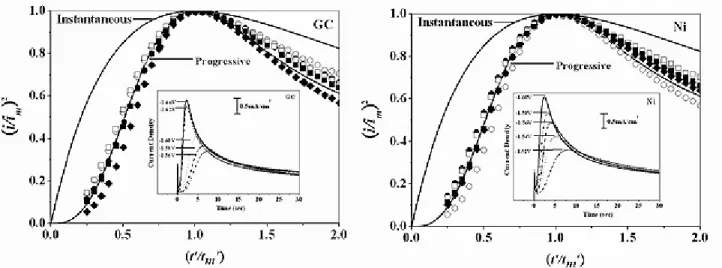
The deposition of copper at Ni and GC substrates requires a nucleation overpotential.
Chronoamperometry experiments were carried out in quiescent solutions to study the nucleation process. As shown in Fig. 2 the electrodeposition of Cu at both electrodes involves a 3D-progressive nucleation/growth process.
Fig. 2. Comparison of the dimensionless experimental curves derived from current-time curves shown
in the insets with the theoretical models for three-dimensional nucleation/growth process. Insets: current–time transients of the chronoamperometric experiments recorded at GC and Ni electrodes for 50 mM CuCl in EMI-DCA ionic liquid at 313K.
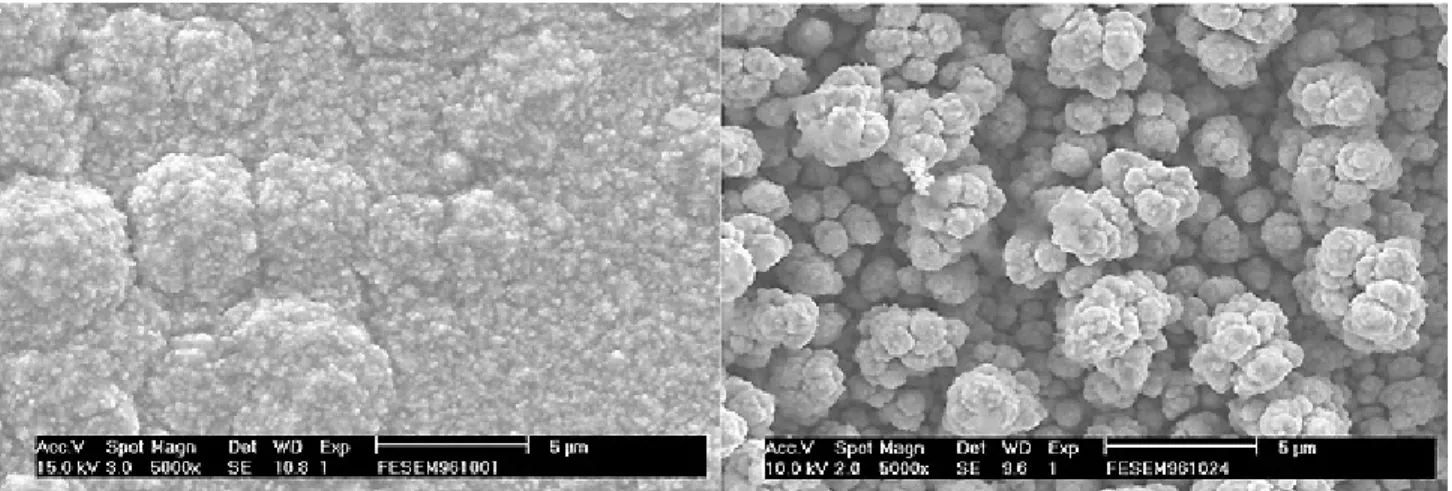
Electrodeposition of Cu was performed in EMI-DCA containing 50 mM Cu(I) using bulk controlled-potential electrolysis experiments on nickel wires (surface areas = 0.08cm2). The SEM images of typical
Research Express@NCKU - Articles Digest
as-deposited Cu samples depicted in Figure 3 show that the electrodeposits produced at lower overpotentials (-1.55V), at which the deposition rate is low, have a dense, fine-grained and compact surface containing hemispherical nodules. As the deposition potential is made progressively more negative to -1.80 V, the deposits become less compact and less uniform; cauliflower structures of different sizes are observed. The formation of cauliflowers is apparently due to the increased deposition rate. The micrograph of the surface in higher magnification shown in Fig. 4A reveals that the nodules are the cluster of Cu nano-crystals with average sizes of about 40-100 nm which agrees the value
calculated from X-ray powder diffraction pattern of the Cu deposits. EDS analysis (Fig. 4B) of the sample indicates that it is free of the ionic liquid residual.
In summary, EMI-DCA is an Il with low viscosity and high coordination ability. The electrochemistry of CuCl in this IL shows that this IL would be a promising electrolyte for electrochemical applications.
Fig. 3. SEM micrographs of the copper electrodeposits that were prepared on nickel wires at 313K by
electrolysis of solutions of 50 mM CuCl in EMI-DCA at -1.55V, and-1.80 V. The charge passed during the electrolysis was 300 mC.
Fig. 4. (A) SEM micrographs of the as-deposited copper that was prepared at 313K by electrolysis of a
solution of 50 mM CuCl in EMI-DCA at -1.65 V. The charge for the electrolysis was 300 mC. (B) EDS profile of the sample shown in (A).
Research Express@NCKU - Articles Digest