
Effects of annealing on thermochromic properties of W-doped vanadium dioxide thin films deposited by electron beam evaporation
28
0
0
全文
(2) Outline 1. Introduction 2. Motivation 3. Experimental Procedure 4. Result & discussion 5. Conclusion. 2.
(3) 1. Introduction. 3.
(4) Thermochromic (TC) materials Thermochromic (TC) materials Structure A RT. Δ. Structure B. Ti2O3, Fe3O4, Mo9O26, VnO2n-1, VO2. VO2. electric optical magnetic. phase transition temperatures (Tt) ~ 68 °C nearest to RT convenient range for technical applications. Ref: Morin, F. J. (1959). "Oxides Which Show a Metal-to-Insulator Transition at the Neel Temperature." Physical Review Letters 3(1): 34-36.. 4.
(5) Structure and Properties of VO2 VO2(M/R) Low temperature phase (LTP) 25 °C. High temperature phase (HTP) hysteresis loop. 80 °C. IR transmitting semiconducting state. TIR. T ∆H. IR reflecting metallic state. R. R. T. Tt, c Tt Tt, h. wavelength (nm). Temperature. Ref: Wu, Y., et al. (2014). "Depressed transition temperature of WxV1-xO2: mechanistic insights from the X-ray absorption fine structure (XAFS) spectroscopy." Physical Chemistry Chemical Physics 16(33): 17705-17714. Tazawa, M., et al. (1998). "Optical constants of V1-xWxO2 films." Applied Optics 37(10): 1858-1861.. wavelength (nm). 5.
(6) Applications of VO2. electronic/optical switching devices ρ. TIR. uncooled microbolometer. smart window. Mott field effect transistor (MottFET). anti-detection device. ultrafast switches electronic oscillator memristive device solid-state memory devices thermal/chemical sensor Ref: Gabriel Popkin. (2013). Material looks cool while heating up. Retrieved from https://www.sciencenews.org/article/material-looks-cool-while-heating. 6.
(7) Relevant phases and structures of VOx V3+. VO2(B). Magneli phases. VO2(T) 1 atm. VO2(M). V4+. VO2(R) Wadsley phases. too high for RT-related energy applications. Tt5+ should be reduced to near the RT V maximum benefit from the variable solar energy inflow. Ref: Bahlawane, N. and D. Lenoble (2014). "Vanadium Oxide Compounds : Structure, Properties, and Growth from the Gas Phase." Chemical Vapor Deposition 20(7-9): 299-311.. 7.
(8) Impurities doping acceptor. Tt size. V4+ (VO2). charge De- carrier. donor. Tt ↓ most effective dopant ion in reducing the Tt. Ref: Goodenough, J. B. (1971). "The two components of the crystallographic transition in VO2." Journal of Solid State Chemistry 3(4): 490-500. Wu, Y., et al. (2014). "Depressed transition temperature of WxV1-xO2: mechanistic insights from the X-ray absorption fine structure (XAFS) spectroscopy." Physical Chemistry Chemical Physics 16(33): 17705-17714.. 8.
(9) Fabrication methods of VO2 thin films CVD. Solution-based deposition. Gas-based deposition. . PVD. short evaporation time in situ monitored film thickness low target density is acceptable easily doping different dopant and concentration in one target via traditional technique. No work has been reported on W-doped VO2 films by e-beam evaporation. 9.
(10) 2. Motivation. 10.
(11) Motivation VO2(M) TIR. step. 1. Synthesis VO2(M/R) thin films. ∆H. hysteresis loop VO2(R). Tt, c Tt Tt, h. Temperature. step. 2. TIR. VO2. Tt, c Tt Tt, h. Temperature. Decrease Tt of VO2 thin films 11.
(12) 3. Experimental Procedure. 12.
(13) Experimental methods Target preparation. Thin films deposition. VO2 powder. VO2 target. WO3 powder. WxV1-xO2 target Substrate: Quartz glass --------------------------------Working Voltage : 8 kV Working Current : 30 mA Base Pressure : 1.46×10 −6 Torr Substrate Temperature : RT Thickness : 77±5 nm. Post annealing treatment. Characterization. Temperature : none, 400, 450, 500 °C. sample name:. VO – VO2 WV – WxV1-xO2. VO-500 none – as-deposited 400 – 400 °C 450 – 450 °C 500 – 500 °C 13.
(14) 4. Result & discussion. 14.
(15) VO2(M). Relative intensity. (011). VO2(B). (2� 11). (d) VO-500 (220). (100). (c) VO-450. the films annealed at 500 °C shows better crystallinity with (011)-preferred orientation of VO2(M) and that annealed at (200) 400 °C/450 °C shows undesired VO2(B). (002) (6� 01). (b) VO-400. (a) VO 1) heating VO2(B) at relatively high temperature. (provide sufficient thermal energy.) 2) overcome the most thermodynamically 10the energy barrier 20 to form30 40 50 stable phase 60 VO2(R). 3) converted to VO2(M) upon cooling below Tt (~68 °C for bulk VO2(M/R)).. 2 Theta (°). Fig. 1. XRD spectra of (a) as-deposited VO2 films annealed at (b) 400 °C, (c) 450 °C, and (d) 500 °C.. 15.
(16) VO2(M). Relative intensity. VO2(B) (d) WV-500. (c) WV-450. (b) WV-400. (a) WV absence of any other peaks either from the initial precursors or from the 10 20 the incorporation 30 502 lattice. 60 compounds indicate of W 40 ions into the VO. 2 Theta (°) Fig. 2. XRD spectra of (a) as-deposited WxV1-xO2 films annealed at (b) 400 °C, (c) 450 °C, and (d) 500 °C.. 16.
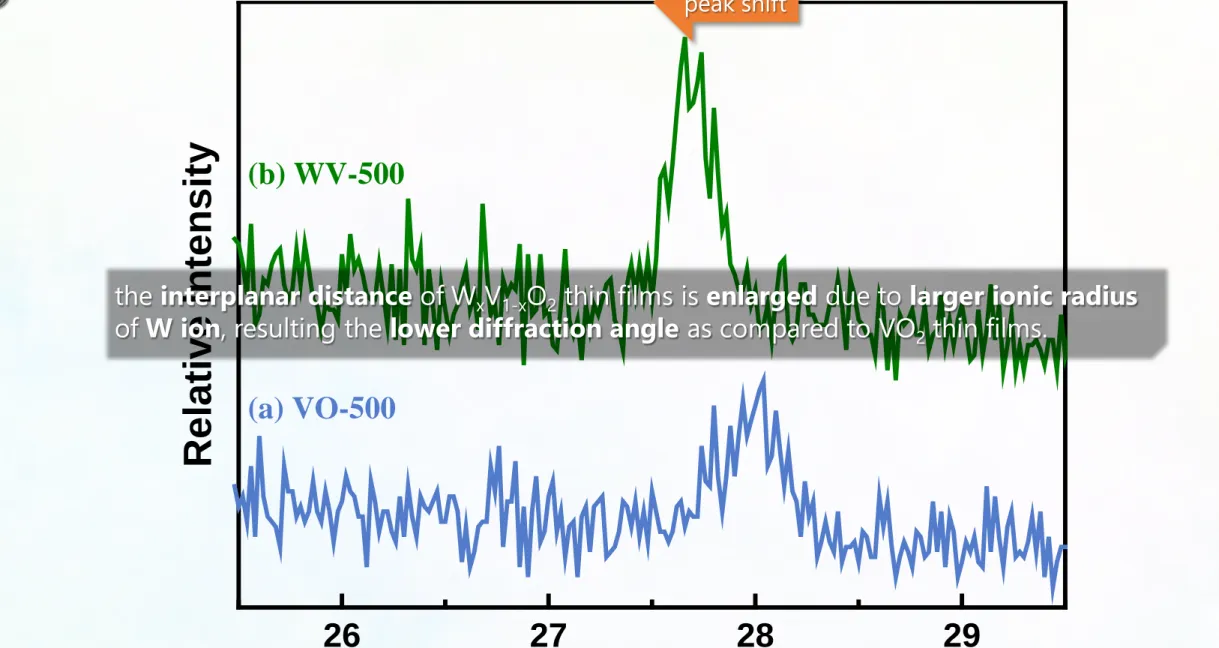
(17) Relative intensity. peak shift. (b) WV-500. the interplanar distance of WxV1-xO2 thin films is enlarged due to larger ionic radius of W ion, resulting the lower diffraction angle as compared to VO2 thin films.. (a) VO-500. 26. 27. 28. 29. 2 Theta (°) Fig. 3. The magnified XRD patterns of (a) VO2 and (b) WxV1-xO2 films annealed at 500 °C with 2θ ranging from 26° to 30°.. 17.
(18) (a). O1s. Intensity. V2s. surface contamination. W4f. V2p. WV-500. V3p N1s. C1s W4d. V3s. V, O, N, C, W VO-500. V, O, N, C 800. 600. 400. 200. Binding energy (eV) Fig. 4. XPS spectra of VO2/WxV1-xO2 films annealed at 500 °C: (a) survey spectrum. 0 18.
(19) (b) W4f7/2 W4f5/2. Intensity. W6+ WV-500. 37.3 eV. 35.1 eV. VO-500. 40. 38. 36. 34. 32. Bindingforenergy W6+ ion substitutes V4+ ion (eV) in VO2 lattice.. Fig. 4. XPS spectra of VO2/WxV1-xO2 films annealed at 500 °C: (b) W 4f core-level spectra Table 1. The element analysis results of VO2 and WxV1-xO2 films annealed at 500 °C by XPS.. Sample VO-500 WV-500. Element concentration (%) O 1s V 2p W 4f 68.4 31.6 67.3 28.7 4.0. (V+W)/O atomic ratio 0.4620 0.4859. W/V atomic Composition ratio V0.92O2 0.1394 W0.14V0.83O2. 19.
(20) (c). Intensity. WxVy4+V1-y3+O2. WV-500. V2p3/2 reduction in the oxidation state of V from V4+ toward V3+ for the electronic compensation.. V2p1/2. 515.4 eV. V. V3+. 5+. V4+. 517.3 eV. VO-500. 516.0 eV. 1. highly surface sensitive of XPS analysis 2. strong redox ability of V4+, which mainly caused by surface of thin films exposure to air since V2O5 is the most stable phase of vanadium oxide.. 528. 526. 524. 522. 520. 518. 516. 514. Binding energy (eV) Fig. 4. XPS spectra of VO2/WxV1-xO2 films annealed at 500 °C: (c) V 2p core-level spectra.. 512 20.
(21) (a) VO-500. (b) WV-500. W ion can densify the structure of VO2 films. the interfacial energy difference between the film and the substrate caused by W ions. 1 μm. 1 μm. Fig. 5. The SEM plan view images of (a) VO2 and (b) WxV1-xO2 films annealed at 500 °C.. Ref: Zhou, S., et al. (2012). "Microstructures and thermochromic characteristics of low-cost vanadium–tungsten co-sputtered thin films." Surface and Coatings Technology 206(11–12): 2922-2926.. 21.
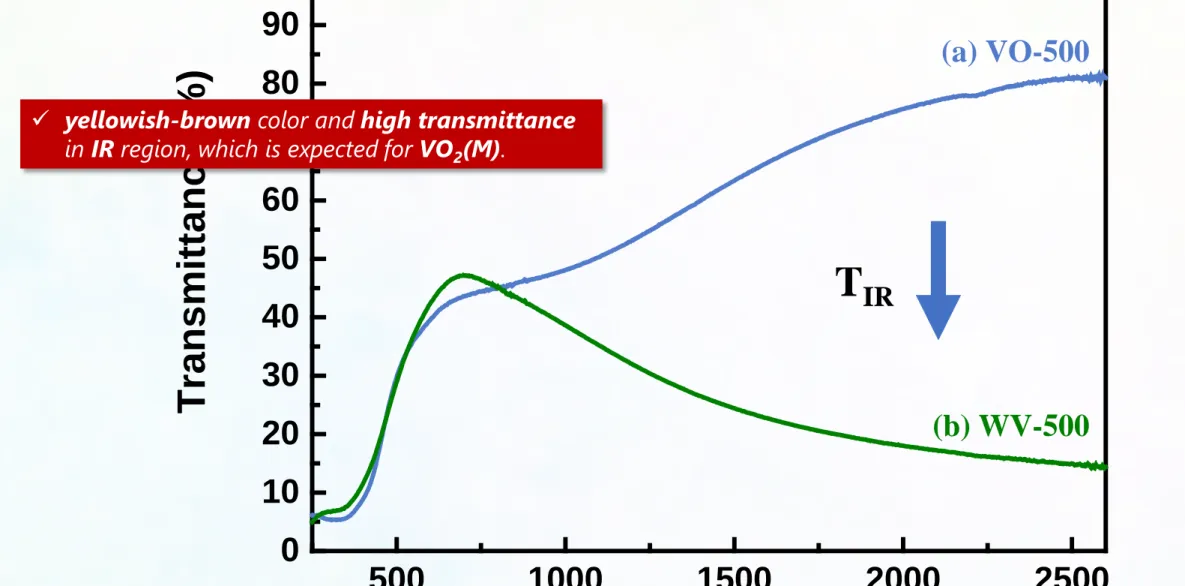
(22) 100. W ion distorts the structure from VO2(M) towards VO2(R) at RT.. Transmittance (%). 90. (a) VO-500. 80. yellowish-brown color and high transmittance in IR region, which 70 is expected for VO2(M).. 60 50. TIR. 40 30. (b) WV-500. 20 10 0. 500. 1000. 1500. 2000. Wavelength (nm) Fig. 6. The optical transmittance of VO2 and WxV1-xO2 films annealed at 500 °C.. 2500 22.
(23) the reduction of Tt for VO2 thin film may be due to several parameters, such as stresses, thickness, stoichiometry, etc., which are directly related to the chosen processing conditions. heating. ∆H = 6.79 °C. 0. cooling (a) VO-500. 50. switching efficiency. ΔTIR = 30.0 °C quite large to effectively control the TIR.. 40. d(TIR)/dT. Transmittance (%). 60. hysteresis loop width. -2 Tt,h = 67.67 °C. -4 Tt,c = 60.88 °C. (b) WV-500. 30. heating cooling. -6. 20. 30. 40. 50. 60. 70. 80. 90. 10. 20. 30. Temperature (°C). Tt =. 40. 50. 60. (Tt,h+ Tt,c) = 64.28 °C 2. 70. 80. 90. 100. Temperature (°C). Fig. 7. The optical transmittance measured at 1400 nm of VO2 and WxV1-xO2 films annealed at 500 °C. Fig. 8. The Gauss fitting derivative plots of d(TIR)/dT – T of VO2 films annealed at 500 °C. Table 2. The thermochromic properties (°C) of VO2 films annealed at 500 °C.. ΔTIR (°C) Tt, h (°C). FWHMt, h Tt, c (°C). FWHMt, c ∆H (°C). ∆Tt (°C). 30.0. 7.15. 4.32. 64.28. 67.67. 60.88. 6.79. Ref: Kittiwatanakul, S., et al. (2013). "Transport behavior and electronic structure of phase pure VO2 thin films grown on c-plane sapphire under different O2 partial pressure." Journal of Applied Physics 114(5): 053703. Zhang, D.-p., et al. (2016). "High performance VO2 thin films growth by DC magnetron sputtering at low temperature for smart energy efficient window application." Journal of Alloys and Compounds 659: 198-202. Batista, C., et al. (2011). "Synthesis and characterization of VO2-based thermochromic thin films for energy-efficient windows." Nanoscale Research Letters 6(1): 1-7.. 23.
(24) Goodenough’s semiempirical expression critical V-V distance 𝑅𝑅𝑐𝑐 = 𝟐𝟐. 𝟗𝟗𝟗𝟗 ± 0.04Å Low temperature phase (LTP). 𝑅𝑅 < 𝑅𝑅𝑐𝑐 → 3𝑑𝑑 𝑒𝑒 − 𝑖𝑖𝑖𝑖𝑖𝑖𝑖𝑖𝑖𝑖𝑖𝑖𝑖𝑖𝑖𝑖𝑖𝑖𝑖𝑖 𝑅𝑅 > 𝑅𝑅𝑐𝑐 → 3𝑑𝑑 𝑒𝑒 − 𝑙𝑙𝑙𝑙𝑙𝑙𝑙𝑙𝑙𝑙𝑙𝑙𝑙𝑙𝑙𝑙𝑙𝑙. High temperature phase (HTP). dimer. 3.12 Å. 2.86 Å. 2.65 Å. Ref: Tang, C., et al. (1985). "Local atomic and electronic arrangements in WxV1-xO2." Physical Review B 31(2): 1000-1011. He, X., et al. (2015). "Orbital change manipulation metal-insulator transition temperature in W-doped VO2." Physical Chemistry Chemical Physics 17(17): 11638-11646.. 24.
(25) 1) W6+ enters into VO2 lattice and substitutes the V4+. (Enhanced carrier concentration) V4+ V4+ V4+. 6+ V4+ W. 3+ V4+. V4+. 2) as a result of charge compensation, V3+–V4+ and V3+–W6+ pairs along the a-axis of the VO2(M) cell are formed. (The loss of V4+–V4+ pairs.) semiconducting phase (VO2(M)) becomes destabilized. 3) the energy level of the d|| orbital relative to the O 2p orbital and the relative orbital position of π* and d|| orbitals is decreased. (decrease in the occupancy of the d|| orbitals.) the strength of V–V pair interactions are reduced. 4) Fermi energy level shifts toward the conduction band and. reduce the band gap.. 5) the Tt is decreased pronounced metallic (VO2(R)) properties. 𝛼𝛼0 ↓ doping𝛼𝛼1W ↓ ion can dramatically affect the electron structure of VO2(M), that lower 𝛼𝛼2 ↓ the Tt, and thus, yield good IR shielding ability at RT. 𝛼𝛼2 − 𝛼𝛼1 ↓ 25 Ref: Tang, C., et al. (1985). "Local atomic and electronic arrangements in WxV1-xO2." Physical Review B 31(2): 1000-1011. He, X., et al. (2015). "Orbital change manipulation metal-insulator transition temperature in W-doped VO2." Physical Chemistry Chemical Physics 17(17): 11638-11646..
(26) 5. Conclusion. 26.
(27) Conclusion 1.. VO2/WxV1-xO2 thin films are prepared via electron beam evaporation over quartz glass and annealed under vacuum for the first time.. 2.. The XRD result shows the structure of the thin films change from VO2(B) to VO2(M) with increasing the annealing temperature.. 3.. Temperature dependent optical transmittance measurement shows the large switching efficiency of VO2(M) thin films at Tt around 64.28 °C.. 4.. The reduction in the Tt and high TIR rejecting ability observed in WxV1-xO2 thin films is attributed to the variation of electron structure in VO2 due to the electrical compensation caused by high W doping level (x=0.14).. 27.
(28) Thank you for your attention. Shao-En Chen. Jow-Lay Huang. Horng-Hwa Lu. 28.
(29)
數據



+6



相關文件
Various learning activities such as exp eriments, discussions, building models, searching and presenting information, debates, decision making exercises and project work can help
Then, we tested the influence of θ for the rate of convergence of Algorithm 4.1, by using this algorithm with α = 15 and four different θ to solve a test ex- ample generated as
Particularly, combining the numerical results of the two papers, we may obtain such a conclusion that the merit function method based on ϕ p has a better a global convergence and
Then, it is easy to see that there are 9 problems for which the iterative numbers of the algorithm using ψ α,θ,p in the case of θ = 1 and p = 3 are less than the one of the
Define instead the imaginary.. potential, magnetic field, lattice…) Dirac-BdG Hamiltonian:. with small, and matrix
• What if the quark bilinear is slightly away from the light cone (space-like) in the proton
We investigate some properties related to the generalized Newton method for the Fischer-Burmeister (FB) function over second-order cones, which allows us to reformulate the
• elearning pilot scheme (Four True Light Schools): WIFI construction, iPad procurement, elearning school visit and teacher training, English starts the elearning lesson.. 2012 •
