在語意的理解而後兩個階段則著重在語法的精 熟。小數教學不能一味地求「快」,唯有透過 每個階段的完全發展,才是真正的小數概念學 習。之後,Hiebert(1992)又將小數知識具體 分成三種:(1) 記數系統知識:有關小數符號 的知識。(2) 運算規則知識:根據規則操弄小 數符號以進行運算的知識。(3) 數量表示知識: 將小數表示數量的知識。Hiebert 非常強調「連 結」,如果希望學生對小數概念是真正內化與 了解,那就必須加強「記數系統知識」、「運算 規則知識」與「數量表示的知識」彼此的連結。 教師在完整的教學程序可以讓學生建立正確的 連結,但需事先規劃:(1) 有明確的活動去連 結小數的符號和意義。(2) 能寫出小數的符號 和理解語意。(3) 發展符號的語言和語法。這 些文獻為我們的小數教學提供了一個明確的方 向。因此,本研究在進行教學時將會加強連結 階段,隨時讓學生操作表徵,透過等分概念將 小數與分數做連結,並強調多單位記數系統, 以幫助學生學習小數。
二、小數迷思概念
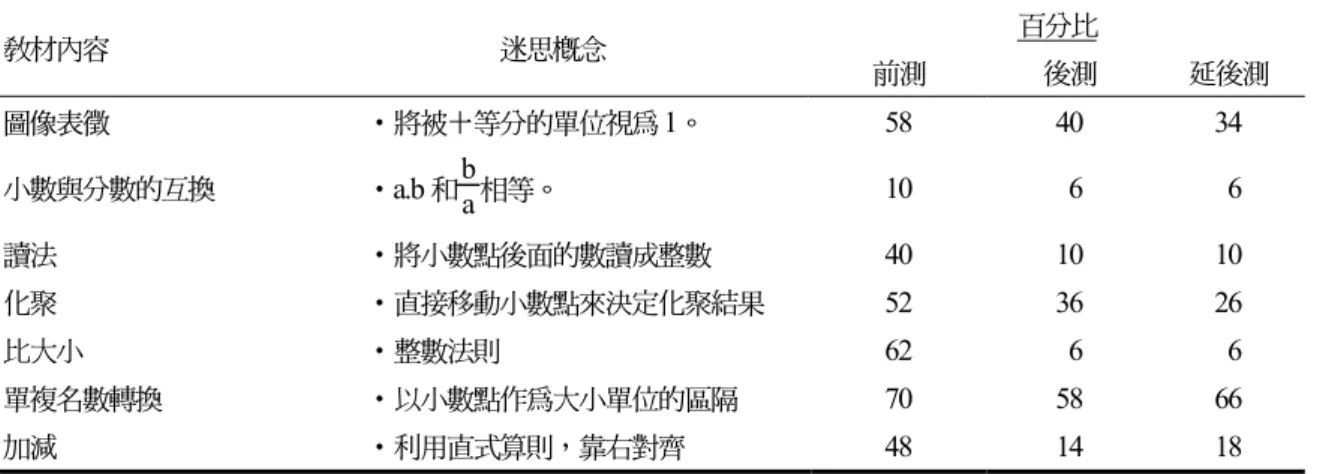
從現行的教材分析中,與小數相關的內容 皆分布在三至六年級。學生學習小數極易產生 的迷思概念大都集中在四、五年級,而六年級 則偏向小數乘除的問題(劉曼麗, 2002)。 四、五年級有關小數的教材是以發展學生二 位及三位小數概念為主。如將這些教材內容以 Hiebert 的三種小數知識分類(1992)來看,記數 系統知識可包括小數符號的寫法、讀法、位值、 位名和單位小數之間的化聚;運算規則知識可 包括小數與分數的互換、小數的比大小和小數 的加減運算;數量表示知識可包含小數圖像表 徵和單複名數轉換須涉及小數的。針對這些細 部內容,再參考相關研究和文獻,探討學生可 能產生的迷思概念,並將其整理如下表1。 從文獻發現,不論過去或現在,國內外學 生學習小數均有許多的迷思概念產生。而這些 迷思概念大都是學生受過去所學的整數知識 (如寫法、讀法、位值、位名、比大小與加減) 與分數知識(如比大小)的影響,可見當學生 學習小數時,對於無法掌握的問題,往往將其 所知的整數知識或分數知識過度類推,而產生 迷思概念。此正符合 Case(1975, 1978)所提 出的診斷教學假設:「當學習者所處的學習環 境,需要他掌握的資訊量超過他的能力時,就 趨向於發展出合理但過於簡化的解題策略。」 因此,欲幫助學生破除迷思概念以改進小數教 學,診斷教學應可融入到小數課程中。三、診斷教學
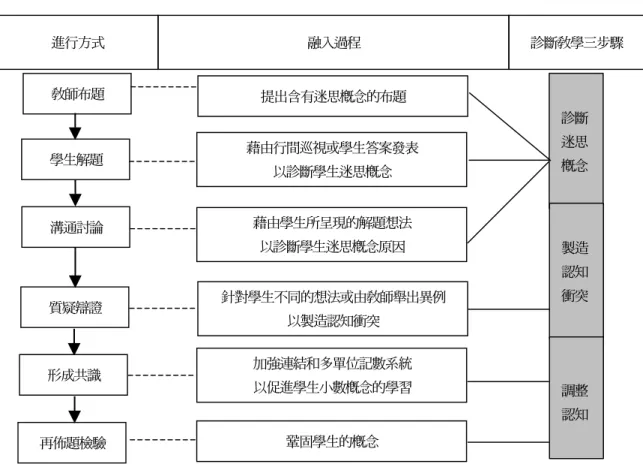
「診斷」(diagnosis)原為醫學用語,其 意義是指透過診察症候,以了解此症狀背後的 根本原因,並作為消除此原因的依據(黃瑞煥 和詹馨, 1982)。近年來,國內外教育學者(林 福來、黃敏晃和呂玉琴, 1996; Bell, 1989, 1994) 將「診斷」的概念應用在數學教學上,強調在 教學過程中,教師需先診斷出學生的迷思概 念,再針對迷思概念製造出認知衝突的情境, 使學生察覺、承認自己的錯誤,進而調整其原 有的認知。所謂「認知衝突」是指智能發展過 程中原有概念(或認知結構)與現實情境不符 時,在心理產生的衝突現象。認知衝突的結果, 導致個人原有概念的改變(張春興, 1989)。目 前,國內外已有相當多的教學實驗是依上述理 念來進行,且均獲致良好的教學成效(林福來、 郭汾派和林光賢, 1995; 何明昇, 1998; 李源順 和林福來, 1998, 2000; 李源順, 2002; Bell, 1989;表1:小數迷思概念表 小數知識 迷思概念 相關研究或文獻 寫法 •將0.8、0.9 的下一位寫成0.10 •將0.08、0.09 的下一位寫成0.010 •省略小數點後數字中的零 •劉曼麗(2001; 2002); Frobisher, Monaghan, A. Orton, J. Orton, Roper & Therlfall(2002) 讀法 •將小數點後面的數讀成整數 •陳永峰(1998);
劉曼麗(2001, 2002); Frobisher, et al.(2002) •0.1 和0.10 不一樣多 •杜建台(1996)
•0.8 和8 一樣大 •Bell, Swan, & Taylor(1981) 位值 •受到整數位值的影響 、 •劉曼麗(2002) 位名 •受到整數位名的影響 •杜建台(1996); 吳昭容(1996); 陳文利(2001); 陳永峰(1998); 劉曼麗(2002); Carpenter, Corbitt, Kepner, Lindquist, & Reys(1981) 記 數 系 統 知 識 化聚 •直接移動小數點來決定化聚結果,如:0.9 是9 個0.01、36 個0.1 是0.36 •陳文利(2001); 郭孟儒(2002); 劉曼麗(2001, 2002)
•0.a 和 a 相等1 •Irwin(2001); Resnick, et al.(1989); Markovits & Sowder(1991); Moskal & Magone(2000) •a.b 和 a 或b b 相等a •梁惠珍(2003); 劉曼麗(2002);
D’Entremont(1991); Hiebert & Wearne(1983); Markovits & Sowder(1991); Resnick, et al.(1989) 運 算 規 則 知 識 小數與分數的 互換
•100和0.a 相等(或 a 1000和0.ab 相等)ab •Resnick, et al.(1989) 比大小 •小數是比0 還小的數 •劉曼麗(2001)
•整數法則(小數點後的位數愈多其值愈大,•艾如昀(1994); 吳昭容(1996); 如3.21 > 3.8) Irwin(2001); Resnick, et al.(1989);
Greer(1987);
Moskal & Magone(2000); Sackur-Grisvard & Le’onard(1985); Steinle & Stacey(1998)
續表1:小數迷思概念表
小數知識 迷思概念 相關研究或文獻
•分數法則(小數點後的位數愈多其值愈小, 如3.45 < 3.2)
•艾如昀(1994); 吳昭容(1996); Irwin(2001); Resnick, et al.(1989); Sackur-Grisvard & Le’onard(1985); Steinle & Stacey(1998)
•忽略小數點,如12.7 < 4.28(認為127 小 於428)
•吳昭容(1996);
Hiebert & Wearne(1986); Irwin(2001);
Sackur-Grisvard & Le’onard(1985) 加減 •將兩數向右對齊後計算,如
表6:製造認知衝突的策略 策略 圖示 舉例說明 二對一法 針對學生回答問題Q1的錯誤答案A,再舉另一問題Q2,使其答案也 為A,以製造認知衝突。 舉例如下(化聚問題) Q1:0.9 是幾個0.01? A:9 個。 Q2:0.09 是幾個0.01?(或0.9 是幾個0.1?) A:9 個。 反向法 針對學生錯誤答案A1,再由A1這個答案反問回去,得到答案A2,並 對照原問題Q1,以製造認知衝突。 舉例如下(小數與分數的互換問題) Q1:1000 化成小數是多少?85 A1:0.85。 Q2:0.85 化成分數是多少? A2:100 。85
概念及其成因之研究。屏東市:國立屏東師 範學院數理教育研究所碩士論文(未出版)。 15. 陳文利(2001):國小四年級學童小數迷思 概念之研究。屏東市:國立屏東師範學院數 理教育研究所碩士論文(未出版)。 16. 陳永峰(1998):國小六年級學童小數知識 之研究。屏東市:國立屏東師範學院國民教 育研究所碩士論文(未出版)。 17. 張春興(1989):張氏心理學辭典。台北市: 東華書局。 18. 黃瑞煥和詹馨(1982):低成就學生的診斷 與輔導。台中: 臺灣省政府教育廳。 19. 劉曼麗(1999):小數認識與運算。國民小 學數學實踐課程總結性評量分析(pp. 129-146)。教育部台灣省國民學校教師研習會。 20. 劉曼麗(2001):國小學童的小數知識研究。 屏東師院學報, 14, 823-858。 21. 劉曼麗(2002):台灣地區國小學童小數概 念研究(II):國小學童「小數與小數運算」概 念之調查研究。九十年度行政院國家科學委 員會專題研究計劃成果報告,國科會科學教 育發展處。(NSC90-2521-S-153-003)。 22. 戴政吉(1999):四年級學童的小數迷思概 念~由學童習作所犯之錯誤談起。國教天地, 134, 106-112。 23. 簡茂發和劉湘川(1993):八十一學年度國 民教育階段學生基本學習成就評量國小組試 題編製及抽測結果報告。台中市:國立臺中 師範學院。
24. Bell, A., Swan, M., & Taylor, G. (1981). Choice of operation in verbal problems with decimal numbers. Educational Students in Mathematics,
12, 399-420.
25. Bell, A. W. (1989). Teaching for the test. The
Times Educational Supplement. Outlines the
Shell Centre's research into diagnostic teaching methods.
26. Bell, A. W. (1993). Diagnostic teaching. Selected
Lectures from the 7th International Congress on Mathematical Education, 19-34.
27. Bell, A. W. (1994). Some experiments in diagnostic teaching. Educational Studies in
Mathematics, 24(1), 115-137.
28. Booth, L. R. (1984). Algebra: Children's
strategies and error. Windsor, Berkshire, United
Kingdom: NFER-Nelson.
29. Carpenter, T. P., Corbitt, M. K., Kepner, H. S. Jr., Lindquist, M. M., & Reys, R. E. (1981). Decimals: Results and implications from national assessment. Arithmetic Teacher, 28(8), 34-37.
30. Case, R. (1975). Gearing the demands of instruction to the developmental capacities of the learner. Review of Educational Research 45(1), 59-87.
31. Case, R. (1978). A developmentally based theory and technology of instruction. Review of
Educational Research 48(3), 439-63.
32. D’Entremont, Y. M. (1991). The reconstruction
of decimal knowledge in young adult.
Unpub-lished doctoral dissertation University of Alberta, Edmonton, Alberta.
33. Frobisher, L., Monaghan, J., Orton, A., Orton, J., Roper, T., & Therlfall, J. (2002). Learning to
teach number. A handbook for students and teachers in the primary school. Cheltenham,
United Kingdom: Nelson Thornes Ltd.
34. Glasgow, R., Ragan, G., Fields, W. M., Reys, R., & Wasman, D. (2000). The decimal dilemma.
Teaching Children Mathematics, 7(2), 89-93.
35. Greer, B. (1987). Nonconservation of multiplication and division involving decimals.
36. Hart, K. M. (1984). Ratio: Children's strategies
and errors. Windsor, Berkshire, United
Kingdom: NFER-Nelson.
37. Hiebert, J., & Wearne, D. (1986). Procedures over concepts: The acquisition of decimal number knowledge. In J. Hiebert (Ed.), Conceptual and procedural knowledge: The case
of mathematics (pp. 199-222). Hillsdale, NJ:
Lawrence Erlbaum Associates.
38. Hiebert, J., & Wearne, D. (1988). Instruction and Cognitive change in Mathematics. Educational
Psychologist, 23(2), 105-117.
39. Hiebert, J. (1992). Mathematical, cognitive, and instructional analyses of decimal fractions. In G. Leinhardt, R. Putnam, & R. A. Hattrup (Eds.),
Analysis of arithmetic for mathematics teaching
(pp. 283-322). Hillsdale, NJ: LEA.
40. Hiebert, J., & Wearne, D. (1983). Students’
conceptions of decimal numbers. Paper
presented at the annual meeting of the American Educational Research Association, Montreal. (ERIC Document Reproduction Service No. Ed 230415).
41. Irwin, K. C. (2001). Using everyday knowledge of decimal to enhance understanding. Journal for
Research in Mathematics Education, 32(4),
399-420.
42. Kouba, V. L., Brown, C. A., Carpenter, T. P., Lindquist, M. M., Silver, E. A., & Swafford, J. O. (1988). Results of the fourth NAEP assessment of mathematics: Number, operations, word problems. Arithmetic Teacher, 35(8), 14-19. 43. Markovits, Z., & Sowder, J. T. (1991). Students’
understanding or the relationship between
fractions and decimals. Focus on Learning
Problems in Mathematics, 13(1), 3-11.
44. Moskal, B. M., & Magone, M. E. (2000). Making sense of what students know: Examining the referents, relationships and modes students displayed in response to a decimal task. Educational Studies in
Mathematics, 43, 313-335.
45. Onslow, B. (1986). Overcoming conceptual
obstacles concerning rates. Shell Centre,
University of Nottingham.
46. Resnick, L. B., Nesher, P., Leonard, F., Magone, M., Omanson, S., & Peled, I. (1989). Conceptual bases of arithmetic errors: The case of decimal fractions. Journal for Research in Mathematics
Education, 20(1), 8-27.
47. Sackur-Grisvard, C., & Le’onard, F. (1985). Intermediate cognitive organization in the process of learning a mathematical concept: The
order of positive decimal number. Cognition and Instruction, 2(2), 157-174.
48. Steinle, V., & Stacey, K. (1998). The incidence of misconceptions of decimal notation among students in Grades 5 to 10. In C. Kanes, M. Goos, & E. Warren (Eds.), Teaching
mathematics in new times (pp. 548-555).
Brisbane: Mathematics Education Research Group of Australia.
49. Tirosh, D., & Stavy, R. (1999). The intuitive
rules theory and inservice teacher education (pp.
A Study for Diagnostic Teaching on Decimals
Man-Li LiuGraduate Institute of Mathematics and Science Education, National Pingtung Teachers College
Abstract
The main purpose of this study was to explore the process of diagnostic teaching on decimals and the effects on students’ misconceptions. Subjects were 98 students in grades 4 and 5 from four classes in four elementary schools from south Taiwan. Data were collected from written tests, videotapes of teaching, and interviews. Data analysis was conducted using both quantitative and qualitative aspects. During the process of diagnostic teaching, (a) seven misconceptions for fourth graders and three misconceptions for fifth graders were diagnosed, (b) five strategies of provoking cognitive conflict were implemented, two-to-one, reverses, one-to-many, using referents, and representations, and (c) four ways of clarifying misconceptions were used, manipulating concretes, connecting pure decimals and fractions, dividing into equal parts and using a notation system. In addition, the main results indicate that (a) diagnostic teaching can raise and retain the results of students’ performance on decimals, and (b) diagnostic teaching can overcome students’ misconceptions of decimals.