
不同訂正方式用於大學生英文作文之效益
106
0
0
全文
(2) . . The Effect of Different Error Treatments on College Students’ English Writing Essays . Advisor: Dr. Lin, Shih-Chung By: Shoau, Wei-Chiung . A Thesis Submitted to the Graduate Program of Applied Foreign Languages In Partial Fulfillment of the Requirements For the Degree of Master of Arts National Pingtung Institute of Commerce. Pingtung, Taiwan, R.O.C. June, 2012. 2 .
(3) . 摘要. 本研究旨在探討不同訂正學生英文作文方式之成效。研究過程中,透過多種訂正 反饋的應用:只在錯誤句法下劃底線、劃底線與提示、直接給答案及使用簡短中 文解釋幫助學生修正錯誤,並分析其結果。本研究中,九十七位英文主修的大一 學生參與本實驗,並被分成四組、給予不同的訂正方法。研究完成後,研究者分 析了各篇文章中使用句子的複雜度、使用動詞的形式、整體錯誤比率及多種文法 類型的錯誤。實驗後,參與的學生以填寫問卷的方式表達他們對這四種作文訂正 方式的看法。結果指出,間接訂正法比直接給學生答案:一、有較高的效益,二、 更有助於學生在之後寫作的正確性,三、在多類文法型態中發現顯著不同。在問 卷方面,學生們希望老師指出所有的錯誤、寫出提示、讓學生自己可以找出正確 的寫法。 關鍵字:錯誤訂正方式,寫作教學,寫作表現,文法錯誤 . i .
(4) . Abstract. Although many studies have dealt with different kinds of error corrections and the effects on student writing, a more appropriate way to give feedback is seldom found in previous research. The present study revealed a more effective way to correct students’ English writing essays through a series of practice on various kinds of error treatments: underlining only, underlining with hints, direct correction, and Chinese description only. Ninety two college freshmen majoring in applied English were recruited in the present study in their spring semesters in 2009 and 2010, and divided into four groups treated with different error treatments during the experiment. Then, a number of grammatical elements were analyzed: the complexity of sentences, verb forms, total error percentage, and errors in various grammatical categories. Afterwards, a questionnaire was used to elicit participants’ perceptions about the experiment. Findings were that the more indirect the error treatment was, the more progress students would have. It also uncovered that the Chinese description only helped students correct significantly more errors and further decrease error rates in their subsequent writing. Finally, in the questionnaire, the participants expected that the teachers could (a) point out all the errors, (b) provide hints next to the errors, and (c) allow themselves to make corrections. Pedagogical implications were discussed and some suggestions were provided in the present research. Keywords: error treatment, writing instruction, writing performance, grammatical errors, preference and perception on error treatments ii .
(5) . Acknowledgements. I began the writing of this thesis with none of the usual feelings of apprehension. This was not because of my limited experience in doing research, but because of the strong confidence I felt in my advisor and the committee members who kindly agreed to help me in completing this final and tough task in my master program. To my advisor, Dr. Shih-Chung Lin, I deeply express my gratitude on his suggestions to help edit and refine this study. Besides, to the committee members, Dr. Tzung-Hung Tsai and Dr. Feng-Hung Tsai, I would also express my acknowledgements on the invaluable comments on the study. I have learned a lot from their advice.. iii .
(6) . Table of Contents Abstract (Chinese) ..........................................................................................................i Abstract .......................................................................................................................ii Acknowledgements ...................................................................................................... iii Table of Contents ..........................................................................................................iv Figures ......................................................................................................................vi Tables ......................................................................................................................vi CHAPTER 1 .................................................................................................................. 1 Introduction ............................................................................................................ 1 Background and Motivation .......................................................................... 1 Problem Statement of the Present Study ........................................................ 4 Purpose of the Study ...................................................................................... 6 Research Questions ........................................................................................ 7 Significance of the Study ............................................................................... 8 Definition of Terms ........................................................................................ 8 CHAPTER 2 ................................................................................................................ 10 Literature Review ................................................................................................. 10 Error Treatment and Revision on Writing .................................................... 11 Error Categorization ..................................................................................... 13 Direct Correction vs. Indirect Correction .................................................... 15 Related Studies ............................................................................................. 23 CHAPTER 3 ................................................................................................................ 28 Methodology ........................................................................................................ 28 Patterns of the Error Treatments .................................................................. 28 Subjects ........................................................................................................ 31 Instruments ................................................................................................... 33 Procedure ..................................................................................................... 39 Data Analysis ............................................................................................... 41 CHAPTER 4 ................................................................................................................ 44 Results and Discussion ........................................................................................ 44 Overview ...................................................................................................... 44 Effect on Sentence Types with Different Error Treatments ......................... 44 Effect on the Uses of Verb Forms with Different Error Treatments ............ 47 Results of Error Percentage Among the Four Groups ................................. 49 The Effect of Error Treatments on the Improvement from Pre- to Post-test ............................................................................................ 61 Results of the Questionnaire ........................................................................ 63 . iv .
(7) . Summary of Findings ................................................................................... 65 CHAPTER 5 ................................................................................................................ 68 Conclusion ........................................................................................................... 68 Conclusion ................................................................................................... 68 Pedagogical Implication ............................................................................... 75 Suggestion for Future Studies ...................................................................... 76 References .................................................................................................................... 79 Appendix A: Student Response Questionnaire (Chinese)............................................ 85 Student Response Questionnaire ........................................................... 86 Appendix B: Error Categories and the Examples ........................................................ 88 Appendix C: Examples of the Four Error Treatments ................................................. 90 Appendix D: Error Treatment Instruction for the First Essay...................................... 94 Appendix E: Example Essays for the First Essay ........................................................ 97 . v .
(8) . Figures Figure 1. Procedures of Data Collection .................................................................... 41. Tables Table 1 Table 2 Table 3 Table 4 Table 5 Table 6 Table 7 Table 8 Table 9 Table 10 Table 11 Table 12 Table 13 Table 14 Table 15 Table 16 Table 17 Table 18 Table 19 Table 20. Comparison on Direct vs. Indirect Correction Research ............................. 22 Error Categorization on Three Levels ......................................................... 29 Identification of Errors and Examples......................................................... 31 Analysis of Competence Among Groups on the Error Percentage of the Pre-test................................................................... 32 Five Steps of Collecting the Participants’ Writing Essays .......................... 34 The Participants’ Responses on Different Error Treatments ....................... 38 The Use of Sentence Types Shown as Percentage of the Four Groups ....... 45 The Use of Verb Forms Shown as Percentage of the Four Groups ............. 48 Comparison of Error Percentage Among the Four Groups ......................... 50 Tukey HSD Pos Hoc Test on Error Percentage ........................................... 51 Comparison of Error Types Counted as Error Percentage Among the Four Groups .............................................................................. 53 Types of Errors Made the Most and the Least in the Participants’ Writing Essays ........................................................................ 54 Tukey HSD Pos Hoc Test for Error Percentage on Verb Forms .................. 56 Tukey HSD Pos Hoc Test for Error Percentage on Noun ........................... 57 Tukey HSD Pos Hoc Test for Error Percentage on Adjective ..................... 58 Tukey HSD Pos Hoc Test for Error Percentage on Adverb......................... 58 Tukey HSD Pos Hoc Test for Error Percentage on Sentence Structure ...... 61 Mean Percentage on Errors of Pre- and Post-Test Among the Four Groups .............................................................................. 62 Paired T-test of Mean Percentage on Error Reduction of Pre-test and Post-test ................................................................................... 62 The Participants’ Reflections of the Error Treatments ................................ 64 . vi .
(9) . CHAPTER 1. Introduction The present study aims at exploring the effect of four different kinds of error treatments on applied English major college freshmen’s writing performance and their perceptions toward the error treatments. This chapter consists of four sections. The first section explains the background and motivation of this experiment. The second one states the purpose of the present study. The third points out the significance of the present study. Finally, the research questions are listed to elicit the results. Background and Motivation English writing is crucial in terms of institutional requirements, examinations, and personal developments. The access to writing provides learners with keys to get involved in the world’s most academic or living activities. Therefore, the writing test is also one of the testing sections in today’s mainstream examinations like the General English Proficiency Test (GEPT), Scholastic Achievement Test (SAT), Test of English as a Foreign Language (TOEFL), and department-required tests for midterm and final exams, etc. In school curriculum, writing class is also one of the required courses for students majoring in applied English in order to train them to apply writing skills on their future career or higher education. In addition, writing, as for lifelong personal development, enables a person to perform well in this trans-national and trans-lingual 1 .
(10) . global village after a writer manages the practices and preferences of literacy (Purves, 1987). In the present study, the researcher, as also the teaching assistant, participated and observed in a writing class in the applied English department in southern Taiwan. After each session of writing instruction, the participants were assigned to write six English essays after each period. Among these six writing essays, four take-home writing assignments for practice as well as two achievement tests for midterm and final exams were asked to hand in on the allotted dates. Hence, two out of these six writing essays were from the first take-home assignment and the last in-class department-required final exam for the analyses as pre- and post-test respectively in the present study. During the time the six essays were practiced by the participants in this experiment, the researcher corrected the writing essays with four different kinds of error treatments, and provided them with in-class error treatment instruction. It was hoped that they could generalize the usage and rules emphasized in the error treatments to correct the errors and to improve their subsequent writing. Nowadays, generally, when students received their writing essays corrected, they were required to revise based on the feedback, error treatments, or error corrections from their instructors. Under this circumstance, when students faced the errors, some with better proficiency might refer to reference books and/or ask the teachers or their. 2 .
(11) . peers for advice on revision. For the students with lower proficiency, they might be too shy to ask for help or feel it too troublesome to turn to others, so they would simply copied the teacher’s feedback or correction on their own way or revised their essays with their own acquaintance on specific usage of grammar rules. It remains some problems that English teachers cannot effectively convey their ideas through the error treatments, corrections, or comments to their students. Therefore, their students may have a hard time revising their writing essays with teacher’s error treatments, corrections, or comments, and even making use of the teacher’s feedback in their future performance. Many studies have dealt with the relationship between error treatments and student revision. For example, Goldstein (2004) found that students could see what they have achieved and what they have to strive for with appropriate error treatments. Under this circumstance, the researcher in the present study wanted to find out a more effective way that would help students improve their writing ability and attitudes toward writing, and thus reduce their grammatical errors in the students’ future writing essays. On the other hand, in a study administered by Guentte (2007), she noticed that Chandler’s (2003) Correction (direct correction) groups might have different effects whether they revived direct correction first or last because all Chandler’s groups received four types of error corrections in rotation. This situation. 3 .
(12) . would make the students be alerted and pay more attention to the errors because they had experienced different kinds of corrections. Based on this notion in Chandler’s (2003) study, Guentte (2007) concluded that it would be interesting to replicate Chandler’s study with four different groups working with the same teacher, without alternating the treatments. It would probably be the only way to ascertain whether direct correction was superior or equivalent to the indirect one. Under this circumstance, each writing essay in the present study was corrected with different ways of error treatments: underlining only (Underlining), underlining with hints (Hints), underlining with answers (Correction), and Chinese description only (Description). Afterwards, the results from each error treatment were analyzed, based on the sentence complexity, the verb use complexity, error percentage, and error percentage in each error category. Then, students’ reflections of error treatments would also be analyzed. Finally, a proper way to meet the needs of both teachers and students would be elicited through the experiment. Problem Statement of the Present Study Many researchers (Chandler, 2003; Ferris, 1997; Goldstein, 2004; Guentte, 2007) have discussed the practicality of English writing error treatment, feedback, or error correction, and its effects on students’ performance. Error treatment studies might focus on the traditional ways of making corrections, such as directly providing. 4 .
(13) . answers based on errors that students made, giving directions on the marginal space or at the end of the writing essays, and supplying coded error treatment or a signal that marks the position of an error for students to revise. However, few studies mentioned that the need for effective error treatment was of importance and that it was necessary to combine the direct and indirect corrections on treatable or untreatable errors, to make use of students’ native language instead of using error codes, and to give error treatments according to students’ preference and needs. Giving error treatment, teachers or instructors thus hoped that the students might take advantage of the error treatments and then internalize the knowledge indicated in the error treatments to improve the subsequent writing. Nonetheless, it was difficult for both teachers and students to choose the ways of giving error treatments or to make use of them. Thus, the researcher in the present study attempted to find a way to make an improvement in providing error treatments for the future writing course. Previous studies (Ferris & Robert, 2001; Ashwell, 2000; Huang, 2006) have probed into different aspects on ways to correct students’ essays, and error treatment was one of various kinds. As for error treatments, coded correction (an indirect one) and direct correction had their respective advantages. To be more specific, the former (indirect correction) enhanced students’ autonomy through discovery and acquainted learners with linguistic forms. Hence, indirect correction was favored by the students. 5 .
(14) . who were fond of self-discovery or who were more proficient. The latter yielded correct revision easily because all the students needed to do was just copy the teacher’s corrections in place of the errors. Nonetheless, direct correction made the students depend more on the help from their writing teachers and lack opportunities for their own self-recovery on errors. Thus, the combination of both direct and indirect ones to correct writing essays was seldom found in previous research. Purpose of the Study The present study aims at examining the progress on accuracy of students’ writing essays by providing different error treatments. There were four methods of corrections that combined direct and indirect one: (a) underlining only (Underlining), (b) underlining with Chinese hints (Chinese) next to the errors with answers (if errors were untreatable) and with Chinese explanations (if errors were treatable), (c) giving answers directly (Correction), and (d) providing Chinese descriptions (Description) next to each error. As Chandler (2003) mentioned, the best way to measure what the participants learned from error treatments was how they wrote a subsequent writing more accurately. Base on this notion, students’ writing essays, in the present study, were analyzed after a series of writing practice, which was individually corrected with four different kinds of error treatments in the four groups. On the other hand, grades were not assigned to each essay except for the third and sixth ones of the six essays. 6 .
(15) . which were submitted as grades for midterm and final exams. Without the interference of scores, students could concentrate more on the error treatments. It was hoped that students could make better performance in overall writing quality and accuracy through this experiment. Finally, after the practice of the error treatments, the students could take a positive attitude toward writing as well as the error treatments in the near future to improve themselves in the English language learning environment. Research Questions To elicit the results of giving error treatments which could be generalized in the future English writing class, the research questions addressed in the present study were as follows: 1. Which error treatment helps the participants increase the sentence complexity of their writing essays? 2. Which error treatment helps the participants increase the verb use complexity in their writing essays? 3. Which error treatment helps the participants reduce the errors on grammatical categories? 4. What are the participants’ reflections of the four kinds of error treatments?. 7 .
(16) . Significance of the Study Although many studies have focused on the effects of various kinds of error treatments, corrections, or feedback, the present study is significant in incorporating the strengths of combining indirect correction with direct one on treatable and untreatable errors respectively. Hence, the present study took advantage of the participants’ native language–Chinese on error treatments (instead of using error codes in the previous research), and provided error treatments according to the students’ needs and preference. The present study was to improve the effect of error treatments on applied English freshmen’s writing essays in the process of the participants’ writing assignments analyzed in pre- and post-tests. Also, a questionnaire was administered in the end of the treatment to investigate the students’ perception on error treatments. It was hoped that this study could figure out a more effective way for the teachers to give error treatments in the students’ writing essays with both practical evidence and students’ perceptions. Then, the students could cultivate a positive attitude toward writing with the practice of error treatments. Definition of Terms 1.. Treatable and untreatable errors Treatable errors can be self-edited by students themselves, like verb form, tense and aspect, and subject-verb agreement, etc., which can be referred in some. 8 .
(17) . handbooks or set of rules. Untreatable errors are non-idiomatic, idiosyncratic errors in word choice and sentence construction (Ferris, 1999). 2.. Direct correction and indirect correction Indirect correction identifies the errors rather than corrects them, while direct correction provides correction directly. Types of indirect correction can be seen like errors coded, errors circled, errors underlined, error underlined and coded, errors underlined with description, and errors counted in the margin but neither marked nor coded (Guenette, 2007).. 9 .
(18) . CHAPTER 2. Literature Review The aim of the present study is to find out a more effective error treatment in students’ English writing essays based on theoretical and practical evidences. Thus, in this chapter, four sections on previous research are demonstrated. First, error treatments and revision on writing shows the effect of error treatments, corrections, or feedback on students’ writing essays in previous studies. Second, error categorization lists the errors on grammatical types students frequently made, and the effect of different error treatments on the error types of grammatical elements. Third, the practicality of direct and indirect corrections on students’ writing essays is then compared. Finally, a number of related studies about error treatments are placed for reference. The basis of English writing contained many foci in order to meet its intended goals. Sokolik (2003) suggested that writing could be seen in pairs of contrasts: (a) the act of writing was visualizing the mental work of ideas into words through physical actions with some media, like the computer software in the present study, (b) the purpose of writing was to express writers’ ideas to impress their intended readers, and (c) what the writer went through was a process and what the reader saw was a product. For the aspect of writers, they had to generate contents, to organize their 10 .
(19) . ideas, to apply conventions of writing, and to integrate all the other necessary knowledge (O’Malley & Pierce, 1996) and the writers were also obliged to consider the purpose and audience of their writing. The former (purpose) influenced the nature of writing (O’Malley & Pierce, 1996) and the latter (audience) affected the choices of language use and details (Winterowd & Murray, 1985). Since successful writing relied both on what a writer knew and on how deep he/she was in deploying the knowledge (Purves, 1987), extensive practice was crucial (O’Malley & Pierce, 1996). On the other hand, Ferris (1999) noticed that students could be successfully taught to self-edit their own texts when they were (a) taught to focus on the importance of editing; (b) trained to identify and correct patterns of frequently-made and serious errors; and (c) given explicit instruction as needed about the rules governing these patterns of errors. Those studies attracted plenty of attention in both second language acquisition research and second language writing studies. However, on the way to give error treatments, Ferris (1999) also argued that indirect correction (identification of error) was preferable to direct correction (direct correction on errors). Error Treatment and Revision on Writing For writing instruction, feedback (as error treatments in the present study) and revision were important pedagogical tools (Ferris, 1997). The success of revision. 11 .
(20) . relied both on the writer’s competence and effective instruction and feedback (Hedgcock & Lefkowitz, 1992). Besides, it took effective writing instruction and feedback to wipe out the limitations that the writers had and to help them compose a text matching their intellectual abilities (Leki, 2005). On the other hand, students with varying writing proficiency revised the essays with different foci. The less skilled students revised on the local level (specific errors pointed out) while the more advanced rewrote based on the global level (sentence structures and ways of expression) (Zamel, 1987). As for the practical problems attributed to student writers, grammar correction and instruction were influenced by students’ first language, their English language proficiency, and their prior experience on English grammar instruction and editing strategies. For example, a grammar checklist appended by the teacher to students’ writing might be incomprehensible if the students had little or no prior experience on formal English grammar terminology (Ferris, 1999). Moreover, regarding the relationship between students’ competence and revision, the less competent student writers made more changes in lexicon with teacher-generated rules, while the more capable students revised from a global perspective of discourse and content (Zamel, 1987). As Fordeson and Holten (2003) claimed, students in the same English as a second language (ESL) writing class varied widely in their command of English grammar, familiarity with the sentence structure and the vocabulary used in. 12 .
(21) . academic writing, and the background on formal instruction. Consequently, with a proper error treatment, students knew what they had done and what they had to do to meet their learning goals (Goldstein, 2004). Therefore, students paid much attention to the error treatments in a multiple-draft setting (Ferris, 1995b), and the writing feedback (or error treatment) was regarded as part of a learning process rather than a means of assessment (Harmer, 2001). On the other hand, acknowledging teachers’ language competence and experience in explaining and providing strategies for revision, students highly valued teachers’ error treatments (Ferris, 1995b, 1997; Goldstein, 2005) and incorporated a high percentage of teachers’ advice in revision (Ashwell, 2000; Miao, Badger, and Zhen, 2006). Teachers’ error treatment was also beneficial to learning and to fostering the interpersonal conditions suitable for learning (Hyland & Hyland, 2001). Hence, a thoughtful writing instructor also addressed the issue of student motivation by raising students’ awareness about the importance of accuracy in their writing essays and about the need to develop independent self-editing skills (Ferris, 1995c; Ferris, 1999; Reid, 1997). Error Categorization Researchers categorized error types based on some common traits (Ferris, 1999; Hendrickson, 1987). Considering the treatability of error, Ferris (1999) depicted treatable errors as those that “occurred in a patterned, rule-governed way” and she. 13 .
(22) . attributed untreatable errors to the fact that “there was no handbook or set of rules students could consult to avoid or fix those types of errors” (p.6). To be more specific, treatable errors included features like verb tenses and forms, subject-verb agreement, article usage, plural and possessive noun endings, and sentence fragments, while untreatable errors consist of word choice, exceptions of pronoun and preposition usage, unidiomatic sentence structure, problems with word order, and missing and unnecessary words (Ferris, 1999). On the other hand, empirical studies proved that there was significant difference in students’ capability in editing different types of grammatical errors (Ferris & Roberts, 2001). For example, in Ferris & Roberts’s (2001) study, it was found that untreatable errors were more troublesome. For untreatable errors, wrongly used words (e.g., word choice, preposition and pronoun errors) were easier to mend than sentence structures which included errors in sentence/clause boundaries, omitted phrases, unnecessary words or phrases, and other unidiomatic sentence construction. Research indicated that students tended to make errors of different types (Chiang, 1992; Ferris & Roberts, 2001). In terms of comprehensibility, Hendrickson (1987) classified errors into global errors and local ones. He defined global errors as communicative errors which hindered a proficient non-native speaker from comprehending a written message, and labeled local errors as linguistic errors with which a proficient non-native speaker could still understand the. 14 .
(23) . intended meaning with the assistance of the context. Analyzing the diagnostic drafts of 72 ESL college students, Ferris & Roberts (2001) found that the error counts of verb category, sentence structure, word choice, noun endings, and articles descended in order of error frequency. As for adult immigrant students, Bitchener, Young, and Cameron (2005) found preposition, definite article, and the past simple tense were the most troublesome. Direct Correction vs. Indirect Correction Errors, no matter direct or indirect ones, occurred naturally in learning a second language, but students could learn from the errors with the help of continuous, systematic, and supportive correction (Hendrickson, 1987). Types of corrections or error treatments included (a) pointing out an error with a mark in the margins, (b) giving the correct expression, (c) labeling an error with a code or description that shows the rule it violates, and (d) pointing out the presence of an error but not indicating the precise position (Kroll, 2001). In general, error correction was divided into direct and indirect ones. The former is that teachers gave correct expressions and students transcribed the correction into revision, while the latter is that students themselves had to correct errors teachers identified (Bitchener et al., 2005; Ferris & Roberts, 2001). Experimental studies investigated whether either correcting strategy was better than the other (Bitchener et al., 2005; Chandler, 2003; Hayward, 1993). As. 15 .
(24) . for the time needed for the teachers to correct a 100-word student text, direct correction took 0.9 minute, in comparison with underlining (0.8 min), underlining paired with description, (1.0 min) and description (1.0 min) (Chandler, 2003). The findings indicated that either direct or indirect correction took the teacher almost the same time. Whether to treat errors or not was another topic in some research. Another issue was to let nature take its course (Truscott, 1996, 1999, 2004; Miao et al., 2006). Truscott (1996, 1999) claimed that grammar correction ignored second language acquisition (SLA) insights about the gradual acquisition process of language learners because students might apply avoidance strategy to prevent committing errors. Then the students would confine themselves to the limited expression and usage (Truscott, 1999, 2004). Thus, error correction diverted students’ attention from more productive aspects in writing (Truscott, 1996). Still, there were a range of problems associated with the ability and attitudes of teachers and students in error correction (Truscott, 1996). For example, students might fail to correct errors because they thought that further correction was unnecessary since the teachers had indicated all the errors (Miao et al. 2006). However, Truscott’s assumptions met lots of challenges (Ashwell, 2000; Chandler, 2003; Ferris, 1999; Ferris & Roberts, 2001). In practice, students relied heavily on the error correction for improvement in grammatical accuracy. 16 .
(25) . (Ashwell, 2000; Ferris & Roberts, 2001). According to ESL research of error treatments on form, making errors salient to adult second language (L2) learners was necessary in avoiding fossilization and in improving linguistic ability (Ellis, 1998). In identifying errors, Ferris & Roberts (2001) claimed that ESL college students were only able to detect six out of an average of 33.6 errors per text without teacher feedback on form. In Ferris and Robert’s (2001) experiment, ESL college students who received error correction significantly outperformed those who did not. About the effect on revision, compared with indirect correction, direct correction contributed to greater increase in accuracy for revision (Chandler, 2003; Ferris, 2002) and for subsequent writing (Chandler, 2003). The reasons were assumed that students might internalize the correct usage pointed out by their teachers soon after they received the corrected writing essays and that the time period for students to identify errors was reduced without waiting for a hypothesized usage to be proven correct (Chandler, 2003). Therefore, in revision, direct correction had better short-term result because it was easier (Chandler 2003), but indirect correction brought about greater long-term effect, which was advocated by some researchers. Indirect correction gave students chances to take part in the decision-making (Hayward, 1993 and Ferris & Roberts, 2001) and facilitated learning linguistic forms, which might in turn enhance long-term acquisition (Ferris & Roberts, 2001). Hence, weighing the pros and cons of. 17 .
(26) . direct and indirect correction, indirect one was superior for students’ sake in a long-term curriculum of writing instruction. Moreover, indirect correction could be further classified into coded feedback and uncoded one (Bitcherner et al., 2005). The former showed the type of errors, and the latter only indicated the location of error by underlining, circling, or placing a tally (Bitchener et al., 2005). In practice, students and teachers were advised to focus on major patterns of errors rather than on every single mistake (Ferris, 1995a). Thus, to acquaint students with grammatical rules and terminology, coded feedback was often accompanied with detailed explanations with error codes in a list of example errors (Ferris & Roberts, 2001). However, in the present study, Chinese (the participants’ mother tongue) description was used in place of the list, since each participant was quite familiar with the grammatical terms because they received at least 6 years of prior grammar instruction (in their high schools) and were able to be admitted to applied English department. Besides, it was noticed by some researchers that students’ ability of editing should be considered in deciding which error treatment to apply in their writing essays (Chandler, 2003; Ferris & Roberts, 2001). Ferris & Roberts (2001) noticed that untreatable errors, especially sentence structures, were more challenging than treatable errors for students who received indirect error treatment. In fact, in. 18 .
(27) . comparison with a range of 55%-79% successful correcting ratio of the other types of errors, ESL college students edited about half of the errors in sentence structure (e.g., missing and unnecessary words, wrong word order, run-ons and sentence fragments). Since students at different language levels were prone to make errors of various kinds (Chiang, 1992), the effect of combining error indication with coded feedback (indirect correction) on the first draft with direct correction in subsequent revisions might provide some insight into error treatments in writing instruction. Practically, in a semester-long study of Ferris’s (2002), indirect correction contributed significantly more decrease in error frequency ratio than direct correction did. It was also similar to Lalande’s (1982) experimental group of American students learning German as a second language. The participants improved in grammatical accuracy in the subsequent writing after the teacher used an error code as the error treatment, whereas the control group, which received direct correction from the teacher, actually made more errors in the essays at the end of the semester. However, the difference between the groups’ improvement was not statistically significant. In another study that dealt with the effects of various kinds of error corrections on accuracy of both revision and subsequent writing, Ferris, Chaney, Komura, Roberts, & McKee (2000) claimed that indirect correction on errors by the teacher led to more correct revisions (88%) than direct one (77%). This study was not published,. 19 .
(28) . but Ferris (2002) discussed the findings: “However, over the course of the semester, students who received primarily indirect feedback reduced their error frequency ratios substantially more than the students who received mostly direct feedback (p.20).” Research on indirect correction focused on students’ performance and their perceptions (Chandler, 2003; Ferris & Roberts, 2001). Ferris and Roberts (2001) conducted a study to examine whether underlining with codes or underlining alone made a difference to types of errors (e.g., verbs, noun endings, articles, wrong words, and sentence structure) in revision for ESL college students. No significant statistic difference was found in editing success ratios in the two feedback groups whether with codes or without codes, but the students who received error feedback with codes successfully corrected more errors in every category except in the use of articles. Besides, the students embraced coded marking technique most in the questionnaire. Slight difference was found in Chandler’s (2003) experiment. In Chandler’s study, coded feedback was further divided into underlining alone and underlining with description. ESL college students performed better in revision with the help of underlining paired with description, but those with underlining only had best accuracy for subsequent writing. Surprisingly, the writing performance did not fully support students’ preference. In the same study carried out by Chandler (2003), the results of the questionnaire showed that the students preferred underlining correction combined. 20 .
(29) . with description for three reasons: (a) the students were better at identifying the type of error, (b) the students learned the most from underlining with description, and (c) the students found it the most useful in the future writing. However, the students’ performance did not match their preference. Namely, students made fewer errors with the help of direction correction in Chandler’s experiment. Furthermore, as to students’ preference, compared with indirect correction, direct correction was easier (Chandler, 2003) because the students just copied the correct expressions into the next draft (Bitchener et al., 2005; Ferris & Roberts, 2001). Thus, Ferris & Roberts (2001) suggested that teachers give indirect feedback for students to self-edit some errors before they applied direct correction to the more problematic errors. This suggestion corresponded to a feedback treatment practiced by Hendrickson (1987) in Spanish picture writing course mentioned in the postscript of Chandler’s (2003) research on ESL writing. Therefore, students favored a combining form of underlining only and direct correction because of the benefits deriving from the fact that the former focuses on the errors students could self-edit and the latter targets at the errors they failed to correct (Chandler, 2003). Therefore, in performance, coded feedback (using a code to identify the type of error) was more effective in revision than the other types of error treatments. Uncoded correction, however, had positive results in subsequent writing, especially for the more competent students.. 21 .
(30) . Studies (Cohen, 1987; Cohen & Cavalcanti, 1990; Ferris, 1995; Ferris & Roberts, 2001; Ferris at al., 2000; Hedgcock & Lefkowitz, 1994; Komura, 1999; Leki, 1991; Radecki & Swales, 1988; Chandler, 2003) have consistently reported that student writers wanted such error feedback. According to Ferris & Roberts (2001), the most popular type of feedback was underlining with description, followed by direct correction, and underlining. Generally, Table 1 shows the results compared on the use of direct and indirect correction in the previous research. Table 1 Comparison on Direct vs. Indirect Correction Research Topics. Types of Experiments. Results Direct correction with mini conference helped the most.. Ferris (2002). Direct correction with mini conference, Direct correction only, and no correction but a note Direct correction, underlining, and descriptions Direct vs. Indirect correction. Ferris et al. (2000). Direct vs. Indirect correction. Ferris & Roberts (2001). Indirect correction: underlining with codes, and underlining alone Direct vs. Indirect correction. Bitchener et al. (2005). Chandler (2003). Lalande (1982) . 22 . Direct correction > Indirect correction Indirect correction helped the most. Indirect correction helped the most. underlining with codes > underlining alone Indirect correction helped the most..
(31) . Related Studies The Effect of Different Types of Error Treatments on ESL Student Writing In previous research, John (2005) advocated that the way for future research to examine the effects of error treatments needed to be focused on: (a) a new pieces of writing, (b) a wide range of linguistic error categories, (c) less advanced learners, including migrant and international learners in non-academic and pre-degree settings, and (d) ways that involved different correction strategies, and combination of strategies. In John’s study, 53 migrant post-intermediate English for Speakers of Other Languages (ESOL) students at a New Zealand university were divided into three groups (19, 17, 17, the number of participants in each group) according to the classes they attended. Group 1 received direct feedback with mini conference with the teacher researcher; Group 2 received direct feedback only, and Group 3 received no error treatment but a note for content and organization. The participants were asked to write four 250-word informal essays (e.g. a letter to a friend), and then the essays were analyzed under linguistic errors (mainly on preposition, past simple tense, and definite articles), short term and long term effects, and correction methods. It was primarily found that Group 1 (receiving direct feedback and conference sessions) performed significantly better than the other two groups on past simple tense and definite articles (treatable), but not on preposition uses (untreatable).. 23 .
(32) . Salience of Feedback on Error and Its Effect on EFL Writing Quality Moreover, in an experiment which compared the application of different error treatments, all four of Robb, Ross, and Shortreed (1986) treatment groups of Japanese college students learning English improved after receiving different types of error treatments—direct correction, notation of the type of error using a code, notation in the text of the location of error, and marginal feedback about the number of errors in the line. All of Robb et al.’s treatment groups improved in fluency and in syntactic complexity. On the other hand, Lizotte (2001) reported gains with ESL Hispanic Bilingual students of a low-intermediate English proficiency. After attempting to introduce students to the errors using codes, Lizotte indicated only the location of errors for students to self-correct. As a result, Lizotte’s students significantly reduced errors in their writing over one semester, and at the same time, the students made significant gains in fluency. Like the experiment in Robb et al.(1986), Lizotte did not have a control group since it could not be justified, either to himself as the teacher or to his students, providing no error feedback. Error Feedback in L2 Writing Classes: How Explicit Does it Need to Be? Only Ferris & Roberts (2001) and Lee (1997) had control groups that received no error feedback. Lee (1997) studied EFL college students in Hong Kong and found that students were significantly more able to correct errors that were underlined than. 24 .
(33) . errors that were either not marked or only indicated by a check in the margin. In addition, Ferris & Roberts (2001) made an experiment on ESL students from a U.S. university and found that the experimental group receiving error treatments (either on types of errors or on location) corrected significantly more errors than the control group (no error treatment) on the self-editing task. However, there was no significant difference between the two groups. From a pedagogical perspective, if the study was carried out in a ‘real’ classroom, it would, as Ferris (2004) proposed, appear almost unethical to single out a ‘no feedback’ group in a regular writing course. Hence, Ferris & Roberts (2001) had a non-correction control group, and the effect of correction versus non-correction could be compared with better evidence. Generally, as Guenette (2007) noticed, analyzing the two (correction and non-correction) confirmed that the time spent correcting the students’ errors was not in vain. Student Reactions to Teacher Response in Multiple-Draft Composition Classrooms Moreover, from teachers’ perspective, feedback on form was emphasized (Ferris, 1995b; Zamel, 1985). Zamel (1985) noticed that ESL college instructors were more attentive to form-related errors than to meaning-related ones. This phenomenon was also observed by Ferris (1995b). Ferris’s 155 ESL college students responded in a questionnaire that they received the most feedback on grammar than on organization, content, and mechanics and vocabulary. It follows that, being evaluated in an. 25 .
(34) . accuracy-oriented academic setting or workplace, L2 students showed concerns over an error-free text (Hyland, 2004). Therefore, students appreciated teachers’ responses on the grammatical problems (Ferris, 1995b). Consequently, error treatments focusing on form claimed a place in writing instruction in terms of necessity and agreement of teachers and students. Research Design Issues in Studies of Feedback Guentte (2007) proposed that Chandler’s Correction (direct correction) group might have different effects whether the students received error correction first or last because the same group received four types of error corrections in rotation. Namely, the four groups received direct correction, underlining with description, description, and underlining only successively. Hence, the students would be alerted to pay attention to the errors because they had experienced different kinds of error treatments. It would be interesting, advocated by Guentte, to replicate Chandler’s study with four different groups working with the same teacher, without alternating the treatments. This will probably be the only way to ascertain whether direct corrections were superior or equivalent. Guentte further announced that students had to understand the correction and to be capable of doing something with the correction. Teachers also needed to be consistent with the error treatments and adapted it to their students’ proficiency level and ability to self-correct. Guenette (2007) further proposed that. 26 .
(35) . dialogue journals, like the writing essays the participants practiced in the present study, are commonly used in the second language classroom to encourage students to write because the dialogue journals foster a comfortable and positive writing environment.. 27 .
(36) . CHAPTER 3. Methodology The methodology of the current study consists of five sections. The first section explains the patterns of the error treatments. The second section describes the subjects. The third section lists the instruments employed at each phase. The fourth section details the procedure and data collection. Finally, the fifth one deals with data analysis. Patterns of the Error Treatments In the present study, the four error treatments used were the combination of both direct and indirect ones. On the other hand, the researcher administered these four ways of error treatments on the writing essays within each individual group. Then an error classification adapted from Huang’s (2006) with reference to Chandler’s (2003) and Ferris’s (1999) studies was used on making error treatments of the present study. The classification of grammatical errors was applied on the error types the participants frequently made and the errors were sorted into word, phrase, and structure levels. (see Table 2).. 28 .
(37) . Table 2 Error Categorization on Three Levels Level. Errors in words. Errors in phrases. Errors in structures. idiomatic expressions collocations awkwardness. Elements. articles/ determiners Prepositions Auxiliaries verb forms Nouns Possessives Adjectives Adverbs Misspellings word choice. tense/aspect voice subject-verb agreement pronoun-reference agreement relative pronouns/relative adverbs conjunctions/transitional words sentence structures/fragments mechanics. Table 2 shows the elements of error categorization (see examples in Appendix B). Hence, errors from the participants’ writing essays were pointed out and treated with the four different kinds of error treatments. For instance, the error treatment in Group A did not provide the answers directly but just underlined the errors according the list of error categories in Table 2. Each error focused on form was indicated in red color on every single word, phrases, problematic sentences, and mechanisms like punctuations, indentions of each paragraph, and small or capital letters. On the other hand, Group B received underlined errors with hints written in Chinese if errors were treatable (the grammar rules of the error can be found in the handbooks), and underlined errors with appropriate answers if errors were untreatable (the rules cannot be found in the handbooks) (see Appendix C). Errors focusing on form in Group B. 29 .
(38) . were all underlined with purple markers; the hints or answers were written in red for the participants to easily comprehend and recognize the difference between errors and error treatments. Based on the error classification, the error treatment for Group B focused on the list (in Table 2) too, but the participants were provided with different ways of hints in a communicative way to boost comprehension of the error treatment between themselves and the researcher, instead of the ‘error codes’ utilized in the previous research. Besides, the hints (if the errors were treatable) or answers (if the errors were untreatable) were marked with brackets when there were English words in the front and back of each sentence (see Appendix C) to differentiate the error treatments from the contents of the participants’ essays. Additionally, as indicated by Conrad & Goldstein (1999) and by Hyland & Hyland (2001), because students received feedback in a foreign language, indirectness and mitigation misled students on teachers’ intention to give error treatments. Hence, in preventing possible hindrance to understanding the error treatment in the present study, the comment hints used for Group B and descriptions used for Group D were written in Chinese and were expressed in a straight-forward way within three words. Error treatment for Group C applied underlining purple marks on each error. It was based on either single elements or even phrases, and directly equipped appropriate answers in red ink next to the errors (see Appendix C). Finally, for error. 30 .
(39) . treatment in Group D, there was no underlining mark but only Chinese descriptions (less than three words) on the right-hand-side of each error in red ink (see Appendix C). Table 3 shows the correction codes and examples of the four groups. Table 3 Identification of Errors and Examples Group. A. Examples. eror. B eror 拼字錯誤. Title. underlining only. underlining with Chinese hints. Abbreviation. Underlining. Hints. C eror error. D eror 拼字. direct correction. Chinese description. Correction. Description. Subjects The participants enrolled in the present study were 97 college freshmen from a college in southern Taiwan in their spring semesters. In the school year of 2009, two groups (Group A and B) of the participants in a writing class participated in this experiment. In 2010, the other two groups (Group C and D) joined the treatment. The participants were all novice English majors aged from eighteen to twenty coming from northern, central, and southern parts of Taiwan. As for their previous education, Some of the participants majored in English (35 students), some majored in business (35 students) and some majored in the other subjects (27 students) such as computer data processing, child care, ordinary high school, and so on in their senior high schools.. 31 .
(40) . In the present study, the researcher observed a writing course, English Grammar and Writing, and corrected their writing essays as both take-home and in-class assignments after each writing course. They attended in the class lasting three hours per week in the spring semesters of 2009 and 2010. Those participants were then separated into four groups receiving the same instruction but different error treatments. These four groups were made based on the participants’ school numbers on odd and even ones. For example, the participants in Group A consisted of 23 students on odd numbers in the first semester from September to December in 2009, and 24 students in Group B on even numbers in the same semester. Accordingly, Group C and D were 24 and 26 participants respectively also from the first semesters of September to December in 2010. Furthermore, their competence of pre-test writing essays was analyzed to be homogeneous among groups (p. > .05) (see Table 4). Table 4 Analysis of Competence Among Groups on the Error Percentage of the Pre-test Group Mean Error Rates. Source of Variance. A (N=22). B (N=25). C (N=24). D (N=25). .0723. .1035. .1011. .0788. SS. df. MS. Between Groups Within Groups. .018 .247. 3 92. .006 .003. Total. .265. 95. 32 . F value. Sig.. 2.175. .096.
(41) . The mean error rates in Table 4 were calculated on the percentage of errors (numbers of error / all words). Although the results among the four groups differed from one another (Group A<D<C<B), there was no significant difference among them (F(3)= 2.175 at p=.096), which signifies that the competence of the four groups was homogeneous, and they had similar beginning on the performance of their writing essays. Instruments The instruments implemented in the present study were (a) the participants’ writing essays (six topics) with the four kinds of error treatments (combination of direct and indirect ones), and (b) a participants’ response questionnaire, shown as follows: Writing Essays with Four Kinds of Error Treatments To examine whether there was any significant difference among the four kinds of treatments in overall writing quality and accuracy, the six writing essays and the first and final ones of them, as pre- and post-test, were administered for not only training the participants to understand and take advantage of the error treatments but examining the effects of each error treatment in the present study. The participants had to write six essays in the writing class within the semester with a computer software, Microsoft Word, and those writing essays were saved in the file server provided by. 33 .
(42) . the department administrator. The first take-home essay employed for the practice as well as analysis was the pre-test in this study. After another one was composed by the participants for practice, there came a midterm in-class writing examination. After other two assignments were done for practice, it was followed with the final exam in-class writing essay (outlook on my future) as the one to be analyzed as the post-test (see Table 5). Table 5 Five Steps of Collecting the Participants’ Writing Essays Procedures 1. Pre-test. Content The participants composed the first take-home writing essay, My Summer Vacation, as a pre-test in the present study. Afterwards, the error treatment was provided.. 2. Practice. 3. Mid-term Exam. Another writing essay, My Favorite Teacher, was used for take-home practice. Afterwards, the error treatment was provided. The participants needed to compose an in-class writing essay around 150 words, My Favorite Sports. Afterwards, the error treatment was provided.. 4. Two Writing Essays for Practice 5. Final Exam. Other two take-home writing essays were practiced: ‘Brief Introduction of Myself,’ and ‘Introducing Taiwan to Foreigners.’ Afterwards, the error treatments were provided. Each participant was asked to write an in-class writing essay, Outlook of My Future, as the post-test analyzed in the present study.. In other words, among the six writing essays made by the participants, two of them, the first and the last essays, were used to see if there was any difference on the competence among the four groups of different error treatments. In addition, all the. 34 .
(43) . writing essays were saved as a research file. After each writing essay was collected, it was corrected with four kinds of error treatments with computers by the researcher. The topics of all the six narrative writing essays were about daily life experience for the applied English majors with more than six years of instruction on English grammar in their elementary and high schools to express their thought. The six topics were: ‘my summer vacation,’ ‘my favorite teacher,’ ‘my favorite sports,’ ‘brief introduction about myself,’ ‘introducing Taiwan to foreigners,’ and ‘outlook on the future.’ Moreover, the six assignments were corrected individually with different error treatments in the four groups, and the participants were asked to revise their writing essays according to the treatments. Hence, the participants were hoped to reduce the errors in their subsequent essays through the practice of the error treatments. After the experiment was done, the first writing essay, my summer vacation, was used to see their competence among the four error treatment groups through the error ratio and was compared with the final writing essay for the progress along the process. Moreover, the final writing essay from each participant was corrected with the four kinds of error treatments, classified into grammatical types, and analyzed to answer the questions of this current study. For the use of sentence types, the writing essays composed in the participants’ final exam was categorized into five sentence types: (a) the simple sentence (e.g. I. 35 .
(44) . write an essay), (b) the compound sentence, two independent clauses (e.g. I write an essay and it will be read), (c) the complex sentence, one independent clause with another dependent clause (e.g. I write an essay which will be read tomorrow), (d) the compound-complex sentence, two independent clauses with one dependent clause or one independent clause with two dependent ones (e.g. I write an essay which will be read and my teacher will give comments on it.) and (e) the fragment (incomplete sentence, e.g. I writing an essay). The frequency of using the five types of sentences was calculated and examined to answer the research question one. Furthermore, the use of verb forms in each sentence was also sorted into five parts: (a) single verb, (b) ‘be’ auxiliary plus verb, (c) ‘have’ auxiliary plus verb, (d) ‘do’ auxiliary plus verb and (e) modal auxiliary plus verb. In a similar way, the frequency on the use of verb forms was also analyzed and compared. In addition, the error ratio on the grammatical types out of each writing essay was also calculated for analysis. Afterwards, the frequency of errors was reckoned and then classified as types described in Table 2 (p. 27), to see if there was any difference with the four different error treatments. Error Treatment Instruction for the Participants It would be troublesome if the participants had difficulty understanding the error treatments. In the present study, the error treatment instruction was administered right after each writing essay was received by the participants in each group. Beforehand,. 36 .
(45) . the researcher corrected the essay with different error treatments, copied the problematic sentences the participants in different groups frequently wrote, gave appropriate answers right below each problematic sentence on a new sheet. Then, with the files, the researcher explained the problematic sentences separately in the four groups providing different error treatments with the computer software, Microsoft Power Point (see Appendix D). Moreover, with the error treatment instruction in the present study, the participants receiving this instruction in class could be aware of each error in sentences made by themselves or other peers. Hence, each error was corrected with appropriate usages and grammar rules to make a new sentence right below each problematic sentence. Afterwards, either the researcher or the professor in charge of the writing course explained the list to familiarize the participants of each group on more proper uses of lexicon, grammar, and sentence structure. After the participants made revision and repaired the errors in the writing essays, the researcher thereupon collected all the writing essays, chose three example essays, and put them under this error treatment instruction column in the internet server for the reference of all the participants within the same group to appreciate the example essays from their classmates in the internet server. Hopefully, the participants were able to recognize their own errors and also the errors of the other peers, and correct the errors pointed. 37 .
(46) . out in their own writing essays. Hence, the participants could also adopt the information to improve the future writing with the help of error treatment instruction. Student Response Questionnaire To acquire the participants’ perceptions of these four kinds of error treatments, a questionnaire was administered. The questionnaire began with demographic information enquiring such as gender, and previous education in their senior high schools, followed by 9 questions on the reflections of the error treatments. Item 1-8 are paired questions focusing on the reflections of the practice of error treatments and Item 9 is on the perception for 2nd or 3rd revision (see Table 6). Table 6 The Participants’ Responses on Different Error Treatments Item. Content. 1.. I think it helps learning when the teacher points out all the errors.. 2.. I think it helps learning when the teacher points out the more critical errors instead of all ones.. 3.. I think it helps learning when the teacher points out the errors and provides hints.. 4.. I think it helps learning when the teacher points out the errors without providing hints. I like the teacher to point out the errors and provide hints in the end of the essays.. 5. 6.. I like the teacher to point out the errors and provides hints next to them.. 7.. I think it helps learning when the teacher points out the errors and provide correct usage directly.. 8.. I think it helps learning when the teacher points out the errors and allows me to find the answers myself.. 9.. I don’t think it helpful to rewrite the essays more than twice.. 38 .
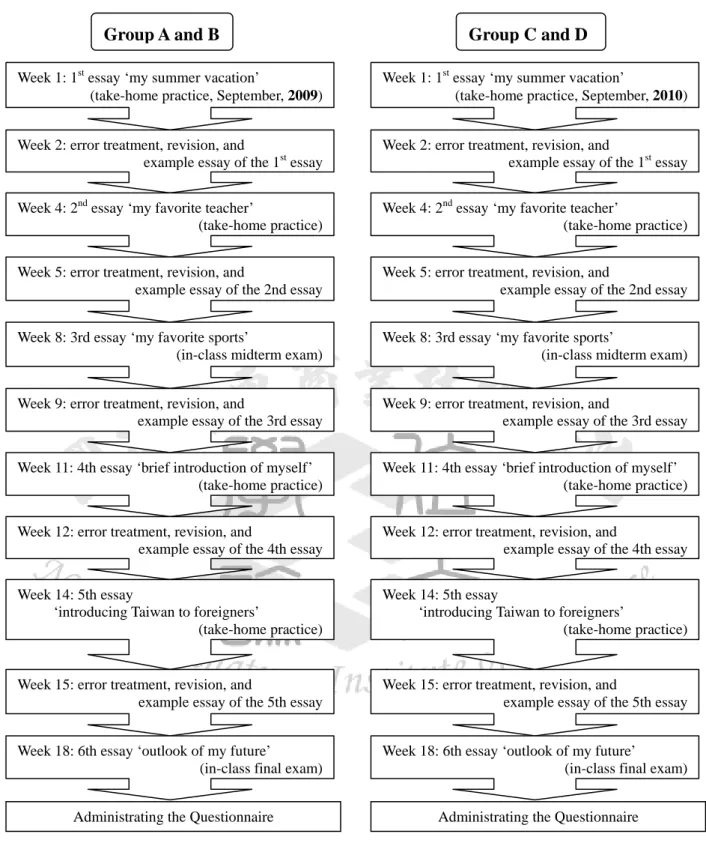
(47) . Item 1 and Item 2, within a pair, asked about how each error needed to be corrected, that is, whether errors in the same writing essay needed to be entirely corrected or only those being more critical did. Item 3 and Item 4 were used to answer the questions if providing hints was a practical and helpful way deemed by the participants. Item 5 and 6 were used to see the position of hints in the writing essay that the participants preferred. Then, Item 7 and 8 asked if direct correction was effective and if the participants would revise their essays without the help from the teacher. Moreover, Item 9 was used to see whether second or third rewriting of the same essay was necessary. Procedure The present study was executed in two spring semesters in the school year of 2009 and 2010 lasting for 4 months within two periods (from Septembers to Januarys in 2009-2010 and 2010-2011, respectively, see Figure 1). In the beginning, after the outset of the Grammar and Writing course, the researcher observed the class, corrected and analyzed the six writing essays from the participants. The first essay, my summer vacation, was then assigned, followed by the second one, my favorite teacher, for the participants to practice not only the essence of writing but also the format of the error treatments. Afterwards, other three essays: ‘my favorite sports,’ ‘brief introduction about myself,’ and ‘introducing Taiwan to foreigners’ were. 39 .
(48) . practiced. For each writing session, students received their corrected essays saved as a computer file including their own writing essays and the error treatments (Underlining in Group A; Hints in Group B; Correction in Group C; Description in Group D, see Table 3, p. 31). After the participants’ writing essays were corrected, the list of problematic sentences that the participants frequently made was corrected and displayed with the computer software, Microsoft Word as the error treatment instruction. Then it was presented and explained in class for the participants to better-recognize the errors of their own and by the others. In addition, based on different error treatments, the participants made revision on a next page of each original essay. Then three example writing essays revised were subsequently selected from all the revised writing essays in the four groups. Thus, the participants would appreciate to the example writing essays from their peers on the six topics. On the final exams in two periods of the school year in 2009 and 2010, the participants composed the essay, my outlook on the future, which was examined as the post-test in the current study. After the experiments in the present study were finished, all the participants were required to fill in the questionnaire which contained the demographic data and perception for the error treatments. . 40 .
(49) . Group A and B. Group C and D. Week 1: 1st essay ‘my summer vacation’ (take-home practice, September, 2009). Week 1: 1st essay ‘my summer vacation’ (take-home practice, September, 2010). Week 2: error treatment, revision, and example essay of the 1st essay. Week 2: error treatment, revision, and example essay of the 1st essay. Week 4: 2nd essay ‘my favorite teacher’ (take-home practice). Week 4: 2nd essay ‘my favorite teacher’ (take-home practice). Week 5: error treatment, revision, and example essay of the 2nd essay. Week 5: error treatment, revision, and example essay of the 2nd essay. Week 8: 3rd essay ‘my favorite sports’ (in-class midterm exam). Week 8: 3rd essay ‘my favorite sports’ (in-class midterm exam). Week 9: error treatment, revision, and example essay of the 3rd essay. Week 9: error treatment, revision, and example essay of the 3rd essay. Week 11: 4th essay ‘brief introduction of myself’ (take-home practice). Week 11: 4th essay ‘brief introduction of myself’ (take-home practice). Week 12: error treatment, revision, and example essay of the 4th essay. Week 12: error treatment, revision, and example essay of the 4th essay. Week 14: 5th essay ‘introducing Taiwan to foreigners’ (take-home practice). Week 14: 5th essay ‘introducing Taiwan to foreigners’ (take-home practice). Week 15: error treatment, revision, and example essay of the 5th essay. Week 15: error treatment, revision, and example essay of the 5th essay. Week 18: 6th essay ‘outlook of my future’ (in-class final exam). Week 18: 6th essay ‘outlook of my future’ (in-class final exam). Administrating the Questionnaire. Administrating the Questionnaire. . Figure 1. Procedures of Data Collection Data Analysis In the present study, all the data were analyzed through SPSS statistical analysis software. After the post-test in each experimental period (2009 and 2010), all the 41 .
(50) . writing essays were corrected again in a year to increase intra-reliability by the researcher. That is, for example, the writing essays in Group A and B were corrected in October, 2009 and in the other October in 2010. Meanwhile, the first criterion was then established for each grammatical error at first, and applied to the second correction to make the data more reliable. On the other hand, the amounts on sentence types, verb forms, total error percentage, and errors in grammatical types were recorded and keyed in. The percentage of the four groups (errors in pre-test divided by the whole words in each essay) was compared through ANOVA to make sure if the four groups had similar onset for the experiment. For the calculation of sentence types and verb forms, the amount of each category was computed among the four groups using different error treatments through ANOVA. On the aspect of overall errors, error percentage (errors in post-test divided by all words in each essay) was then analyzed with ANOVA to see if it was significantly different. Afterwards, Tukey HSD pos hoc test was applied to see the significant difference between groups. Furthermore, errors in each grammatical type were also counted and recorded. After the percentage (numbers of errors in each type divided by all words in each essay) was computed with ANOVA, grammatical types that were found to be significantly different were also analyzed through Tukey HSD pos hoc test to find the significant difference on each error type among the four groups receiving different error treatments.. 42 .
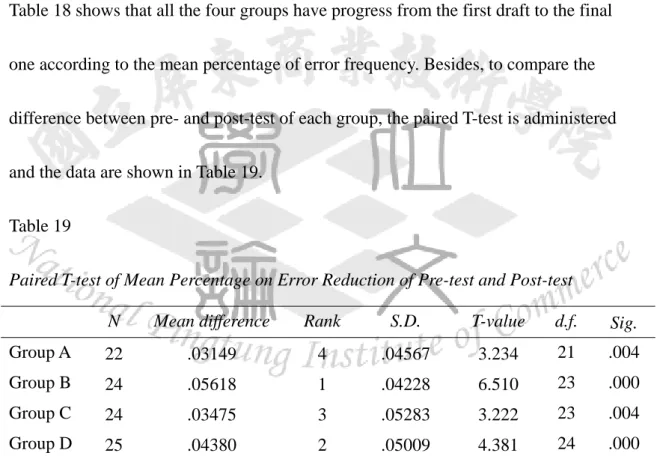
(51) . For the progress the participants made after the treatment, the error percentage in both pre- and post-test divided by the total errors in each essay was compared with paired t-test among the four groups. Finally, the results from the questionnaire with 9 questions were shown as descriptive statistics with frequency and mean scores to tell the preferences and reflections of the participants after the experiment.. 43 .
(52) . CHAPTER 4. Results and Discussion Overview In this chapter, the answers to the research questions are exhibited and the findings are discussed. First, the effect of error treatments on the use of sentence types and verb forms is examined to see if there is any difference before and after the treatment of the four groups on the complexity of sentences and the uses of verb forms. Second, to better analyze the effect of each error treatment, error percentage of each writing essay from the participants is then calculated and compared. Third, to see the progress from the beginning to the final draft, the improvement (of the error ratio) from pre-test to post-test is also compared. Finally, the results of the questionnaire administered at the end of each semester about the participants receiving the four kinds of error treatments are demonstrated. Effect on Sentence Types with Different Error Treatments To answer the research question 1, ‘which error treatment helps the participants increase the sentence complexity of their writing essays,’ the use of sentence types in each group are demonstrated in Table 7 as percentage (numbers of each sentence of the individual types divided by the total amount of sentences within each essay), and calculated through ANOVA for F value, degree of freedom, and significance level. 44 .
數據
相關文件
Curriculum Leadership Series – Ongoing Renewal of the School Curriculum (English Panel Chairpersons)
• Assessment Literacy Series - Effective Use of the Learning Progression Framework to Enhance English Language Learning, Teaching and Assessment in Writing at Primary Level.
The aim of the competition is to offer students a platform to express creatively through writing poetry in English. It also provides schools with a channel to
The teacher explains to learners their duties: to present their ideas and findings on the questions on their role sheet, and lead the other group members to discuss the
Encouraging students to think purposefully about what they want, and how they’re getting there, is a great way to make creative writing assessable.. One more
Building on the strengths of students and considering their future learning needs, plan for a Junior Secondary English Language curriculum to gear students towards the
e-Learning Series: Effective Use of e-Resources to Develop Students’ English Language Skills at the Secondary Level.. Dr Timothy Taylor, Senior Lecturer Department of English
incorporating creative and academic writing elements and strategies into the English Language Curriculum to deepen the learning and teaching of writing and enhance students’
To help students appreciate stories related to the theme and consolidate their knowledge and language skills in writing stories, the English Club has organised a workshop on story
