Some Mathematical Properties of ISO 216 A Series Paper Format and New Teaching Ideas
Yung Hong Kiu Bosco
Physics Department, University of Hong Kong
1. Introduction
Names like A4, A3 and A2 papers are often heard nowadays in almost everywhere. These names are actually originated from the international standard paper size ISO 216 (A series). It gives a vigorous definition to the sizes and dimensions of the most common format of writing paper that we are using. In this article, some mathematical properties of this type of papers are investigated, and the new teaching ideas arise from the investigation are discussed.
What I am going to discuss in this article are as follows:
1. The aspect ratio of a piece of An paper for any non-negative integer n (section 2.1, a recommended problem for Form 2 students).
2. The length in meters of the longer side of a piece of An paper as a function of n (section 2.2, a recommended problem for Form 5 students who take Additional Mathematics).
3. Some problems about paper folding (section 2.3, a recommended problem for Form 4 students).
The International Organization for Standardization (ISO) is a non-governmental world-wide organization which sets up different commercial and industrial standards (International Organization for Standardization, 2008).
Each of their standards is given a code and 216 is the one for the most widely used paper format, the standard is named ISO 216. It gives definition to two formats of paper, A Series and B Series. The names like A4 and A3 represents different sizes of paper from A Series (ISO 216, 2008). In general, all An papers from A Series of ISO 216 are rectangles with the same aspect ratio. An
A(n+1) paper is obtained by folding an An paper into half along the perpendicular bisector of its longer side, which means the folding axis is parallel to the shorter side of the An paper (Kuhn, 2006). An illustration on how to obtain an A4 paper from an A3 paper is shown in Figure 1. We shall show in Section 2 that the aspect ratio of the rectangles is 1: 2 .
The area of an (ISO) A0 paper is set to be 1 m2 , and therefore the size of any An paper can be deduced. Note that in reality, the lengths of the sides of the paper manufactured is rounded to the nearest millimeter, and all the mathematical definitions mentioned above are done prior to the rounding (ISO 216, 2008). The rounding, however, will not be discussed and every quantity mentioned in this article is assumed to be exact.
2 : 2 2 :
1 =
Figure 1: The dimensions of, and the relation between ISO A3 and A4 papers (Kuhn, 2006).
2. Some Properties of an ISO 216 (A Series) Paper 2.1 Deduction of the Aspect Ratio
It is mentioned that the aspect ratio of any An paper is 1 : 2 . The ratio can be deduced by considering the procedure of how an A(n+1) paper is obtained from an An paper. In Figure 2, a and b are the shorter and longer side for an An paper respectively. If it is divided into half along the given middle axis, two A(n+1) papers are obtained as shown. The shorter and longer sides are b2 and a respectively.
=
A4 A4 A3
2
1
2
1 2
Figure 2: An ISO An paper with a and b being the length of its shorter and longer side respectively.
By definition the aspect ratios of the two rectangles are the same, we have b
a = a
b
2 (1)
b a =
a b
2 (2)
2 2
b
a = 2
1 (3)
b a =
2
1 or 2
− 1 (rejected) (4)
I believe that this is the easiest mathematical way to deduce the aspect ratio.
It could be a suitable problem for Form 2 students after they have learnt ratio, similarity, irrational numbers and surds.
The key to obtain (1) is to compare the length of any pair of successive members from A series. Students also need to be aware that all the members from A series are similar figures because they have the same aspect ratio.
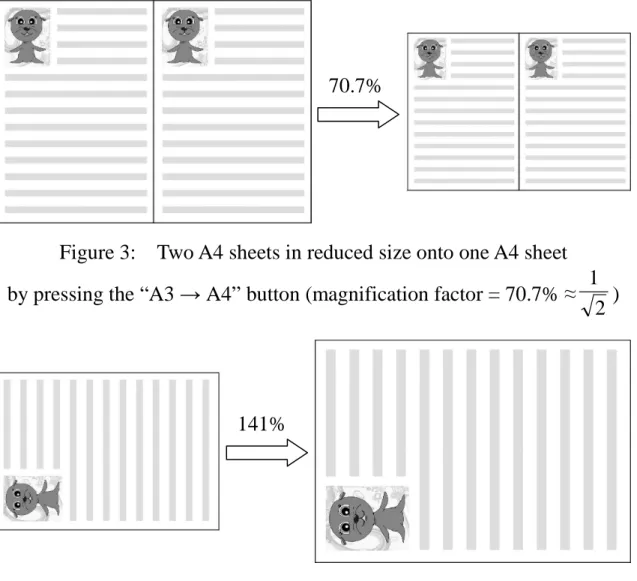
The above property has an important application in photocopying (Kuhn, 2006). Imagine you have found two pages of article printed on an A4-sized journal and you wish to make a copy of it. You could save papers (and money) by copying two (A4) pages on one A4 paper. Figure 1 shows that two A4 pages make up an A3 page, so what you need to do is set magnification factor to 70.7% ≈ 2
1 by pressing the “A3 → A4” button that is available on most a
b
photocopy machines as shown in Figure 3. On the other hand, if we want to make a copy of the content printed on an A4 paper onto an A3 paper (i.e. A4 to A3), the magnification factor will be equal to 2 ≈141% as shown in Figure 4. In both cases, there are no wasted margins of papers and no contents are being cut out. All thanks to the neat property of the A series formats.
Figure 3: Two A4 sheets in reduced size onto one A4 sheet by pressing the “A3 → A4” button (magnification factor = 70.7% ≈
2 1 )
Figure 4: An A4 sheet in enlarged size onto one A3 sheet
by pressing the “A4 → A3” button (magnification factor = 141% ≈ 2 ) With regard to the calculations, the problem of the aspect ratio of A series format is actually not difficult and it covers various topics in Form 2 mathematics. In addition students are required to apply the definition of ISO 216 (A series) format in order to solve the problem. For teaching geometry the most difficult part is to write down all the given conditions in mathematical/graphical “language”. Here the given condition is “an A(n+1)
70.7%
141%
paper is obtained by folding an An paper into half along the perpendicular bisector of its longer side”, but we are not able to do anything just by reading the words. We need to convert it into a graphical representation (i.e. draw out Figure 2), or more importantly, to rewrite it into a mathematical statement like (1). This example provides a good chance for the students to think about how they could construct their first step in solving geometry problems.
2.2 Deduction of the General Formula for Calculating the Side
What is the similarity between an A0-A1 pair, an A1-A2 pair, or any An-A(n+1) pair of papers? All of them are having the relation that the latter one in the pair is formed by folding the former one into half. Since we can obtain all the members in A series by using a single mechanism and the relation between each successive member is the same, one would expect that the members in the series are actually forming a kind of sequence. I am going to talk about it in this section.
We are basically considering similar rectangles as in the previous section.
This time I am going to investigate the area and the length of a rectangle. I denote the area in m2 of the An paper by Sn , and its longer side in meters by ln . Note that since we already have the aspect ratio 1 : 2 , the shorter side can be given by 2−½ln .
Applying the folding characteristic, we can easily get
Sn = 2Sn+1 (5)
Together with the definition mentioned earlier that the area of an A0 paper is equal to 1 m2 , i.e. S0 = 1 , we have the followings:
Sn = 2Sn+1
⇒ Sn = 21 Sn−1 (6)
Sn = 21 ( 21 Sn−2) (7) M
Sn = 2n
1 S0 (8)
Sn = 21n (9)
Any student (most likely in Form 5) who knows about simple recurrence
relation is capable of handling these steps. The result in (9) gives us a general formula for calculating the area of an An paper in terms of a single parameter n.
Now I move on to find the expression for ln.
Sn is just the area of a rectangle with its longer side equal to ln and shorter side equal to 2−½ln , thus
ln (2−½ln) = Sn (10) Combining (9) and (10), we have
ln (2−½ln) = n 2
1 (11)
2 1
2
2
ln
= n
2
1 (12)
ln =
2 4 1
2 2
n (13)
ln = 241−2n (14)
This is what I am looking for, a general formula for finding the length of the longer side of the An paper. To get the length of the shorter side we just need to divide the R.H.S. of (14) by 2 .
The prerequisites for this problem are simple method of finding the area of a rectangle, laws of indices, and recurrence relations.
There are two key steps in this approach. One is to find the expression for the area as in (9), second is to write down (11). The problem looks difficult in a sense that it is asking for a general formula which sounds abstract. I notice that students are often afraid of this type of question. They probably have no problem if I ask them to find the area or the length of an A7 paper, but they would have difficulties in handling questions about general formula. This problem, however, is based on a practical example about paper sizes. It will give the students a better understanding about the topic.
I am going to present another approach in deducing the same formula as in (14). As we know that, the length of the longer side of an A(n+1) paper, is equal to the length of the shorter side of an An paper. Mathematically,
2−½ln = ln+1 . (15) Yet it is just another recurrence relation. By substituting n by (n− 1) as before, we get
2−½ ln−1 = ln (16)
ln = 2−½ln−1 (17)
ln = 2−½(2−½ln−1) (18) M
ln = 2−2n l0 (19) l0 can be evaluated by considering the area of an A0 paper, i.e. 1 m2 (or S0= 1), thus
2−½ l0×l0 = 1 (20)
⇒ l0 = 2 41 (21)
Therefore we obtain the same expression for ln by substituting (21) into (19):
ln = 2−2n ×214 (22) ln = 241−2n
The steps from (11) to (14), and from (16) to (19) could be quite tricky for the students because of the index operations involved. Both methods of deducing the expression for ln require the use of recurrence relations as well as the definition of an ISO An paper. The first method is the area approach which makes use of the fact that the area of an A(n+1) paper is half that of an An paper. The second method focuses on the relationship between the sides of those papers, though in the last step it also applies the area condition S0 = 1 . This problem shows the importance of finding alternative approaches. By considering different approaches we can have deeper understanding of the problem itself, and it can give you more confidence to the answer that you get. Just like in this case, the result I obtained by the second method confirms that by the first method, and vice versa.
Nowadays students always like to seek a so-called “model answer”. Once an answer from the teacher is shown, everyone will follow it or even recite it
without understanding (i.e. surface learning). However, is there always a model answer, or the “best” answer? What is the meaning of the “best”? In the above problem I cannot say any one of the methods totally outweighs the other. I believe the process of finding alternative approaches for a question enhances students’ deeper learning, and by comparing the work from different classmates they will have an all round understanding to the problem and the solutions.
2.3 Some problems about paper folding
To get angles such as 45° and 60° by paper folding are some famous problems. Students may also find this activity interesting because it provides a different platform for solving mathematical problems other then just writing equations and steps on a worksheet.
The way of making a 45° is rather simple, so I will not describe the method but it will be used without proof. Now I am going to review a way to produce a 60° with any rectangular paper. It can serve as a challenge for students in case they have not done that before.
To produce an angle of 60° :
Figure 5: Using a rectangular paper to produce an angle of 60° by folding only.
Consider a rectangular paper ABCD of any size. First we need to fold the paper into half along axis MN with M and N be the mid-points of
A
B C
D
M N
P
B’
sides AB and CD respectively (i.e. AD , MN and BC are parallel lines perpendicular to AB and CD ), as shown in Figure 5. Then by keeping A in position, we move AB inwards by folding the paper along AP such that the corner of the paper, B , touches MN at B’ . We can fold the whole paper along AB’ in order to make a “scratch” to mark the line AB’ if you wish. Unfold the paper and we get ∠MAB’ = 60° . The procedures are illustrated in Figure 5.
The proof for this result is not difficult. By adding lines AB’ and BB’ , we obtain ∆AMB’ and ∆BMB’ . Then we have,
AM = BM (given, by folding)
∠AMB’ = ∠BMB’ (right angle) MB’ = MB’ (common side)
therefore, ∆AMB’ ≅ ∆BMB’ (S.A.S.) (23)
By considering the corresponding sides of these congruent triangles, we have AB’ = BB’ . On the other hand, from the folding procedures we know that AB = AB’ . Thus we conclude that AB = AB’ = BB’ , which means
∆ABB’ is an equilateral triangle. Therefore ∠MAB’ = 60° .
There is also another way to prove it. Since AB’ = 2AM , consider
∆AMB’ with ∠AMB’ = 90° , we have the followings:
cos ∠MAB’ = AM AB’ = 2
1
Q 0° < ∠MAB’ < 90 ° in this folding case,
∴ ∠MAB’ = 60° (24)
Once again students are encouraged to explore alternative solutions to a given problem.
In addition, one can also show that ∆APB ≅ ∆APB’ by looking at the folding characteristics. Here the proof is omitted. In that case we get
∠PAB = ∠PAB’ (corr. ∠s of cong. ∆s) = 2
1 ∠MAB’
= 30° (25)
and, ∠DAB’ = 90° − ∠MAB’
= 30° (26)
That means ∠BAP , ∠PAB’ and ∠DAB’ are all equal to 30° . When we know how to produce an angle of 60° , we know how to make a 30° as well. Here we have trisected the right angle at corner A . Trisecting an angle is not always possible except for a few special angles (e.g.
90° ) in Euclidean construction, as proved by Wantzel in year 1836 (Weisstein, 2008). However, Geretschläger (1995) has proposed a way of trisecting any angle by paper folding. Mentioning this story or not depends on which type of students that I am teaching. A very good way to explore new knowledge is to bring up another question that arises from the old question.
Students who have not tried out this problem before would find it difficult.
It is because they do not know how to start. As I have mentioned that in solving geometry problem, the direction (i.e. the first step) is very important.
At the same time this is the most difficult step for the students. For example, instead of thinking how you can get a 60° from a rectangle, ask yourself in what situation will bring you a 60° . That is to say we need to think in another way, and sometimes it helps. For Form 4 students, they would probably remember trigonometric properties like cos 60° = ½ , and the angles of an equilateral triangle.
They need to think of a way to apply these facts in order to solve this question. Always start with the things that you know when you are handling a new problem. This is an important message to the students. In this case I have applied both of the mentioned ways to get the 60° .
To produce two special isosceles triangles:
The above operations apply on all types of rectangular papers. Now if we use a paper in ISO 216 (A series) format, we could consider a new problem.
The problem is to produce two different isosceles triangles by folding the paper.
The conditions are:
1. The two isosceles triangles appear at the same time on the same paper.
2. The shorter side of the An paper should be equal to the equal sides from one of the isosceles triangles.
3. The longer side of the An paper should be equal to the equal sides from the other isosceles triangle.
I admit that the description here is a bit clumsy, it can be written in a better way. Nonetheless the problem is set. It is similar to the previous one but a little bit more difficult.
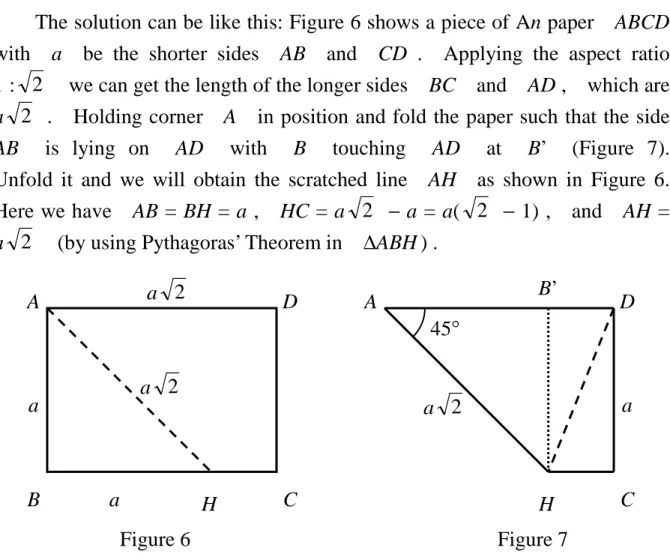
The solution can be like this: Figure 6 shows a piece of An paper ABCD with a be the shorter sides AB and CD . Applying the aspect ratio 1 : 2 we can get the length of the longer sides BC and AD , which are a 2 . Holding corner A in position and fold the paper such that the side AB is lying on AD with B touching AD at B’ (Figure 7).
Unfold it and we will obtain the scratched line AH as shown in Figure 6.
Here we have AB = BH = a , HC = a 2 − a = a( 2 − 1) , and AH = a 2 (by using Pythagoras’ Theorem in ∆ABH) .
Figure 6 Figure 7
Remarkably we have AH = AD here, but if we fold other types of rectangular papers in this way we will not get this result. This only happens
A
B C
D
H a
a
a 2
a 2 A
C D
H B’
a 2 a
45°
because of the unique aspect ratio for the An papers. Add a line DH (or by folding it to get a scratched line if we want to obey the only-folding rule), we get two isosceles triangles, namely ∆ABH and ∆AHD which satisfy the stated conditions.
The procedures are simple but again the students may not be able to figure out. The key step here is the application of Pythagoras’ Theorem. I emphasize that we need to start with the things that we have already known.
This is another example. Students would probably have no problem in letting a and a 2 be the sides of an An paper after they have learnt about the aspect ratio. In order to think of Pythagoras Theorem, they need to be sensitive to the number 2 which is indeed a direct consequence to the theorem. Condition 2 requires them to get an isosceles triangle with two sides equal to a , sounds not too bad; but condition 3 asks for an isosceles triangle with two sides equal to a 2 , students then need to think of a way to
‘generate’ another a 2 other than the one appears on the longer side of the An paper. When the students find the right direction, they will see that once they fold the paper along AH , the two required triangles will come out immediately with all 3 given conditions being satisfied at the same time.
This problem actually requires Form 2 mathematics only, but I guess Form 4 students should be more suitable to take up the challenge because the lower form students may not be mature enough to get the meaning behind the procedures. In that case the problem is wasted because the most important part to this question is not the mathematical steps but the inspiration it gives in handling geometry problems.
3. Conclusion
It is very interesting that the most commonly used ISO 216 (A series) paper format have so many mathematical features. You can always find something new if you give it a try. Paper folding is a fun way to learn geometry and I am looking forward to any new ideas suggested by other teachers.
In this article, I am not only talking about the mathematical contents but also trying to think of some ways to teach my students. Whenever I have solved a problem, I will think whether it is possible for my students to do that.
If not, what are they missing? How can I guide them on the right track? To conclude, the following ideas are important:
1. For every geometry problem, we should start with writing down all the given conditions in mathematical/graphical “language”. Especially in secondary school level all geometry problems are related to lines and shapes in 2D or 3D space, so this is a wise step for starting.
2. Attempts in finding alternative solutions are encouraged because by doing so students will have a deeper understanding of the problem, and if they get the same result by different ways they will have more confidence to the answer they have.
3. Always start solving the problem by considering the things you know.
I believe if every time the teacher needs to teach the students how to handle the problems step by step (i.e. the old-fashion method), they cannot learn too much. The new idea is to teach the students how to learn and explore the problems by themselves. This is the mission of modern teachers.
Reference
Geretschläger, R. (1995). Euclidean Constructions and Geometry of Origami.
Mathematics Magazine, 68(5), 351 – 371.
International Organization for Standardization. (2008, May 5). In Wikipedia, the free encyclopedia. Retrieved May 9, 2008, from http://en.wikipedia.org/wiki/International_
Organization_for_Standardization
ISO 216. (2008, April 22). In Wikipedia, the free encyclopedia. Retrieved May 9, 2008, from http://en.wikipedia.org/wiki/ISO_216
Kuhn, M. (2006). International standard paper sizes. Retrieved May 9, 2008, from http://www.cl.cam.ac.uk/~mgk25/iso-paper.html
Weisstein, E. W. (2008). Angle Trisection. In MathWorld - A Wolfram Web Resource.
Retrieved May 15, 2008, from http://mathworld.wolfram.com/AngleTrisection.html
Author’s e-mail: [email protected]