
國立臺灣大學工學院化學工程學系 碩士論文
Department of Chemical Engineering College of Engineering
National Taiwan University Master Thesis
己烷噻吩-己烷氧噻吩共聚物(P3HT-P3HOT) 之合成機制探討與性質鑑定
Synthesis, Characterization and Mechanism Investigation of Poly(3-hexylthiophene-co-3-hexyloxythiophene)
via Grignard Metathesis
吳俊慶 Chun-Ching Wu
指導教授:戴子安 博士 Advisor: Chi-An Dai, Ph.D.
中華民國 97 年 7 月 July, 2008
謝辭
兩年過去了,彷彿是一轉眼的事,首先我第一個要感謝的人就是我的指導教 授戴子安老師,老師不僅在實驗上給了我很多的建議與鼓勵,也讓我了解到對於 追求學術研究上應有的方法,永遠都要有追求真理的態度,感謝老師讓我了解到 如何讓一份研究從無到有,以及處理事情的方法,這兩年真是辛苦您了。
感謝口試委員—芮祥鵬老師、程耀毅老師、王立義老師、邱文英老師對於我 論文方面的指導,點出我沒注意到的細節與寫作邏輯的技巧,也給予我很多建議 與未來可行的工作,在此非常感謝。
在實驗生活方面,感謝惟哲學長的教導,使我在合成方面碰到的問題得以解 決;感謝鈞傑、宜桓學長對於我研究上的幫助,使我的論文更加多采多姿;感謝 昂志、安呈、世豪,這兩年我們互相扶持、互相交流,最後大家都一起順利的畢 業了。感謝學弟妹偉鈞、莉庭、世鈞、嘉鴻、伯盛的幫助,很多事情如果沒有你 們的幫助,我的實驗不會那麼順利。還有化工 206 的學長姐及同學們平常的照 顧,讓我在有時很枯燥的實驗中,還可以很開心的繼續努力,另外我們在實驗上 的經驗討論,使我節省了很多摸索實驗的時間,謝謝你們。
最後我要特別感謝我的女朋友黃莉雯,平常時對我的照顧,幫我整理家裡,
陪我聊天,讓我不寂寞,最後幾個月的那段時間,如果沒有你的打氣以及陪伴,
我一定會非常難熬的,我能完成這本論文有一半是你的功勞。另外我要謝謝我的 爸爸、媽媽,感謝你們這兩年對我的關心,雖然我們一個禮拜只見一次面,但我 每天都可以感受到你們對我的關心,以及無私的付出,我能有今天都是因為你們。
感謝大家的幫忙,讓我能在全台最高學府順利完成我的求學歷程,這一直是 我的夢想,如今終於實現,謝謝你們,我對你們每一個人都充滿了無限的感激。
吳俊慶 民國 97 年 7 月 17 日
中文摘要
用格林鈉反應(Grignard Reaction)原理為基礎,然後以鎳(Ni)的錯合物當作 觸媒合成出一系列同時具有烷基和烷氧基側鏈的噻吩共聚物(P3HT-P3HOT),接 著利用觸媒與分子量的關係實驗,發現共聚物由於受到了溶解度的影響,觸媒與 分子量的相關性只限於某個分子量之內,而過了此分子量之值後,減少觸媒的量 將再也不能提高共聚物的分子量。此外,我們也利用對於兩個單體不同的進料比 例與實際比例實驗中,發現不管在任何不同比例下,烷氧基的噻吩的實際比例皆 高於進料比例6~10%。後來再更進一步的實驗中,發現原來是因為烷氧基噻吩再 形成格林納反應中間物時,具有比較好的化學選擇性,可以在反應時產生較多的 可聚合中間物,而造成這個現象。最後我們利用了共聚合公式,將我們的實驗結 果回推我們的反應係數,得到r1為1.2,r2為0.8,r1r2的乘積為0.96,得到此反應 屬於一個高度隨機共聚合的行為(random copolymerization),而不是交互共聚合 (alternating copolymerization)或是塊狀共聚合(block copolymerization)。最後我們 將不同比例的烷機和烷氧基側鏈的噻吩共聚物(P3HT-P3HOT)進行紫外-可見光 光譜(UV-vis)、螢光光譜(PL)、熱裂解分析(TGA).循環伏安法(CV)、X光散射(XRD) 和元件測試,元件效率等一系列的光電性質以及熱性質測試,發覺當烷氧基側鏈 的噻吩在共聚物中比例增加時,光譜吸收會產生紅移的現象,再配合循環伏安法
的測試,發覺加入烷氧基側鏈的噻吩會使其最高填滿軌域(HOMO)上升,整體能 隙(band gap)下降,也了解到可以藉由控制烷氧基側鏈的噻吩在共聚物的內部比
例來控制其最高填滿軌域以及能隙。此外我們發現由於烷氧基較易被氧化的關 係,加入含烷氧基側鏈的噻吩會使熱穩定性變差,且經由X光散射的實驗發現加 入烷氧基側鏈的噻吩會使整體的結晶性下降,最後,我們將此材料應用於太陽能 電池中的活性層上面,發覺雖然降低能隙可以使原件吸收更多的光子,但由於最 高填滿軌域的上升,造成元件的開路電壓(Voc)下降而影響元件的效率。
關鍵字: 格林鈉反應、烷基、烷氧基、噻吩共聚物、隨機共聚合、低能隙共聚物、
推電子性質高分子
Abstract
Poly(3-hexylthiophene-co-3-hexyloxythiophene) (P3HT-P3HOT) was synthesized using Grignard reaction, and confirm the inert structure by H NMR. And we do a series of experiments about the relationship of catalyst and molecular weight to study the mechanism of copolymerization, due to the effect of solubility, we find that the copolymerization only obey the GRIM chain-growth phenomenon below certain molecular weight, after is number the molecular won’t grow up even you reduce the amount of catalyst. And we find the real ratio of 3-alkoxythiophene is always 6~10%
higher than feed ratio in different molar fraction of comonomer experiment. And we assume the phenomenon is because of the 3-alkoxythiophene has well degree of regiocontrol than 3-alkylthiophene. That is, 3-alkoxythiophene will form more react Grignard intermediate than 3-alkylthiophene. And we also use copolymerization equation and our result to calculate the monomer reactivity ratios r1 and r2, and r1 is equal to 1.2 and r2 is equal to 0.8, the multiple of r1 and r2 is equal to 0.96, indirectly prove the copolymerization is a random copolymerization rather than alternating or block copolymerization. We choose five different fraction of copolymers and detect in UV-vis, photoluminescenece(PL), cyclic voltammetry(CV), thermal gravimetric analysis(TGA), X-ray diffraction(XRD) and solar device. And when we add
alkoxythiophene into our copolymer, it will be red shift in optical absorption because of the electro-donation property of alkoxythiophene, and the highest occupied molecule orbital (HOMO) increase and the band gap decrease when we increase the mole fraction of alkoxythiophene, in other words, we can control the HOMO and the band gap by controlling the mole fraction of alkoxythiophene. In TGA test of thermal stability, because the alkoxy is more oxidize, the thermal stability become worse when we increase the mole fraction of alkoxythiophene, and also the crystallinity in the copolymers. Finally , we use the copolymers on the active layer of the organic solar cell, due to the reason of HOMO increasing, the Voc become smaller and lower the efficiency.
Keywords: Poly(3-hexylthiophene-co-3-hexyloxythiophene)、P3HT-P3HOT、Grignard reaction、random copolymer、alkoxy-substituted thiophene、low band gap copolymer.
Index
Chapter 1 General introduction ... 1
1.1 The origin of semiconducting behavior[6] ... 1
1.2 History and synthesis of Poly(alkyl-thiophene) ... 4
1.3 Configuration of Poly(alkyl-thiophene) ... 5
1.4 Mechanism of the Nickel-Initiated Grignard reaction ... 8
1.5 Photovoltatic properties of poly(3-alkyl thiophene) ... 10
1.6 Working principles of organic solar cell[6] ... 11
1.7 Solar cell performance of P3HT-PCBM bulk heterojunction system ... 14
1.8 Development on poly(3-alkoxythiophene) ... 16
1.9 Development on poly(alkoxythiophene-co-alkylthiophene ) ... 17
Chapter 2 Experimental Part ... 19
2.1 Experiment materials ... 19
2.2 Experiment instrument ... 20
2.3 Synthesis of 3-hexylthophene ... 21
2.4 Synthesis of 2,5-dibromo-3-hexylthiophene . ... 22
2.5 Synthesis of 3-hexyloxythiophene ... 23
2.6 Synthesis of 2,5-dibromo-3-hexyloxythiophene . ... 24
2.7 Synthesis of poly(-3-hexylthiophene)-co-poly (-3-hexyloxy thiophene) by the Grignard Metathesis method. ... 25
2.8 Experiment in the different feed ratio of 2,5,Br-3HOT and add the same molar ratio of catalyst. ... 26
2.9 Experiment of different molar ratio of catalyst in equal molar fraction of two monomers system (P3HT-P3HOT[5:5]) ... 27
2.10 Quenching result of Grignard metathesis reaction of 2,5,dibromo-3-hexylthiophene and 2,5,dibromo-3-hexyloxythiophene ... 28
Chapter 3 Result and discussion ... 30
3.1 Synthesis of 3-hexylthophene ... 30
3.2 Synthesis of 2,5-dibromo-3-hexylthiophene . ... 30
3.3 Synthesis of 3-hexyloxythiophene ... 31
3.4 Synthesis of 2,5-dibromo-3-hexyloxythiophene . ... 31
3.5 Experiment in the different feed ratio of 2,5,Br-3HOT and add the same molar ratio of catalyst. ... 31
3.6 Experiment of different molar ratio of catalyst in equal molar fraction of
two monomers system (P3HT-P3HOT[5:5]) ... 32
3.7 Quenching experiment of Grignard metathesis reaction of 2,5,dibromo-3-hexylthiophene and 2,5,dibromo-3-hexyloxythiophene .... 35
3.8 Adjustment of the ideal molecular calculation in P3HT-P3HOT[5:5] system based on the quenching experiments ... 36
3.9 Mechanism prediction of P3HT-P3HOT[5:5] system ... 37
3.10 Calculation of the reactivity ratio in 2,5,Br-3-HT and 2,5,Br-3- HOT copolymerization base on the copolymerization equation ... 38
3.11 Characteristic of five different molar fraction of P3HT-P3HOT ... 40
3.12 Appearance ... 40
3.13 UV-Visible Absorption of P3HT-P3HOT in different molar fraction ... 41
3.14 Electrochemical Characterization of P3HT-P3HOT in different molar fraction ... 42
3.15 X-ray diffraction (XRD) of P3HT-P3HOT in different molar fraction .... 44
3.16 Thermal analysis (TGA) ... 45
3.17 FT IR ... 46
3.18 Organic solar cell performance ... 47
Chapter4 Conclusion ... 48
Chapter5 Reference ... 50
Table index
Table2.1 Experiment in the different feed ratio of 2,5,Br-3HOT and add the same molar ratio of catalyst. ... 81 Table 2.2 Experiment of different molar ratio of catalyst in equal molar fraction of
two monomers system... 82 Table 3.1 Summary of five different molar fraction of 3-HT and 3-HOT experiment 83 Table 3.2 Summary of the different ratio of monomer to Ni(dppp)Cl2 experiment results in equal molar fraction of 3HT and 3HOT system(P3HT-P3HOT[5:5]) ... 84 Table 3.3 Photovoltaic and thermal properties of five different molar fraction of 3-HT
and 3-HOT copolymer ... 85 Table 3.4 X-ray diffraction 2θpositions and calculated d spacing of P3HT-P3HOT ... 86 Table 3.5 Summary of P3HT-P3HOT/PCBM bulk heterojunction solar cell
performance ... 87 Table 3.6 All experiments of the relationship between mole percentage and derived
Mn ... 88
Figure index
Figure 3.1 H NMR of 3-hexyl thiophene ... 53
Figure 3.2 H NMR of 2,5,dibromo-3-hexyl thiophene ... 54
Figure 3.3 H NMR of 3-hexyloxy thiophene ... 55
Figure 3.4 H NMR of 2,5,dibromo-3-hexyloxy thiophene ... 56
Figure 3.5 H NMR of poly(3-hexyl thiophene ... 57
Figure 3.6 H NMR of poly(3-hexyl thiophene)-co-poly(3-hexyloxy thiophene) Feed ratio: 7:3 ... 58
Figure 3.7 H NMR of poly(3-hexyl thiophene)-co-poly(3-hexyloxy thiophene) Feed ratio: 5:5 ... 59
Figure 3.8 H NMR of poly(3-hexyl thiophene)-co-poly(3-hexyloxy thiophene) Feed ratio: 3:7 ... 60
Figure 3.9 H NMR of poly(3-hexyloxy thiophene) ... 61
Figure 3.10 Different ratio of monomer to Ni(dppp)Cl2 results in equal molar of 3HT and 3HOT system(P3HT-P3HOT[5:5]) ... 62
Figure 3.11 Five GPC peak of different ratio of monomer to Ni(dppp)Cl2 results in equal molar of 3HT and 3HOT system(P3HT-P3HOT[5:5])... 63
Figure 3.12 The relationship of Mn and [monomer]/[Ni(dppp)Cl2] in different molar ratio of P3HT-P3HOT ... 64
Figure 3.13 Quenching result of Grignard metathesis reaction of 3-hexylthiophene .. 65
Figure 3.14 Quenching result of Grignard metathesis reaction of 3-hexyloxythiophene. ... 66
Figure 3.15 Different ratio of monomer to Ni(dppp)Cl2 results in equal molar of 3HT and 3HOT system(P3HT-P3HOT[5:5]) ... 67
Figure 3.16 Mechanism prediction of equal molar of 3-HT and 3-HOT copolymerization(P3HT-P3HOT[5:5] ... 68
Figure 3.17 The relationship between the molar fraction of 3-HOT in comonomer feed(f1) and the molar fraction of 3-HOT in copolymer(F1) ... 69
Figure 3.18 Outlook of five different molar fraction of P3HT-P3HOT, from left to right are (a)P3HOT, (b)P3HT-P3HOT[3:7], (c)P3HT-P3HOT[5:5], (d)P3HT-P3HOT[7:3], (e)P3HT respectively ... 70
Figure 3.19 UV-absorption of five copolymers in chloroform solution ... 71
Figure 3.20 UV-absorption of five copolymers in thin film state ... 72
Figure 3.21 X-ray diffraction patterns of five polymer films cast from chloroform solutions ... 73
Figure 3.22 (a) simulate arrangement inside P3HT ... 74 Figure 3.23 TGA curve of five polymer ... 75 Figure 3.24 Cyclic voltammograms diagram(CV) of five different molar fraction of
P3HT-P3HOT(A)P3HOT (B)P3HT-P3HOT[3:7] (C)P3HT-P3HOT[5:5]
(D)P3HT-P3HOT[7:3] (E)P3HT ... 76 Figure3.25 Energy-level diagram of five different molar fraction of P3HT-P3HOT .. 77 Figure 3.26 FT-IR of five different molar fraction of P3HT-P3HOT ... 78 Figure 3.27 The current-voltage characteristics of a P3HT-P3HOT/PCBM bulk
heterojunction solar cell ... 79 Figure 3.28 UV-vis of five different molar fraction of P3HT-P3HOT blend with
PCBM in equal mole ... 80
Chapter 1 General introduction
The conjugated polymer-based electronics has rapidly investigating wherever the advantages of low cost, flexibility and lightweight is desirable. In the recently, conjugated polymers have a lot of applications such as photovoltaic devices[1, 2], integrated electronic circuits based on field effect transistors[3, 4] and the polymer-based light emitting diodes. To fulfill the energy need in the future. Flexible and cheap polymer solar cells are considered as the most significant devices[5]. The best performing polymer solar cell was made by bulk heterojunction to an active layer, which is blend with each other and use spin coating method to form a thin film, was polymer/molecule blends thin film on active layer, in such active layer, photo generated electron-hole pairs, called exciton, are separated at the donar acceptor interface and the free charge carriers are collected by the respective electrodes.
And the free carriers are collected by respective electrodes. Bulk heterojunction films constructed from a glass substrate such as ITO are processed from solutions mainly through spin coating method, which is quite easy and cheap.
1.1 The origin of semiconducting behavior [6]
Since carbon atom (C-atom) is the main building block of most polymers, the type of bonds that its valence electrons make with other C-atoms or other elements
determines the overall electronic properties of the respective polymer. Polymers can, in general, be categorized as saturated and unsaturated based on the number and type of the carbon valence electrons involved in the chemical bonding between consecutive C-atoms along the main chain of the polymers. Saturated polymers are insulators since all the four valence electrons of C-atom are used up in covalent bonds, whereas most conductive polymers have unsaturated conjugated structure.
π-Conjugated polymers are excellent examples of unsaturated polymers whose electronic configuration from their alternate single and double carbon-carbon bonds.
The fundamental source of semiconducting property of conjugated polymers originates from the overlap of the molecular orbitals formed by the valence electrons of chemically bonded C-atoms. Two different hybridizations are shown in Fig2.1, the sp3 hybrids allow a strong degree of overlap in bond formation with another atom and this produces high bond strength and stability in the molecules. In most carbon compounds containing σ-bonds are sp3 hybrid orbital, which is saturated bond and high band gap and classified as insulator. And the sp2 hybridization has one unpaired electron (π-electron) per C-atom. The three sp2 hybrid orbitals of a C-atom arrange themselves in three-dimensional space to attain stable configuration. And the residue Pz orbital exhibit π-overlap, which resuls into a delocalization of an electron along along the polymer chain. Therefore, the π-bonds are considered as the basic source of
transport band in the conjugated systems[7, 8].
Ground state 2p3
2s3
2p3 2s3
Excited state Hybridized state(sp3 hybrides)
Ground state 2p3
2s3
2p3
2s3
Excited state Hybridized state(sp2 hybrides) unhybridized p orbital
Fig2.1 The hybridizations of the valence shell electrons of a carbon atom. The upper and lower panels show sp3 and sp2 hybridization, respectively[6].
Some polymers have semiconducting properties due to their unique structural behavior such as formation of alternating single and double bonds between the adjacent backbone carbon atoms. These conducting polymers are known as π-conjugated polymers. The semiconducting polymers have attracted considerable attention due to their wide range of applications. And a typically π-conjugated polymer poly(3-alkylthiophene)(P3ATS) had been discussed for several years due to its good performance in organic solar cell.
Poly(3-alkylthiophenes) belong to the most extensively studied conductive polymers in the past decade due to their solubility, which is rare in polyconjugated systems, and their interesting electrochemical and physical properties make a lot of tension recently
year. And we will have a simple introduce in P3AT about its history and some photovoltaic properties.
1.2 History and synthesis of Poly (alkyl-thiophene)
The study of polythiophene has intensified in 1980. The maturation of the field of conducting polymers was confirmed by the awarding of the 2000 Nobel Prize in Chemistry to Alan Heeger, Alan MacDiarmid, and Hideki Shirakawa “for the discovery and development of conductive polymers." The most notable property of these materials, electrical conductivity, results from the delocalization of electrons along the polymer backbone. But, conductivity is not the only interesting property resulting from electron delocalization. But the optical properties of these materials, with dramatic color shifts in response to changes in solvent, temperature, applied potential[9]. But the development was restricted in solubility, at 1985, Elsenbaumer developes a new polythiophene derivative Poly (3-alkylthiophene) (P3AT) which contains alkyl side chain to solve the problem of solubility. After that, a lot of relative research had been investigated, there are many way to synthesize P3AT, such as electrochemical polymerization(Sato1991) and oxidative polymerization by iron(III) chloride(Sugimoto 1986) had been reported in early time[10], and the configuration was regiorandom which the photovoltatic property will decrease, the regioregular
P3AT had been synthesized at 1993 by McCullough who used Grignard reaction and nickel complex(Ni(dppp)C12) to synthesis a highly head-to tail configuration P3AT, and another way to synthesis highly head-to-tail P3AT was reported by Rieke at 1995[11], who used highly reactive “Rieke zinc(Zn*)” to activate the monomer and nickel complex(Ni(dppp)Cl2) as a initiator, also synthesize a highly H-T regioregular P3AT up to 98%[10].
1.3 Configuration of Poly(alkyl-thiophene)
There are four possible configuration in P3AT: 1.head-to-tail head-to-tail(HT-HT) 2.head-to-tail head-to-head(HT-HH) 3.tail-to-tail head-to-tail(TT-HT) 4.tail-to-tail head-to-head(TT-HH), as shown in Figure2.2, and the real configuration inside the P3AT can be analysed by H NMR, there are different chemical shift on the proton of the thiophene ring(H1) andα-methylene-H of the side chain, as shown in Table2.1.
The best configuration for the photovoltatic property is HT-HT, due to the arrangement of alkyl side will be more regular than other three configurations, otherwise, the HT-HT configuration also help the arrangement of polymer backbone, and it will increase π-π stacking to form a coplanar structure. it can be proved by X-ray diffraction(XRD)[12], the morphology of HT-HT P3AT is lamellar[13] which appears more regularity than others. The 2-D lamellar structure with interlayer
spacing of H-T P3ATs[14]are shown in Fig2.4.
S R
S
R S
R
S R
S
R S R
S
S
R S
R R
S
S
R S
R R
HT-HT HT-HH
TT-HT TT-HH
Figure2.2 Four configuration of P3AT[10]
S
H CH2 CH2
R
n 1
α β
HT-HT TT-HT HT-HH TT-HH
H1 6.98 7 7.02 7.05
head-to tail head-to-head
α-methylene-H 2.8 2.58
β-methylene-H 1.72 1.63
Table2.1 H NMR Chemistry Shift (ppm) of 'H in Different Regiostmctures[15]
Figure 2.3 NMR spectra of(a)HT-P3AT and(b)regiorandom P3AT[15]
Figure2.4 2-D lamellar structure with interlayer spacing of H-T P3ATs[15]
1.4 Mechanism of the Nickel-Initiated Grignard reaction
Figure 2.5 Proposed Mechanism for the Nickel-Initiated Cross-Coupling Polymerization[16]
The chain growth mechanism had been discussed extensively in recently years, at 2004, Mccullough report an credible mechanism on Macromolecules, and also proved it by a lot of experiments, the assumption is shown in Fig2.5. First of all, 2,5,dibromo-3-hexlythiophene react with Grignard regent(RMgX) to form 2-bromo-5-bromomagneisium-3-hexylthiophene, and two 2-bromo-5-bromo magnesium-3-hexylthiophene react with Ni(dppp)Cl2 to yield a new organonickel compound, then reductive elimination occurs, the organonickel compound transfer to an associated pair quickly, which is consist of the tail-to-tail aryl halide dimmer and nickel(0). The dimmer undergoes fast oxidative addition to nickel center generating
nickel complex which on the terminal C-Br bond react with a new monomer to form a organonickel compound, and the reductive elimination occurs quickly and the next following steps are the same as before, growth of the polymer chain occurs by insertion of one monomer at a time in the reaction cycle.
After a lot of experiment, they defined Grignard mothod as a living nature polymerization, and also found that the molecular weight of polymer can be predicted by the molar ratio of monomer to Ni(dppp)Cl2, which means that 1mol of Ni(dppp)Cl2 initiates one polymer chain. Therefore, the polydispersity index(PDI) is quite narrow[16]
Figure 2.6 Mechanism of Chain-Growth Polymerization[17]
In 2005, Mccullough had another report “Catalyst-Transfer Polycondensation.
Mechanism of Ni-Catalyzed Chain-Growth Polymerization Leading to Well-Defined Poly(3-hexylthiophene)”, which is published on JACS. They use matrix-assisted laser desorption ionization time-of-flight (MALDI-TOF) mass spectrometry to prove all
polymer have the same end qroup with one bromine atom and one hydrogen atom, and the hydrogen end qroup is generated from nickel complex upon quenching, based on the result and another experiments, they propose the Grignard reaction as a new mechanism of chain-growth polycondensation. First of all, Ni(0) generated by the formation of the bithiophene, then Ni(0) transferred from intramolecule to the C-Br bond of the bithiophene. And growth continues with the coupling reaction followed by the transfer of Ni(0) to the terminal C-Br bond. The scheme is shown in Fig2.6[18]
1.5 Photovoltatic properties of poly (3-alkyl thiophene)
The conjugation length is defined as the distance that charge can delocolize. Longer conjugation length in polymer backbone results in small energy gap. And the HT-P3ATs had a larger adsorption λmax than that of reiorandom P3ATs, the HT P3HT had a λmax in 456nm, and regiorandom in 427nm, a 29nm red-shift as shown in Fig 2.7, due to the arrangement of HT-P3AT is more regular, the packing between polymer chain will be more close, increasing the π-π interaction and low theπ-π transition energy, this phenomenon is favor for charge transition and decrease the band gap.
Figure 2.7. UV-vis and fluorescence spectra of (a) regioregular HT-P3HT and (b) regiorandom P3HT of CHC13 solution. ( ):UV-vis; (- - -): fluorescence[15].
1.6 Working principles of organic solar cell[6]
Organic solar cell is activated by shining light to produce excitons. But excitons have a binging energy of several tenths of electron volts. And the diffusion length of an exciton is quite low in most conducting polymers. This makes solar cell to charge generation more difficult as it leads to a lot of recombination within the bulk of the active layer. To improve this bad phenomenon in polymer solar cell, the most efficient improved way was blend some electron acceptor molecules with bulk heterojunction mothod[18]. The bulk heterojunction of donar/acceptor blend which are suitable for efficient exciton dissociation. At donar/acceptor interfaces, the driving force for
exciton dissociation is generated by the electrochemical potential difference between the LUMO of the donor and the LUMO of the acceptor. The electrodes collect the photogenerated free carriers; the anode collects holes and the cathode collects the electrons, and we can separate this mechanism into four steps, which are 1.exciton creation. 2. exciton migration. 3. exciton dissociation 4.free charge carrier transfer, as shown in Figure 2.8.
Figure 2.8 The simplified four basic steps of photocurrent generation in bulk heterojunction based solar cells.[6]
The typical I-V curve is shown in Figure2.9, which is measured under full sun illumination immediately gives several photovoltaic parameters including Voc, short-circuit current density (Jsc), fill-factor (FF), and overall power conversion
efficiency (η). Each of these parameters is shortly described in this section. The spectral response of a solar cell is also defined.
(a) The open-circuit voltage (Voc) of a solar cell under light is defined as a voltage at which the net current in the cell is equal to zero. In a well behaving device, the current measured in the dark and under illumination conditions should be the same when the voltage is exceeding the Voc, so the Voc corresponds to the net internal electric field of the device.
(b) The short-circuit current (Jsc) is the photogenerated current of a solar cell, which is extracted at zero applied voltage. Photocurrent is directly related to optical and electrical material properties. As observed from Figure 3.3, in the region of the voltage between 0 to Voc, the current is dominated by a photo-generated current.
(c) The fill factor (FF) of a solar cell is the measure of the power that can be extracted from the cell and is defined as
FF = JscVoc (JV)max
where the (JV)max represents the maximum power that can be extracted from the cell.
In Figure2.8, the (JV) max is defined by the area of the filled rectangle. The shape of the I-V curve is a measure of the FF; rectangular shapes is the best shape for high efficiency solar cell.
(d) The power conversion efficiency (η) is simply the ultimate measure of the device
efficiency in converting photons to electrons, which is defined as
fin Jsc Voc Efficiency = FF
where in f in accounts for the flux of light incident on the solar cell.
Figure 2.9 Typical current-voltage characteristics of a polymer/acceptor based solar cell. Which is measured in the dark and under white light illumination[6]
1.7 Solar cell performance of P3HT-PCBM bulk heterojunction system
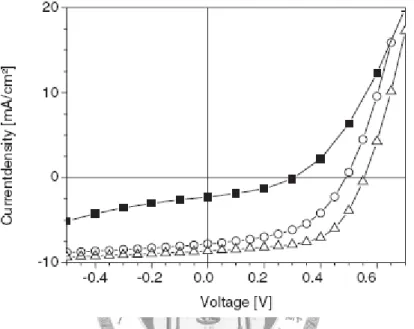
P3HT-PCBM system have been report in 2003, Niyazi S.Sariciftci reported the I-V behavior of P3HT-PCBM has Voc~300mV, Jsc of ~2.5 mA cm-2 and a calculated filling factor of 0.4 and the overall efficiency for this soalr cell is therefore 0.4%. But if solar cell heated to 75℃ for 4min and the Voc rises to 500mV, and Jsc increase to 7.5 mA cm-2 and filling factor has a value of 0.57, the overall efficiency rises to 2.5%, they proved thermal annealing is useful in these system, and they also make another
solar cell heated to 75℃ plus an external voltage about 2.7V, and the Voc had a value 550 mV, a Jsc of 8.5mA cm-2 ,a FF of 0.6 and efficiency of 3.5%. it prove that an addition of external voltage when annealed the solar cell will give rise to the efficiency[19]. The I-V curve are shown in Figure 2.10
Figure 2.10 I-V curves of P3HT-PCBM solar cell under illumination with white light at an irradiation of 800 W m-2, as-produced solar cell(filled squares), anneal cell(open circles), and cell simultaneously treated by annealing and applying an external electric field(open triangles)[19]
In 2007, Alan J. Heeger reported a breakthrough invention called “Tandem cell”[20], which combined with two linked solar cells with different absorption region. The tandem cell was fabricated by the front cell and back cell with were processed from solution. And the active layers of the back and front cell are PCPDTBT-PCBM and P3HT-P70CBM respectively (PCPDTBT is a kind of low band gap polymer).
Furthermore, a transparent titanium oxide (TiOx) layer separates and connects the
front cell and the back cell. The TiOx layer serves as an electron transport and collecting layer for the first cell and as a stable foundation that enables the fabrication of the second cell to complete the tandem cell architecture. and tandem cell had a performance in Voc~1.24V, Jsc of 7.8 mA cm-2, FF of 0.67 and the overall efficiency is up to 6.5%.which was an extensively high efficiency than before[20].
1.8 Development on poly(3-alkoxythiophene)
Polythiophenes with substitutes other than alkyl groups have also been investigated[21, 22], among which those with electron-donating alkoxy groups have displayed promising electrical and optical properties, at 1991, M. Leclerc had synthesized a series of alkoxy-substituted polythiophene such as poly(3-butoxythiophene(PBT) by chemical polymerization using iron(III) chloride as oxidizing agent[23], but the polymers were regioirregular oligomers with low molecular weight. He also found PBT had a good electrical transport property, and a relatively low oxidation potential (0.60-0.64V). also another research on alkoxy-substituted thiophene at 2000 was reported by Xiao Hu[24]. They found chemical polymerization of 3-alkoxythiophene by oxdative polymerization (FeCl3) under lower temperature and controlled addition of monomer helps to obtain polymers with relatively higher molecular weight. They also had a comparison with different length of alkoxy group to their thermal properties and the crystallinity. They
found alkoxy-substitued thiophene was worse than alkyl-substituted thiohene in thermal stability and crystallinity. In 2005, McCullough report a new synthesize method on alkoxy-substituted polythiophene rather than origin oxidative polymerization[25]. He use GRIM method to get a larger molecular weight and regioregular polymers such as Poly(3-hexyloxythiopehne) (P3HOT) according to its mechanism[26], which Mn=7.2k, PDI=1.7 in P3HOT, the breakthrough of GRIM method-synthesized P3HOT is the intensively increment of molecular weight (2k to 7k)compare to the origin P3HOT synthesized by oxidative polymerization, and the highly head-to-tail arrangement, due to good ptotovoltaic property by the alkoxy side chian electron-donating effect, but bad solubility in organic solvent. Some research about alkoxy-substitued thiophene and alkyl-substituted thiophene copolymer had been discussed.
1.9 Development on poly (alkoxythiophene-co-alkylthiophene )
In 2006, Yang Yang and Qibing Pei report a random copolymer consist of alkyl and alkoxy side chain thiophene Poly(3-octylthiophene-co-3-decyloxythiophene) (POT-co-DOT)[27], they had synthesized poly(3-decyloxythiophene) (P3DOT) with molecular weight(Mn) 10.7k and polydispersity index(PDI) 1.48 and POT-co-DOT with Mw 14.5k and PDI 1.75,which is slightly larger P3DOT, and the solubility of
POT-co-DOT is also larger than P3DOT. they also verified by H NMR that the alkoxy-substituted thiophene is more reactive than alkyl-substituted thiophene during GRIM copolymerization. And a lot of photovoltaic properties detection, they detected that P3DOT soluted in chloroform have a maximum adsorption in 565nm and POT-co-DOT in 538nm, which a lot blue shifted when copolymer contains alkyl side chian. And verified the exact position of HOMO and LUMO by cyclic voltammetry, they find HOMO of P3DOT locate at -4.47eV and POT-co-DOT at -4.55eV, which is effected by addition of alkyl-side chain group. And they also make solar cell device, but the efficiency of solar cell is bad. Therefore, combine all of result in these area, we think the alkoxy-substituted thiophene combine alkyl-substituted thiophene copolymer still need to be deeply discussed, also a lot of characterization need to be built. So we decide to discuss this region and do some experiments to know more about it.
Chapter 2 Experimental Part
2.1 experiment materials
All procedures involving air-sensitive reagents were carried out under an atmosphere of high purity argon. All starting organic compounds were purchased from Acros, Sigma- Aldrich and used without further purification. THF and DMF were dried before use by sodium and CaH2, respectively. Column chromatography was performed on silica gel (230-400 mesh ASTM, Merck silica gel).
1. Ether, anhydrous, stabilized, ACS reagent (Acros, UK)
2. Tetrahydrofuran, 99+%, pure, stabilized with BHT (Merck, USA) 3. Methanol, 99+%, pure (Acros, UK)
4. Hexane,95+%, pure (Acros, UK)
5. Magnesium, turnings 99.9+% (Acros, UK) 6. 1-Bromohexane, 99+% (Acros, UK) 7. Ni(dppp)Cl2, 99% (Acros, UK)
8. NBS(N-Bromosuccinimide), 99% (Acros, UK)
9. Cyclohexyl magnesium chloride, 1.3M in THF (Acros, UK) 10. Copper(I) bromide, 98% extra pure (Acros,UK)
11. Ammonium chloride, 99.5%, extra pure (Acros, UK)
12. 1-Hexanol alcohol, 98% (Acros, UK)
13. CaH2, 0-2 mm grain size ca. 93% (Acros, UK) 14. Diiodomethane, 99+%, stabilized (Acros, UK) 15. 3-Bromothiophene, 97% (Acros, UK)
16. Chlorotrimethylsailain, 98% (Acros) 17. Chloroform, 99+%, pure (Acros, UK) 18. Sodium hydride, dry, 95% (Aldrich)
19. N,N-Dimethylformamide(DMF),99.8+% (Acros, UK)
2.2 Experiment instrument
Instrument name Instrument model Company/
Origin country
Nuclear magnetic resonance(NMR)
AVANCE 400 (400MHz) BURKER/USA
Fourier transform infrared spectroscopy (FT-IR)
Excalibur series FTS
3000 VARIAN/USA
UV-vis spectroscopy (UV)
Jasco V-570 JASCO/UK
Photoluminescence (PL)
Jasco FP-6300 JASCO/UK
Thermal Gravimetric Analysis (TGA)
PYRIS 1 Perkin-Elmer/U SA
Gel Permeation Chromatogrpahy (GPC)
Waters 2695 Waters/USA
Cyclic Voltammetry (CV)
CHI instrument CHI/USA
ROTA VAPOR ROTAVAPOR R-114 BUCHI/Sweden
2.3 Synthesis of 3-hexylthophene
C6H13Br Mg/ether
C6H13MgBr 1hr
S Br
S
C6H13
Synthesis of 3-hexylthiophene(Zimmer 1986)
Ni(dppp)Cl2 2
Magnesium was add in a two-neck round bottom flask and charged with anhydrous ether, then 1-bromohexane was added dropwise into the flask via syringe and react for 1hr,after reaction, the mixture was purged into a new flask with 3-bromothiophene and Ni(dppp)Cl2 inside and react for 1day,after reaction, the flask was poured into water and stirred for 10min, the organic phase was extracted with ether and the aqueous phase was extracted with 1M NaCl solution, then dried over anhydrous
magnesium sulfate(MgSO4), After the product was filtered, the solvent was removed by rotary evaporation. The crude product was purified by reduced pressure distillation (65-70oC (0.28 Torr)), the final product was a colorless oil.
2.4synthesis of 2,5-dibromo-3-hexylthiophene .
S
C6H13
NBS THF 2HR
Br S Br
C6H13
Synthesis of 2,5-Dibromo-3-hexylthiophene (McCullough 1999)
A three-neck round bottom flask was flushed with nitrogenand charged with distilled 3-hexylthiophene and anhydrous THF, then the anhydrous n-bromo succinimide(NBS) was added and react for 1day, after 1 day, the solution change from light yellow to orange . The solvent was removed by rotary evaporation. The resulting residue was washed with hexanes, filtered, and purified using column chromatography on silica gel with hexanes as the eluent . The product was dried over anhydrous MgSO4, After filtration, the solvent was removed by rotary evaporation. The product was purified under reduced pressure distillation(145 ,0.021torr)℃ , finally we got a light yellow oil, the product was flushed with N2 and stored in a dark cool place (~ 0 oC).
2.5 Synthesis of 3-hexyloxythiophene
HO + NaH DMF NaO + H2
ice bath
Synthesis of 3-hexyloxythiophene (McCullough2005)
S
OC6H13
S Br
Na O
CuBr,1hr +
110 oC
A three-neck round bottom flask equipped with a condenser and a funnel, which was flushed with nitrogen and NaH (gray powder) was added into the flask, then anhydrous DMF was added via syringe. The reaction flask was cooled down to 0oC, then anhydrous 1-hexanol (0.48mol) was added dropwise via syringe over a 30 minute time period. The solution was stirred for 1.5 hour to assure complete consumption of NaH, while the temperature was maintained at 0
oC,3-bromothiophene (16.3 g, 0.10 mol) and CuBr (1.44 g, 0.01 mol) were added quickly into the flask, and the ice bath was replaced with oil bath and heated up to about 110 oC. After 30 minutes, an equimolar amount of CuBr was added and the reaction was allowed to proceed for an additional 30 minutes to ensure the reaction was completed. The flask was then poured into a 1 M aqueous solution of NH4Cl
(100mL) and stirred for 10 minutes. The organic phase was extracted with hexanes and dried over anhydrous magnesium sulfate (MgSO4). After the product was filtered, the solvent was removed by rotary evaporation. The crude product was purified by reduced pressure distillation (60-70 oC (1Torr)), and then used column chromatography on silica gel with hexanes to remove the residual radical, the final product was a colorless oil.
2.6synthesis of 2,5-dibromo-3-hexyloxythiophene .
S
OC6H13
NBS,2hrs -78OC 0OC
S
OC6H13
Br Br
Synthesis of 2,5-Dibromo-3-hexylthiophene (McCullough2005)
A three-neck round bottom flask was flushed with nitrogenand charged with distilled 3-hexyloxythiophene and anhydrous THF. The reaction flask was cooled down to –78
oC to stabilized the reaction, the anhydrous n-bromo succinimide (NBS) was added.
The reaction mixture was stirred for 30 minutes at –78 oC. The ice bath was removed and the reaction was allowed to slowly warm up to ambient temperature. The reaction was stopped in two hours, after which the solution became dark green. The solvent
was removed by rotary evaporation. The resulting residue was washed with hexanes, filtered, and purified using column chromatography on silica gel with hexanes as the eluent . The product was dried over anhydrous MgSO4, The solution had a distinct color change from a yellow color to almost colorless. After filtration, the solvent was removed by rotary evaporation. The compound was dried under vacuum, finally an yellow color oil was left, the flask was flushed with N2 and stored in a dark cool place (~ 0 oC).
2.7 Synthesis of poly(-3-hexylthiophene)-co-poly (-3-hexyloxy thiophene) by the Grignard Metathesis method.
S
Br Br
C6H13
+
S
Br Br
OC6H13
RMgBr reflux/THF/1.5h
S
BrMg Br
C6H13
S
BrMg Br
OC6H13
+
Ni(dppp)Cl2
S C6H13
S
OC6H13
a b n
Synthesis of poly(-3-hexylthiophene)-co-poly (-3-hexyloxythiophene) 70oC
A three-neck round bottom flask equipped with a condenser and a funnel was flushed with N2 and charged with dirrerent fraction of 2,5-dibromo-3-hexyloxythiophene and 2,5-dibromo-3-hexylthiophene. Anhydrous THF and cyclohexylmagnesium chloride
were added to the flask via syringe. The reaction mixture was allowed to stir for 120 minutes at gentle reflux(~75oC),then Ni(dppp)Cl2 was added into the funnel first and previously dissolved by some anhydrous THF. Then the mixture was flushed into the flask as fast as possible, the polymerization was allowed to proceed for 30mins at gentle reflux. Then, the reaction mixture cool down to ambient conditions and precipitated into a mixture of methanol (CH3OH). The polymers were filtered, purified by Soxhlet extraction in sequence with hexanes, CH3OH, and CHCl3. Chloroform was removed under reduced pressure and the residues were dried under vacuum.the final product was a dark red powders or a golden chips depend on your procedure. The polymers were stored under inert atmosphere.
2.8 Experiment in the different feed ratio of 2,5-Br-3HOT and add the same molar ratio of catalyst.
First, we did five different molar feed fraction of 2,5,Br-3-HT and 2,5,Br-3-HOT but with the same molar ratio of catalyst, according to the chain growth mechanism of Grignard reaction, the molecular should be the same no matter which kind of monomer is or what molar fraction in a comonomer system polymerization is, therefore, we did five different fraction of 2,5,Br-3-HT and 2,5,Br-3-HOT copolymerization, which are 100%, 70%, 50%, 30%, 0% in 2,5,Br-3-HOT feed ratio
and all reaction is added 0.2mol% of catalyst, and the other condition are all the same, the detail condition are shown in Table2.1
2.9 Experiment of different molar ratio of catalyst in equal molar fraction of two monomers system (P3HT-P3HOT[5:5])
Molecule weight was an significance property of polymer, it could effect many properties to polymer, based on the mechanism of P3HT, we expect P3HT-P3HOT had similar result with homo-P3HT, so we changed the catalyst/monomer ratio from 0.2mol%, 0.5mol%, 0.7mol%, 1.0mol% to 1.2mol% to see the change of molecule weight, also anything change in other properties, the reaction condition are shown in Table2.2
2.10 Quenching result of Grignard metathesis reaction of 2,5,dibromo -3-hexylthiophene and 2,5,dibromo-3-hexyloxythiophene
S
Br Br
R-MgBr C6H13
S
Br MgBr
C6H13
S
Si Br
C6H13
+
S
Br Si
C6H13 TMS-Cl
-40oC
THF,reflux,1h
Quenching experiment of Grignard metathesis reaction of 3-hexylthiophene.
S
Br Br
R-MgBr OC6H13
S
Br MgBr
OC6H13
S
Si Br
OC6H13
+
S
Br Si
OC6H13 TMS-Cl
-40oC
THF,reflux,1h
Quenching experiment of Grignard metathesis reaction of 3-hexyloxythiophene
In Grignard reaction of 2,5,Br-3-hexylthiophene, both 2-bromomagnesio-3-hexyl-5- bromothiophene and 2-bromo-3-hexyl-5-bromomagnesio thiophene are formed. But the catalyst only reacts with 2-bromo-3-hexyl-5-bromomagnesiothiophene due to steric hindrance. To test this hypothesis, McCullough did a quenching experiment of
Grignard metathesis reaction by 2,5,dibromo-3-hexylthiophene[28], and they found the Grignard exchange occurs with a large degree of regiocontrol (80:20 distribution of isomers, regardless of the Grignard reagent employed). Since the result could effect the molar fraction in P3HT-P3HOT copolymerization. We decide to do the same experiment on 2,5,dibromo-3-hexyloxythiophene, also on 2,5,dibromo-3-hexyl thiophene to double check the result
A three-neck round bottom flask equipped with a condenser and a funnel was flushed with N2 and charged with 2,5-dibromo-3-hexyloxythiophene and 2,5-dibromo-3- hexylthiophene respectively. Anhydrous THF and cyclohexylmagnesium chloride were added to the flask via syringe. The reaction mixture was allowed to stir for 90 minutes at gentle reflux(~75oC), the quenched with trimethylsilyl chloride(TMS-Cl) at -40℃ for 120mins. And we use the chemical shift of the proton on the thiophene ring to calculate the result.
Chapter 3 Result and discussion
3.1Synthesis of 3-hexylthophene
The product is a colorless oil, and the yield is about 65% to 70%, The 1H NMR of 3-hexyl thiophene shown in Figure3.1. the product has six peaks at 0.88ppm(f);
1.25ppm(e);1.61ppm(d);2.61ppm(c) ; 6.91ppm(b);7.21ppm(a) ,and the proportion of the integral area in each peak is accord with the theoretically number except peak(a) and (b), this phenomenon is caused by the byproduct C12H26, this byproduct forms in the reactions and also distillated with our product, but we can’t separate them because two boiling points are too close, but we can separate it in the next step, so it is acceptable to do the next reaction
3.2synthesis of 2,5-dibromo-3-hexylthiophene .
The product is an yellow oil and has a good yield(>90%), in Fig4.4, we can see peak 7.21ppm disappear compare with Fig3.2, that means the reaction is success, and the proportion of peak 0.88ppm(e) and 1.25ppm(d) are accord with the throry number, the byproduct C12H26 is removed because the different boiling point between 2,5-dibromo-3-hexyl thiophene and C12H26, the product is flushed with N2 and stored in a dark cool place (~ 0 oC).
3.3Synthesis of 3-hexyloxythiophene
The product is a colorless oil, and the yield is about 60% to 65%, the crude will accompanied some reactant 1-hexanol and be found a unique peak 3.69ppm, this reactant can be eliminated by column chromatography on silica gel with hexanes as the eluent, 1-hexanol will be stock on the top of the gel and removed, The 1H NMR of 3-hexyloxythiophene shown in Figure3.3 has seven peaks at 0.93ppm(f) 1.47ppm(g) 1.47ppm(f);1.79ppm(e);3.95ppm(d);6.23ppm(c) ; 6.76ppm(b);7.25ppm(a), and the proportion of the integral area in each peak is accord with the theoretically number, the product is flushed with N2 and stored in a dark cool place (~ 0 oC).
3.4 synthesis of 2,5-dibromo-3-hexyloxythiophene .
The product is an yellow oil and has a good yield(>90%), in Fig3.4, we can see peak 7.25ppm and 6.23ppm disappear compared with Fig4.6, that means the reaction is success, it is unstable at bright place, so the product needs to be flushed with N2 and stored in a dark cool place (~ 0 oC).
3.5Experiment in the different feed ratio of 2,5,Br-3HOT and add the same molar ratio of catalyst.
The results are summarized in Table3.1. First of all, we detect the real ratio of 3-HOT in copolymer by H NMR. The H NMR of each copolymer shows one sharp peak at
4.16ppm, which is for the –OCH2- group, and one at 2.79ppm for the –CH2- group, on the basis of the relative areas of the peaks at 4.16ppm and 2.79ppm[27], the mole fraction of 3-hexyloxythiophene(3-HOT) and 3-hexylthiophene(3-HT) units in P3HT-P3HOT can be estimated. The H NMR of five copolymers is shown in Fig 3.5, Fig3.6, Fig3.7, Fig3.8 and Fig3.9. We find the molar fraction of 3-HOT in copolymer is a little higher (6%~10%) than the molar fraction of comonomers no matter what fraction of 3-HOT is. Then we detect the molecular weight by GPC with Polystyrene as the standard. Surprisingly, the result of the molecular weight is totally different to the expected number, and the molecular weight decrease when molar fraction of 3-HOT increase in feed ratio. The number-average molecular weight (Mn) decrease from 40k to 6k when the mole fraction of 3-HOT increase. If reaction followed the GRIM chain growth polymerization, the molecular should be the same no matter what molar fraction of 3-HOT is. Therefore, we decide to discuss the copolymer mechanism synthesized by GRIM method.
3.6 Experiment of different molar ratio of catalyst in equal molar fraction of two monomers system (P3HT-P3HOT[5:5])
It is known that the mechanism of poly(3-hexylthiophene) had been proved to be a catalyst-transfer polycondensation[26], also considered as nickel-catalyzed
Chain-Growth Polymerization, that is, one Ni catalyst molecule forms one polymer chain. But the result is quite different at P3HT-P3HOT copolymer system, so we decide to study on the relationship between catalyst and molecular weight in 3-HT and 3-HOT system. We did a series of experiments on equal molar ratio of 3-HT and 3-HOT which added 1.2mol%, 1.0mol%, 0.7mol%, 0.5mol% and 0.2mol% of nickel catalyst. And the results are shown in Table3.2, and we plot the relationship of Mn and mol% of Ni-catalyst, which is shown in Fig3.10. According to Fig3.10, We find the increment of molecular weight is basically following the GRIM mechanism (Ni-catalyzed chain-growth polymerization) when the number-average molecular weight (Mn) is low than 23k, and a little smaller than predicted molecular weight. The reason for the phenomenon might be caused by two isomers formed during the GRIM reaction. (Both 2-bromomagnesio-3-alkyl-5-bromo thiophene and 2-bromo-3-alkyl-5-bromomagnesiothiophene are formed). Also, due to the selectivity of the Ni(dppp)Cl2, 2-bromomagnesio-3-alkyl-5-bromothiophene is almost unreact by the effect of steric hindrance. Therefore, a part of reactant can’t be reacted and the molecular weight will be lower than prediction, we will have more detail explanation in GRIM quenching experiment. After 23k, the molecular weight didn’t increasing when the molar ratio of Ni(dppp)Cl2 become lower. And we find the reason of this phenomenon might be caused from the solubility of the copolymer according to the
GPC diagram, which is shown in Fig 3.11. The curve of the peak becomes different when molecule weight reaches higher molecular weight. And the slope of curve at left part, which means higher molecule weight part in one polymerization, becomes steeper than those curve at lower molecule weight, it means these higher molecular polymers might be limited by the solubility and stop growing. Base on these results, we can define two regions in 3HT-3HOT copolymer system. One region call
“GRIM-obeyed region”, the other call ”solubility –limited region”, In GRIM-obeyed region, the copolymerization follow the Ni-transfer chain-growth mechanism. And the molecular weight can almost be predicted if we know the fraction of unreact reactants.
At the solubility-limited region, molecule weight are almost the same caused by factor of the solubility, and the real molecular weight is a lot of different with the predicted number, in this region, the molecular will almost be the same no matter what mole fraction of catalyst we added. Figure3.12 is draw by all experiments of the relationship between the mole percentage of catalyst and the derived Mn at Table3.6.
We can realize the GRIM-obeyed region becomes smaller and the solubility limited region becomes larger when alkoxy group increase, This is a obvious evidence that the copolymerization is affected by the solubility. Base on these conclusions, we can explain the weird result in the before-mentioned experiment of different feed ratio of 2,5,Br-3HOT with the same molar ratio of catalyst (0.2mol%). Because every
copolymerization is located on the “solubility-limited region”, the molecular weight can’t be predicted by GRIM mothod. Therefore, the alkoxy-side chain thiophene will decrease the solubility and limit the larger molecule formed.
3.7 Quenching experiment of Grignard metathesis reaction of
2,5,dibromo-3-hexylthiophene and 2,5,dibromo-3-hexyloxythiophene
The H NMR of 2,5,Br-3HT quenching result is shown in Fig3.13. Basically, there should be two product form during quenching reaction, which are 2-TMS-5-bromo-3-hexyl thiophene (6.86ppm) and 2-bromo-5-TMS-3-hexyl thiophene (6.78ppm) respectively, but we find that there is still another product form, which are 5-bromo-3-hexyl thiophene (6.799ppm) and 2-bromo3-hexyl thiophene (6.875ppm). We guess the result was effected by reactant TMS-Cl. TMS-Cl has good volatility and it may volatilize during the reaction, but we only add equal molar of TMS-Cl compared with 2,5,Br-3HT. Therefore, some Grignard reagent did’t react with the TMS-Cl and finally react with water and form 2-bromo-3-hexyl thiophene (6.875ppm) and 5-bromo-3-hexyl thiophene(6.799ppm), but base on the theory of GRIM theory[29]. Due to the only bromide end group doesn’t react with water, we still can figure out that the 5-bromo-3-hexyl thiophene is formed by 2-bromomagnesio-3- hexyl-5-bromothiophene, and 2-bromo-3-hexyl thiophene isformed by 2-bromo -3-hexyl-5-bromomagnesio thiophene. Base on the theory, we can calculate the fraction by the integral of the proton area. We find 5% of 2,5-dibromo-3-hexyl thiophene(6.768ppm) doesn’t react, 76% reactants form 2-bromomagnesio-3-hexyl- 5-bromothiophene and 19% reactant form 2-bromo-3-hexyl-5-bromomegnesio thiophene. And this result is very similar to the result of McCullough reported at 1999[28]. and the result of 2,5,Br-3HOT is shown in Fig3.14, the H NMR shows 5% of 2,5-dibromo-3-hexyloxythiophene(6.750ppm) doesn’t react, 89% reactants form 2-bromomagnesio-3-hexyl-5-bromothiophene (6.736ppm) and 6% reactant form 2-bromo-3-hexyl-5-bromomegnesiothiophene. And we get important information from these. The regiocontrol of alkoxythiophene(94:6) is better than alkyl thiophene(80:20) in Grignard methathesis. In other, the useful intermediate of 2,5,Br-3-HOT is more than 2,5,Br-3-HOT during equi-molar fraction feed ratio copolymerization.
3.8 Adjustment of the ideal molecular calculation in P3HT-P3HOT[5:5] system based on the quenching experiments
According to the results of quenching experiments, we know 5% unreact reactant and 19% unreact Grignard methathesis in the 2,5-dibromo-3-hexylthiophene system, and 5% unreact reactant and 6% unreact Grignard metathesis in 2,5-dibromo-3-hexyloxy
thiophene system, which means 17% of reactant doesn’t react in the P3HT-P3HOT [5:5] copolymerization. Therefore, we build another ideal molecular curve which reduce the unreact material, as shown in Fig3.15. And we can see the ideal molecular weight is more close to the real molecular weight, also intensify the chain growth properties of P3HT-P3HOT[5:5] system which is the same with the mechanism of P3HT.
3.9 Mechanism prediction of P3HT-P3HOT[5:5] system
Base on a series of experiments. We make an assumption on P3HT-P3HOT[5:5]
system, the scheme are shown in Fig3.16. first ,equal molar fraction of 2,5,Br-3-HT and 2,5,Br-3-HOT both are added to the flask, during the Grignard metathesis intermediate reaction, 44.5% of 2,5,Br-3-HOT become 2-Br-5-MgBr-3HOT and 38%
of 2,5,Br-3-HT become 2-Br-5-MgBr-3HT, which means only 82.5% of reactant is involved in the copolymerization, and we assume if two monomers were totally reacted. it would be 56% of 3-hexyloxythiophene in the copolymer, and the predicted molar fraction of 3-hexyloxythiophene is coincide with the experiment results, which intensify the assumption of our prediction.
3.10 Calculation of the reactivity ratio in 2,5,Br-3-HT and 2,5,Br-3- HOT copolymerization base on the copolymerization equation
Since we have proved the P3HT-P3HOT[5:5] obey the GRIM chain growth rule in certain region, the reaction can be considered as a chain copolymerization just like the others. Therefore, the monomer reactivity ratio of 2,5,Br-3-HT and 2,5,Br-3-HOT can be calculated by copolymerization equation[30]. The equation assumed that the reactivity of the propagating species was dependent only on the monomer unit at the end of chain. Thus, four possible propagation reactions (1),(2),(3) and (4) are shown as followed
M1* + M1 M1*
M1* + M2 M2*
M2* + M1 M1*
M2* + M2 M2* k11
k12
k21
k22
(1)
(2)
(3)
(4)
This assumption is acceptable for GRIM reaction, which only react on the Ni -catalyzed group during reaction. And in order to simplify the equation. A steady-state concentration is assumed for each of the reactive species M1* and M2* separately.
Finally, we derive an equation
2 2 2 2 1 2 1 1
2 1 2 1 1
1 2
f r f f f r
f f f F r
+ +
= + where
12 11
1 k
r = k and
21 22
2 k
r = k
f1 and f2 are the mole fractions of monomers M1 and M2 in the feed, and F1 and F2 are
the mole fractions of M1 and M2 in the copolymer. Base on the copolymerization equation, we consider 1 as 3-hexyloxythiophene and 2 as 3-hexylthiophene. And put our experiment data into the copolymerization equation to derive r1 and r2, which are 1.2 and 0.8 respectively. Therefore, we plot a diagram between the copolymer composition F1 and the comonomer feed composition f1 based on the r1 value of 1.2 and r2 value of 0.8. The diagram is shown in Fig3.17. And the value of r1 and r2 can also be a prediction of which type of copolymerization is. When the multiple of r1 and
r2 is equal to zero, the copolymerization is referred to as alternating copolymerization.
When the multiple of r1 and r2 is equal one, the copolymerization is referred as
random copolymerization. When the multiple of r1 and r2 is larger than one, the copolymerization is referred as block copolymerization [30]. In other words, as the
r1r2 product decreases from one toward zero, there is an increasing tendency toward alternation, as the value of r1r2 are greater than one, there is an increasing tendency to form a block copolymer, as the value of r1r2 is closer to one, there is an tendency to form a random copolymer[30]. The value of r1r2 in P3HT-P3HOT copolymer system is equal to 0.96, which can almost be referred as a random copolymerization.
Therefore, we can define P3HT-P3HOT copolymerization as a random copolymerization by experiment data and copolymerization equation.
3.11 Characteristic of five different molar fraction of P3HT-P3HOT
Although there are some reseach on alkyl and alkoxy side chain copolymers[27], but are all short and brief. Thus, we would like to do more deeply discussion to each different molar fraction of P3HT-P3HOT on photovoltaic and thermal properties. We select five different molar fraction of P3HT-P3HOT as our samples, which are P3HT(Mw=62k, Mn=40k), P3HT-P3HOT[7:3](Mw=54k, Mn=30k), P3HT-P3HOT [5:5](Mw=49k, Mn=23k), P3HT-P3HOT[3:7](Mw=15.8k, Mn=10k) and P3HOT(Mw=10k, Mn=6k) respectively, and the following result are all based on these five samples.3.12 Appearance
After soxhlet extraction in sequence with methanol, hexane, chloroform, we get differenet color of of powders, and they appear distinct color change in organic solvent, the outlook of five copolymers which dissolved in chloroform are shown in Fig3.18, which are orange(P3HT), berry red(P3HT-P3HOT[7:3]), purple (P3HT-P3HOT[5:5]), navy blue(P3HT-P3HOT[3:7]) and dark blue(P3HOT) respectively. And it represent that each copolymers have different UV adsorption. and we will discuss in the next section.
3.13 UV-Visible Absorption of P3HT-P3HOT in different molar fraction
We can see obviously color change between five copolymers. So we decide to start at the UV-vis detection. Optical absorption spectra detection were measured in dilute chloroform solution, also measured in thin films state by spin coating, the spectra of solution condition and in thin film condition are shown in Fig3.19 and Fig3.20 respectively, and the spectroscopic data of five copolymers are summarized in Table3.3, we can see a distinct red shifted when 3-HOT exist in copolymer no matter which condition is, and the amount of red-shifted is proportional to the mole fraction of 3-HOT exist in the copolymer. Because the molecule weight was lower when the absorption reach higher wavelength, it proves the red shift phenomenon is effect by the alkoxy side chain but the molecule weight increasing. The absorption maximum of homogeneous P3HOT is approximately 150nm red-shifted compared to that of homogeneous P3HT in dilute chloroform solution, and a 90nm red-shifted in thin film state, the red-shift may be due to the strong electron-donating alkoxy side groups which intensify the π-π* interaction on the thiophene rings, which are more effective in lowering the band gap of the polymer than the alkyl side chain. It is a good phenomenon in organic solar cell device, which means more photon can be absorbed from the sunshine, and further improve the efficiency theoretically.
3.14 Electrochemical Characterization of P3HT-P3HOT in different molar fraction
We can use the result of UV-vis spectroscopic data to define the energy gap by the UV onset point. The onset point of optical absorption can be verified by the UV-onset and PL-offset cross point, and the band gap (Eg) was calculated by equation
ONSET
Eg =1240UV
based on the result of calculation, the band gap is smaller when the mole fraction of 3-HOT increase, the band gap of homogeneous P3HOT is 1.58eV, which is lower than that of homogeneous P3HT (Eg=1.94) of 0.36eV, and the high occupied molecular orbital(HOMO) are determined by cyclic voltammetry (CV), The polymer is coated on Pt electrode in thin film, and detected in a 0.1M TBAP solution in acetonitrile, the scan rate is 100Mv/s, and the oxidation potentials (Eox) are derived from the onset point in the cyclic voltammograms, which is shown in Fig3.24. We find the oxidative potential of P3HT is 0.97eV, P3HT-P3HOT[7:3] is 0.77eV, P3HT-P3HOT[5:5] is 0.52eV, P3HT-P3HOT[3:7] is 0.40eV and P3HOT is 0.25eV. The oxidative potential becomes smaller when alkoxy group increase in the copolymer, which is caused from the electron-donating property of the alkoxy group. This result is coincide with the theory. And the HOMO level can be calculated by the following equation[31].
) (
)
(complex E12 reference E
EHOMO = ox −
![Figure 2.5 Proposed Mechanism for the Nickel-Initiated Cross-Coupling Polymerization[16]](https://thumb-ap.123doks.com/thumbv2/9libinfo/9607642.633342/19.892.152.725.186.748/figure-proposed-mechanism-nickel-initiated-cross-coupling-polymerization.webp)
![Figure 2.8 The simplified four basic steps of photocurrent generation in bulk heterojunction based solar cells.[6]](https://thumb-ap.123doks.com/thumbv2/9libinfo/9607642.633342/23.892.243.635.489.906/figure-simplified-basic-steps-photocurrent-generation-heterojunction-based.webp)


![Figure 3.10 different ratio of monomer to Ni(dppp)Cl2 results in equal molar of 3HT and 3HOT system(P3HT-P3HOT[5:5]), the solid line represent the ideal molecular weight calculated by the amount of feed, and the red dot represent the result of each expe](https://thumb-ap.123doks.com/thumbv2/9libinfo/9607642.633342/73.1263.355.994.169.667/figure-different-monomer-results-represent-molecular-calculated-represent.webp)
![Figure 3.11 Five GPC peak of different ratio of monomer to Ni(dppp)Cl2 results in equal molar of 3HT and 3HOT system(P3HT-P3HOT[5:5]), the slope of curve at left part has differen't](https://thumb-ap.123doks.com/thumbv2/9libinfo/9607642.633342/74.1263.377.951.117.572/figure-different-ratio-monomer-results-equal-molar-differen.webp)
![Figure 3.12 The relationship of Mn and [monomer]/[Ni(dppp)Cl2] in different molar ratio of P3HT-P3HOT](https://thumb-ap.123doks.com/thumbv2/9libinfo/9607642.633342/75.1263.353.920.219.660/figure-relationship-monomer-dppp-different-molar-ratio-hot.webp)
