The Journal of Systems and Software 00 (2018) 1–21
JSS
Mining Repair Model for Exception-Related Bug
Hao Zhong, Hong Mei
Department of Computer Science and Engineering, Shanghai Jiao Tong University, China
Abstract
It has long been a hot research topic to fix bugs. As a common practice, researchers propose approaches for specific bugs, and their approaches typically are limited in handling the variety among bugs. Recently, researchers start to explore automatic program repair. With predefined repair operators and test cases, test-based repair approaches use search algorithms to generate patches for a bug, until a patch passes all the test cases. To improve the effectiveness to generate patches, Martinez and Monperrus [43]
proposed an approach that mines repair models from past fixes. Although their approach produces positive results, we argue that it can be feasible to further improve their approach, if we mine repair models for bug categories, instead of all bugs. However, the benefits are still unclear, since existing benchmarks do not classify bug into categories and existing approaches cannot mine repair models for bug categories. In this paper, we implement a tool, called EXFI, that classifies bugs into categories based on their related exceptions. With its support, we construct a benchmark, in which bug categories are marked. Furthermore, we propose an approach, called MIMO, that mines a repair model for each exception. We compare the general repair model with our mined repair models. Our results show that our mined models are all significantly different from the general model. Outside of the projects where our models are mined, we selected 59 real bugs. For each bug, we used our models and the general model to generate correct repair shapes for these bugs. The results show that for 43 out of 59 bugs, our models found faster a correct shape than the general repair model [43], and for 5 bugs, our models were able to find correct shapes that were not found by the compared model.
Keywords: repair models; exception-related bugs; benchmark
1. Introduction
It has long been a hot research topic to detect and fix bugs automatically, since it is time-consuming and error-prone to fix bugs. As a common practice, researchers analyze the nature of their target bugs, and then propose corresponding treating techniques. The research in this line has difficulty in handling the variety in bugs, and fails to detect bugs if they are different from analyzed bugs. Instead, another research line is to explore automatic approaches that fix all bugs, referred to as automatic program repair. In this research line, under the guidance of search algorithms, a typical approach (e.g., [77]) mutates the faulty code with predefined repair operators, until a mutation passes all the test cases.
This research line produces promising results (e.g., [28]), and a recent study [93] shows that at least twenty percents of bugs can be fixed in this way. However, the positive results also attract criticisms (e.g., [58, 48]), partially due to the overfitting problem when validating correct patches with test cases.
Martinez and Monperrus [43] propose an approach that mines repair models from past bug fixes. When mining repair models, they first use ChangeDistiller [15] to extract a set of repair actions for each bug fix, and then calculate the probability distribution of repair actions. From 62,179 commits of 14 projects, they mined two repair models such as the CT (Change Type) and the CTET (Change Type Entity Type) models, with different granularity. For example, a part of the CTET model is as follows:
inserting method invocations 6.9%
1
inserting if statements 6.6%
updating method invocations 6.4%
...
According to the above model, the probability of inserting method invocations is 6.9%. Martinez and Monper- rus [43] use repair models to guide generating repair shapes. A repair shape is an unordered tuple of repair actions, and is a similar concept of repair hints that are mined by Kaleeswaran et al. [23].
Martinez and Monperrus [43] shows that their mined repair models are useful to reduce the effort of generating repair shapes. Despite of their positive results, we argue that it can be more promising to mine a repair model for each category of bugs, due to the following three considerations. First, it is easier to repair a specific type of bugs than to repair general bugs. Second, Liang et al. [31] show that different programming rules can exist in the same repository. Mining repair models for bug categories can reduce the interference of violating different programming rules. Finally, it is easier to build the connection between the symptoms of bugs and their fixes. With such connections, researchers may design more effective guidance algorithms for fixing bugs. However, to compare such models, we have to overcome the following challenges:
Challenge 1. It is challenging to collect bug categories for analysis. Although researchers [22, 30, 69] have proposed several benchmarks, these benchmarks do not present bug categories. It can take much effort, if we manually identify bug categories from benchmarks.
Challenge 2. It is challenging to compare the general repair model with repair models for bug categories. Martinez and Monperrus [43] admit that their generation algorithm is a guided random search. As a random-based approach can produce different results in executions, it is not conclusive to compare two models with only several executions.
Our contributions. In this paper, we implement EXFIthat automatically classifies more than one thousand bug fixes into categories (Section 2), and implement MIMOthat mines repair models for each category (Section 4). As we resolved the above challenges, we conduct the first empirical study that compares the general repair model with repair models that are mined for bug categories. This paper makes the following contributions:
• The first benchmark for bug categories. Researchers [22, 30, 69] have proposed several benchmarks for auto- matic program repair, which are widely used in the research community (e.g., [41]). We implement EXFIthat builds mappings between bugs and their related exceptions. With its support, we construct the first benchmark, in which bugs are classified into categories. Comparing with existing benchmarks, our benchmark is marked with bug categories, and it is large scale, since it contains more than one thousand bug fixes.
• A tool, called MIMO(Mining repair Models for exception-related bugs), that mines a repair model for each category of bugs, i.e., bugs whose reports mention the same exception. MIMOfirst builds the links between exceptions and their modifications, and then mines repair models for each exception. In total, MIMOmines 21 repair models from our benchmark.
• Two comparisons between the existing general repair model and the top eight mined repair models. The result of the first comparison shows that the action probabilities of all our mined repair models are significantly different from the action probabilities of the general repair model. The result of the second comparison shows that our repair models are more effective in generating correct repair shapes than the baseline general repair model, and our models spend less time, for 43 out of 59 real bugs.
The rest is organized as follows. Section 2 introduces our benchmark. Section 3 introduces the general model of Martinez and Monperrus [43]. Section 4 presents MIMOthat mines models for exception-related bugs. Section 5 presents the general model and our mined models. Section 6 presents our comparison results. Section 7 discusses issues of our study. Section 8 presents related work. Section 9 concludes this paper.
2. Benchmark
We consider that a bug is related to an exception, if its bug report mentions the exception, and we consider bugs that are related to the same exception as a category of bugs. In this paper, we select exception-related bugs to construct our benchmark, since (1) exception-related bugs cover many bug categories (e.g., IO bugs in IOEx- ception, memory bugs inNullPointerException, and network bugs inSocketException); (2) the previous
2
Table 1: Importance of Exception-Related Bugs
Name Exception-related Bug Bug
B C Ma Mi T B C Ma Mi T %
Aries 2 5 85 8 2 5 18 403 63 8 20.5%
Cassandra 8 25 344 237 35 29 94 1138 1034 232 25.7%
Derby 9 27 463 164 14 27 80 1426 790 110 27.8%
Lucene/Solr 18 18 315 119 15 101 104 1861 911 168 15.4%
Mahout 1 4 54 40 6 5 12 262 139 39 23.0%
Total 38 79 1261 568 72 167 308 5090 2937 557 22.3%
Percentage 1.9% 3.9% 62.5% 28.1% 3.6% 1.8% 3.4% 56.2% 32.4% 6.1%
B: Blocker; C: Critical; Ma: Major; Mi: Minor; T: Trivial.
work has used exceptions for bug clustering [10] and to guide fault localization [65]; and (3) it needs much expertise to handle the variety in fixing bugs, even if the same exception is thrown. As many factors can lead to a thrown exception, wrapping methods withtry-catchstatements is typically insufficient to repair exception-related bugs. In literature, researchers have proposed many approaches that detect and repair exception-related bugs. For example, to reduceOutOfMemoryError, Thummalapenta and Xie [71] propose an approach that cleans up resources incatch statements. Here, we agree that it is feasible to classify bugs into categories based on other criteria, and researchers can construct their benchmarks based on their own criteria other than exceptions.
2.1. Exception-Related Bug
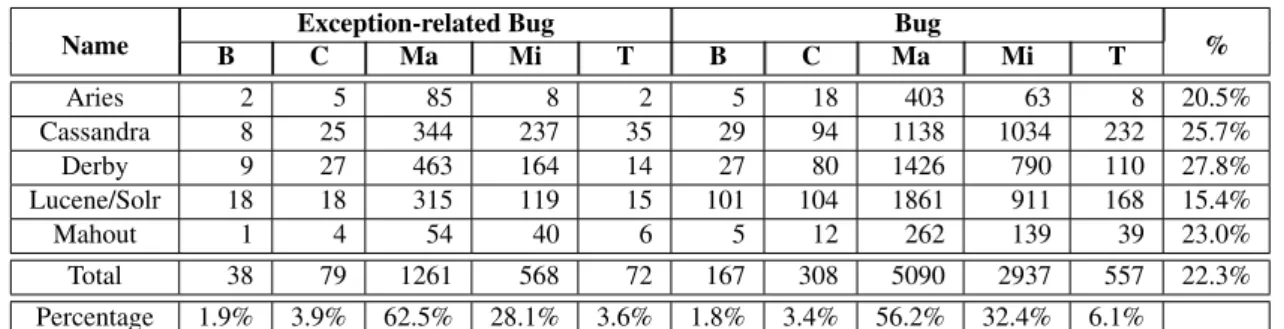
In this paper, we refer to exception-related bugs as bugs whose reports mention exceptions. To analyze the im- portance of exception-related bugs, we queried the issue trackers of six popular Apache Java projects in February 2014, and Table 1 shows the results. Column “Exception-related Bug” lists the number of exception-related bugs with respect to their priorities. We queried the projects with the keywords such as “Exception” and “Error”, since Java implements three types of exceptions such as unchecked exceptions (e.g.,NumberFormatException), checked exceptions (e.g.,ClassNotFoundException), and errors (e.g., OutOfMemoryError) [8]. Here, we required the first capitalized letters to reduce irrelevant bug reports, and counted only fixed bugs to reduce superficial bugs, since a bug (e.g., CASSANDRA-82961) can be resolved as not a problem. Column “Bug” lists the number of total fixed bugs with respect to their priorities. Column “%” lists percentage of exception-related bugs among all the fixed bugs.
The result shows that exception-related bugs are many, and account for more than 20% of the fixed bugs in total. As a comparison, although concurrency bugs are important, Lin et al. [33] show that only about five percents of bugs are related to concurrency issues. Row “Percentage” lists percentage of the corresponding bugs over the total bugs. In total, exception-related bugs are important, since more exception-related bugs are marked as blocker (1.9% vs 1.8%), critical (3.9% vs 3.4%), or major (62.5% vs 56.2%) than all the bugs.
Exception-related bugs can be difficult to be repaired. First, programming languages may define many exceptions.
For example, as shown in the J2SE’s document2, Exceptionhas more than seventy direct subclasses. Second, programming languages may allow customized exceptions. Finally, the symptoms of exceptions can be quite different.
In the same category of bugs, the symptom is straightforward, and we can infer corresponding fixes. For example, as shown in its document3, NullPointerException is thrown when a program attempts to use anull object.
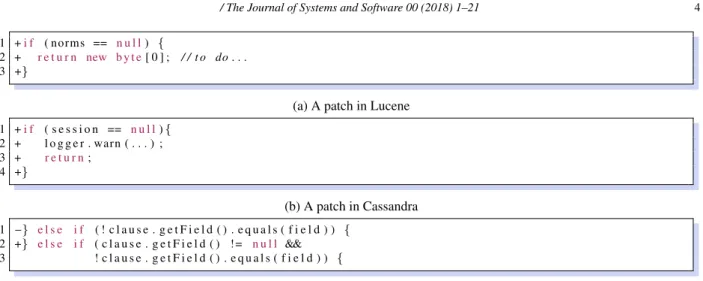
Based on this domain knowledge, it is feasible to fix related bugs by checking whether objects arenull. In particular, Figures 1a and 1b show two fixes from Lucene4 and Cassandra5. Although the two bugs are from different projects and are fixed by different programmers, programmers use the same pattern to fix the two bugs, i.e., adding anif statement to check a value, and areturnstatement to exit the method, if such a value isnull. Their repair shapes are similar, and they share two repair actions, i.e., inserting anifstatement and inserting areturnstatement. Here,
1https://issues.apache.org/jira/browse/CASSANDRA-8296
2http://docs.oracle.com/javase/7/docs/api/java/lang/Exception.html
3http://docs.oracle.com/javase/7/docs/api/java/lang/NullPointerException.html
4https://issues.apache.org/jira/browse/LUCENE-1510
5https://issues.apache.org/jira/browse/CASSANDRA-2377
3
1 +i f ( norms == n u l l) {
2 + r e t u r n new b y t e[ 0 ] ; / / t o do . . . 3 +}
(a) A patch in Lucene 1 +i f ( s e s s i o n == n u l l){
2 + l o g g e r . warn ( . . . ) ; 3 + r e t u r n;
4 +}
(b) A patch in Cassandra 1 −} e l s e i f ( ! c l a u s e . g e t F i e l d ( ) . e q u a l s ( f i e l d ) ) {
2 +} e l s e i f ( c l a u s e . g e t F i e l d ( ) ! = n u l l &&
3 ! c l a u s e . g e t F i e l d ( ) . e q u a l s ( f i e l d ) ) {
(c) The other way to fix bugs
Figure 1: The different ways to fix bugs that throwNullPointerException
Martinez and Monperrus [43] define a repair action as a modification on a code element. Still, due the complexity of fixing bugs, a pattern is insufficient to describe all bug fixes. For example, Figure 1c shows the other way to fix buggy code that throws the same exception6. The condition of anifstatement is modified to avoid the exception. Its repair shape is updating anifstatement. Furthermore, different from above two patterns, Cornu et al. [7] propose another fix pattern that catches unanticipated exceptions. The observations show that it needs different strategies to fix even a simple exception, which highlights the importance of automatic program repair.
2.2. EXFI
Many projects provide source code repositories that record all the commits (e.g., bug fixes, improvements, and new features), and a commit consists of a message and a set of modified files. The message of a commit often includes an issue key for tracking issues. For example, in the code repository of Aries, the message of a commit is “ARIES- 1269 Add blueprint maven plugin”. In this message, the issue key is “ARIES-1269”. In some projects, the practice is strictly complied. Existing studies [80, 3] show that most commits in Apache projects follow the practice, so their approach achieves similar precisions and recalls with the issue key heuristic, when they rebuild the links between bug reports and commits for Apache projects. For each exception-related bug report, EXFIuses its issue key to retrieve related commits. It is a simple heuristic, but it works well when the practice is followed. For those projects that do not follow this practice, Tian et al. [72] and Wu et al. [80] propose approaches that uses various features (e.g., the number of addedifstatements) to identify bug fixes from commits. It is feasible to collect more bug fixes for analysis with the support of their approaches.
It is difficult to identify specific bug fixes (e.g., exception-related bugs). Tufano et al. [73] analyzed commits of 100 Apache projects, and they found that only 38% of the total commits are compilable. Tufona et al. [73] released their analysis results on their website7. In particular, 58% of such cases are caused by the resolution of dependencies.
Without such dependencies, commits are not compilable, even if their code does not have syntax errors. As bug fixes are commits that repair bugs, many bug fixes are not compilable. Although researchers (e.g., [76, 56]) proposed approaches that can determine whether a bug is caused by exceptions, it is expensive to adapt such techniques to analyze bug fixes, since many bug fixes are not compilable. Although a recent approach [94] enables static analysis on partial programs, it needs dynamic analysis to determine related exceptions. Hassan et al. [18] repair configuration files to fix complication errors in commits, but can fix only half of commits.
Instead of commit source code, EXFIanalyzes bug reports to identify bug categories. A bug report can be superfi- cial, since programmers can resolve the report as other types of issues (e.g., “Improvement”). To filter superficial bug reports, EXFIselects only fixed bugs. EXFIthen queries fixed bug reports with the keywords such as “Error” and “Ex- ception”. We notice that bug reports can mention exceptions or errors, but do not describe their names. It is difficult to
6https://issues.apache.org/jira/browse/LUCENE-5450
7http://www.cs.wm.edu/semeru/data/breaking-changes
4
Table 2: Exception-related Bugs.
Name Identified bug Exception-related bug Percent Exception Unique exception Average file
Aries 102 102 100.0% 159 62 1.45
Cassandra 282 649 43.5% 461 84 1.55
Derby 662 677 97.8% 1,004 115 1.45
Lucene/Solr 343 485 70.7% 465 81 1.92
Mahout 94 105 89.5% 125 39 1.26
Total 1,483 2,018 73.5% 2,214 257 1.57
C: exception-related bugs whose commits are identified; E: exception-related bugs; Ex.: mentioned exceptions; U.Ex: unique mentioned exceptions.
link such bug reports to specific exceptions or errors. To filter these bug reports, EXFIrequires that the first letters of mentioned exceptions/errors shall be capitalized. For example, if a bug report mentionsOutOfMemoryError, EXFI
considers this bug report, since it mentions an exception name whose first letter is capitalized. Furthermore, EXFI
links this bug report toOutOfMemoryError. 2.3. Dataset
Table 2 lists our dataset. Column “Name” lists names of projects. Aries is an OSGi application programming tool.
Cassandra is a distributed database management system. Derby is a relational database. Lucene is an information retrieval library, and Solr is an enterprise search platform that is built on Lucene. Lucene and Solr share the same source code repository, so we have to put their results into a row. Mahout is a machine learning library. All the six projects are from Apache and in Java. We collected their bug reports and fixes in February 2014. Column “Identified bug” lists the number of exception-related bugs whose commits are identified by EXFI. Column “Exception-related bug” lists the total number of the exception-related bugs. Column “Percent” lists the percents of identified bugs. The result shows that EXFIidentified bug fixes for most exception-related bugs. The remaining bug fixes are not identified, since their issue number is not found in commit messages. Here, Cassandra changed its source code repository from SVN8to Git9in December 2011. EXFIretrieved commits from only SVN repositories, so the commits after December 2011 are not extracted. If a bug report is reported after December 2011, it is infeasible to identify its corresponding bug fix from our extracted commits. As a result, the ratio of Cassandra is low. Column “Exception” lists the number of mentioned exceptions. Among them, column “Unique exception” lists the number of unique ones. Its total number is smaller than its sum, since some exceptions are mentioned in multiple projects. Column “Average file” lists the averages of modified source files per bug. More details of the benchmark are presented in its website10.
3. The General Repair Model
Martinez and Monperrus [43] define a repair action as a modification on a code element, and a repair model as a set of repair actions. For example, the repair model of Weimer et al. [77] has three repair actions such as deleting a statement, inserting a statement taken from the software, and swapping two statements. The repair model of an approach determines its repair capability, and it needs much expertise to design effective repair models. Martinez and Monperrus [43] propose an approach that mines repair models from past manual fixes. From 14 open source Java projects, they collected 62,179 commits that fix bugs. From each commit, they extracted repair actions with the support of ChangeDistiller [15], and calculated two repair models such as CT and CTET with different granularity (see Section 5.1 for details). Here, their mined repair model is the probability distribution of repair actions. The appendix of Martinez and Monperrus [42] provides the complete distributions of the CT and CTET models. In their evaluation, they use mined repair models to guide generating repair shapes. Martinez and Monperrus [43] define a repair shape as an unordered tuple of repair actions, and the shape space as all possible combinations of repair actions.
A generated repair shape is more abstract than a patch and cannot be executed. As a result, it is infeasible to guide the
8https://svn.apache.org/repos/asf/cassandra/
9https://git-wip-us.apache.org/repos/asf?p=cassandra.git
10https://github.com/drzhonghao/exception.bugs
5
search with fitness functions. Martinez and Monperrus [43] use weighted random search for repair actions, and the weights are based on the probabilities of repair actions dictated by their models (see Section 7 for more discussions).
With repair models, automatic program repair can generate fixes more effectively.
4. MIMO
MIMOhas two major steps such as identifying exception-method mappings (Section 4.1), and mining a repair model for each exception (Section 4.2).
4.1. Identifying Exception-method Mapping
The first step of MIMOis to build the mappings between mentioned exceptions and modified methods. Some bug reports have stack traces [78]. From such bug reports, MIMOextracts stack traces by parsing their contents. Zhong and Su [92] detect errors in API documents, and their approach includes a component that extracts code samples from API documents. MIMOreuses the component, and employs a natural language checker [47] to detect language errors (e.g., spelling errors, grammar errors, style errors, and semantic errors). The error ratio is defined as follows:
error ratio= |errors|
|words| (1)
As stack traces do not follow the grammars of natural languages, they have much higher error ratios than natural language sentences. MIMOuses the error ratio to identify stack traces. Here, although code samples can be identified as stack traces, it is easy to distinguish them, since stack traces follow a different format from code samples. As a result, we do not need a more advanced technique (e.g., [2]) to identify stack traces. In a stack trace, an exception is followed by a sequence of methods. For example, a bug report of Cassandra11mentions three exceptions, and the reporter presents the stack trace as follows:
Looks related to ...
java.util.concurrent.ExecutionException:...
at ...FutureTask$Sync.innerGet(...) ...
Caused by: java.lang.RuntimeException...
at ...WrappedRunnable.run(...) ...2 more
Caused by: java.lang.AssertionError...
at ...CommitLog.discardCompletedSegmentsInternal(...) ...1 more
MIMO links a thrown exception to its follow-up methods, if such methods are modified. For example, in the above stack trace,AssertionErrorhas a follow-up method,discardCompletedSegmentsInternal(). This bug report has an attached patch12. The patch shows that ten methods are modified, and one of the them is the discardCompletedSegmentsInternal()method. In particular, a line of the method is deleted:
- assert context.position >= context.getSegment();
The fixed code does not throw the exception any more, since in the method, theassert statement is deleted.
As only this method appears afterAssertionError, MIMOlinks thediscardCompletedSegmentsInternal() method toAssertionError. We inspected the other nine modified methods, and we found that all the methods are related to refactoring. In this paper, we useMstto denote mappings that are identified by stack traces.
Schroter et al. [62] show that in about 40% of bug reports with stack traces, programmers do not modify any methods that appear in stack traces to fix bugs. For example, we notice that some fixes do not modify any source files (see Section 5.2 for examples). In this paper, we useMnsto denote mappings where no Java source files are modified to fix bugs. Some remaining mappings are one-to-one, since only an exception is mentioned, and only a method is modified. For example, a bug report of Aries13is related toNullPointerException, and programmers modified a method to fix the thrown exception:
11https://issues.apache.org/jira/browse/CASSANDRA-1330
12https://issues.apache.org/jira/secure/attachment/12456141/1330.txt
13https://issues.apache.org/jira/browse/DERBY-4306
6
private synchronized void unregisterMBean(...){ + //Has this service been shut down?
+ if (registeredMbeans == null)
+ return;
For one-to-one mappings, MIMOlinks exceptions with their corresponding modified methods. In this paper, we use M1−1to denote one-to-one mappings.
From the other bug reports, MIMOextracts two special mappings, i.e., 1-to-n mapping (M1−n) and n-to-1 mapping (Mn−1). AnM1−nmapping indicates that a bug report mentions an exception, and multiple methods are modified to fix the bug. MIMOlinks the exception to all the modified methods. AnMn−1mapping indicates that a bug report mentions multiple exceptions, and only a method is modified to fix the bug. MIMOlinks all the exceptions to the modified method. The remaining bugs fall into theMn−mcategory, where a bug report mentions multiple exceptions, and programmers modify multiple methods to fix the bug. In summary, MIMOidentifies six types of mappings such asMns,Mst,M1−1,M1−n,Mn−1, andMn−m.
4.2. Mining Repair Model for Exception
When they repair a bug, programmers often modify its test code to determine whether the bug is correctly fixed.
As a result, the modifications on test code are more like implementing new features than repairing bugs. As we mine repair models for fixing bugs, MIMOignores changes on test code. For the remaining source code, MIMOextracts a repair shape from each pair of modified methods, with the support of ChangeDistiller [15]. A repair shape (s) is a pair⟨n, A⟩, where n is a client code method, and A is the set of repair actions on n. Based on the exception-method mappings of each exception, MIMOmines a repair model,⟨e, H, X⟩, where:
• e is the thrown exception.
• H = {h1, . . . , hn} is the set of known repair shapes that fix e-related bugs. In our approach, H is extracted from linked methods of e, and it includes mappings such asM1−1,Mst,Mn−1, andM1−n.
• X = {x1, . . . , xm} is the probability distribution that is built from H, and xiis a pair,⟨ai, ρi⟩. Here, aidenotes a type of repair actions, andρiis calculated as ∑|ami|
1|ai| where|ai| denotes the frequency of ai.
Zhong and Su [93] show that automatic program repair is less effective to fixM1−nandMn−mbugs. To improve the state of the art, we focus on the other four types of mappings such asM1−1,Mst,M1−n, andMn−1. We use⟨E, M⟩
to denote a mapping where E is a set of exceptions, and M is the set of mapped methods. When calculating the repair model⟨e, H, X⟩ for the e exception, if ⟨E, M⟩ is a mapping and e ∈ E, MIMOextracts a repair shape (h) from each method in M, and adds h toH. In addition, MIMOextracts repair actions A in M, and counts A toX.
5. Repair Models 5.1. The General Model
As introduced in Section 1, we choose the repair models of Martinez and Monperrus [43] as the baseline for com- parison. Martinez and Monperrus [43] mine two models such as the CT model and the CTET model. The two repair models define the probability distributions of repair actions. From 14 open source Java projects, they collected 62,179 commits that fix bugs. From each commit, they extracted repair actions with the support of ChangeDistiller [15], and refined the repair actions on different granularity. In particular, the CT model counts at a coarser granularity, and the CTET model counts at a finer granularity. For example, when ChangeDistiller identifies anInsert:IF STATEMENT action and anInsert:FOR STATEMENTaction, the CT model counts the two actions as twoInsert:STATEMENT actions. In contrast, when ChangeDistiller identifies anUpdate:MODIFIERaction, the CTET model refines it into multiple categories (e.g., increasing or decreasing the accessibility of a modifier).
Typically, a finer repair model leads to a larger search space and a lower probability for generating correct repair shapes. For example, CTET is finer than CT, and Martinez and Monperrus [43] show that it is able to generate longer correct repair shapes with the CT model than with the CTET model. Despite of a lower capability of generating correct repair shapes, a finer repair model generates more detailed repair actions, which make it easier to synthesize patches.
7
Table 3: Mined Repair Models.
CM NPE AIOOBE IAE IOE
U:MI 8.1% I:IF 13.6% I:IF 11.8% U:VDS 8.1% U:IF 8.5%
I:MI 6.9% I:VD 8.5% I:VD 10.8% I:VD 8.1% I:MI 6.4%
I:IF 6.6% M:MI 7.5% U:VD 8.8% M:AS 8.1% I:IF 6.4%
D:MI 5.5% U:IF 6.7% U:IF 6.9% I:MI 7.5% M:IF 6.4%
D:IF 5.0% I:AS 6.3% M:AS 6.9% I:AS 6.8% U:MI 5.3%
I:VD 4.6% U:MI 5.5% I:MI 5.9% I:IF 5.6% M:MI 5.3%
U:IF 4.4% I:MI 5.3% U:RS 4.9% M:IF 5.0% U:VD 5.3%
U:VD 4.3% U:VD 4.4% U:AS 4.9% M:MI 4.3% U:AS 4.3%
I:AS 4.1% I:RS 4.1% I:AS 4.9% U:AS 4.3% I:CC 4.3%
I:ME 4.1% M:VD 4.1% U:MI 4.9% D:TS 3.7% I:VD 4.3%
FNFE IOOBE CCE NCDFE
U:IF 10.6% I:MI 13.8% I:MI 13.6% M:MI 22.0%
I:MI 10.6% I:VD 8.6% I:IF 12.3% I:IF 11.0%
M:CO 9.1% M:MI 6.9% I:VD 9.3% U:IF 9.3%
D:MI 7.6% I:IF 6.9% U:VD 8.6% I:MI 6.8%
D:VD 6.1% U:VD 5.2% I:AS 5.6% M:VD 5.9%
D:IF 4.5% U:IF 5.2% I:EL 4.3% I:VD 5.9%
M:VD 4.5% M:VD 5.2% I:TR 3.7% M:AS 4.2%
D:CO 3.0% I:TR 5.2% U:TS 3.7% D:MI 4.2%
D:TS 3.0% I:AE 3.4% D:MI 3.7% I:RS 4.2%
D:CC 3.0% U:MI 3.4% U:MI 3.1% U:VD 3.4%
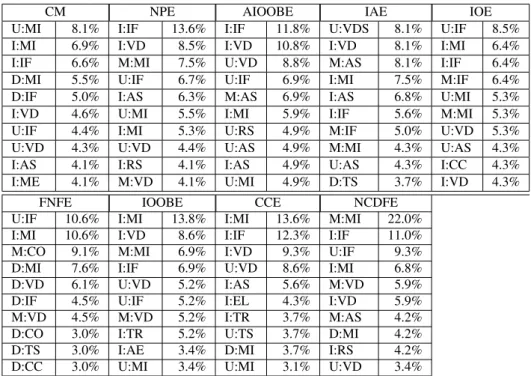
Models. CM: The general repair model that is calculated from CTET; NPE: NullPointerException; AIOOBE: ArrayIndexOutOfBoundsEx- ception; IAE: IllegalArgumentException; IOE: IOException; FNFE: FileNotFoundException; IOOBE: IndexOutOfBoundsException; CCE:
ClassCastException; NCDFE: NoClassDefFoundError.
Edit action. U: Update; I: Insert; M: Move; D: Delete.
Code element. MI: METHOD INVOCATION; IF: IF STATEMENT; VD: VARIABLE DECLARATION STATEMENT; ME: METHOD; AS:
ASSIGNMENT; RS: RETURN STATEMENT; TS: THROW STATEMENT; CO: CONTINUE STATEMENT; TR: TRY STATEMENT; CC:
CATCH CLAUSE; AE: ASSERT STATEMENT; EL: ELSE BRANCH.
As introduced in Section 4, when MIMOmines repair models, it does not refine the granularity of ChangeDistiller.
As a result, CT, CTET, and our mined models are at different granularity. The granularity becomes an independent variable of a controlled experiment. Even if our models achieve better results than CT and CTET, we cannot determine whether our different repair probabilities or different granularity lead to the better results. To eliminate the impacts from granularity, we have to recount a repair model at the same granularity of ChangeDistiller. It is infeasible to recount the model from CT, since the details are missing. In the above example, CT counts twoInsert:STATEMENT actions, but it does not record the two actions are anInsert:IF STATEMENTaction and anInsert:FOR STATEMENT action. However, it is feasible to recount the model from the CTET model. In the above example, we can count all increasing or decreasing the accessibility of a modifier toUpdate:MODIFIERactions of ChangeDistiller.
The appendix of Martinez and Monperrus [42] lists all the occurrences of repair actions. Based on their appendix, we align the repair actions of CTET to the repair actions of ChangeDistiller, and recount a CM model. In Table 3, column “CM” shows the recounted model. Although the CM model is calculated from the CTET model, the CM model is different from the original CTET model, since some repair actions of CTET are merged. For example, as shown in Section 1, the first repair action of the CTET model is inserting method invocations (6.9%), but the first repair action of the CM model is updating method invocations (8.1%).
5.2. Our Mined Models
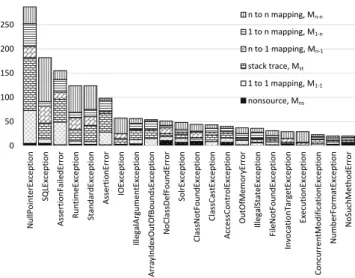
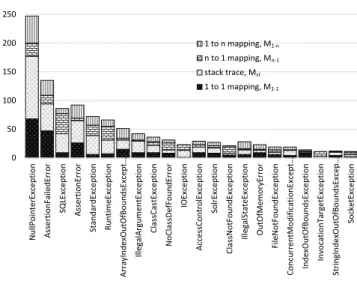
Figure 2 shows bugs that are related to exceptions. Its vertical axis lists the number of bugs with regards to their relations, and its horizontal axis lists exceptions in the descending order of total corresponding bugs. Due to space limit, we do not show exceptions whose linked bugs are fewer than twenty. Comparing the number of unique exceptions in Table 2 with the number of bugs in Figure 2, we found that only about ten percents of exceptions have more than twenty related bugs. Most exceptions are a special type of API classes, and we found that the long tail
8
NPE SQLE AFE RE SE AE IOE IAE AIOOBE NCDFE SE CNFE CCE ACE OOME ISE FNFE ITE EE CME NFE NSME
M
M
M
M
M
M
Figure 2: The bugs that are related to each exception.
effect of exceptions is consistent with other API elements. For example, Thummalapenta and Xie [70] found that even in popular API libraries, some API classes are rarely used. As another example, Parnin et al. [54] found that only 36.9% of J2SE classes are frequently discussed on StackOverflow, and 22.7% of J2SE classes are never mentioned.
The long tail effect of APIs does not indicate that those rarely mentioned exceptions are useless. In contrast, it takes much more effort to fix a rare exception, since programmers are unfamiliar with the exception, but the effect allows us to mine repair models for those popular exceptions.
Yin et al. [87] show that programmers may introduce configuration bugs into their code. We found that theMns
category contains configuration bugs, and these bugs are associated with several exceptions (e.g.,ClassNotFound- ExceptionandAccessControlException). For example, to fix aAccessControlException-related bug14, programmers modified a configuration file to allow a required permission:
+grant codeBase "${derbyTesting.codejar}/derbynet.jar" { ...
+ permission java.io.FilePermission "${derby...","write";
+};
Besides configuration errors, we notice that some bugs in the Mns category are related to source files in pro- gramming languages other than Java. For example, to fix aClassNotFoundException-related bug15, programmers modified a batch file:
-if NOT DEFINED CASSANDRA_HOME set CASSANDRA_HOME=%CD%
+if NOT DEFINED CASSANDRA_HOME set CASSANDRA_HOME=%˜dp0..
Moreover, we find documentation errors that throw exceptions. For example, a bug report of Lucene16says that the online user guide threwSAXParseException, and the modified line is as follows:
-<!DOCTYPE...".../xhtml1/DTD/xhtml1-transitional.dtd">
+<!DOCTYPE...".../html4/loose.dtd">
Figure 2 shows that some exceptions (e.g., SQLException) have moreMn−m relations than others. In other words, these exceptions are often mentioned with other exceptions, and multiple methods have to be modified to fix such exceptions.
14https://issues.apache.org/jira/browse/DERBY-1334
15https://issues.apache.org/jira/browse/CASSANDRA-1713
16https://issues.apache.org/jira/browse/LUCENE-4302
9
NPE AFE SQLE AE SE RE AIOOBE IAE CCE NCDFE IOE ACE SE CNFE ISE OOME FNFE CME IOOBE ITE SIOOBE SE
M
M
M
M
Figure 3: The bugs that are used to mine repair models.
MIMOmines repair models from bug fixes ofM1−1,Mst,M1−n, andMn−1. Figure 3 shows bugs that belong to the four relations. The vertical axis lists the number of bugs with regards to their relations. The horizontal axis lists exceptions in the descending order of total bugs. MIMOfurther builds repair models for all the twenty-one exceptions in Figure 3. Table 3 showsX of the top nine mined repair models, and the general model (the CM model). For a column, the first subcolumn lists repair actions (ai), and the second subcolumn lists probability distributions (ρi). In total, MIMOmined 21 repair models. Due to space limit, Figure 3 ignores exceptions whose related bugs are fewer than ten, and Table 3 presents only the top ten repair actions of nine repair models. We select the nine models, since we will use the nine models in the next evaluation. In addition, Table 3 does not presentH either, but Section 6.2.2 presents an example. Our results show that MIMOsuccessfully mined repair models for popular exceptions.
6. Empirical Comparison
We conducted two empirical comparisons to address the following two research questions:
(RQ1) To what degree are our mined repair models different from the general repair model (Section 6.1)?
(RQ2) To what degree do our mined repair models improve the general model (Section 6.2)?
RQ1 mainly concerns the differences among repair models, and RQ2 mainly concerns the improvement of our repair models over the general repair model of Martinez and Monperrus [43]. In Section 6.1, our results show that our mined repair models are all significantly different from the general repair model of Martinez and Monperrus [43], and it may be feasible to mine a repair model for several exceptions. The difference does not indicate effectiveness, which we explored in Section 6.2. In Section 6.2, our results show that in 43 out of 59 real bugs, our repair models significantly improve the general repair model of Martinez and Monperrus [43].
6.1. RQ1. The Differences 6.1.1. Hypotheses
The motivation of our work is that instead of a general repair model, we need different repair models to fix specific types of bugs. The motivation can be verified by the differences between the general repair model of Martinez and Monperrus [43] and our mined repair models. The null hypothesis is as follows:
(H0) The difference between the general repair model of Martinez and Monperrus [43] and our mined repair models is not statistically significant.
10
Table 4: The Differences among Repair Models.
NPE AIOOBE IAE IOE FNFE IOOBE CCE NCDFE
CM 0.0032 <0.0001 <0.0001 <0.0001 <0.0001 <0.0001 <0.0001 <0.0001 NPE 0.0002 0.0247 0.0121 0.0003 <0.0001 0.0063 0.0001
AIOOBE 0.261 0.2624 0.9002 0.7915 0.4807 0.7529
IAE 0.8296 0.3319 0.1761 0.5159 0.1868
IOE 0.4679 0.265 0.8164 0.208
FNFE 0.8957 0.5225 0.7958
IOOBE 0.3185 0.9491
CCE 0.3598
1 S t r i n g B u i l d e r b u i l d e r = b u i l d e r s [ c u r r e n t F i e l d ] ; 2 −i f( b u i l d e r . l e n g t h ( ) >0){
3 +i f( b u i l d e r . l e n g t h ( )>0&&b u i l d e r . l e n g t h ( )<maxLength ){ 4 b u i l d e r . a p p e n d ( ) ; / / . . .
5 }
6 i f( b u i l d e r . l e n g t h ( ) + v a l u e . l e n g t h ( )>maxLength ){
(a) A patch that fixes an IOOBE-related bug 1 −ColumnDescriptor cd ;
2 + C o l u m n D e s c r i p t o r cd = n u l l; 3 i f ( t c l == n u l l) {
4 cd = t t d . g e t C o l u m n D e s c r i p t o r ( i n d e x + 1 ) ;
5 }
6 −e l s e
7 +e l s e \ t e x t b f {i f ( i n d e x < t c l . s i z e ( ) )} 8 {
9 R e s u l t C o l u m n t r c = ( R e s u l t C o l u m n ) t c l . e l e m e n t A t ( i n d e x ) ;
(b) A patch that fixes an AIOOBE-related bug Figure 4: Similar patch
In addition, it is interesting to investigate whether different repair models are similar. The null hypothesis is as follows:
(H1) The difference between our mined repair models is not statistically significant.
Although Arcuri and Briand [1] recommend the Mann-Whitney U test to compare random-based approaches, the test is not limited to only this application. As introduced by McKnight and Najab [44], the Mann-Whitney U test is more general than many other tests, since it does not require specific distributions. For example, the independent samples t-test requires that two groups shall be normally distributed. Before we test the hypotheses, we run the Shapiro-Wilk test [49] on all the repair models, and the results show that the repair models are not normally distributed.
As a result, it is proper to use the Mann-Whitney U test to compare mined repair models. We reject a null hypothesis only when p is less than 0.05.
6.1.2. Results
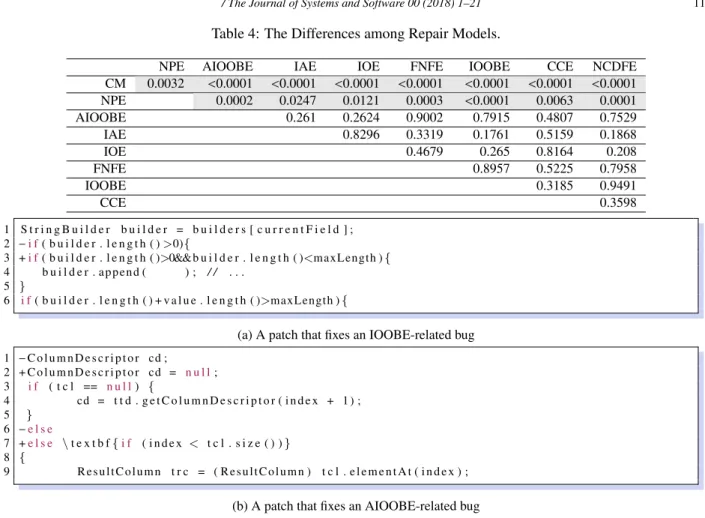
Result 1. Our repair models are all significantly different from the general model.The first row of Table 4 shows the results. In Table 4, the column and the row of a cell denote two compared repair models. The abbreviations are consistent with the abbreviations in Table 3. For each cell, the grey background indicates that a hypothesis is rejected.
The results show that our repair models are all statistically different from the general repair model, since all the null hypotheses in this row are rejected. The results confirm our motivation of mining repair models for specific bugs, and highlight the importance of the divide-and-conquer strategy.
Result 2. H1does not always hold on our repair models.In Table 4, the rows except the first row show the results.
For NPE, we reject all the hypotheses. When fixing bugs, programmers often simply avoid thrown NPEs by guiding nullpointers. However, other exceptions are more complicated, and need much different repairs to be fixed.
11
For the other exceptions, we do not reject any hypotheses. That is to say, we cannot tell whether these repair models are significantly different. We found that inheritance relations may lead to less difference. For example, IOOBE17has only two subclasses, and AIOOBE is a subclass of IOOBE. The description of IOOBE says “Thrown to indicate that an index of some sort (such as to an array, to a string, or to a vector) is out of range”, and the description of AIOOBE says “Thrown to indicate that an array has been accessed with an illegal index. The index is either negative or greater than or equal to the size of the array.” As the similar descriptions indicate, their fixes may be similar. For example, Figure 4a shows a patch that fixes an IOOBE-related bug18, and Figure 4b shows a patch that fixes an AIOOBE-related bug19. The above two patches show the same good practice to avoid IOOBE or AIOOBE, i.e., checking whether an index is smaller than the size of an array before accessing the array. The long tail effect of APIs makes it infeasible to mine repair models for rarely used exceptions, but our results indicate that it may be feasible to merge similar exceptions to mine a repair model for multiple exceptions. Still, our results show that the inheritance relation does not guarantee the similarity between two repair models. For example, FNFE is a direct subclass of IOE, but the p value between their repair models is relatively low. As shown in the API document of IOE20, IOE has more than thirty direct subclasses, and its direct subclasses can have even more subclasses. For example,SocketExceptionis a direct subclass of IOE, and as shown in its API document21, it has four direct subclasses. The similarity between IOE and FNFE is relatively low, since IOE has many subclasses and FNFE is only one of its subclasses.
In summary, MIMOmined twenty-one repair models, and all our tested repair models are significantly different from the general model of Martinez and Monperrus [43]. The result highlights the importance of an approach like MIMO. The long tail effect of APIs places a barrier to mine repair models for rare exceptions, but our results indicate that we can overcome the barrier, since it may be feasible to merge bugs of similar exceptions to mine a repair model for multiple exceptions.
6.2. RQ2: Generating Repair Shape 6.2.1. Setup
In this section, we select another project called FLEX22, since the project is large and actively maintained. Table 5 shows the selected bugs. We use the names of the exceptions to query the issue tracker of FLEX. From the returned bugs, we selectedM1−1,Mst, andMn−1ones. Column “Issue key” lists issue keys of all the selected bugs. The size is comparable to the sizes in existing studies (e.g., [57]). In Table 5, Column “Exception” lists the names of exceptions.
Column “Priority” lists the priorities of the bugs. Column “Size” lists the size of golden repair shapes.
6.2.2. Comparison Criteria
Martinez and Monperrus [43] use generated correct repair shapes to evaluate the effectiveness of their approach, since generating correct repair shapes is an essential step in automatic repairs and researchers (e.g., [23]) believe such shapes are even useful for manual repairs. As a generated repair shape is more abstract than a patch and cannot be executed, it is infeasible to guide the search, since its fitness function requires execution results but generated repair shapes cannot be executed. As a result, for each bug, we also use our corresponding repair model and the general model (the CM model in Table 3) to guide the random search for correct repair shapes.
Martinez and Monperrus [43] use repair shapes of manual fixes as the golden standard. To compare with their approach, we use the same golden standard when we explore this research question. In particular, for each selected fix, we use ChangeDistiller to compare its buggy code and fixed code, and use the extracted repair shape as the oracle.
Based on the golden standard, we define two criteria:
1. Success rate. For each bug, we execute with the two compared models for 1,000 times. In each execution, we stop the search when the correct repair shape is generated, or the number of attempts reaches the maximum value of 1,000,000. If the correct repair shape is generated in an execution, we consider the execution as a success. In addition, before using our model (⟨e, H, X⟩) to generate repair shapes, we compare the oracle repair shape with H. In Columns
17http://docs.oracle.com/javase/8/docs/api/java/lang/IndexOutOfBoundsException.html
18https://issues.apache.org/jira/browse/LUCENE-5032
19https://issues.apache.org/jira/browse/DERBY-4449
20http://docs.oracle.com/javase/8/docs/api/java/io/IOException.html
21http://docs.oracle.com/javase/8/docs/api/java/net/SocketException.html
22http://flex.apache.org
12
“Mean” and “Median”, h denotes that the oracle is found inH. When this happens, we consider that the MiMo model achieves better results than the CM model for two considerations. First, the size ofH is small as shown in Figure 3.
Table 5: The Results of Generating Repair Shapes.
Issue key Exception Priority Size Model Mean Median Rate Result
FELIX-143 NPE Major 1
MiMo h h 100.0%
CM 12 9 100.0% X
FELIX-1195 NPE Major 10
MiMo 794,454 1,000,001 38.8%
CM 1,000,001 1,000,001 0.0% X
FELIX-1238 NPE Minor 3
MiMo 1,763 1,235 100.0%
CM 32,971 22,778 100.0% X
FELIX-1496 NPE Major 10
MiMo 979,650 1,000,001 4.1%
CM 1,000,001 1,000,001 0.0% X
FELIX-1566 NPE Major 6
MiMo 4,723 3,417 100.0%
CM 989,759 1,000,001 2.0% X
FELIX-1629 NPE Minor 2 MiMo h h 100.0%
CM 63 44 100.0% X
FELIX-1846 NPE Blocker 4
MiMo 1,603 1,151 100.0%
CM 2,206 1,608 100.0% X
FELIX-1867 NPE Major 2 MiMo h h 100.0%
CM 701 515 100.0% X
FELIX-1872 NPE Major 2
MiMo h h 100.0%
CM 187 131 100.0% X
FELIX-1961 NPE Major 1 MiMo h h 100.0%
CM 44 29 100.0% X
FELIX-2143 NPE Minor 1
MiMo h h 100.0%
CM 43 29 100.0% X
FELIX-2159 NPE Minor 1 MiMo h h 100.0%
CM 39 29 100.0% X
FELIX-2213 NPE Major 7
MiMo 708,241 918,791 53.4%
CM 1,000,001 1,000,001 0.0% X
FELIX-2230 NPE Minor 7 MiMo 174,687 125,250 99.7%
CM 723,187 1,000,001 48.8% X
FELIX-2326 NPE Minor 7
MiMo 998,119 1,000,001 0.4%
CM 997,940 1,000,001 0.3% —
FELIX-2432 NPE Major 1 MiMo h h 100.0%
CM 44 30 100.0% X
FELIX-2574 NPE Minor 2
MiMo h h 100.0%
CM 752 507 100.0% X
FELIX-2596 NPE Minor 2
MiMo h h 100.0%
CM 702 465 100.0% X
FELIX-2796 NPE Minor 2
MiMo h h 100.0%
CM 758 552 100.0% X
FELIX-3117 NPE Major 5
MiMo 46,001 33,041 100.0%
CM 997,109 1,000,001 0.7% X
FELIX-780 AIOOBE Major 1
MiMo h h 100.0%
CM 39 27 100.0% X
FELIX-1164 AIOOBE Major 1
MiMo h h 100.0%
CM 38 25 100.0% X
FELIX-1580 AIOOBE Critical 3
MiMo 4,494 3,034 100.0%
CM 11,258 8,022 100.0% X
FELIX-2922 AIOOBE Minor 15
MiMo 1,000,001 1,000,001 0.0%
CM 1,000,001 1,000,001 0.0% — FELIX-3463 AIOOBE Major 3
MiMo 1,207 854 100.0%
13 X
Table 5 – continued from previous page
Issue key Exception Priority Size Model Mean Median Rate Result
CM 6,535 4,587 100.0%
FELIX-3548 AIOOBE Major 6
MiMo 1,000,001 1,000,001 0.0%
CM 988,283 1,000,001 2.3% ×
FELIX-3977 AIOOBE Major 2
MiMo h h 100.0%
CM 41 29 100.0% X
FELIX-4565 AIOOBE Major 7
MiMo 1,000,001 1,000,001 0.0%
CM 1,000,001 1,000,001 0.0% —
FELIX-2610 IAE Major 14
MiMo 1,000,001 1,000,001 0.0%
CM 1,000,001 1,000,001 0.0% —
FELIX-2375 IAE Minor 7
MiMo 878,615 1,000,001 23.6%
CM 1,000,001 1,000,001 0.0% X
FELIX-2387 IAE Major 2
MiMo 515 374 100.0%
CM 754 537 100.0% X
FELIX-2672 IAE Major 10 MiMo 999,887 1,000,001 0.1%
CM 1,000,001 1,000,001 0.0% —
FELIX-3086 IAE Major 1
MiMo h h 100.0%
CM 42 28 100.0% X
FELIX-3567 IAE Major 7 MiMo 149,136 106,681 99.9%
CM 134,058 94,461 99.8% ×
FELIX-3670 IAE Major 1
MiMo h h 100.0%
CM 39 28 100.0% X
FELIX-4444 IAE Major 5 MiMo 19,006 13,624 100.0%
CM 195,048 135,349 99.3% X
FELIX-4616 IAE Major 4
MiMo 2,004 1,731 100.0%
CM 258,356 176,386 97.7% X
FELIX-547 IAE Major 3 MiMo 2,864 1,994 100.0%
CM 27,091 17,841 100.0% X
FELIX-414 IOE Major 5
MiMo 235,813 166,509 98.6%
CM 925,487 1,000,001 15.0% X
FELIX-1188 IOE Major 4 MiMo 3,369 2,346 100.0%
CM 95,333 65,472 100.0% X
FELIX-1517 FNFE Major 6
MiMo 998,565 1,000,001 0.2%
CM 998,942 1,000,001 0.3% — FELIX-2912 FNFE Major 7 MiMo 996,182 1,000,001 0.8%
CM 995,310 1,000,001 1.1% — FELIX-4628 FNFE Major 3
MiMo 1,225 827 100.0%
CM 104 73 100.0% ×
FELIX-1580 IOOBE Critical 3
MiMo 4,525 3,157 100.0%
CM 13,923 10,196 100.0% X
FELIX-2120 IOOBE Major 1
MiMo 65 46 100.0%
CM 44 29 100.0% ×
FELIX-2615 IOOBE Major 2
MiMo 451 307 100.0%
CM 924 652 100.0% X
FELIX-3402 IOOBE Minor 12
MiMo 1,000,001 1,000,001 0.0%
CM 1,000,001 1,000,001 0.0% — FELIX-4524 IOOBE Major 6
MiMo 240,146 171,505 98.5%
CM 969,506 1,000,001 5.5% X
FELIX-411 CCE Major 1
MiMo h h 100.0%
CM 42 30 100.0% X
FELIX-1197 CCE Major 29
MiMo 1,000,001 1,000,001 0.0%
CM 1,000,001 1,000,001 0.0% —
FELIX-1216 CCE Major 2 MiMo 130 91 100.0%
X 14
Table 5 – continued from previous page
Issue key Exception Priority Size Model Mean Median Rate Result
CM 969 632 100.0%
FELIX-2306 CCE Minor 4
MiMo 18,799 13,353 100.0%
CM 45,515 33,058 100.0% X
FELIX-3001 CCE Minor 2
MiMo h h 100.0%
CM 793 512 100.0% X
FELIX-3323 CCE Major 3
MiMo 345 231 100.0%
CM 986 678 100.0% X
FELIX-3960 CCE Blocker 4
MiMo 9,179 6,194 100.0%
CM 23,716 16,927 100.0% X
FELIX-819 NCDFE Major 11
MiMo 1,000,001 1,000,001 0.0%
CM 1,000,001 1,000,001 0.0% — FELIX-1516 NCDFE Major 7
MiMo 999,756 1,000,001 0.1%
CM 999,480 1,000,001 0.1% —
FELIX-2492 NCDFE Major 2 MiMo 2,502 1,766 100.0%
CM 2,188 1,569 100.0% ×
FELIX-3153 NCDFE Major 4
MiMo 21,033 14,613 100.0%
CM 1,000,001 1,000,001 0.0% X
Second, a found match inH provides valuable hints to synthesize patches. For example, Figure 5a shows the fault code of FELIX-187223. With our repair model, we found a match, LUCENE-303224, and Figure 6 shows the patch for this bug. This patch indicates that programmers can place a buggy line inside anIfstatement, and check whether its values arenullto avoid NPE. Although the programmers of FLEX are unlikely to read LUCENE-3032 before they fix FELIX-1872, they follow the same way to fix this bug, as shown in Figure 5c.
The success rate is calculated as successes over the total times of executions (it is 1,000 in our evaluation).
2. Tried times.In each execution, if both compared models successfully generate a correct repair shape, we compare their tried times. As our generation is a guided random search, we follow the guidance of Arcuri and Briand [1]. Our null hypothesis is as follows:
(H2) The difference between the the CM model and our mined repair model, as far as times of attempts are concerned, is not statistically significant.
We reject the null hypothesis, when the p value is smaller than 0.05. When it is rejected, if the mean times of our model is smaller than the mean times of the CM model, we consider that our model synthesizes a correct repair shape faster than the general mode. That is to say, we consider a model (t1) is better than another model (t2), only when t1
needs significantly fewer tried times to generate the golden standard than t2does.
6.2.3. Results
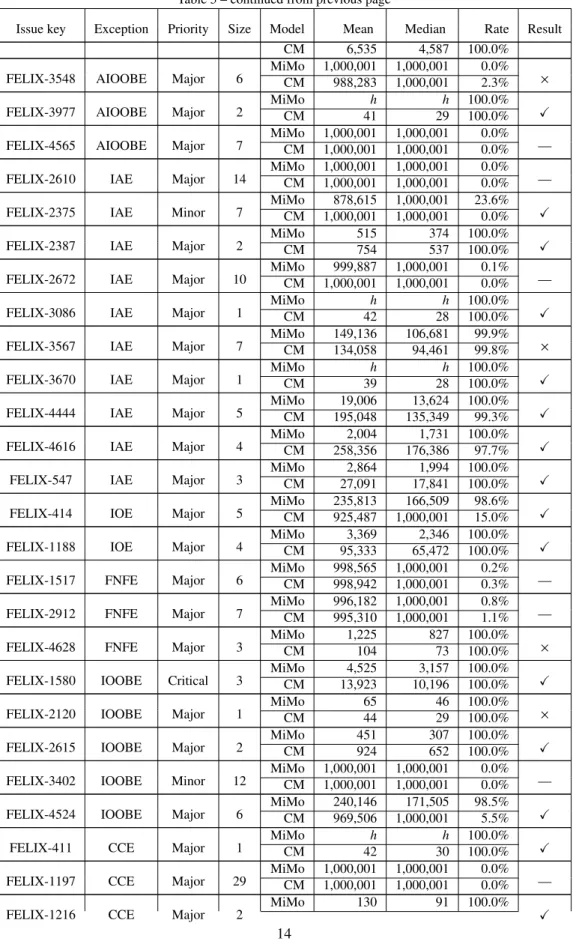
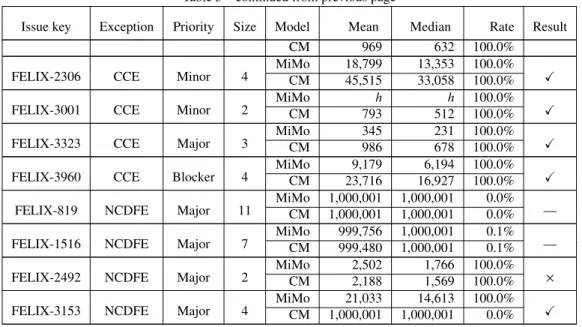
Table 5 shows the overall results. Column “Model” lists compared repair models. In each row, “MiMo” denotes our repair models, and “CM” denotes the general repair model. Column “Success rate” lists success rates. Based on this column, we come to the following results:
Result 1. The success rates of the CM model are consistent with the prediction of Martinez and Monperrus [43].
The evaluation results of Martinez and Monperrus [43] show that when generating correct repair shapes, the maximum lengths for the CT model and the CTET model are eight and four, respectively. As the CM model is finer than the CT model and is coarser than the CTET model, the maximum length for CM shall be between four and eight. In Table 5, the maximum length for the CM model is seven (FELIX-2230, FELIX-2326, FELIX-2912, and FELIX- 3567), with low success rates (e.g., 1.1%). We estimate that seven is near to the maximum value. Our result indicates
23https://issues.apache.org/jira/browse/FELIX-1872
24https://issues.apache.org/jira/browse/LUCENE-3032
15
1 p u b l i c v o i d s e t A t t r i b u t e ( S t r i n g name , O b j e c t v a l u e ){ 2 t h i s. a t t r i b u t e s . p u t ( name , v a l u e ) ;
3 }
(a) The buggy code of FELIX-1872 1 − d e l e t e S l i c e . a p pl y ( p e n d i n g D e l e t e s , numDocsInRAM ) ;
2 +i f( d e l e t e S l i c e ! = n u l l) {
3 + d e l e t e S l i c e . a p p l y ( p e n d i n g D e l e t e s , numDocsInRAM ) ; 4 +}
(b) The patch of LUCENE-3032 1 p u b l i c v o i d s e t A t t r i b u t e ( S t r i n g name , O b j e c t v a l u e ){
2 i f ( ( name ! = n u l l) && ( v a l u e ! = n u l l) ) { 3 t h i s. a t t r i b u t e s . p u t ( name , v a l u e ) ; }}
(c) The fixed code of FELIX-1872 Figure 5: The usefulness ofH
that the CM model and our random generation are correct, since the capability meets the prediction of Martinez and Monperrus [43] (seven is between four and eight).
Result 2. Our models have higher success rates than the CM model.In Table 5, Row “MiMo” shows the results of our models. The maximum length for our models is ten (FELIX-1195, FELIX-1496, and FELIX-2672), which is higher than the CM model (seven). In particular, for the six bugs such as FELIX-1195, FELIX-1496, FELIX-2213, FELIX-3117, FELIX-2375, and FELIX-3153, our repair models are able to generate correct repair shapes, but the CM model fails to generate any correct repair shapes. The results show that the divide-and-conquer strategy improves the state of the art. However, we notice that some bug fixes (e.g., FELIX-2922) are too complicated for all the repair models. This could be a limitation of the random search, and we further discuss this issue in Section 7.
In Table 5, Columns “Mean” and “Median” list the mean and median values of attempts when generating the first correct repair shape, respectively. Based on the test, we come to the following result:
Result 3. Our models have fewer tried times than the CM model for most bugs.Column “Result” lists comparison results. For each row of this column, “X” denotes that the mean values of MiMo attempts are significantly smaller than the mean values of CM attempts; “×” denotes that the mean values of CM attempts are significantly smaller than the mean values of MiMo attempts; and “—” denotes that the difference is not significant. The results show that our repair models are more effective in 72.8% of bugs; are less effective in 8.5% of bugs; and are not significantly different in the remaining bugs. For the three “×” bugs such as FELIX-4628, FELIX-2120, and FELIX-2492, our models also achieve 100% success rates, despite of more tried times.
As shown in Table 2, our repository includes only 6 projects for mining repair models, and as shown in Figure 3, even the most popular exception, NPE, has only about two hundred bugs. In contrast, the repair model of Martinez and Monperrus [43] is built on 89,993 commits from 14 projects. Our much smaller pool of commits can reduce the effectiveness of our repair models. Our results are inspiring, since our repair models still achieve better results.
6.2.4. More Findings
Finding 1. The priorities of bug reports are not correlated with exception names nor repair sizes. In Table 5, Column “Priority” lists priorities of bugs. The distribution of priorities shows the importance of exception-related bugs. Column “Size” lists sizes of oracle repair shapes. It is interesting to know whether exception names and repair sizes are correlated with priorities, and we run the Pearson correlation analysis [21] on the above three columns. The sig value between exception names and priorities is 0.591, and the sig value between repair sizes and priorities is 0.556. The results show that priorities are not correlated with exception names nor repair sizes. That is to say, a bug can be important, even if the bug throws a simple exception and it does not involve many repair actions.
The result is inspiring for automatic program repair. Although Monperrus [48] criticises that existing approaches can fix only limited bugs, our result shows that simple bugs may still be critical. For example, in Table 5, FELIX-
16
1 −f i n a l S t r i n g t a r g e t F i l t e r = ( S t r i n g ) p r o p e r t i e s . g e t ( . . . ) ; 2 −i f( ( g e t T a r g e t ( ) ==n u l l&& t a r g e t F i l t e r ==n u l l)
3 | | g e t T a r g e t ( ) . e q u a l s ( t a r g e t F i l t e r ) )
4 +f i n a l S t r i n g n e w T a r g e t = ( S t r i n g ) p r o p e r t i e s . g e t ( . . . ) ; 5 +f i n a l S t r i n g c u r r e n t T a r g e t = g e t T a r g e t ( ) ;
6 +i f( ( c u r r e n t T a r g e t ==n u l l&&n e w T a r g e t ==n u l l)
7 + | | ( c u r r e n t T a r g e t !=n u l l&&c u r r e n t T a r g e t . e q u a l s ( n e w T a r g e t ) ) ) 8 . . .
9 − S e r v i c e R e f e r e n c e [ ] r e f s = . . . ( t a r g e t F i l t e r ) ; 10 + S e r v i c e R e f e r e n c e [ ] r e f s = . . . ( n e w T a r g e t ) ;
Figure 6: The patch that fixes FELIX-1846
184625is a blocker bug (the highest priority in an Apache issue tracker). Its description says that NPE is thrown, when a target filter is undefined, and Figure 6 shows its patch. When a target filter is undefined,getTarget()returns a nullvalue, and thenullvalue leads to NPE, when its member method,equals(), is called. The fixed code solves the problem, since the return value is checked whether it isnull, before its member method is called. The fix is simple, and it takes only several hours to fix the bug. However, the reporter still believes that it is a critical bug.
Finding 2. Small fixes are similar, but are often not identical.Nguyen et al. [52] show that similar small bug fixes frequently recur. Our results are consistent with their results, since all the found matches are small bug fixes (marked as h in Table 5). Although Nguyen et al. [52] show that many bug fixes are similar, our results show that most bug fixes are not identical. The results highlight the importance of automatic program repair, since this direction deals with the variety in fixing bugs.
6.3. Threats to Validity
The threat to internal validity includes the possible errors in the recounted model. To make a fair comparison, we have to recount the CM model from the CTET model, and a miscalculation could lead to a wrong model. To reduce the threat, we read the CTET model carefully, when we build the CM model. As the CTET model does not explain its repair actions, we can misunderstand some repair actions, and miscalculate the probabilities of some merged repair actions. However, our results show that the effectiveness of the CM model is in line with the predication of Martinez and Monperrus [43], which indicates that the CM model is correctly counted. The threat to external validity includes that selected open source projects may not fully reflect the nature of commercial projects. However, Ma et al. [39]
show that many commercial companies involve in open source development, which weakens the boundary between open source projects and commercial projects. The threat to external validity also includes the selected oracle bugs.
Although we conducted our study on 59 real bugs, our approach is evaluated on limited bugs. In addition, we notice that programmers can hide exceptions, even if they do not fully understand the causes of thrown exceptions. In some cases, hiding exceptions does not repair bugs, but makes the debugging process even more difficult. As a result, our golden standard is not fully reliable. The threat could be further reduced by introducing more bugs and more manual inspection in future work.
7. Discussion and Future Work
Mining repair models for more bug categories. We notice that many bugs do not throw exceptions. For example, concurrency bugs can hang a system without any exceptions. For these bugs, it is feasible to determine their categories with other sources (e.g., runtime behaviors [55, 32]). Furthermore, researchers have conducted various empirical studies on bugs (e.g., [67]). Their results are useful to identify more categories of bugs for analysis.
Mining synthesis models for bug categories. Kaleeswaran et al. [23] show that an approach is useful, even if it provides only hints on fixing bugs but does not fix bugs. Still, we understand the importance of reducing the gap between repair shapes and patches. It can be feasible to build the mappings between bug symptoms and their treatments. For example, when we fix NPE-related bugs, we often check variables againstnullvalues. In addition, as pointed out by Le Goues et al. [29], researchers proposed approaches that mine specifications from code [95, 89],
25https://issues.apache.org/jira/browse/FELIX-1846
17