Synthesis of fluorene-based polyelectrolytes tethering different
counterions for single-component white light-emitting electrochemical
cells
Sheng-Hsiung Yang*, Chia-Sheng Tsai, Bo-Cun Liu, Hai-Ching Su
Institute of Lighting and Energy Photonics, National Chiao Tung University, 301 Gaofa 3
rdRoad,
Guiren Dist., Tainan 71150, Taiwan (R.O.C.)
ABSTRACT
A series of polyfluorene (PF) electrolytes bearing Br−, BF4−, or PF6− counterions were synthesized and characterized.
2,1,3-benzoselenadiazole moieties were incorporated into polymer main chains to produce single-component white light-emitting polymers. The thermal stability of Br-containing ionic PF was decreased because of the Hofmann elimination occurred at higher temperature. By replacing Br− with BF
4− or PF6− counterions, the thermal stability of polymers was
significantly improved. The emission intensity around 550 nm was decreased for ionic polyelectrolytes. The optimized spin-coated light-emitting electrochemical cell (LEC) with the configuration of ITO/PEDOT/polymer/Ag showed a maximum luminescence efficiency of 1.56 lm/W at a low operation bias of 3 V. The single-component LEC device exhibited pure white light emission with CIE’1931 coordinates approaching (0.33, 0.33) and high color rendering index (CRI > 85), referring to its potential use in solid-state-lighting application.
Keywords: polyelectrolytes, counterions, light-emitting electrochemical cells, solid-state lighting.
1. INTRODUCTION
Organic polymers based on polyfluorene (PF) have widely been used in organic optoelectronic devices such as organic
light-emitting diodes (OLEDs) and organic solar cells1,2. PF and its derivatives, with their high photoluminescence (PL)
quantum efficiencies, good thermal and chemical stability, excellent solubility in common organic solvents, are often used as good blue-light emitters. By properly adjusting the chemical structure and/or copolymerizing with suitable co-monomers, one can fine-tune their optical and electrical properties to obtain red, green, and even white emission3,4. Apart
from being emitters in OLEDs, PF electrolytes carrying ionic groups on the end of C-9 substituents are also synthesized and utilized as electron-transporting layer to help carrier transport and to increase luminescence efficiency of devices5,6.
Light-emitting electrochemical cells (LECs), demonstrated by Q. Pei et al. in 1995, have drawn a great deal of attention
in the area of organic light-emitting devices7. The device structure of LECs is constructed as sandwiched layer with the
configuration of anode/emissive layer/cathode, using organic materials blended with inorganic salts as active layer. The
function of added salts includes better carrier transport and lower operation voltage8. The p-doped and n-doped regions
are formed near the anode and cathode, respectively, under bias operation. The p-i-n interface is then constructed,
confining emissive species in the intrinsic region9. However, the phase separation between organic materials and ionic
salts are usually observed, resulting in reduced device performance for traditional LECs.
Considering the advantages of low voltage operation and simple layered structure, LECs are especially suitable for the application in solid-state lighting that requires high luminous efficiency and facile fabrication process. Several white emission LECs based on light-emitting polymers or ionic transition metal complexes have been reported in the literature. Alkoxyphenyl or ethylene oxide-containing PF derivatives doped with lithium salts were used as active layer in LECs to obtain white light10,11. In those cases, additional ion-transport materials such as polyethylene oxide, trimethylolpropane
ethyloxylate, and lithium salts LiCF3SO3 were added, which increased complexity of active layer and might lead to
phase separation. Iridium complexes coordinating with ionic ligands were reported to achieve high-efficiency white LECs12,13. In this system, however, the emissive layer is comprised of two (or more) complexes to emit white light that
cannot be achieved by only one individual phosphorescent material so far. Furthermore, additional ionic liquid
BMIM+PF
In this article, we demonstrate salt-free white LECs based on PF electrolytes. A series of fluorene-benzoselenadiazole copolymers bearing different counterions, including bromo Br−, tetrafluoroborate BF4−, or hexafluorophosphate PF6− ions
were synthesized. Polymer main chains comprised of blue light-emitting fluorene segments and electron-deficient 2,1,3-benzoselenadiazole were designed to produce white light. Beside, ionic side chains on C-9 position of fluorene were built for carrier injection and transportation, i.e., no additional salt would be added. The thermal, optical, as well as electrochemical properties of the synthesized polymers were investigated to understand the influence of different counterions. Finally, single-component white emission LECs were fabricated and evaluated.
2. EXPERIMENTAL
2.1 Characterization of materials
The synthesized materials were characterized by the following techniques. 1H-NMR spectra were recorded on a Bruker
Avance 600 MHz NMR spectrometer. Gel permeation chromatography (GPC) data assembled from Viscotek with a VE3850 RI detector and three columns in series were used to measure the molecular weight distribution (MWD) relative
to polystyrene standards at 35oC. TGA was undertaken on a Seiko TG/DTA 7200 instrument with a heating rate of 10
oC/min. UV-vis absorption and Photoluminescence (PL) spectra were obtained with a Princeton Instruments Acton 2150
spectrophotometer.
2.2 Preparation of polymers
The chemical structures of polymers P1 and corresponding polyelectrolytes tethering different counterions Br, P1-BF4, and P1-PF6 are shown in Figure 1. The polymers P1 and P1-Br are prepared according to the previous literatures14,15.
The polymers P1-BF4 and P1-PF6 are obtained by treating P1-Br with different ionic salts via ionic exchange reaction.
Detailed synthetic procedures are listed as follows.
Synthesis of P1-BF4. To a solution of P1-Br (100 mg) in methanol (20 mL) was slowly added a solution of sodium
tetrafluoroborate (0.528 g, 4.8 mmol) in de-ionized water (20 mL). The mixture was stirred at room temperature for 48 hr, followed by removing the solvent by rotary evaporation. The previous procedure was repeated for 4 or 5 times to
achieve high percentage of ionic exchange from Br to BF4. The final product was collected and dried in oven as a yellow
solid (80 mg, 78%).
Synthesis of P1-PF6. To a solution of P1-Br (100 mg) in methanol (20 mL) was slowly added a solution of ammonium
hexafluorophosphate (0.4 g, 4.8 mmol) in de-ionized water (20 mL). The mixture was stirred at room temperature for 48 hr, followed by removing the solvent by rotary evaporation. The previous procedure was repeated for 4 or 5 times to
achieve high percentage of ionic exchange from Br to PF6. The final product was collected and dried in oven as a yellow
solid (79 mg, 77%).
2.3 Fabrication of LECs
ITO-coated glass substrates were cleaned and treated with UV/ozone prior to use. A PEDOT:PSS layer was spin-coated at 4000 rpm onto the ITO substrate in air and baked at 150 °C for 30 min. The emissive layer was then spin-coated at 3000 rpm from acetonitrile solutions. The thicknesses of P1-BF4 and P1-PF6 thin films from their solutions with
concentrations of 150 mg/mL are 370 and 380 nm, respectively. The thickness of thin film was measured by employing ellipsometry. All solution preparing and spin-coating processes were carried out under ambient conditions. After spin
coating, the thin films were then baked at 70 oC for 10 hours in a nitrogen glove box (oxygen and moisture levels below
1 ppm), followed by thermal evaporation of a 100-nm Ag top contact in a vacuum chamber (~10-6 torr). The electrical
and emission characteristics of LEC devices were measured using a source-measurement unit and a calibrated Si photodiode. All device measurements were performed under a constant bias voltage (3.0, 3.3 and 3.5 V). The EL spectra were taken with a calibrated CCD spectrograph.
Br Br Se N N (CH3)3N CH3OH NaBF4 or NH4PF6 CH3OH or THF P1-BF4, X = BF4 P1-PF6, X = PF6 m = 0.25% n m N+ N+ Se N N n m Br -Br -N+ N+ Se N N n m X -X -P1-Br, m = 0.25% P1, m = 0.25%
Figure 1. Chemical structures of polymers P1, P1-Br, P1-BF4, and P1-PF6.
3. RESULTS AND DISCUSSION
3.1 Characterization of polymers
The number-average and weight-average molecular weights of P1 were determined by GPC to be 7.1×10³ and 2.8×10⁴
g/mol, respectively, with its polydispersity index of 3.9. The molecular weights of polymers P1-Br, P1-BF4, and P1-PF6
were not measured by GPC because of low solubility in THF. Since the polymer backbone of these three polymers are the same before and after ionic exchange, the molecular weights of ionic polymers are assumed to be similar to their original polymer P1.
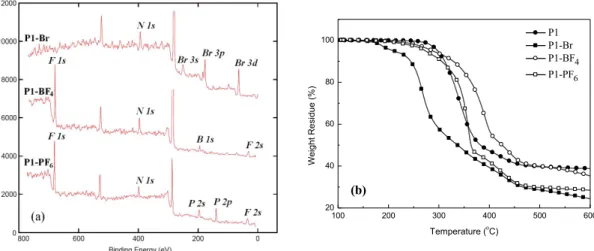
The electron spectroscopy for chemical analysis (ESCA) was used to examine the ionic exchange of polymers. Figure 2
(a) shows the ESCA spectra of ionic polymers P1-Br, P1-BF4, and P1-PF6. For P1-Br, a clear peak at 400 eV is found
and assigned as N 1s signal; three discrete peaks at 260, 180, and 80 eV are assigned as Br 3s, 3p, and 3d signals,
respectively, which means the incorporation of trimethylammonium bromide —N(CH3)3Br group on alkyl chain ends.
For P1-BF4, three new peaks are observed at 700, 190, 20 eV, belonging to F 1s, B 1s, and F 2s signals, while Br signals
are vanished, referring to successful replacement of Br− by BF4−. As for P1-PF6, two additional peaks at 195 and 150 eV
(assigned as P 2s and 2p signals) and existence of N 1s, F 1s, 2s signals also prove that Br− is replaced by PF
6− after ionic
exchange.
The solubility test also provides evidence of ionic exchange. P1 are soluble in many organic solvents, such as toluene,
tetrahydrofuran (THF), dichloromethane, and chlorobenzene (CB), while polymers P1-Br, P1-BF4, and P1-PF6 are not.
P1-Br can be dissolved in some high polar solvents, such as methanol, dimethyl sulfoxide (DMSO), and
N,N-dimethylformamide (DMF). After ionic exchange from Br− to BF
4− or PF6−, the solubility of resulting polymers P1-BF4
and P1-PF6 is significantly decreased in methanol, indicating change of nature of ionic polymers.
The thermal stabilities of P1 and its corresponding ionic polymers were investigated by TGA. Figure 2 (b) shows the
TGA thermograms of all polymers by heating from 100 to 600 oC. The decomposition temperatures T
d (defined as 5%
weight loss) were determined at 298, 211, 289, and 274 oC for P1, P1-Br, P1-BF
4, and P1-PF6, respectively. It is seen
that Td of three ionic polymers is lower than that of the original polymer P1, which is explained by the formation of
Hofmann elimination16. Nguyen et al. proposed that quaternary ammonium group on the side chain is cleaved and eliminated by heating over 180 oC. Besides, it is found that Td of P1-BF4 and P1-PF6 are much higher than that of P1-Br,
revealing that BF4− and PF6− groups possess resistance to thermal heating. It is concluded that ionic polymers bearing
PF4− and PF6− groups show improved thermal stability and bring benefit in device application, since the inner
100 200 300 400 500 600 20 40 60 80 100 W ei gh t Re si du e ( %) Temperature (o C) P1 P1-Br P1-BF4 P1-PF6 (b)
Figure 2. (a) ESCA spectra and (b) TGA thermograms of polymers P1, P1-Br, P1-BF4, and P1-PF6.
3.2 Optical properties of polymers
The UV-vis absorption spectra of polymers in film state are depicted in Figure 3 (a). The absorption maxima (λmax) of
polymers are located in the range of 388-400 nm, belonging to π-π* transition along the main chain. It is noted
absorption λmax of three ionic polymers are red-shifted compared with original polymer P1. The difference in absorption
spectra between original and ionic polymers can be attributed to polar effect. Polymers P1-Br, P1-BF4, and P1-PF6
contain many ionic groups, i.e., —N(CH3)3Br, —N(CH3)3BF4, and —N(CH3)3PF6, bringing closer packing of polymer
chains and leading to red-shift in absorption measurement.
The PL emission spectra of polymers in film state are shown in Figure 3 (b). All polymers reveal a major emission at 430 nm and an additional yellow emission around 560 mm arises, owing to energy transfer from fluorene to 2,1,3-benzoselenadiazole moieties. Combining two bands would bring white emission that can be utilized for lighting application. Furthermore, it is observed that intensity of the yellow emission band is decreased as quaternary ammonium group is tethered. The reason to this phenomenon is explained as follows. The heterocyclic 2,1,3-benzoselenadiazole is
known as an electron-deficient moiety; the nature of quaternary ammonium groups —N(CH3)3Br, —N(CH3)3BF4, and —
N(CH3)3PF6 are also electron-transport dominating. The competition between these two moieties would lower the ratio
of carrier recombination on 2,1,3-benzoselenadiazole and, in consequence, decrease yellow emission band for those ionic polymers. 300 350 400 450 500 550 600 0.0 0.2 0.4 0.6 0.8 1.0 A bsorbance (a. u. ) Wavelength (nm) P1 P1-Br P1-BF4 P1-PF6 (a) 400 450 500 550 600 650 0.0 0.2 0.4 0.6 0.8 1.0 No rmal ized PL Intensi ty (a .u.) Wavelength (nm) P1 P1-Br P1-BF4 P1-PF6 (b)
3.3 Evaluation of LECs
EL characteristics of white LECs based on P1-BF4 and P1-PF6 were measured to evaluate their applications in LECs.
The data of devices based on P1-Br is not involved since it is rather unstable under electrical driving. It would be attributed to the degradation of polymers caused by Hofmann elimination, as discussed in the section 3.2. The white LECs have the structure of indium tin oxide (ITO) (120 nm)/ PEDOT:PSS (30 nm)/emissive layer/Ag (100 nm), where
the emissive layer is a thin film of P1-BF4 370 nm or P1-PF6 380 nm for each device. The EL spectra of white LECs
based on two polyelectrolytes under various bias voltages are shown in Figure 4. Simultaneous EL emissions from the blue emitting fluorene segments and the yellow emission were measured in all devices. However, the bias voltage and the thickness of the emissive layer affect the relative amount of the yellow emission with respect to the blue one, resulting in altered white EL spectra. In these white LECs, electrochemically doped regions of the emissive layer result in ohmic contact with metal electrodes and consequently facilitate carrier injection onto both the fluorene segments and the 2,1,3-benzoselenadiazole moieties. Hence, both exciton formation on the higher-gap fluorene followed by energy transfer to the lower-gap benzoselenadiazole and direct exciton formation on the lower-gap 2,1,3-benzoselenadiazole induced by charge trapping contribute to the yellow emission. At a lower bias, e.g., 3 V, carrier injection and trapping on the smaller-gap 2,1,3-benzoselenadiazole would be favored and thus direct exciton formation on the lower-gap chromophore would lead to more significant yellow emission, as shown in Figure 4 (a). As the bias increases, carrier injection and exciton formation on the higher-gap fluorene is facilitated and subsequent partial energy transfer dominates the yellow emission, resulting in less significant yellow emission. Yellow emission mainly comes from partial energy transfer from blue excitons on the fluorene to electron-deficient 2,1,3-benzoselenadiazole. EL spectra
of P1-PF6 exhibited similar evolution trends when the bias voltage and the thickness of the emissive layer are varied, as
shown in Figure 4 (b). These results show that white LECs based on these PF electrolytes at 3.3 V show CIE’1931 coordinates close to (0.33, 0.33) and good CRI > 85, which are essential for solid-state lighting applications.
All white LECs based on polyelectrolytes P1-BF4 and P1-PF6 showed similar time-dependent EL characteristics. The
time-dependent brightness and current density of P1-BF4 device under constant biases of 3.0~3.5 V are shown in Figure
5 (a). After the bias was applied, the device current first rose and then stayed rather constant. On the other hand, the brightness first increased with the device current, reaching maximum values before undergoing gradual decreases over time. The time required for the brightness to reach its maximum value decreased as the bias voltage increased, presumably because a higher accumulation rate of mobile ions facilitated the formation of electrochemically doped
regions under a higher electric field. The maximum brightness of P1-BF4 device reached 17, 151, and 226 cd/m2 under
biases of 3.0, 3.3 and 3.5 V, respectively. The brightness then dropped with time with a rate depending on the bias voltage (or current). The lifetime of devices was decreased upon increasing the bias voltage. It results from that higher current density induced by a higher bias voltage led to a higher rate of irreversible multiple oxidation and subsequent decomposition of the emissive material, thereby accelerating the degradation of the LEC devices17. The external
quantum efficiency (EQE) and power efficiency of P1-BF4 device under constant biases of 3.0~3.5 V are shown in
Figure 5 (b). Immediately after a forward bias was applied, the EQE was rather low because of unbalanced carrier injection. During the formation of the doped regions near the electrodes, the balance of the carrier injection was improved and, accordingly, the EQE of the device increased rapidly. The peak EQE and peak power efficiency for P1-BF4 device under 3 V were 0.4% and 0.79 lm W–1, respectively.
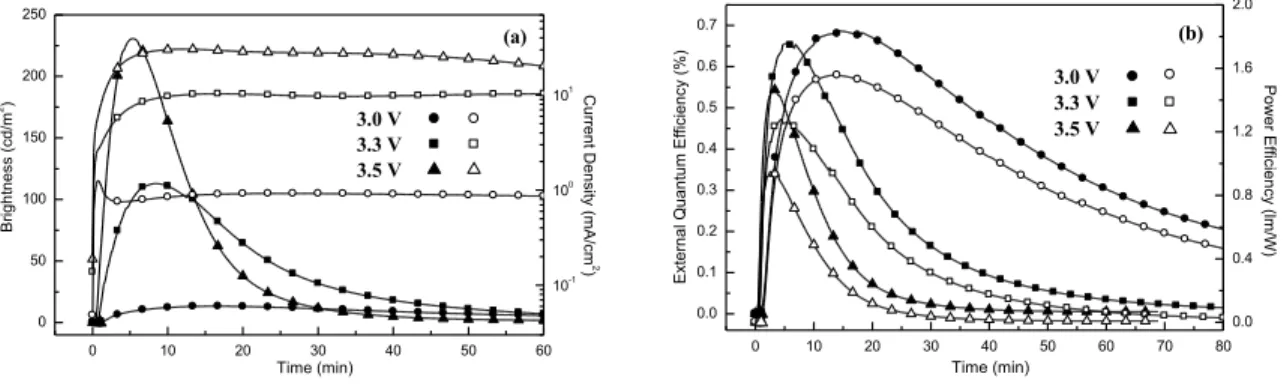
The time-dependent brightness/current density and EQE/power efficiency of P1-PF6 device under constant biases of
3.0~3.5 V are shown in Figure 6 (a) and (b), respectively. Replacing BF4− anions with larger PF6− anions did not
significantly alter the trend in the time-dependent EL characteristics of the white LECs. However, the device response is slower in devices containing larger PF6− anions due to a lower ionic mobility of larger anions in the emissive layer18. In
addition, devices employing PF6− counterions exhibited lower device current density and thus longer device lifetimes
were obtained compared with P1-BF4 device. It is noted that the thicker P1-PF6 device showed high peak EQE and
power efficiency up to 0.69% and 1.56 lm W-1, respectively. These results are approaching the upper limit (~0.8%) that
one would expect from the PLQY of the thin film of P1-PF6 (16%, measured by fluorescent spectrophotometer equipped
with integrating sphere) when fluorescent spin statistics of ca. 25% and an optical out-coupling efficiency of ca. 20% are estimated. Thus, superior carrier balance in white LECs based on P1-PF6 could be speculated. It may result from the
bipolar characteristic of the molecular structure of P1-PF6, which is consisted of hole transporting fluorene segments and
white-light polymer LECs9. Furthermore, white EL spectra with CIE coordinates approaching (0.33, 0.33) and high CRI
> 85 have been reported for the first time in polymer white LECs to the best of our knowledge. 400 500 600 700 800 0.0 0.3 0.6 0.9 1.2 1.5 (a) 3.0 V 3.3 V 3.5 V E L Int ensi ty (a. u. ) Wavelength (nm) 400 500 600 700 800 0.0 0.3 0.6 0.9 1.2 1.5 (b) 3.0 V 3.3 V 3.5 V EL In te nsit y (a .u .) Wavelength (nm)
Figure 4. EL spectra of LEC devices based on (a) P1-BF4 and (b) P1-PF6 under different bias operation.
0 10 20 30 40 0 50 100 150 200 250 100 101 102 (a) 3.0 V 3.3 V 3.5 V Br ig ht ne ss (c d/ m 2) Time (min) C urr en t D en si ty (mA/cm 2 ) 0 10 20 30 40 50 0.0 0.1 0.2 0.3 0.4 0.0 0.2 0.4 0.6 0.8 1.0 (b) 3.0 V 3.3 V 3.5 V Ext er na l Q ua ntum Ef fici en cy (%) Time (min) Powe r Ef fici en cy (lm/ W )
Figure 5. (a) Brightness-time-current density and (b) external quantum efficiency-time-power efficiency curves of LEC device based on P1-BF4. 0 10 20 30 40 50 60 0 50 100 150 200 250 10-1 100 101 (a) 3.0 V 3.3 V 3.5 V Bri g h tn e ss (cd /m 2) Time (min) C u rren t D e n si ty ( mA/cm 2 ) 0 10 20 30 40 50 60 70 80 0.0 0.1 0.2 0.3 0.4 0.5 0.6 0.7 0.0 0.4 0.8 1.2 1.6 2.0 (b) 3.0 V 3.3 V 3.5 V Ex terna l Q ua ntum Ef ficie ncy (%) Time (min) Powe r Ef ficie ncy (lm/ W )
Figure 6. (a) Brightness-time-current density and (b) external quantum efficiency-time-power efficiency curves of LEC device based on P1-PF6.
4. CONCLUSIONS
A series of PF electrolytes bearing Br−, BF4−, and PF6− counterions on the side chains were synthesized and characterized.
Electron-deficient 2,1,3-benzoselenadiazole moieties were copolymerized into PF main chains to produce white light. Polymers P1-BF4 and P1-PF6 were found to suppress the formation of Hoffmann elimination and to increase thermal
stabilities. All polymers showed two emission bands around 430 and 560 nm in thin film state; in addition, the intensity of the yellow emission band was decreased as quaternary ammonium group is tethered. Electrochemical analysis
revealed that oxidation potentials of P1-BF4 and P1-PF6 were significantly decreased compared to their original polymer
P1. Single-component white LECs were fabricated using P1-BF4 and P1-PF6 as active layer, without adding additional
inorganic salts. Characteristics including high luminescence efficiency of 1.56 lm/W, pure white EL emission, and high CRI values demonstrated the best device result among white-light polymer LECs so far.
REFERENCES
[1] Grimsdale, A. C., Chan, K. L., Martin, R. E., Jokisz, P. G., and Holmes, A.B., "Synthesis of light-emitting conjugated polymers for applications in electroluminescent devices," Chem. Rev. 109, 897-1091 (2009). [2] Cheng, Y. J., Yang, S. H., and Hsu, C.S., "Synthesis of conjugated polymers for organic solar cell applications,"
Chem. Rev. 109, 5868-5923 (2009).
[3] Herguth, P., Jiang, X., Liu, M. S., and Jen, A. K.-Y., "Highly efficient fluorene- and benzothiadiazole-based conjugated copolymers for polymer light-emitting diodes," Macromolecules 35, 6094-6100 (2002).
[4] Luo, J., Li, X., Hou, Q.. Peng, J., Yang, W., and Cao, Y., "High-efficiency white-light emission from a single copolymer: fluorescent blue, green, and red chromophores on a conjugated polymer backbone," Adv. Mater. 19, 1113-1117 (2007).
[5] Oh, S. H., Na, S. I., Nah, Y. C., Vak, D., Kim, S. S., and Kim, D. Y., "Novel cationic water-soluble polyfluorene derivatives with ion-transporting side groups for efficient electron injection in PLEDs," Org. Electron. 8, 773-783 (2007).
[6] Hoven, C. V., Garcia, A., Bazan, G. C., and Nguyen, T. Q., "Recent applications of conjugated polyelectrolytes in optoelectronic devices," Adv. Mater. 20, 3793-3810 (2008).
[7] Pei, Q., Yu, G., Zhang, C., Yang, Y., and Heeger, A. J., "Polymer light-emitting electrochemical cells," Science 269, 1086-1088 (1995).
[8] Kosilkin, I. V., Martens, M. S., Murphy, M. P., and Leger, J. M., "Polymerizable ionic liquids for fixed-junction polymer light-emitting electrochemical cells," Chem. Mater. 22, 4838-4840 (2010).
[9] Norell Bader, A. J., Ilkevich, A. A., Kosilkin, I. V., and Leger, J. M., "Precise color tuning via hybrid light-emitting electrochemical cells," Nano Lett. 11, 461-465 (2011).
[10] Sun, M., Zhong, C., Li, F., Cao, Y., and Pei, Q., "A fluorene-oxadiazole copolymer for white light-emitting electrochemical cells," Macromolecules 43, 1714-1718 (2010).
[11] Tang, S., Pan, J., Buchholz, H., and Edman, L., "white light-emitting electrochemical cell," Appl. Mater. Interfaces 3, 3384-3388 (2011).
[12] He, L., Qiao, J., Duan, L., Dong, G., Zhang, D., Wang, L., and Qiu, Y., "Toward highly efficient solid-state white light-emitting electrochemical cells: blue-green to red emitting cationic iridium complexes with imidazole-type ancillary ligands," Adv. Funct. Mater. 19, 2950-2960 (2009).
[13] He, L., Duan, L., Qiao, J., Dong, G., Wang, L., and Qiu, Y., "Highly efficient blue-green and white light-emitting electrochemical cells based on a cationic iridium complex with a bulky side group," Chem. Mater. 22, 3535-3542 (2010).
[14] Liu, B. and Bazan, G. C., "Optimization of the molecular orbital energies of conjugated polymers for optical amplification of fluorescent sensors," J. Am. Chem. Soc. 128, 1188-1196 (2006).
[15] Guo, X., Qin, C., Cheng, Y., Xie, Z., Geng, Y., Jing, X., Wang, F., and Wang, L., "White electroluminescence from a phosphonate-functionalized single-polymer system with electron-trapping effect," Adv. Mater. 21, 3682-3688 (2009).
[16] Lin, C. Y., Garcia, A., Zalar, P., Brzezinski, J. Z., and Nguyen, T. Q., "Effect of thermal annealing on polymer light-emitting diodes utilizing cationic conjugated polyelectrolytes as electron injection layers," J. Phys. Chem. C 114, 15786-15790 (2010).
[17] Parker, S. T., Slinker, J. D., Lowry, M. S., Cox, M. P., Bernhard, S., and Malliaras, G. G., "Improved turn-on times of iridium electroluminescent devices by use of ionic liquids," Chem. Mater. 17, 3187-3190 (2005). [18] Rudmann, H., Shimada, S., and Rubner, M. F., "Solid-state light-emitting devices based on the tris-chelated
ruthenium(II) complex. 4. High-efficiency light-emitting devices based on derivatives of the tris(2,2’-bipyridyl)ruthenium(II) complex," J. Am. Chem. Soc. 124, 4918-4921 (2002).