Chapter III
Diurnal Retreat Site Selection by the Arboreal Chinese Green Tree Viper (Trimeresurus s. stejnegeri) as Influenced by Temperature
Introduction
Habitat selection of snakes is influenced by complex biotic and abiotic factors (reviewed in Reinert 1993), of which the availability of suitable retreat sites is a critical determinant (Shah et al. 2004). Many nocturnal lizards and snakes spend long periods concealed in their diurnal retreat sites (Huey et al.
1989, Webb et al. 2004). Research on the selection of retreat sites by snakes is conducive to understanding their habitat utilization behaviors and needs (Shah et al. 2004). Furthermore, it is a less demanding undertaking than attempting to describe an entire environment of an actively moving animal (Webb and Shine 1998b, Shah et al. 2004).
Safety or predator avoidance is considered the most critical factor that determines how a reptile may choose its retreat sites or microhabitats (Downes and Shine 1998, Theodoratus and Chiszar 2000, Downes 2001, Blouin-Demers and Weatherhead 2002, Stapley 2003). With respect to arboreal lizards or snakes that do not normally hide in holes or crevices, the selection of a dense vegetative structure can provide cover and protection from predators (Lillywhite and
Henderson 1993, Mullin and Cooper 2000, Fitzgerald et al. 2003, Pringle et al.
2003, Reaney and Whiting 2003, Shah et al. 2004). Therefore, the complexity and density of vegetative structure should be an important determinant in the arboreal reptile’s selection of retreat sites.
Prey acquisition or foraging requirements is another important cue for snakes when selecting retreat sites. This is especially true for “sit-and-wait” predators, since a poor choice may significantly affect their hunting efficiencies (Downes 1999). It has been supported by studies which show that reptiles prefer habitats with high prey abundance (Houston and Shine 1994b, Mullin and Cooper 2000, Theodoratus and Chiszar 2000, Blouin-Demers and Weatherhead 2002, Shine and Sun 2002, Shine et al. 2002, Heard et al. 2004, Tsairi and Bouskila 2004).
For example, the odors of small mammal prey (chemical cues) played an important role in the microhabitat selection of timber rattlesnakes (Crotalus horridus) in long-term studies (Reinert et al. 1984, Reinert 1993).
Additionally, temperature is a basic factor that influences the choice of retreat sites for many reptiles (Dial 1978, Huey et al. 1989, Webb and Shine 1998b, Kearney 2002, Pringle et al. 2003). The body temperature of ectotherms can influence their physiology, ecological and behavioral performance (Huey and Kingsolver 1989, Brodie and Russell 1999, Shine et al. 2000). Reptiles rely on specific components of their habitat to maintain appropriate body temperature (Christian et al. 1983, Kearney 2002, Heard et al. 2004). Webb et al. (2004) reported that both the broad-headed snake (Hoplocephalus bungaroides) and the common small-eyed snake (Cryptophis nigrescens) used substrate temperature as a cue to choose among potential retreat sites. Suitable retreat sites should not
only provide refuges, but also fulfill thermoregulation requirements during inactive periods.
Although predator avoidance, prey availability, and thermoregulation needs are three key factors that appear to have major influence over a snake’s selection of retreat site; the complex correlations among factors make it difficult to pin down any specific causal determinant (Shah et al. 2004). It has been demonstrated that some reptiles use multiple cues in making decisions regarding retreat site selection (Reinert 1993, Webb and Shine 1997b, Downes and Shine 1998, Downes 1999, Theodoratus and Chiszar 2000, Fitzgerald et al. 2002, 2003, Stapley 2003, Shah et al. 2004). For example, a snake’s choice of certain microhabitats often represents a compromise between predation risk and resource acquisition (Downes 2001). Heard et al. (2004) discovered that habitats providing both favorable physical structure and prey availability were more attractive to the inland carpet python (Morelia spilota metcalfei) than habitats with only high prey availability. Thick-tailed geckos (Nephrurus millii) displayed a strong preference for retreat sites which offered the dual advantages of enhanced thermoregulation and predator avoidance (Shah et al. 2004).
However, relative to lizard, bird and mammal taxa, the role of proximate cues in influencing the retreat site selection of snakes is less well understood (Huey et al. 1989, Webb and Shine 1997b, Heard et al. 2004, Webb et al. 2004, Fitzgerald et al. 2005). This may be attributable to the inherent difficulties in quantifying and manipulating the attributes and the range of habitats used by creatures with a propensity to conceal themselves in their surroundings such as snakes (Shah et al. 2004). Therefore, in a controlled laboratory manipulating or
field enclosure is probably more suitable for investigating the cues used by such creatures in selecting retreat sites (Downes and Shine 1998, Webb and Shine 1998b, Shah et al. 2004).
The Chinese green tree viper (Trimeresurus s. stejnegeri) is one of the most common snakes in Taiwan and an excellent model for studying retreat site selection. This serpent is a “sit-and-wait” predator with nocturnal and arboreal tendencies (Tu et al. 2000). Green tree vipers often retreat into vegetation during daytime hours and at dusk they move to ambush sites (Tu et al. 2000, Xiao 2000).
They usually spend several days (sometimes up to two weeks) around the same ambush site waiting for prey (Lin H, unpublished). Although several factors influencing microhabitat selection by green tree vipers in the field has been suggested (Tu et al. 2000), further investigations are required to reach unambiguous conclusions.
I used an experimental approach to investigate the role of prey availability and vegetation density with respect to diurnal retreat site selection of the Chinese green tree viper in outdoor enclosures. I address two basic questions: 1. Do green tree vipers tend to retreat to locations closer to the source of prey? 2. Do green tree vipers tend to select retreat sites with denser vegetation for safety’s sake? In order to take into consideration of air temperature, I conduct further investigation into a third question: Would the selection of retreat site under different ambient temperatures change with seasonal changes?
Materials and methods
Outdoor enclosures
Two outdoor enclosures (length: 12.0 m; width: 2.4 m; height: 3.0 m) were constructed using stainless steel pillars and mesh at the Taipei Zoo, Taiwan.
The top of each enclosure was covered with opaque plastic plates and enclosed on all sides with black shading nets. The floors were made of smooth concrete.
Twelve sets of fluorescent lights, each with three 40-Watt lamps, were installed at 45-cm intervals, and were controlled by timers which turned the lights on at 0700 hrs and off at 1730 hrs each day.
Each enclosure was partitioned into two sections: the vegetation area (length:
10.0 m; width: 2.4 m) and the smaller foraging area (length: 2.0 m; width: 2.4 m) (Fig. 3-1A). Within the vegetation area, horticultural pots of Schefflera arboricola were provided as potential retreat sites for the vipers. The foliage and
branch structure of S. arboricola are similar to those of S. odorata, one of the most common plants in which green tree vipers retreat in the field (Lin H, unpublished). Each S. arboricola pot was 1.3-1.4 m in height, and formed a tree-crown about 0.7 m in diameter. I used potted plants to allow easy manipulation and control of vegetation cover and shade. After each trial, the leaves and branches of each plant were sprayed with ethanol (Tsai and Tu 2005) and rinsed with fresh water for ten minutes in order to remove the scent of snakes from the vegetation.
At the center of foraging area is a square water pool (1.5 m × 1.5 m) with a water depth of 5-10 cm. Paddy frogs (Rana limnocharis limnocharis), a common prey of green tree vipers in the field (Mao 1970), were provided in the foraging
area as food for snakes during the prey availability experiments. Pebbles and aquatic plants were provided to shelter the paddy frogs. A perching log (length:
2.5 m; diameter: 10 cm) was positioned above the water to provide an ambush-site for the vipers (Fig. 3-1A). The paddy frogs were fed meal worms and crickets daily. In order to effectively confine the frogs within the foraging area, a vertical stainless steel wall with smooth surface (height: 0.9 m; thickness:
1 mm) was installed between the foraging and vegetation sections. Two 2-cm-diameter ropes were placed between the log above the pool and plants adjacent to the stainless steel partition, to allow the vipers to travel between the foraging and vegetation areas (Fig. 3-1B).
Collection and housing of snakes
I collected 186 Chinese tree vipers, from northern Taiwan, including the regions of Wulai, Sanchih, Yuanshan, Tsaochiao and Nuannuan. Only adult males, characterized by a snout-vent length more than 37 cm (Tsai and Tu 2000), were included in this study in order to avoid any experimental bias due to juvenile-adult or female-male interactions or the influence of gravid females.
The snakes were housed in a single room in the Taipei Zoo. Each individual snake was marked with a unique number on the dorsal scales using a water-resistant marker for identification purposes. Tree vipers tend not to interact in an antagonistic or repellent manner; in fact, they generally ignore each other’s presence even when they are in physical contact or in ambush positions on the same or adjacent sites in the field or laboratory (Lin H, unpublished). Therefore, the vipers were housed in groups of five in commercial aluminum netted cages
(length: 50 cm; width: 50 cm; height: 75 cm). Each cage was covered with paper substrates and contained a pot of Schefflera arboricola, a small water dish.
Snakes were fed paddy frogs every 10 days, and supplied with water ad libitum.
Lighting in the room was adjusted to match the appropriate photoperiod in the outdoor enclosures. Each snake was tested only once, and released back to their exact capture locations after the experimental trials were completed.
Data collection
In order to eliminate experimental bias from possible differences in thermoregulation requirements between tree vipers in postprandial and preprandial state (Tsai and Tu 2005), snakes in a postprandial state would not be immediately released into the enclosures for experimental trials. A preliminary study showed that none of the snakes would perch themselves completely on the plants until the third day after being released into the enclosure. Therefore, data collection began on the third day. Time, ambient temperature, vipers’ motion, posture, location, perch site and perch height were recorded for each experimental trial while surveyors entered the enclosures during the daytime.
Postures were categorized as follows: (1) When a viper was stationary and coiled with its head in the center, or laid its head on its body, it was deemed as being in a “resting” position. (2) When a viper was stationary with its neck and fore body positioned in a sigmoid shape, and its head pointed downward, it was deemed as bring in a “foraging” position. In order to compare differences in temperature between different strata of vegetation as well as different vegetation densities, the data at shaded air temperatures in the upper (130cm-height), middle
(80cm-height) and lower strata (28cm-height) of the different vegetation densities was recorded using data loggers (Dickson TK120, USA) every two hours during the experiments conducted in 2005. For each trial, five to ten vipers were released into the vegetation area during late afternoon.
Activity patterns
Activity patterns for nine green tree vipers were established in August 2002.
Two columns of 14 pots of S. arboricola were positioned at intervals of 30 cm within the vegetation area. Within the foraging area, 15 paddy frogs were maintained in the pool to enhance prey availability and provide a choice for retreat site selection of the vipers. The activities and behavior of the green tree vipers were observed for every two hours over a 24 hour period.
Prey availability
I studied the role of prey availability and perch site selection of 48 green tree vipers between November 2002 and October 2005. Vegetation areas were subdivided into two plots, C1 (beside the foraging area) and C2 (away from the foraging area). Two columns of seven S. arboricola pots were positioned at 30-cm intervals within each plot. To ensure ample prey availability, the paddy frog population was maintained at a 3:2 ratio to the tree viper population within the enclosures. Vipers were released randomly on plot C1 or plot C2 during each trial. Each viper’s preferred retreat site, C1 versus C2, was determined based on a chi-square test.
Perch height and temperature
The activity pattern indicated that green tree vipers tended to move to lower layers of vegetation after 1200 hrs, when the ambient temperature increased (see Results). To further investigate the relationship between perch height and ambient temperature, I pooled data from the activity pattern (n = 9) and prey availability experiments (n = 43, 5 individual snakes were disqualified because they were on the ground under vegetation during the recording visits) with the same vegetation arrangement.
Vegetation density and temperature
Between August 2002 and November 2005, I studied the effects of vegetation density and structure on retreat site selection of 129 green tree vipers.
Eight S. arboricola pots were placed in a single column within the vegetation area, and manipulated the percentage of vegetation coverage by changing the distance between pots and foliage. Average relative coverage (ARC) of each treatment was calculated. ARC is mean illumination from the upper (130cm-height), middle (80cm-height) and lower (28cm-height) strata of each plant divided by the concurrent illumination of the open area without shade within the enclosure. Illumination was measured with Lutron illumination readers (Lutron Lx-101, Taiwan).
I established four levels of vegetation density: (1) dense (D), with a pot interval of 15 cm (Mean ± SD: ARC = 0.14 ± 0.09, n = 24); (2) medium (M), with a pot interval of 30 cm (Mean ± SD: ARC = 0.23 ± 0.14, n = 24); (3) loose (L), with a pot interval of 45 cm (Mean ± SD: ARC = 0.31 ± 0.19, n = 24); and
(4) foliage stripped (F), with a pot interval of 45 cm, with all foliage stripped from the plants (Mean ± SD: ARC = 0.53 ± 0.17, n = 24). The vegetation area was evenly divided into two longitudinal halves in each with a different vegetation density. Three pairwise comparisons of vegetation densities were performed: L vs. M, M vs. D, and L vs. F, and made the comparisons in random order. The position of column of each vegetation density was replaced randomly after each experimental trial. Vipers also were released randomly in each column with a different vegetation density for each trial. The distribution of the retreat sites selected by the snakes was compared with tests involving vipers that preferred retreating into more dense vegetation. Therefore, to distinguish the effects of different ambient temperatures in the enclosures, I divided vipers’
distribution data into two categories: hot season – ambient temperature above 25℃ and cool season – ambient temperature below 25℃ .
Results
Activity pattern
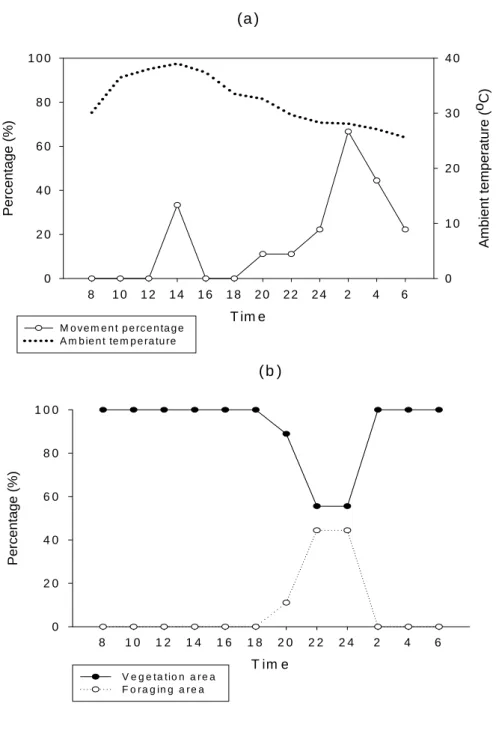
Movements of the green tree vipers mainly occurred at night (Fig. 3-2A).
Activities started after 1800 hrs and reached its peak at 0200 hrs. During this activity peak, over 40% of individual snakes moved to the foraging area (Fig.
3-2B). By 0600 hrs, the vipers gradually ceased all movement. Observations made during the night showed all of the stationary vipers in a foraging position.
During the daytime, all of the vipers would perch within the vegetation area,
most of which (89%) were in a resting position. Only 11% of the individual snakes were observed in a foraging position during the daytime. A secondary peak of activity would occur between 1200 hrs and 1600 hrs when the vipers moved vertically to lower layers of vegetation. This behavior was coincident with the rise in the ambient temperature within the test enclosures after midday (Fig. 3-2A).
Prey availability
The selection of retreat sites in the vegetation area did not appear to be influenced by the distance to food source. The frequency of green tree vipers in the C1 (beside the foraging area) versus C2 (away from the foraging area) were similar (Chi-square test: C1 = 27, C2 = 21, x2 = 0.75, df = 1, p = 0.386). The snakes did not exhibit a significant preference for retreat into areas closer to food sources.
Perch height and temperature
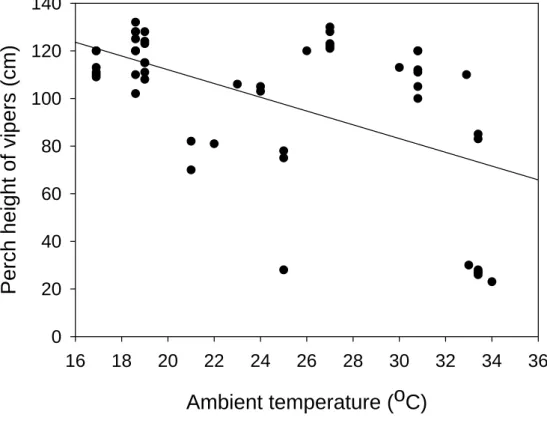
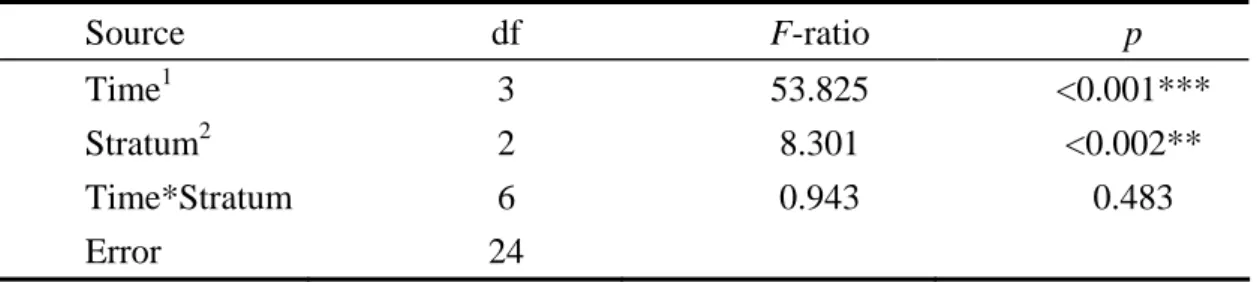
A significant inverse relationship between perch height and ambient temperature was found (Fig. 3-3). Vipers tended to stay on the lower stratum of vegetation when ambient temperature was high. The concurrent shaded temperatures were significantly different among the three strata in the hot season (Table 3-1A). In particular, when vipers moved from high to low stratum at 1300 hrs, the shaded temperature within the bottom strata was significantly lower than those of the upper and middle strata (ANOVA, Scheffe Test, Mean ± SD: upper stratum = 32.76 ± 0.42°C A, middle stratum = 32.07 ± 0.24°C A, lower stratum
= 29.64 ± 1.51°C B, F = 9.542, p = 0.014). However, there was no significant difference in the shaded temperature between the lower and upper strata during the cool season (Mean± SD: upper stratum = 17.65 ± 1.34°C, middle stratum = 17.65 ± 1.16°C, lower stratum = 17.27 ± 1.22°C, F = 0.001, p = 0.998) (Table 3-1B).
Vegetation density and temperature
Fifty-seven green tree vipers were studied to determine their preference of retreat sites in vegetation of densities L and M, respectively. Overall, vipers significantly preferred retreating into medium rather than low vegetation density (Chi-square test: L = 19, M = 38, x2 = 6.333, df = 1, p = 0.011). However, the preference was significant only during the hot season (p = 0.012) and not during the cool seasons (Fig. 3-4A). Shaded temperature was significantly lower from 0900 hrs. to 1500 hrs. at density M than density L during the hot seasons (Paired t test, Mean ± SD: M = 29.72 ± 1.99°C, L = 30.36 ± 2.06°C, n = 27, t = 5.728, p
< 0.001). During the cool seasons there was no difference in shaded temperatures between two types of vegetation density (Paired t test, Mean ± SD:
M = 18.28 ± 2.44°C, L = 18.23 ± 2.48°C, n = 27, t = -1.12, p = 0.273).
Fifty-two green tree vipers were tested to determine their preference of retreat sites between vegetation density M and D, but no significant difference in the snakes’ selections of retreat site attributable to the differences in vegetation density (Chi-square test: M = 23, D = 29, x2 = 0.692, df = 1, p = 0.405) was found in either the hot or cool seasons (Fig. 3-4B). However, shaded temperature in vegetation density D was significantly lower than that in vegetation density M
during both the hot (Paired t test, Mean ± SD: D = 25.83 ± 1.61°C, M = 26.61 ± 1.74°C, n = 27, t = -9.536, p < 0.001) and cool (Paired t test, Mean ± SD: M = 19.63 ± 1.14°C, D = 19.48 ± 1.21°C, n = 27, t = -3.29, p = 0.004) seasons.
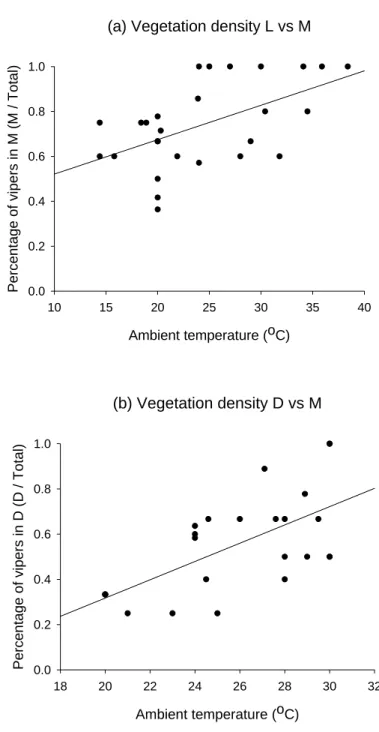
In order to further investigate the correlation between retreat site selection and ambient temperature, I pooled data samples from the third, fourth, and fifth morning visits during the hot season and cool season. For vegetation density L and M, there was a significant correlation between the frequency at which snakes remained in M type vegetation cover and the ambient temperatures (correlation analyses: p = 0.004, R = 0.539, Fig. 3-5A). In comparing vegetation densities M vs. D, there was also a significant correlation between the frequency of the snakes perched in vegetation density D and the ambient temperature (correlation analyses: p = 0.001, R = 0.627, Fig. 3-5B). My observations indicated that under high ambient temperatures, the green tree vipers would consistently chose shaded areas with lower temperature, M instead of L, and D instead of M.
Between October and November 2005, twenty green tree vipers were tested for selection of retreat sites in vegetation density L and F. The results showed that all vipers selected vegetation density L and none retreated in vegetation density F (Chi-square test: L = 20, F = 0, x2 = 20, df = 1, p < 0.0001). There was no significant difference in shaded temperature within vegetation between F and L (Paired t test, Mean± SD: F = 21.99 ± 1.31°C, L = 22.01 ± 1.27°C, n = 27, t = -0.247, p = 0.807).
Discussion
An animal’s choice of a retreat site reflects a set of decisions that give priority to certain factors over others (Downes and Shine 1998). I discovered that relative to vegetation density and/or prey availability, available thermal conditions appeared to be the most significant temporal cue to influence the retreat site selection of the green tree viper. According to previous studies, reptiles within retreats often adjust their posture or position to exploit the thermal gradients to regulate body temperature (Losos 1987, Huey et al. 1989, Kearney and Predavec 2000). The vertical movements of green tree vipers in enclosures appear to be position adjustments to achieve optimum thermal regulation. The crowned vegetation canopy provides a wide range of temperatures due to solar radiation and radiative cooling (Lillywhite and Henderson 1993). Although the top of enclosures was not transparent, solar radiation could still pass through.
The screening effect provided by the plant leaves resulted in a lower temperature within the lower strata of the vertical vegetation structure, which helped to form a distinctive thermal gradient. A positive correlation between a snake’s perch height in the tree and its body temperature was observed (Fitzgerald et al. 2003).
Green tree vipers may utilize this temperature gradient to accommodate variations in their thermal needs. Snakes tend to move vertically between the upper and bottom strata to achieve optimum thermoregulation in the daytime. At high ambient temperatures, vipers tended to remain at the lower stratum of the vegetation, where the temperature was lower. This phenomenon was especially obvious when the ambient temperature was higher than 28°C. Tsai and Tu (2005)
discovered that the preferred fasting temperature of Chinese tree vipers in the laboratory was 20.3 - 24.3°C. Therefore, I believe that the vipers tend to move towards the lower stratum of vegetation in order to reach their preferred temperature to achieve thermal regulation when the ambient temperature is high.
The types of vegetation density selected by green tree vipers as retreat sites are also influenced by temperature cues; moreover, the physical environment within a habitat structure may influence the thermal attributes and microclimate of a reptile’s selected habitat (Christian et al. 1983, Huey et al. 1989, Pringle et al. 2003, Heard et al. 2004, Tsairi and Bouskila 2004, Webb et al. 2004). When the ambient temperature is higher than 25°C, tree vipers prefer to retreat into denser vegetation (Fig. 3-4A, Fig. 3-5), which provides significantly lower shaded temperatures. In contrast, while the ambient temperature in the enclosures dropped to below 25°C, vipers did not appear to have a consistent preference for retreating into denser vegetation, apart from an apparent distaste for vegetation with only bare branches and little or no foliage. This may attributable to the fact that there is either no perceivable distinction in the shaded temperatures between sparse and dense vegetation, or the difference between the shaded temperature and the green tree vipers’ preferred temperature (20.3 - 24.3°C) is insignificant.
Nocturnal reptiles spend a large portion of their time sequestered in diurnal retreat sites where thermal conditions will make a strong impact on their long-term fitness (Huey et al. 1989, Kearney and Predavec 2000, Webb et al.
2004). Thermal requirements and exploitation of microclimates are the overriding determinants of temporal variations or seasonal differences in the
space utilization patterns of some reptiles (Christian et al. 1983, Kearney 2002, Heard et al. 2004). For example, the Galapagos land iguana (Conolophus pallidus ) exploits the warmer microclimate provided by the cliffs, which allow
the iguana to maximize the duration it is able to maintain a constant body temperature during the cool seasons (Christian et al. 1983). Webb et al. (2004) also proposed that the influence of temporally variable cues such as substrate temperature, may be particularly significant for habitat selections of both the broad-headed snake and the common small-eyed snake (Webb et al. 2004).
This study showed that temporal thermal conditions had significant influences on the retreat site selections of green tree vipers, and I suggest that the daily and seasonal differences in the space utilization patterns (perch height and vegetation density) may be for the purpose of satisfying their thermoregulation needs.
Small ectotherms appear to select their retreat sites with the objective of enhancing fitness (Webb and Shine 1998a, Mullin and Cooper 2000, Downes 2001, Shah et al. 2004). Tree vipers did not appear to have a consistent preference for retreating into denser vegetation. In the field, I also discovered that some green tree vipers at perch heights of less than two meters from the ground would frequently retreat upwards into trees, bushes, or ferns with sparser vegetation. Which leads us to an important question: Why don’t green tree vipers prefer to retreat into the denser, and presumably “safer”, vegetation structure?
There are few known diurnally visual predators of the green tree viper, but the crested serpent eagle (Spilornis cheela) is among the known predators (Lin 2005). One possible explanation may be that the diurnal raptors that fly in the sky, which cannot easily discover green tree vipers that rest in mid-layer
canopies or within the lower shrubs and ferns of a forest during the day, even in retreats having sparse vegetation. Additionally, cryptic (camouflage) coloration and immobilization are very important protective mechanisms that help arboreal reptiles to avoid or minimize the risk of being attacked by potential predators (Clark and Gillingham 1990, Lillywhite and Henderson 1993). Tree vipers’
arboreal behavior, linked with their green coloration and sedentary seclusion within branches and foliage, enhances their protection as they can go unnoticed by predators even as they rest in the upper canopy of vegetation structures during the day. Based on observations of two nesting pairs of crested serpent eagles during their entire brooding period, of the 65 recorded instances where snakes were taken as food for their chicks, only two episodes involved green tree vipers (Lin 2005). This is a very low frequency of predation considering the green tree viper’s abundance in the Taipei area.
Enhancing foraging advantage may be another reason why green tree vipers tend not to retreat into denser vegetation. A snake’s habitat selection of a particular structural complexity may reflect a compromise between protection from its predators and the snake’s visual ability to pursue its own prey (Mullin and Cooper 2000). Visual cues may be an important factor in a snake’s orientation to obtain prey (reviewed in Ford and Burghardt 1993, Shine and Sun 2002). The complexity of the vegetation structure may affect the ability of a snake to visually detect and pursue its prey (Mullin et al. 1998). A clear and bright line-of-view is necessary for the capture of prey (Mullin and Cooper 2000, Shine and Sun 2002, Shine et al. 2002). Green tree vipers primarily feed on frogs, lizards of Agamidae, birds, and rodents (Mao 1970, Lee and Lue 1996, Creer et
al. 2002). Some of them are diurnally arboreal species such as Japalura polygonata xanthostoma (Lin H, unpublished). Because green tree vipers may
encounter their arboreal prey when resting in trees during the day, selecting an excessively complex or dense vegetation structure is not conducive to detecting and attacking their prey.
Although I intuitively expected that green tree vipers would prefer retreat sites closer to prey resources, my research did not support this prediction. One reason may be due to the length of the artificial enclosure, which was insufficient when compared to physical conditions in the wild. Based on field observations of 55 vipers, the averaged foraging distance which is defined as the average distance between retreat sites during daytime and ambushing sites on the same night for each individual snake was 2.3 meters (Lin H, unpublished).
This distance is similar to those observed for some other arboreal snakes (Henderson et al. 1977, Lillywhite and Henderson 1993, Webb and Shine 1997a, Shine and Sun 2002). However, due to the difficulty of finding snakes that are perched high up in the trees, the foraging distance might be underestimated (Lillywhite and Henderson 1993, Heard et al. 2004). In this study, the vegetation I provided was an interlocking canopy that facilitated the green tree vipers’
movement without descending to the ground. Therefore, it was possible that the difference in time and energy spent by green tree vipers resting in different locations of the vegetation area may have been minimal in the 10 meter-long enclosures (vegetated areas). Consequently, no significant preference to prey resources was detected.
Furthermore, failure on the part of the green tree vipers to show a clear
preference for retreating into the close proximity of the pool area (where the frogs were located) may also be due to their ability to capture not only terrestrial prey but also arboreal species. Aside from diurnally arboreal prey, green tree vipers also feed upon various nocturnal tree frogs (Tu et al. 2000). High probability for encounters with prey is an important factor in the selection of microhabitats by the desert snakes (Echis coloratus ), but the key to predicting the future availability of prey by the desert snakes appears to relate to the type of microhabitat structure where prey is likely to appear rather than the actual odor of the prey (Tsairi and Bouskila 2004). Therefore, some vipers may not use the availability or odor of paddy frogs as the sole determinant for selecting a retreat site. They may select microhabitats where arboreal lizards and/or tree frogs appear more often at their retreat sites, rather than locations closest to the provided foraging area. Nighttime movements of green tree vipers for foraging purposes did not uniformly move towards the ground in the field (Tu et al.
2000). Likewise, my nighttime observations have also shown that over 50% of the snakes in the enclosures elected to stay on trees (Fig. 3-2B), all of which consistently remained in the foraging position. This comparison appears to provide further support for my conclusion that the selection of a retreat site is not solely determined by the abundance of terrestrial prey.
This study demonstrates that temperature is the most important temporal cue for retreat site selection for Chinese green tree vipers. The strong correlation between temperature and retreat site selection have the benefit of allowing snakes to better thermoregulate while remaining concealed. The absence of a consistent preference for retreating into denser vegetation on the part of the
snakes may reflect a compromise between protection from predators and acquisition of prey.
(A) Top view
(B) Side view
Figure 3-1. Arrangement of the foraging and vegetation areas in the outdoor enclosures. represents the log. represents
the water pool (foraging area). represents pots of S. arboricola (shelter vegetation). represents the climbing ropes. (A) Top view. (B) Side view.
2 m
Foraging area
2.4m
Vegetation area 10 m
Foraging area Vegetation area
(a )
T im e
8 1 0 1 2 1 4 1 6 1 8 2 0 2 2 2 4 2 4 6
Percentage (%)
0 2 0 4 0 6 0 8 0 1 0 0
Ambient temperature (o C) 0 1 0 2 0 3 0 4 0
M o v e m e n t p e rc e n ta g e A m b ie n t te m p e ra tu re
( b )
T im e
8 1 0 1 2 1 4 1 6 1 8 2 0 2 2 2 4 2 4 6
Percentage (%)
0 2 0 4 0 6 0 8 0 1 0 0
V e g e ta tio n a r e a F o r a g in g a r e a
Figure 3-2. (A) Activity pattern of green tree vipers and the ambient temperature within the enclosure during a 24 hr. period. Movement percentage = Moving individuals / total vipers (n = 9). (B) Percentage of individual snakes remaining in the foraging area or in the vegetation area during a 24-hour period.
Percentage = Number of individuals in the foraging or vegetation areas / total vipers (n = 9). Lights in the enclosures were turned on from 0730hrs to 1730hrs (the white area).
Ambient temperature (oC)
16 18 20 22 24 26 28 30 32 34 36
Perch height of vipers (cm)
0 20 40 60 80 100 120 140
Figure 3-3. The correlation between perch height of green tree vipers and ambient temperature within the enclosure (n = 52, p < 0.001***, R = -0.542).
(A) Vegetation density L vs. M
Hot season
Vegetation density
L M
Number
0 5 10 15 20 25
Cool season
Vegetation density
L M
Number
0 2 4 6 8 10 12 14 16 18 20
(B) Vegetation density M vs. D
Hot season
Vegetation density
M D
Number
0 2 4 6 8 10 12 14 16
Cool season
Vegetation density
M D
Number
0 2 4 6 8 10 12 14 16
Figure 3-4. The number of green tree vipers selecting different vegetation densities in hot seasons and cool seasons (Chi-square test). Vegetation densities were divided into three categories, including D (dense, with a pot interval of 15 cm), M (medium, with a pot interval of 30 cm), L (loose, with a pot interval of 45 cm). (A) Comparison between vegetation density L and M. (B) Comparison between vegetation density M and D.
x2=6.26
df= 1 P=0.012*
x2=2.13
df = 1 P=0.144
x2=0.03
df = 1 P=0.85
8
15 15
14 7
20
12
18
x2=1.20 df= 1 P=0.273
(a) Vegetation density L vs M
Ambient temperature (oC)
10 15 20 25 30 35 40
Percentage of vipers in M (M / Total)
0.0 0.2 0.4 0.6 0.8 1.0
(b) Vegetation density D vs M
Ambient temperature (oC)
18 20 22 24 26 28 30 32
Percentage of vipers in D (D / Total)
0.0 0.2 0.4 0.6 0.8 1.0
Figure 3-5. The correlation between the percentage of green tree viper’s perch selection in different vegetation densities and ambient temperature regimes.
Vegetation densities were divided into three categories, including D (dense, with a pot interval of 15 cm), M (medium, with a pot interval of 30 cm), L (loose, with a pot interval of 45 cm). (A) Comparison between vegetation density L and M (correlation: n = 27, p = 0.004**, R = 0.539). (B) Comparison between vegetation density M and D (correlation, n = 24, p = 0.001***, R = 0.627).
Table 3-1. Analysis of effects of time and stratum on shaded temperature (A) Hot season (Oct.4-6, 2005, n = 36). (B) Cool season (Dec. 10-12, 2005, n =36).
(A) Hot season
Source df F-ratio p
Time1 3 53.825 <0.001***
Stratum2 2 8.301 <0.002**
Time*Stratum 6 0.943 0.483
Error 24
(B) Cool season
Source df F-ratio p
Time1 3 0.704 0.559
Stratum2 2 0.211 0.803
Time*Stratum 6 0.007 1.000
Error 24
Two-way ANOVA
1Categories of variable “Time” are: 0900 hrs., 1100 hrs., 1300 hrs., and 1500 hrs.
2Categories of variable “Stratum” are upper (height = 130cm), middle (height = 80cm), and lower (height = 28cm).
*** p≦ 0.001