Chapter 1 outline
• Modeling
• Differential equation (DE): ODE 、 PDE
• Linear ODE
• 手繪 Directional field
• 求解 ODE:
• Separable ODE
• Non-separable ODE
Mathematical Models
• If we want to solve an engineering problem (usually of a physical nature), we first have to formulate the problem as a mathematical expression in terms of v ariables, functions, equations, and so forth.
• Such an expression is known as a mathematical mo del.
(Mathematical) Modeling
• The process of (1) setting up a model, (2) solving it m athematically, and (3) interpreting the result in physi cal or other terms; is called mathematical modeling, or, briefly, modeling.
• All math models can be solved (obtaining solutions) o ne way or the others. However this mathematical solu tion is not necessarily a solution to the engineering (p hysical) problem.
Physical System
Mathematical Model Mathematical Solution
Physical Interpretation
Differential Equations 微分方 程 (DE)
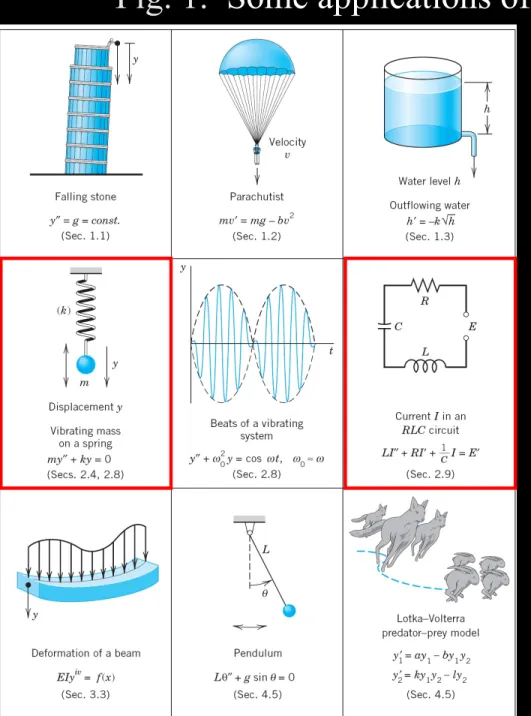
• Since many physical concepts, such as velocity and acceleration, are derivatives, a model is very often an equation containing derivatives of an unknown f unction.
• Such a model is called a differential equation.
Fig. 1. Some applications of differential equations
Newton’s second law of motion
x m x
dt m x m d
v m v
dt m m dv ma
F
v dt v
a dv
x dt x
v dx
2 2
Concept of a solution
• Given an simple ODE below, the solution y(x) is a fu nction of x, whose first derivative with respect to x i s cos x.
x
y cos
Classification of DEs
• ODE: Note that an ODE involves a function with on e independent variable ( 自變數 ) o
nly.
• PDE: For DEs with two or more independent var iables, we called them partial differential equations, or PDEs.
Concept of a solution
• Given an simple ODE below, the solution y(x) is a fu nction of x, whose first derivative with respect to x i s cos x.
• To solve the ODE is equivalent to ask the question – whose first derivative with respect to x is cos x?
• From calculus, we know that y = sin x satisfies this O DE, and is thus a solution.
• On the other hand, y = sin x + c1, where c1 is any con stant, also satisfies this ODE.
Formal Definition of a Solu tion
• A function
y = h(x)
is called a solution of a given ODE (4) on some ope n interval a < x < b if h(x) is defined and differentiab le throughout the interval and is such that the equa tion becomes an identity if y and y’ are replaced wit h h and h’, respectively.
The curve (the graph) of h is called a solution curve.
• The solution y(x) to a first-order ODE will involve one i ntegration constant. This constant can be often deter mined by supplying an initial condition (for example, y (0)=k1, or the value of y at x=0 is k1.) or a boundary co ndition (for example, y(a)=k2).
• Similarly, the solution y(x) to a second-order ODE will i nvolve two integration constants, which will need two conditions to solve. (We will see in a few lectures late r.)
Solution
• 若某個函數被稱為某 ODE 在開區間 a < x < b 的 解
• 則該函數在區間內有定義 且 可微分