
新世代液晶顯示器用調諧式光學活性化合物及聚合物之製備及特性研究 --- 場色序法液晶顯示器
62
0
0
全文
(2) 中 文 摘 要 : 本研究合成了一系列具有光學活性的Smectic C (SmC*)液晶化合物 ,所合成化合物的相轉移溫度及光電特性等均有詳細探討。所合成 具有鐵電型液晶特性化合物,更以DSC、POM、廣角WAX分析、及光電 特性分析確認。所合成的鐵電型液晶具有低熔點(<0°C),廣光學活 性Smectic C相溫度範圍,及高自發極性(Ps值,~130 nCcm-2)。由 於trisiloxane及甲基側鏈的導入,使形成具廣溫度範圍的SmC*液晶 。由WAXS分析,我們成功的製得高傾斜角配列的液晶槽。以所合成 液晶所製得的液晶槽,在10V/m的操作電壓下,具有0.3ms的操作速 率,可被應用於場色序法液晶顯示器。以所合成鐵電性液晶所製得 液晶顯示器,背光配以RGB三色燈源,進行實際顯示應用,具有相當 優異的光電特性500Hz(亦即,每一像素顯示可達166Hz以上)。以單 一液晶材料來說,本研究所合成的鐵電性液晶具有非常優異的光電 特性。 中 文 關 鍵 詞 : 鐵電性液晶,場序效應,高敏性,像素,液晶。 英 文 摘 要 : A series of low transition temperature and fast response chiral smectic C (SmC*) liquid crystals was designed and synthesized. The phase transition behaviors and electrooptical properties of the synthesized compounds were investigated and compared with reported values. The ferroelectric phase of the liquid crystals were characterized by means of DSC, POM, wide-angle X-ray scattering (WAXS) and electro-optical measurements. The synthesized materials had low melting points (< 0°C), wide chiral smectic C phase ranges (~80°C) and high spontaneous polarization Ps (~130 nCcm-2). The wide SmC* phase was achieved via the induction of achiral trisiloxane and a chiral methyl-lateral substituent onto the terminuses of the molecules. The optimized packing arrangement model was studied based on the exceptionally high apparent tilt angles (~41°) and smectic layer spacing observed usingWAXS. A fast response time of 0.3 ms in an electric field of 10 V/μm provides an opportunity to use the synthesized materials for field-sequential color liquid crystal displays (FSCLCD). A FSCLCD sample cell was fabricated using the synthesized ferroelectric LCs via a backlight of RGB LEDs. A color frame frequency of more than 500 Hz (i.e., a frame frequency more than 166 Hz) was achieved. As a single material LCD cell, the synthesized ferroelectric liquid crystals showed great performances at room temperature. 英 文 關 鍵 詞 : ferroelectric, field-sequential, fast response, pixel, liquid crystals..
(3) 行政院國家科學委員會補助專題研究計畫. V □成果報告 □期中進度報告. Development of Liquid Crystal Materials for the Full-Color Energy-Saving Displays Without Color Filters --- Field Sequential Color Display 新世代液晶顯示器用調諧式光學活性化合物之製備及特性研究 ---場色序法液晶顯示器 V 計畫類別:□個別型計畫 □整合型計畫 計畫編號:MOST:104-2923-E-006 -004 -MY3 執行期間:104 年 1 月 1 日至 106 年 12 月 31 日. 執行機構及系所:成功大學化學工程系 計畫主持人:劉瑞祥 共同主持人: 計畫參與人員:研究室之研究生 V 成果報告類型(依經費核定清單規定繳交):□精簡報告 □ 完整報告 本計畫除繳交成果報告外,另須繳交以下出國心得報告: □赴國外出差或研習心得報告 □赴大陸地區出差或研習心得報告 □出席國際學術會議心得報告 □國際合作研究計畫國外研究報告. 處理方式:除列管計畫及下列情形者外,得立即公開查詢 V □涉及專利或其他智慧財產權,□一年□二年後 可公開查詢 中. 華. 民. 國 107 年 3 月 21 日.
(4) 國科會補助專題研究計畫成果報告自評表. 請就研究內容與原計畫相符程度、達成預期目標情況、研究成果之學術或應用價值(簡要敘 述成果所代表之意義、價值、影響或進一步發展之可能性)、是否適合在學術期刊發表或申 請專利、主要發現或其他有關價值等,作一綜合評估。. 1. 請就研究內容與原計畫相符程度、達成預期目標情況作一綜合評估 V □. 達成目標. □. 未達成目標(請說明,以 100 字為限) □ 實驗失敗 □ 因故實驗中斷 □ 其他原因. 說明:. 本研究合成了一系列具有光學活性的Smectic C (SmC*)液晶化合物,所合 成化合物的相轉移溫度及光電特性等均有詳細探討。所合成具有鐵電型液晶特 性化合物,更以DSC、POM、廣角WAX分析、及光電特性分析確認。所合成的 鐵電型液晶具有低熔點(<0°C),廣光學活性Smectic C相溫度範圍,及高自發極 性(Ps值,~130 nCcm-2)。由於trisiloxane及甲基側鏈的導入,使形成具廣溫度範 圍的SmC*液晶。由WAXS分析,我們成功的製得高傾斜角配列的液晶槽。以所 合成液晶所製得的液晶槽,在10V/µm的操作電壓下,具有0.3ms的操作速率, 可被應用於場色序法液晶顯示器。以所合成鐵電性液晶所製得液晶顯示器,背 光配以RGB三色燈源,進行實際顯示應用,具有相當優異的光電特性500Hz(亦 即,每一像素顯示可達166Hz以上)。以單一液晶材料來說,本研究所合成的鐵 電性液晶具有非常優異的光電特性。 本研究成果已發表於Advanced Functional Materials, IF= 12.124 https://onlinelibrary.wiley.com/doi/full/10.1002/adfm.201706994. 2. 研究成果在學術期刊發表或申請專利等情形: 論文:□投稿中 □未發表之文稿 □撰寫中 □無 V 專利:□已獲得 □申請中 □無 技轉:□已技轉 □洽談中 □無 其他:(以 100 字為限). 3. 請依學術成就、技術創新、社會影響等方面,評估研究成果之學術或應用價值(簡要敘述 成果所代表之意義、價值、影響或進一步發展之可能性)(以 500 字為限).
(5) 本研究合成了一系列具有光學活性的 Smectic C (SmC*)液晶化合物,所 合成化合物的相轉移溫度及光電特性等均有詳細探討。所合成具有鐵電型液 晶特性化合物,更以 DSC、POM、廣角 WAX 分析、及光電特性分析確認。 所合成的鐵電型液晶具有低熔點(<0°C),廣光學活性 Smectic C 相溫度範 圍,及高自發極性(Ps 值,~130 nCcm-2)。由於 trisiloxane 及甲基側鏈的導 入,使形成具廣溫度範圍的 SmC*液晶。由 WAXS 分析,我們成功的製得高 傾斜角配列的液晶槽。以所合成液晶所製得的液晶槽,在 10V/µm 的操作電 壓下,具有 0.3ms 的操作速率,可被應用於場色序法液晶顯示器。以所合成 鐵電性液晶所製得液晶顯示器,背光配以 RGB 三色燈源,進行實際顯示應 用,具有相當優異的光電特性 500Hz(亦即,每一像素顯示可達 166Hz 以 上)。以單一液晶材料來說,本研究所合成的鐵電性液晶具有非常優異的光 電特性。本研究計畫之執行,訓練了新生代在本液晶技術領域的技巧及知 識,本計畫之成果可實際幫助我國液晶顯示產業在技術上之提升。尤其是, 本計畫為與俄羅斯間的雙邊學術合作計畫,本計畫之執行實際提升了與對方 窗口莫斯科大學教授們的雙邊合作關係,提升國際友誼。.
(6) Development of Liquid Crystal Materials for the Full-Color Energy-Saving Displays Without Color Filters --- Field Sequential Color Display 新世代液晶顯示器用調諧式光學活性化合物之製備及特性研究 ---場色序法液晶顯示器 (3rd Year) 場色序法液晶顯示器的製備及光電特性研究 Preparation and Electro-Optical Characterization of Field Sequential Display 劉瑞祥 JUI-HSIANG LIU Synthesis of Predesigned Ferroelectric Liquid Crystals and Their Applications in Field- Sequential Color Displays Department of Chemical Engineering, National Cheng Kung University, Tainan 70101, Taiwan E-mail: [email protected] Abstract A series of low transition temperature and fast response chiral smectic C (SmC*) liquid crystals was designed and synthesized. The phase transition behaviors and electro-optical properties of the synthesized compounds were investigated and compared with reported values. The ferroelectric phase of the liquid crystals were characterized by means of DSC, POM, wide-angle X-ray scattering (WAXS) and electro-optical measurements. The synthesized materials had low melting points (< 0°C), wide chiral smectic C phase ranges (~80°C) and high spontaneous polarization Ps (~130 nCcm-2). The wide SmC* phase was achieved via the induction of achiral trisiloxane and a chiral methyl-lateral substituent onto the terminuses of the molecules. The optimized packing arrangement model was studied based on the exceptionally high apparent tilt angles.
(7) (~41°) and smectic layer spacing observed usingWAXS. A fast response time of 0.3 ms in an electric field of 10 V/μm provides an opportunity to use the synthesized materials for field-sequential color liquid crystal displays (FSCLCD). A FSCLCD sample cell was fabricated using the synthesized ferroelectric LCs via a backlight of RGB LEDs. A color frame frequency of more than 500 Hz (i.e., a frame frequency more than 166 Hz) was achieved. As a single material LCD cell, the synthesized ferroelectric liquid crystals showed great performances at room temperature. Keywords: ferroelectric, field-sequential, fast response, pixel, liquid crystals.. 摘要: 本研究合成了一系列具有光學活性的 Smectic C (SmC*)液晶化合 物,所合成化合物的相轉移溫度及光電特性等均有詳細探討。所合成 具有鐵電型液晶特性化合物,更以 DSC、POM、廣角 WAX 分析、及 光電特性分析確認。所合成的鐵電型液晶具有低熔點(<0°C),廣光學 活性 Smectic C 相溫度範圍,及高自發極性(Ps 值,~130 nCcm-2)。由 於 trisiloxane 及甲基側鏈的導入,使形成具廣溫度範圍的 SmC*液晶。 由 WAXS 分析,我們成功的製得高傾斜角配列的液晶槽。以所合成 液晶所製得的液晶槽,在 10V/µm 的操作電壓下,具有 0.3ms 的操作 速率,可被應用於場色序法液晶顯示器。以所合成鐵電性液晶所製得 液晶顯示器,背光配以 RGB 三色燈源,進行實際顯示應用,具有相 當優異的光電特性 500Hz(亦即,每一像素顯示可達 166Hz 以上)。以 單一液晶材料來說,本研究所合成的鐵電性液晶具有非常優異的光電 特性。 關鍵詞:鐵電性液晶,場序效應,高敏性,像素,液晶。.
(8) 1. Introduction Liquid crystal displays (LCD) are the mainstream display devices in our daily lives. LCDs occupies a large portion of the market share of panels,[1-4] owing to several advantages, such as high screen resolutions, light weights and thin profiles, which enable portable applications.[5-8] However, the optical throughput of traditional LCD is still very low, and the imperfect “dark” state affects the quality of viewing. The main reason behind these faults is that the nematic liquid crystal itself is not colored; to form a full color image, a color filter must be built into the pixel structures during manufacturing. These filters remove 30% of the light transmittance efficiency, which results in only approximately 5–10% of the optical throughput reaching the front of the screen image.[9,10] Therefore, a high optical throughput technique without color filters called the field- sequential color (FSC) method has been proposed to overcome this drawback.[11-17] Persistence of vision refers to the optical illusion that occurs when visual perception of an object does not cease for some time after the rays of light coming from it have ceased to enter the eye.[18] This is because the optic nerve transmissions of visual information from the retina to the brain need 1/16 second (62.5 Hz), after the image disappears, our eye can continue to retain its image for approximately 0.1– 0.4 seconds. Base on this phenomenon, a full-color image can be synthesized by rapidly displaying red (R), green (G), and blue (B) fieldimages time-sequentially. Theoretically, without color filters, FSCLCD can show three times higher screen resolutions and light transmittance efficiencies with a wide color gamut at lower energy and material costs. To achieve this goal, certain properties of the liquid crystal material are essential, especially its response time. Unfortunately, the response times.
(9) for nematic liquid crystals are not fast enough to avoid the color break-up effect.[19-25] Because the target liquid crystal cell response time for FSCLCD should be less than 1 ms (τon +τoff), each color (RGB) field image must have a frequency higher than 180 Hz (60 Hz frame frequency). Using thin twisted-nematic cells, Gauza et al. fabricated FSCLCD with response times of approximately 1 ms but only at temperatures higher than 45°C.[26] Thus, the best candidates for the next generation of fieldsequential color liquid crystal displays are ferroelectric liquid crystals (FLC), which are 1–2 orders of magnitude faster than nematic liquid crystals. In 1975, Meyer et al. reported a novel mechanism for the formation of liquid crystalline ferroelectricity in which the asymmetry of the chiral smectic C phase forces the transverse dipole moments of the constituent molecules to align in a direction perpendicular to the tilting plane, leading to spontaneous polarization within a smectic layer.[27] By studying the synthetic. liquid. crystal. 13(S)-4-n-decyloxybenzylideneamino-2-. methylbutylcinnamate (DOBAMBC), the mechanism was confirmed and the class of materials that use the mechanism were called ferroelectric liquid crystals. A vast number of new molecules have been synthesized and reported, but substantial research is being invested in the development of low-molar mass liquid crystals exhibiting wide, room-temperature chiral smectic C (SmC*) phases.[28-34] These types of ferroelectric liquid crystals (FLC) have great potentials for achieving fast responses, large spontaneous polarizations and wide viewing angles in electro-optic devices. Steric hindrance usually interferes with molecular interactions, decreasing the phase transition temperature. In this study, we investigated the effect of introducing of the substantially sterically hindered achiral compound.
(10) trisiloxane and a chiral methyl-lateral substituent onto the terminuses of molecules on their phase transitions. The ferroelectric phase was identified using DSC, POM and electro-optical measurements. The synthesized molecules had broad SmC* ranges and high spontaneous polarizations. A possible arrangement of FLC was proposed based on the results of wide-angle X-ray scattering experiments. The fast response time of the synthesized FLC molecule at room temperature, approximately 290 μs, was applied in a sample FSCLCD cell. 2. Mesophase behavior Herein, we report six new low-molar mass liquid crystals and the synthetic route shown in Figure 1. The phase sequences and transition temperatures of the synthesized materials were identified and estimated using differential scanning calorimetry (DSC), polarizing optical microscopy (POM) and electro-optical measurements. The terminal substituents affected the phase behavior of the synthesized liquid crystalline compounds. The results are summarized in Table 1. The cooling cycles of the DSC results are shown. For all the synthesized compounds, a chiral smectic C phase was observed in each cooling cycle. Compound 3b contains more widely spaced carbon chains compared with 3a and had a lower cleaning point (112°C) and a broadened SmC* phase (40°C–112°C). Increasing the length of the terminal alkylene spacer may disturb the intermolecular packing arrangement and reduce the strength of the π-π interactions between biphenyl groups, so that the long alkane spacer occupies a large rotational volume and decreases the transition temperature.[35] For the diastereotopic compounds 3c and 3d, lower phase transition temperatures with different liquid crystal phases were observed. The results suggest that the introduced chiral methyl-lateral substituent shows a branching effect that disturbs the alignment of the liquid crystalline molecules. Consequently, the cleaning points of the branched.
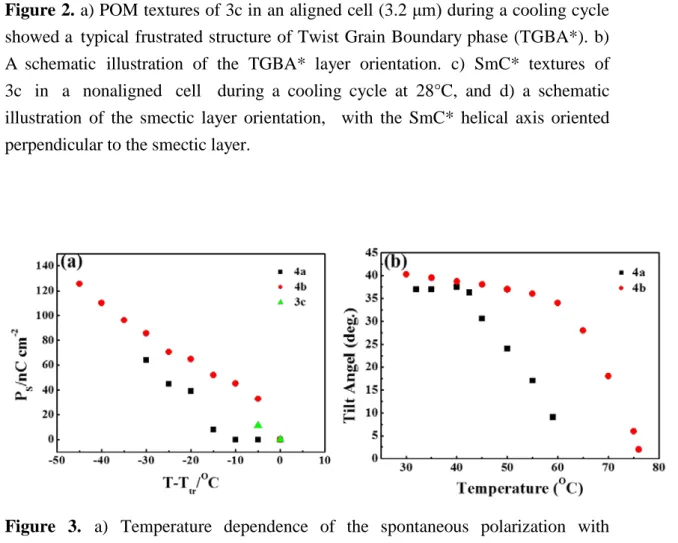
(11) chain alkanes are lower than those of the straight chain isomers.[36] However, the tendency to form helical superstructures became stronger after the introduction of another chiral center. Competition between twist formation and smectic layer formation results in a stabilized defect, allowing the twist grain boundary phase (TGBA*) to appear during the cooling process between the N* and SmC* phases. As shown in Figure 2a, when the cooling rate was 5°C/min, 3c formed a typical frustrated structure that was observed using POM. The UV-vis optical fiber probe photometer showed that the reflection band shifted from 390 nm (blue color) to 800 nm (red color) when the temperature decreased from 41°C to 39°C (shown in supporting information Fig. S20). This texture contains colored grains, where the color corresponds to the pitch length of TGBA* helices with axes perpendicular to the sample cell, as shown in Figure 2b.[37] Figures 1c and 1d show a schematic illustration of the smectic layer orientation at 28°C with a SmC* helical axis oriented perpendicular to the smectic layer, observable as a line pattern of equidistant concentric rings parallel to the sample cell.[38] To further lower the phase transition temperature of the SmC* phase of 3a and 3b towards room temperature, siloxy groups was introduced onto the molecules. As shown in Table 1, the crystallization temperatures of 4a and 4b were substantially lower. This can be ascribed to the flexibility of the bulky siloxane groups, which can self-assemble into layered structures.[39-41] A wide temperature range for the SmC* phase (-3°C to 76°C) of 4b was observed. DSC thermograms of the synthesized 4a and 4b are shown in the supporting information. 3. Ferroelectric liquid crystal properties The magnitude of spontaneous polarization is one of the main factors that affect the optical response times of ferroelectric liquid crystals. Additionally, the spontaneous polarization value dominates the strong,.
(12) field-induced ferroelectric properties of the liquid crystals. The spontaneous polarization (PS) was measured with a triangular wave method as a function of temperature. A digital storage oscilloscope was used to record the voltage drop (V) across a resistor (R) in series with the cell as a function of time. The area under the curve was determined from the stored image after creating an appropriate baseline according to a previously reported procedure. PS was calculated using the equation PS = ∫Vdt/(2AR), where A is the active area of the cell. Figure 3a shows the variations in the PS of 4a, 4b and 3c versus temperature at a 10 Hz reversal current and a saturated electric field. Temperature is inversely proportional to spontaneous polarization, and thus the maximum value of PS was achieved at the lowest temperature. This effect is ascribed to the fact that the mobility of the liquid crystals was higher near the phase transition point and that the liquid crystals became closer 6 during cooling, which increased PS when the dipole aligned into the same direction.[42-45] For 4b, the largest spontaneous polarization was observed to be 126 nCcm-2 at 30°C. The sign of the spontaneous polarization is defined as the sign of the vector cross product between the smectic layer normal and the director. For the case of the low-molar mass ferroelectric liquid crystals 4a, 4b and 3c, the spontaneous polarization was determined to be positive. The tilt angles (θ) of 4a and 4b plotted as a function of temperature are shown in Figure 3b. A large tilt angle up to ~41 degrees was observed for 4b, while 4a, with its shorter alkane spacer, showed a tilt angle that was almost 4 degrees smaller at room temperature. Moreover, the tendencies of the tilt angles of both liquid crystals were similar to those of the spontaneous polarizations. At low temperatures, 4a and 4b showed high Ps and large tilt angles. However, 3c and 3d had a SmC* phase transition point around room temperature, which is the highest temperature at which both compounds showed ferroelectric properties.[46] Due to the limitations of.
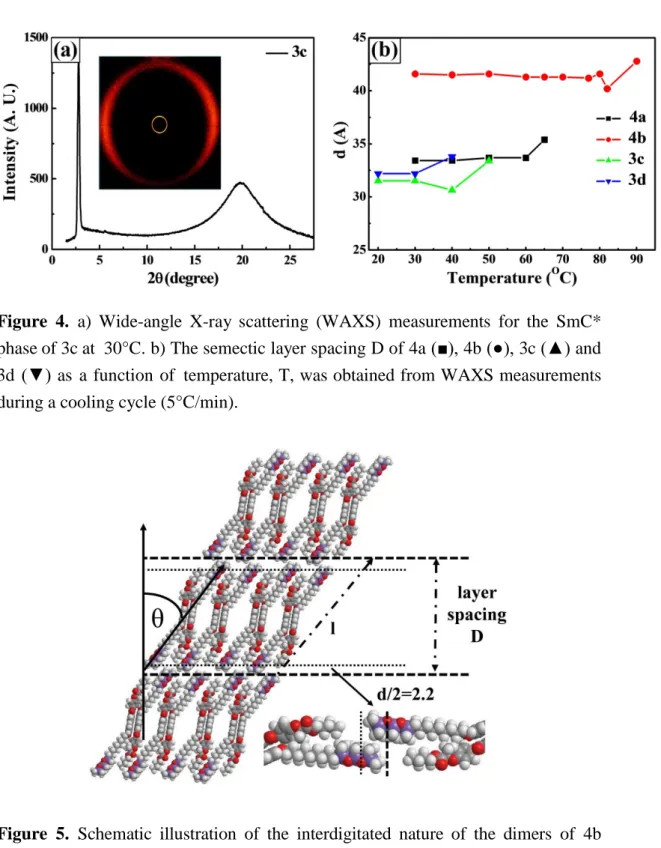
(13) the instrument, the tilt angles of 3c and 3d were not measured. An X-ray diffraction analyzer was used to propose the molecular arrangements. Based on the different electron densities of each atom, the mean positions of the atoms in the crystal can be determined, as well as their chemical bonds, their disorder, and various other information.[47] The layer spacing of 3c was measured using wide-angle X-ray scattering (WAXS) from a nonaligned sample and is given in Figure 4a. The measured results are summarized in Table 2. As shown in Figure 4(a), a large peak at 2.80° and a broad peak at 19.76° were observed. From the Bragg equation, 2dsinθ = nλ (n = 1, λ = 1.54 Å), a layer spacing of 31.5 Å and a lateral distance of 4.5 Å between molecules in the chiral smectic C layer were estimated. For 4a and 4b, the WAXS diffraction patterns are shown in the supporting information (Figure S21). Based on the measured values in Table 2, we propose a molecular model, in which the length of the molecules (l was estimated by space-filling models/CPK models) was compared with the calculated layer spacing (lcosθ). The estimated elongated single molecular form (lcosθ = 32.5 Å) in a large tilt angle (θ = 40.3°) is much smaller than expected for the layer spacing (D = 41.6 Å ). Such a difference demands additional assumptions about the conformation and packing arrangement of the molecules. We suppose that, at minimum energy state, the molecules were packing in opposite directions. If two molecules head-to-tail self-assembled as a dimer, as shown in Figure 5, the length of the dimer model was increased to 54.6 Å (lcosθ = 41.6 Å). This optimized packing arrangement had tilt angles that agreed well with the experimental results from WAXS, proving the existence of an interdigitated SmC phase. The layer spacing as a function of temperature is also shown in Figure 4b. During cooling, the D of the layer spacing decreased through the SmA*SmC* phase transition before slightly decreasing further after the.
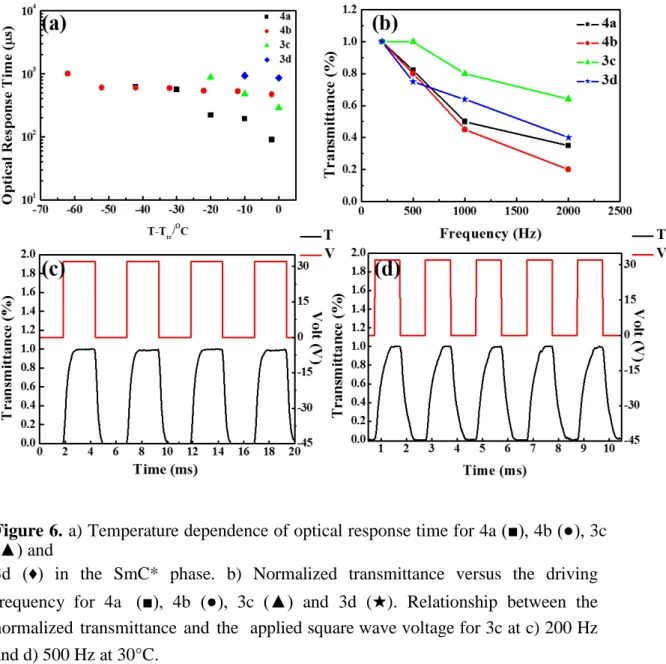
(14) transition of the SmC* phase. At high temperatures, the long axes of all the dimers are aligned in the same direction along the normal vector, so that the SmA* layer spacing is larger than that of SmC*.[48-50] During the SmA*-SmC* transition, increasing intermolecular forces cause a strong steric effect, particularly from the terminal siloxane groups, which have a great influence on the ferroelectric order. In the opposite direction, dimers were formed with an onset optical tilt that could reduce the steric effects, leading to decreased layer spacings during the SmA-SmC* transition. On further cooling, the intermolecular arrangement tends to be stable and the tilt angle increased, making the layer spacing gradually smaller. 3. Field-sequential color The optical response time (τr) of a ferroelectric liquid crystal are of vital importance in liquid crystal display applications. Decreasing the response time can increase the resolution of the display. The optical response time is given by the following equation: τ =ηr/PsE, where ηr and E denote the rotational viscosity and the electric field, respectively. To the best of our knowledge, both spontaneous polarization and rotational viscosity depend on temperature. Because lower temperatures are closer to the crystallization point and intermolecular forces become stronger as the intermolecular spacing decreases, increases to either the spontaneous polarization or rotational viscosity affects the switching time. However, the thickness of the liquid crystal cell and the strength of the electric field also affected the switching time. The response time, as evaluated by optical switching, is shown in Figure 6a; compounds 4a-b and 3c-d were tested in a parallel-alignment cell with a thickness of 3.2 μm. Decreasing the temperature increased the switching time. Near the smectic C transition temperature, the molecule with the six-carbon spacer, 4a, moves faster and the switching time (τr) decreases to as low as 90 μs. The response time is.
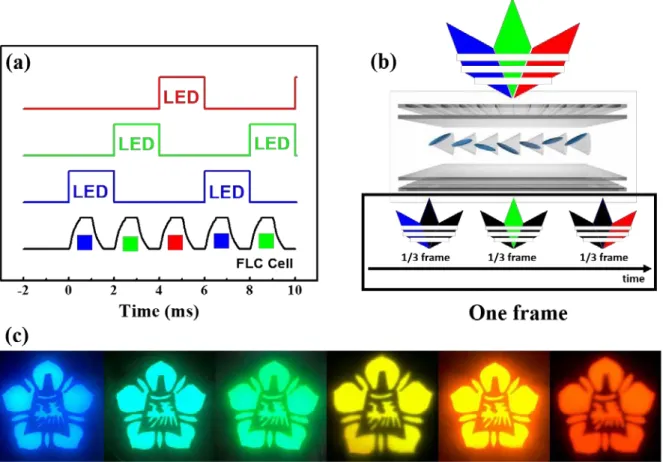
(15) two orders of magnitude faster than NLC. Even at room temperature, the other three compounds have response times that are still five times faster than NLC (approximately 290–900 μs). The dependence of the switching time on temperature can be understood by considering the different packing schemes of the materials. At lower temperatures, the intermolecular entanglement of the terminal groups reduces the rotational speed, increasing the response times. For further application, the pulse width modulation (PWM) driving technique was used to control the residual light and provide eight-bit gray levels. Figure 6c shows the comparison of the normalized transmittance for 3c under different driving frequencies with the same maximum drive voltage (10 V/μm). As seen, increasing the driving frequency from 200 Hz to 500 Hz maintained the response time at a constant 0.3 ms, but the duration of the maximum transmittance was decreased. The normalized transmittance versus the frequency after further increasing the driving frequency to 2 kHz is shown in Figure 6b. Although the driving frequency was increased to 2 kHz for the 3c cell, the maximum transmittance was still approximately 70%. To the best of our knowledge, the fastest response time reported for one single material without blending in liquid crystal cells of thicknesses of 2 μm or less is close to 0.1–0.2 ms at room temperature. However, in our case, the liquid crystal cell thickness was up to 3.2 μm, and the fabricated cell also showed a fast response time. These results suggest that optically saturated bright and dark states could be achieved at a very high driving frequency f = 2 kHz. The driving schematics for the field-sequential color display with a deformed helix ferroelectric liquid crystal (DHFLC) cell are illustrated in Figure 7.[51]A driving frequency of 500 Hz has been applied to the fabricated DHFLC cell, as shown in Figure 7a. At the same time, instead the white LED backlight, the RGB LED backlight with 2 ms durations for.
(16) each color has been applied. Therefore, we can obtain a one-color frame frequency of approximately 166 Hz, as shown in Figure 7b. The RGB color-frame frequency of 166 Hz is much higher than the persistence of human vision (1/16 s, 62.5 Hz), which avoids color breakup and flickering problems. Based on this driving mode, a portable field-sequential color display device has been fabricated. For easy handling and storage, a 2 × 4 cm sample cell size was used. Figure 7c shows real color pictures of the fabricated field-sequential color display device using the synthesized SmC* 3c. 4. Conclusion A series of designed chiral ferroelectric liquid crystals were synthesized and characterized. Terminal achiral trisiloxane and chiral methyl-lateral substituents gave the synthesized liquid crystalline compounds great phase transition properties. The SmC* phase was found to exist across a wide range near room temperature and had a high spontaneous polarization and a large tilt angle. The observed fast response time of 0.3 ms is sufficient to drive the FLC cell with a high frequency. At high driving frequencies of up to 2 kHz, approximately 70% light transmittance was observed. 5. Experimental Section Analytical Apparatus: Chemicals used in this investigation were characterized using 1H-NMR and FT-IR. 500 MHz 1H NMR spectra were obtained on a Bruker 500 MHz FT-NMR. All spectra were run in CDCl3 or DMSO-d6 solutions. Fourier transform infrared spectroscopy spectra were recorded on a Jasco VALOR III spectrophotometer using KBr pellets. The liquid crystal phase behavior of the different materials was identified using polarizing optical microscopy (POM), differential scanning calorimetry (DSC), wide angle X-ray scattering (WAXS) and electrooptical measurements. Polarizing optical microscopy was performed using.
(17) a Mettler FP82HT hot stage, a Mettler FP80 central processor and a highspeed TUCSEN TrueChrome II charge-coupled device (CCD) with a microscope (Nikon labophot- pol). DSC measurements were conducted with a Perking Elmer DSC 6000 differential scanning calorimeter. Wideangle X-ray scattering was recorded using a NANOSTAR U SYSTEM (Bruker AXS Gmbh). Materials and Synthesis: Materials and reagents were of commercial grade quality and used without further purification unless otherwise noted. The synthesis of compounds 3a-d and 4a- b were conducted according to the reactions in Schemes 1. All the structures were identified using 1H-NMR, and the data agreed with the structures in all cases. To prepare the deformed helix ferroelectric liquid crystal cell, two inner surfaces of ITO glass plates were washed with acetone twice and coated with a 0.5% polyvinyl alcohol aqueous solution (Mw = 80,000– 110,000). After drying, the two ITO glass plates were rubbed in an antiparallel direction then separated by 3.2 μm spacers and sealed with epoxy resin on two sides of the cell. [52-53] Supporting Information Supporting Information is available from the Wiley Online Library or from the author. Acknowledgements The authors would like to thank the Ministry of Science and Technology (MOST) of the Republic of China (Taiwan) for financially supporting this research under Contract No. NSC 104-2923-E-006-004-MY3 as well as the financial support from the Russian Foundation for Basic Research under project no. 15-59-32410. The authors also would like to thank Dr. Jia-De Lin from Department of Engineering Science, University of Oxford and Prof. Chia-Rong Lee from Department of Photonics, National Cheng Kung University for supporting spectra were recorded on a Jasco VALOR III spectrophotometer using KBr pellets..
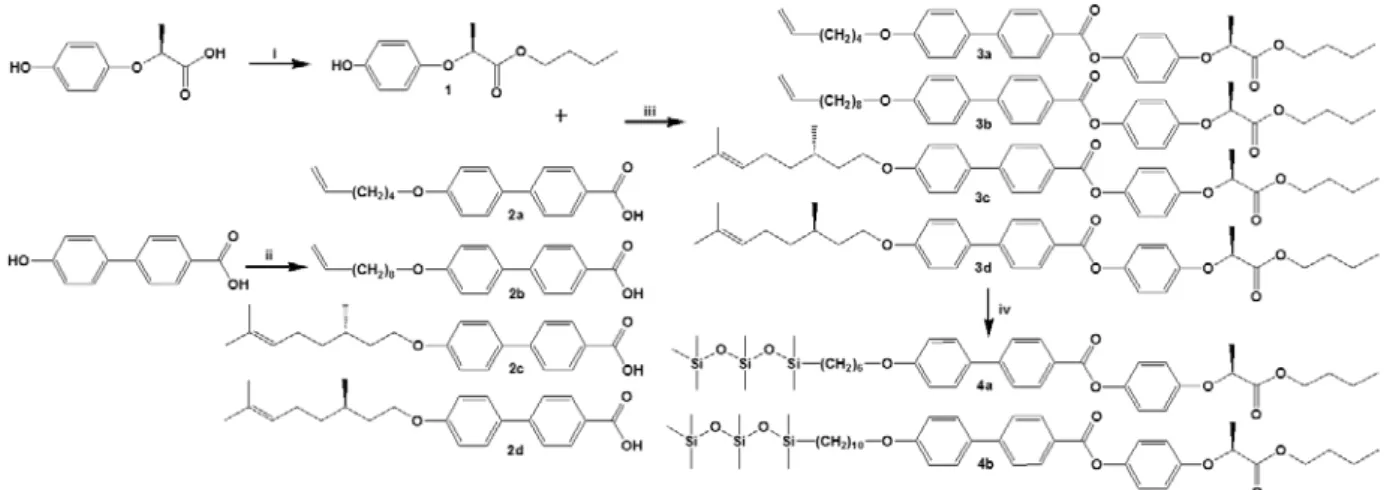
(18) References [1] J. A. Castellano, Liquid gold: the story of liquid crystal displays and the creation of an industry,World Scientific, SG 2005. [2] J. A. Castellano, Handbook of display technology, Elsevier, CA, USA 2012. [3] D. Dunmur, T. Sluckin, Soap, science, and flat-screen TVs: a history of liquid crystals, Oxford University Press, OX, UK 2012. [4] H. S. Kwok, S. Naemura, H. L. Ong, Progress in Liquid Crystal Science and Technology: In Honor of Shunsuke Kobayashi's 80th Birthday (Vol. 4),World Scientific, SG 2013. [5] D. Zhao, F. Fan, J. Cheng, Y. Zhang, K. S. Wong, V. G. Chigrinov, B. Z. Tang, Adv. Opt. Mater. 2015, 3, 199-202. [6] H. Chen, F. Peng, Z. Luo, D. Xu, S. T. Wu, M. C. Li, W. C. Tsai, Opt. Mater. Express, 2014, 4, 2262-2273. [7] B. Bahadur, Mol. Cryst. Liq. Cryst. 1984, 109, 3-93. [8] S. T.Wu, D. K. Yang, Reflective liquid crystal displays.Wiley, Hoboken, NJ, USA 2001. [9] J. S. Seo, T. E. Yeom, J. H. Ko, J. Opt. Soc. Korea, 2012, 16, 151-156. [10] F. C. Lin, Y. P. Huang, H. P. D. Shieh, J. Display Technol, 2010, 6, 107-112. [11] F.Yamada, H. Nakamura, Y. Sakaguchi, Y. Taira, J. Soc. Inf. Display, 2002, 10, 81-85. [12] N. Koma, T. Uchida, J. Soc. Inf. Display, 2003, 11, 413-417. [13] F. C. Lin, Y. P. Huang, C. M.Wei, H. P. D. Shieh, J. Display Technol, 2010, 6, 98-106. [14] M. Okabe, N. Sawatari, M. Ishikawa, H. Hama, In.
(19) SID Symposium Digest of Technical Papers, 2005, 1, 1084-1087. [15] Y. Zhang, F. C. Lin, E. H. Langendijk, J. Soc. Inf. Display, 2011, 19, 258-264. [16] E. Pozhidaev, V. Chigrinov, A. Murauski, V. Molkin, D. Tao, H. S. Kwok, J. Soc. Inf.13 Display, 2012, 20, 273-278. [17] J. H. Lee, X. Zhu, S. T.Wu, J. Display Technol, 2007, 3, 2-8. [18] E. S. Ferry, Am. J. Sci. 1892, 261, 192-207. [19] V. Lapanik, V. Bezborodov, A. Minko, G. Sasnouski, W. Haase, A. Lapanik, Ferroelectrics, 2006, 344, 205-211. [20] T. Järvenpää, J. Soc. Inf. Display, 2005, 13, 139-144. [21] A. K. Srivastava, R. Manohar, Liq. Cryst. 2011, 38, 183-190. [22] R. Manohar, A. K. Misra, A. K. Srivastava, Polym. Compos. 2010, 31, 1776-1781. [23] V. Lapanik, V. Bezborodov, S. Timofeev, W. Haase, Appl. Phys. Lett. 2010, 97, 251913. [24] N. Koma, T. Uchida, J. Soc. Inf. Display, 2003, 11, 413-417. [25] C. H. Chen, F. C. Lin, Y. T. Hsu, Y. P. Huang, H. P. D. Shieh, J. Display Technol, 2009, 5, 34-39. [26] S. Gauza, X. Zhu, W. Piecek, R. Dabrowski, S. T. Wu, J. Display Technol, 2007, 3, 250- 252. [27] R. B. Meyer, L. Liebert, L. Strzelecki, P. Keller, J. Physique Lett. 1975, 36, 69-71. [28] W. K. Robinson, C. Carboni, P. Kloess, S. P. Perkins, H. J. Coles, Liq. Cryst. 1998, 25, 301-307. [29] N. Mizoshita, T. Kato, Adv. Funct. Mater. 2006, 16, 2218-2224. [30] W. K. Robinson, P. Lehmann, H. J. Coles, Mol. Cryst. Liq. Cryst. 1999, 328, 229-236. [31] A. Kaeding, P. Zugenmaier, Liq. Cryst. 1998, 25, 449457..
(20) [32] N. A. Lockwood, J. C. Mohr,L. Ji, C. J. Murphy, S. P. Palecek, J. J. De Pablo, N. L. Abbott, Adv. Funct. Mater. 2006, 16, 618-624. [33] J. Naciri, C. Carboni, A. K. George, Liq. Cryst. 2003, 30, 219-225. [34] Y. H.Kim, D. K. Yoon, H. S. Jeong, O. D. Lavrentovich, H. T. Jung, Adv. Funct. Mater. 2011, 21, 610-627. [35] N. Olsson, B. Helgee, G.Andersson, L. Komitov, Liq. Cryst 2005, 32, 1139-1150.14 [36] M. Svensson, B. Helgee, K. Skarp, G. Andersson, J. Mater. Chem. 1998, 8, 353-362. [37] L. Lejček, V.Novotná, M. Glogarová, Phys. Rev. E. 2015, 92, 032505. [38] P. Das, S. Basu, R. K. Sinha, U. Das, Chem. Phys. Lett. 2005, 410, 417-422. [39] N. Olsson, M. Schröder, S. Diele, G. Andersson, I. Dahl, B. Helgee, L. Komitov, J. Mater. Chem. 2007, 17, 2517-2525. [40] J. Ruth, B. R. Ratna, J. W. Naciri, R. Shashidhar, S. K., Prasad, D. S. Rao, S. Chandrasekhar, In IS&T/SPIE's Symposium on Electronic Imaging: Science and Technology,1993, p, 104-110. [41] P. Heinze, H. Finkelmann, Macromolecules, 2010, 43, 6655-6665. [42] J. Naciri, B. R. Ratna, S. Baraltosh, P. Keller, R. Shashidhar, Macromolecules, 1995, 28, 5274-5279. [43] A. Debnath, P. K. Mandal, Journal of Molecular Liquids, 2016, 221, 287-291. [44] K. Miyasato, S. Abe, H. Takezoe, A. Fukuda, E. Kuze, Jpn. J. Appl. Phys. 1983, 22, L661. [45] Y. Takanishi, Y. Ouchi, H. Takezoe, A. Fukuda, A. Mochizuki, M. Nakatsuka, Jpn. J. Appl. Phys 1990, 29, L984. [46] B. Helgee, T. Hjertberg, K. Skarp, G. Andersson, F. Gouda, Liq. Cryst..
(21) 1995, 18, 871-878. [47] Y. S. Zhang, A. V. Emelyanenko, J. H. Liu, J. Taiwan. Inst. Chem. E. 2016, 65, 444-451. [48] K. Sunohara, K. Takatoh, M. Sakamoto, Liq. Cryst. 1993, 13, 283-294. [49] J. P. Lagerwall, F. Giesselmann, M. D. Radcliffe, Phys. Rev. E. 2002, 66, 031703. [50] F. Giesselmann, P. Zugenmaier, I. Dierking, S. T. Lagerwall, B. Stebler, M. Kašpar, M. Glogarova, Phys. Rev. E. 1999, 60, 598. [51] L. A. Beresnev, V. G. Chigrinov, D. I. Dergachev, E. P. Poshidaev, J. Fünfschilling, M. Schadt, Liq. Cryst. 1989, 5, 1171-1177. [52] L. Pelliser, M. Manceau, C. Lethiec, D. Coursault, S. Vezzoli, G. Leménager, A. Maitre, Adv. Funct. Mater. 2015, 25, 1719-1726. [53] A. Kholkin, A. Morozovska, D. Kiselev, I. Bdikin, B. Rodriguez, P.Wu, M. Kosec, Adv. Funct. Mater. 2011, 21, 1977-1987.. Figure 1. Reagents: i, HCl(g), BuOH; ii, KOH, KI, EtOH, 6-bromohex-1-ene/10bromodec- 1-ene/(S)-(+)-Citronellyl bromide/(R)-(−)-Citronellyl bromide; iii,.
(22) DCC, DMAP, DCM; iv, dichloro(dicyclopentadienyl)platinum(II), 1,1,1,3,3,5,5hepta- methyltrisiloxane.. Figure 2. a) POM textures of 3c in an aligned cell (3.2 μm) during a cooling cycle showed a typical frustrated structure of Twist Grain Boundary phase (TGBA*). b) A schematic illustration of the TGBA* layer orientation. c) SmC* textures of 3c in a nonaligned cell during a cooling cycle at 28°C, and d) a schematic illustration of the smectic layer orientation, with the SmC* helical axis oriented perpendicular to the smectic layer.. Figure 3. a) Temperature dependence of the spontaneous polarization with reference to the SmA*/TGBA*-SmC* phase transition (T-Ttr): 4a (■), 4b (●) and.
(23) 3c (▲). (Vpp=60 V, active area = 1 cm2) b) Tilt angle as a function of temperature for 4a (■) and 4b (●).. Figure 4. a) Wide-angle X-ray scattering (WAXS) measurements for the SmC* phase of 3c at 30°C. b) The semectic layer spacing D of 4a (■), 4b (●), 3c (▲) and 3d (▼) as a function of temperature, T, was obtained from WAXS measurements during a cooling cycle (5°C/min).. Figure 5. Schematic illustration of the interdigitated nature of the dimers of 4b molecules in the ferroelectric phase. l represents the length of the dimer, θ represents.
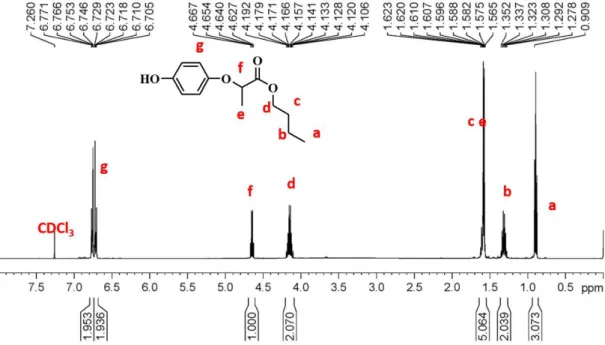
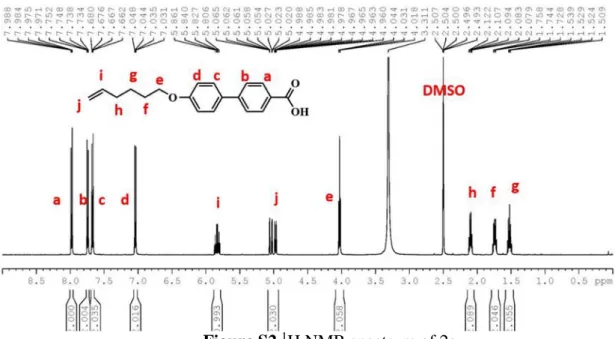
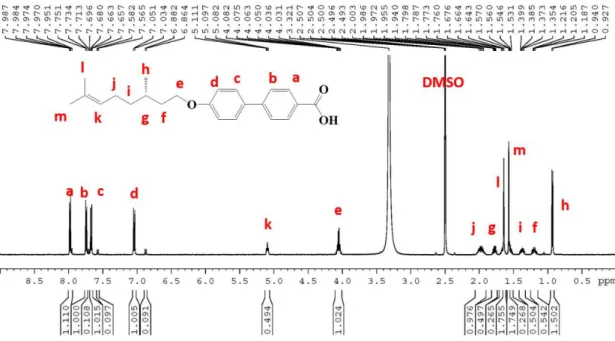
(24) the tilt angle, D is the layer spacing and d is the interdigitated length.. Figure 6. a) Temperature dependence of optical response time for 4a (■), 4b (●), 3c (▲) and 3d (♦) in the SmC* phase. b) Normalized transmittance versus the driving frequency for 4a (■), 4b (●), 3c (▲) and 3d (★). Relationship between the normalized transmittance and the applied square wave voltage for 3c at c) 200 Hz and d) 500 Hz at 30°C..
(25) Figure 7. The driving of DHFLC: a) the top three waveforms are the applied signal to the sequential RGB LED, and the bottom waveform is the combined appearance of the DHFLC cell with 3c. b) Top: target colorful image, middle: deformed-helix ferroelectric liquid crystal cell, bottom: one frame consists of three R-G-B sub-images. c) Photographs of the developed Field-Sequential Color Liquid Crystal Display operated at a color frequency of 500 Hz (i.e., a frame frequency of 166 Hz) of SmC* 3c. The device size is 2 cm × 4 cm, and the effective electrode area is 1 cm × 1 cm.. Table 1. Phase sequences and transition temperatures of the materials. Material 3a. Treatment cooling. 3b 3c. cooling cooling. 3d 4a. cooling cooling. 4b. cooling. a). Phase sequence a)/°C Cr 72 SmC* 83 SmA* 128 I. Cr Cr Cr. Cr 40 SmC* 112 I -27 SmC* 30 TGBA* 43. N* 51 I. -7 SmC* 18 TGBA* 33 N* 40 Cr 32 SmC* 59 SmA* 66 I. I. -3 SmC* 76 SmA* 82 TGBA* 90 I. Cr: crystal, SmC*: chiral smectic C, SmA*: chiral smectic A, TGBA: twist grain boundary phase, N*: chiral nematic, I: isotropic..
(26) Table 2. Layer spacing of the SmC* phase. Material. Layer spacing Da)/Å. ld)/ Å. lcosθ/ Å. 33.4. db) 4.5. Θc)/°. 4a. 37.0. 38.2. 30.5. 4b. 41.6. 4.5. 40.3. 42.7. 32.5. 3c. 31.5. 4.5. -. 33.7. 3d a). 32.2. 4.4. -. 33.7. b). Large peak from wide angle X-ray scattering; broad peak from wide-angle Xray scattering, c) tilt angle, d) simulation length of the molecule.. Supporting Information Title Synthesis of Predesigned Ferroelectric Liquid Crystals and Their Applications in Field- Sequential Color Displays Contents: 1. Synthetic Route 2. Supplementary Figures. Figure S1-S11. Identification of 1HNMR spectrum of FLC. Figure S12-S14. Differential scanning calorimetry (DSC) measurement of FLC. Figure S15-S19. POM texture of FLC in different temperature. Figure S20.Temperature-dependent reflection spectra of 3c FLC. Figure S21. WAXS measurements for FLC. Figure S22-S24. Electric-optical measurements for FLC..
(27) Synthetic Route The synthesis of compounds 3a-d and 4a-b were conducted according to the reactions in Figure 1. Here show you the details of synthetic route. (R)-butyl 2-(4-hydroxyphenoxy)propanoate 1. Hydrogen chloride was processed. in. a. butanol. (200. mL). solution. of. (R)-2-(4-. hydroxyphenoxy)propanoic acid (0.02 mol, 3.6 g) at room temperature until no further heat evolved. The reaction mixture was evaporated to dryness. The product was separated by column chromatography on silica gel with hexane- ethyl acetate (2:1) as the eluent. Yield: 3.3 g (69%). 1HNMR in CDCl3 δ: 0.91 (t, 3 H), 1.33 (m, 2 H), 1.61 (d+m, 5 H), 4.15 (m, 2 H), 4.65 (q, 1 H), 6.72 (m, 4 H). FTIR (KBr, νmax/cm-1): 3580–3250 (-OH), 2930 (CH2), 1702 (C=O in Ar –COO-), 1598 (C=C in Ar).. 4'-(hex-5-enloxy)biphenyl-4-carboxylic. acid. 2a.. First,. 4'-. hydroxybiphenyl-4-carboxylic acid (0.010 mol, 2.14 g) was dissolved in a mixture of ethanol (150 mL) and water (5 mL) together with potassium hydroxide (0.020 mol, 2.24 g) and a few crystals of potassium iodide. After stirring, the solution was heated and refluxed for 1 h, a solution of 6bromohex-1-ene (0.015 mol, 2.45 g) in EtOH (15 mL) was added dropwise to the mixture and then further refluxed for 24 h. The reaction mixture was cooled to room temperature and acidified with concentrated hydrochloric acid. Then, the precipitate was filtered and washed with water. The crude product was purified by recrystallization in ethanol. Yield: 2.46 g (83%). 1H-NMR in DMSO-d6 δ: 1.51 (m, 2 H), 1.73 (quintet, 2 H), 2.11 (q, 2 H), 4.00 (t, 2 H), 4.95 (m, 2 H), 5.80 (m, 1 H), 7.03 (d, 2 H), 7.67 (d, 2 H), 7.75 (d, 2 H), 7.98 (d, 2 H). FTIR (KBr, νmax/cm-1):.
(28) 3300–2500 (-COOH), 2921 (CH2), 1687 (C=O in Ar –COO-), 1603 (C=C in Ar). 4'-(dec-5-enloxy)biphenyl-4-carboxylic acid 2b. 10-Bromodec-1-ene was used as the starting material in a reaction similar to that described for the synthesis of precursor 2a. Yield: 3.06 g (85%). 1H-NMR in DMSO-d6 δ 1.29–1.51 (m, 12 H), 1.71 (quintet, 2 H), 2.01 (q, 2 H), 4.00 (t, 2 H), 4.99 (d+d, 2 H), 5.78 (m, 1 H), 7.03 (d, 2 H), 7.66 (d, 2 H), 7.73 (d, 2 H), 7.97 (d, 2 H). FTIR (KBr, νmax/cm-1): 3300–2500 (-COOH), 2920 (CH2), 1685 (C=O in Ar –COO-), 1605 (C=C in Ar). (S)-4'-(3,7-dimethyloct-6-enloxy)biphenyl-4-carboxylic acid 2c. (S)(+)-citronellyl bromide was used as the starting material in a reaction similar to that described for the synthesis of precursor 2a. Yield: 2.75 g (78%). 1H-NMR in DMSO-d6 δ 0.93 (d, 3 H), 1.20 (q, 2 H), 1.37(s, 2 H), 1.56 (s, 3 H), 1.75 (quintet, 1 H), 1.97 (q, 2 H), 4.04 (t, 2 H), 5.10 (t, 1 H), 7.04 (d, 2 H), 7.57 (d, 2 H), 7.67 (d, 2 H), 7.97 (d, 2 H). FTIR (KBr, νmax/cm-1): 3300– 2500 (-COOH), 2919 (CH2), 1683 (C=O in Ar –COO-), 1608 (C=C in Ar). (R)-4'-(3,7-dimethyloct-6-enloxy)biphenyl-4-carboxylic acid 2d. (R)(-)-citronellyl bromide was used as the starting material in a reaction similar to that described for the synthesis of precursor 2a. Yield: 2.82 g (80%). 1H NMR in DMSO-d6 δ 0.95 (d, 3 H), 1.22 (q, 2 H), 1.38(s, 2 H), 1.56 (s, 3 H), 1.77 (quintet, 1 H), 2.00 (q, 2 H), 4.06 (t, 2 H), 5.10 (t, 1 H), 7.04 (d, 2 H), 7.67 (d, 2 H), 7.74 (d, 2 H), 7.98 (d, 2 H). FTIR (KBr, νmax/cm-1): 3300–2500 (- COOH), 2920 (CH2), 1685 (C=O in Ar – COO-), 1600 (C=C in Ar). (R)-4-(1-butoxy-1-1oxopropan-2-yloxy)phenyl. 4'-(hex-5-enyloxy).
(29) biphenyl-4-carboxylate 3a. A solution of 1 (3.37 mmol, 1.0 g), 3.36 mmol (0.80 g) of 2a and 0.06 mmol (0.073 g) of dimethylaminopyridine (DMAP) in dry methylene chloride (50 mL) was stirred vigorously at 0°C under N2. After. 30. mins,. a. solution. of. 6.69. mmol. (1.38. g). of. dicyclohexylcarbodiimide (DCC) in dried CHCl3 was added dropwise to the mixture. The temperature was allowed to rise to room temperature and stirred for 12 h. Urea was filtered off and the solution was evaporated to dryness. The crude product was purified via column chromatography with silica gel using hexane-ethyl acetate (6:1) as an eluent. Yield: 1.26 g (73%). 1H-NMR in CDCl3 δ 0.92 (t, 3 H), 1.35 (m, 2 H), 1.5–1.7 (m, 7 H), 1.85 (quintet, 2 H), 2.21 (q, 2 H), 4.03 (t, 2 H), 4.18 (t, 2 H), 4.74 (q, 1 H), 5.07 (m, 2 H), 5.85 (m, 1 H), 6.93 (d, 2 H), 7.01 (d, 2 H), 7.13 (d, 2 H), 7.59 (d, 2 H), 7.68 (d, 2 H), 8.21 (d, 2 H). FTIR (KBr, νmax/cm-1): 3048 (=C-H), 2938 (CH2), 1722 (C=O in Ar –COO-), 1633,1512 (C=C in Ar). (R)-4-(1-butoxy-1-1oxopropan-2-yloxy)phenyl. 4'-(dec-9-enyloxy). biphenyl-4-carboxylate 3b. Monomer 3b was synthesized from 2b and 1 following the steps described for the synthesis of 3a. Yield: 1.13 g (72%). 1H-NMR in CDCl3 δ 0.92 (t, 3 H), 1.3–1.7 (m, 17 H), 1.81 (quintet, 2 H), 2.05 (q, 2 H), 4.01 (t, 2 H), 4.17 (t, 2 H), 4.74 (q, 1 H), 5.05 (m, 2 H), 5.85 (m, 1 H), 6.93 (d, 2 H), 6.99 (d, 2 H), 7.13 (d, 2 H), 7.58 (d, 2 H), 7.67 (d, 2 H), 8.21 (d, 2 H). FTIR (KBr, νmax/cm-1): 3048 (=C-H), 2937 (CH2), 1733 (C=O in Ar – COO-), 1635,1513 (C=C in Ar). 4-((R))-1-butoxy-1-oxopropan-2-yloxy)phenyl 4'-((S)-3,7-dimethyloct6-enyloxy) biphenyl-4-carboxylate 3c. Monomer 3c was synthesized from 2c and 1 following the steps described for the synthesis of 3a. Yield:.
(30) 1.03 g (66%). 1H NMR in CDCl3 δ 0.92 (t, 3 H), 0.98 (d, 3 H), 1.2–1.7(m, 17 H), 1.87 (m, 1 H), 2.09 (q, 2 H), 4.05 (t, 2 H), 4.17 (t, 2 H), 4.75 (q, 1 H), 5.12 (t, 1 H), 6.92 (d, 2 H), 7.00 (d, 2 H), 7.13 (d, 2 H), 7.58 (d, 2 H), 7.68 (d, 2 H), 8.21 (d, 2 H). FTIR (KBr, νmax/cm-1): 3050 (=C-H), 2950 (CH2), 1716 (C=O in Ar –COO-), 1628,1510 (C=C in Ar). 4-((R))-1-butoxy-1-oxopropan-2-yloxy)phenyl4'-((R)-3,7-dimethyloct6-enyloxy) biphenyl-4-carboxylate 3d. Monomer 3c was synthesized from 2d and 1 following the steps described for the synthesis of 3a. Yield: 0.91 g (59%). 1H NMR in CDCl3 δ 0.89 (t, 3 H), 1.00 (d, 3 H), 1.2–1.7(m, 17 H), 1.87 (m, 1 H), 2.21 (q, 2 H), 4.03 (t, 2 H), 4.18 (t, 2 H), 4.74 (q, 1 H), 5.13 (t, 1 H), 6.95 (d, 2 H), 6.99 (d, 2 H), 7.15 (d, 2 H), 7.52 (d, 2 H), 7.68 (d, 2 H), 8.21 (d, 2 H). FTIR (KBr, νmax/cm-1): 3052 (=C-H), 2950 (CH2), 1716 (C=O in Ar –COO-), 1628,1510 (C=C in Ar). (R)-4-((1-butoxy-1-1oxopropan-2-yl)oxy)phenyl. 4'-((6-(1,1,3,3,5,5,5-. heptamethyl trisiloxanyl)hexyl)oxy)-[1,1'-biphenyl]-4-carboxylate 4a. Dry equipment was used. A solution of 3a 1.0 mmol (0.52 g) and 1.1 mmol (0.25 g) of 1,1,1,3,3,5,5- heptamethyltrisiloxane dissolved in anhydrous toluene (40 mL) was stirred at 60°C under N2. A catalyst solution containing. 0.015. mmol. (6.0. mg). of. dichloro(dicyclo-. pentadienyl)platinum(II) in dried toluene was added dropwise to the mixture. After 36 h, the solution was evaporated to dryness. The crude product was purified via column chromatography with silica gel using hexane-ethyl acetate (8:1) as the eluent. Yield: 0.46 g (62%). 1H-NMR in CDCl3 δ: 0.02–0.09 (s, 21 H), 0.56 (m, 2 H), 0.92 (t, 3 H), 1.35 (m, 2 H), 1.21–1.73 (m, 11 H), 1.81 (quintet, 2 H), 4.01 (t, 2 H), 4.17 (t, 2 H), 4.74 (q, 1 H), 6.93 (d, 2 H), 6.99 (d, 2 H), 7.13 (d, 2 H), 7.58 (d, 2 H), 7.67 (d, 2 H), 8.21 (d, 2 H). FTIR (KBr, νmax/cm-1): 3045 (=C-H), 2960 (CH2), 1740 (C=O in Ar –.
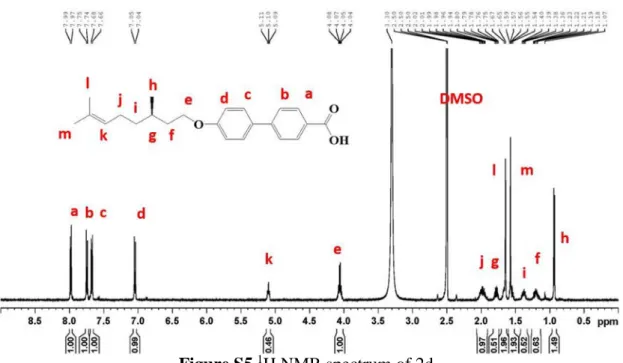
(31) COO-), 1628,1510 (C=C in Ar), 1072,998 (Si-O). (R)-4-((1-butoxy-1-1oxopropan-2-yl)oxy)phenyl. 4'-((10-. (1,1,3,3,5,5,5-heptamethyl trisiloxanyl)decyl)oxy)-[1,1'-biphenyl]-4carboxylate 4b. Similar to the synthesis of compound 4a, compound 4b was synthesized from 3b following the steps described above. Yield: 0.45 g (57%). 1H-NMR in CDCl3 δ: 0.02–0.08 (s, 21H), 0.56 (m, 2H), 0.92 (t, 3 H), 1.30–1.63 (m, 21 H), 1.81 (quintet, 2 H), 4.01 (t, 2 H), 4.17 (t, 2 H), 4.74 (q, 1 H), 6.93 (d, 2 H), 6.99 (d, 2 H), 7.13 (d, 2 H), 7.58 (d, 2 H), 7.67 (d, 2 H), 8.21 (d, 2 H). FTIR (KBr, νmax/cm-1): 3048 (=C-H), 2960 (CH2), 1740 (C=O in Ar – COO-), 1628,1510 (C=C in Ar), 1065,1000 (Si-O).. Figure S1 1H NMR spectrum of 1..
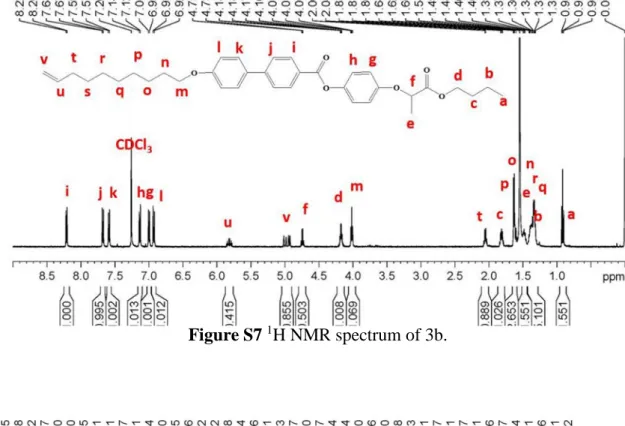
(32) Figure S2 1H NMR spectrum of 2a..
(33) Figure S3 1H NMR spectrum of 2b.. Figure S4 1H NMR spectrum of 2c..
(34) Figure S5 1H NMR spectrum of 2d.. Figure S6 1H NMR spectrum of 3a..
(35) Figure S7 1H NMR spectrum of 3b.. Figure S8 1H NMR spectrum of 3c..
(36) Figure S9 1H NMR spectrum of 3d.. Figure S10 1H NMR spectrum of 4a..
(37) Figure S11 1H NMR spectrum of 4b.. DSC.
(38) Figure S15 POM texture of nonaligned compound 3a: (a) the SmA* phase at 115°C and (b) the SmC* phase at 75°C. (5°C/min cooling rate, ×400 magnification).. Figure S16 POM texture of nonaligned compound 3b: (a) the SmA* phase at 90°C and (b) a crystal at 30°C. (5°C/min cooling rate, ×400 magnification)..
(39) Figure S17 POM texture of nonaligned compound 4a: (a) the SmA* phase at 61°C and (b) the SmC* phase at 50°C. (5°C/min cooling rate, ×400 magnification).. Figure S18 POM texture of nonaligned compound 4b: (a) the TGBA* phase at 85°C and (b) the SmA* phase at 79°C. (5°C/min cooling rate, ×400 magnification).. Figure S19 POM texture of aligned compound 3d: (a) the N* phase at 39°C and (b) the N* phase transitioning to the TGBA* phase at 33°C. (5°C/min cooling rate, ×400 magnification)..
(40) Reflection band. Figure S20 Temperature-dependent reflection spectra of 3c in its TGBA* phase.. WAXS. Figure S21 Wide-angle X-ray scattering (WAXS) measurements for the SmC* phase at 40°C..
(41) Electric-optical measurements. Figure S22 Optical transmission while applying a square wave voltage to 4b at (a) 200 Hz and (b) 500 Hz at 30°C.. Figure S23 Optical transmission while applying a square wave voltage to 4a at (a) 200 Hz and (b) 500 Hz at 35°C. Figure S24 Optical transmission while applying a square wave voltage to 3d at (a) 200 Hz and (b) 500 Hz at 15°C.
(42) 科技部補助專題研究計畫項下出席國際學術會議報告 日期:106 年 7 月 10日. 計畫編號 計畫名稱 出國人員 姓名. 會議時間. MOST 104-2923-E-006-004-MY3 新世代液晶顯示器用調諧式光學活性化合物及聚合物之製 備及特性研究-場色序法液晶顯示器 服務機 劉瑞祥、蔡宜 國立成功大學 構及職 霖、陳乙禾 稱 106 年 10 月 26 日至 106 年 10 月 29 日. 會議地. 日本東京理科大學. 點. 會議名稱. 發表論文 題目. (中文) 2017 年第六屆奈米結構奈米材料以及奈米工程國際 會議 (英文) 2017 6th International Conference on Nanostructures, Nanomaterials and Nano-engineering (中文) 利用預設計鐵電液晶的合成及光學鑑定應用於場序 式液晶顯示器 (英文) Synthesis and Optical Characterization of Field-Sequential Color Display Using Predesigned Ferroelectric Liquid Crystals. 1.
(43) 一、參加會議經過 會議第一天到東京理科大學的分校區進行註冊並和老師一同預先勘 查一下報告場地,也遇到不少與會者進行了學術交流,第二天開場由來自 國立新加坡大學兼任主席的龔教授宣布會議開始,就開始一整天的英文口 頭報告,一開始大家都在一個大會議廳聽演講,上午第一場是由來自東京 理科大學的梅村和夫教授演講,題目是:Oxidation/reduction of carbon nanotubes monitored by near-infrared photoluminescence and absorbance ,第 二場則是由東京農工大學的荻野賢司教授發表演講,題目為: Fatigue properties of friction stir processed materials,在休息十分鐘後,第三場由來 自新加坡大學兼任主席的Prof. Hao Gong發表他的演講:Transparent Conductors and Semiconductors: Synthesis, Properties and Applications,中午 餐敘的時候,大會安排大家一起吃飯,同桌的有來自馬來西亞與韓國的與 會者,吃飯的時候交流各國的文化與不同處,相當有趣,下午於會場第一 會議室參與了聚合物與建構材料方面的報告,這間會議室的主席是來自日 本岐阜大學的Prof. Yoshihiko Uematsu,報告者多是來自東南亞的同學,題 目也比較偏向生物化學方面,下一個下午的時段則在第三會議室參與材料 化學與化學工程的部分,這間會議室的主席是來自韓國忠北大學的Prof. Byung-Ki Na,許多東南亞的與會者都報告了菱角殼的相關運用,並提出. 2.
(44) 了許多綠色化學相關的觀點,研究方向也傾向再生再利用的目標,老師也 對與會者提出了許多有機的觀點互相交流,主席也發表了鋰電池相關的報 告,題目為:Synthesis and electrochemical characteristics of SnOx/Li4Ti5O12 for Lithium-ion Secondary Battery,實驗室的同行夥伴蔡宜霖報告膽固醇液 晶的應用也相當精采,題目為:Chiral inductions on supramolecular self-assembly and super-twisted nematic liquid crystal cells ,報告結束後,晚餐到飯田橋國際大飯店進行晚宴,第三天上午在第二 會議室參與官能性材料相關的報告,這間會議室的的主席也同時是會議 主席,來自新加波大學的龔教授,並有實驗室同學陳乙禾報告鐵電性質 的液晶應用,題目為:Synthesis and Optical Characterization of Field-Sequential Color Display by Using Predesigned Ferro-electronic Liquid Crystal ,僥倖獲得最佳報告獎,會議下午安排參觀東京理科大 學的博物館,在博物館內有校史,在這方面相較於台灣,日本確實歷史 悠長也較有傳統。第四天我們同樣到會場集合,開放了一些實驗室讓我 們去參觀,進到系館後真是讓我大開眼界,整棟系館都做成負壓系統, 讓大家不會受到刺激性臭味的影響,這點確實是台灣的建築物可以去效 法學習的地方,參與了各種研究領域的實驗室以後,主席感謝大家共襄 盛舉的同時,宣布會議結束。. 3.
(45) 二、與會心得 不同於過去都是參加國內的會議,此次參加的國際會議,能夠觀察各國頂 尖大學的研究領域,由於本次研討會著重在奈米的理論以及應用方面的探 討,因此許多講者介紹了關於新型半導體材料的開發,例如本次會議主席 新加坡大學的 Prof. Hao Gong 所發表的 Transparent Conductors and Semiconductors: Synthesis, Properties and Applications,就在探討新一代透明 可彎曲的半導體材料;另外韓國忠北大學的 Prof. Byung-Ki Na 則是在其演 講題目 Synthesis and Electrochemical Characteristics of SnOx/Li4Ti5O12 for Lithium-ion Secondary Battery 中提到了如何開發新的混合金屬,提升一般 鋰電池的電容以及改善重複充電之後效能下降的問題。在口頭報告競賽的 部分,研究內容更是豐富,從一般金屬材料的理論研究到真正能夠商業化 的奈米材料應用都有所著墨。較為特殊的是部分東南亞國家的研究多以綠 色化學為研究題材,例如泰國農業大學的博士班 Dr. Chinnathan Areeprasert 所發表的 Biochar Preparation from Simulated Municipal Solid Waste Employing Low Temperature Carbonization Process,是在講述如何利用該實 驗室合成的奈米材料將廢棄物以低溫的方式碳化,在減少垃圾量的同時又 能減少使用的能源。這些綠色奈米科技讓我們在奈米領域方面的研究課題 有諸多啟發。. 4.
(46) 本次會議各國的報告者準備相當充足,報告得也相當流暢,研究題材也相 都具有新穎性,並且分成了許多組別讓參與者能夠針對有興趣的主題分別 探討,報告過程以及評分也都相當嚴謹:在個別教室進行口頭報告時,每 個房間都有兩名教授進行評分,報告結束之後也都有開放提問時間,讓報 告者與台下聽眾能更進一步交流研究內容,提升彼此的研究能力。供餐時 採取隨意入座,讓各國學者可以在吃飯的同時進行交流,我們有幸和台灣 還有馬來西亞跟韓國的教授同桌吃飯,介紹了許多在液晶相關的問題,同 時也得到了不少鋰電池相關的知識;除了學術方面的討論我們也討論了不 少台灣與國外學校之間培養學生以及文化方面的差異,從餐敘時間之中我 們了解到了馬來西亞其實很多人都會說中文,也知道韓國在物資方面其實 相當的缺乏,學術研究比較艱辛。 我們在口頭報告的部分皆有不錯的表現,學生蔡宜霖在第二天下午的報告 中應對順利,獲得該場主席的肯定;學生陳乙禾在第三天早上報告,報告 內容清晰生動,並且在提問中確切回答提問者的問題,同樣獲得本次會議 主席 Prof. Hao Gong 的肯定,也獲得該場會議最佳演講的殊榮。第三天下 午與第四天參觀東京理工大學博物館以及實驗室時,發現日本大學在興建 建物時,對於各方面的系統都有相當的考量,舉例來說:整棟實驗室建築 做成負壓(上方抽氣,且整棟密閉),以防不慎外洩的時候對人員的傷害可. 5.
(47) 以減到最小;另外校史系史的解說,都相當的精緻有條理;實驗室內的儀 器及設備也非常乾淨且井然有序,再一次讓我見識到,要成就強大,確實 需要步步為營。. 三、建議 由於此次會長在較偏遠的地方並非在東京理科大學校區內,而是在西邊 得散落型校區的建築內,指示標誌更是只有在入口小巷有一張海報,讓 我們找了很久繞了兩三圈才真的找到會議地點,希望可以多一點指示。. 四、攜回資料名稱及內容 會議參與證明以及得獎獎狀,報告照片及合照等。. 6.
(48) 出席人員在會場前留影. 出席學生會場留影. 7.
(49) 陳乙禾發表論文情形. 蔡宜霖口頭發表情形. 8.
(50) 與會場教授們合影紀念. 9.
(51) 科技部補助專題研究計畫項下出席國際學術會議 以及與台俄計畫俄方團隊討論心得報告 日期:106 年 7 月 10 日. 計畫編 號 計畫名 稱. MOST 104-2923-E-006-004-MY3 新世代液晶顯示器用調諧式光學活性化合物及聚合 物之製備及特性研究-場色序法液晶顯示器 國立成功大學. 劉瑞祥. 服務機 構及職 稱. 會議時 間. 106 年 6 月 25 日至 106 年 6 月 30 日. 會議地 點. 俄羅斯莫斯科大學. 會議名 稱. (中文)2017 年歐洲液晶國際學術研討會議 (英文) European Conference on Liquid Crystals--2017 (英文) Imprinting of Cholesteric Liquid Crystal Constructions Via UV-Induced Polymerization. 出國人 員姓名. 發表論 文題目. 一、參加會議經過 106 年 6 月 27 日搭乘港龍飛機於 8 點出發前往香港轉機,在飛 往俄羅斯莫斯科市,到達 SVO 機場已經是當地 6 月 27 日下午 7:30。由於機場入境檢察非常嚴格,因此耽誤了 2 小時方才入境, 力及前往下塌的莫斯科大學飯店住宿。 隔天(28 日)一大早,立即前往莫斯科大學報到,並開始參加此 次學會的研討會議。第一場演講為瑞典的 Sven Lagerwall 教授的大.
(52) 會演講,為有關於層列型液晶在顯示器上的應用,接著分為三個並 行的三個液晶領域的研討會議。我及學生張彥松依據個人喜好,選 擇自己喜歡的講題參與聽講及討論。當天上午,張彥松的演講被安 排於 12 點在 Ferroelectric and Ferromagnetic LC systems (II)領域,經 20 分中的演講及提問討論,完美結束。由於本研究室所合成的 Ferroelectric LC 具有良好的光學物性,因此很多學者非常有興趣。 29 日上午第一場演講為葡萄牙的 Maria Godinho 教授的大會演 說,演講有關於纖維衍生物液晶的先進材料應用。接著,又分為三 大領域進行一般演講及討論。我的演講被安排於液晶材料應用(IV) 於下午 16:20 開始,經過 30 分中的演講及討論,完美結束。我的演 講題目為,Imprinting of Cholesteric Liquid Crystal Constructions Via UV-Induced Polymerization,內容是本研究室開發的膽固醇液晶結構 複印,以及有關於膽固醇液晶在場效應色序液晶顯示氣的應用研 究,使用自行合成的液晶材料,探討在場色序液晶顯示的應用成 果,結果大家都非常有興趣。 30 日的第一場大會演講,是由俄羅斯的 Serguel Palto 教授演 講,有關於液晶設計的光子系統研究,第二場大會演講則由台灣清 華大學化工系的陳壽安教授演講,有關於到電性高分子在液晶顯示 器的應用。接折大會再分為三個研究領域,繼續最後一天的學術研 究發表及討論。 研究海報發表被安排於 27 日下午 2 點至 4 點,以及 29 日下午 2 點至 4 點;自由參觀閱覽及討論。此次大會於 30 日下午 2 點正式 結束。.
(53) 30 日當天下午吃過午餐後,立即被安排與莫斯科大學的研究團 隊進行合作研究題目的討論,各自發表目前的研究進度以及未來的 研究構想。其中一位來自白俄羅斯的 Valery Loiko 教授,也來參與 討論。針對目前的研究成果,以及未來的方向,大家相互交換了意 見。7 月 1 日及 2 日雖然是星期六與星期日,而且目前在俄羅斯是 暑假期間,對方團隊還是犧牲假日,與我們繼續交換意見,討論往 後的研究方針。我們也了解到合作對方莫斯科大學液晶團隊的團長 為莫斯科大學副校長,他的職位等同於俄羅斯科技部副部長職,相 當具有代表性及權力。 7 月 3 日中午退房後,立即準備離開莫斯科市區,前往謝列梅 捷沃(svo)機場,準備搭機前往香港轉機台灣。7 月 4 日下午終於抵 達高雄,結束此次的參加學會以及前往莫斯科大學,與國際研究團 隊討論研究事宜的行程。. 二、與會心得與建議 此次參加於俄羅斯莫斯科大學舉辦的歐洲液晶國際學術會議 (European Conference on Liquid Crystals-2017),遇見了很多相同 領域的國際知名教授,也和他們進行了學術交流,以及交換了彼 此的學術研究經驗,獲利良多。趁此機會,也拜訪了莫斯科當地 歷史性的古蹟,例如紅場、克里姆林宮等,了解到俄羅斯的一些 歷史及古蹟,可以實地了解過去歷史的紀錄。在學術方面,此次 被邀請為邀請口頭演講(Invited Speaker)。參加此類國際會議,不 但可以與國際學者交流,而且可以將國立成功大學的名聲帶入國.
(54) 際舞台,對成功大學在國際知名度的提升,應有所助益。建議應 鼓勵教授多參加國際會議,以提升國內各大學在世界學術領域的 知名度。. 三、相關活動照片. 與對方研究員在莫斯科大學會場前合照. 與對方研究團隊莫斯科大學教授合照.
(55) 與對方研究團隊成員合照. 歐洲液晶學術研討會議會場(莫斯科大學).
(56) 參觀莫斯科紅場前東正教堂.
(57) 104年度專題研究計畫成果彙整表 計畫主持人:劉瑞祥. 計畫編號:104-2923-E-006-004-MY3. 計畫名稱:新世代液晶顯示器用調諧式光學活性化合物及聚合物之製備及特性研究 --- 場色序法液 晶顯示器 成果項目. 學術性論文. 質化 (說明:各成果項目請附佐證資料或細 單位 項說明,如期刊名稱、年份、卷期、起 訖頁數、證號...等) . 量化. 期刊論文. 0. 研討會論文. 0. 專書. 0 本. 專書論文. 0 章. 技術報告. 0 篇. 其他. 0 篇. 專利權 國 內. 發明專利. 申請中. 0. 已獲得. 0. 新型/設計專利. 篇. 0. 商標權 智慧財產權 營業秘密 及成果 積體電路電路布局權. 0. 著作權. 0. 品種權. 0. 其他. 0. 件數. 0 件. 收入. 0 千元. 技術移轉. 國 學術性論文 期刊論文 外. 0 件 0. Yan-Song Zhang, A. V. Emelyanenko and Jui-Hsiang Liu, 2016, Fabrication of Resonance Core Assisted Self-Assembling Gelators Derived From Cyclohexanone, Journal of the Taiwan Institute of Chemical Engineers, Journal of the Taiwan Institute of Chemical Engineers, JTICE-D-16-00208R1. IF=3.0, subject 10 篇 categories ENGINEERING, CHEMICAL, 19/135= 14.07%. https://ac.elscdn.com/S1876107016301067/1-s2.0S1876107016301067main.pdf?_tid=e898922c-ea1e-11e7a99800000aab0f01&acdnat=1514280593_cc85 661d194436b64b8f63c48b732133 N. V. Kalinin, A. V. Emelyanenko & J.-H. Liu, 2017, Structure,.
(58) elasticity and phase transitions in liquid crystals with deformations, Phase Transitions, 90, 86-94. IF= 1.060 http://dx.doi.org/10.1080/01411594. 2016.1201823 M. N. Krakhalev, A. P. Gardymova, A. V. Emel’yanenko, Jui-Hsiang Liu, and V. Ya. Zyryanov, 2017, Untwisting of the Helical Structure of Cholesteric Droplets with Homeotropic Surface Anchoring, ISSN 0021-3640, JETP Letters, 2017, Vol. 105, No. 1, pp. 51–54. Pleiades Publishing, Inc., 2017. IF= 1.235 https://link.springer.com/article/1 0.1134/S002136401701012X Bipolar configuration with twisted loop defect in chiral nematicdroplets under homeotropic surface anchoring / Krakhalev M.N., Gardymova A.P., Prishchepa O.O., Rudyak V.Yu, Emelyanenko A.V., Jui-Hsiang Liu, Zyryanov V.Ya // Scientific reports, 2017, Vol. 7, P. 14582. https://www.ncbi.nlm.nih.gov/pmc/ar ticles/PMC5674080/ Communication: Orientational structure manipulation in nematic liquid crystal droplets induced by light excitation of azodendrimer dopant / Shvetsov Sergey A., Emelyanenko Alexander V., Boiko Natalia I., Liu Jui-Hsiang, Khokhlov Alexei R. // Journal of Chemical Physics, 2017, Vol. 146, no. 21, P. 211104. http://aip.scitation.org/doi/pdf/10 .1063/1.4984984 Electrically induced structure transition in nematic liquid crystal droplets with conical boundary conditions / Rudyak V.Yu, Krakhalev M.N., Sutormin V.S., Prishchepa O.O., Zyryanov V.Ya, J-H Liu, Emelyanenko A.V., Khokhlov A.R. // PHYSICAL REVIEW E, 2017, Vol. 96, P. 052701–1–052701–5. https://journals.aps.org/pre/abstra ct/10.1103/PhysRevE.96.052701 Kalinin N. V., Emelyanenko A. V.,.
(59) Liu J. H. Structure, elasticity and phase transitions in liquid crystals // Phase Transitions, 2017, Vol. 90, no. 1, P. 86–94. IF= 1.060 http://www.tandfonline.com/doi/pdf/ 10.1080/01411594.2016.1201823?needA ccess=true Filimonova E. S., Emelyanenko A. V., Liu J. H. The study of polarization in smectic liquid crystals by methods of statistical physics // MOSCOW UNIVERSITY PHYSICS BULLETIN, 2017, Vol. 72, no. 4, P. 369–375. https://researchoutput.ncku.edu.tw/ zh/publications/a-study-ofpolarization-in-smectic-liquidcrystals-via-statistica M. N. Krakhalev, A. P. Gardymova, A. V. Emelyanenko, Jui-Hsiang Liu, V. Ya. Zyryanov, Untwisting of the helical structure of cholesteric droplets with homeotropic surface anchoring // JETP Letters, 2017, Vol. 105, no. 1, P. 51-54. IF= 1.235 https://link.springer.com/article/1 0.1134/S002136401701012X Yan-Song Zhang1, Chun-Yen Liu2, Alexander V. Emelyanenko3 and JuiHsiang Liu1*, 2018, Synthesis of Predesigned Ferroelectric Liquid Crystals and Their Applications in Field-Sequential Color Displays, Advanced Functional Materials, adfm.201706994R1, Accepted. IF= 12.124 Adv. Funct. Mater. 2018, 1706994 http://onlinelibrary.wiley.com/doi/ 10.1002/adfm.201706994/abstract;jse ssionid=554E0BCE8C4E14700D1F32389E2 2DC29.f03t01 研討會論文. 0. 專書. 0 本. 專書論文. 0 章. 技術報告. 0 篇. 其他. 0 篇. 申請中 智慧財產權 專利權 發明專利 及成果 已獲得. 0 0. 件.
(60) 新型/設計專利. 技術移轉. 本國籍 參 與 計 畫 人 力 非本國籍. 0. 商標權. 0. 營業秘密. 0. 積體電路電路布局權. 0. 著作權. 0. 品種權. 0. 其他. 0. 件數. 0 件. 收入. 0 千元. 大專生. 0. 碩士生. 10. 博士生. 0. 博士後研究員. 0. 專任助理. 0. 大專生. 0 人次. 碩士生. 3. 訓練學生在液晶領域的知識及技術,培 訓新生代人才。. 博士生. 2. 訓練學生在液晶領域的知識及技術,培 訓新生代人才。. 博士後研究員. 0. 專任助理. 0. 訓練學生在液晶領域的知識及技術,培 訓新生代人才。. 其他成果 訓練學生在液晶領域的知識及技術,培訓新生代人才。 (無法以量化表達之成果如辦理學術活動 、獲得獎項、重要國際合作、研究成果國 際影響力及其他協助產業技術發展之具體 效益事項等,請以文字敘述填列。) .
(61) 科技部補助專題研究計畫成果自評表 請就研究內容與原計畫相符程度、達成預期目標情況、研究成果之學術或應用價 值(簡要敘述成果所代表之意義、價值、影響或進一步發展之可能性)、是否適 合在學術期刊發表或申請專利、主要發現(簡要敘述成果是否具有政策應用參考 價值及具影響公共利益之重大發現)或其他有關價值等,作一綜合評估。 1. 請就研究內容與原計畫相符程度、達成預期目標情況作一綜合評估 ■達成目標 □未達成目標(請說明,以100字為限) □實驗失敗 □因故實驗中斷 □其他原因 說明: 2. 研究成果在學術期刊發表或申請專利等情形(請於其他欄註明專利及技轉之證 號、合約、申請及洽談等詳細資訊) 論文:■已發表 □未發表之文稿 □撰寫中 □無 專利:□已獲得 □申請中 ■無 技轉:□已技轉 □洽談中 ■無 其他:(以200字為限) 已發表於Advanced Functional Materials, IF= 12.124 https://onlinelibrary.wiley.com/doi/full/10.1002/adfm.201706994 3. 請依學術成就、技術創新、社會影響等方面,評估研究成果之學術或應用價值 (簡要敘述成果所代表之意義、價值、影響或進一步發展之可能性,以500字 為限) 本研究合成了一系列具有光學活性的Smectic C (SmC*)液晶化合物,所合成化 合物的相轉移溫度及光電特性等均有詳細探討。所合成具有鐵電型液晶特性化 合物,更以DSC、POM、廣角WAX分析、及光電特性分析確認。所合成的鐵電型 液晶具有低熔點(<0°C),廣光學活性Smectic C相溫度範圍,及高自發極性 (Ps值,~130 nCcm-2)。由於trisiloxane及甲基側鏈的導入,使形成具廣溫度 範圍的SmC*液晶。由WAXS分析,我們成功的製得高傾斜角配列的液晶槽。以所 合成液晶所製得的液晶槽,在10V/m的操作電壓下,具有0.3ms的操作速率,可 被應用於場色序法液晶顯示器。以所合成鐵電性液晶所製得液晶顯示器,背光 配以RGB三色燈源,進行實際顯示應用,具有相當優異的光電特性500Hz(亦即 ,每一像素顯示可達166Hz以上)。以單一液晶材料來說,本研究所合成的鐵電 性液晶具有非常優異的光電特性。本研究計畫之執行,訓練了新生代在本液晶 技術領域的技巧及知識,本計畫之成果可實際幫助我國液晶顯示產業在技術上 之提升。尤其是,本計畫為與俄羅斯間的雙邊學術合作計畫,本計畫之執行實 際提升了國際友誼。.
(62) 4. 主要發現 本研究具有政策應用參考價值:■否 □是,建議提供機關 (勾選「是」者,請列舉建議可提供施政參考之業務主管機關) 本研究具影響公共利益之重大發現:□否 □是 說明:(以150字為限) 本研究成果可以提供國內LCD產業參考。.
(63)
數據
+7
Outline
相關文件
(1)針對具有中子研究專長者,具備下列要件之 一:①物理、化學、核工系所博士畢業,具 二年以上中子研究經驗;執行中子散射、繞
具二年以上中子研究經驗;執行中子散 射、繞射以及台澳中子計畫 SIKA 實驗設施 運轉計畫。2.凝態物理系所博士畢業,具良
本專題研究目的旨在活用 kinect 捕捉人體動作,並設法順暢與 設備連動的方法;同時對 HTML5(少許)與 javascript 進行研究,設
本專題研究目的旨在活用 kinect 捕捉人體動作,並設法順暢與 設備連動的方法;同時對 HTML5(少許)與 javascript 進行研究,設
(1) 廢棄物處理應依回收技術及對人員危害特性分類。. (2)
ADtek assumes no responsibility for any inaccuracies that may be contained in this document, and make no commitment to update or to keep current the information contained in
單晶片電路接受到 A/D 轉換器的信號後,即將此數位信號由顥示器 顯示。此時單晶片 IC 並將此一 A/D 轉換器與指撥設定開關做比較,A/D 轉換器的信號高於設定值時,即由 OUT CONTROL
IOB2 為反相輸出方式 與 IOB4 組成一個 RC.
