Research Express@NCKU - Articles Digest
1 of 3
Research Express@NCKU Volume 30 Issue 9 - September 2, 2016 [ http://research.ncku.edu.tw/re/articles/e/20160902/4.html ]
Analysis of optically anisotropic materials by using optical coherence tomography
Chia-Chi Liao1 and Yu-Lung Lo1,2,*
1 Department of Mechanical Engineering, National Cheng Kung University 2 Advanced Optoelectronic Technology Center, National Cheng Kung University [email protected]
Optics Express, Vol. 23, Issue 8, pp. 10653-10667, 2015.
Optical coherence tomography (OCT) is a powerful technique for performing in-depth cross-sectional imaging in scattering-type media [1]. Recent enhancements to the traditional OCT structure have enabled the incorporation of polarized control into the system to evaluate the polarization effect or anisotropic properties of certain optical materials. Several researches have been proposed and are related to the use of polarization-sensitive (PS) OCT structures based on Jones calculus to establish the depth-resolved optical birefringence properties of biological tissues [2-4]. However, in general, the polarization of biological
tissue is complicated and cannot be assumed only by 2×2 Jones matrix. As is known, Stokes vectors and Mueller matrices provide complete representation of anisotropic properties in optical samples. As a result, A Mueller OCT system for measuring the full 4×4 Mueller matrix of biological tissue was proposed [5, 6]. By measuring the Stokes vectors of the light that is backscattered from biological tissues and calculating the Mueller matrix, a complete characterization of the optically anisotropic properties of the sample can be obtained. Nevertheless, the Mueller OCT system in [5, 6] only can obtain the Mueller expression of the sample but not solve the exactly parameters related to anisotropic properties. Hence, the current group proposed an analytical model in the reflection mode to obtain optically anisotropic parameters of the hybrid sample containing linear birefringence (LB) and linear dichroism (LD). Additionally, the limitation in the range of the measurement could be overcome by the proposed model. The simulation confirms that the analytical model is able to achieve the full range measurements of LB and LD parameters in an OCT system. The calibration and compensation for the polarization distortion induced by a beam splitter are performed for more accurate measurements in multiple parameters.
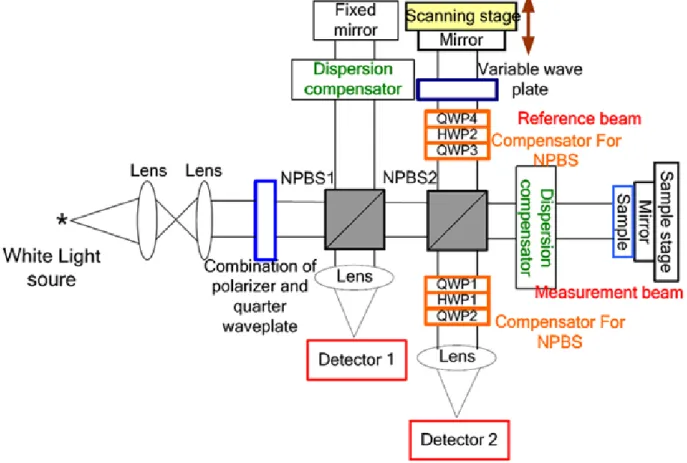
Figure 1 presents a schematic illustration of the proposed Mueller OCT structure. As shown, the structure is similar to that of a traditional OCT system other than the use of a thermal light source to enhance the axial resolution and a combined polarizer, quarter waveplate and variable waveplate in both arms to induce polarization effects such that the multiple anisotropic parameters of the optical sample can be measured. As shown in Fig 1, the OCT system additionally includes two composite structures, each comprising two quarter-waveplates and one half-waveplate, designed to compensate the polarization distortion induced by the non-perfect beam splitters. In a Mueller OCT, the polarization distortion due to an non-ideal beam splitter should be compensated and well controlled for the more accurate extractions in the multiple properties of anisotropic materials.
Research Express@NCKU - Articles Digest
2 of 3
Fig. 1. Schematic illustration of proposed Mueller OCT system
A method has been proposed for extracting the LB and LD properties of anisotropic optical samples using a reflection-mode Mueller OCT system, an analytical model based on a hybrid Mueller matrix formalism, and a GA.
In addition, a compensation scheme based on a composite quarter-waveplate / half-waveplate / quarter-waveplate structure has been proposed for compensating the polarization distortion effect induced by the beam splitters in the OCT structure. In addition, the simulated and experimental results have confirmed the practical feasibility of the proposed approach. In the present study, the Mueller OCT structure has been applied to a quarter-waveplate sample with LB properties only and to a defective polarizer with both LB and LD properties. In a future study, the proposed method will be extended to the measurement of samples having not only combined LB/LD properties, but also combined circular birefringence (CB)/circular dichroism (CD) properties by considering the hybrid model proposed by the current group [7]. Furthermore, the application of the proposed method to scattering optical media will also be addressed.
Reference:
[1] H. D. Huang, E. A. Swanson, C. P. Lin, J. S. Schuman, W. G. Sinson, W. Chang, M. R. Hee, T. Flotte, K.
Gregory, C. A. Puliafito, and J.G. Fujimoto, “Optical coherence tomography,” Science, 254, 1178-1181 (1991).
[2] M. R. Hee, D. Huang, E. A. Swanson, and J.G. Fujimoto, “Polarization-sensitive low-coherence reflectometer for birefringence characterization and ranging,” J. Opt. Soc. Am. B, 9, 903-908 (1992).
[3] J. F. de Boer, T. E. Milner, M. J. C. van Gemert, and J. S. Nelson, “Two-dimensional birefringence imaging in biological tissue by polarization-sensitive optical coherence tomography,” Opt. Lett., 22, 934-936 (1997).
[4] C. K. Hitzenberger, E. Goetzinger, M. Sticker, M. Pircher, and A. F. Fercher, “Measurement and imaging of birefringence and optic axis orientation by phase resolved polarization sensitive optical coherence tomography,”
Opt. Express, 9, 780-790 (2001).
[5] G. Yao and L. V. Wang, “Two-dimensional depth-resolved Mueller matrix characterization of biological tissue by optical coherence tomography,” Opt. Lett., 24, 537-539 (1999).
[6] S. Jiao, G. Yao, and L. V. Wang, “Depth-Resolved Two-Dimensional Stokes Vectors of Backscattered Light
Research Express@NCKU - Articles Digest
3 of 3
and Mueller Matrices of Biological Tissue Measured With Optical Coherence Tomography,” Appl. Optics, 39, 6318-6324 (2000).
[7] C. C. Liao and Y. L. Lo, “Extraction of anisotropic parameters of turbid media using hybrid model comprising differential- and decomposition-based Mueller matrices,” Opt. Express, 21, 16831-16853 (2013).