Applicability of perturbative QCD to
⌳
b\⌳cdecays
Hsien-Hung Shih*and Shih-Chang Lee†Institute of Physics, Academia Sinica, Taipei, Taiwan 105, Republic of China
Hsiang-nan Li‡
Department of Physics, National Cheng-Kung University, Tainan, Taiwan 701, Republic of China
共Received 15 June 1999; published 1 May 2000兲
We develop a perturbative QCD factorization theorem for the semileptonic heavy baryon decay ⌳b
→⌳cl¯, whose form factors are expressed as the convolutions of hard b quark decay amplitudes with universal ⌳b and ⌳c baryon wave functions. Large logarithmic corrections are organized to all orders by Sudakov resummation, which renders perturbative expansions more reliable. It is observed that perturbative QCD is applicable to ⌳b→⌳c decays for velocity transfer greater than 1.2. Under the requirement of heavy quark
symmetry, we predict the branching ratio B(⌳b→⌳cl¯)⬃2%, and determine the ⌳b and ⌳c baryon wave
functions.
PACS number共s兲: 12.38.Bx, 11.30.Rd, 12.38.Cy, 12.39.Fe
I. INTRODUCTION
Analyses of exclusive heavy hadron decays are a chal-lenging subject because of their complicated QCD dynamics. Recently, we have proposed a rigorous theory for these pro-cesses based on perturbative QCD 共PQCD兲 factorization theorems 关1,2兴. In this approach heavy hadron decay rates are expressed as convolutions of hard heavy quark decay amplitudes with heavy hadron wave functions. The former are calculable in perturbation theory, if processes involve large momentum transfer. The latter, absorbing nonperturba-tive dynamics of processes, must be obtained by means out-side the PQCD regime. Since wave functions are universal, they can be determined once and for all, and then employed to make predictions for other processes containing the same hadrons. With this prescription for nonperturbative wave functions, PQCD factorization theorems possess a predictive power.
For semileptonic decays, the PQCD approach comple-ments heavy quark symmetry in studies of heavy hadron transition form factors 关3兴. Heavy quark symmetry deter-mines the normalization of transition form factors at zero recoil of final-state heavy hadrons, up to power corrections in 1/M , M being the heavy quark mass, and up to perturba-tive corrections in the coupling constant␣s, while PQCD is
appropriate for fast recoil, the region with large energy re-lease, and gives a dependence of transition form factors on velocity transfer. For nonleptonic decays, PQCD is a more systematic approach compared with the phenomenological Bauer-Stech-Wirbel 共BSW兲 model 关4兴. In PQCD factoriza-tion theorems contribufactoriza-tions to nonleptonic decay rates char-acterized by different scales are carefully absorbed into dif-ferent subprocesses, among which renormalization-group 共RG兲 evolutions are constructed 关2兴, leading to a scale and scheme independent, gauge invariant, and infrared finite
theory 关5兴. Not only factorizable but nonfactorizable contri-butions can be evaluated关6兴. The BSW model considers only factorizable contributions: two fitting parameters a1 and a2 are associated with external and internal W-emission form factors, respectively. Nonfactorizable contributions must be included as additional parameters 关7兴.
The above PQCD formalism has been applied to heavy meson decays successfully. It is then natural to extend the formalism to more complicated heavy baryon decays. In关8兴 we have developed a factorization theorem for the semilep-tonic decay ⌳b→pl¯ , in which Sudakov resummation of
double logarithmic corrections to the⌳b baryon wave
func-tion was included, and a full set of diagrams for the hard b quark decay amplitudes was calculated. This is an analysis more complete than the work in the literature 关9兴. On the other hand, b baryons have been observed in experiments at LEP and at the Tevatron. Masses and decay widths of the lightest b baryons, as compared with theoretical predictions, have stimulated many interesting discussions and investiga-tions关10–14兴. When run II of the Tevatron comes up with a vertex trigger employed, it will be expected to collect more than 106 b baryon events. Therefore, an intensive study of exclusive heavy baryon decays is urgent.
Exclusive heavy baryon decays are dominated by b→c modes. In this paper we shall develop a factorization theo-rem for the semileptonic decay ⌳b→⌳cl¯ , and locate the
kinematic region where PQCD is applicable. It will be shown that PQCD predictions for the involved transition form factors are reliable at fast recoil of the⌳c baryon with
velocity transfer greater than 1.2. Under the requirement of heavy quark symmetry, we predict the branching ratio B(⌳b→⌳cl¯ ) ⬃2%. We shall also determine the unknown
parameters in the⌳b and⌳c baryon wave functions, which
can be employed to study nonleptonic ⌳b baryon decays
because of the universality.
In Sec. II we develop a factorization theorem for the semileptonic decay ⌳b→⌳cl¯ . Sudakov resummation of
double logarithmic corrections to the process is performed. The factorization formulas for the involved heavy baryon transition form factors and their numerical results are pre-*Email address: [email protected]
†Email address: [email protected] ‡Email address: [email protected]
sented in Sec. III and in Sec. IV, respectively. Section V is the conclusion.
II. FACTORIZATION THEOREM
The amplitude for the semileptonic decay ⌳b→⌳cl¯ is written as M⫽GF
冑
2Vcbl¯␥ 共1⫺␥ 5兲l具
⌳c共p⬘
兲兩c¯␥共1⫺␥5兲b兩⌳b共p兲典
, 共1兲 where GF is the Fermi coupling constant, Vcb is theCabibbo-Kobayashi-Maskawa共CKM兲 matrix element, and p and p
⬘
are the⌳b and⌳cbaryon momenta, respectively. AllQCD dynamics is contained in the hadronic matrix element
M⬅
具
⌳c共p⬘
兲兩c¯␥共1⫺␥5兲b兩⌳b共p兲典
, ⫽⌳¯ c共p⬘
兲关 f1共q2兲␥⫺i f2共q2兲q⫹ f3共q2兲q兴⌳b共p兲 ⫹⌳¯ c共p⬘
兲关g1共q 2兲␥ ␥5⫺ig2共q 2兲 ␥5q ⫹g3共q2兲␥5q兴⌳b共p兲. 共2兲In the second expressionMhas been expressed in terms of six form factors fi and gi, where⌳b( p) and⌳c( p
⬘
) are the⌳b and⌳c baryon spinors, respectively, and the variable q
denotes q⫽p⫺p
⬘
. In the case of massless leptons with ql¯␥共1⫺␥5兲l⫽0, 共3兲the form factors f3 and g3 do not contribute. Since the con-tributions from f2and g2are small, we shall concentrate on f1 and g1 in the present work.
The idea of PQCD factorization theorems is to sort out nonperturbative dynamics involved in QCD processes and factorize it into hadron wave functions. Nonperturbative dy-namics is reflected by infrared divergences in radiative cor-rections to quark-level amplitudes in perturbation theory. The construction of a factorization theorem for the decay ⌳b→⌳cl¯ is basically similar to that for the decay ⌳b →pl¯ in 关8兴. The lowest-order diagrams for b→c decays are shown in Fig. 1, where two hard gluons attach the three incoming and outgoing quarks in all possible ways. We then investigate infrared divergences from radiative corrections to these diagrams. Small transverse momenta kTare associated with the valence quarks, such that they are off mass shell a bit. The transverse momenta kTserve as a factorization scale,
below which dynamics is regarded as being nonperturbative, and absorbed into ⌳b and ⌳c baryon wave functions, and
above which perturbation theory is reliable, and radiative corrections are absorbed into hard b→c decay amplitudes.
Infrared divergences from radiative corrections are collin-ear, when loop momenta are parallel to an energetic light quark, and soft, when loop momenta are much smaller than the ⌳b baryon mass M⌳
b. Collinear and soft enhancements
may overlap to give double logarithms. Three-particle reduc-ible corrections on the⌳b baryon side are absorbed into the
⌳b baryon wave function. If the light valence quarks move
slowly, collinear divergences associated with these quarks
will not be pinched关1兴, and soft divergences are important. However, there is a probability, though small, of finding light quarks in the⌳b baryon with longitudinal momenta of order M⌳
b. Therefore, reducible corrections on the ⌳b
baryon side are dominated by soft dynamics, but contain weak double logarithms with collinear ones suppressed. Similarly, three-particle reducible corrections on the ⌳c baryon side are absorbed into the ⌳cbaryon wave function.
In the fast recoil region collinear divergences become stron-ger, and double logarithms associated with the ⌳c baryon
wave function are more important. The remaining part of radiative corrections, with all collinear and soft divergences subtracted, is characterized by a scale of order M⌳
b, and
absorbed into the hard b quark decay amplitudes. Irreducible corrections, with a gluon attaching a quark in the⌳b baryon
and a quark in the⌳c baryon, are infrared finite in the large
recoil region关15兴 and also absorbed into the hard decay am-plitudes.
The kinematic variables are defined as follows. The ⌳b
baryon is assumed to be at rest with momentum
p⬅共p⫹, p⫺,pT兲⫽
M⌳
b
冑
2 共1,1,0兲. 共4兲 The valence quark momenta in the ⌳b baryon are param-etrized ask1⫽共p⫹,x1p⫺,k1T兲, k2⫽共0,x2p⫺,k2T兲,
k3⫽共0,x3p⫺,k3T兲, 共5兲
where k1 is associated with the b quark. The momentum fractions and the transverse momenta obey the conservation laws
x1⫹x2⫹x3⫽1, k1T⫹k2T⫹k3T⫽0. 共6兲 The ⌳c baryon momentum is chosen as p
⬘
⬅(p⬘
⫹, p⬘
⫺,0)with p
⬘
⫹Ⰷp⬘
⫺at fast recoil. We define the velocity transfer, ⫽Mp•p
⬘
⌳bM⌳c , 1⬍⬍ M⌳ b 2 ⫹M ⌳c 2 2 M⌳ bM⌳c , 共7兲 M⌳cbeing the⌳cbaryon mass. Using the on-shell condition
p
⬘
2⫽M⌳c
2 , the plus and minus components of p
⬘
are written asp
⬘
⫹⫽⫹p⫹, p⬘
⫺⫽⫺p⫺, 共8兲 with⫹⫽共⫹
冑
2⫺1兲r, ⫺⫽共⫺冑
2⫺1兲r, 共9兲 and r⫽M⌳c/ M⌳b. The valence quark momenta in the ⌳c
baryon are parametrized as
k1
⬘
⫽共x1⬘
p⬘
⫹, p⬘
⫺,k⬘
1T兲, k2⬘
⫽共x2⬘
p⬘
⫹,0,k2T⬘
兲, k3⬘
⫽共x3⬘
p⬘
⫹,0,k3T⬘
兲, 共10兲where k1
⬘
is associated with the c quark. The primed vari-ables obey similar relations to Eq.共6兲.According to the factorization theorem, the hadronic ma-trix element is expressed as
M⫽
冕
0 1 关dx兴关dx⬘
兴冕
关d2k T兴关d2kT⬘
兴⌿¯⌳c␣⬘⬘␥⬘共ki⬘
,兲 ⫻H␣⬘⬘␥⬘␣␥共ki⬘
,ki,, M⌳b,兲⌿⌳b␣␥共ki,兲, 共11兲 with the notation关dx兴⫽dx1dx2dx3␦
冉
1⫺兺
i⫽1 3 xi冊
, 关d2k T兴⫽d 2k 1Td 2k 2Td 2k 3T␦ 2冉
兺
i⫽1 3 kiT冊
. 共12兲 关dx⬘
兴 and 关d2k T⬘
兴 associated with the ⌳cbaryon are definedin a similar way. The hard amplitude Hwill be computed in Sec. III. The dependence on the factorization 共renormaliza-tion兲 scale will disappear after performing a RG analysis. The structure of the ⌳b baryon distribution amplitude
⌿⌳b␣␥is simplified under the assumptions that the spin and
orbital degrees of freedom of the light quark system are de-coupled and that the ⌳b baryon is in the ground state (s
wave兲. The distribution amplitude is then expressed as 关9兴
⌿⌳b␣␥共ki,兲⫽ 1 2
冑
2Nc冕
l兿
⫽1 2 d yl⫺dyl 共2兲3 e ikl•yl⑀abc具
0兩T关b ␣ a 共y1兲u b 共y2兲d␥ c 共0兲兴兩⌳b共p兲典
⫽ f⌳b 8冑
2Nc关共p” ⫹M⌳b兲␥5C兴␥关⌳b共p兲兴␣⌽共ki,兲, 共13兲where Nc⫽3 is the number of colors, b, u, and d are quark fields, a, b, and c are color indices,␣,, and␥are spinor indices,
f⌳
b is a normalization constant, C is the charge conjugation matrix, and⌽ is the ⌳b baryon wave function. Under similar
assumptions, the⌳c baryon distribution amplitude⌿⌳c␣␥ is written as
⌿⌳c␣␥共ki
⬘
,兲⫽ 1 2冑
2Nc冕
兿
l⫽1 2 d y⬘
l⫺dy⬘
l 共2兲3 e ikl⬘•yl⬘⑀abc具
0兩T关c ␣ a共y 1⬘
兲ub共y 2⬘
兲d␥c共0兲兴兩⌳ c共p⬘
兲典
⫽ f⌳c 8冑
2Nc 关共p”⬘
⫹M⌳c兲␥5C兴␥关⌳c共p⬘
兲兴␣⌸共ki⬘
,兲, 共14兲where the normalization constant f⌳
c and the wave function
⌸ are associated with the ⌳cbaryon.
Because of the inclusion of parton transverse momenta, Sudakov resummation for a hadron wave function should be performed in impact parameter b space with b conjugate to kT 关1,16兴. The result is 关8兴 ⌽共ki⫺,bi,兲⫽exp
冋
⫺兺
l⫽2 3 s共w,kl⫺兲 ⫺3冕
w d¯ ¯ ␥q„␣s共¯兲…册
共xi兲, 共15兲 where ␥q⫽⫺␣s/ is the quark anomalous dimension, andthe factorization scale w is chosen as w⫽min
冉
1 b1 , 1 b2 ,1 b3冊
, 共16兲with b3⫽兩b1⫺b2兩. The explicit expression of the Sudakov exponent s is given by关17兴 s共w,Q兲⫽
冕
w Qd p p冋
ln冉
Q p冊
A„␣s共p兲…⫹B„␣s共p兲…册
, 共17兲 where the anomalous dimensions A to two loops and B to one loop areA⫽CF ␣s ⫹
冋
67 9 ⫺ 2 3 ⫺ 10 27nf⫹ 8 30ln冉
e␥E 2冊册冉
␣s 冊
2 , B⫽2 3 ␣s ln冉
e2␥E⫺1 2冊
, 共18兲CF⫽4/3 being a color factor, nf⫽4 the flavor number, and
␥E the Euler constant. The one-loop running coupling
con-stant ␣s共兲 ⫽ 1 0ln共2/⌳QCD 2 兲, 共19兲
with the coefficient 0⫽(33⫺2nf)/12 and QCD scale ⌳QCD, will be substituted into Eq.共17兲. The initial condition
of the Sudakov evolution absorbs nonperturbative dynam-ics below the factorization scale w.
Following the derivation in关3,18兴, we obtain the Sudakov resummation for the⌳c baryon distribution amplitude:
⌸共ki
⬘
⫹,bi,兲⫽exp冋
⫺兺
l⫽1 3 s共w,kl⬘
⫹兲 ⫺3冕
w d¯ ¯ ␥q„␣s共¯兲…册
共xi⬘
兲. 共20兲 We have included the Sudakov exponent s associated with the c quark, which carries large longitudinal momentum in the fast recoil region. Notice the same transverse extents bias those for the ⌳b baryon. This is the consequence of ne-glecting the transverse momenta which flow through the vir-tual quark lines in H 关18兴.
The RG analysis of H leads to H共ki
⬘
⫹,ki⫺,bi,, M⌳b,兲 ⫽exp冋
⫺3兺
l⫽1 2冕
tld¯ ¯ ␥q„␣s共¯兲…册
⫻H共xi⬘
,xi,bi,, M⌳b,t1,t2兲, 共21兲 where the superscripts ␣⬘
, ⬘
, . . . , have been suppressed. Since large logarithms have been collected by the exponen-tial, the initial condition H of the RG evolution on theright-hand side of the above expression can be computed reliably in perturbation theory. To simplify the formalism, we shall make the approximations Mb⬇M⌳b and Mc
⬇M⌳c, and neglect the transverse momentum dependence of
the virtual quark propagators as mentioned before. The two arguments t1 and t2 of H, which will be specified in the next section, imply that each running coupling constant␣sis
evaluated at the mass scale of the corresponding hard gluon. Substituting Eqs.共13兲–共21兲 into Eq. 共11兲, we derive the fac-torization formula for the semileptonic decay ⌳b→⌳cl¯ ,
where the dependence has disappeared as stated before. For the⌳b baryon wave function(x1,x2,x3), we adopt the model proposed in 关19兴,
共,兲⫽N2共1⫺兲共1⫺兲exp
冋
⫺ Mb 2 22共1⫺兲 ⫺ ml 2 22共1⫺兲册
, 共22兲with N being a normalization constant,a shape parameter, and ml the mass of light degrees of freedom in the ⌳b
baryon. The new variables and are defined by
⫽ x2
x2⫹x3, ⫽x2⫹x3. 共23兲 In terms ofand, the normalization of(,) is given by
冕
dd共,兲⫽1, 共24兲 which determines the constant N, once the parameters and ml are fixed. The above wave function with the factor2(1⫺)(1⫺)⫽x
1x2x3 suppresses contributions from the end points of momentum fractions. The exponents pro-portional to Mb2/(1⫺)⫽Mb2/x1 and to ml 2 /关(1⫺)兴 ⫽ml 2/x 2⫹ml 2/x
3 with MbⰇml indicate that has a
maxi-mum at large x1and at small x2and x3, and that the b quark momentum k1
2
is roughly equal to Mb 2
. For (x3,x1,x2) which will appear in the factorization formulas presented in Sec. III, the above expression is transformed into
共,兲⫽N2共1⫺兲共1⫺兲exp
冋
⫺ Mb 2 22共1⫺兲 ⫺ml 2 共1⫺⫹兲 22共1⫺兲册
. 共25兲For convenience, we assume that the ⌳c wave function
(
⬘
,⬘
) possesses the same functional form and the same parameters  and ml as of (,), but with the b quarkmass Mb replaced by the c quark mass Mc. The wave
func-tion(x1
⬘
,x2⬘
,x3⬘
) also has a maximum at large x1⬘
, such that the c quark momentum k1⬘
2 is roughly equal to Mc2.III. TRANSITION FORM FACTORS
In this section we present the factorization formulas for the form factors f1 and g1, which are associated with the spin structures ⌳¯c␥⌳b and ⌳¯c␥␥5⌳b in M,
respec-tively. Working out the contraction of ⌿¯
⌳c␣⬘⬘␥⬘H
␣⬘⬘␥⬘␣␥⌿
⌳b␣␥ in momentum space, we
ex-tract the hard part H. Employing a series of permutations of the valence quark kinematic variables as in 关8兴, the summa-tion over the leading diagrams in Fig. 1 reduces to two terms for each form factor. The factorization formulas for the form factors f1() and g1() are written as
f1共兲⫽ 4 27
冕
0 1 关dx⬘
兴关dx兴冕
0 ⬁ b1db1b2db2冕
0 2 df⌳ cf⌳b兺
j⫽1 2 Hj共xi⬘
,xi,bi,, M⌳b,tjl兲Fj共xi⬘
,xi,兲 ⫻exp关⫺S共xi⬘
,xi,w,, M⌳b,tjl兲兴, 共26兲 g1共兲⫽ 4 27冕
0 1 关dx⬘
兴关dx兴冕
0 ⬁ b1db1b2db2冕
0 2 df⌳ cf⌳b兺
j⫽1 2 Hj共xi⬘
,xi,bi,, M⌳b,tjl兲Gj共xi⬘
,xi,兲 ⫻exp关⫺S共xi⬘
,xi,w,, M⌳b,tjl兲兴, 共27兲where is the angle between b1 and b2.
The functionsFj andGj, which group together the products of the initial and final baryon wave functions, are, in terms of
the notation, 123⬅共x1,x2,x3兲, 123⬅共x1
⬘
,x2⬘
,x3⬘
兲, 共28兲 given by F1 123123 ⫽ r 2 关共1⫺x1⬘
⫺⫺兲⫹⫹r 2兴共1⫺x 1⬘
兲x2⫹ 兵2共2冑
2⫺1⫺1兲共1⫺x1⬘
兲⫹关2共1⫹r兲⫺4r⫺1兴x2⫹关2共2⫺1兲 ⫹共2⫺3兲1兴x2x1⬘
其⫹ r2 关共1⫺x1⬘
⫺⫺兲⫹⫹r 2兴共1⫺x 1兲x2⬘
⫹ 兵共1⫹2r冑
2⫺1⫹3⫹4r⫺r兲共1⫺x1兲 ⫺共1⫹3兲共1⫺x1兲x1⬘
⫹2关2共⫺1兲共冑
⫹1⫹兲⫺1兴x2⬘
其⫹ r 共1⫺x1兲2x2⬘
⫹ 2 兵2r共2冑
2⫺1⫺1⫹2兲共1⫺x 1兲 ⫹2共冑
2⫺1⫺2⫹兲x 2⬘
⫺r关共2⫺兲1⫹1⫺2兴共1⫺x1兲x2⬘
其⫹ r 共1⫺x1兲共1⫺x1⬘
兲x2⫹ 2 兵2共冑
2⫺1⫹2⫺兲⫹r共 1⫹3兲 ⫻共1⫺x1兲共1⫺x1⬘
兲⫹2r关2共⫺1兲共冑
2⫺1⫹兲⫺1兴x 2其, 共29兲 F2 312312⫽ r 关共1⫺x3⬘
⫺⫺兲⫹⫹r2兴共1⫺x3兲x1⬘
⫹ 兵2r1共1⫺x3⬘
兲⫹4r 2共1⫹兲共1⫺x 1兲⫹2r2共3⫺冑
2⫺1兲x1 ⫺2r关共⫺1兲冑
2⫺1⫺2兴x 2⬘
⫺共1⫹1兲关r共⫺1兲x1⫹x2⬘
兴共1⫺x3⬘
兲其 ⫹ 2r 关共x2⬘
⫺⫺兲共1⫺x1兲⫹⫹r2兴关1⫺共1⫺x1⫹兲共1⫺x2⬘
兲兴 兵r共⫹冑
2⫺1兲关x1x2⬘
⫺1共x1⫹x2⬘
兲兴 ⫹1共2r2x1⫹x2⬘
⫹2r冑
2⫺1兲其⫹ r 关1⫺共1⫺x2⫹兲共1⫺x1⬘
兲兴共1⫺x3兲⫹ 兵2r1共1⫺x3兲⫹4共1⫹兲共1⫺x1⬘
兲 ⫺2共冑
2⫺1⫺3兲x 1⬘
⫺2r关共⫺1兲共⫹冑
2⫺1兲⫹1兴x 2⫺r共1⫹2兲共rx2⫹冑
2⫺1x1⬘
兲共1⫺x3兲其, 共30兲G1 123123⫽ r2 关共1⫺x1
⬘
⫺⫺兲⫹⫹r 2兴共1⫺x 1⬘
兲x2⫹ 关共2⫺3⫹共2⫺1兲2兲x2共1⫺x1⬘
兲⫹2共2⫺⫺冑
2⫺1兲x2 ⫺2共2⫺1⫹2冑
2⫺1兲共1⫺x 1⬘
兲兴⫹ r 2 关共1⫺x1⬘
⫺⫺兲⫹⫹r 2兴共1⫺x 1兲x2⬘
⫹ 兵2关2共⫺1兲共冑
2⫺1⫹兲⫺1兴x2⬘
⫹2r共冑
2⫺1⫹1兲共1⫺x 1兲⫺共32⫹1兲共1⫺x1兲共1⫺x1⬘
兲其⫹ r2 共1⫺x1兲2x2⬘
⫹ 2 关共2⫺3⫹共2⫺1兲2兲x2⬘
共1⫺x1兲 ⫹2共2⫺⫺冑
2⫺1兲x 2⬘
⫺2共2⫺1⫹2冑
2⫺1兲共1⫺x 1兲兴⫹ r 共1⫺x1兲共1⫺x1⬘
兲x2⫹2 兵⫺2r关2共⫺1兲 ⫻共冑
2⫺1⫹兲⫺1兴x 2⫺2共冑
2⫺1⫹2⫺兲共1⫺x1⬘
兲⫹r共32⫹1兲共1⫺x1兲共1⫺x1⬘
兲其, 共31兲 G2 312312 ⫽ r 关共1⫺x3⬘
⫺⫺兲⫹⫹r 2兴共1⫺x 3兲x1⬘
⫹ 兵⫺4r2共1⫹兲⫹r 2共4⫺⫺2兲x1⫹r共⫺1兲共2⫺1兲x3⬘
x1⫹2r共1⫺x3⬘
兲 ⫹2r关共⫺1兲共冑
2⫺1⫹兲⫹1兴x 2⬘
⫺共2⫹1兲x2⬘
共1⫺x3⬘
兲其 ⫹ 2r 关共x2⬘
⫺⫺兲共1⫺x1兲⫹⫹r2兴关1⫺共1⫺x1⫹兲共1⫺x2⬘
兲兴 关r共冑
2⫺1⫺2⫺兲⫹r2x 1⫹x2⬘
⫺2r共⫹冑
2⫺1兲共1⫺x 1兲 ⫻共1⫺x2⬘
兲兴⫹ r 关1⫺共1⫺x2⫹兲共1⫺x1⬘
兲兴共1⫺x3兲⫹ 兵⫺4共1⫹兲⫹2r共1⫺x3兲⫺2共冑
2⫺1⫹2⫺1兲x1⬘
⫹2r关共⫺1兲 ⫻共冑
2⫺1⫹兲⫹1兴x 2⫺r共2⫹1兲共rx2⫹共⫺1兲x1⬘
兲共1⫺x3兲其, 共32兲 with1⫽冑
(⫹1)/(⫺1) and2⫽1/1. The hard parts are given byH1⫽␣s共t11兲␣s共t12兲K0共
冑共1⫺x
1兲共1⫺x1⬘
兲⫹M⌳bb1兲 ⫻K0共冑
x2x2⬘
⫹M⌳bb2兲, 共33兲 H2⫽␣s共t21兲␣s共t22兲K0共冑
x1x1⬘
⫹M⌳bb1兲⫻K0共冑x2x2
⬘
⫹M⌳bb2兲, 共34兲 with K0 being the modified Bessel function of order zero. The complete Sudakov exponent S is written asS共xi
⬘
,xi,w,, M⌳b,tjl兲⫽Sd共xi⬘
,xi,w,, M⌳b兲⫹Ss共w,tjl兲, 共35兲 with Sd⫽兺
l⫽2 3 s共w,xlp⫺兲⫹兺
l⫽1 3 s共w,xl⬘
p⬘
⫹兲, 共36兲 Ss⫽3冕
w tj 1d¯ ¯ ␥q„␣s共¯兲…⫹3冕
w tj 2d¯ ¯ ␥q„␣s共¯兲…. 共37兲The hard scales tjl are chosen as
t11⫽max关
冑共1⫺x
1兲共1⫺x1⬘
兲⫹M⌳b,1/b1兴, t21⫽max关冑
x1x⬘
1⫹M⌳b,1/b1兴,t21⫽t22⫽max关冑x2x
⬘
2⫹M⌳b,1/b2兴, 共38兲 which are always greater than w. It is possible that the hard scales tjl are small and the running coupling constantsbe-come large as biare close to 1/⌳QCD. These nonperturbative enhancements are, however, suppressed by the Sudakov ex-ponential exp(⫺Sd), which decreases quickly in the large bi
region and vanishes as bi⭓1/⌳QCD. The exponential exp (⫺Sd) approaches unity; that is, there is no Sudakov
suppres-sion from the all-order summation of infrared logarithmic corrections at small bi. In these short-distance regions higher-order corrections are regarded as being hard and should be absorbed into H 关20兴. Another exponential exp (⫺Ss), as a consequence of single-logarithm summation,
de-scribes the RG evolution from the factorization scale w to the hard scales tjl.
For the case with massless leptons, it is easy to show that the differential decay rate in the rest frame of the⌳bbaryon
d⌫ d⫽ M⌳ b 5 r3 24 GF 2兩V cb兩 2
冑
2⫺1兵兩 f 1兩 2共⫺1兲 ⫻关3⫹3r2⫺2共2⫺1兲r兴⫹兩g 1兩 2共⫹1兲 ⫻关3⫹3r2⫺2共2⫹1兲r兴其, 共39兲 where only the contributions from the form factors f1and g1 are considered. It is straightforward to obtain the total decay rate⌫⬅
冕
dd⌫d 共40兲
from Eq.共39兲 and thus the branching ratio B(⌳b→⌳cl¯ ), if
the form factors f1() and g1() in the whole range of are known.
IV. RESULTS
In order to reduce the number of unknown parameters, we make an approximation. Consider the baryonic decay con-stant f˜⌳defined, in heavy quark effective theory, by
具
0兩 j˜v兩⌳Q典
⫽ f˜⌳⌳Q, 共41兲in terms of the⌳ baryonic current 关21,22兴 j ˜v⫽⑀abc共uaC␥ 5d b兲h v c, 共42兲
where ⌳Q is the heavy baryon spinor, hv the heavy quark field, and a, b, c denote the color indices. We contract a Dirac tensor (C␥5)␥ with a heavy ⌳ baryon distribution amplitude such as ⌿⌳
b␣␥ in Eq. 共13兲 and integrate out the
valence quark momenta ki. Compared with Eq. 共41兲, we
extract the baryonic decay constant
f˜⌳⫽ f⌳
QM⌳Q. 共43兲
It implies that in the heavy quark limit the normalization constants f⌳
b and f⌳c are related by
f⌳
bM⌳b⫽ f⌳cM⌳c. 共44兲
Therefore, f⌳
c associated with the ⌳c baryon will not be
treated as a free parameter in the numerical analysis below. We are now ready to compute the form factors f1() and g1() from Eqs. 共26兲 and 共27兲, adopting the CKM matrix element Vcb⫽0.04, the masses M⌳b⫽5.624 GeV and M⌳c
⫽2.285 GeV, and the QCD scale ⌳QCD⫽0.2 GeV. We ex-amine the self-consistency of our calculation by considering the percentage of the full contribution to the form factor f1 that arises from the short-distance region with all ␣s(tjl)/
⬍0.5. The percentages for different  with ml fixed at 0.3
GeV are listed in Table I. It is observed that the perturbative contributions become dominant gradually as and  in-crease: a larger corresponds to larger momentum transfer involved in decay processes, and a larger  corresponds to heavy baryon wave functions which are less sharp at the high
ends of the momentum fractions x1 and x1
⬘
. We conclude that the PQCD analysis of the transition form factors is self-consistent for ⬎1.0 GeV and ⬎1.2, viewing the pertur-bative percentage of about 80%. Compared to the corre-sponding meson decay B→Dl¯ 关3兴, a perturbative expansion is less reliable in the baryon case, because partons in a baryon are softer, such that Sudakov suppression is weaker.To obtain the total decay rate, we need the information on f1 and g1 in the whole range of . Since the perturbative analysis is reliable only in the fast recoil region, we extrapo-late the PQCD predictions at large to small. Hinted at by 关23兴, we propose the following parametrization for the form factors: f1共兲⫽ cf ␣f , g1共兲⫽ cg ␣g , 共45兲
where the constants cf and cg and the powers␣f and␣gare
determined by the PQCD results at large. The constants cf
and cg, equal to the values of the form factors at zero recoil
(⫽1), should be close to unity according to heavy quark symmetry. We fit Eq.共45兲 to the PQCD results in the range with⬎1.3 for⫽1.0, where the perturbative contribution has exceeded 80%. The powers ␣f⫽5.18 and ␣g⫽5.14,
close to␣f⬃4.6 at largefrom the method of wave function
overlap integrals关24兴, are obtained. These values are larger than 1.8 extracted from the transition form factors associated with the corresponding meson decay B→Dl¯ 关3兴. This is expected, because perturbative baryon decays involve more hard gluon exchanges.
On the experimental side, there exist only the data of the semileptonic branching ratio B(⌳b→Xl¯ ) ⬃10% 关25兴,
where the final-state particles X are dominated by the charm baryons. The data of the B meson semileptonic decays show B(B→D*l¯ ) ⬃3B(B→Dl¯ ), indicating that each of the three polarization states of the D* meson contributes the same amount of branching ratio as the D meson does. It is possible that this observation applies to dominant modes in the ⌳b→Xl¯ decays with the excited charm baryons ⌳c(2593) of spin J⫽1/2 and ⌳c(2625) of J⫽3/2. That is,
the branching ratio B(⌳b→⌳cl¯ ) is about 1/4 of B( ⌳b →Xl¯ ), i.e., about 2–3 %. This estimation is consistent with the experimental upper bound of the branching ratio from the data B(⌳b→⌳cl¯⫹X)⫽(8.27⫾3.38)% 关25兴.
We substitute Eq.共45兲 for the form factors f1and g1into the decay rate ⌫ in Eq. 共40兲, and adjust the normalization
TABLE I. Percentages of perturbative contributions for various
 and .
Percentage ⫽1.2 ⫽1.3 ⫽1.4
⫽1.0 GeV 77.7% 83.6% 85.2%
⫽2.0 GeV 79.3% 83.0% 85.7%
constant f⌳
bsuch that our predictions for the branching ratio
are located in the range of 2–3 %. The ⌳c baryon
normal-ization constant f⌳
cchanges according to Eq.共44兲. We adopt
the⌳b baryon lifetime⫽(1.24⫾0.08)⫻10⫺12 s关25兴. The
value of f⌳
b determines the parameters cf and cg. It is then
found that f⌳ b⫽2.71⫻10 ⫺3 GeV2, corresponding to f1共兲⫽ 1.32 5.18, g1共兲⫽ ⫺1.19 5.14 , 共46兲
gives a branching ratio 2%, and f⌳
b⫽3.0⫻10 ⫺3 GeV2, cor-responding to f1共兲⫽1.62 5.18, g1共兲⫽ ⫺1.46 5.14 , 共47兲
gives the branching ratio 3%. Since the values of the form factors at zero recoil should be close to unity as stated above, we prefer Eq. 共46兲 with f1(1)⫽1.32 and g1(1)⫽⫺1.19, which are also consistent with the conclusion in 关24兴. The corresponding normalization constant f⌳
b⫽2.71
⫻10⫺3 GeV2, of the same order as f
P⫽(5.2⫾0.3)
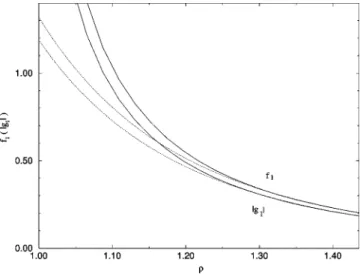
⫻10⫺3 GeV2for the proton关26兴, is reasonable. The PQCD predictions and the corresponding extrapolations are dis-played in Fig. 2, which deviate from each other at small . Applying the PQCD formalism to the zero recoil region, we shall obtain divergent form factors as shown in Fig. 2, which imply the failure of PQCD. Note that our results of the form factors exhibit slopes larger than the dipole behavior as-sumed in关23兴.
We then examine the sensitivity of our predictions for the branching ratio B(⌳b→⌳cl¯ ) to the variation of the param-
eter . Choosing ⫽2.0 GeV and ⫽4.0 GeV, and
nor-malizing the corresponding form factors in the way that they have similar values to those for⫽1.0 GeV in Eq. 共46兲, we obtain the form factors
f1共兲⫽ 1.34 5.04, g1共兲⫽ ⫺1.17 4.92 共48兲 and f1共兲⫽ 1.34 4.94, g1共兲⫽ ⫺1.18 4.79 , 共49兲
respectively. Equations共48兲 and 共49兲 lead to increases of the branching ratio by 4% and 8%, respectively. That is, our predictions for the branching ratio are not sensitive to the choice of baryon wave functions. This observation is attrib-uted to the fact that the PQCD results of the transition form factors at large recoil are insensitive to the variation of baryon wave functions.
We present in Fig. 3 the differential decay rate d⌫/d derived from the form factors in Eq. 共46兲, which can be compared with experimental data in the future. The ⌳b and
⌳cbaryon wave functions determined in this work are given
by 共,兲⫽6.67⫻10122共1⫺兲共1⫺兲 ⫻exp
冋
⫺ Mb 2 2共1.0 GeV兲2共1⫺兲 ⫺ ml 2 2共1.0 GeV兲2共1⫺兲册
, 共50兲FIG. 2. Dependence of f1 and 兩g1兩 on for ⫽1.0 and ml
⫽0.3 obtained from PQCD 共solid lines兲 and from the extrapolation
in Eq. 共46兲 共dashed lines兲. The upper 共lower兲 set of curves repre-sents the form factor f1 (兩g1兩).
FIG. 3. Dependence of d⌫/d on obtained from Eq. 共46兲 in units of 10⫺13 GeV.
共,兲⫽6.94⫻1042共1⫺兲共1⫺兲 ⫻exp
冋
⫺ Mc 2 2共1.0 GeV兲2共1⫺兲 ⫺ ml 2 2共1.0 GeV兲2共1⫺兲册
. 共51兲 At last, we compare our predictions with those derived from other approaches in the literature. The ⌳b→⌳ctransi-tion form factors have been evaluated by means of overlap integrals of infinite-momentum-frame共IMF兲 wave functions, nonrelativistic and relativistic quark models, and QCD sum rules. For a review, refer to关27兴. Basically, they are nonper-turbative methods without involving hard gluons. QCD dy-namics is completely parametrized into IMF wave functions in the overlap-integral approach 关24,28兴 and into baryon– three-quark vertex form factors in the relativistic quark model 关29兴. Information on the above bound-state quantities can be obtained by solving Bethe-Salpeter equations 关30兴. Most of the analyses, including QCD sum rules关22,31,32兴, led to branching ratios about or below 6%. The prediction B(⌳b→⌳cl¯ ) ⬃9% in 关28兴 is a bit higher compared to the data of B(⌳b→⌳cl¯⫹X). Our result is close to (3.4
⫾0.6)% derived in 关31兴.
V. CONCLUSION
In this paper we have developed a PQCD factorization theorem for the semileptonic heavy baryon decay ⌳b →⌳cl¯ , whose form factors are expressed as the
convolu-tions of hard b quark decay amplitudes with universal ⌳b
and⌳cbaryon wave functions. It is observed that the PQCD formalism with Sudakov suppression in the long-distance re-gion is applicable to⌳b→⌳cdecays for the velocity transfer
greater than 1.2. This observation indicates that PQCD is an appropriate approach to analyses of two-body exclusive non-leptonic⌳bbaryon decays. Requiring that the normalizations
of the form factors at zero recoil be consistent with heavy quark symmetry, we have predicted the branching ratio B(⌳b→⌳cl¯ ) ⬃2%. We have also determined the ⌳b and
⌳c baryon wave functions shown in Eqs. 共50兲 and 共51兲,
re-spectively. These wave functions, because of their universal-ity, will be employed to study nonleptonic⌳bbaryon decays
in the future.
ACKNOWLEDGMENTS
This work was supported by the National Science Council of the Republic of China under Grants Nos. NSC-88-2112-M-001-041 and NSC-88-2112-M-006-013.
关1兴 H-n. Li and H.L. Yu, Phys. Rev. Lett. 74, 4388 共1995兲; Phys.
Rev. D 53, 2480共1996兲.
关2兴 C.H. Chang and H-n. Li, Phys. Rev. D 55, 5577 共1997兲; T.W.
Yeh and H-n. Li, ibid. 56, 1615共1997兲.
关3兴 H-n. Li, Phys. Rev. D 52, 3958 共1995兲.
关4兴 M. Bauer, B. Stech, and M. Wirbel, Z. Phys. C 29, 637 共1985兲;
34, 103共1987兲.
关5兴 H.Y. Cheng, H-n. Li, and K.C. Yang, Phys. Rev. D 60, 094005 共1999兲.
关6兴 C.Y. Wu, T.W. Yeh, and H-n. Li, Phys. Rev. D 55, 237 共1997兲.
关7兴 H.Y. Cheng, Phys. Lett. B 335, 428 共1994兲.
关8兴 H.H. Shih, S.C. Lee, and H-n. Li, Phys. Rev. D 59, 094014 共1999兲.
关9兴 W. Loinaz and R. Akhoury, Phys. Rev. D 53, 1416 共1996兲. 关10兴 H-n. Li, hep-ph/9904449.
关11兴 W.F. Chang, H-n. Li, and H.L. Yu, Phys. Lett. B 457, 341 共1999兲.
关12兴 M. Neubert and C.T. Sachrajda, Nucl. Phys. B483, 339 共1997兲. 关13兴 G. Altarelli, G. Martinelli, S. Petrarca, and F. Rapuano, Phys.
Lett. B 382, 409共1996兲.
关14兴 H.Y. Cheng, Phys. Rev. D 56, 2783 共1997兲. 关15兴 H-n. Li and B. Tseng, Phys. Rev. D 57, 443 共1998兲. 关16兴 J.C. Collins and D.E. Soper, Nucl. Phys. B193, 381 共1981兲. 关17兴 J. Botts and G. Sterman, Nucl. Phys. B325, 62 共1989兲. 关18兴 H-n. Li, Phys. Rev. D 48, 4243 共1993兲; B. Kundu, H-n. Li, J.
Samuelsson, and P. Jain, Eur. Phys. J. C 8, 637共1999兲.
关19兴 F. Schlumpf, Ph.D. thesis, 1992, hep-ph/9211255. 关20兴 H-n. Li and G. Sterman, Nucl. Phys. B381, 129 共1992兲. 关21兴 Y.B. Dai, C.S. Huang, C. Liu, and C.D. Lu¨, Phys. Lett. B 371,
99共1996兲.
关22兴 Y.B. Dai, C.S. Huang, M.Q. Huang, and C. Liu, Phys. Lett. B
387, 379共1996兲.
关23兴 H.Y. Cheng and B. Tseng, Phys. Rev. D 53, 1457 共1996兲. 关24兴 X.H. Guo and P. Kroll, Z. Phys. C 59, 567 共1993兲.
关25兴 Particle Data Group, C. Caso et al., Eur. Phys. J. C 3, 1 共1998兲.
关26兴 V.L. Chernyak and A.R. Zhitnitsky, Phys. Rep. 112, 173 共1984兲.
关27兴 J.G. Ko¨rner, M. Kra´mer, and D. Pirjol, Prog. Part. Nucl. Phys.
33, 787共1994兲: M. Neubert, Phys. Rep. 245, 259 共1994兲.
关28兴 B. Ko¨nig, J.G. Ko¨rner, M. Kra¨mer, and P. Kroll, Phys. Rev. D
56, 4282共1997兲.
关29兴 M.A. Ivanov, J.G. Ko¨rner, V.E. Lyubovitskij, and A.G.
Rusetsky, hep-ph/9910342, and references therein.
关30兴 M.A. Ivanov, J.G. Ko¨rner, V.E. Lyubovitskij, and A.G.
Rusetsky, Phys. Rev. D 59, 074016共1999兲.
关31兴 H.G. Dosch, E. Ferreira, M. Nielsen, and R. Rosenfeld, Phys.
Lett. B 431, 173共1998兲.
关32兴 R.S. Marques de Carvalho, F.S. Navarra, M. Nielsen, E.