以型態與程序對稱性探討曲面造型之設計與工程整合
計 畫 類 別 : 個別型
計 畫 編 號 : NSC 101-2221-E-011-157-
執 行 期 間 : 101 年 08 月 01 日至 102 年 07 月 31 日 執 行 單 位 : 國立臺灣科技大學建築系
計 畫 主 持 人 : 施宣光
計畫參與人員: 碩士班研究生-兼任助理人員:簡睿永 碩士班研究生-兼任助理人員:李志謙 碩士班研究生-兼任助理人員:周東諭 博士班研究生-兼任助理人員:賴宛吟 博士班研究生-兼任助理人員:巫明璋 博士班研究生-兼任助理人員:何毓仁
報 告 附 件 : 出席國際會議研究心得報告及發表論文
公 開 資 訊 : 本計畫可公開查詢
中 華 民 國 102 年 10 月 31 日
象。建模操作的流程相關資訊僅僅被保留作提供回復與重製 的功能使用。對於建模流程的控管與操作缺乏適當的工具可 以讓建模工作者針對建模流程做更深入的應用。曲面構造不 適合以傳統的平立剖面進行設計與溝通,本研究指出程序的 對稱性是有效處理曲面設計建模資訊的關鍵,而衍生式建模 系統提供設計人員以程序性資訊為操作對象,可以是提升曲 面構造設計工程整合度的有效工具。
衍生式建模系統提供設計人員記錄並再利用建模過程中的程 序性資訊。程序性資訊可以用來揭露曲面構造設計模型所隱 含的高階對稱性,可以大幅降低曲面構造建模與溝通成本,
同時程序對稱性也與工程可建性有正面的相關性。本研究的 結論指出使用衍生式建模有助於設計師在設計初期透過程序 對稱性的分析來整合工程相關知識,提升工程可建性。
中文關鍵詞: 衍生式建模, 程序對稱性, 工程可建性, 曲面構造 英 文 摘 要 : In most CAD systems, geometric entities are the
focused objects for operations. Procedural
information regarding how designers build up their models is merely kept at the most primitive level, for implementing the undo/redo function basically.
Tools are hardly provided for the manipulation of the modeling process. With generative modeling, designers model the process that generates shapes. Curved forms are very difficult to be represented with
conventional drawings. With generative modeling, the procedural symmetry can be used to simplify the design and construction of curved forms.
Generative modeling enables designers to record and reuse the procedural information that would otherwise be lost if CAD tools cannot recognize and manipulate the generative process of shapes. The lost
information could have been useful to disclosing procedural symmetry for generating curved forms, and reducing the cost of design operation and
communication. In this report, it is concluded that generative modeling may facilitate knowledge
integration in early design stages for the design of curved forms. Architectural design cases that use
constructability are displayed and discussed.
英文關鍵詞: Generative modeling, Procedural symmetry, Constructability, curved structure
Shen-Guan Shih
National Taiwan University of Science and Technology
摘要
大多數的電腦輔助設計系統都是以幾何元件作為操作的對象。建模操作的流程相關資訊僅僅被保 留作提供回復與重製的功能使用。對於建模流程的控管與操作缺乏適當的工具可以讓建模工作者 針對建模流程做更深入的應用。曲面構造不適合以傳統的平立剖面進行設計與溝通,本研究指出 程序的對稱性是有效處理曲面設計建模資訊的關鍵,而衍生式建模系統提供設計人員以程序性資 訊為操作對象,可以是提升曲面構造設計工程整合度的有效工具。
衍生式建模系統提供設計人員記錄並再利用建模過程中的程序性資訊。程序性資訊可以用來揭露 曲面構造設計模型所隱含的高階對稱性,可以大幅降低曲面構造建模與溝通成本,同時程序對稱 性也與工程可建性有正面的相關性。本研究的結論指出使用衍生式建模有助於設計師在設計初期 透過程序對稱性的分析來整合工程相關知識,提升工程可建性。
In most CAD systems, geometric entities are the focused objects for operations.
Procedural information regarding how designers build up their models is merely kept at the most primitive level, for implementing the undo/redo function basically. Tools are hardly provided for the manipulation of the modeling process. With generative modeling, designers model the process that generates shapes. Curved forms are very difficult to be represented with conventional drawings. With generative modeling, the procedural symmetry can be used to simplify the design and construction of curved forms.
Generative modeling enables designers to record and reuse the procedural information that would otherwise be lost if CAD tools cannot recognize and manipulate the generative process of shapes. The lost information could have been useful to disclosing procedural symmetry for generating curved forms, and reducing the cost of design operation and communication. In this report, it is concluded that generative modeling may facilitate knowledge integration in early design stages for the design of curved forms. Architectural design cases that use generative modeling to integrate structure and construction domain knowledge to increase constructability are displayed and discussed.
Generative modeling, Procedural symmetry, Constructability
Prior to the development of industry, manufacturing was often done at homes or workshops with hand tools or basic machines. Designers were also fabricators of their own works. When it was necessary, design was expressed as fabrication processes, such as recipes for cooking. As design and fabrication were separated into different jobs, designers created specifications to the artifact, and fabricators manufactured in respect to the specification. The work of a designer was shifted from the creation of artifacts to making drawings that specify the artifact. The situation eventually built up to
shift the paradigm over design thinking and education, most conspicuously, in architecture. Architects are trained to be experts of drawing drawings, instead of building buildings.
Drawings are abstract representations of artifacts. Architectural design drawings such as plan, elevation and section are abstractions based on the geometric symmetry of buildings along orthogonal axes. When someone draws a column in a building plan, it is assumed that the profile of the column would not be varied in other heights, unless it is specified differently in other plans or sections. The invariance of shapes under axial translation is presumed in architectural design drawings and architectural design thinking. In other words, symmetry, which can be referred as unchanged aspects of shapes or systems under certain transformations, greatly accounts for the very reasons of why and how drawings are used as media for conveying what are in designers’ minds to explicit forms.
The ruler and compass are tools to ensure the translational and rotational symmetry of shapes.
Computer-aided design systems also create and manipulate geometric objects based on symmetric features of forms. Symmetrical forms such as spheres and cubes are used as basic elements to construct more complicated shapes. Commands for shape manipulation such as move, rotate, scale, offset, as well as commands for shape creation such as copy, extrude, revolve, array, sweep and the likes are all based on geometrical symmetry. Designing consists largely in the act of realizing the symmetric features of the form in mind, and the act of realizing what is in mind into drawings with commands and tools that are based on symmetry.
In this report, procedural symmetry is regarded as a kind of higher orders of symmetry than that of geometry. Generative modeling systems enable designers to model the generative process of modeling based upon the realizing and breaking of symmetry in higher orders. The speculation is that generative modeling would be a powerful tool to downsize the cost of information procession for curved forms. In addition to theoretical arguments on issues regarding symmetry, information processing, and communication, examples on generative modeling are displayed for explanations.
Processes are regarding transformations. A process consists of a sequence of actions that transform things. Procedural symmetry is defined as the property of actions that are unchanged under transformations in space and time. In other words, it is the invariant pattern of actions that we can find within the process of making things. In professor Leyton's generative theory of shapes [8], shapes are thoroughly derived by productions of symmetrical transformations. Leyton speculated that transformation sequences that comply with “maximization of transfer” and “maximization of recoverability” are essential to human cognition and reasoning of shapes. According to the theory, the keeping and breaking of symmetry is fundamental to all intellectual behaviors concerning with the recognition and reasoning of shapes.
A straight line is symmetrical under the group of translations along its direction. The first derivative of a straight line is invariant everywhere on the line. The symmetry of a conical curve, such as the parabola y=x2, is not limited to symmetry under reflection over the Y axis of the coordinate system. Although the tangents of the parabola are variable along the curve, yet the first derivative of the curve, which can be represented as dy/dx=2x, is a straight line with translational symmetry when represented graphically. The second derivative of a conical curve is a constant, which implies that
“translational symmetry” can be found on the curve in a higher order. Derivatives in differential calculus are regarding changes, and changes of changes, and so on to the endlessly higher orders of meta-changes. Following Leyton’s theory, we speculate that procedural symmetry can be viewed as higher orders of symmetry on geometry, similar to the relations among the first, second and higher orders of derivatives to curves in differential calculus.
In turtle geometry [1] shapes are defined with sequences of actions. A square can be drawn by iterative actions of drawing a line segment and then turning right. Using the symbols d for drawing a line of one unit length and r90 for turning right with a right angle, we can represent the process of drawing a square as (dr90dr90dr90dr90). Imagining that the list of actions be extended infinitely on both ends, the process remains invariant by shifting any even number of symbols in either directions. The list of symbols is symmetrical under the transformation of time, or more precisely, under the group of transformations that is generated by shifting two actions. The list is also symmetrical under the
groups of reflection either with an arbitrary d or r90 as the center. If we refer the 90 degrees rotation of a square to the action shifting of the generative process, and reflections on orthogonal axes and diagonals of the square to the reflections on d and r90 of the process, we can define a one-to-one mapping between each member of the dihedral group of D4 to the members of the symmetry group for the procedural representation of the square. In this case, the symmetry in the geometrical representation of a square is converted to the symmetry in the procedural representation of the same square.
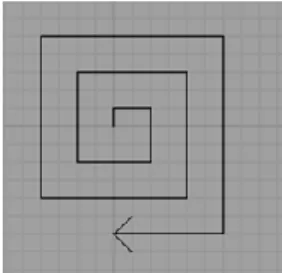
Fig. 1 shows a rectangular spiral form that is generated with the process (d1r90d2r90d3r90…dnr90). The list is no longer symmetrical on shifting or reflection, because the exponent of d increases as the process goes further with time. If we let symbol concatenation to be a kind of non-commutative multiplication, and let the exponent of d’s as a variable t, then the process can be represented as the product of a sequence, which can be written as ∏ . We can derive the necessary transformation that transfers one item of the sequence to the next one by dividing the ith item 𝑑𝑖𝑟 with the (i-1)th item 𝑑𝑖− 𝑟 of the sequence. With the following calculation, we get the invariant .
𝑑𝑖𝑟 (𝑑𝑖− 𝑟 )− = 𝑑𝑖𝑟 𝑟− 𝑑−𝑖+ = 𝑑𝑖 𝑑−𝑖+ = 𝑑
Fig. 1: A rectangular spiral form generated by (d1r90d2r90d3r90…dnr90).
In this case, the necessary transformation for transferring an action to the succeeding action is invariant throughout the generative process of the spiral form. We have found procedural symmetry in a higher order. Symmetry is the key to the reduction of information processing. Experienced draftspersons would learn that much work can be saved if they are able to disclose symmetry in the forms to be drawn. This might be the very reason why all CAD systems assist drafting by providing tools based on geometric symmetry. It is expected that CAD systems would be more helpful by providing tools to create and manipulate shapes on procedural symmetry in higher orders.
In most CAD systems, procedural information regarding how designers build up their design models is merely kept at the most primitive level, for implementing the undo/redo function basically. Tools are hardly provided for the manipulation of processes. Script editor and interpreter are mostly provided for the extension and customization of the system; may not be properly engineered to be used by designers for modeling. Procedural symmetry is not recognized and recorded. As a model is getting more complicated, it would be much harder to edit. Generative modeling is an aged-old paradigm, within which processes are the focused objects of modeling, while shapes are by-products. It concerns
“how” to generate the shape, rather than “what” the shape is composed of. Most CAD systems have adopted the “what” strategy instead of the “how” strategy for the modeling of buildings.
Generative modeling enables designers to record and reuse the information of shape generation that would otherwise be lost if the CAD tool can only manage what the designed shape is composed of.
The lost information could have been useful to disclosing procedural symmetry, and reducing cost of design operation and communication. Generative Modeling Language (GML) [6] can be viewed as a 3D extension to PostScript, which is a programming language devised for specifying print layouts. As a kind of standard format, PostScript takes the advantage of being a fully expressive programming language that is interpreted upon printing. The data-exchange between print layout authoring tools and printers is extremely efficient and powerful. The efficiency of data-exchange between designers
and 3D modelers are further realized by GML. It has been shown that with a GML file as small as 18kb in size, the interpreter can generate a 3D model of the Cologne Cathedral that consists of 70 tracery windows [5], and a single window in highest resolution contains about 7 million triangles. The GML file very efficiently encodes the information that is necessary for specifying the 3D model of the Cologne Cathedral. The efficiency cannot have been achieved without the disclosed procedural symmetry in the generative process of the complicated 3D form of the cathedral.
GML’s ability for parametric design is another feature that makes it particularly apt for being used as a language for design modeling. For more examples, Generative component for Microstation ™ and Grasshopper for Rhinoceros ™ may also be regarded as being generative modeling based. They are tools frequently referred as parametric design systems. These systems enable designers with the ability to create shape variations by changing values of parameters. Parametric design has now been widely recognized as a kind of powerful tools for modeling curved and complicated forms. It is shown that GML has been used to define a large variety of parametric designs for buildings and products [5].
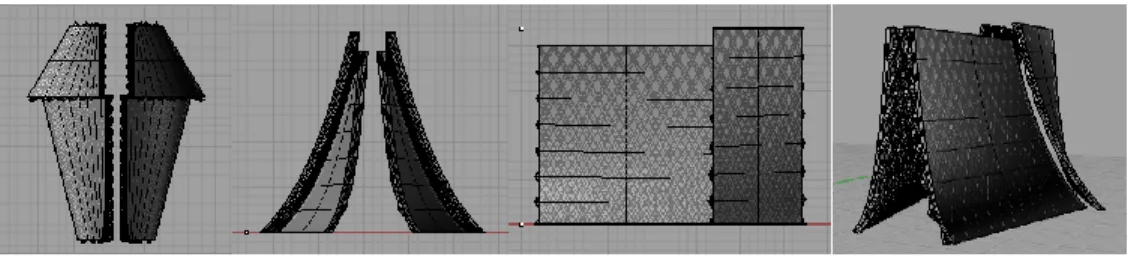
Fig. 2 shows a parametric model and its generative process of the Luce Memorial Chapel, a building designed by I.M. Pei. The model consists of 10 parameters for the building mass with the curved envelop, and 11 parameters to specify the waffle panel structure. Fig. 2 shows the Grasshopper generative process. Fig. 3 shows the rendered images of the model generated with specific values for parameters so that the result resembles the actual building. The parametric model would have been helpful for the communication between the architect, the client, and the structure engineer during the design process. The parametric model can be linked to Karamba, which is a software application for structure analysis, so that the designer can get prompt feedback upon any change to the parameters.
Fig. 2: A generative process that models the Luce Memorial Chapel in Taiwan.
Fig. 3: The Luce Memorial Chapel model generated by the process.
The cores of parametric shapes are the distinctions of the variants and the invariants in the generative process. The variants are the parameters that may be changed effortlessly in the design process, and the invariants are the processes that transmit parameters to the desirable form. Being apt for capturing procedural symmetry, generative modeling systems are by nature very powerful in defining and customizing parametric shapes. Here we use the turtle geometry notation defined in the prior section for further explanation. Mathematical function is a natural way to define processes that take variable input to perform more generic tasks. For example, squares of arbitrary sizes can be defined with the function square(x)=(dxr90)4, where x can be any positive number; the function polygon(n)=(dr360/n)n defines the set of n-sided regular polygons; and the spiral form in fig. 1 can also be defined as a recursive function spiral(n), where
spiral(1)=dr90, and spiral(n)=spiral(n-1)dnr90.
We can define another operator “+” so that enough number of turtles would be activated to perform all tasks that are separated with the “+” operator simultaneously. For example, the expression (d+r90d+r180d+r270d) would activate four turtles from the initial position, each of which would turn to the desirable direction and draw one of the four arms of the cross. The expression can be expanded from (1+r90+ r180 +r270)d, where 1 is the identity element of multiplication and the turtle would simply do nothing when seeing this symbol. We can define a function to generate crosses with various sizes as
cross(x)= (1+r90+r180+r270)dx.
L-system [9] was devised to define biological forms, specialized but not limited to the generation of plant-like shapes. L-system can be regarded as a kind of generative modeling systems using rewrite rules to generate strings that are interpreted as geometric forms based on turtle geometry. With the above notation, we can define recursive functions that generate tree-like forms as rewrite rules in L- systems do. For example, the recursive function,
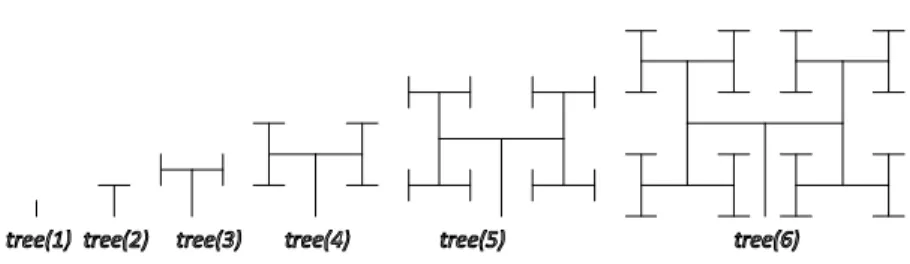
tree(1)=d, tree(n)=dn(r90+r-90)tree(n-1),
can be expanded to generate parametric tree-like shapes as shown in fig. 4. We can evaluate the function to get the following instantiations with n equals to 2, 3 and 4:
tree(2)= d2(r90+r-90)tree(1)=d2(r90+r-90)d,
tree(3)=d3(r90+r-90)tree(2)=d3(r90+r-90)d2(r90+r-90)d,
tree(4)= d4(r90+r-90)tree(3)=d4(r90+r-90)d3(r90+r-90)d2(r90+r-90)d.
Fig. 4: Tree-like shapes generated with various values for the parameter n.
If someone is to draw these shapes with geometric transformations such as copy, scale and rotate, symmetrical patterns of actions would be observed. Procedural symmetry can be defined by using functions as parameters to other functions. For example, the function four(x)=(xr90)4 would generate a shape by executing the input expression x four times with a right turn inserted in between each pair of x’s. For example, four(dr90dr90dr-90dr-90) would draw the shape shown in fig. 5(a).
Fig. 5: (a) Left, The shape generated by four(dr90dr90dr-90dr-90). (b) Right, A cubic Bézier curve defined by 4 control points
Parametric curves can be defined based on the same notation. The expression (dπ/nr360/n)n draws a unit circle as n approaches towards infinity. Modeling with procedural symmetry does not necessarily lead to trivial symmetrical forms. Symmetry exists in an infinite number of orders, much of which can hardly be recognized by even the smartest human minds. A cubic Bézier curve such as the one shown in fig. 5(b) is asymmetrical as it seems. The symmetry of the curve is yet to be uncovered after the
third derivative of the three degree polynomial function that defines it. Many designers have the illusion that they can create and manipulate the so-called “freeform” with current CAD systems using B-splines. The illusion comes from the ignorance of symmetry in higher orders that lay behind the appearance. Designers must learn the lesson from mathematicians that symmetry can still be found within deviations that break symmetry. Once they do, the gap between design and construction would be down.
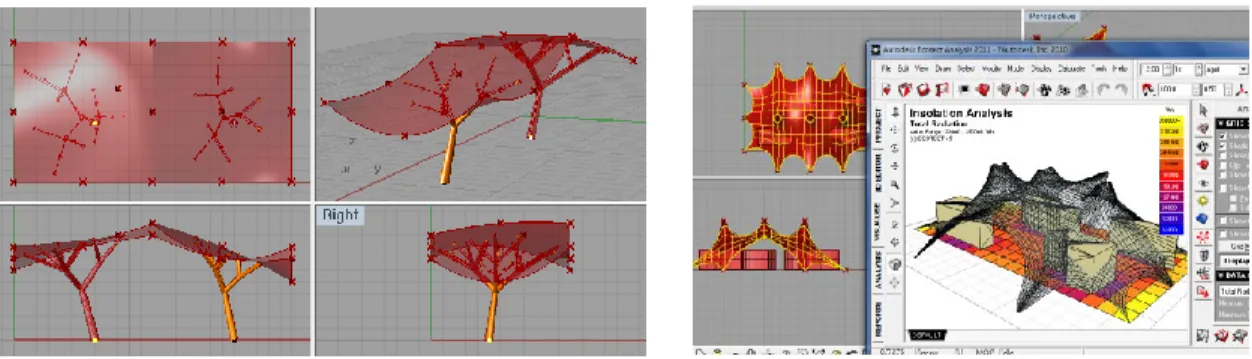
Fig. 6 and Fig. 7 show some examples of parametric design used as exercises in a design modeling course for undergraduate students in the department of architecture. Fig. 6 shows variations
generated by a parametric shape defined with Grasshopper and Rabbit, which is an L-system extention to Grasshopper. Fig. 7(a) shows tree-like structures that automatically connect to the curve surface on top upon editting of parameters and the surface. Fig. 7(b) shows parameteric design for simulating tent structure using Kangaroo, a kinetic simulator, and Gecko, that enables links to Ecotect for solar analysis.
Fig. 6: Parameteric shapes created by a L-system
Fig. 7: Parametric shapes with generative modeling. (a) Left, parametric tree-like structure supporting a curve surface. (b) Right, parameteric design with tent structure linked to Ecotect for solar analysis.
Design communication requires efficient media for exchanging information. In a paper that sets up the foundation for the theory of communication, Shannon [10] defines message as a sequence of recognizable patterns of signals that are transmitted with some communication channels, and information as the capability of differentiation enabled by the transmitted message, with which some certain situations can be identified from all possible situations that can be represented with the same set of message encoding. Shannon further suggested that information can be measured by calculating the uncertainty, or the unlikelihood, of the recognized situations with a logarithm function over probability. These definitions became the firm foundation for the development of the entire discipline of communicational theory in decades that followed.
Weaver [12] elaborated Shannon's theory by distinguishing three levels of communication in terms of the technical, the semantic, and the effectiveness. Research in architectural design communication concerns more with the semantic and effectiveness levels than the technical level. Although Shannon's discussion was focused on the technical level, Weaver concluded that the mathematical model proposed by Shannon can also be extended to the semantic and effectiveness levels of communication.
As an example for communication within the semantic level, the amount of the information that is transmitted by a message consisting of the winning numbers for the lottery is much larger than the amount of information that is transmitted by a message of the same length consisting a number set that will not win. The message consisting of the winning set enables the message receiver to identify the very unlikely situation of winning the lottery. The message consisting of the other set does very little help by identifying one of the millions of ways that will not win, which is almost completely certain to the receiver even without the message. For design communication, drawings and models are messages that encode the necessary information for identifying the desirable design specifications between the sender and the receiver of the message. The lesson that we learned from Shannon is that the message sent by the designer does not need to include specifications that are certain to the receiver. The same amount of information can be sent by more compact message consisting of only the uncertain things that are unlikely for the receiver to derive without the message. Design communication between professionals takes this advantage so that compact representations such as abstract symbols and hatch patterns can be used to define construction specification, plan, and section to define 3D forms.
Operations on design drawings and models are costly and risky, for any change may induce cascades of necessary changes for maintaining the consistency of the entire set of construction documents, and any unresolved inconsistency may induce great losses in later stages of construction and operation. The organization of a design team has much to do with the cost for design communication. Design related works are divided by various disciplines of domain knowledge such as architects, interior designers, structure engineers, and other consultants. Each member of the design team would receive messages from other team members and feedback with messages that encode professional contribution. One of the difficult situations is that all contributions can be interdependent and vulnerable for changes from other parts of the design.
The structure of the team for a construction project minimizes the cost for interdisciplinary communication. A price to be paid is that the separation of design and construction in the industry has a negative effect on the constructability for the project. Building Information Modeling (BIM) [2]
has been widely accepted as the bright avenue leading the industry out of the unsatisfactory situation.
Most recognized is the promised land of Integrated Project Delivery (IPD), where project information can be exchanged across disciplines almost for free and retains its operability from source to destination. The magic is brought by advances of building information modeling platforms, with which the project team is supposed to integrate all necessary information including the form, the structure, the material, the MEP systems, and the construction altogether as a strongly interrelated data bank.
The magic is further extended to every corner of the industry with Industry Foundation Classes (IFC), a universal file format for project information, and dialects that are developed through Information Delivery Manual (IDM) and Model View Definition (MVD) for exchanging information between specific professions within specific phases in the project lifecycle. [2]
An important issue needed to study is that how can the integrated project data bank be created and manipulated efficiently. In the back stage, how can the project information be encoded with a compact structure for storage, edit and retrieval, as well as for the maintenance of consistency? On the front stage, how can the authoring platforms of project information interact with project participants so that the rewards of integration outshine the increased work load for information processing? The standpoint is that generative modeling based parametric design may partially answer the front stage question, while the answer of the back stage question may need further insight to the fundamental theory of design modeling.
Claude Shannon [10] applied the formula for calculating entropy as the formula to measure the amount of information that is consisted in messages sent within a communication system. The quantity of information is useful in analyzing complexity. We extended the use of entropy formula to the estimation of information that is needed for the communication between design and fabrication.
Shannon calculate information of message based on the following formula:
In the formula, is the quantity of information that is to be calculated. is a constant and is the probability of the occurrence of the th datum in the message. The warren truss shown in fig 8 can be regarded as a message in Shannon’s model. Assuming that there are two types of rods and two types of joint used to construct the truss. Rods 0, 1, 2, 9, 10 are type A, and rods 3, 4, 5, 6, 7, 8 are type B. Joint A, D, E, G are of type 1, and joints B, C, F are of type 2. Assuming that the shape of the truss is known to the fabricator and all structural elements, including rods and joints are prefabricated. The information that is needed to assemble the truss can be calculated using the formula of entropy. The result of calculation is 8.864.
Fig 8. A Warren truss
The Pratt truss shown in fig 9 consists of more elements than the Warren truss, including 3 types of rods ([0-3, 6-11], [4, 5, 17-20], [12-16]) and 4 types of joints ([A, G], [B, J, F], [H, I, K, L,C, E, F], [D]).
The estimated amount of information is 12.32 due to the larger variations on construction elements and joints.
Fig 9. A Pratt truss
The five types of regular polyhedron, namely tetrahedron, cube, octahedron dodecahedron and icosahedrons, are the most symmetrical polyhedron, and therefore, consist of least information among all types of polyhedron. The construction of regular polyhedron requires only one type of joints, one type of rods and one type of faces. The amount of information it takes for the fabricator to pick the right element for construction is zero; and therefore, the total amount of information for fabrication is zero when the shape is known. We take octahedron as an example. There are 6 joints on an octahedron, and each of which joints 4 rods in the same way. The consistency implies that the construction of joints on an octahedron takes no extra effort for a fabricator to differentiate on joint from another. There are 8 rods on an octahedron, all with equal length. There are also 8 triangular faces on an octahedron, exactly of the same size and shape. The symmetry among all joints, rods and faces imply that the fabricator needs no extra information for the installation of the prefabricated construction elements once he/she manage to know the installation of the first one of each types.
Fig 10. Regular polyhedron(http://en.wikipedia.org/wiki/Platonic_solid)
Fig 11 shows two types of Archimedean polyhedron, the truncated tetrahedron and cuboctahedron. A truncated tetrahedron is composed of one type of joints, one type of rods and two types of faces. The consisted information in a truncated tetrahedron is 0 for joints and rods, but 4.0 for faces. The cuboctahedron consists of 8 triangles and 6 squares. The required information of constructing a cuboctahedron is 6.834.
Fig 12. Two types of Archimeadian polyhedron(http://en.wikipedia.org/wiki/Archimedean_solid)
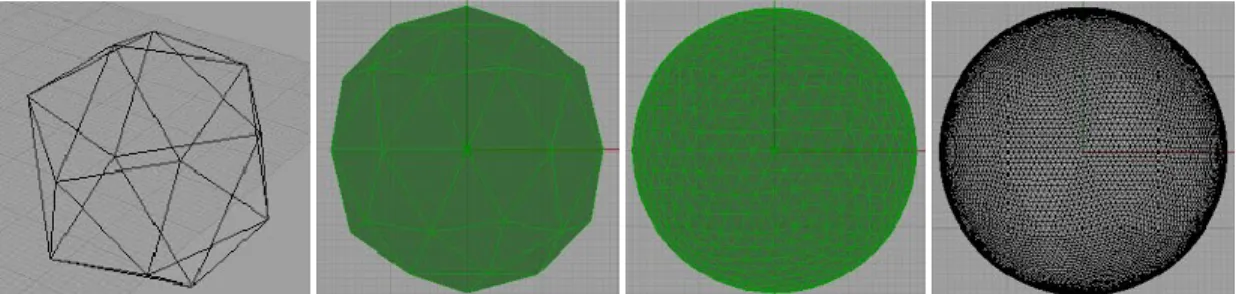
Geodesic dome (Fig 13) is derived from Icosahedron by dividing each of the triangles into four triangles and projecting the added vertices onto the sphere. On each level of refinement, extra types of rods and faces are required. The first level refinement of geodesic dome consists of two types of joint, including 12 joints with five connecting rods, and 30 joints with six connecting rods.
There are also two types of rods with different length, and two types of triangular faces. The information that is required to assemble the first level sphere is 105.275.
Fig 13. Icosahedron and further refinements based on dividing each faces into smaller triangles.
Fig 14. Buckminster Fuller, Montreal Biosphère(http://en.wikipedia.org/wiki/Montr%C3%A9al_Biosph%C3%A8re)
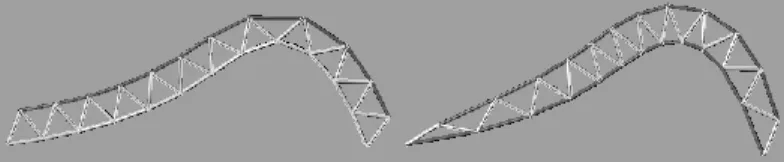
The two curved truss shown in fig 14 are derived using different rules. The one on the left is composed with right triangles (bright rods) at the bottom, and each of which is connected to next triangle with dark rods of various lengths at the top. The truss on the right is formed by zigzagging bright rods of identical length and dark rods in various lengths. The two curved trusses use different design to reduce information by using uniform sized rot as many as possible.
Fig. 15 Curved plane trusses with different design to reduce types of rods
Fig 16 shows three different designs for curved trusses based on the same curve which is shown at the bottom. Using the information measurement method of Shannon, the consisting information of truss A is 26.265, 38.744 for truss B and 37.808 for truss C. The three designs are similar in the configuration of joints and rods, but vary in the lengths of rods. However, the total lengths of rods for the tree trusses are almost the same, within 0.003 of discrepancy. Truss A is the most symmetrical among the three. The result of information measurement implies that with truss A least amount of information is needed to be processed.
Fig. 16 Three different designs for a curved truss
Most construction projects are divided into phases, each of which is performed by teams of distinct professions. As professor Fischer [3] has stated,
, in most construction projects, the desirable knowledge for constructability is often not available in early phases such as programming and design. However, the fragmentation of the construction industry could have been inevitable due to the inefficiency of interdisciplinary communication. Professor Fischer and his research team took up the challenge to formalize the knowledge for analyzing constructability of building design [4]. Recommended general contractors, designers, subcontractors, and suppliers of construction materials and equipment were interviewed for knowledge acquisition. The following design variables that contribute to the constructability of reinforced concrete structure were derived by the research team.
1. Dimensions of elements (e.g., height, depth, width, thickness and length) 2. Distances between elements (e.g., clear spans and story heights)
3. Changes in dimensions and distances (e.g., from floor to floor or from bay to bay) 4. Quantity and type of reinforcement
5. Concrete strength
6. Repetition of dimensions and distances, and modularity of layout
Among the six variables, the third, fourth, and the last are related to the geometrical symmetry of layout, element, and reinforcement of the structure system. Variables one and two are related to the compatibility of formwork systems that may greatly raise the constructability when applied properly
to the construction. Most of such systems, such as tunnel form, flying form, and gliding form, are devised based on some symmetric features of the design. For example, the applicability of flying form would depend on the following three symmetric features of the structure system. First, as the flying form is moved out from the constructing structure after the concrete has been cured, the process requires at least a clearance with translational symmetry along the path based on the size and shape of the form. Second, the use of flying forms would be more efficient if they can be repeatedly used throughout the project. Third, the spaces between adjacent flying forms would require customized formwork if the void spaces are not of the same shape and size. It is obvious that the first, second, and sixth variables of constructability devised by Fischer can be characterized with the required symmetry described above. Other types of formwork systems might require other types of symmetry.
An example is the jump form system used in a construction project in Hong Kong [11]. The formwork can be lifted floor by floor as the construction goes on to the top. It requires that the design possesses translational symmetry in vertical direction.
In early design phases, it is often unrealistic to analyze constructability of the design based on specific types of construction systems for that related decisions would not be set until later stages of the design phase. The analysis of constructability in early design phase requires reasoning on a higher level of abstraction. The five types of regular polyhedron, namely the tetrahedron, hexahedron, octahedron, dodecahedron and icosahedron, are of the highest symmetry among all polyhedron for that all vertices, edges and faces are interchangeable. There is no need of information to distinguish one vertex from another either in the design modeling or in the construction. If we are allowed to ignore asymmetrical factors such as gravity and weather, the constructability of a regular polyhedron would potentially be among the highest because all faces can be constructed with identical elements that are jointed with identical interfaces. Interchangeable vertices imply that if the form is constructed with linear elements along the edges of the polyhedron, the installation of all joints would probably take same machinery, information, skill and process to complete. Interchangeable edges imply that all panel elements can be installed in similar way. Interchangeable faces imply that same panel element can be used repeatedly and interchangeably. The symmetrical features of building design are strongly related to constructability. For building design with symmetrical shapes, dimensions and interfaces, systematic and prefabricated construction methods are more applicable; material and parts can be massively fabricated; engineers and workers take less effort in communication and control; tools, machinery and equipment can be reused without specific customization.
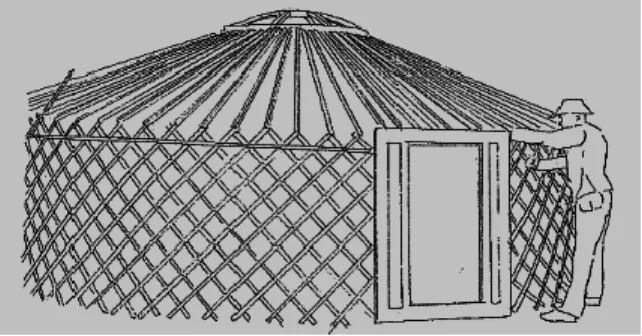
The Ger, as a building type developed by pastoralists, for whom mobility is the very means to keep alive, is a good subject to learn about constructability. Fig. 17 shows a drawing of a Mongolian Ger under construction. The wall panels of a Ger are criss-crossed lattices that are made with sticks of the same size and length. The rafters for the roof are identical sticks notch into the top of the wall panels and the roof ring, in the same way for all of them. Procedural symmetry can easier be observed in the construction process. A family sized Ger can be assembled and made ready for living in half an hour by the family members. The form, the structure, and the construction are seamlessly integrated with their living environment and living style. It would be very hard, if possible, for any designer based on similar criteria to come up with better design alternatives that overtake traditional Ger by constructability. For modeling the Ger, a designer can take the most advantage out of the symmetrical form with symmetrical processes, and that is exactly what generative modeling is best of.
Fig. 17: A Mongolian Ger under construction
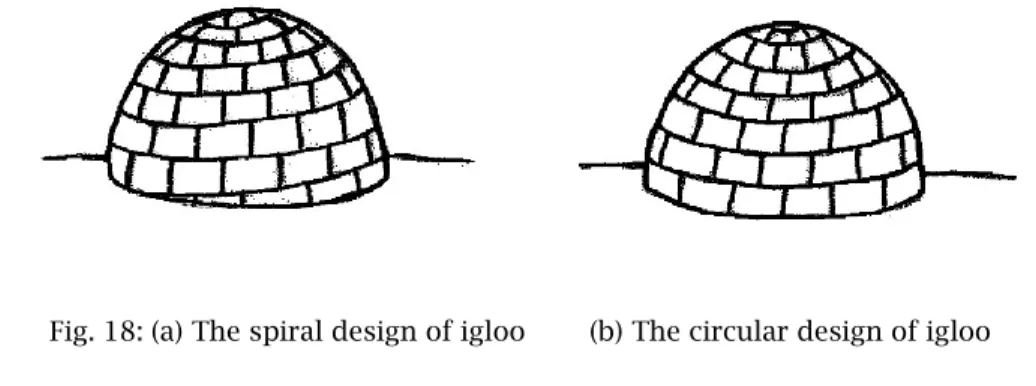
Fig. 18 shows two different ways to build an igloo. On the left, the igloo is built by laying snow bricks onto a sloped spiral curve to the top. The igloo on the right shows that snow bricks were arranged as layered circular rings on top of another with reduced sizes. According to a documented film in 1949 by D. Wilkinson [7], the Inuit build igloos with the spiral design. The circular design of an igloo might be more natural from a designer’s standpoint, for its geometric symmetry is more apparent and is easier to draw and model with pencils and CAD systems. However, the spiral design of the igloo has the advantage over constructability, at least from the point of view of Inuit igloo builders.
The spiral design sacrifices the geometrical symmetry of snow bricks for procedural symmetry. For every brick that is being laid, it is supported by bricks underneath and the brick on the down side of the spiral. With the circular design, procedural symmetry is broken whenever the first snow brick of each layer has to stand on the tilted top of the lower layer without getting any support from both sides. Procedural symmetry is broken again when the last snow brick of each layer has to be cut smaller for fitting into the space within blocks on both sides. It would require further effort and skill to ensure the air-tightness of the construction.
Fig. 18: (a) The spiral design of igloo (b) The circular design of igloo
It is speculated that there might be relations between procedural symmetry in design modeling and constructability from the standpoint of information processing. For every task to be performed, be it an act for design modeling or for construction, there is some certain information that needs to be processed. Such information, which may either be derived from memory or from the working context, is required for appropriate actions upon the encountered situation. In our cases with turtle geometry, the only required information for the turtle to act is the input symbol that is being given to it right at the moment. The turtle needs no sensors to get information from the context, nor does it need to memorize anything. It is not difficult to define more sophisticated turtles that are capable of sensing the environment, or memorizing what they have done, and making decisions autonomously. In the field of computational theory, classes of autonomous devices such as finite state machines, push- down automata and Turing machines were defined based on levels of complexity for information processing. Although the classification was used to analyze computational complexity for tasks that are defined with mathematical constructions, it could also be applied to real world tasks as well. In design modeling or construction, work processes are composed of individual tasks performed by some actors such as draftspersons, designers, workers, engineers or robots. Actors in the design and construction process are analogous to the autonomous devices in computational theory. It is required that these actors are able to retrieve and process the necessary information so that they can make the right decision over what and how to perform the task, in ways similar to the autonomous devices that take information from input and process it for output. Constructability can be classified by the complexity of the information processing that is required for jobsite activities.
Procedural symmetry implies that there exists some ways to distinct the invariants from the variants so that complicated processes can be decomposed into simpler tasks that are symmetrical in the way information is retrieved and processed. Symmetry is the key to simplicity and complexity.
Generative modeling, as a platform to formalize processes, could be used as an adequate design media for designers to build up design models of curved structure based on higher orders of symmetry for better constructability.
We gratefully acknowledge the support of the National Science Foundation, Taiwan, R.O.C. and the National Taiwan University of Science and Technology for the research presented.
[1] Abelson, H.; diSessa, A.: Turtle Geometry, The MIT Press, 1986.
[2] Eastman, C. M.: BIM handbook : a guide to building information modeling for owners, managers, designers, engineers and contractors (2nd ed. ed.). Hoboken, N.J.: Wiley. 2011.
[3] Fischer, M.: Automating Constructibility Reasoning with A Geometrical and Topological Project Model, Computing Systems ni Engineering Vol. 4, Nos. 2-3, pp. 179-192, 1993
[4] Fischer, M.; Tatum, C.B.: Characteristics of Design-Relevant Constructability Knowledge. Journal of Construction Engineering and Management, (1997) 123(3), 253–260.
[5] Havemann, S.; Fellner, D.W.: Generative Parametric Design of Gothic Window Tracery. The 5th International Symposium on Virtual Reality, Archaeology and Cultural Heritage, 2004
[6] Havemann, S.: Generative Mesh Modeling, Doctoral Dissertation, der Technischen Universität Braunschweig, 2005.
[7] How to Build an Igloo: http://www.nfb.ca/film/How_to_Build_an_Igloo/ . National Film board of Canada
[8] Leyton, M.: A Generative Theory of Shape, Springer-Verlag Berlin Heidelberg, 2001
[9] Prusinkiewicz, P.; Lindenmayer, A.: The Algorithmic Beauty of Plants (The Virtual Laboratory).
Springer-Verlag. 1990.
[10] Shannon, C.E.: The Mathematical Theory of Communication, in The Mathematical Theory of Communication, University of Illinois Press, 1949
[11] The Jump Form System:
http://www.cityu.edu.hk/CIVCAL/production/advanced/jump_form.html, City University of Hong Kong.
[12] Weaver, W.: Some Recent Contributions to the Mathematical Theory of Communication, in The Mathematical Theory of Communication, University of Illinois Press, 1949
1
日期: 年 月 日
一、參加會議經過
本次會議主辦及贊助單位為Information Processing Society of Japan, Special Interest Group on Groupware and Network Services (IPSJ SIG-GN), Human Interface Society, Special Interest Group on Communication Enhancement (HIS SIG-CE)以及 The Virtual Reality Society of Japan, Special Interest Group on Cyberspace (VRSJ SIG-CyberSpace)。其關注主題是群體協同作業的相關資訊技術、人機介面 與溝通技術,以及虛擬實境技術。建築設計須結合多重專業領域,尤其是曲面建築構造的設計與施工,
更需要透過先進的資訊技術提升跨專業領域的資訊交換與協同作業的效率。
本次會議的主題為群體協同作業相關科技,與科技強化之合作學習。建築設計是跨專業的協同作 業,尤其針對複雜的曲面構造,從設計階段開始計必須整合結構、工程以及管理專業。面對資訊科技 的日新月異,尤其在現代科技社會裡,更值得我們深思及關心。在我們生活環境中,充斥著各式各樣 的訊息,藉由不同的傳播方式,成為有意義和需要的資訊。在傳播科技的研究與發展的輔助下,資訊 的運用與功能與人類生存的環境更是密不可分,傳播技術的進步使得資訊科技無遠弗屆,也因此本研 究探討如何以網路平台協助設計工作室的設計人員,以規格化的方式進行知識整合。論文內容檢討一 次在建築設計課程中進行的教學實驗,目的在了解網路溝通平台如何協助設計人員交換彼此的知識與 設計構想。本篇論文獲得評審的肯定而得以在研討會中發表,獲得熱烈的回應。研討會其他論文分別 在不同領域中探討如何以資訊技術強化團隊協同作業的成效,與會收穫良多。
二、與會心得
第六屆協同作業科技國際研討會的主題是協同作業相關科技,大會中接觸到許多不同領域,從各 專業的角度來探討協同作業的議題,例如Development of a Collaborative Educational Computer Game based on a Knowledge Engineering Approach, 從知識工程角度切入以電腦遊戲強化合作學習,對於建 築設計的合作學習環境的經營上而言有很大的啟發。大會中也有同為建築與工程協作的論文,例如 Designing Collaborative Learning Environments for Architecture, Engineering and Construction (AEC) Students,討論如何為建築與工程領域規劃合作學習作業環境。由於本次研討會參與者來自各個領域 的專家學者,大多為電腦科學資訊工程相關,人文互動方面研究以社群網路或人機互動等研究範疇為 主,本研究以建築設計合作學習的部份切入則為較為特別的部份,也因此受到許多國外研究者的好奇 與詢問。整體而言,是很不錯的一次經驗,受益良多。
計畫編號 NSC 101-2221-E-011 -157 -
計畫名稱 以型態與程序對稱性探討曲面造型之設計與工程整合 出國人員
姓名 施宣光 服務機構
及職稱
國立台灣科技大學建築系 教授
會議時間
101 年 08 月 27 日 至
101 年 08 月 29 日
會議地點 Sapporo, Japan
會議名稱 (中文) 第六屆協同作業科技國際研討會
(英文) The Sixth International Conference on Collaboration Technologies
發表論文 題目
(中文) 再訪Kihaus: 一個建築設計工作室合作學習的省思
(英文) Revisiting Kihaus: Reflections on Collaborative Learning in an Architectural Design Studio
2
四、建議
無
一、 攜回資料名稱及內容
Proceedings of The Sixth International Conference on Collaboration Technologies Papers & Posters
Full paper 25 min. (17min.+8min.)
Short paper & Workshop paper 15 min. (10 min.+5 min.) Monday, August 27
Workshop Session I [10:00 - 12:00]
(8 Presentations)
Assessing Students' Reactions to Mobile Collaborative Learning: A Cognitive Style Perspective Li-Ping Chang, Pei-Ren Huang and Sherry Y. Chen
Design Implications for Supporting Students' Conceptualization of Science with New Media Tools Daniel Spikol and Nuno Otero
Supporting English Vocabulary Learning with SCROLL Noriko Uosaki, Hirogaki Ogata, Bin Hou and Mengmeng Li
GS-supported Collaborative Learning for Primary School Students' Reading Comprehension Chiu-Pin Lin and Su-Jian Yang
A Innovative Collaborative Search System: Impact on Information Problem Solving Process and Ability Chester S.J. Huang, Addison Y.S. Su and Stephen J.H. Yang
A Collaborative Ubiquitous Learning Approach to Improving Students' Knowledge for Classifying In-Field Targets Hui-Chun Chu, Gwo-Jen Hwang and Yu-Shih Lin
Helping Novices to Learn Alice Programming through Pair-Learning Ming-Puu Chen, Nian-Shing Chen and Wan-Nien Chen
A Collaborative WebQuest Approach to Improving Students' Learning Achievement in a Computer Course Hsiu-Ying Wang and Gwo-Jen Hwang
Conference Session I: Collaborative Learning I [13:00 - 13:55]
(Full paper 1, Short paper 2)
Mobile Collaborative Learning and Cognitive Style Grouping (Full) Li-Ping Chang, Pei-Ren Huang and Sherry Y. Chen
4D Sandbox-MMORPG for Cooperative Learning in the Historical Context (Short) Shun-Cian Jheng, Ju-Ling Shih and Yen-Jen Wang
The Creation of A Massive Multiplayer Online Adventure Game for Cooperative Learning (Short) Yi-Han Wang, Yen-Jen Wang and Ju-Ling Shih
Workshop Session II [14:10 - 16:10]
(8 Presentations)
Effects of Technology-Enhanced Collaborative Writing on Students' Learning in Creative Drama Practice Lu-Ho Hsia, Iwen Huang and Gwo-Jen Hwang
Development of a Collaborative Educational Computer Game based on a Knowledge Engineering Approach Han-Yu Sung, Gwo-Jen Hwang, Chun-Ming Hung and I-Wen Huang
A Computerized Concept Map Approach to Conducting Peer Tutoring Activities for a Social Science Course Chien-Wen Chuang, Gwo-Jen Hwang and Wen-Jen Tsai
Revisiting Kihaus: Reflections on Collaborative Learning in an Architectural Design Studio Shen-Guan Shih, Hi-Lian Jeng and Yen-Hong Chen
Emerging Challenges, Emerging Trends: On the Use of Context-aware Ubiquitous Technology and Video for English Listening Collaborative Learning Activities
Gi-Zen Liu, Jing-Yao Chen and Gwo-Jen Hwang
A Collaborative Virtual Environment for Situated Language Learning: A case study of English learning in Second Life Tosti H.C. Chiang and Stephen J.H. Yang
Developing Rubrics for Assessing Questioning Ability in Ubiquitous Problem-based Learning
3 Wen-Yi Chang, Gwo-Jen Hwang, I-Hua Lin and Pi-Hsia Hung Tuesday, August 28
Conference Session II: Video Streaming and Creativity Support [9:30 - 10:50]
(Full paper 2, Short paper 2)
A Streaming Video Modification Method for Improving Visibility of the Content in the Video (Full) Katsuhiko Kaji and Nobuo Kawaguchi
An Experimental Live Streaming of an Ice Hockey Game with Enhancement of Mutual Awareness (Short) Toshihiko Izumi, Hiroyuki Tarumi, Erina Kagawa, Rihito Yaegashi and Toshihiro Hayashi
The Effect of Using Photographs in Idea Generation Support System (Full)
Tomohiro Kokogawa, Yuji Maeda, Takahiro Matsui, Junko Itou and Jun Munemori
Basic research on time series of idea generation for reducing idea-creation time (Short)
Hideki Goromaru, Tomohiro Kokogawa, Takaya Yuizono, Takayuki Higashi, Junko Itou and Jun Munemori Conference Session III: Co-Dining Support [11:05 - 12:10]
(Full paper 2, Short paper 1)
Development of KIZUNA System to Support Time-Shifted Co-Dining (Full) Mamoun Nawahdah and Tomoo Inoue
Automatic Dish Recommendation System for People Dining Together: The Group FDT (Full) Junshan Hu, Yuichiro Otsuka and Tomoo Inoue
GiantCutlery: A Dining Table-Talk Medium that Brings Out Mutual-Aid Interactions among Tablemates around Large Platters (Short)
Kanayo Ogura, Yuta Tanaka and Kazushi Nishimoto Conference Session IV: Collaborative Learning II [13:30 - 15:00]
(Full paper 3, Short paper 1)
Supporting Daily Reflection for Ubiquitous Learning Log Using SenseCam (Full) Bin Hou, Hiroaki Ogata, Mengmeng Li and Noriko Uosaki
The Design of Shared Display Groupware for Supporting Interdisciplinary Collaborative Learning (Full) Chen-Wei Chung, Yunhan Lai, Chen-Chung Liu and Shu-Yuan Tao
Formal and Informal Collaborative Learning in 3D Virtual Campuses (Full) Mikhail Fominykh, Ekaterina Prasolova-Førland and Peter Leong
Designing Collaborative Learning Environments for Architecture, Engineering and Construction (AEC) Students (Short) Caroline T.W. Chan and Willy Sher
Conference Session V: Understanding Communication and Work [15:20 - 16:40]
(Full paper 2, Short paper 2)
The Measurement of Dialogue: From a Case Study of the Workshop Using World Cafe as a Collective Dialogue Method (Full)
Masamichi Takahashi, Keiichi Nemoto, Naoki Hayashi and Ryoji Horita
User Interruptibility Estimation based on Focused Application Switching (Full) Takahiro Tanaka and Kinya Fujita
A System for Breaking Poor Posture in Performing VDT Tasks Using Pseudo-Negative Effects Associated with User Actions (Short)
Mariko Kikugawa and Hideaki Kanai
Supporting Context Based Chats for Enterprise Use (Short) Tanuj Shah and Joyce Ohgi
Poster Session [16:40 - 17:40]
Development of a Massively Multiplayer Online Role?Playing Game for English Learning Lu Ting Liu, Jie Chi Yang and Ben Gao Huang
A Proposal of Video Communication System in Which Talker's Avatar is Superimposed for a Virtual Face-to-Face Scene
Yutaka Ishii, Tomohiro Takada and Tomio Watanabe
A Context-aware Multimodal Interface for Mobile Learning Mengmeng Li, Hiroaki Ogata, Bin Hou and Noriko Uosaki
Development of a Travel Assistant System Using Google Maps and a Pictograph Chat Jun Munemori, Motohide Terao and Junko Itou
Design of GUNGEN-SPIRAL III for Laboratory Management
4 Masashi Okubo, Satoshi Tanaka and Takuhiro Fujii Wednesday, August 29
Conference Session VI: Augmented Reality [9:30 - 10:45]
(Full paper 3)
Collimation Using Transparent Projection Screen for Augmented Environment HUDs (Full) Divya Udayan J, Hyungseok Kim and Mu Wook Pyeon
Analyzing Interactions between a Pair Out Together Real and Virtual (Full) Ching-Tzun Chang, Shin Takahashi and Jiro Tanaka
Introducing Gestural Operation of the Viewpoint in a 3D Virtual Space of a Multiple Perspectives System (Full) Kasumi Tarukawa, Tomoo Inoue and Ken-ichi Okada
Conference Session VII: Augmented Reality and Collaborative Learning [11:05 - 12:00]
(Full paper 1, Short paper 2)
Method of Displaying Injured Person Information with Augmented Reality for Electronic Triage Training (Full) Yoshiaki Ando, Yuki Takahashi and Ken-ichi Okada
System for Peer Review by Relative Evaluation in Group Learning (Short) Takayuki Watabe and Yoshinori Miyazaki
A Collaborative Learning Support System for Software Engineering Education (Short) Longming Zhang and Atsuo Hazeyama
Conference Session VIII: Collaborative Work [13:20 - 14:35]
(Full paper 3)
Cybersecurity Incident Management through Collaborative Security Log Analysis System (Full) Hiroshi Kure, Chifumi Nishioka and Ken-ichi Okada
Implementing the Coupled Objects paradigm for Supporting Collaborative Applications Programming with HTML5 (Full)
Nelson Baloian, Jonathan Frez and Gustavo Zurita
A Study of Laptop with Projector Camera System for Collaboration (Full) Takahiro Suzuki, Nobuchika Sakata, Daiki Matsuda and Shogo Nishida