行政院國家科學委員會補助專題研究計畫■
成 果 報 告
□期中進度報告
自來水系統中新型藻毒素
β-甲氨基-L-丙氨酸之分析、流佈調查
及氧化處理研究
計畫類別:
■ 個別型計畫 □ 整合型計畫
計畫編號:NSC 103-2221-E-006-011-MY3
執行期間:2014 年 08 月 01 日至 2017 年 07 月 31 日
計畫主持人:林財富
計畫參與人員:陳逸廷、劉志泉、廖冠旻、楊明敏
成果報告類型(依經費核定清單規定繳交):□精簡報告 ■ 完整報告
本成果報告包括以下應繳交之附件:
□赴國外出差或研習心得報告一份
□赴大陸地區出差或研習心得報告一份
□出席國際學術會議心得報告一份
□國際合作研究計畫國外研究報告書一份
處理方式:除產學合作研究計畫、提升產業技術及人才培育研究計畫、列
管計畫及下列情形者外,得立即公開查詢
■ 涉及專利或其他智慧財產權,■ 一年□二年後可公開查詢
執行單位:國立成功大學環境工程學系
中 華 民 國 106 年 10 月 31 日
自來水系統中新型藻毒素
β-甲氨基-L-丙氨酸之分析、流佈調查及氧化處理
研究
Analysis, Monitoring, and Oxidation Treatment of New Cyanotoxin BMAA in Drinking Water Systems
計劃編號:103-2221-E-006-011-MY3 執行期間:104 年 08 月 01 日至 107 年 07 月 31 日 計畫主持人: 林財富 成功大學環境工程學系 教授 計畫參與人員: 陳逸廷 成功大學環境工程學系 博士生 劉志泉 成功大學環境工程學系 博士後研究員 廖冠旻 成功大學環境工程學系 碩士生 楊明敏 成功大學環境工程學系 碩士生
摘要
水庫優養化及其影響是當前水領域研究的重點之一,其中藻類毒素一直是研究者關注 的重點。近年研究指出大多數藍綠菌(藻)具備合成神經性毒素 β-甲氨基-L-丙氨酸(β-N-methylamino-L-alanine, BMAA)的能力,這種毒素可能引發肌萎縮性側索硬化症/帕金森氏症 或者阿茲海默症。這意味著以優養化水庫水為飲用水源時,可能會因 BMAA 的存在而影響 民眾的身體健康。然而目前學術界尚未建立統一的、準確的標準方法,以分析水環境及藻 細胞內的 BMAA 濃度,所得的有限結果彼此之間互相矛盾,且 BMAA 的去除方法尚無人 進行研究。鑒於此,本計畫擬定展開此議題之深入研究,包括以下幾方面研究內容: (1) 結合文獻資料,建立準確的 BMAA 分析方法,用於檢測水環境中 BMAA 濃度。 (2) 分析臺灣主要水庫中不同形態 BMAA 的濃度變化情況、水廠各處理單元對 BMAA 的去除能力以及最終清水中的 BMAA 濃度。 (3) 研究常見氧化劑對 BMAA 的去除效果,影響因素,建立二者之間反應的動力模式, 探討反應機制。 研究結果顯示,本研究建立以液相層析串聯質譜儀的方法,以分析水中 BMAA,在未 經濃縮情況下,偵測極限可以達2 μg/L。BMAA 在加氯反應過程中共會生成由一或兩個氯 原子與 BMAA 結合的四種含氯中間產物,反應速率 k1 介於 2.1 × 10³ ~1.21× 10⁵M-1s-1,並 會隨著 pH 值增加而變大;含氯中間產物的自體降解反應速率常數於 pH=5.8 時 k2 = 0.012 min-1,pH =7-9 時變化並不大,約為 0.0027 min-1;自由餘氯與含氯中間產物之反應速率常 數則不受 pH 質及水體天然有機物的含量所影響,反應速率 k3=17.8M-1s-1。當系統中有還 原性物質存在時,其含氯中間產物會被還原成 BMAA。若於飲用水系統中,不僅會有檢測 上的疑慮,更可能造成民眾健康上的風險。氧自由基則為 1.11±026 × 108~1.05±0.16 × 10⁹,同時水體中的天然有機物會減慢氫氧自由基 與 BMAA 的反應速率。過錳酸鉀在 3 小時內則是幾乎不與 BMAA 反應。 以固相萃取法濃縮環境水體之 BMAA 研究中,於藻華發生時的金門太湖原水、馬祖勝 利水庫、寶山水庫原水、寶山水庫清水、葫蘆埤水和成功湖水皆有偵測到 BMAA,其濃度 約為0.1~0.55μg L-1 。固相萃取管柱的選擇上,以串連 HLB+MCX 萃取效果較 C-18+HCX-3 的管柱串聯方式為佳。吹氮濃縮法在低倍的濃縮倍率下可以濃縮天然水中 BMAA,然而 在高倍濃縮水樣時效果不如預期,推測其天然有機物之基質效應造成 LC-MS/MS 分析訊號 減弱之情形。 關鍵詞:藻毒素;飲用水;β-甲氨基-L-丙氨酸;氧化;固相萃取
Abstract
A neurotoxin, β-N-methylamino-L-alanine (BMAA), produced by most species of cyanobacteria, has been recently shown to cause amyotrophic lateral sclerosis/parkinsonism–dementia complex or Alzheimer’s disease. This implies that it may pose additional risk to the people who drink the water originated from eutrophic lakes or reservoirs. However, this problem has not drawn enough concern to date. Currently, no standardized method is available for the analysis of BMAA in aquatic environment or in algal cells, with limited reports showing contradictory results. In addition, removal method for BMAA has never been reported in the literature. To evaluate the risk of BMAA in Taiwan and provide feasible treatment methods for BMAA, this study aims on the following research topics:
(1) Develop an accurate analytical method for different forms of BMAA.
(2) Evaluate the distribution of BMAA in aquatic environment and in different processed water of water treatment plants.
(3) Study the removal rates of BMAA by different oxidants and their impact factors, establish the reaction kinetic model and understand the reaction mechanisms.
A method based on liquid chromatograph equipped with triple quadrupole mass spectrometry (LC/MS-MS) was developed for the analysis of BMAA. With pre-concentration, the developed method was able to quantify the concentration of BMAA down to 2 μg/L. The reaction of BMAA with chlorine, a common drinking-water oxidant/disinfectant, was investigated. BMAA and its chlorinated intermediates were detected using the LC/MS-MS. Upon chlorination, four chlorinated intermediates, each with 1 or 2 chlorines, were identified. The reaction of BMAA with chlorine follows a second-order reaction, with the pH-dependent rate constant k1 being about 2.1 × 10³ ~1.21× 10⁵M-1s-1. The
chlorinated intermediates were found to further react with free chlorine, exhibiting a second-order rate constant k3 = 17.75 M-1s-1. After all free chlorine was consumed, the chlorinated intermediates auto-decomposed slowly with a first order rate constant k2 = 0.0121 min-1 at pH=5.8, and about 0.0027 min-1 between pH=7-9; when a reductant was added, these chlorinated intermediates were then reduced back to BMAA. The results as described shed a useful light to the reactivity, appearance, and removal of BMAA in the chlorination process of a drinking-water system.
The rate constants of ozone for BMAA were 5.8 × 10⁶~3.1 × 10⁹ M−1 s−1, and the rate constants
of OH radical were 1.11±026 × 108~1.05±0.16 × 10⁹ under different conditions. The reaction rates of the tested oxidants for the destruction of BMAA were determined to be OH radicals > ozone > chlorine > permanganate ~ H2O2. All the rate constants for chlorine, ozone and OH radicals are pH dependent.
The higher pH, the higher the rate constant is. In addition, NOM in water was found to have effect on degradation of BMAA.
Monitoring of reservoir water in Taiwan show that BMAA was found to not only be present in several reservoirs in Taiwan and offshore islands but also in raw water and finished water in one of the tested water treatment plants while the blooms occurred. The concentrations were about 0.1~0.55μg L-1. For SPE column selection, the performance of HLB coupled with MCX column was better than C-18 coupled with HCX-3. To reduce the detection limit of the developed method, nitrogen purging of the samples were employed to concentrate BMAA. Results show that NOM will cause the matrix effect and have influence on the signal intensity of LC/MS-MS after concentrating for 40 folds, resulting in a decrease of recovery.
目錄
摘要... I Abstract ... III 1. 前言... 1 2. 文獻回顧... 2 3. 實驗方法... 6 4. 氯對水體中 BMAA 的去除效能、機制及副產物生成研究 ... 13 5. 各種氧化劑對水體中 BMAA 的去除效能及在不同水體中的反應動力學研究 ... 27 6. 台灣地區湖庫及飲用水藻類毒素β-甲氨基-L-丙氨酸流佈之研究 ... 49 7. 結論與建議... 67 8. 參考文獻... 69圖目錄
圖 2- 1. BMAA 之分子結構 ... 2 圖 2- 2. 關島地區藻毒素 BMAA 的生物濃縮作用 ... 4 圖 2- 3. 2005-2013 年,檢測水生生態系 BMAA 濃度的分析方法 ... 5 圖 3- 1. 液相層析串聯式質譜儀(LC/MS/MS)分析 BMAA 之層析圖 ... 8 圖 3- 2. 液相層析串聯式質譜儀(LC/MS/MS)分析 BMAA 之檢量線 ... 8圖 4- 1. Changes of (a) total and free chlorine levels and (b) BMAA and combined chlorine concentrations with time. ... 17
圖 4- 2. Molecular structure and functional groups of BMAA ... 18
圖 4- 3. The relationship between combined chlorine and chlorinated BMAA intermediates (BMAA-Cl). ... 18
圖 4- 4. Changes of the combined and free chlorine concentrations. ... 19
圖 4- 5. Spectrogram and proposed structures of BMAA and four intermediates. ... 20
圖 4- 6. LC/MS/MS chromatogram under SRM mode ... 21
圖 4- 7. Variations of relative abundances of BMAA and intermediates with time during chlorination. ... 22
圖 4- 8. Change of BMAA concentration with time under the conditions of with and without dechlorination using ascorbic acid... 23
圖 4- 9. Competition reaction of BMAA/DCR. ... 25
圖 4- 10. Changes of total and free chlorine levels with time. ... 25
圖 4- 11. The concentrations of chlorinated BMAA intermediates (Re-BMAA) and fit with auto-decomposition model. ... 26
圖 4- 12. The reaction rate between the chlorinated-intermediates and free chlorine.. ... 26
圖 5- 1. Competitional reaction of BMAA/DCR. ... 30
圖 5- 2. The concentrations of chlorinated BMAA intermediates (Re-BMAA)... 31
圖 5- 3. The reaction rate between the chlorinated-intermediates and free chlorine under different pH and in nature water condition. ... 32
圖 5- 4. The degradation of BMAA by permanganate under different pH condition.. ... 32
圖 5- 5. Competitional reaction of BMAA/4-Chloroguaiacol. ... 33
圖 5- 6. The reaction of BMAA and OH radicals. ... 34
圖 6- 1. 台灣地區湖庫及飲用水藻類毒素β-甲氨基-L-丙氨酸流佈之研究研究流 ... 49 圖 6- 2. 濃縮柱孢藻液之固相萃取步驟(凍融法) ... 50 圖 6- 3. 樣品前處理流程圖(超音波破碎法)... 52 圖 6- 4. 串聯 HLB+MCX 管柱之固相萃取步驟 ... 55 圖 6- 5. 改變參數之 Yan 等人(2017)論文中固相萃取步驟 ... 58 圖 6- 6. 改變參數之 Yan 等人(2017)論文中固相萃取步驟 ... 58
圖 6- 8. 清洗串聯管柱 HLB+MCX,分開脫附管柱 HLB/MCX ... 62 圖 6- 9. 清洗串聯管柱 HLB+MCX,脫附串聯管柱 HLB+MCX ... 62 圖 6- 10. 吹氮濃縮搭配乾式加熱器、水浴槽 ... 65
表目錄
表 2- 1. BMAA 之物化性質 ... 2
表 3- 1. 移動相混合之濃度梯度表 ... 7
表 3- 2. 質譜儀分析參數 ... 7
表 5- 1. Rate constant of BMAA and chlorine under different pH condition. ... 30
表 5- 2. Rate constant of BMAA and oxidants under different pH condition. ... 33
表 6- 1. 固相萃取對數生長期與穩定期之柱孢藻液(凍融法)... 51 表 6- 2. 固相萃取對數生長期與穩定期之柱孢藻液(超音波破碎法)... 53 表 6- 3. 固相萃取 10mL 去離水子添加回收率測試 ... 53 表 6- 4. 台灣湖庫中 BMAA 之調查 ... 54 表 6- 5. 串聯 HLB+MCX 管柱之環境水樣固相萃取 ... 56 表 6- 6. 改變參數串聯 HLB+MCX 管柱之環境水樣固相萃取 ... 59 表 6- 7. 兩種串聯 HLB+MCX/ C-18+HCX-3 管柱對寶山原水的萃取效果 ... 59 表 6- 8. 清洗步驟對寶山原水的萃取效果 ... 63 表 6- 9. 吹氮濃縮法濃縮環境水樣 ... 66
1. 前言
1-1 研究背景 近年來,水質優養化已成為全世界皆會面臨的議題,而在台灣由於水源區的 農牧業及家庭所排放出含高營養鹽的廢水,包含本島和離島,在近 10 年中有半 數水庫皆曾發生優養化之現象(環保署全國水質監測年報,2016),每年到了高溫 炎熱的夏季也時有藻華的現象發生。當藻華現象發生時,水體中的藻類和藍綠菌 大量生長時所產生的二次代謝物如藻類毒素及臭味物質等都會成為淨水廠所面 臨的問題。 本 研 究 的 標 的 為 新 型 藻 毒 素 β-甲氨基-L-丙氨酸(Beta-N-methylamino-L- alanine , BMAA),是一種能藉由生物放大作用,累積在生物體中,且在相當低的 濃度下即會對神經細胞及腦部海馬迴體組織造成傷害之神經毒素,並可能與引發 肌 萎 縮 性 側 索 硬 化 症 / 帕 金 森 氏 症 (Amyotrophic lateral sclerosis/Parkinson– dementia complex, ALS/PDC)或阿茲海默症有關(Elliott et al. 2006),目前已知有超 過 20 種常見的藍綠菌皆能產生此毒素(Cox et al. 2005)。相較於 BMAA 毒性已引 起的廣泛關注,飲用水系統中之研究則非常少,目前關於 BMAA 在臺灣水體的 分佈以及濃度範圍仍不清楚,本研究團隊曾在 2007 年於離島金門地區進行初步 調查分析,在五個湖泊中均有檢測到 BMAAL(林與曾, 2007),證明其在飲用水體 中確實存在。在淨水程序部分,自來水業者習慣在原水使用不同前氧化劑,以增 加後端藻類去除之有效性,其中又以氯最為被普遍使用,然而氯與水中有機物反 應所產生的消毒副產物或是致癌物質的前驅物也是近年來相當被關注的議題。以 往文獻中已對其他藻毒素如微囊藻毒(Microcystin)、柱孢藻毒(Cylindrospermopsin) 和魚腥藻毒素(Anatoxin-a)等與氯的反應有相當詳盡的研究(Rodríguez et al. 2007a, Rodríguez et al. 2007b, Senogles et al. 2000),然而在對於如何應對飲用水中也可能 存在的 BMAA 問題則尚未見研究與報導。而對於如何應對飲用水中可能存在的 BMAA 問題還未見研究報導,除了氯之外,其他常用的氧化劑包括臭氧、氯、 高錳酸鉀等在淨水廠的作業中也同等重要(Plummer and Edzwald 2000; Chen and Yeh 2005; Henderson et al., 2008)。因此開發與了解對 BMAA 的處理方法研究可 以保障供水安全性,維護民眾健康,具有重要的價值與意義。現有研究大多針對水生和陸生環境之藍綠 細菌、藻類及動植物等進行 BMAA 濃度 檢測, 僅 有少部分研究直接針對環境水體中 BMAA 濃度調查 (Jonasson et al. 2010, Lage et al. 2014, Faassen et al. 2009, Metcalf et al. 2008),有鑒 BMAA 極可能分布在台灣的湖庫及飲用水系統中,本研究亦針對 BMAA 進行湖 泊水庫及淨水流程中的檢測分析與探討,作為將來風險評估及永續水質管理的依 據。
1-2 研究目的 本研究計劃主要分為三部份,包括: 氯對水體中 BMAA 的去除效能、機制及副產物生成研究 各種常見氧化劑對水體中 BMAA 的去除效能及在不同水體中的反應動力學 研究 台灣地區湖庫及飲用水藻類毒素β-甲氨基-L-丙氨酸流佈之研究 計劃由建立準確的 BMAA 分析方法開始,分三年逐步完成 BMAA 分佈情況調 查和氧化處理研究工作。
2. 文獻回顧
2-1 β-甲氨基-L-丙氨酸(β-methylamino-L-alanine, BMAA)的性質及來源 β-甲氨基-L-丙氨酸(β-methylamino-L-alanine, BMAA),為一種具神經毒性的 非合成蛋白質胺基酸,與非必要胺基酸丙氨酸(alanine)結構相似 (圖 2-1)。1967年,BMAA 首次在太平洋周圍常見的裸子植物─蘇鐵科的種子中發現(Vega and
Bell 1967),由於與蘇鐵共生的念珠藻屬藍綠藻可以生成 BMAA,且這些藍綠藻 亦常見於湖泊、海洋及地球土壤中(Cox et al. 2003; Jonasson et al. 2010; Munro 2005),並隨物種及採樣地點不同而有 BMAA 濃度差異;據研究在關島地區以外 的人體中發現 BMAA;更有研究指出矽藻亦可以生成 BMAA(Jiang et al. 2014)。
圖 2- 1、BMAA 之分子結構
表 2- 1. BMAA 之物化性質(National Toxicology Program 2008)
性質 參考文獻
熔點 (°C) 177 (with decomposition) Nunn et al. (1987) 沸點 (°C) 284.2±30.3 @ 760.0 Torr Registry (2005)*
閃火點 (°C) 125.7±44.2 Registry (2005)*
蒸氣壓 (Torr) 0.000782779 @ 25.0 °C Registry (2005)* 溶解度 (mol/L) ≥1 @ pH 1, 4, 7, 8, 10 Registry (2005)*
生物濃縮係數 1 @ pH 1, 4, 7, 8, 10 Registry (2005)*
2-2 BMAA 的神經毒性
BMAA 是潛伏性的神經毒素,蛋白質代謝過程時會釋放游離的 BMAA,被 視為導致關島型「肌肉萎縮性側索硬化症 / 帕金徵群癡呆綜合症」(Amyotrophic lateral sclerosis/Parkinson–dementia complex, ALS/PDC)或阿茲海默症高患病率和 高死亡率之可能成因(Cox et al. 2003)。當食用藍綠藻華水體之水生生物和蘇鐵製 品,人們可能暴露 BMAA (Buenz and Howe 2007)。
據研究,酸化蘇鐵製成的麵粉釋放將近169 μg/g 游離的 BMAA;年齡 50 歲
以上狐蝠的毛髮和皮膚中 BMAA 濃度分別為 146 μg/g 和 2 μg/g (Murch et al.
2004);解剖六位患 ALS/PDC 之關島查莫羅人(死於年齡 39-89)的上額葉腦組織
發現:游離態 BMAA 濃度為 3-10 μg/g(其中五位),蛋白質鍵結 BMAA 濃度為
82-1190 μg/g(全部六位)。除此之外,自從關島查莫羅人減少食用狐蝠,而減低 ALS/PDC 的患病率更支持了狐蝠為接觸 BMAA 的主要來源(Cox and Sacks 2002)。
台灣毒物中心研究了二十一起食用洗滌並煮熟的蘇鐵種子中毒案例,患者在 攝入 1-30 粒種子後的 30 分鐘至 7 小時,引發症狀包括嚴重嘔吐和胃腸道紊亂於 短時間內即恢復;據研究,這些受試者的氰化氫或硫氰酸鹽濃度高於正常水平 (Chang et al. 2004)。 2-3 BMAA 的生物濃縮作用 在陸地和水生生態系中,人體暴露 BMAA 會經由生物濃縮作用累積在體內, 造成潛在健康影響(Jonasson et al. 2010, Cox et al. 2003)。
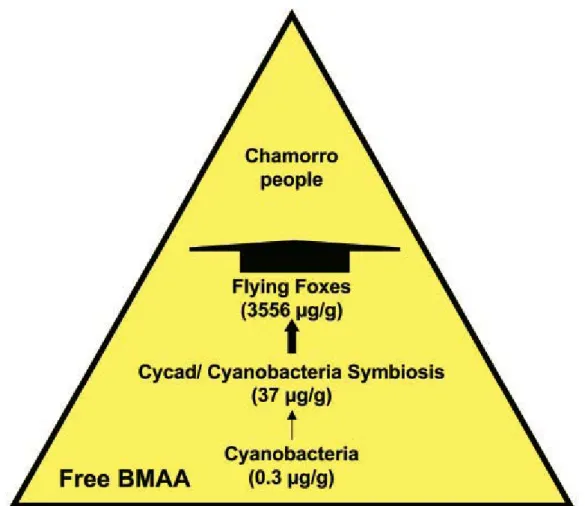
第一個 BMAA 生物濃縮作用的案例為關島查莫羅人,當地有食用狐蝠的風 俗,而狐蝠以蘇鐵種子為主要食糧,故 BMAA 大量累積在狐蝠體內(Cox and Sacks 2002),查莫羅人食用一定份量便會產生毒性。且解剖患有 ALS/PDC 疾病的查莫 羅人腦中都含有 BMAA,更加強了 BMAA 與 ALS 病理學的關聯(Murch, Cox, Banack, et al. 2004)。在溫帶水生生態系波羅的海中,藍綠藻生成之 BMAA 可經 由食物鏈轉移到浮游動物,並累積在各種脊椎動物和無脊椎動物中,進一步造成 人類暴露健康風險(Jonasson et al. 2010)。
BMAA 的生物濃縮作用也在亞熱帶生態系佛羅里達灣中發現(Brand et al. 2010),因為大規模滋長浮游生物(如:藍細菌、矽藻、鞭毛藻及鞭毛蟲),使得濾 食 性 動物 (如 : 牡蠣和 貽 貝) 和低 階 消 費者 ( 如 :藍 蟹) 體內發 現 高含 量 BMAA(Richardson 2004)。
圖 2- 2. 關島地區藻毒素 BMAA 的生物濃縮作用,轉移之游離態 BMAA 濃度正 比於箭頭寬度(Cox et al. 2003)
2-4 BMAA 的分析方法
BMAA 目前可以下列儀器分析:液相層析法、高效液相層析法、胺基酸分 析、毛細管電泳、核磁共振光譜法。其中,針對 BMAA 最具選擇性的分析方法 為核磁共振氫光譜法(Proton Nuclear Magnetic Resonance Spectroscopy, 1H-NMR) 和液相層析串聯式質譜儀(Liquid Chromatograph Tandem Mass Spectrometer, LC-MS/MS),但僅有一篇論文以 1H-NMR 分析 BMAA,其偵測極限(Limit of Detection, LOD)為 5 mg/L(Moura et al. 2009);而最頻繁使用於分析 BMAA 的儀器為 LC- MS/MS,其辨別目標物依據以下四項條件:停留時間、母離子的荷質比(mass-to-charge ratio, m/z)、子離子的荷質比及母離子間的比例,因此可以大幅減少誤判的 情形(Faassen 2014)。 近年來,串聯式質譜(MS/MS)被認定為較合適的 BMAA 分析儀器,儘管 MS/MS 結合液相層析儀(LC)進行分離有缺點:分析時基質效應造成潛在的訊號 損失,即待測物外的基質可能減低或增強待目標物訊號(Duncan 2012)。 圖 2- 3. 2005-2013 年,檢測水生生態系 BMAA 濃度的分析方法(Faassen 2014)
3. 實驗方法
3-1 BMAA 分析方法
本 研 究 使 用 液 相 層 析 串 聯 式 質 譜 儀 (Liquid Chromatography/ Mass Spectrometry/ Mass Spectrometry)分析,高壓液相層析儀為 Agilent 公司所生產之 1260 Infinity Quaternary LC System,搭配串聯式質譜儀為 Thermo 公司生產之 TSQ Quantum Ultra,選用之層析管柱為 HILIC 管柱(Shiseido 公司,Capcell Core PC , S 2.7um, 4.6mm X 150 mm I.D.),BMAA 標準品則由 Merck 公司購買。
本研究所採用的高壓液相層析質譜儀,配合著兩個高壓微量移動相幫浦,而
後接著串聯式質譜儀(Mass Spectrometry);分析所用的溶劑移動相為 0.1% Formic
acid 的水溶液與添加 0.1% Formic acid 的乙晴(Acetonitrile),混合之濃度梯度如
表 1 所示,分析管柱選用內徑2.7 μm (Capcell Core PC, Shiseido, Japan),分析時
管 柱 溫 度 維 持 在 40℃ , 設 濃 度 梯 度 進 行分 析 , 選 擇 使 用 的 偵檢 器 為 ESI (Electrospray),監測模式為正電荷(Positive)模式,分析模式為 SRM,流速為 0.25 ml/min,注入樣本體積為20 μl,分析時間為 20 分鐘,高壓液相層析質譜儀之設 定分析參數與欲偵測 BMAA 之最佳特徵 m/z 值,整理如表 3-1, 3-2 所示。 研究中以標準品配製100 μg/L 的 BMAA 進行定性分析,以得知 BMAA 在 分析管柱中的停留時間,結果顯示 BMAA 的出峰時間為 10.53 分鐘,precursor ion m/z 為 119,product ions m/z 為 44.0 及 88.0,如圖 3-1 所示。另配製 BMAA
於一系列之稀釋濃度進行分析,配製濃度分別為 2、5、10、100、250、500 μg/L,
體積為 0.5mL,而後以 LC/MS/MS 以上述所設定之 SRM 模式進行定量分析,並
利用統計軟體進行迴歸分析,所獲得之檢量線如圖 2-2,R2值為 0.99976,顯示
表 3- 1. 移動相混合之濃度梯度表
A: 0.1% Formic acid water solution B: Acetonitrile with 0.1% Formic acid
表 3- 2. 質譜儀分析參數 Parameter MS/MS Probe ESI Model Positive Spray Voltage (v) 3500 Vaporizer Temperature (℃) 270
Sheath Gas Pressure 40
Aux Gsa Pressure 10
Capillary Temperatuere (℃) 275
Tube Lens Offset 145
Collision Energy 119/44 12 Collision Energy 119/88 10 Time A(%) B(%) 0 15 85 0.5 15 85 1.5 70 30 9 70 30 11 15 85 20 15 85
0 5 107 1 108 1.5 108 0 100 200 300 400 500 600 y = -4.78e+5 + 2.95e+5x R2= 1 Ar ea Conc. (ug/L) 圖 3- 1. 液相層析串聯式質譜儀(LC/MS/MS)分析 BMAA 之層析圖 (A) 100 ug/L BMAA TIC 圖 (B) 100 ug/L BMAA at m/z 119>44.0 amu (C) 100 ug/L BMAA at m/z 119>88.0 amu
RT:0.00 - 19.90 0 2 4 6 8 10 12 14 16 18 Time (min) 0 20 40 60 80 100 0 20 40 60 80 100 R el at iv e A bundanc e 0 20 40 60 80 100 10.53 18.41 12.72 16.32 17.38 4.08 1.98 0.97 2.56 4.14 5.55 9.03 9.15 11.71 15.37 10.53 10.73 13.59 14.68 3.78 4.94 17.23 2.56 15.42 18.81 1.89 8.84 0.64 6.42 8.32 9.52 10.53 16.02 5.83 0.41 3.12 3.50 4.86 6.70 9.52 10.17 11.11 11.64 13.93 18.34 NL: 1.03E6 TIC MS std100 NL: 7.10E5 m/z= 43.50-44.50 F: + p ESI SRM ms2 119.039 [43.995-44.005, 87.995-88.005] MS std100 NL: 3.22E5 m/z= 87.50-88.50 F: + p ESI SRM ms2 119.039 [43.995-44.005, 87.995-88.005] MS std100
3-2 BMAA 氧化動力模式介紹 本研究為探討氧化劑對於 BMAA 之破壞動力模式,首先模擬水中氧化劑濃 度之變化,假設氧化劑與水中物質反應,由兩項組成,如 3-1 式中所示。 𝐶𝐶𝑜𝑜𝑜𝑜𝑜𝑜𝑜𝑜𝑜𝑜𝑜𝑜𝑜𝑜 = 𝑎𝑎𝑒𝑒−𝑚𝑚𝑜𝑜+ 𝑏𝑏 Coxidant = a × e-mt + b (3- 1) 其中 Coxidant為氧化劑之濃度(mg/L),a (mg/L)為參與反應部分、b (mg/L)為不參與 反應部分(或反應較慢部分)及 m (1/min)為反應指數,三者皆為模擬氧化劑濃度之 常數,t 則為反應時間(min)。 本研究假設 BMAA 被氧化劑的降解反應,可以用二階反應描述(分別對氧化 劑及 BMAA 濃度呈一階),因此 BMAA 降解的速率與氧化劑接觸時間及劑量的 關係如式(3-3、3-4)所示, 𝑜𝑜𝑑𝑑 𝑜𝑜𝑜𝑜 = −𝑘𝑘𝐶𝐶𝑜𝑜𝑜𝑜𝑜𝑜𝑜𝑜𝑜𝑜𝑜𝑜𝑜𝑜𝐶𝐶 (3- 2)
式中 C 為 BMAA 濃度,k (L/mg-min)為 BMAA 氧化動力常數,將(3- 1)式對 t 積 分,可以求得式(3-3), ln �𝑑𝑑𝑑𝑑 𝑜𝑜� = −𝑘𝑘 ∫ 𝐶𝐶𝑜𝑜𝑜𝑜𝑜𝑜𝑜𝑜𝑜𝑜𝑜𝑜𝑜𝑜𝑑𝑑𝑑𝑑 (3- 3) 其中 Co為 BMAA 初始濃度,氧化劑對時間的積分值,為常用於自水消毒的氧化 劑-時間乘積值(Ct 值),可以如(3-4)式所示。 C𝑜𝑜𝑜𝑜𝑜𝑜𝑜𝑜𝑜𝑜𝑜𝑜𝑜𝑜t = ma (e−mt− 1) + bt (3- 4) 整合式(3-3)及(3-4),BMAA 濃度變化與 Ct 的關係如式(3-5)所示, lnCC 0 = −kC𝑜𝑜𝑜𝑜𝑜𝑜𝑜𝑜𝑜𝑜𝑜𝑜𝑜𝑜t (3- 5) 上述式(3-5),即可以應用於與實驗數據擬合,以求出求出反應速率常數(k 值)。
3-3 BMAA 競爭實驗介紹 在本研究各氧化劑的氧化實驗中,因為氯和臭氧與 BMAA 的反應速率太大, 以致於無法以直接計算 CT 值的方式求得其二階反應速率。參考 Shan 等人(2006) 的研究,可以使用同樣反應速率也相當大的另一化合物做為競爭劑,以競爭實驗 之方式求得氯與臭氧對 BMAA 之反應速率。在競爭實驗中,假定競爭劑與 BMAA 與氧化劑皆為二階反應,即遵守上述 3- 5 之公式: ln (𝑑𝑑𝑐𝑐𝑜𝑜𝑐𝑐𝑐𝑐𝑐𝑐𝑐𝑐𝑐𝑐𝑐𝑐𝑜𝑜𝑐𝑐 𝑑𝑑𝑐𝑐𝑜𝑜𝑐𝑐𝑐𝑐𝑐𝑐𝑐𝑐𝑐𝑐𝑜𝑜𝑐𝑐0) = −𝑘𝑘𝑐𝑐′ [Oxidant]𝑑𝑑 ln (𝑑𝑑𝐵𝐵𝐵𝐵𝐵𝐵𝐵𝐵 𝑑𝑑𝐵𝐵𝐵𝐵𝐵𝐵𝐵𝐵0) = −𝑘𝑘𝐵𝐵𝐵𝐵𝐵𝐵𝐵𝐵′ [Oxidant]𝑑𝑑 若競爭劑與 BMAA 在同一系統中初始莫耳濃度相同,則兩式合併後可改寫為為 3-6 式,並求出 BMAA 之反應動力常數
ln �
[competitor]0𝑐𝑐 [competitor]𝑐𝑐� =
𝑘𝑘𝑎𝑎𝑐𝑐𝑐𝑐𝑐𝑐𝑜𝑜𝑚𝑚𝑐𝑐𝑐𝑐𝑜𝑜𝑜𝑜𝑜𝑜𝑜𝑜𝑐𝑐 𝑘𝑘𝑎𝑎𝑐𝑐𝑐𝑐𝐵𝐵𝐵𝐵𝐵𝐵𝐵𝐵× ln �
[BMAA]0 [BMAA]𝑐𝑐�
(3-6)3-4 加氯氧化實驗及中間產物之分析 本實驗係以次氯酸鈉做為氧化劑,分為三部分進行實驗。第一部分為自由餘 氯與 BMAA 之競爭實驗,並使用 4,6 二氯間本二酚(4,6-dichlororesorcinol, DCR) 做為競爭劑。BMAA 與 DCR 之初始濃度皆為5μM,並分別加入 3.3, 5.9, 7.7, 9.3 and 13.5 μM 之次氯酸納於反應器中,並分析 BMAA 及 DCR 剩餘之濃度。DCR 於不同 pH 值下和氯的反應速率則參考 Rebenne 等人於 1996 年所發表之文獻, 並利用 3-6 式求得反應速率常數。 第二部份分別以濃度為 5mg/L 之 BMAA 與濃度為 0.1、0.2、0.5、0.8 及 1mg/L 之次氯酸鈉反應,採樣時間分別為 0、10、30、60、90、120、180、240、300、 360 分鐘,並於各時間點取出樣品後加入抗壞血酸 (Ascorbic acid)以終止氧化反 應。第三部分則固定次氯酸鈉之起始濃度為 5 mg/L,BMAA 濃度則為 0.5、0.8 及 1.25mg/L。氧化實驗的採樣時間分別為 0、10、20、40、60、90 及 120 分鐘, 加入抗壞血酸 (Ascorbic acid)以終止氧化反應。同時,進行殘餘氧化劑濃度之測 定、BMAA 濃度之分析。研究中餘氯以標準方法中之 DPD-FAS 法配合綜合水質 分析儀法(No. No.14828, Merck, Nova 60, US)分別量測自由餘氯與總氯之濃度。
BMAA 的分析採用 SRM 模式,其中 BMAA 的 precursor ion m/z 為 119, product ions m/z 為 44.0 及 88.0,定量時所使用的母子離子對為 119.1>44.0 amu。 加氯反應的中間產物分析則使用 parent scan 模式,Q3MS 設定為 m/z 44 amu,
3-5 過錳酸鉀氧化實驗 本部分實驗分別以濃度為 3、4、5mg/L 之高錳酸鉀,氧化初始濃度皆為 0.5mg/L 之 BMAA,採樣時間為 0、5、10、30、60、90、120、180 分鐘,同樣加入抗壞 血酸做為中止劑停止氧化反應進行,並分析過錳酸鉀及 BMAA 之剩餘濃度。 3-6 臭氧氧化實驗 臭氧與 BMAA 的反應速率相當快,在前置實驗中發現在一分鐘內就會與 BMAA 反應完畢,因此同樣使用競爭實驗來求得 BMAA 與臭氧之反應速率。在 此部分實驗用使用 4-氯-2-甲基苯酚(4-chloroguaiacol, 4-CG)做為競爭劑。BMAA 與 4-CG 之初始濃度皆為5μM,並分別加入稀釋後濃度 0.27, 0.54, 0.81, 1.08, 1.35 及 1.62 mg/L 之臭氧水溶液於反應器中,隨後分析 BMAA 及 4-CG 剩餘之濃度。 4-CG 於不同 pH 值下和臭氧的反應速率則參考Benitez等人於 2000 年所發表之 文獻,並利用 3-6 式求得反應速率常數。 3-7 過氧化氫/UV 系統氧化實驗 本實驗利用過氧化氫在紫外光照射下會產生氫氧自由基,再由氫氧自由基氧 化 BMAA。本研究依據前人研究發展之方法,以羅丹明 B (Rhodamine B, Rh)作 為氫氧自由基之探針化合物(probe compound) (Kwon et al. 2014),以量化推估氫 氧自由基的濃度,可以以公式 (3-7)表示: OH RhB RhB , OH RhB • • = − k C C dt dC (3-7) 其中 CRhB [mg·L-1] 及 C·OH [M] 分別為 RhB 及氫氧自由基的濃度, t 為反應時 間,而反應速率常數 k·OH,RhB =3.75 ± 0.15×10⁹ M-1 s-1。 公式 (3-7)經積分後,可以得到公式 (3-8) t C k C C RhB OH RhB , OH 0 RhB ln =− • • (3-8) 其中CRhB0 [mg·L-1]為 RhB 的初始濃度。 RhB 在反應過程中透過自由基反應模式(3-8)可計算出氫氧自由基濃度,便可 再依公式(3-9)算出氫氧自由基對 BMAA 之氧化動力常數。
(3-9) 本實驗以濃度為 10 及 60 mg/L 之過氧化氫,分別在 57.4 Wm-2的紫外光照 強度下與 0.2 及 0.5mg/L 之 BMAA,進行氧化反應。在游(2014)的研究結果中顯 示,過氧化氫與在紫外光照射下與藻體細胞反應,6 小時的反應過程中過氧化氫 濃度幾乎均維持不變。因此在本實驗 3 小時的反應過程中也將過氧化氫濃度視為 不變,能持續產生相同濃度之氫氧自由基。 3-9 DCR 與 4-CG 之分析
本研究使用高壓液相層析儀(Shimadzu-Diode-array-detector, Shimadzu Inc.,
Japan)進行 DCR 與 4-CG 之分析。分析管柱為 C18 ODS column (150 mm × 4.6 mm), 流動相為水、甲醇及乙酸之混合溶液(45:54:1),流速為 0.8 ml/min,分 析時間為 28 分鐘。UV detector (SPD-M10A, Shimadzu Shimadzu Inc.,日本)設定的 偵測波長為 295 及 280 nm。
3-10 BMAA 濃縮方式之探討
本研究中 BMAA 的濃縮方式分為固相萃取 (Solid phase extraction, SPE)方法 及吹氮濃縮方法。探討固相萃取對比不同 SPE 管柱對 BMAA 的吸附、脫附效率, 選擇適合分析水中溶解態 BMAA 的固相萃取前處理方法,以提高濃縮倍率,降 低於樣品中的偵測極限。同時測試吹氮濃縮對 BMAA 的濃縮效率,及樣品中基 質是否干擾後續於串連式質譜儀中的分析結果。 此部分的詳細實驗細節與結果,及後續於環境水樣中 BMAA 的檢測分析, 將於第 6 章台灣地區湖庫及飲用水藻類毒素β-甲氨基-L-丙氨酸之研究中詳加討 論。 t C k C C OH BMAA , OH 0 BMAA BMAA ln =− • •
4. 氯對水體中 BMAA 的去除效能、機制及副產物生成研究
此部分之研究成果已發表於 Chen, Y. T., Chen, W. R., Liu, Z. Q., & Lin, T. F.
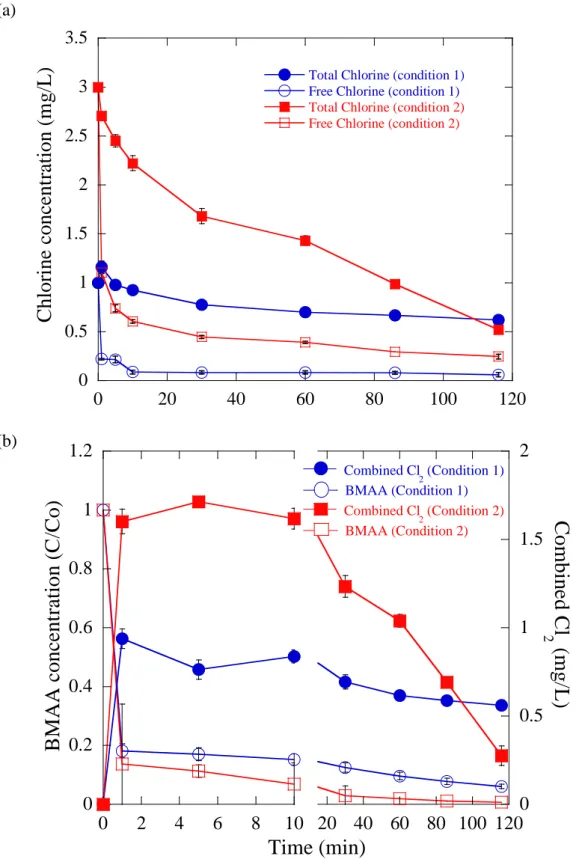
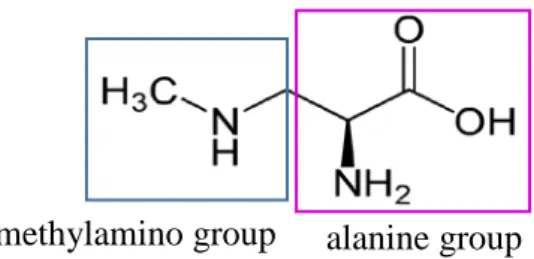
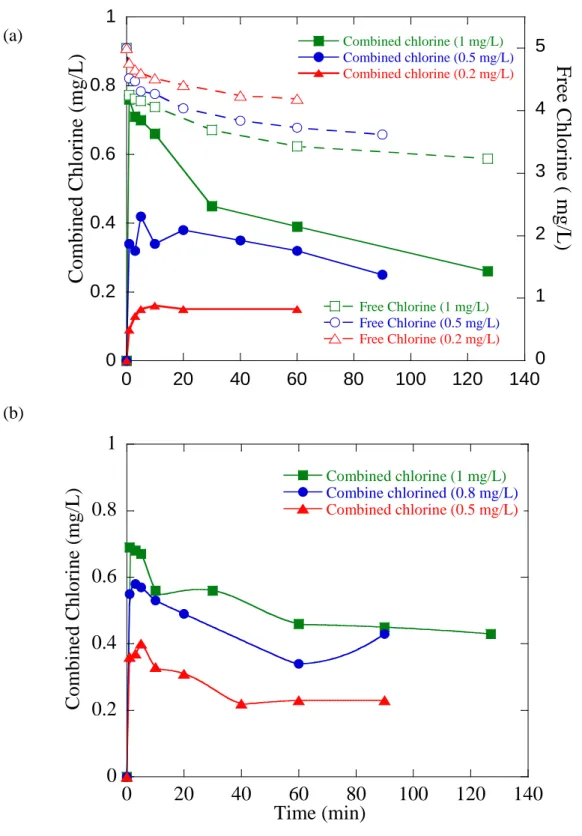
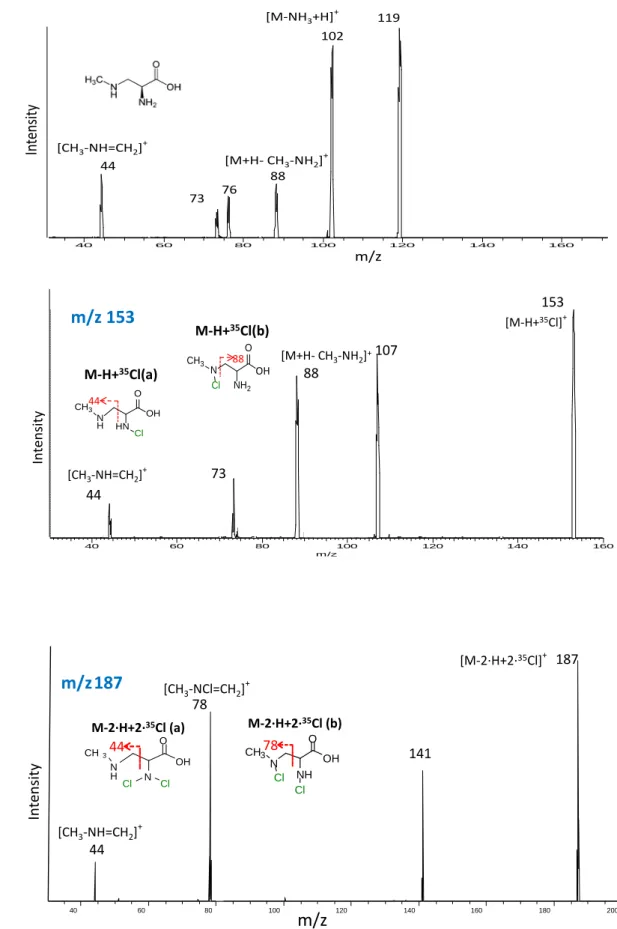
(2017). Reaction Pathways and Kinetics of a Cyanobacterial Neurotoxin β-N-Methylamino-L-Alanine (BMAA) during Chlorination. Environmental science & technology, 51(3), 1303-1311.,詳細請見附件。以下為簡要說明。 4-1 BMAA 減少與結合餘氯生成 加氯氧化實驗過程中,兩組 BMAA 和氯初始濃度相同的實驗結果皆顯示在 加氯後的第一分鐘,總氯的濃度並沒有太大的改變,而自由餘氯則僅有初始劑量 的 50% (圖 4-1),顯示在系統中有結合餘氯的生成,而同時間 BMAA 的濃度即 減少為原來的 15%。推測由於 BMAA 結構中有兩個氨基(圖 4-2),氯原子可能與 氨基結合形成一氯胺、二氯胺分子或三氯胺分子。在此兩組實驗中,BMAA 減少 的莫耳濃度為 6.9 和 22.8 nM,而所觀察到相對應的結合餘氯莫耳濃度為 7.8 和 33.2 nM,而結合餘氯和含氯中間產物的比例為 1:1.23 (圖 4-3),代表可能有 1-2 個氯原子與 BMAA 結合,與前述所推論之結果一致。而當將 BMAA 初始濃度固 定時,結合餘氯的濃度會隨著加入次氯酸鈉的濃度增加而增加,反之亦然 (圖 4-4)。 4-2 加氯反應中間產物檢測 本研究中利用質譜儀所產生之碎片離子的質譜圖比對來推測反應中所生成 之中間產物的結構。利用 Q3 Full scan 模式偵測到 BMAA 的離子碎片為 44.0 amu ([CH3-NH=CH2]+),76.0 amu ([M+H-CH2=N-CH3]+) 及 88.0 amu ([M+H-CH3-NH2]+)
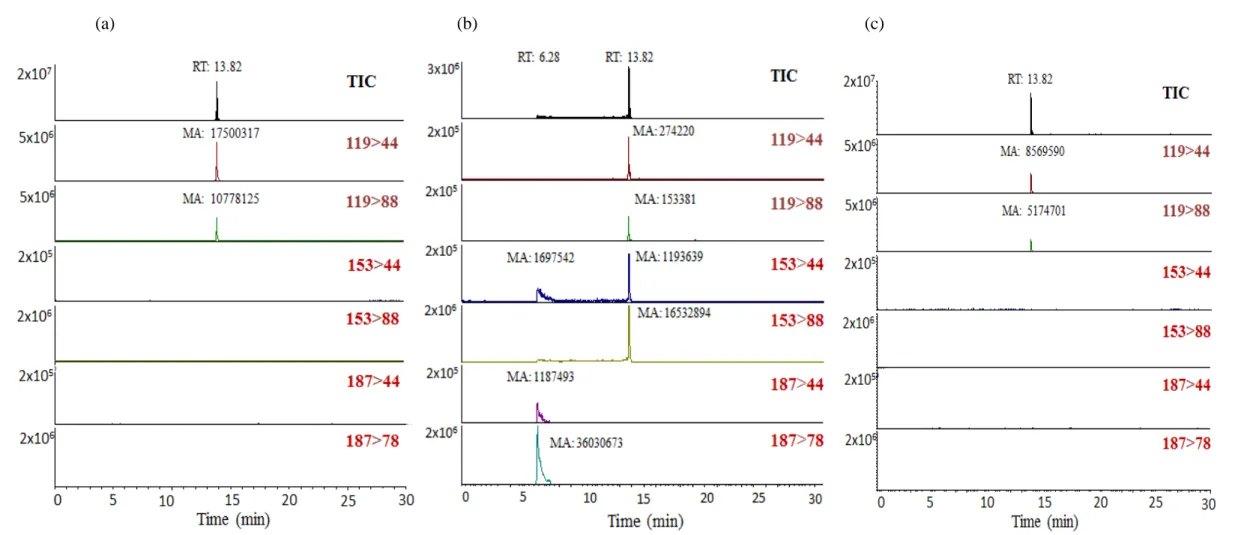
(圖 4-5a),與 Kruger 於 2010 年所研究之結果相符合(Krüger et al. 2010)。根據上 段所述結果,推測在加氯氧化過程中會有氯胺等中間產物的生成,根據其接上 1-3 個氯原子,其可能的分子量為 151-3(M+1-34)、187(M+68)或 191(M+102),預測的 結構式則於圖 4-5b 及 4-5c 中顯示。將 Q3MS 設定為 m/z 44 amu,Q1MS 為 full scan 模式時,同樣也能得到含有 m/z 為 153 amu 及 187 amu 之圖譜,顯示的確有 m/z 為 153 amu 及 187 amu 的分子存在於系統中;再將 Q1MS 設定為 m/z 153 amu 及 m/z 187 amu,Q3MS full scan 模式,則可得到圖 4-5b 及 4-5c 的質譜圖,表示 為 M+34(a)、M+34(b)、 M+68(a)及 M+68(b)。 由圖 4-5b 及 4-5c 中可看出,m/z 為 153 amu 及 187 amu 的碎片離子質譜圖與 BMAA 之碎片離子質譜圖相似,可 推測這四個中間產物是由 BMAA 與氯作用後形成。利用 LC/MS/MS 層析圖於 SRM 模式下做進一步的確認,比對加氯氧化前(圖 6a)及加氯氧化五分鐘(圖 4-6b)後,可以看出分別代表四個中間產物的離子碎片 m/z 187>44 amu、187>78 amu、
153>44 amu 及 153>44 amu 的波峰出現,顯見這四個產物確實為加氯反應後所產 生。
由於目前尚無法獲取這四個中間產物的標準品用以定量,因此在本研究中採
用質譜圖中相對訊號強度的變化(A/Amax)來表示該中間產物的濃度變化。Amax代
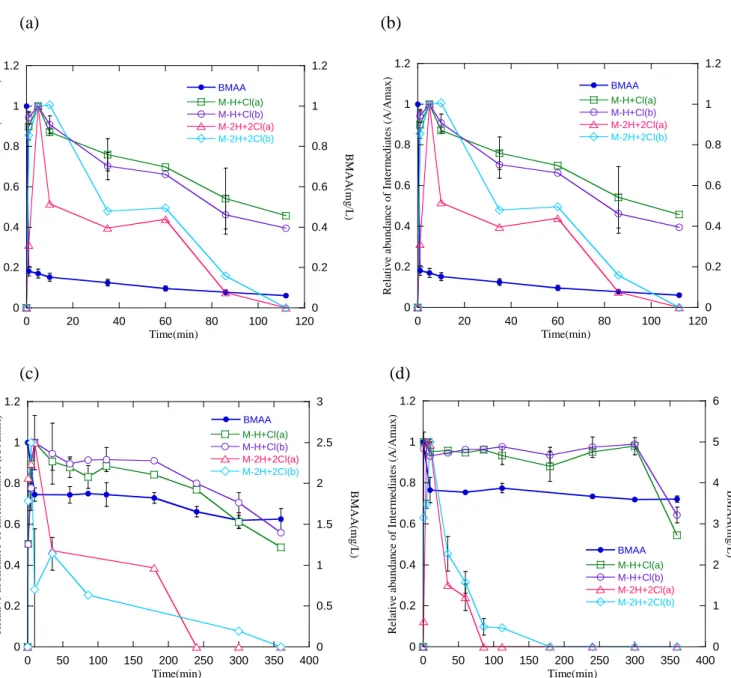
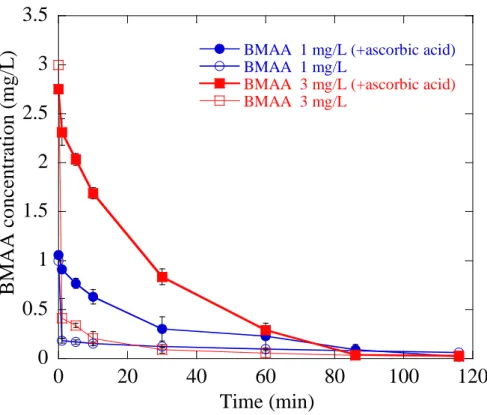
表該中間產物在當次實驗中最大積分面積值,A 則為每個採樣時間點的面積值, 如此標準化後則可用於了解各中間產物於反應過程中的濃度變化趨勢。實驗結果 顯示,BMAA 與氯的作用相當迅速,在反應的第一分鐘內即被大量降解,並隨之 生成四種中間產物(圖 4-7)。而若尚有餘氯存在於系統中時,中間產物則會再次 與餘氯反應,濃度隨反應時間下降(圖 4-7a 及 4-7b);相反地,若系統中的餘氯 已不足以繼續和 BMAA 或中間產物反應時,相較於 M+34(a)和 M+34(b)於反應 時間 6 小時內仍可以穩定的持續存在於系統中(圖 4-7c 及 4-7(d),M+68(a) 和 M+68(b)則在生成後隨反應時間降解消失。此外,從圖中也可發現在各組實驗中, 四種中間產物於反應過程中的濃度變化趨勢在一氯胺及二氯胺之間相當一致。 4-3 BMAA 含氯中間產物之還原作用 在飲用水系統中,除氯(dechlorination)常被用作中止與氯化反應相關的程序, 為進一步探討 BMAA 與其含氯中間產物的特性,在本研究中也進行了加氯反應 後使用抗壞血酸除氯的實驗。由前置實驗結果得知,抗壞血酸並不會與 BMAA 反應。由前述 LC/MS/MS 層析圖結果已知,在加氯反應後,BMAA 的訊號強度 大幅下降,並出現 m/z 187>44 amu、187>78 amu、153>44 amu 及 153>44 amu 等 四個中間產物的離子碎片的波峰(圖 4-6b),然而在加入抗壞血酸除氯後,這四個 中間產物的離子碎片的波峰隨即消失(圖 4-6c),同時 BMAA 的濃度也比除氯前 增 加許 多(圖 4-8)。 文獻中曾指出抗壞血 酸能與血液透析液中 的氯胺反應 (Wiseman 1997, Botella et al. 1977),加之以上觀察可推測,抗壞血酸會與含氯的 中間產物作用,並且將其還原成 BMAA。
4-4 BMAA 與氯作用之反應途徑
氯氣在水中根據 pH 值的不同會形成 HOCl 和 OCl-兩種型態(Lewis 1980),
而本研究中的 pH 值介於 5.5-7.0 之間,因此主要為 HOCl 存在於系統中。綜合以 上結果,可以推測 BMAA 與 HOCl 作用會形成四種含氯的中間產物。雖然這四 種中間產物生成的時間幾乎相同,但也不排除先生成兩種含一個氯的中間產物 (M+34(a)和 M+34(b))後再繼續與 HOCl 反應生成(M+68(a) and M+68(b))的可能 性,而完整的反應途徑則描述於 Scheme 4-1 中。
4-5 BMAA 與氯反應動力模式
由上述各實驗結果可得知,BMAA 會先與氯反應作用後生成含氯的中間產 物,若此時系統中尚有自由餘氯存在,則會繼續和含氯的中間產物反應。本研究
為探討氯對於 BMAA 之破壞動力模式,參考 Daly et al. 及 Lin et al.研究中所提
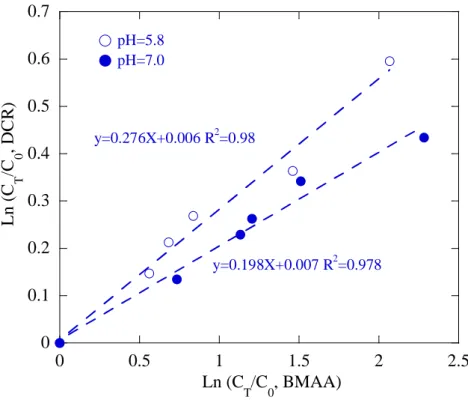
出的公式(Daly et al. 2007, Lin et al. 2009),首先模擬水中自由餘氯濃度之變化, 假設自由餘氯與系統中之 BMAA 或含氯中間產物反應,可由 3-1 式中所示。 CCl=CCl,1e-kClt+CCl,2 (3- 2) 其中 CCl為自由餘氯之濃度(mg/L),CCl,1 (mg/L)為參與反應部分、CCl,2 (mg/L)為不 參與反應部分(或反應較慢部分)及 kCl (1/min)為反應指數,三者皆為模擬氧化劑 濃度之常數,t 則為反應時間(min)。 將上述公式對時間積分後,便可求得 Ct。本研究假設 BMAA 及含氯中間產 物被氧化劑的降解反應,可以用二階反應描述(分別對氧化劑及 BMAA 濃度呈一 階), BMAA 濃度變化與 Ct 的關係如式(3-2)所示, ln C C0 = −kC𝑜𝑜𝑜𝑜𝑜𝑜𝑜𝑜𝑜𝑜𝑜𝑜𝑜𝑜t (3- 2) 上述式(3-2),即可以應用於與實驗數據擬合,以求出求出反應速率常數(k 值)。 由圖 4-7 中可看出,BMAA 與自由餘氯在一分鐘內即反應完畢。為求得 BMAA 與自由餘氯的反應速率常數(以 k1 表示),本研究以初始濃度為 5 和 2.5 mg-L-1的氯與初始濃度為 1 和 0.5 mg-L-1的 BMAA 反應,然而其反應過於迅速, 在 10 秒鐘內即結束,因此後續以 4-6 DCR 做為競爭劑,由競爭實驗的方式求出 二階反應速率(圖 4-9)。結果顯示,在 pH=5.8 時的反應速率為 2.1×10³M-1s-1,而 pH=7 時則為 5.0×10⁴。 而即使在自由餘氯劑量已不足以繼續氧化 BMAA 或含氯中間產物的情況下, 含氯中間產物的濃度仍會隨著反應時間緩慢下降(圖 4-7c 和 4-7d)。此外,在加 入抗壞血酸還原反應的實驗中,被還原的 BMAA(Re-BMAA)濃度加上未反應的 BMAA,仍舊小於 BMAA 的初始濃度,而被還原的 BMAA 可視為由含氯中間產 物與抗壞血酸還原反應而成,可由此推測含氯中間產物可能不甚穩定,會有自體 降解(auto-decomposition)的現象。前人的研究報告中也曾指出一氯胺會自體降解 並提出其降解速率的公式(Ozekin et al. 1996, Jafvert and Valentine 1992, Vikesland et al. 2001),本研究則採用擬一階反應來描述含氯中間產物的自體降解情形,其 公式如下,
𝑜𝑜𝑑𝑑𝑅𝑅𝑐𝑐−𝐵𝐵𝐵𝐵𝐵𝐵𝐵𝐵 𝑜𝑜𝑜𝑜 = −𝑘𝑘2[𝐶𝐶𝑅𝑅𝑐𝑐−𝐵𝐵𝐵𝐵𝐵𝐵𝐵𝐵] (3- 3) 其中以 k2 表示含氯中間產物的自體降解反應速率常數。由於 BMAA 與氯的反應 相當迅速,在 BMAA 劑量遠多於氯的實驗中於極短時間內便將自由餘氯耗盡, 且在反應五分鐘之後 BMAA 和自由餘氯的濃度即不再變動(圖 4-10)。假設剩餘 的自由餘氯劑量已不足以繼續反應(< 0.1 mg-L-1),此後 Re-BMAA 的變化量則可 視為自體降解,並適用至 3-3 式以求得 k2。帶入三組不同濃度的實驗中進行模 擬,可得於 pH=5.5-5.8 時 k2 = 0.012 min-1 ;pH=7 時 k2 = 0.003 min-1, R2 = 0.897 和 0.814 (圖 4-11)。 而為求得自由餘氯與含氯中間產物之反應速率常數(k3),此部分則以氯的初 始濃度遠大於 BMAA 進行實驗。由於 BMAA 同樣會在極短的時間內與自由餘氯 反應完畢,因此採用反應進行五分鐘後 Re-BMAA 的變化量即代表含氯中間產物 的變化量,同樣可利用 3-2 式求出反應速率常數,從圖 4-12 可看出 pH 值對於此 部分的反應速率常數並無顯著影響,k3=16.8 M-1s-1,且其擬合結果相當好(圖 5, R2 =0.97)。
(a)
(b)
圖 4- 1. Changes of (a) total and free chlorine levels and (b) BMAA and combined chlorine concentrations with time. The reaction condition 1: [BMAA]0= [Cl2]0 =1
mg/L. The reaction condition 2: [BMAA]0=[Cl2]0 =3 mg/L. (The pH was set at
7.0-7.3) 0 0.5 1 1.5 2 2.5 3 3.5 0 20 40 60 80 100 120
Total Chlorine (condition 1) Free Chlorine (condition 1) Total Chlorine (condition 2) Free Chlorine (condition 2)
C
hl
ori
ne
c
onc
ent
ra
ti
on
(m
g/
L
)
0 0.2 0.4 0.6 0.8 1 1.2 0 0.5 1 1.5 2 0 2 4 6 8 10 20 40 60 80 100 120Co
m
b
ine
d Cl
2(m
g/
L
)
Time (min)
BM
A
A
c
onc
ent
ra
ti
o
n (C
/C
o)
Combined Cl 2 (Condition 1) BMAA (Condition 1) Combined Cl 2 (Condition 2) BMAA (Condition 2)0 0.005 0.01 0.015 0.02 0.025 0.03 0.035 0 0.005 0.01 0.015 0.02 0.025 0.03 C ombi ne d C hl or in e ( nmol ) BMAA-Cl (nmol) y = 1.225x + 0.002 R2 = 0.841
圖 4- 2. Molecular structure and functional groups of BMAA
圖 4- 3. The relationship between combined chlorine and chlorinated BMAA intermediates (BMAA-Cl).
0
0.2
0.4
0.6
0.8
1
0
20
40
60
80
100
120
140
Combined chlorine (1 mg/L) Combine chlorined (0.8 mg/L) Combined chlorine (0.5 mg/L)Com
bi
ne
d
Chl
ori
ne
(m
g/
L
)
Time (min)
0 0.2 0.4 0.6 0.8 1 0 1 2 3 4 5 0 20 40 60 80 100 120 140 Combined chlorine (1 mg/L) Combined chlorine (0.5 mg/L) Combined chlorine (0.2 mg/L) Free Chlorine (1 mg/L) Free Chlorine (0.5 mg/L) Free Chlorine (0.2 mg/L)Com
bi
ne
d C
hl
ori
ne
(m
g/
L
)
F
re
e C
h
lo
rin
e
( m
g
/L
)
(a) (b)圖 4- 4. Changes of the combined and free chlorine concentrations for (a) initial BMAA concentration = 0.2, 0.5, and 1 mg-L-1 and chlorine dosage = 5 mg-L-1, and (b) chlorine dosages of 0.5, 0.8, 1 mg-L-1and BMAA concentration = 5 mg-L-1.
圖 4- 5. Spectrogram and proposed structures of BMAA and four intermediates, where (a) is for BMAA, (b) is for M-H+35Cl(a) and M-H+35Cl (b), and (c) is for
M-M-2·H+2·35Cl (a) M-2·H+2·35Cl (b) 40 60 80 100 120 140 160 180 200 m/z 44 78 141 187 CH3 N Cl NH Cl OH O 78 CH3 N H N Cl Cl OH O 44 m/z m/z 187 [CH3-NH=CH2]+ [CH3-NCl=CH2]+ [M-2·H+2·35Cl]+ In te ns ity p [ ] 40 60 80 100 120 140 160 m/z 0 5 10 15 20 25 30 35 40 45 50 55 60 65 70 75 80 85 90 95 100 Rel ati ve A bundanc e 44 88 73 107 153 88 M-H+35Cl(b) CH3 N Cl NH2 CH3 O OH CH3 N H HN OH O Cl 44 M-H+35Cl(a) In te ns ity m/z 153 [CH3-NH=CH2]+ [M+H- CH3-NH2]+ [M-H+35Cl]+ 40 60 80 100 120 140 160 m /z 0 5 10 15 20 25 30 35 40 45 50 55 60 65 70 75 80 85 90 95 100 Rel ativ e A bundanc e Int en sit y 44 73 76 88 102 119 [M-NH3+H]+ m/z [CH3-NH=CH2]+ [M+H- CH3-NH2]+
(a) (b) (c)
圖 4- 6. LC/MS/MS chromatogram under SRM mode of (a) standard solutions of BMAA at 1 mg-L-1, (b) BMAA (1 mg-L-1) reacted with free
chlorine (1 mg-L-1) for 5 mins, and (c) BMAA (1 mg-L-1) reacted with free chlorine (1 mg-L-1) for 5 mins and then dechlorinated with ascorbic acid.
0 0.2 0.4 0.6 0.8 1 1.2 0 0.2 0.4 0.6 0.8 1 1.2 0 20 40 60 80 100 120 M-H+Cl(a) M-H+Cl(b) M-2H+2Cl(a) M-2H+2Cl(b) BMAA R e la ti v e a b u n d an ce o f I n te rm ed ia te s ( A /A m ax ) BMA A (m g /L ) Time(min) 0 0.2 0.4 0.6 0.8 1 1.2 0 0.5 1 1.5 2 2.5 3 0 50 100 150 200 250 300 350 400 M-H+Cl(a) M-H+Cl(b) M-2H+2Cl(a) M-2H+2Cl(b) BMAA R e la ti v e a b u n d an ce o f I n te rm ed ia te s ( A /A m ax ) BMA A (m g /L ) Time(min) 0 0.2 0.4 0.6 0.8 1 1.2 0 1 2 3 4 5 6 0 50 100 150 200 250 300 350 400 M-H+Cl(a) M-H+Cl(b) M-2H+2Cl(a) M-2H+2Cl(b) BMAA R e la ti v e a b u n d an ce o f I n te rm ed ia te s ( A /A m ax ) B M A A( m g /L) Time(min) (a) (b) (c) (d)
圖 4- 7. Variations of relative abundances of BMAA and intermediates with time during chlorination. The A/Amax is the ratio of the MS integrated area of each intermediate (A)
to the highest MS integrated area of the same intermediate (Amax). (a) BMAA = 1 mg/L,
chlorine = 1 mg/L; (b) BMAA = 3 mg/L, chlorine = 3 mg/L; (c) BMAA = 2.5 mg/L, chlorine = 0.5 mg/L; and (d) BMAA = 5 mg/L, chlorine = 1 mg/L. (The pH was set at 7.0-7.3) 0 0.2 0.4 0.6 0.8 1 1.2 0 0.2 0.4 0.6 0.8 1 1.2 0 20 40 60 80 100 120 M-H+Cl(a) M-H+Cl(b) M-2H+2Cl(a) M-2H+2Cl(b) BMAA R e la ti v e a b u n d an ce o f I n te rm ed ia te s ( A /A m ax ) BMA A (m g /L ) Time(min)
0
0.5
1
1.5
2
2.5
3
3.5
0
20
40
60
80
100
120
BMAA 1 mg/L (+ascorbic acid) BMAA 1 mg/L
BMAA 3 mg/L (+ascorbic acid) BMAA 3 mg/L
BM
A
A
c
o
nc
ent
ra
ti
on (m
g/
L
)
Time (min)
圖 4- 8. Change of BMAA concentration with time under the conditions of with and without dechlorination using ascorbic acid, with the initial chlorine and BMAA concentrations both set at 1 and 3 mg/L, pH=7.0-7.3. Ascorbic acid was added immediately when the samples were taken. The ratios of ascorbic acid and free chlorine in two sets of experiment were 7:1 and 2.4:1. (The difference between solid symbol and open symbol is the Re-BMAA)
Scheme 4-1. Proposed reaction pathways for BMAA with free chlorine.
+HO
Cl
+HO
Cl
CH3 N H HN OH O Cl CH3 N Cl NH2 CH3 OOH
CH3 N Cl NH Cl OH O CH3 N H N Cl Cl OH O0 0.1 0.2 0.3 0.4 0.5 0.6 0.7 0 0.5 1 1.5 2 2.5 L n ( C T /C 0 , D C R) Ln (C T/C0, BMAA) y=0.198X+0.007 R2=0.978 y=0.276X+0.006 R2=0.98 pH=5.8 pH=7.0 0 0.2 0.4 0.6 0.8 1 1.2 0 20 40 60 80 100 120 140 Total Cl2 (1 mg/L) Free Cl2 (1 mg/L) Total Cl2 (0.5 mg/L) Free Cl2 (0.5 mg/L) C hl ori ne c onc ent ra ti on (m g/ L ) Time (min)
圖 4- 9. Competition reaction of BMAA/DCR. The initial BMAA and DCR
concentration were set at 10μM, and the dosages of chlorine were at 3.3, 5.9, 7.7, 9.3 and 13.5 μM at pH 5.8 and 7.0.
圖 4- 10. Changes of total and free chlorine levels with time, with the initial chlorine dosage at 0.5 and 5 mgL-1, and BMAA concentration set at 2.5 and 5 mgL-1.
-6 -5 -4 -3 -2 -1 0 1 0 50 100 150 200 250 300 350 400 L n ( C/ C 0, R ev e rse d B MA A) Time (min) y=-0.0121X-0.281 R2=0.897 y=-0.003X+0.09 R2=0.814 pH=5.5-5.8 pH=7.0 0 0.2 0.4 0.6 0.8 1 1.2 0 100 200 300 400 500 600 L n (C/ C 0 , R eve rs ed BM A A ) CT C/C o = e -0.0142(CT) , R2 = 0.965 pH=5.5-5.8 pH=7.0-7.3
圖 4- 11. The concentrations of chlorinated BMAA intermediates (Re-BMAA) and fit with auto-decomposition model. The initial BMAA concentration was set at 5 mg-L-1, and the dosages of chlorine were at 0.5, 0.8, and 1.25 mg-L-1.
圖 4- 12. The reaction rate between the chlorinated-intermediates and free chlorine. The initial chlorine dosage was set at 5 mg/L, and the concentrations of BMAA were
5. 各種氧化劑對水體中 BMAA 的去除效能及在不同水體中的反應
動力學研究
本部分研究已完成論文之撰寫,即將投稿中,詳見於後續 p.35-p.48 5-1 次氯酸鈉與 BMAA 於不同 pH 值及天然水體中之反應動力模式 關於氯與 BMAA 之反應動力學模式,已詳述於 3-2 BMAA 氧化動力模式介 紹中。由 4-1 節的研究結果得知,BMAA 與氯反應可分為三個階段,分別是自由 餘氯與 BMAA 反應、含氯中間產物的自體降解以及含氯中間產物再度被自由餘 氯降解(Scheme 4-1)。此部分的研究,則接續 4-1 節的內容,針對氯在不同 pH 值 及天然水體中與 BMAA 的反應動力進行更深入的研究和探討。 在自由餘氯與 BMAA 反應的部分,同樣使用 4-6 DCR 做為競爭劑,由競爭 實驗的方式求出二階反應速率,分別於 pH5.5、7、9 及蘭潭水庫的湖水(pH=8.5) 進行實驗。結果顯示(圖 5-1),在不同 pH 值及天然水中的擬合程度均相當好 (R2>0.97),且 BMAA 和自由餘氯的反應速率會隨著 pH 值的增加而變大(表 5-1)。 值得注意的是,BMAA 和自由餘氯在蘭潭湖水為背景液中的反應速率常數較在 pH=7 中小,可以推測天然水中的天然有機物( Natural organic matter)同時也會與 BMAA 競爭系統中的自由餘氯,而減低了反應速率。 BMAA 的含氯中間產物在 BMAA 初始濃度遠大於氯的條件下進行實驗,並 假定在反應開始 5 分鐘後系統中的自由餘氯濃度已不足以繼續和 BMAA 或 BMAA 的含氯中間產物反應。此時於樣品中加入抗壞血酸,使 BMAA 的含氯中 間產物被還原成 BMAA,與未加入抗壞血酸樣品中所測得 BMAA 之濃度差,即 可視為系統中 BMAA 含氯中間產物的濃度,再利用擬一階反應(公式 4-3),即可 求出 BMAA 含氯中間產物之自體降解速率 k2。從圖 5-2 中可看出,pH=7-9 範 圍中(包含蘭潭湖水),其自體降解速率的差異並不大,而於酸性條件下的自體降 解速率則較快(表 5-1)。此部分結果與 Vikesland 等人在 2001 年觀測一氯胺於不 同 pH 值中的自體降解速率結果相似,而水體中的天然有機物並不會影響其自體 降解的速率。 自由餘氯與 BMAA 含氯中間產物之反應速率常數 k3,此部分則以氯的初始 濃度遠大於 BMAA 的條件下進行實驗。由於 BMAA 同樣會在極短的時間內與自 由餘氯反應完畢,因此採用反應進行五分鐘後被還原的 BMAA 變化量來代表 BMAA 含氯中間產物的變化量,同樣可利用 4-2 式求出二階反應速率常數。此部 分實驗除了在 pH=5.5, 7, 9 條件下進行,另有蘭潭湖水(LT water, DOC = 1.4 mg/L) 及成功湖水(CKL water, DOC = 3.7 mg/L)。實驗結果發現,不論是 pH 值或是水體 中天然有機物的含量對於此部分的反應速率常數皆無顯著影響( 表 5-1), k3=17.75 M-1s-1,且在五組不同條件下的實驗數據整體擬合結果相當好(圖 5-3, R2 =0.97)。而在 CT 值為 150 mgL-1•min 時,90%以上的 BMAA 及其含氯中間產物可以有效的被氯降解。 5-2 過錳酸鉀與 BMAA 之氧化反應 本部分實驗分別以濃度為 3、4、5mg/L 之高錳酸鉀,氧化初始濃度皆為 0.5 mg/L 之 BMAA,採樣時間為 0、5、10、30、60、90、120、180 分鐘,同樣加入 抗壞血酸做為中止劑停止氧化反應進行,並分析過錳酸鉀及 BMAA 之剩餘濃度。 從圖 5-4 中可看出,過錳酸鉀濃度並沒有隨時間而下降,在反應時間 180 分 鐘後仍有超過 90%的過錳酸鉀存在於反應器中。相同的結果可以對應至剩餘 BMAA 比例上,至反應結束時同樣也還有超過 95%的 BMAA,顯示過錳酸鉀並 沒有氧化 BMAA 的能力,在水體中也幾乎不與 BMAA 反應,其反應速率常數只 有 0.25±0.23 M-1S-1。由於過錳酸鉀的氧化機制,主要是針對碳-碳雙鍵的破壞, 而 BMAA 的分子結構中並沒有碳-碳雙鍵,因此推測可能是過錳酸鉀幾乎不與 BMAA 反應的原因。相較其他常見的藍綠藻毒,過錳酸鉀對魚腥藻毒(anatoxin-a) 的反應速率相當大,二階反應速率可達 6.4 × 10⁵ M-1s-1,微囊藻毒則為 400-470 M-1s-1,至於柱孢藻毒則只有 0.3 M-1s-1。 5-3 臭氧與 BMAA 之氧化反應 臭氧與 BMAA 的反應速率相當快,在前置實驗中發現一分鐘內就會與 BMAA 反應完畢,因此同樣使用競爭實驗來求得 BMAA 與臭氧之反應速率。在 此部分實驗用使用 4-氯-2-甲基苯酚(4-chloroguaiacol, 4-CG)做為競爭劑。由於臭 氧分子在 pH <7 的情況下在水中很容易分解同時產生氫氧自由基,而為了要區別 此部分的實驗是由臭氧分子直接與 BMAA 反應,因此在各條件下皆有一組於反 應器中添加異丙醇(2-propanol)之對照組,以了解氫氧自由基是否有參與反應。 實驗結果顯示,在各條件下添加異丙醇與否對臭氧與 BMAA 的反應速率並 沒有顯著的差別(圖 5-5),顯示在臭氧與 BMAA 反應完成的極短時間中,並沒有 太多臭氧分子於水體中分解成氫氧自由基,因此可直接由競爭實驗的結果得到臭 氧對 BMAA 的反應速率常數。參考 Benitez 等人於 2000 年所發表之 4-CG 於不 同 pH 值下和臭氧的反應速率,並利用 3-6 式求得 BMAA 和臭氧的反應速率常 數 (表 5-2)。從表中可看出,pH 值會影響臭氧對 BMAA 的反應速率常數,pH 值越高,反應速率越快,最快為在蘭潭湖水中(pH=8.5),其反應速率為 3.1 × 10⁹ M−1 s−1。參考其他文獻,臭氧對微囊藻毒、柱孢藻毒及魚腥藻毒的反應速率常數 約為 6.4 × 10⁴- 4.1 × 10⁵ M−1 s−1,顯示 BMAA 較容易受到臭氧的破壞。 5-4 BMAA 在 H2O2/UV 系統下之氧化反應 此實驗 H2O2 初始濃度為 10 mg/L 和 60 mg/L,在 UV 光強度設定為 57.4 Wm
-由基濃度。於不同 pH 值條件下及蘭潭湖水的背景液中,範圍約介於 5.3 × 10⁻¹⁴- 3.3 × 10⁻¹³M,若與文獻報導高級氧化處理程序中,氫氧自由基濃度在 10-10M 至 10-12M (Esplugas et al. 2002)相比較,本實驗系統氫氧自由基生成濃度較低;由於 本研究使用之紫外光波段能量強度並不高,因此較低的自由基產生量是可預期的 (游,2014;Xuo et al., 2015)。 為了要確認 BMAA 是否會直接和 H2O2 產生反應,各條件下皆有一組 BMAA=0.5mg/L, H2O2 = 60 mg/L 不照射 UV 光的對照組。從圖 5-6 可看出,在 實驗時間的 180 分鐘內,各對照組中 BMAA 的濃度幾乎維持恆定,顯示 H2O2和 BMAA 的反應速度相當慢,在 180 分鐘內並無法對 BMAA 做有效降解,同時能 由此結果確認在 UV 燈照射下,是由氫氧自由基進行對 BMAA 的降解。 圖 5-6 為 BMAA 在氫氧自由基做用下於各不同條件水體中隨時間降解的情 形。從圖中可以看出,當 pH 值越高時,相同時間內被降解的 BMAA 量就越多, 代表氫氧自由基在 pH 值較高的情況下與 BMAA 的反應速較快;而同樣在 pH 值 為 8.5 的條件下,在 DI water 中 BMAA 被降解的比在蘭潭湖水中多。由氫氧自 由基濃度代入公式 3-9 後可計算出氫氧自由基對 BMAA 的反應速率常數(表 5-2),與氯及臭氧相同,pH 值越高反應速率常數越大,在 pH=8.5 的情況下可達 1.05±0.16 × 10¹⁰ M−1 s−1,也是所有氧化劑中反應速率最快的。另外,氫氧自由基 在蘭潭湖水中的反應速率約為在 DI water 中的一半,顯見水體中的天然有機物會 影響並降低對 BMAA 的降解速率。
0 0.1 0.2 0.3 0.4 0.5 0.6 0.7 0 0.5 1 1.5 2 2.5 pH=9.0 pH=7 pH=5.8 LT L n (C T /C 0 , D C R) Ln (C T/C0, BMAA) y=0.198X+0.007 R2=0.978 y=0.276X+0.006 R2=0.98 y=0.657X+0.019 R2=0.991 y=1.67X+-0.133R2=0.977
圖 5- 1. Competitional reaction of BMAA and DCR. The initial BMAA and DCR concentration were set at 5μM, and the dosages of chlorine were at 33.3, 5.9, 7.7, 9.3, 13.5 and 15 μM, at pH 5.8, 7.0, 9.0 and in LT water (pH=8.5)
表 5- 1. Rate constant of BMAA and chlorine under different pH condition.
k1 (M-1s-1) k2(min-1) k3 (M-1s-1) 5.8 2.1 × 10³ 0.0121 17.75 7 5.0 × 10⁴ 0.0029 8.5 (LT water) 3.78 × 10⁴ 0.0027 9 1.21 x 10⁵ 0.0023
* k1: rate constant of free chlorine and BMAA k2: auto-decomposition rate of chlorinated-BMAA k3: rate constant of free chlorine and chlorinated-BMAA
-6 -5 -4 -3 -2 -1 0 1 0 50 100 150 200 250 300 350 400 pH=5.5-5.8 pH=7.0 pH=9.0 LT water (pH=8.5) L n ( C/ C 0, R ev e rse d B MA A) Time (min) y=-0.0121X-0.281, R2=0.897 y=-0.0029X+0.09, R2=0.81 y=-0.0027X-0.002, R2=0.85 y=-0.0023X-0.12, R2 =0.74
圖 5- 2. The concentrations of chlorinated BMAA intermediates (Re-BMAA) and the fitting with auto-decomposition model. The initial BMAA concentration was set at 5 mg/L, and the dosages of chlorine were at 0.5, and 1 mg/L.
0 0.2 0.4 0.6 0.8 1 1.2 0 0.2 0.4 0.6 0.8 1 1.2 0 50 100 150 200 pH=7 pH=5.5 KMnO4 B MA A ( C /C 0 ) K M nO 4 (C/ C 0 ) Time (min) 0 0.2 0.4 0.6 0.8 1 1.2 0 100 200 300 400 500 600 CT pH=5.5-9.0 LT Water (pH=8.5) L n (C/ C 0 , R eve rs ed BM A A ) CKL Water (pH=8.3)
圖 5- 3. The reaction rate between the chlorinated-intermediates and free chlorine under different pHs and in natural water. The initial chlorine dosage was set at 5 mg/L, and the concentrations of BMAA were at 0.5 and 1.25 mg/L.
* DOC: LT water- 1.4 mg/L; CKL water- 3.7 mg/L
圖 5- 4. The degradation of BMAA by permanganate under different pH conditions. The initial permanganate dosage were set at 3,4 and 5 mg/L, and the concentrations of
0 0.1 0.2 0.3 0.4 0.5 0.6 0.7 0 0.05 0.1 0.15 0.2 0.25 0.3 0.35 0.4 pH=5.5 pH=5.5/ Propanol pH=7 pH=7/ Propanol LT water (pH=8.5) LT water/ Propanol L n ( C 0 /C T , 4 -C G ) Ln (C/C T, BMAA)
圖 5- 5. Competitional reaction of BMAA/Chloroguaiacol. The initial BMAA and 4-chloroguaiacol concentration were set at 5μM, and the dosages of ozone were at 0.27, 0.54, 0.81, 1.08, 1.35 and 1.62 mg/L, at pH 5.8, 7.0, 9.0 and in LT water (pH=8.5). (Solid symbols- experiments with scanvenger, 2-propanol; Open symbols- experiments without scanvenger, 2-propanol; R2 > 0.93 in all cases.)
表 5- 2. Rate constant of BMAA and oxidants under different pH condition.
pH KBMAA (M
−1 s−1)
Chlorine KMnO4 Ozone OH radical
5.8 2.1 × 10³ Slow 5.8 × 10⁶ 1.11±026 × 108 (n=6)
7 5.0 × 10⁴ Slow 6.14 × 10⁷ 6.65±2.01 × 10⁹ (n=6)
8.5 1.05±0.16 × 10¹⁰ (n=4)
8.5 (LT water) 3.78 × 10⁴ - 3.10 × 10⁹ 6.88±1.25 × 10⁹ (n=4)
-1 -0.8 -0.6 -0.4 -0.2 0 0 2000 4000 6000 8000 1 104 1.2 104 BMAA=0.1;[OH?]=3.73E-13 BMAA=0.2; [OH?]=1.6E-13 BMAA=0.5; [OH?]=1.07E-13 BMAA=0.2;[OH?]=2.7E-13 BMAA=0.5; [OH?]=2.7E-13 BMAA=0.1; [OH?]=3.2E-13 BMAA=0.5 ln (C/ C0 ) pH=5.5 -7 -6 -5 -4 -3 -2 -1 0 0 2000 4000 6000 8000 1 104 1.2 104 BMAA=0.2 [OH?]=1.07E-13 BMAA=0.2 [OH?]=1.1E-13 BMAA=0.5 [OH?]=1.1E-13 BMAA=0.5 [OH?]=1.1E-13 FBMAA=0.2 [OH?]=3.2E-13 FBMAA=0.5 [OH?]=3.2E-13 BMAA=0.5 ln (C/ C0 ) pH=7 -7 -6 -5 -4 -3 -2 -1 0 0 2000 4000 6000 8000 1 104 1.2 104
BMAA=0.2 [OH? ]=5.3E-14
BMAA=0.5 [OH? ]=5.3E-14
BMAA=0.2 [OH? ]=1.6E-13
BMAA=0.5 [OH? ]=1.6E-13 BMAA=0.5 ln (C/ C0 ) Time (sec) pH=8.5 -7 -6 -5 -4 -3 -2 -1 0 0 2000 4000 6000 8000 1 104 1.2 104 BMAA=0.2;[OH?]=5.3E-14 BMAA=0.5;[OH?]=5.3E-14 BMAA=0.2;[OH?]=1.6E-13 BMAA=0.5;[OH?]=1.6E-13 BMAA=0.5 ln (C/ C0 ) Time (sec) LT water (pH=8.5)
圖 5- 6. The reaction of BMAA and OH radicals. The initial concentration of BMAA were 0.2 and 0.5 mg/L. The dosage of H2O2 were 10 and 60 mg/L, UV light intensity
was set at 56.7 Wm-2.
(▓: Control experiments were conduct under BMAA=0.5 mg/L, H2O2= 60 mg/L
Removal of cyanobacterial neurotoxin beta-N-methylamino-L-alanine (BMAA)
by four oxidants
Introduction
The blooming of cyanobacteria has become a global phenomenon in recent years because of eutrophication of many lakes and reservoirs. As many cyanobacteria are producers of cyanotoxins and taste and odor compounds, excess growth of cyanobacteria may deteriorate water quality of water resources, posing additional risk to public health and public perception for drinking water.
Recently, studies have demonstrated most species of cyanobacteria have the ability to produce a neurotoxin, β-N-methylamino-L-alanine (BMAA)(Cox et al. 2005), which has received renewed attention as an environmental risk factor and associated with amyotrophic lateral sclerosis/parkinsonism–dementia complex (ALS/PDC) or Alzheimer's disease (Murch et al. 2004, Pablo et al. 2009, Bradley et al. 2013). In addition, BMAA has been proved to be neurotoxic to chicks, rats and monkeys (Bell, 2009), and may be mis-incorporated into brain proteins, where it recycles, causing slowness of neurodegeneration(Murch et al. 2004, Rao et al. 2006).
The early investigation of the linkage between BMAA and ALS was from the Chamorro people who live on the island of Guam. Chamorro people not only consume the flour made from the seeds of Cycas micronesica but also flying fox and other animals that fed by cycad seeds(Cox and Sacks 2002). Several neurtoxins were identified in cycad seeds, including BMAA (Bell 2009), produced by the cyanobacterium, Nostoc, which was symbiotic in roots of C. Micronesia and biomagnified 10,000-flood in flying foxes (Cox et al. 2003, Banack et al. 2010). High concentrations of BMAA was detected in the brains of Chamorros who died of ALS/DC and Alzheimer’s disease(Murch et al. 2004). Similarly, in Florida, USA, the high
BMAA levels in the brains of the ALS patients in Florida was linked to the high BMAA concentrations present in the carbs and shrimps they consumed (Brand et al. 2010, Mondo et al. 2012).
Chemical oxidation process has been applied in water treatment for the removal of cyanobacteria cells and extracellular cyanotoxins. Westrick et al. reviewed and summarized the effectiveness and application of six oxidants, for the inactivation of the four conventional cyanotoxins, which including microcystin, anatoxin-a, cylindrospermopsin, and saxitoxin (Westrick et al. 2010). Among these oxidants, chlorine is the most commonly used oxidant/disinfectant in drinking water systems, and the reactions between chlorine and cyanotoxins have been extensively documented. Chlorine can effectively degrade these cyanotoxins except anatoxin-a. Although oxidation of BMAA was studied to a much lesser extent, Chen et al. (2017) examined chlorination of BMAA in water, including formation of intermediates, reaction mechanisms and kinetics. In their report, four chlorinated intermediates, each with one or two chlorines, were identified, and the intermediates may form reversely back to BMAA under a reducing condition (Chen et al. 2017).
Potassium permanganate (KMnO4) is another oxidant commonly used in drinking
water treatment,. The oxidant may inhibit the growth of microorganism, remove iron and manganese, control taste and odor and enhance the removal efficiency for coagulation and filtration processes(Rodríguez et al. 2007a). However, KMnO4 cannot
effectively degrade cylindrospermopsin and saxitoxin.
Ozone is effective for degradation of many pollutants, and is widely used in advanced water treatment plants. Ozone reacts with alkene groups, activated aromatic and neutral amine functional groups, with great specificity of hydroxyl radicals (·OH), which are formed from ozone decomposition in aqueous solutions, especially under higher pH
Compared to other oxidants, hydrogen peroxide is known for environmental friendliness. H2O2/UV system is one of the advanced oxidation processes which is a
newly developed technology in water treatment. The hydroxyl radicals are produced during the processes with the strong oxidative capacity, and it had been demonstrated can control cyanobacteria and degrade microcystin, anatoxin-a and cylindrospermopsin effectively (Westrick et al. 2010, Huo et al. 2015).
As cyanobacteria are an important group of microorganisms present in many source waters, occurrence of BMAA in drinking water systems is very likely. However, the study about removal of BMAA from water is limited to chlorination of BMAA (Chen et al. 2017, Cao and Xian 2016), with the rate constants between chlorine and BMAA being only available at pH<7. As in eutrophic source water, the pH is commonly higher than 8.0 (Xie et al. 2003), it is necessary to understand the influence of pH of the reactions between chlorine and BMAA.
In light of the shortage of current literature on BMAA removal, the aims of this study include (1) a description of the reaction kinetics during the BMAA chlorination processes in natural water and under alkaline condition, (2) an understanding the removal of BMAA by different oxidants, including KMnO4, ozone and H2O2/UV, and (3) to evaluate the reaction kinetics between these oxidants and BMAA.
Materials and Methods
BMAA analyses
The quantification of BMAA was performed using a liquid chromatograph (1260
Infinity Binary LC System, Agilent, USA), coupled to a tandem mass spectrometer (MS/MS) (TSQ Quantum Ultra, Thermo Scientific, USA). A HILIC column (2.7μm, 4.6mm× 150 mm I.D., Capcell Core PC, Shisido, Japan) was used in this analysis and
flow rate was set at 0.25 mL-min1. The gradient came with mobile phase A (0.1%
formic acid) 15% and mobile phase B (ACN + 0.1% formic acid) 85% for 1.5 mins, then decreased to 30% in 2 mins, held at 30% for 7 min, and finally returned to 85% until 20 min.
To identify BMAA, the MS/MS system was operated under positive ion mode, and three SRM transitions of m/z were monitored, 119.1>44.0 amu (collision energies (CE) = 14 eV), 119.1>88.0 amu (CE = 11 eV), and 119.1>102.1 amu (CE = 9 eV). The ion source parameters were optimized with the parameters being set as spray voltage = 3500 V, vaporizer temperature = 300 °C, and capillary temperature = 280 °C. Nitrogen was used as the sheath gas, with pressure = 20 psi, the aux gas pressure = 40 psi, and argon collision gas pressure = 1.5 mTorr.
Chlorination Experiments
A batch reaction was used for chlorination experiments in this study, 500-mL glass vessels were used as reactors. The stock solution of BMAA, ≥ 97% purity (Sigma-Aldrich, USA), was prepared at 250 mg/L before use. Two natural waters collected from Lan Tan Reservoir, Chiayi, Taiwan and Cheng Kung Lake, Tainan, Taiwan, and deionized water (Milli-Q, USA), were used as the studied water matrix. For the chlorination experiments, the pH of the deionized was adjusted to 9.0 using using sodium hydooxide (GR Grade, Showa Chemical, Japan), while that for the two natural water was not adjusted. Both chlorine and BMAA dosages were set at 0.5-5 mgL-1 in
the chlorination experiments. Ascorbic acid was used as the reductant for the kinetic experiments of chlorine and chlorinated-BMAA.
quickly, both within 1 minute. Therefore, the reaction kinetics could not be obtained through direct measurement of BMAA concentration. Therefore, competition experiments were conducted to obtain the reaction kinetics of BMAA with chlorine and with ozone, following a similar approach reported in Shah et al. (2006) and Chen et al. (2017). The reactions between BMAA with oxidants assuming can be described as a second-order reaction as following,
ln
𝑑𝑑𝐵𝐵𝐵𝐵𝐵𝐵𝐵𝐵𝑑𝑑𝐵𝐵𝐵𝐵𝐵𝐵𝐵𝐵0
= −𝑘𝑘 ∫ 𝐶𝐶
𝑜𝑜𝑜𝑜𝑜𝑜𝑜𝑜𝑜𝑜𝑜𝑜𝑜𝑜𝑑𝑑𝑑𝑑
(1)where CBMAA/CBMAAo is the ratio of the BMAA concentration at time t relative to the
initial concentration,
∫ 𝐶𝐶
𝑜𝑜𝑜𝑜𝑜𝑜𝑜𝑜𝑜𝑜𝑜𝑜𝑜𝑜𝑑𝑑𝑑𝑑
= CT is the oxidant exposure, and k (M−1 s−1) is the second-order rate constant. Both free chlorine and ozone follow second-order reaction while the competitor and BMAA are at equal molar concentrations. Then equation (1) can be rewritten asln �
[competitor]0 [competitor]𝑐𝑐� =
𝑘𝑘𝑎𝑎𝑐𝑐𝑐𝑐𝑐𝑐𝑜𝑜𝑚𝑚𝑐𝑐𝑐𝑐𝑜𝑜𝑜𝑜𝑜𝑜𝑜𝑜𝑐𝑐 𝑘𝑘𝑎𝑎𝑐𝑐𝑐𝑐𝐵𝐵𝐵𝐵𝐵𝐵𝐵𝐵× ln �
[BMAA]0 [BMAA]𝑐𝑐�
(2)For chlorination of BMAA, the competitor chemical used for the competition experiments was 4,6-dichlororesorcinol (DCR), and detailed experimental procedure can be found in Chen et al. (2017). In the experiment, both DCR and BMAA was set at 5 uM, and different chlorine concentrations were added in six batches (3.3, 5.9, 7.7, 9.3, 13.5 and 15 μM).
Similar to that for the chlorination experiments, a chemical competitor, 4-chloroguaiacol (4-CG), was used in ozonation of BMAA, and the concentrations of BMAA and 4-CG were both set at 5μM. Ozone solution was prepared from purging