行政院國家科學委員會專題研究計畫 成果報告
跆拳道連續踢擊動作技術診斷分析
計畫編號:NSC 94-2413-H-179-008 執行期限: 94 年 8 月 1 日至 95 年 8 月 31 日 主持人:張榮三 副教授 國立體育學院 技擊運動技術系 共同主持人:湯文慈 博士 國立體育學院 教練研究所 計畫參與人員:念裕祥 博士生 國立體育學院 教練研究所 壹、前言本研究部分結果已發表在
2006 年世界生物力學研討會(WCB),德國慕尼黑。
Yu-Hsiang Nien, Jung-San Chang, Wen-Tzu Tang (2006) The comparison of
kinematics characteristics between single and successive kicking techniques for the Taekwondo player with an Olympic medal: a case study. Journal of Biomechanics,
39 supplement, S563.
2006 年台灣運動生物力學年會,屏東教育大學。
出席國際學術會議心得報告
計畫編號 NSC 94-2413-H-179-008 計畫名稱跆拳道連續踢擊動作技術診斷分析
出國人員姓名 服務機關及職稱 念裕祥 國立體育學院 教練研究所 博士研究生 會議時間地點 自 95 年 7 月 29 日至 95 年 8 月 4 日,德國慕尼黑 會議名稱 第五屆世界生物力學研討會 5thWorld Congress of Biomechanics 發表論文題目
The Comparison of Kinematics Characteristics Between Single and Successive Kicking Techniques for The Taekwondo Player With an Olympic Medal: A Case Study
一、參加會議經過
此次參加的會議為第五屆世界生物力學研討會(5th
World Congress of Biomechanics),承辦 單位為歐洲生物力學學會及慕尼黑應用科學大學(The European Society of Biomechanics, Munich University of Applied Sciences ),開會日期為 2006 年 7 月 29 日至 8 月 4 日,共計七天,地點在 慕尼黑應用科學大學 (Munich University of Applied Sciences )。以下為參加會議的經過描述:
此次世界生物力學研討會於 7 月 29 日開始。此研討會為四年舉辦一次的國際性的生物力 學研討會,涵蓋領域非常廣泛,舉凡與生物力學有關的範圍皆包含在內,此次參與此研討會 的國家多達 30 國、人數超過 3000 人、海報發表 850 篇及口頭發表 2050 篇。由於發表場次及 人數眾多,因此同一時段中有 28 個場地同時進行口題發表,故在如此大型的研討會能得到更 多新的資訊及觀念,使國際間的學術交流更多元化,另外於會場中心有多家廠商擺設最新儀 器產品參與展示,提供與會學者最新的儀器資訊。
會期中計有 4 場 Plenary Lectures,由來自 University Auckland, New Zealand 的 P. Hunter 主講 Challenges in Multi-Scale Modelling。來自 University of Pittsburgh, USA 的 Savio L.-Y-Woo 主講 Biomechanics Research and Sports Medicine’s Future: Meeting the Challenges of Keeping your Knee and Shoulder Healthy。來自 Hospital Vandoeuvre les Nancy, France 的 J. F. Stolz 主講 Regenerative Medicine: From Engineer to Clinical Application。及來自 MIT, Boston, USA 的 Roger Kamm 主講 The Role of Molecular Mechanics in Intracellular Signaling-Mechanisms and Modells。
附件
The comparison of kinematics characteristics between single and
successive kicking techniques for the Taekwondo player
with an Olympic medal: a case study
Yu-Hsiang Niena, Jung-San Changb, Wen-Tzu Tanga
a
Institute of Coaching Science, National College of P.E. & Sports, Taoyuan, Taiwan.
b
Department of Sports Training Science-Combats , National College of P.E. & Sports, Taoyuan,Taiwan. E-mail: [email protected]
INTRODUCTION
The competition rules of Taekwondo was modified to prefer the successive kicking
which can get more points since the last official event of the Olympic game. The rule
encourages the number of attacks relative to the intensity of attacks. In previous
studies, the researchers were focus on single kicking technique, not successive
kicking yet (Park,1989; Sung,1987). The successive kick is composed of several
single roundhouse kicks the most frequently used technique in competitions (Fig. 1).
However, the training of successive kicking technique depends on coach experiences
at present, the guidelines are not clear. Therefore, the purpose of this study was to
analyze the differences of kinematics characteristics between single kicking
technique and successive kicking technique through Motion Analysis System.
Fig. 1. successive kicking
METHODS
used to collect the kinematics data through tracking the makers automatically, and
then the timing sequence of peak joint velocity for each lower limb were derived
from the time series.
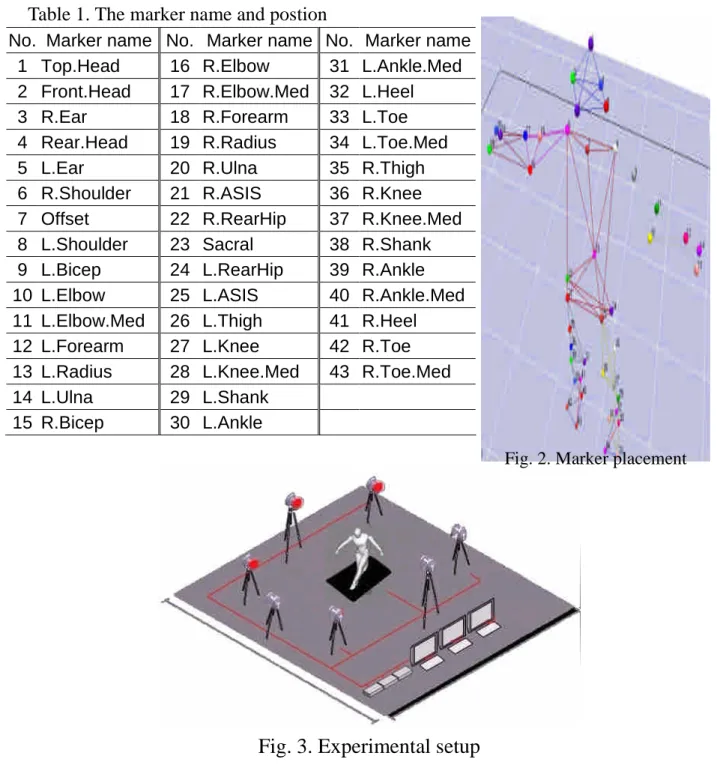
Table 1. The marker name and postion
No. Marker name No. Marker name No. Marker name 1 Top.Head 16 R.Elbow 31 L.Ankle.Med 2 Front.Head 17 R.Elbow.Med 32 L.Heel 3 R.Ear 18 R.Forearm 33 L.Toe 4 Rear.Head 19 R.Radius 34 L.Toe.Med 5 L.Ear 20 R.Ulna 35 R.Thigh 6 R.Shoulder 21 R.ASIS 36 R.Knee 7 Offset 22 R.RearHip 37 R.Knee.Med 8 L.Shoulder 23 Sacral 38 R.Shank 9 L.Bicep 24 L.RearHip 39 R.Ankle 10 L.Elbow 25 L.ASIS 40 R.Ankle.Med 11 L.Elbow.Med 26 L.Thigh 41 R.Heel 12 L.Forearm 27 L.Knee 42 R.Toe 13 L.Radius 28 L.Knee.Med 43 R.Toe.Med 14 L.Ulna 29 L.Shank
15 R.Bicep 30 L.Ankle
Fig. 3. Experimental setup
RESULTS AND DISCUSSION
The results were: 1. The sequence of the peak joint velocities for the lower extremity
were hip, knee, and ankle, which were in accord with the kinematics chain of human
exercise which smaller joints move after bigger joints move for both type of kicking
techniques. 2. The successive kick was larger than the single roundhouse kick in the
shoulder-hip-axis projected angle on horizontal plane.
CONCLUSIONS
The results suggest that the successive kicking movement perform more trunk twist
which may contribute to balance the lower extremity round kick motion through the
conservation principle of the angular momentum.
ACKNOWLEDGMENT
This study have been supported by the National Science Council, Taiwan, R.O.C.,
NSC 94-2413-H-179-008.
REFERENCES
Park, Y. J. (1989). A Biomechanical analysis of Taekwondo front-kicks. Unpublished doctoral dissertation, Uneversity of Minnesota.