Conformational Analysis of the Sodium/12-Crown-4 Complex: Photoionization and ab
Initio Molecular Orbital Studies
T.-S. Yeh and T.-M. Su*
Department of Chemistry, National Taiwan UniVersity, Taipei, Taiwan, and The Institute of the Atomic and Molecular Sciences, Academia Sinica, Taipei, Taiwan
ReceiVed: March 17, 1998; In Final Form: April 24, 1998
The molecular complexes formed between sodium atoms and 12-crown-4 molecules were generated in a flow reactor and studied with photoionization mass spectroscopy. The photoionization threshold energies of these complexes, which are dependent on the complex conformations, were obtained from the analysis of the photoionization efficiency spectra. Ab initio molecular orbital calculations were performed on the possible conformers of these complexes and their corresponding ionic states. With the help of theoretical calculations, the photoionization threshold energy of the C4conformer of Na(12-crown-4) was determined to be 3.01 ( 0.02 eV, and the Csconformer to be 3.36 ( 0.04 eV. The photoionization threshold energy of the Ciconformer was estimated to be 3.82 ( 0.04 eV. The conformation-dependent valence electron spatial distributions, bond dissociation energies, and photoionization threshold energies of the Na(12-crown-4) complex could be rationalized and classified in the framework of the general properties of the complexes formed between the sodium atoms and Lewis base molecules.
1. Introduction
Since the first successful synthesis of an alkalide in 1973, more than 40 alkalides and 5 electrides have been synthesized and characterized by Dye and co-workers.1-3 Experimentally, these compounds have been shown to have a wide range of interesting structures and properties. Theoretically, because of the comparatively large number of atoms per unit cell for these systems, reliable solutions were difficult to obtain by ab initio methods. It was only quite recently that some simpler electride systems were studied theoretically and the nature of the valence electrons was elaborated.4-8
In the past few years, molecular complexes formed between the alkali metal atoms and multifunctional Lewis bases, such as ethylenediamine, 1,2-ethanediol, and 1,2-dimethoxyethane, have been studied in this laboratory.9-11 The conformation-dependent bond dissociation energies and photoionization threshold energies of these complexes were emphasized in these works. In the present study, we extend the Lewis base molecules to cyclic crown ethers and, more specifically, 12-crown-4 (12C4). Their molecular complexes with the alkali metal atoms may be regarded as the first intermediates in the formation process of the corresponding electrides and alkalides. Additionally, these complexes are also simple enough to be treatable by higher level ab initio methods. In the present study the photoionization efficiency spectrum of Na(12C4) was taken. Its conformatdependent Mulliken electron population, ion-ization energies, and bond dissociation energies were calculated by the ab initio methods. With the help of the theoretical results, the measured ionization threshold energies were then assigned as the ionization threshold energies of specific complex conformers populated by the thermal energy. The present study might shed some light on the general behavior of valence electrons in electrides and alkalides.
Since both the neutral and ionic states of the complexes are involved in the present one-photon ionization process, the
conformation-dependent geometrical structures and bond ener-gies of Na+(12C4) calculated by the ab initio methods were also reported. As there were already quite a few theoretical and experimental works on the alkali metal ion/crown ether complexes in the literature,12-16in light of the present study, a general discussion on the bonding energies of the ionic complexes was also given.
2. Experimental Section
The details of the experimental arrangement, which is basically composed of a photoionization mass spectrometer and a flow reactor, have been reported in previous publications.9-11,17 Only a brief account of the relevant experimental conditions for the present molecular complexes is given here.
The sodium vapor was first generated by heating a sodium oven to about 585 K, and then it was introduced into the flow reactor by a minor argon gas flow of about 0.5 Torr partial pressure. The temperature of the sodium flow tube was kept at 513 K. In previous photoionization experiments, the Lewis base molecules, such as ethylenediamine and 1,2-dimethoxy-ethane, all have high enough vapor pressures to form a manageable vapor flow at temperatures around 370 K or below. Their vapors were fed into the main flow reactor through an outside sample holder kept at a fixed temperature by a thermostat. Because of the relatively low vapor pressure of 12C4, in the present experiment, the sample holder was placed directly in the main flow chamber and kept at the same temperature. The photoionization efficiency spectra of the monosodium complex were taken with a main reactor temper-ature of 328 K and a 12C4 vapor pressure of around 0.05 Torr. The total pressure of the flow reactor was kept at around 2.4 Torr by an argon buffer flow.
3. Ab Initio Molecular Orbital Calculations
The molecular orbital calculations were carried out with the Gaussian 94 package.18 The geometric parameters and the S1089-5639(98)01524-2 CCC: $15.00 © 1998 American Chemical Society
Published on Web 06/23/1998
Downloaded by NATIONAL TAIWAN UNIV on September 9, 2009 | http://pubs.acs.org
harmonic vibrational frequencies of the neutral and ionic molecular complexes were calculated at the HF/6-31G* level. The single-point energies were then calculated up to the MP2(Fu)/6-311+G**//HF/6-31G* and B3PW91/6-311+G**// HF/6-31G* levels. The adequacy of these calculation levels shall be discussed in the following results section.
The conformation notation of 12-crown-4 is in accord with those reported in the literature.15,19 The conformation-dependent vertical and adiabatic ionization energies of the neutral com-plexes and the sudden and adiabatic equilibrium bond dissocia-tion energies of both the neutral and ionic complexes were reported. All the theoretical bond dissociation energies were corrected with basis set superposition errors calculated by the counterpoise method.
4. Results and Discussion
The results are discussed in the following six subsections. 4.A. Basic Four Conformers of 12-Crown-4 and an Evaluation of Various Calculation Levels. Four basic con-formers of the free 12-crown-4 molecule, which are labeled C4, Cs, Ci, and S4 according to their geometric symmetries, are considered in this report. Upon complexation with the sodium atom, these four conformers are capable of forming their own stable and unique tetra-, tri-, di-, and monodentate sodium/12C4 complexes according to the above symmetric order. As shown in Table 1, at the present ab initio calculation levels, the relative energies of these four conformers also follow the same energy ordering in which the most stable conformer is in S4symmetry. These values are in general agreement with those of similar calculation levels reported in the literature: the RHF/DZ+P energies of Seidl and Schaefer;19and the RHF, MP2, BLYP, and BP86 energies at the 6-31+G* basis set by Feller et al.15 Among the present calculation results, the relative conformation energies of B3LYP are in good agreement with those of B3PW91. These values, in turn, are all slightly lower than the corresponding MP2 energies by about 0.026 eV. It has been suggested that, for a more accurate prediction of the confor-mational energies of poly(ethylene oxide), at least, moderately large basis sets and correlation energy recovery are required.15,20 The good agreement of the Ci conformation energy of 0.092 eV calculated at the MP2/6-311+G** level with that of 0.082 eV calculated at the MP2/aug-cc-pVDZ//MP2/cc-pVDZ level by Feller et al.15also supports this general observation. The present relative MP2 conformational energies of the four basic conformers are estimated to be accurate to within 0.026 eVs the energy difference between the MP2 and B3LYP energiess and are reckoned to be adequate for the present purpose.
Table 2 shows the sudden dissociation energies of the Na-(C4) and Na+(C4) conformers with BSSE corrections obtained at various calculation methods and levels. Four general observations can be drawn from these energies. First, the electron correlation is more pronounced in the ionic state than the neutral state. Second, with the present highest 6-311+G** basis set, the dissociation energies are generally in quite good
agreement with each other among the three calculation methods of MP2, B3PW91, and B3LYP. Third, at a closer examination, for the neutral complex, the dissociation energies of B3PW91 and B3LYP are essentially the same, and both are less than the MP2 energy by about 0.10 eV. For the ionic complex, the MP2 and B3PW91 dissociation energies are essentially identical, and both are less than the B3LYP value by about 0.12 eV. Finally, the energy variation caused by the differences in the MP2- and HF-optimized geometries is only about 0.015 eV for both the neutral and ionic complexes.
It has been found previously that, for the sodium-di-methoxyethane complexes and other related systems, the ioniza-tion energies could be predicted quite accurately by the B3PW91 method.11 Along with the above observations, the present Na/ 12C4 and its ionic complexes shall be discussed mainly in terms of the theoretical results of the MP2 and B3PW91 methods at the HF geometries.
4.B. Geometric Structures of Na(12C4) and Na+(12C4). As mentioned previously, each of the four basic 12C4 conform-ers could combine with the sodium atom to form its own most stable and also unique complex conformer. Figures 1 and 2 show the ball-and-stick representations of these conformers. The most stable Na/C4complex is in a tetradentate conformation which still preserves the C4symmetry of the ligand. The most stable Na/Cscomplex is in a tridentate conformation and also still in the Cs symmetry. Similarly the most stable Na/Ci complex is in a bidentate conformation, but its ligand’s symmetry is already distorted and not in a strict Ci form. Finally, only a monodentate conformation is possible for the most stable Na/S4complex, and its 12C4 symmetry is also in a distorted S4form. In this report, the symbols Ciand S4are still used for the distorted Na/Ciand Na/S4complexes, respectively. The corresponding conformation notations for the above specific complexes are denoted as Na(C4), Na(Cs), Na(Ci), and Na(S4), respectively.
In the case of the Na+/12C4 complex, among the four basic ligand conformations, only three locally stable conformers are located: Na+(C4), Na+(Cs), and Na+(S4). The Na+(Ci) con-former is not locally stable at the HF/6-31+G* level. Being similar to their neutral counterparts, the first two cationic con-formers preserve their symmetries upon complexation. Nev-ertheless, owing to the strong ion-dipole interaction, the third S4conformer actually settles down to a C2symmetry form, in which the sodium cation is sitting on the center of the ligand as in the case of the C4conformer but with two different Na+-O bond distances.
For the geometric structures of the neutral complex, the 12C4 ligand is essentially in the same geometries as the free state in all four conformations. The shortest sodium-oxygen bond distances are 2.559, 2.506, 2.454, and 2.446 Å for the C4, Cs, TABLE 1: Relative Conformation Energies (eV) of
12-Crown-4a C4 Cs Ci S4 HF/6-311+G** 0.300 0.139 0.076 0 MP2/6-31+G* 0.345 0.194 0.112 0 MP2/6-311+G** 0.287 0.152 0.092 0 B3PW91/6-311+G** 0.236 0.113 0.069 0 B3LYP/6-311+G** 0.258 0.126 0.076 0 aHF/6-31G* optimized geometry.
TABLE 2: Sudden Equilibrium Bond Dissociation Energies (eV) of Na(12C4) and Na+(12C4) in C4Conformation at
Various Calculation Levelsa
geometry Na(C4) f Na + C4 Na+(C4) f Na++ C4 HF/6-311+G** HFb 0.589 3.185 MP2/6-31+G* HF 0.635 3.054 MP2/6-311+G** HF 0.586 2.949 B3PW91/6-311+G** HF 0.487 2.979 B3LYP/6-311+G** HF 0.491 3.081 MP2/6-311+G** MP2c 0.576 2.965 B3LYP/6-311+G** MP2 0.506 3.097
aAll energies are BSSE corrected.bHF/6-31G* optimized geometry.
cMP2/6-31G* optimized geometry.
Downloaded by NATIONAL TAIWAN UNIV on September 9, 2009 | http://pubs.acs.org
Ci, and S4conformers, respectively. The decreasing of the bond lengths is in good correlation with the increasing of the sodium coordination number of the conformers. In the case of the cationic complexes, the shortest Na+-O bond distances of Na+ -(C4) and Na+(Cs) are 2.332 and 2.274 Å, respectively. They are shorter then the corresponding bond distances of the neutral counterparts by about 0.23 Å. The ligand geometry of the C4 conformer is quite close to that of its corresponding neutral one. For the Cscomplex, compared with its neutral counterpart, there are moderate changes of the dihedral angles of the molecular fragments that are bonded to the oxygen atom located on the opposite side of the sodium ion. In the case of Na+(Cs), owing to the strong ion-dipole interaction, there are substantial dihedral angle changes for those molecular fragments that are directly bonded to the two oxygen atoms located on the opposite side of the sodium ion. Its Na+-O distance is shorter than that of the corresponding neutral conformer by 0.16 Å. The detailed geometric parameters and harmonic vibrational fre-quencies of 12C4, Na(12C4), and Na+(12C4) discussed in this report are tabulated in the Supporting Information.
4.C. Mulliken Population Analysis and Bonding Nature of Na(12C4) Conformers. In a study of Li(9C3)2 with the ligands in the form of hexadentate D3dsymmetry, Rencsok et al. have shown that the valence electron is predominantly in a Rydberg-type, loosely bound-to-the-complex state.5,6 More recently, Hashimoto and Morokuma studied the stability and
structure of Na(H2O)n and Na(NH3)n (n ) 1-6).21,22 Their Mulliken gross orbital population on sodium shows that the character of the extra electron varies from the normal valence electron to the diffuse, solvated-like electron as the ligand number n increases from 1 to 6, with n ) 2, 3, and 4 falling between these two extremes. Along this general line, the conformation-dependent character of the sodium valence elec-tron in Na(12C4) shall be discussed.
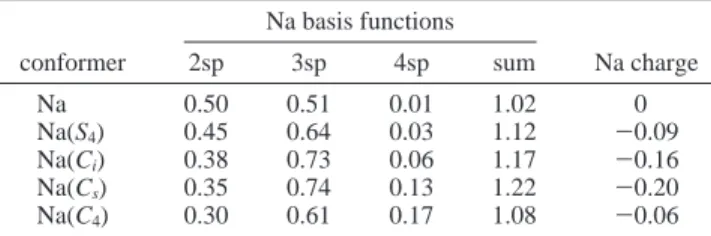
Table 3 shows the Mulliken gross orbital population of the four Na(12C4) conformers on the sodium valence sp basis functions and also the Mulliken sodium atomic charge at the HF/6-31+G* level. Two general population trends were Figure 1. Ball-and-stick representations of the C4and Csconformers
of Na(12C4).
Figure 2. Ball-and-stick representations of the Ciand S4conformers
of Na(12C4). See the text for the symbol definitions.
TABLE 3: Mulliken Gross Population of Na and Na(12C4) in Na Valence sp Basis Functionsa
Na basis functions
conformer 2sp 3sp 4sp sum Na charge
Na 0.50 0.51 0.01 1.02 0
Na(S4) 0.45 0.64 0.03 1.12 -0.09
Na(Ci) 0.38 0.73 0.06 1.17 -0.16 Na(Cs) 0.35 0.74 0.13 1.22 -0.20 Na(C4) 0.30 0.61 0.17 1.08 -0.06
aCalculated at the HF/6-31+G* level.
Downloaded by NATIONAL TAIWAN UNIV on September 9, 2009 | http://pubs.acs.org
observed. First, the populations in the inner valence 2sp basis functions decrease monotonically, while those in the diffusive 4sp basis functions increase monotonically, as the sodium atom varies from the free sodium state to the tetradentate C4 conformation. Second, the populations in the outer valence 3sp basis functions, the summation populations in the complete valence sp basis functions, and the Mulliken sodium atomic charges all increase from the free sodium state to the tridentate Cs conformation and then decrease quite substantially to the tetradentate C4 conformation. The conformation-dependent electron populations of Na(12C4) are consistent with the general characteristics of the valence electron in the Na(H2O)n and Na(NH3)nclusters. In the mono- to tridentate conformations,
both the charge transfer from the ligand to the sodium atom and the shift of the sodium inner valence population to the outer and diffusive valence basis functions suggest that the nature of the Na-O bond still mainly belongs to the category of the localized interactions between the alkali metal atom and simple Lewis base molecules, a subject having been under intensive study for the past two decades or so.21-27 As the conformation reaches the tetradentate C4state, the abrupt decrease of both the sodium atomic charge and the inner and outer valence electron populations and the monotonic increase of the diffuse electron population suggest that the valence electron has acquired some character of the valence electron observed in the Li(9C3)2 complex and the higher Na(NH3)n clusters, i.e., diffusive, Rydberg-type, and solvated-like.
4.D. Photoionization Mass Spectra and Photoionization Efficiency Spectra of Na(12C4). Figure 3 shows the photo-ionization mass spectra of Na(12C4) and Na2(12C4) with 341 nm photon radiation at 328 and 313 K flow reactor temperature, respectively. Both mass peaks would disappear if either the sodium or 12C4 vapor was terminated. The relative signal ratio of the disodium to monosodium complex depends on the flow reactor temperatures, sodium vapor pressure, and the ionization
wavelength. To minimize the possible contamination of the monosodium complex signal by the photoionized disodium complex through the dissociation process in the higher photon energy regime, in the present experiment, the flow reactor was kept at 328 K and the sodium oven temperature was set at the lower side. Under such experimental conditions the disodium complex signal was determined to be less than 25% of the monosodium signal by setting the photon energies between threshold decomposition energy for the fragmentation of the disodium complex ions into the monosodium complex ions and sodium atoms and the threshold electron ionization energy. Figure 3 shows a typical example in this wavelength region. In other words, in the worst situation, at most 20% of the observed monosodium signal might come from the contribution of the disodium complex if the excess photon energy was higher than the required energy for the sodium atoms to split away from the ionic disodium complex and also all the disodium complex ions underwent the dissociation.28
The photoionization efficiency spectra of monosodium com-plexes and their corresponding Watanabe plot are shown in Figure 4. Three general steplike spectral features could be clearly identified, and their corresponding enlarged Watanabe plots are shown in Figure 5. The first and also the lowest ionization threshold was determined to be 3.01 ( 0.02 eV, the second one to be 3.36 ( 0.04 eV, and the third one to be 3.82 ( 0.04 eV. The quoted uncertainties were estimated from the uncertainties in the selection of the linear regions in the Watanabe plots and the intrinsic accuracy of the present experimental setup. Note that the threshold ionization energies of Na and Na2were measured to be 5.134 and 4.875 eV by the present method. Compared with the reported adiabatic ioniza-tion energies of 5.139 eV29and 4.895 eV,30respectively, the agreement is excellent.
Figure 3. Photoionization mass spectra of Na(12C4) at 341 nm laser
radiation.
Figure 4. Photoionization efficiency spectrum of Na(12C4) (a) and
the corresponding Watanabe plot (b).
Downloaded by NATIONAL TAIWAN UNIV on September 9, 2009 | http://pubs.acs.org
In the following section, with the help of the results of molecular orbital calculations, the three measured consecutive ionization threshold energies were assigned as the ionization energies of three specific conformers of Na(12C4).
4.E. Comparisons between Theoretical and Experimental Results. Table 4 shows the theoretical vertical and adiabatic equilibrium ionization energies of the sodium atom and the four possible conformers of Na(12C4) at the HF, MP2, and B3PW91 levels. As the table shows, for the same ionization quantity, the HF method always yields the smallest ionization energy, followed consecutively by the MP2 and the B3PW91 methods. Recent studies of the Na(1,2-dimethoxyethane) complexes and related systems suggested that, among the three calculation levels, the B3PW91 calculations yield the most accurate prediction on the ionization energies, followed by the MP2 and HF methods.11 The B3PW91 ionization energies shall be exclusively used in the present discussion. Those of the HF and MP2 methods are listed for comparison purpose.
The adiabatic ionization energies with respect to the most stable ionic conformer Na+(C4) of the C4, Cs, and Cicomplexes are close to each other to within 0.02 eV, an indication that the neutral-state energies of these three conformers happen to be
quite similar to each other. In other words, the Na-O bonding strength is similar to the energy differences among the 12C4 conformations such that they almost completely counterbalance each other in the formation of the tetra-, tri-, and bidentate conformers. This accidental balance of the interaction strengths is also observed in the adiabatic bond dissociation energies of the neutral complexes discussed in the following section. There is appreciable change between the adiabatic ionization energy with respect to its original conformation state and the corre-sponding vertical ionization energy, especially for the Cs, Ci, and S4 states, in which the Ci ionic state is even not stable locally. These suggest that there are major equilibrium geo-metric changes between the neutral and ionic conformers, especially in the dihedral angles related to the ether functional groups.
The vertical ionization energies of the four conformers increase monotonically from the tetradentate C4conformer to the monodentate S4 conformer. Considering the energetic similarity among the first three neutral conformers, this increas-ing trend is just a direct manifestation of the decreasincreas-ing interaction strengths between Na+and 12C4 in the conformation of the neutral forms. These vertical ionization energies cor-respond to the experimental threshold energies obtained in the present studies. The measured three ionization energies 3.01 ( 0.2, 3.36 ( 0.4, and 3.82 ( 0.4 eV are in excellent agreement with the predicted vertical ionization energies of the C4, Cs, and Ciconformers 2.99, 3.22, and 3.78 eV, respectively. The harmonic vibrational frequency of the sodium ion stretching mode for Na+(C4) is 206 cm-1at the HF level. The possible steplike features due to the vibrational excitation in the photoionization process were buried in the rising slopes of the photoionization efficiency spectrum.
In the above analysis, the assignments of ionization energies are based on Watanabe plots. The applicability of the method for the diatomic molecules has been supported by an earlier theoretical analysis on the photoionization threshold behav-ior.31,32 For polyatomic molecules, the method has been recommended to be applicable for the molecular systems at high temperature and with low vibrational frequency modes.32,33For the present Na(12C4) complex, the major nuclear motions involved in photoionization are the sodium stretching and bending motions, and the ring puckering of the crown ether. These motions are all in the low-frequency domain. At the present experimental temperatures, these low-frequency vibra-tional modes were all densely populated. Apparently, the above high-temperature criterion was met in the present experiments. For the conformers with higher ionization energies, one might expect that the vibrationally induced autoionization would distort the photoionization efficiency intensity in the threshold region. Since the conformers are in the same electronic state, the photoionization transitions would be mainly determined by the Franck-Condon factors between the neutral and ionic electronic states.34 This would ensure that direct photoionization of the conformers with lower threshold ionization energies would prevail over the vibrationally induced autoionization process of those with higher threshold ionization energies if the photon energy was below their threshold ionization energies. The absence of any pronounced autoionization structure in the photoionization efficiency spectrum is consistent with this theoretical observation.
In summary, since the Na+(Ci) conformer is not locally stable and also the possible minor contamination of the ionization signal from the disodium complex was not ruled out in the present experiment, the above threshold ionization energy Figure 5. Enlarged Watanabe plot of Figure 4.
Downloaded by NATIONAL TAIWAN UNIV on September 9, 2009 | http://pubs.acs.org
assigned for the Na(Ci) conformer was presented here as an estimated value. The other two threshold ionization energies for the Na(C4) and Na(Cs) conformers were free of these uncertainties. A further support of the present conformation assignments which is based on the estimation of the relative ionization intensities of the conformers through the equilibrium bond dissociation energies and conformation geometric sym-metry shall be discussed in the following section.
4.F. Equilibrium Bond Dissociation Energies of Na(12C4) and Na+(12C4). Two types of equilibrium bond dissociation energies were calculated: the sudden equilibrium bond dis-sociation energies, i.e., the equilibrium bond disdis-sociation energies with the molecular fragment geometries being frozen in the parent geometry, and the adiabatic equilibrium bond dissociation energies in which the molecular fragments are relaxed to the geometries of either the most stable conformer or the locally stable conformer of the parent molecule. The sudden bond dissociation energy serves as a direct measure of the bond interaction strength; the adiabatic bond dissociation energy with respect to the most stable conformer is just the bond dissociation enthalpy at 0 K; and the adiabatic bond dissociation energy in its original parent conformation state, when compared with the sudden bond dissociation energy could be correlated with the extent of the geometric changes of the ligand in the formation of the complex from its locally stable conformer. Here, as a note, the bond dissociation energy is the summation of the equilibrium bond dissociation energy and the corresponding zero-point energy correction.
As shown in Table 5, for the neutral sodium complexes, the sudden dissociation energies are roughly proportional to the number of Na-O bonds in each conformer. The linear relation is especially good for the MP2 and B3PW91 results. This suggests that the intrinsic bond strengths of the Na-O bonds are more or less additive as the conformation varies from the monodentate to the tetradentate form. Another feature is that the electron correlation effect decreases from the monodentate to tetradentate form if one compares the HF and MP2 energies.
The HF and MP2 sudden dissociation energies of the C4 conformer are essentially identical, which suggests that the electron correlation effect is negligible for the tetradentate sudden bond dissociation energy. Along with the general conclusions reached in the subsection of the Mulliken population analysis, these observations are consistent with the finding of Rencsok et al. in their study of Li(9C3)2; that is, the correlation effects are expected to be very small on the physical quantities which are related to the energy eigenstates of an extremely diffusive valence electron.6
For the adiabatic equilibrium bond dissociation energies with respect to the most stable S4conformer of 12C4, the C4, Cs, and Cibond dissociation energies are essentially the same at the MP2 level; while, at the B3PW91 level, the Ciconformer turns out to be the most stable conformer, the Csconformer is the next higher one by 0.022 eV, and the following C4conformer is further higher by another 0.017 eV. Taking these facts into accounts, one could roughly estimate the population ratio of these three conformers at room temperature as follows. Since the bond dissociation energies and their thermal corrections are close to each for the three most stable conformers, to a good approximation, their thermal equilibrium population ratio would be mainly determined by the ratio of the rotational symmetry numbers of the conformers.35 Note that a thermal molecular beam was employed in the present experiments. The rotational symmetry number is 4, 1, and 1, and the number of the rotationally distinguishable chelating positions is 1, 1, and 2 for the C4, Cs, and Ciconformers, respectively. The resulting population ratio of C4:Cs:Ciis 1:4:8. The ionization intensity ratio obtained from the photoionization efficiency spectrum is 1:6:54. By assuming that the ionization efficiencies of the three conformers are identical, the ionization intensity ratio would be identical to the population ratio. Apparently, the observed C4:Cspopulation ratio is reasonably in line with the statistical estimation, while the observed Ci population is much higher than the statistical value. Several sources could contribute to this discrepancy. One is the possible difference among the bond
TABLE 4: Theoretical and Experimental Ionization Energies (eV) of Na(12C4)a
vertical adiabatic reaction HF MP2 B3PW91 HFb MP2b B3PW91b HFc MP2c B3PW91c exptl Na f Na+ 4.94 5.00 5.27 5.139d Na(C4) f Na+(12C4) 2.57 2.79 2.99 2.40 2.61 2.80 2.40 2.61 2.80 3.01 Na(Cs) f Na+(12C4) 2.80 3.01 3.22 2.39 2.60 2.81 2.54 2.75 2.95 3.36 Na(Ci) f Na+(12C4) 3.39 3.56 3.78 2.36 2.55 2.82 e e e 3.82f Na(S4) f Na+(12C4) 4.01 4.15 4.39 2.23 2.39 2.69 2.74 2.96 3.18
aAt the HF/6-311+G**, MP2(Fu)/6-311+G**, and B3PW91/6-311+G**//HF/6-31G* calculation levels.bAdiabatic equilibrium ionization energy
with respect to the most stable conformer Na+(C4).cAdiabatic equilibrium ionization energy in its original conformation state.d Reference 29. eNeutral parent conformation is not locally stable in ionic form.f Estimated value. See text for the details.
TABLE 5: Theoretical Equilibrium Dissociation Energies (eV)a
sudden adiabatic
reactions HF MP2 B3PW91 HFb MP2b B3PW91b ZPECc HFd MP2d B3PW91d ZPECe
neutral complexes Na(C4) f Na+12C4 0.589 0.586 0.487 0.209 0.239 0.166 -0.037 0.508 0.527 0.401 -0.046 Na(Cs) f Na+12C4 0.423 0.450 0.378 0.197 0.225 0.183 -0.031 0.337 0.376 0.296 -0.041 Na(Ci) f Na+12C4 0.346 0.376 0.318 0.188 0.237 0.205 -0.031 0.264 0.329 0.274 -0.043 Na(S4) f Na+12C4 0.097 0.146 0.104 0.068 0.128 0.092 -0.019 0.068 0.128 0.092 -0.019 ionic complexesf Na+(C4) f Na++12C4 3.185 2.949 2.979 2.724 2.556 2.614 -0.070 3.024 2.844 2.850 -0.079 Na+(Cs) f Na++12C4 2.984 2.756 2.805 2.572 2.382 2.472 -0.062 2.711 2.534 2.584 -0.072 Na+(S4) f Na++12C4 2.698 2.479 2.545 2.198 1.947 2.112 -0.040 2.198 1.947 2.112 -0.040
aAt the HF/6-311+G**, MP2(Fu)/6-311+G**, and B3PW91/6-311+G**//HF/6-31G* calculation levels; all energies were BSSE corrected.
bAdiabatic equilibrium dissociation energy with respect to the most stable conformer of 12-crown-4, S
4.cZero-point energy corrections with respect
to the most stable conformer, S4.dAdiabatic equilibrium dissociation energy in its original conformation state.eZero-point energy corrections in
its original conformation state.fNa+(C
i) is locally unstable.
Downloaded by NATIONAL TAIWAN UNIV on September 9, 2009 | http://pubs.acs.org
dissociation energies of the conformers, even though their magnitudes may not appear to be that large. For instance, the energy difference between the C4and Ciconformer is 0.039 eV if the B3PW91 energies were taken. At 300 K, their population ratio would increase from 1:8 to 1:36. Another contribution may come from the dissociation of the photoionized disodium complex in the Ciphotoionization wavelength region.28 Its contribution has been minimized but was not completely eliminated in the present experiment. Finally, part of the discrepancy may also come from the possible difference in the photoionization efficiencies of the three conformers.
For the neutral conformers, the adiabatic equilibrium bond dissociation energies in the initial parent conformation, as expected, are all lower than the corresponding sudden equilib-rium bond dissociation energies by less than 0.069 eV at the MP2 level. This is consistent with the above observation that the comparatively weak Na-O bond does not perturb the ligand geometries much during the formation of the complexes.
In the case of the cationic conformers, as shown in Table 5, the following features are observed: (a) the MP2 energies are in good agreement with the corresponding B3PW91 energies, particularly in the sudden dissociation energies; (b) the HF ener-gies are consistently higher than the corresponding MP2 and B3PW91 energies by an average of 0.195 eV; (c) due to the much larger interaction energy between the sodium ion and the ether functional group than the energy differences among the conformers of the free crown ether, the relative bond dissociation energies of the three locally stable cationic conformerssC4, Cs, and S4sare dominated by the former interactions and, hence, consistent with the conventional stability picture of the cationic conformers; that is, the tetradentate C4form is the most stable, while the monodentate S4 form is the least stable conformer; (d) the largest bonding energy variation comes from the sudden and adiabatic bond dissociation energies in the S4conformer. These observations also suggest that the contribution of the elec-tron correlation to the bond energy is not negligible, and the strong electrostatic interactions between the sodium cation and the four ether functional groups dominate the complex such that the ligand structure was usually strongly distorted to accom-modate the formation of the Na+-O bonds. The latter case happens, for instance, in the S4conformer, in which essentially four Na+-O bonds were formed and the corresponding ligand conformation is significantly distorted from that of the free state. Experimentally, it has been recommended that the bond dissociation energy of Na+(12C4) with respect to the most stable conformer at 0 K is 2.61 ( 0.13 eV.16 The present theoretical values of 2.654 (HF), 2.486 (MP2), and 2.544 (B3PW91) eV are all in agreement with the experimental result to within the cited experimental uncertainty. Since the present experimental threshold ionization energy of the C4 conformer corresponds to the theoretical vertical ionization energy, along with the experimental ionization energy of the sodium atom, one may use the energy conservation relation to check the internal consistence of the theoretical neutral and ionic bond dissociation energy among the present three calculation levels. Restricting the following consideration of the states to the C4conformation, the energy conservation relation between the adiabatic equilib-rium bond dissociation energies De’s and the adiabatic equi-librium ionization energies Ia’s is
With the help of the theoretical energy difference between the vertical and adiabatic ionization energies and the corre-sponding zero-point energy corrections listed in Tables 4 and
5, the experimental adiabatic equilibrium ionization energy of Ia(Na(C4)) is 2.87 eV. The sodium atom ionization energy is 5.139 eV.29 Substituting the theoretical D
e(Na+(C4)) values of 3.024 (HF), 2.844 (MP2), and 2.850 (B3PW91) eV into the above equation, one obtains the corresponding predicted De -(Na(C4)) values of 0.755, 0.573, and 0.578 eV, respectively. Compared with the theoretical values of 0.508, 0.527, and 0.401 eV, the results of the MP2 level have the best internal energy consistence with respect to the available experimental results. The values of the HF and B3PW91 levels are off by 0.247 and 0.177 eV, respectively. These discrepancies are all large enough to be ruled out by the present experimental results. In short, for the neutral and ionic bond dissociation energies, the MP2 calculations yield more consistent results than those by the HF and B3PW91 calculation methods. This conclusion is consistent with the energetic results of Feller and co-workers on the complexes of alkali cations with simple and complex ethers.15 Note that for the present complex systems the energetic discrepancies calculated by the B3LYP method, which are not specifically considered here, are close to those of the HF method. At room temperature, it has been shown by Armentrout and co-workers that in the gas phase the Na+(12C4) complex is mainly in the C4 conformation.16 This specificity of the C4 configuration is attributed to the extra energetic stability through the full interaction between the cation and the tetradentate 12C4 ligand.16,36 In contrast to the cation complexes, the neutral sodium complex is mainly in the Ciconformation instead of the C4one. The present analysis suggests that the conformer entropy instead of the conformer energy is the major factor in determining the relative populations of the neutral C4, Cs, and Ciconformers.
5. Conclusions
In the present paper, the conformation-dependent properties of the Na(12C4) and Na+(12C4) molecular complexes were reported. With the help of the theoretical ionization energies, the general features of the ionization efficiency spectra of Na-(12C4) were assigned as the contribution from the various conformers, and their experimental threshold ionization energies were obtained. The availability of the experimental ionization energies also enables one to assess the internal energy consis-tency of the theoretical neutral and ionic bond dissociation energies among the various ab initio calculation methods. The relative photoionization intensities as shown in the photoion-ization efficiency spectrum suggest that the Ciconformer is the dominant species under the present experiment condition. It is suggested that the conformer entropy instead of the energy is the major factor in determining the relative conformer population for this neutral system. This is in contrast to the preference of the C4 conformer in the corresponding cationic complex as observed by Armentrout and co-workers.
With the Mulliken electron population analysis, the spatial distribution of the valence electron of the complex was found to vary from the Na-localized valence-type to the diffusive-type distribution as the conformation varies from the mono-dentate to the tetramono-dentate form. Under the condition that the adiabatic conformation energies are more or less equivalent, it is expected that the chemical properties of the complex are also going to be conformation-dependent. These related subjects are interesting and deserve further investigation.
Acknowledgment. The financial support of this work by the National Science Council, Taiwan, R.O.C., is gratefully acknowledged.
Ia(Na(C4)) + De(Na+(C4)) ) Ia(Na) + De(Na(C4)) (1)
Downloaded by NATIONAL TAIWAN UNIV on September 9, 2009 | http://pubs.acs.org
Supporting Information Available: Tables of the geometric parameters and harmonic vibrational frequencies of the stable conformers of 12C4, Na(12C4), and Na+(12C4) discussed in this paper (9 pages). Ordering information is given on any current masthead page.
References and Notes
(1) Dye, J. L.; Debacker, M. G. Annu. ReV. Phys. Chem. 1987, 38, 271.
(2) Wagner, M. J.; Dye, J. L. Annu. ReV. Mater. Sci. 1993, 23, 223. (3) Dye, J. L. Chemtracts; Inorg. Chem. 1993, 5, 243.
(4) Allan, G.; DeBacker, M. G.; Lannoo, M.; Lefebvre, J. Europhys.
Lett. 1990, 11, 49.
(5) Rencsok, R.; Kaplan, T. A.; Harrison, J. F. J. Chem. Phys. 1990,
93, 5875.
(6) Rencsok, R.; Kaplan, T. A.; Harrison, J. F. J. Chem. Phys. 1993,
98, 9758.
(7) Singh, D. J.; Krakauer, H.; Haas, C.; Pickett, W. E. Nature 1993,
365, 39.
(8) Dye, J. L.;Wagner, M. J.; Overney, G.; Huang, R. H.; Nagy, T. F.; Tomanek, D. J. Am. Chem. Soc. 1996, 118, 7329.
(9) Liau, Y.-H.; Su, T.-M. J. Am. Chem. Soc. 1992, 114, 9169. (10) Hsu, C.-L.; Yeh, T.-S.; Su, T.-M. J. Phys. Chem. 1994, 98, 8876. (11) Yeh, T.-S.; Su, T.-M. J. Phys. Chem. A 1997, 101, 1672. (12) Katritzky, A. R.; Malhotra, N.; Ramanathan, R.; Kemerait, R. C.; Zimmerman, J. A.; Eyler, J. R. Rapid Commun. Mass Spectrosc. 1992, 6, 25.
(13) Glendening, E. D.; Feller, D.; Thompson, M. A. J. Am. Chem. Soc.
1994, 116, 10657.
(14) Ray, D.; Feller, D.; More, M. B.; Glendening, E. D.; Armentrout, P. B. J. Phys. Chem. 1996, 100, 16116.
(15) Feller, D.; Apra, E.; Nichols, J. A.; Bernholdt, D. E. J. Chem. Phys.
1996, 105, 1940.
(16) More, M. B.; Ray, D.; Armentrout, P. B. J. Phys. Chem. A 1997,
101, 831.
(17) Kuan, T.-C.; Jiang, R. C.; Su, T.-M. J. Chem. Phys. 1990, 92, 2553. (18) Frisch, M. J.; Trucks, G. W.; Schlegel, H. B.; Gill, P. M. W.; Johnson, B. G.; Robb, M. A.; Cheeseman, J. R.; Keith, T.; Petersson, G.
A.; Montgomery, J. A.; Raghavachari, K.; Al-Laham, M. A.; Zakrzewski, V. G.; Ortiz, J. V.; Foresman, J. B.; Cioslowski, J.; Stefanov, B. B.; Nanayakkara, A.; Challacombe, M.; Peng, C. Y.; Ayala, P. Y.; Chen, W.; Wong, M. W.; Andres, J. L.; Replogle, E. S.; Gomperts, R.; Martin, R. L.; Fox, D. J.; Binkley, J. S.; Defrees, D. J.; Baker, J.; Stewart, J. P.; Head-Gordon, M.; Gonzalez, C.; Pople, J. A. Gaussian 94, Revision C.3; Gaussian, Inc.: Pittsburgh, PA, 1995.
(19) Seidl, E. T.; Schaefer, H. F. J. Phys. Chem. 1991, 95, 3589. (20) Murcko, M. A.; DiPaola, R. A. J. Am. Chem. Soc. 1992, 114, 10010. (21) Hashimoto, K.; Morokuma, K. J. Am. Chem. Soc. 1994, 116, 11436. (22) Hashimoto, K.; Morokuma, K. J. Am. Chem. Soc. 1995, 117, 4151. (23) Nicely, V. A.; Dye, J. L. J. Chem. Phys. 1970, 52, 4795. (24) Trenary, M.; Schaefer, H. F., III; Kollman, P. A. J. Am. Chem.
Soc. 1977, 99, 3885.
(25) Bentley, J. J. Am. Chem. Soc. 1982, 104, 2754.
(26) Curtiss, L. A.; Kraka, E.; Gauss, J.; Cremer, D. J. Phys. Chem.
1987, 91, 1080.
(27) Hsiao, Y.-W.; Chang, K.-M.; Su, T.-M. Chem. Phys. 1992, 162, 335.
(28) The theoretical adiabatic ionization energy of Na2(C4) is 3.39 eV.
The bond dissociation energy of Na2+(C4) f Na + Na+(C4) is 0.27 eV.
The threshold photoionization energy for the sodium atom to split from Na2+(C4) is estimated to be 3.66 eV or 339 nm photon.
(29) Moore, C. E. Atomic Energy LeVels; NSRD-NBS Vol.1; US GPO: Washington, DC, 1971; p 89.
(30) Martin, S.; Chevaleyre, J.; Valignat, S.; Perrot, J.; Broyer, M.; Cabaud, B.; Hoareau, A. Chem. Phys. Lett. 1982, 87, 235.
(31) Guoyn, P. M.; Berkowitz, J. J. Chem. Phys. 1971, 54, 1814. (32) Berkowitz, J. In AdVances in High-Temperature Chemistry; Eyring, L., Ed.; Academic Press: New York, 1971; Vol. 3, p 123.
(33) Dao, P. D.; Peterson, K. I.; Castleman, A. W., Jr. J. Chem. Phys.
1984, 80, 563.
(34) Berkowitz, J. Photoabsorption, Photoionization, and Photoelectron
Spectroscopy; Academic Press: New York, 1979.
(35) McQuarrie, D. A. Statistical Mechanics; Harper & Row Publish-ers: New York, 1976; p 142.
(36) More, M. B.; Ray, D.; Armentrout, P. B. J. Phys. Chem. A 1997,
101, 7007.
Downloaded by NATIONAL TAIWAN UNIV on September 9, 2009 | http://pubs.acs.org