行政院國家科學委員會專題研究計畫 成果報告
家庭內的社會比較:兄弟姊妹的人口組成結構對教育及地位
取得的影響
計畫類別: 個別型計畫 計畫編號: NSC92-2412-H-002-021- 執行期間: 92 年 08 月 01 日至 93 年 07 月 31 日 執行單位: 國立臺灣大學社會學系暨研究所 計畫主持人: 蘇國賢 報告類型: 精簡報告 處理方式: 本計畫可公開查詢中 華 民 國 93 年 12 月 8 日
行政院國家科學委員會補助專題研究計畫
7
成 果 報 告
□期中進度報告
家庭內的社會比較:兄弟姊妹的人口組成結構對教育
及地位取得的影響
計畫類別:7 個別型計畫 □ 整合型計畫
計畫編號:NSC 92-2412-H-002-021
執行期間: 2003 年 8 月 1 日至 2004 年 10 月 31 日
計畫主持人:蘇國賢
共同主持人:
計畫參與人員:
成果報告類型(依經費核定清單規定繳交):7精簡報告 □完整報告
本成果報告包括以下應繳交之附件:
□赴國外出差或研習心得報告一份
□赴大陸地區出差或研習心得報告一份
□出席國際學術會議心得報告及發表之論文各一份
□國際合作研究計畫國外研究報告書一份
處理方式:除產學合作研究計畫、提升產業技術及人才培育研究計畫、
列管計畫及下列情形者外,得立即公開查詢
□涉及專利或其他智慧財產權,□一年□二年後可公開查詢
執行單位:國立台灣大學社會學系
中 華 民 國 2004 年 12 月 8 日
“The Eldest Brother is like Father:”
Family Norms, Sibship Structure, and Educational Attainment
Abstract
Previous research has not fully explored how cultural norms affect intrafamily resource
allocation. We examine the effects of sibship structure on educational attainment during the early period of Taiwan’s development to demonstrate how traditional norms concerning gender and seniority shape resource allocation within Chinese families. Using the Panel Study of Family Dynamics in Taiwan, we find that additional siblings obstruct educational opportunities for all but male firstborns, who are the ultimate inheritors of paternal authority in the family. By contrast, being firstborn is conducive to less schooling among daughters because seniority increases the expectation that they will shoulder family responsibilities like a mother. Among non-firstborn children, whether the elder siblings’ gender affects educational attainment also depends on the child’s family roles shaped by seniority and gender. The analysis shows that existing theories that overlook the normative meanings of birth order cannot adequately explain Chinese family dynamics.
中文摘要 過去的研究尚未深入探討文化規範如何影響家庭內資源配置決策的問題。本文透過分析台 灣早期發展經驗中,家中兄弟姊妹的組成結構如何影響教育取得的分析,來彰顯性別及年 齡的傳統規範對於華人家庭教育資源配置的影響。我們採用「家庭動態調查」的資料來進 行分析,研究發現兄弟姊妹的人數對於個人的教育取得有負面的影響,但具有優先繼承家 長威權的長子除外。相反的,長女由於被賦予擔負家計的代理母職角色期望,導致其教育 程度反而較低。在非長子或長女的其他兄弟姊妹中,也受年資與性別規範所形塑的家庭角 色影響。本文的分析顯示既有的理論忽略了出生排行的文化規範意義,以致於無法適切的 解釋華人家庭的情形。 關鍵字:同袍結構、教育取得、性別規範
INTRODUTION
Sociological research has long emphasized the role of family structure in educational inequality (Blake, 1989; Blau & Duncan, 1967; Buchmann & Hannum, 2001; Cherlin & Furstenberg, 1994; McLanahan, 2000; McLanahan & Sandefur, 1994). Aspects of sibling configuration, including sibship size, birth order, sex composition, and age difference between siblings, are thought to affect intrafamily resource allocation and therefore educational outcomes (Conley, 2000; Downey, 1995; Steelman & Powell, 1989; Steelman, Powell, Werum, & Carter, 2002). While acknowledging the possible impact of sibship structure on life chances, researchers have debated intensely on which parameters of sibship affect educational opportunities and to what degree, as well as the mechanism for the association (Conley, 2000; Downey, 1995, 2001; Downey, Powell, Steelman, & Pribesh, 1999; Guo & Van Way, 1999a, 1999b; Hauser & Kuo, 1998; Philips, 1999; Retherford & Sewell, 1991, 1992; Steelman et al., 2002; Zajonc, 2001).
Most of the empirical evidence facilitating these debates has been based on the U.S. experience (Steelman et al., 2002). However, findings from international contexts, developing countries in particular, are potentially important to the ongoing discourse concerning sibship configuration. Previous research has pointed out that the level of industrialization may influence the effects of sibship size, birth order, and sibling’s gender on educational attainment (Parish & Willis, 1993; Sudha, 1997). Population and educational policies that vary across societies also may affect the association between sibship characteristics and educational outcomes (Anh, Knodel, Lam, & Friedman, 1998; Pong, 1997; Post, 2001).
Only a small portion of the existing research on sibship structure and education in
developing countries has addressed the role of family norms that differ among cultures (Steelman et al., 2002). Attempts to incorporate cultural values, however, have rarely extended beyond the effect of parental gender preferences on children’s education (Greenhalgh, 1985; Post, 2001; Steelman et al., 2002). In this study, we examine how Chinese family norms regarding seniority and gender affect sibling competition for educational resources within the family, using the case of industrializing Taiwan. Our objective is to provide theoretical insight into how the cultural context shapes family processes and thus educational inequality. The context of Chinese society is particularly interesting because the influences of Confucianism have led to highly hierarchical family relations (Stacey, 1983). Such cultural norms may have implications for resource
allocation among siblings.
We believe that the cultural norms shaping one’s relative status within the sibling group are particularly relevant to educational attainment when the average family size is large, family resources are restricted, and educational opportunities are not widespread. For this reason, we chose to focus on family experiences during early industrialization in Taiwan. Moreover, the case of Taiwan enables us to examine the extent to which Chinese family norms affect educational inequality in a capitalist setting, where the state neither regulates fertility behavior nor helps relieve the cost of education (see Tsui & Rich, [2002]; Van Eijck & De Graaf, [1995]; Qian, [1997] for a contrast with socialist societies). We argue that previous research on educational investment within Chinese families has failed to take into account the seniority-based,
hierarchical relations among siblings endorsed by the culture (e.g., Greenhalgh, 1985; Parish & Willis, 1993). As our analysis reveals, different roles that are prescribed for male and female children according to birth order account for how the size, sex composition, and age spacing of the sibship affect educational attainment in Chinese families. Our research contributes to the literature on sibling configuration and educational outcomes by bringing cultural norms into family dynamics.
THEORETICAL BACKGROUND
Sibship Characteristics and Resource Dilution
Research on sibship structure has reported an inverse relationship between the number of siblings and educational outcomes in both advanced and developing economies (Blake, 1989; Downey, 1995; Knodel & Wongsith, 1991; Parish & Willis, 1993; Pong, 1997; Steelman & Powell, 1989; Post, 2001). A prevalent explanation for this association is the resource dilution model (Downey, 1995, 2001; Steelman et al., 2002), which argues that the amount of family resources available for each child decreases with an increase in the number of children. With each additional child, parents become less capable of providing personal attention and financial support for the remaining children in the family. The dilution of parental resources leads to lower academic performance and fewer years of schooling for children of larger families.
While the resource dilution perspective assumes that family resources are finite, parental financial status may change throughout the family cycle. As parents age, many accumulate more assets to invest in their children’s education. Later-born children tend to benefit from their parents’ improving financial status, especially if the family has little wealth during the initial stage. This birth-order effect also should be more relevant to families experiencing a longer time span of child rearing, as parental resources change more in such cases. Perhaps because the advantage of later-born children is conditioned by family wealth and childbearing span, findings on the effect of birth order have been mixed in the United States (Steelman et al., 2002). By contrast, research generally has found an inverse relationship between birth order and
educational attainment in developing countries (Buchmann & Hannum, 2001; Parish & Willis, 1993; Van Eijck & De Graaf, 1995).
Since parents accumulate wealth with time, how closely children are spaced in age also affects the amount of educational resources each child may receive. Parents can afford greater educational expenses when they are required to pay them over an extended rather than a shorter time span. Therefore, having children who are spaced closely in age may diminish the funds allocated to each child’s education (Steelman et al., 2002). Moreover, researchers have argued that age spacing is inversely associated with the amount of parental attention to each child during his or her critical years of development. Children who receive more personal attention and intellectual stimulation during early childhood are more likely to achieve educational success (Steelman & Powell, 1990; Zajonc, 2001).
Gender and Educational Attainment in Developing Countries
While the resource dilution model assumes that each child in the family is an equal contender for parental resources, several researchers have pointed out that parents may allocate educational resources to their sons and daughters differentially (Brinton, 1993; Buchmann, 2000; Conley, 2000; Post, 2001; Steelman & Powell, 1990). Some have argued that parents in patriarchal societies, like those in East Asia, expect financial support from their sons in old age and therefore prefer to invest in sons’ rather than daughters’ education (Greenhalgh, 1985; Lin, Goldman, Weinstein, Lin, & Seeman, 2003). By contrast, others have attributed this preferential resource allocation to parents’ conscious assessment of sons’ and daughters’ relative market opportunities and returns to education when family resources are under constraints (Buchmann, 2000; Brinton, 1993; Parish & Willis, 1993). This second perspective portrays parents’ decisions as based on altruism conditioned by both family budgets and their perceptions of the utility of education for sons versus daughters.
Since parents may allocate educational resources according to their children’s gender, having an additional sister or brother should affect one’s educational opportunities differently. Unlike the U.S.-based literature, which has emphasized the effect of sibship sex composition on
the family’s academic climate (Conley, 2000; Steelman & Powell, 1990; Steelman et al., 2002), research on less industrialized societies has centered on how siblings’ gender alters parental decisions regarding the child’s school versus labor force participation (Buchmann & Hannum, 2001). The patriarchy perspective maintains that having a sister, an elder sister in particular, always helps a boy’s education. Not only do daughters cost less in terms of educational resources, parents following patriarchal norms urge their daughters to leave school at young age to go to work in order to increase family income and support the sons’ education (Greenhalgh, 1985; Salaff, 1981).
Despite the fact that families in developing societies may utilize child labor for improving family welfare, not all empirical findings on sibship sex composition have supported the
patriarchy hypothesis (e.g., Suhda, 1997). Proponents of the perspective that parents are
conditionally altruistic have argued that the effect of siblings’ gender on educational attainment depends on family budget constraints and the market returns to men’s and women’s education. They have shown that having an elder sister who helps increase family income enhances both boys’ and girls’ education (Parish & Willis, 1993). Furthermore, Buchmann (2000) found that in Kenya, once parental assessment of sons’ and daughters’ job market opportunities is taken into account, sibship sex composition no longer affects educational attainment.
In addition to parental strategies of resource allocation, the family’s demand for domestic labor shaped by household composition may differentiate sons’ and daughters’ educational opportunities (Post, 2001; Sassler 1995). Researchers emphasizing the concept of the family economy have argued that parents in less industrialized societies may trade off children’s schooling for their labor to meet short-term family needs (Buchmann, 2000; Horan & Hargis, 1991). Since the household division of labor is highly gendered in most societies, daughters’ education is more likely than sons’ to suffer due to a shortage of domestic labor within the household. Thus, a family with an employed mother is more likely to demand the daughter’s labor. At the same time, the existence of a sister, particularly an elder sister, would reduce a girl’s share of domestic work and improve her educational outcomes.
Following the argument that the demands of the family economy affect children’s schooling, age spacing of the sibship should influence daughters’ education negatively in developing countries. Wider age spacing implies that the mother needs to spend more years taking care of young children, holding family size constant. As the duration of child rearing is inversely associated with a mother’s availability for other domestic work, it is positively
associated with the family’s need for additional household labor. Daughters are more likely than sons to substitute for their mothers in domestic activities. Devoting much time to household chores rather than schoolwork would be expected to hinder a child’s educational opportunities.
Chinese Family Norms: Seniority along with Gender Roles
The research reviewed so far has conceptualized birth order as the timing at which the child is born into the family. The child’s birth order signifies no more than the stage of the family life cycle with which the possession of tangible and intangible family assets varies (Steelman et al., 2002). However, the meaning of birth order may extend beyond this temporal dimension. Sulloway (1996) argued that one’s ordinal position in the family affects power relations and interactions with other family members and therefore shapes one’s personality and achievement. The status discrepancy between siblings who hold different places in the birth order should be particularly salient in Confucianism-influenced societies in East Asia, where seniority plays a crucial role in determining interpersonal relations (Hwang, 1991).
Confucianism endorses seniority-based, hierarchical relations among siblings in Chinese families. These family relations entitle older children with greater authority and higher status.
More importantly, the ultimate authority within the Chinese family is supposed to be passed from the father onto the eldest son (Lin, 1988; Stacey, 1983). The traditional expression “the eldest brother is like father (to his siblings)” reflects this transfer of authority. The eldest son in the family is expected to lead the patrilineal family, which will later include his married brothers and their families. As the future leader and decision-maker for the extended family, the eldest son’s educational achievement is assumed to be relevant to the entire family’s long-term welfare. For this reason, the educational resources for the eldest son may be particularly protected.
In addition to seniority, gender is a major factor that shapes one’s roles within the Chinese family (Stacey, 1983; Ting & Chiu, 2002). Seniority leads to different entitlements and responsibilities for sons and daughters due to their gender roles. Simply stated, while the eldest brother is like a father, the eldest sister is like a mother to the succeeding siblings. The more senior a daughter is in her sibling group, the more likely she will be expected to shoulder family responsibilities like her mother, which obstructs her educational attainment. Since seniority and gender roles define sibling relations at the same time, some tension between these two systems of rules is inevitable. For example, the authority granted to the eldest son would have been weaker had he been the lastborn child, who has the lowest status in the seniority hierarchy. By contrast, when the eldest son happens to be firstborn in the family, he is entitled to the most paternal authority. Likewise, when the eldest daughter in the family is also the first child, the expectation that she will behave “motherly” toward her younger siblings is the strongest.
In sum, if traditional Chinese family norms play a part in intrafamily resource allocation processes, being firstborn should benefit the son’s education but hinder the daughter’s. It is noteworthy that Parish and Willis (1993) found negative effects of birth order on educational attainment for both genders in Taiwan. However, similar to other studies that have shown an inverse relationship between birth order and education (e.g., Van Eijck & De Graaf, 1995), the association might be largely due to parents’ increasing wealth over the family cycle. The fact that later-born children fare better does not mean that they would be preferred if they were competing with their elder siblings for educational resources at the same time. Hence, the empirical findings are not conclusive regarding whether the roles and status related to one’s ordinal position in the sibship affect educational attainment in Chinese society.
In the analysis below, we test the validity of the reviewed perspectives. The resource dilution explanation predicts that large sibship size will hurt children’s educational attainment, while wide age spacing of the sibship is likely to help. By contrast, the family economy model, with its assumption of a strong household division of labor by gender, suggests that age spacing will be inversely associated with a girl’s educational attainment. In addition, having extra domestic labor within the household, such as a homemaking mother or a sister, will increase a girl’s school participation. The patriarchy perspective expects that having a brother will hinder a girl’s educational attainment more than having a sister will. Meanwhile, a boy will benefit from the existence of a sister, particularly an older sister. However, if parents are conditionally altruistic, depending on the family finances and the gendered market returns to education, the preferential resource allocation to sons rather than daughters will be necessary only in large families that have tight budgets. Hence, sibship size is likely to hurt a girl’s education more than a boy’s. Finally, derived from Chinese family norms, parents will be particularly protective of the eldest son’s educational resources, especially if this son is also the oldest in the sibship.
Therefore, sibship structure will have little effect on male firstborn children’s education. This seniority-sensitive argument also suggests that female firstborns are more likely than other daughters to suffer from a shortage of domestic labor in the family.
DATA AND RESEARCH STRATEGY
Data for the present study come from the Panel Study of Family Dynamics (PSFD) in Taiwan conducted by the Institute of Economics at Academia Sinica. The PSFD collected panel data of a nationally representative sample of 4,105 men and women born 1935-1976. Our analysis uses data from the first wave of the PSFD, conducted in three time periods during 1999-2003 due to budgetary constraints. The respondents provided detailed information on their family
background, including the age, sex, birth order, education, and occupation of up to five live siblings.
We are particularly interested in whether the norms concerning seniority and gender affect the allocation of educational resources within Chinese families. As discussed earlier, birth order tends to capture the effect of improving family finances on educational attainment when included as an independent variable in analytic models. Our strategy is therefore to run separate models for children of each rank in the birth order and then compare the dynamics across models. This way we can distinguish the birth order effect caused by cultural norms. We also separated sons from daughters in the analysis because birth order may have different meanings according to the children’s gender. To obtain sufficient cases for each gender-specific, birth-order-specific model, we reconstructed the data and made the family into which each respondent was born the unit of our sample. For each family, we have information on gender, age, birth order, and education for up to six children, including the PSFD respondents and the siblings they reported. From this family sample, we further selected children holding a specific birth order rank and gender for each model.
Since we emphasize Chinese family norms in this study, our sample excluded 87 aboriginal families that might have experienced somewhat different cultural influences. In addition, we selected only families whose first child was born before 1964 for three reasons. First, the Taiwanese government started its highly effective planning program in 1964, resulting in a dramatic decrease in the total fertility rate, from close to six to below three, within a decade. By 1976 about three-fourths of married women aged 22-39 reported to have ever practiced contraception (Chang, Freedman, & Sun, 1987). As the concept and means of family planning prevailed, parents became more likely to time childbirth based on available resources. We argue that relying on cultural norms to prioritize educational investment among children is more necessary when families rarely plan their resources ahead of time. Second, the family planning program has lowered the preferred family size since the 1970s (Chang et al., 1987). Sibship size therefore has different meanings for families that began childbearing before and after the onset of demographic transition. Third, prenatal sex selection has been increasing in East Asian societies during recent decades (Park & Cho, 1995). Since parents with traditional values are likely to prefer their first child to be male, selection bias may exist among more recent families that could manipulate the first child’s sex. Excluding families formed in recent decades helps avoid this potential problem.
To examine sibship effects, we also excluded families with only one child from our sample. As the survey asked respondents to provide information for any five live siblings, we may have missed information regarding some siblings if the family had more than six children. In addition, older families whose first child was no longer alive at the time of the survey would not have entered our sample. We also excluded cases with inconsistent reports of siblings’ birth orders and ages, which were more common among older informants who could not recall the exact ages of all siblings. The resulting sample consisted of 2,120 families. Our missing cases tended to be older and larger families, indicating potential bias. We believe that traditional norms are more influential among older families that are often larger, and our additional analysis
impact of cultural values on family processes in our analysis. This bias, therefore, will not affect our interpretation if we still find influences of Chinese family norms.
MODELS AND MEASURES
We used ordinary least squares regressions to predict years of schooling for male and female children in the first three ordinal positions in our family sample. Ninety percent of the families in the sample had at least three children. We examined only the first three children in the family because the analysis had to exclude more families as we moved to children of a larger birth order. Such sample differences make comparisons across models difficult. Besides, comparing the first three was sufficient to show whether being firstborn matters in Chinese families.
Our independent variables consisted of measures for the socioeconomic background and sibship structure of the focal child. The variables representing one’s socioeconomic background were the father’s and mother’s years of education, as well as the father’s occupational status. We also included a dummy for whether the mother was a homemaker to test the hypothesis regarding a trade-off between mother’s and daughter’s domestic labor. We estimated father’s occupational status based on the PSFD respondents’ reports of the longest occupation the father had when they were growing up. We converted the three-digit occupational codes into the International
Socioeconomic Index of Occupational Status (ISEI) proposed by Ganzeboom and Treiman (1996). The information for maternal nonemployment is also based on the PSFD respondents’ reports of the mother’s longest work status.
Measures for sibship structure included the number of siblings and the average age spacing of the sibship. In addition, we divided siblings into brothers and sisters to assess how sibship sex composition affects educational opportunities. We constructed average age spacing as the mean of age differences between each pair of consecutive siblings in the family. Since we did not know the age gap between each pair of consecutive siblings for all families, we calculated the mean age spacing based on the age spells available. We argue that the average age spacing estimated from the known spells is sufficient as a proxy for parents’ fertility behavior. Since the distribution of average age spacing in the sample tilted toward smaller values, we took the natural logarithm of the average age spacing to adjust for the skewness. For the models on the second and third children in the family, we also constructed variables for the sex composition of the elder and younger siblings in relation to the child under examination to test whether seniority complicates the effects of sibship sex composition on schooling.
For the control variables, our analysis includes ethnicity, farm origin, and birth cohort. Research has documented that Mainlanders, immigrants to Taiwan after the Kuomintang regime lost the civil war in 1949 in China, had significant advantage in educational attainment over other ethnic groups, such as Fukien and Hakka (Tsai, Gates, & Chiu, 1994). In the period under examination, such ethnic differences also may have been prevalent. Moreover, the educational opportunities and family norms may have differed between urban and rural areas, particularly in the early period of economic development. However, we do not have information for each child’s residence and its level of urbanization when the child was growing up. We therefore created a dummy variable for those whose fathers were farmers, as a proxy for rural residence. Children from farming families are likely to have resided in rural areas while they were school age. We also controlled for birth cohort because educational opportunities were not equally provided across periods in Taiwan. Mandatory education was provided through primary school for children born 1946-55, while those who were born in 1956 and later benefited from the extension of mandatory education to nine years. We divided four birth cohorts corresponding to these policy changes: prior to 1935, 1936-45, 1946-55, and from 1956 onward.
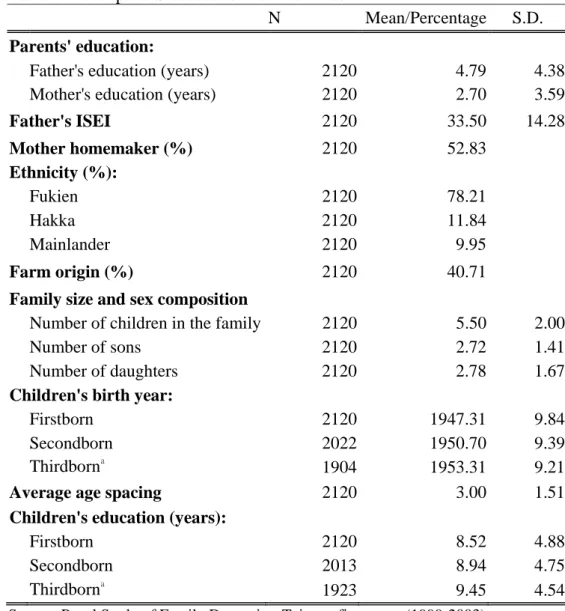
ethnic background or residence, and that interaction terms between sibship structure and ethnicity or farm origin should be hence introduced. Nevertheless, we did not find such interaction effects, so the models we present do not include the mentioned interaction terms. Table 1 provides descriptive statistics for our family sample. Although the actual unit of our analytic models is an individual, we present only family statistics to avoid redundancy, as a number of our variables are invariant for children from the same family.
[Table 1 about here]
RESULTS
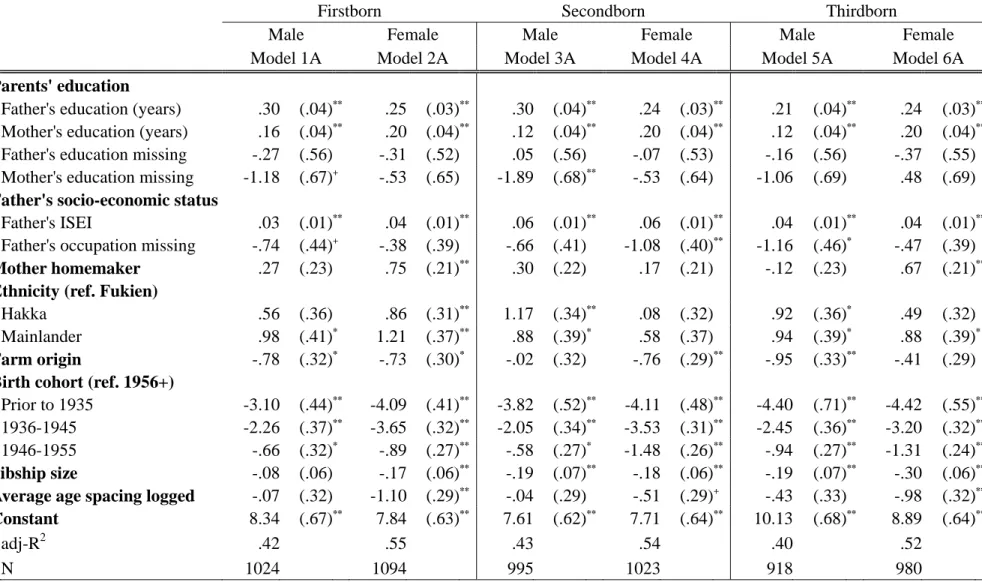
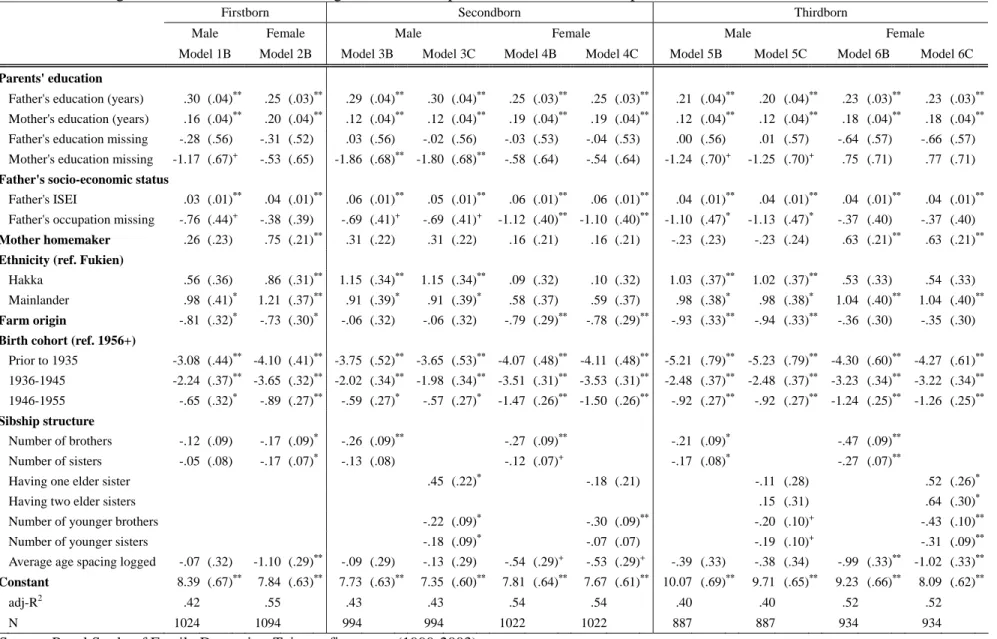
Tables 2 provides our baseline regression models of education on background characteristics, sibship size, and log average age spacing for six groups selected from our family sample: male and female firstborns, male and female second children, and male and female third children. We refer to sons and daughters who are the eldest in the sibship as male and female firstborns, respectively. Likewise, we call a son who is the second birth in the family a male second child, while his female counterpart is a female second child. We refer to male and female third children following the same logic. As a continuation of Table 2, Table 3 presents models that further specify the sibship by gender and seniority. This further specification results in little change in the effects of the background characteristics and control variables.
[Tables 2, 3 about here]
Do factors associated with children’s educational attainment differ according to their ordinal positions within the family? Parents’ education and father’s socioeconomic status have similar, positive effects on children’s years of schooling, regardless of their birth order and gender. Mainlander ethnicity, nonfarm origin, and later birth cohort also increase years of schooling for all six groups. Nevertheless, how sibship structure affects educational attainment varies across groups. Table 2 shows an inverse relationship between years of education and the number of siblings except for male firstborns. How closely children are spaced within the family also has a nonsignificant effect on male firstborns’ education. In addition, Model 1B in Table 3 shows that the sex composition of the sibship is irrelevant to male firstborns’ schooling. The fact that none of these sibship measures affects male firstborns’ educational attainment suggests that the educational resources allocated to male firstborns were particularly protected in Chinese families. Parents were likely to ensure that the existence of other children did not harm male firstborns’ educational opportunities.
By contrast, having an additional sibling led to 0.2 fewer years of schooling for a female firstborn, according to Model 2A. This finding confirms that being a firstborn has different meanings for boys and girls in Chinese families. Furthermore, coefficients from Models 3A and 5A reveal that family size hindered educational attainment for male second and third children. Given that the same effect is not found among male firstborns, we argue that sons born second or third in the sibship lacked their firstborn counterparts’ leverage when competing for educational resources within the family.
While the effects of sibship size on education suggest some divergence from the resource dilution model, the results of age spacing directly contradict the model’s prediction. Daughters from families where children were spaced more widely had less education, based on results in both Tables 2 and 3. At the same time, the sibship’s age spacing did not affect sons’ educational attainment. These findings are consistent with the hypothesis that the family’s demand for domestic labor affects daughters’ schooling in developing countries. The more tied up the mother’s labor in childcare, the more likely the daughter is to spend time on housework instead of schoolwork. Since sons are expected less than daughters to substitute for their mothers, whether the mother undergoes a long childbearing period has no effect on the son’s education.
Results from models that specify sibship sex composition provide little support for the patriarchy hypothesis that an additional brother dilutes more family resources compared to an additional sister. Model 2B shows that having a brother hurt a female firstborn’s schooling as much as having a sister did. Likewise, the differences between having a brother and a sister on educational attainment are not statistically significant for female second and third children, according to Models 4B and 6B. Also contrary to what the patriarchy perspective expects, having an additional sister might hinder a boy’s educational attainment, as Model 5B reveals. Even if we focus on only the benefit of having an elder sister, the results are still not fully consistent with the patriarchy model. Having any elder sister did not affect male third children’s educational
attainment (see Model 5C), but having an elder sister rather than an elder brother increased a male second child’s schooling (see Model 3C).
The Chinese family norms discussed earlier help explain why the elder siblings’ gender does not affect all sons’ educational opportunities equally. Having an elder sister helps a male second child’s education because it makes him the eldest son in the family. We have argued that being the eldest son has a significant meaning in Chinese families. However, having a low rank in the sibling seniority hierarchy can undermine the eldest son’s family privilege. Our analysis shows that a male third child with two elder sisters, though the eldest son in the family, was unlikely to have more education than his counterparts with one or two elder brothers. This finding suggests that the benefit of being the eldest son on educational attainment diminishes the lower his birth order rank.
The elder siblings’ gender also affects the educational attainment of daughters in second and third ordinal positions differently. Model 4C demonstrates that the educational attainment of female second children with an elder sister did not differ significantly from that of those with an elder brother. This result challenges the prediction of the family economy model that the family’s demand for a daughter’s labor will decrease if she has an elder sister with whom she can share domestic responsibilities. However, female third children with one or two elder sisters had more education than those with two elder brothers. Hence, the extent to which an elder sister helps increase a girl’s educational attainment depends on her birth order. As discussed, a daughter’s responsibility for family obligations is inversely associated with her birth order in Chinese society. Being the second oldest in the sibship, a female second child is perhaps too senior to escape her share of family responsibilities, regardless of whether she has an older sister.
Another major finding in our analysis concerns mother’s employment. Overall, a daughter with a homemaking mother attended school for more years than one whose mother participated in the labor market. Mother’s employment did not affect sons’ schooling. These findings are consistent with the family economy model, which expects a trade-off between mothers’ and daughters’ labor within the household. However, the effects of mother’s
homemaking status do not appear to be equivalent in magnitude for daughters of all three ordinal positions. Theoretically, having a stay-at-home mother would benefit female firstborns’
education more than other daughters’ because the particular roles for female firstborns in Chinese families make them the most likely to fill the void of the mother’s household labor. To
demonstrate this empirically, we tested an interaction effect constructed by multiplying having a homemaking mother by being firstborn for all daughters in our family sample, including those from the same family. We utilized the Huber-White estimator of variance to adjust for
within-family correlation (Stata Corporation 2003). This regression model also includes
measures for sibship configuration and background characteristics. Table 4 provides part of the results. The coefficient of the interaction term reveals that while having a homemaking mother
generally increased daughters’ schooling, its benefit to a female firstborn’s education was greater. [Table 4 about here]
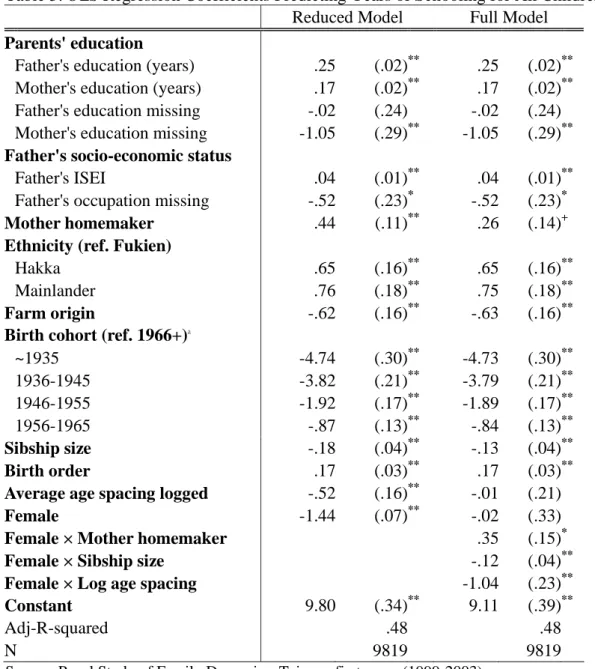
The results discussed so far suggest somewhat different dynamics of educational attainment for sons and daughters. However, we cannot assess the direct effect of the child’s gender on education with the presented models. Hence we specified another regression model of education on the child’s gender in addition to birth order, sibship size, log average age spacing, and all the background and control variables for all children in the family sample. Using Huber-White standard errors, this model corrects for multiple observations from each family. Since the previous models showed that both age spacing and mother’s nonemployment affect daughters’ but not sons’ education, we tested such gender differences directly, by introducing interaction variables between the two factors and the child’s gender in the next model. This full model also includes an interaction term between child’s gender and sibship size because the perspective considering parents to be conditionally altruistic expects larger sibship size and the consequential budget constraints to obstruct daughters’ educational opportunities more than sons’.
Table 5 presents the results for these two additional models. The reduced model shows that after controlling for all background characteristics, daughters still completed 1.4 fewer years of schooling than sons. However, the effect of being female disappears in the full model, after adding the three interaction variables. That is to say, the different effects of mother’s
nonemployment, sibship size, and sibship age spacing on sons’ and daughters’ schooling fully account for the gender gap in educational attainment in industrializing Taiwan. While both sons and daughters from larger families completed fewer years of schooling, the negative effect of having an additional sibling on education nearly doubled for daughters [(-.13) + (-.12) = -.25]. Hence, larger families that were under financial constraints were more likely to differentiate educational investment by the children’s gender, as hypothesized by the conditional parental altruism model. In addition, the results from the long model reveal that daughters, rather than sons, were likely to sacrifice their schooling for the family’s needs when the mother participated in the labor force or spent a long period of time rearing young children. Taken together, the findings indicate that daughters’ educational opportunities were more sensitive than sons’ to the family’s shortages of either financial resources or domestic labor. This difference between sons and daughters explains the latter’s lower educational attainment.
[Table 5 about here]
DISCUSSION AND CONCLUSION
We began by noting the importance of considering cultural norms in examining family dynamics that shape educational inequality. Our analysis shows that existing perspectives that fail to take into account the cultural meanings of birth order and gender do not fully explain the association between sibship structure and educational outcomes in Chinese society. To elaborate, we find that the hypothesis that an additional sibling dilutes family resources is valid only when the child is not male and firstborn. The particularly privileged status of a male firstborn in a Chinese family prevents siblings from diluting his resources. Moreover, our research supplements the family economy perspective by showing that while the household labor demand affects all daughters’ education, a female firstborn is more subject to this demand than others. We argue that the greater likelihood for a female firstborn to sacrifice schooling for family obligations is due to the Chinese family norm that the eldest sister should behave like the mother to her siblings. With regards to the patriarchy model, our analysis indicates that the effects of the elder siblings’ gender for male third children are inconsistent with the hypothesis, while having an elder sister helped male second children’s education. Therefore, rather than patriarchal values, we argue that the cultural context that emphasizes seniority accounts for these different findings regarding the sex composition of elder siblings on sons’ education. Overall, our results support that Chinese
parents are altruistic, conditioned by the family’s financial constraints or labor shortages.
However, parental altruism does not explain the complete family process sufficiently. This study has filled the void by showing that parents are likely to rely on cultural norms concerning birth order and gender roles to make decisions if the family’s conditions necessitate selective resource allocation.
To summarize, the findings of this study suggest that one’s status and roles relative to siblings depend on one’s gender and ordinal position in the sibship in Chinese society. Such status and roles affect the likelihood that one will succeed in competition for educational resources with siblings. Using male firstborns as an example, since their gender and position in the seniority hierarchy provide them with the ultimate paternal authority, their entitlement to educational investment was rarely challenged by other siblings within the family. By contrast, because cultural norms expect female firstborns to take on the maternal role and share family obligations, they were more likely than other daughters to sacrifice their education in the mother’s absence. Therefore, the cultural context can facilitate role expectations and affect resource allocation processes within the family.
This research contributes to existing literature on sibship configuration by emphasizing the normative meanings of birth order that are shaped by the cultural context. Like competition in the society at large, competition within the family is not always fair and independent of ascription, regardless of parental intentions. With few exceptions, past research has focused on the temporal dimension of birth order. The child’s ordinal position has been thought to affect educational outcomes only because the total amount of family resources changes over time (Steelman et al., 2002). However, this study suggests that birth order can represent an ascribed status that empowers some siblings more than the others in the family process, especially if seniority plays a crucial part in defining interpersonal relations in the society. We have
demonstrated that research on sibship structure and educational outcomes needs to move beyond the temporal dimension of birth order and take its normative meanings into account.
This study’s other theoretical contribution is to show that gender is likely to affect the association between a sibship characteristic and educational attainment. Among others, we find that the implications of birth order for educational opportunities differ between sons and
daughters. The extant literature on sibship configuration has tended to consider the effects of the child’s gender and birth order on educational outcomes independently (Steelman et al., 2002). However, overlooking the interaction between these two factors hampers our understanding of Chinese family dynamics. As our study reveals, it is crucial for research on intrafamily resource allocation to examine how sibship characteristics interact with the child’s gender to affect educational outcomes.
Finally, our findings have important policy implications. We have shown that daughters’ disadvantage in educational attainment is strongly associated with large family size or the
mother’s long childbearing period in Chinese families. This is because parents are likely to prefer sons to daughters when the family faces constraints and must allocate resources selectively. Based on these results, we argue that family planning programs that contribute to decreasing family size and the mother’s childbearing period could potentially benefit girls’ educational attainment and increase gender equality in less industrialized societies. Previous research has shown that despite its negative consequences, such as sex-selective abortion and female baby abandonment, the radical one-child policy has an unintended, positive effect on gender equality in education in China (Tsui & Rich, 2002). The case of China is consistent with our suggestion that family size reduction helps improve girls’ life chances in societies with a strong son
preference. Thus, while an over-radical population control policy would be potentially harmful, properly implemented family planning programs are critical for narrowing the gender gap in
REFERENCES
Anh, T. S., Knodel J., Lam, D., & Friedman J. (1998). Family size and children's education in Vietnam. Demography, 35(1), 57-70.
Blake, J. (1989). Family size and achievement. Berkeley: University of California Press. Blau, P. M., & Duncan O. D. (1967). The American occupational structure. New York: John
Wiley and sons.
Brinton, M. C. (1993). Women and the economic miracle: gender and work in postwar Japan. Berkeley: University of California Press.
Buchmann, C. (2000). Family structure, parental perceptions and child labor in Kenya: what factors determine who is enrolled in school? Social Forces, 78, 1349-79.
Buchmann, C., & Hannum E. (2001). Education and stratification in developing countries: review of theories and research. Annual Review of Sociology, 27, 77-102.
Chang, M.-C., Freedman R., & Sun T.-H. (1987). Trends in fertility, family size preferences, and family planning practices in taiwan, 1961-85. Studies in Family Planning, 18(6), 320-337.
Cherlin, A. J., & Furstenberg Jr. F. F. (1994). Stepfamilies in the United States: a reconsideration.
Annual Review of Sociology, 20, 358-381.
Conley, D. (2000). Sibship sex composition: effects on educational attainment. Social Science
Research, 29, 441-457.
Downey, D. B. (1995). When bigger is not better: family size, parental resources, and children's educational performance. American Sociological Review, 60, 746-761.
Downey, D. B. (2001). Number of siblings and intellectual development: the resource dilution explanation. American Psychology, 56, 497-504.
Downey, D. B., & Powell B., Steelman L. C., & Pribesh S. (1999). Much ado about siblings: change models, sibship size, and intellectual development. American Sociological Review, 64, 193-198.
Ganzeboom, H. B. G., & Treiman D. (1996). Comparable measures of occupational status for the 1988 international standard classification of occupations. Social Science Research, 25, 201-239.
Greenhalgh, S. (1985). Sexual stratification: the other side of "growth with equity" in East Asia.
Population and Development Review, 11, 265-314.
Guo, G., & Van Wey L. (1999a). Sibship size and intellectual development: is the relationship causal? American Sociological Review, 64, 169-187.
Guo, G., & Van Wey L. (1999b). The effects of closely spaced and widely spaced sibship size on intellectual development. American Sociological Review, 64, 199-206.
Hauser, R. M., & Kuo H.-H. D. (1998). Does the gender composition of sibships affect women's educational attainment? Journal of Human Resources, 33, 644-657.
Horan, P. M., & Hargis P. G. (1991). Children's work and schooling in the late
nineteenth-century family economy. American Sociological Review, 56(5), 583-596.
Hwang, K. K. (1991). Confucian thoughts on justice. In K.-S. Yang and K. K. Hwang (eds.).
Chinese Psychology and Behavior. Taipei: Laureate Book Publisher. (in Chinese)
Knodel, J., & Wongsith M. (1991). Family size and children's education in Thailand: evidence from a national sample. Demography, 28(1), 119-131.
Lee, Y.-J., Parish W. L., & Willis R. J. (1994). Sons, daughters, and intergenerational support in Taiwan. American Journal of Sociology, 99(4), 1010-1041.
Lin, I.-F., Goldman N., Weinstein M., Lin Y.-H., & Seeman T. (2003). Gender differences in adult children's support of their parents in Taiwan. Journal of Marriage and the Family, 65, 184-200.
Lin, N. (1988). Chinese family structure and Chinese society. Bulletin of the Institute of
Ethnology Academia Sinica, 65, 59-129.
McLanahan, S. (2000). Family, state, and child well-being. Annual Review of Sociology, 26, 703-706.
McLanahan, S., & Sandefur G. (1994). Growing up and a single parent: what hurts, what helps. Cambridge, MA: Harvard University Press.
Parish, W. L., & Willis R. J. (1993). Daughters, education, and family budgets: Taiwan experiences. Journal of Human Resources, 28(4), 863-898.
Park, C. B., & Cho N.-H. (1995). Consequences of son preference in a low-fertility society: imbalance of the sex ratio at birth in Korea. Population and Development Review, 21(1), 59-84.
Philips, M. (1999). Sibship size and academic achievement: what we now know and what we still need to know. American Sociological Review, 64, 188-192.
Pong, S.-L. (1997). Sibship size and educational attainment in peninsular malaysia: do policies matter? Sociological Perspectives, 40(2), 227-242.
Post, D. (2000). Region, poverty, sibship, and gender inequality in Mexican education. Gender
and Sociology, 15(3), 468-89.
Retherford, R. D., & Sewell W. H. (1991). Birth order and intelligence: further tests of the confluence model. American Sociological Review, 56(2), 141-158.
Retherford, R. D., & Sewell W. H. (1992). Four erroneous assertions regarding the accuracy of the confluence model. American Sociological Review, 57, 136-137.
Salaff, J. W. (1981). Working daughters of Hong Kong: filial piety or power in the family? Cambridge, New York: Cambridge University Press.
Sassler, S. (1995). Trade-offs in the family: sibling effects on daughters’ activities in 1910.
Demography, 32 (4), 557-575.
Stacey, J. (1983). Patriarchy and socialist revolution in China. Berkeley: University of California Press.
Stata Corporation (2003). Stata statistical software: release 8.0. user's guide. College Station, TX: Stata Corporation.
Steelman, L. C., & Powell B. (1989). Acquiring capital force for college: the constraints of family configuration. American Sociological Review, 54, 844-855.
Steelman, L. C., & Powell B. (1990). Beyond sibship size: sibling density, sex composition, and educational outcomes. Social Forces, 69(1), 181-206.
Steelman, L. C., Powell B., Werum R., & Carter S. (2002). Reconsidering the effects of sibling configuration: recent advances and challenges. Annual Review of Sociology, 28, 243-269.
Sudha, S. (1997). Family size, sex composition and children's education: ethnic differentials over development in Peninsular Malaysia. Population Studies, 51, 139-51.
Sulloway, F. J. (1996). Born to rebel: birth order, family dynamics, and creative lives. New York: Pantheon.
Ting, K.-F., & Chiu, W. K. (2002). Leaving the parental home: Chinese culture in an urban context. Journal of Marriage and Family, 64, 614-626.
Tsai, S.-L., Gates H., & Chiu H.-Y. (1994). Schooling Taiwan's women: women’s educational attainment in the mid-twentieth century. Sociology of Education 67(4), 243-263.
Tsui, M., & Rich L. (2002). The only child and educational opportunity for girls in urban China.
Gender and Society, 16(1), 74-92.
Van Eijck, K., & De Graaf P. M. (1995). The effects of family structure on the educational attainment of siblings in Hungary. European Sociological Review, 11(3), 273-292.
Zajonc, R. B. (2001). The family dynamics of intellectual development. American Psychology, 56, 490-496.
Table 1: Descriptive Statistics for Families under Examination
N Mean/Percentage S.D.
Parents' education:
Father's education (years) 2120 4.79 4.38 Mother's education (years) 2120 2.70 3.59
Father's ISEI 2120 33.50 14.28 Mother homemaker (%) 2120 52.83 Ethnicity (%): Fukien 2120 78.21 Hakka 2120 11.84 Mainlander 2120 9.95 Farm origin (%) 2120 40.71
Family size and sex composition
Number of children in the family 2120 5.50 2.00 Number of sons 2120 2.72 1.41 Number of daughters 2120 2.78 1.67
Children's birth year:
Firstborn 2120 1947.31 9.84 Secondborn 2022 1950.70 9.39 Thirdborna 1904 1953.31 9.21
Average age spacing 2120 3.00 1.51
Children's education (years):
Firstborn 2120 8.52 4.88 Secondborn 2013 8.94 4.75 Thirdborna
1923 9.45 4.54
Source: Panel Study of Family Dynamics, Taiwan, first wave (1999-2003).
a
Table 2: OLS Regression Models Predicting Year of Schooling by Birth Order and Gender
Firstborn Secondborn Thirdborn
Male Female Male Female Male Female
Model 1A Model 2A Model 3A Model 4A Model 5A Model 6A
Parents' education
Father's education (years) .30 (.04)**
.25 (.03)**
.30 (.04)**
.24 (.03)**
.21 (.04)**
.24 (.03)**
Mother's education (years) .16 (.04)**
.20 (.04)**
.12 (.04)**
.20 (.04)**
.12 (.04)**
.20 (.04)**
Father's education missing -.27 (.56) -.31 (.52) .05 (.56) -.07 (.53) -.16 (.56) -.37 (.55)
Mother's education missing -1.18 (.67)+
-.53 (.65) -1.89 (.68)**
-.53 (.64) -1.06 (.69) .48 (.69)
Father's socio-economic status
Father's ISEI .03 (.01)** .04 (.01)** .06 (.01)** .06 (.01)** .04 (.01)** .04 (.01)**
Father's occupation missing -.74 (.44)+
-.38 (.39) -.66 (.41) -1.08 (.40)**
-1.16 (.46)*
-.47 (.39)
Mother homemaker .27 (.23) .75 (.21)** .30 (.22) .17 (.21) -.12 (.23) .67 (.21)**
Ethnicity (ref. Fukien)
Hakka .56 (.36) .86 (.31)** 1.17 (.34)** .08 (.32) .92 (.36)* .49 (.32) Mainlander .98 (.41)* 1.21 (.37)** .88 (.39)* .58 (.37) .94 (.39)* .88 (.39)* Farm origin -.78 (.32)* -.73 (.30)* -.02 (.32) -.76 (.29)** -.95 (.33)** -.41 (.29)
Birth cohort (ref. 1956+)
Prior to 1935 -3.10 (.44)** -4.09 (.41)** -3.82 (.52)** -4.11 (.48)** -4.40 (.71)** -4.42 (.55)** 1936-1945 -2.26 (.37)** -3.65 (.32)** -2.05 (.34)** -3.53 (.31)** -2.45 (.36)** -3.20 (.32)** 1946-1955 -.66 (.32)* -.89 (.27)** -.58 (.27)* -1.48 (.26)** -.94 (.27)** -1.31 (.24)** Sibship size -.08 (.06) -.17 (.06)** -.19 (.07)** -.18 (.06)** -.19 (.07)** -.30 (.06)**
Average age spacing logged -.07 (.32) -1.10 (.29)**
-.04 (.29) -.51 (.29)+ -.43 (.33) -.98 (.32)** Constant 8.34 (.67)** 7.84 (.63)** 7.61 (.62)** 7.71 (.64)** 10.13 (.68)** 8.89 (.64)** adj-R2 .42 .55 .43 .54 .40 .52 N 1024 1094 995 1023 918 980
Source: Panel Study of Family Dynamics, Taiwan, first wave (1999-2003). Note: Values in parentheses are standard errors. ** p<.01; * p<.05; + p<.1
Table 3: OLS Regressions on Years of Schooling with Further Specifications of the Sibship
Firstborn Secondborn Thirdborn Male Female Male Female Male Female
Model 1B Model 2B Model 3B Model 3C Model 4B Model 4C Model 5B Model 5C Model 6B Model 6C
Parents' education
Father's education (years) .30 (.04)** .25 (.03)** .29 (.04)** .30 (.04)** .25 (.03) ** .25 (.03)** .21 (.04)** .20 (.04)** .23 (.03)** .23 (.03)** Mother's education (years) .16 (.04)** .20 (.04)** .12 (.04)** .12 (.04)** .19 (.04) ** .19 (.04)** .12 (.04)** .12 (.04)** .18 (.04)** .18 (.04)** Father's education missing -.28 (.56) -.31 (.52) .03 (.56) -.02 (.56) -.03 (.53) -.04 (.53) .00 (.56) .01 (.57) -.64 (.57) -.66 (.57) Mother's education missing -1.17 (.67)+ -.53 (.65) -1.86 (.68)** -1.80 (.68)** -.58 (.64) -.54 (.64) -1.24 (.70)+ -1.25 (.70)+ .75 (.71) .77 (.71)
Father's socio-economic status
Father's ISEI .03 (.01)** .04 (.01)** .06 (.01)** .05 (.01)** .06 (.01) ** .06 (.01)** .04 (.01)** .04 (.01)** .04 (.01)** .04 (.01)**
Father's occupation missing -.76 (.44)+ -.38 (.39) -.69 (.41)+ -.69 (.41)+ -1.12 (.40) **
-1.10 (.40)** -1.10 (.47)* -1.13 (.47)* -.37 (.40) -.37 (.40)
Mother homemaker .26 (.23) .75 (.21)** .31 (.22) .31 (.22) .16 (.21) .16 (.21) -.23 (.23) -.23 (.24) .63 (.21)** .63 (.21)**
Ethnicity (ref. Fukien)
Hakka .56 (.36) .86 (.31)** 1.15 (.34)** 1.15 (.34)** .09 (.32) .10 (.32) 1.03 (.37)** 1.02 (.37)** .53 (.33) .54 (.33) Mainlander .98 (.41)* 1.21 (.37)** .91 (.39)* .91 (.39)* .58 (.37) .59 (.37) .98 (.38)* .98 (.38)* 1.04 (.40)** 1.04 (.40)**
Farm origin -.81 (.32)* -.73 (.30)* -.06 (.32) -.06 (.32) -.79 (.29) ** -.78 (.29)** -.93 (.33)** -.94 (.33)** -.36 (.30) -.35 (.30)
Birth cohort (ref. 1956+)
Prior to 1935 -3.08 (.44)** -4.10 (.41)** -3.75 (.52)** -3.65 (.53)** -4.07 (.48) ** -4.11 (.48)** -5.21 (.79)** -5.23 (.79)** -4.30 (.60)** -4.27 (.61)** 1936-1945 -2.24 (.37)** -3.65 (.32)** -2.02 (.34)** -1.98 (.34)** -3.51 (.31) ** -3.53 (.31)** -2.48 (.37)** -2.48 (.37)** -3.23 (.34)** -3.22 (.34)** 1946-1955 -.65 (.32)* -.89 (.27)** -.59 (.27)* -.57 (.27)* -1.47 (.26) ** -1.50 (.26)** -.92 (.27)** -.92 (.27)** -1.24 (.25)** -1.26 (.25)** Sibship structure Number of brothers -.12 (.09) -.17 (.09)* -.26 (.09)** -.27 (.09) ** -.21 (.09)* -.47 (.09)** Number of sisters -.05 (.08) -.17 (.07)* -.13 (.08) -.12 (.07) + -.17 (.08)* -.27 (.07)**
Having one elder sister .45 (.22)* -.18 (.21) -.11 (.28) .52 (.26)*
Having two elder sisters .15 (.31) .64 (.30)*
Number of younger brothers -.22 (.09)* -.30 (.09)** -.20 (.10)+ -.43 (.10)**
Number of younger sisters -.18 (.09)* -.07 (.07) -.19 (.10)+ -.31 (.09)**
Average age spacing logged -.07 (.32) -1.10 (.29)** -.09 (.29) -.13 (.29) -.54 (.29) + -.53 (.29)+ -.39 (.33) -.38 (.34) -.99 (.33)** -1.02 (.33)**
Constant 8.39 (.67)** 7.84 (.63)** 7.73 (.63)** 7.35 (.60)** 7.81 (.64) ** 7.67 (.61)** 10.07 (.69)** 9.71 (.65)** 9.23 (.66)** 8.09 (.62)**
adj-R2 .42 .55 .43 .43 .54 .54 .40 .40 .52 .52 N 1024 1094 994 994 1022 1022 887 887 934 934
Source: Panel Study of Family Dynamics, Taiwan, first wave (1999-2003). Note: Values in parentheses are standard errors.
Table 4: Partial Results for OLS Regression Predicting Daughters’ Education Mother homemaker .50 (.14)**
Mother homemaker × Firstborn .34 (.16)*
Adj-R-squared .52
N 4984
Source: Panel Study of Family Dynamics, Taiwan, first wave (1999-2003).
Note: Results are from a single equation for female survey respondents and their sisters, using
Huber-White standard errors to correct for multiple observations per family. Other independent variables in the model are parents’ education, father’s ISEI, ethnicity, farm origin, birth cohort, sibship size, birth order, and average age spacing logged. Values in parentheses are standard errors.
Table 5: OLS Regression Coefficients Predicting Years of Schooling for All Children
Reduced Model Full Model
Parents' education
Father's education (years) .25 (.02)** .25 (.02)** Mother's education (years) .17 (.02)** .17 (.02)** Father's education missing -.02 (.24) -.02 (.24) Mother's education missing -1.05 (.29)** -1.05 (.29)**
Father's socio-economic status
Father's ISEI .04 (.01)** .04 (.01)**
Father's occupation missing -.52 (.23)* -.52 (.23)*
Mother homemaker .44 (.11)** .26 (.14)+
Ethnicity (ref. Fukien)
Hakka .65 (.16)** .65 (.16)** Mainlander .76 (.18)** .75 (.18)**
Farm origin -.62 (.16)** -.63 (.16)**
Birth cohort (ref. 1966+)a
~1935 -4.74 (.30)** -4.73 (.30)** 1936-1945 -3.82 (.21)** -3.79 (.21)** 1946-1955 -1.92 (.17)** -1.89 (.17)** 1956-1965 -.87 (.13)** -.84 (.13)** Sibship size -.18 (.04)** -.13 (.04)** Birth order .17 (.03)** .17 (.03)**
Average age spacing logged -.52 (.16)** -.01 (.21)
Female -1.44 (.07)** -.02 (.33)
Female × Mother homemaker .35 (.15)*
Female × Sibship size -.12 (.04)**
Female × Log age spacing -1.04 (.23)**
Constant 9.80 (.34)** 9.11 (.39)**
Adj-R-squared .48 .48 N 9819 9819
Source: Panel Study of Family Dynamics, Taiwan, first wave (1999-2003).
Note: Results for each model are from a single equation for the survey respondents and their siblings, using Huber-White standard errors. Values in parentheses are standard errors.
a
We added one more category of birth cohort because the combined sample includes more than the first three children in the family and hence covers a wider range of birth years.