國
立
交
通
大
學
應用數學系
碩 士 論 文
排除混色圈的著色完全二分圖
Forbidding Multicolored Cycles in an
Edge-colored K
m,n研 究 生:裴若宇
指導教授:傅恆霖 教授
排除混色圈的著色完全二分圖
Forbidding Multicolored Cycles in an Edge-colored K
m,n研 究 生:裴若宇
Student:Ryo-Yu Pei
指導教授:傅恆霖
Advisor:Hung-Lin Fu
國 立 交 通 大 學
應 用 數 學 系
碩 士 論 文
A ThesisSubmitted to Department of Applied Mathematics College of Science
National Chiao Tung University in Partial Fulfillment of the Requirements
for the Degree of Master
in
Applied Mathematics June 2009
Hsinchu, Taiwan, Republic of China
排除混色圈的著色完全二分圖
研究生:裴若宇 指導老師:傅恆霖 教授
國 立 交 通 大 學
應 用 數 學 系
摘 要
在一個邊已著色的圖中,若有一個子圖它的每個邊的顏色皆不相同,我們稱這種子 圖為混色子圖。在這篇論文中,我們先整理了一些以往有關混色子圖的定理與猜測,我 們將依照子圖的種類分成四類來介紹;接下來我們討論在一個完全二部圖Km,n中,是否 存在一種恰用了n 色的邊著色可以避免混色的圈出現,我們證明出來當 2 m n 及 n 4 時,在 Km,n中一定會產生混色的C4。而在下列兩種情形:(1) m 3 且 n 9 或 (2) m 4 且 n = 7 時,在 Km,n中也會產生混色的C6。更進一步的,對於k m 2k 且k 為奇數時,我們找到一種 2k 個顏色的著色法使得 Km,2k 中能避免混色的C2k出現。Forbidding Multicolored Cycles in an Edge-colored K
m,nStudent: Ryo-Yu Pei Advisor: Hung-Lin Fu
Department of Applied Mathematics Department of Applied Mathematics National Chiao Tung University National Chiao Tung University
Hsinchu, Taiwan 30050 Hsinchu, Taiwan 30050
Abstract
In an edge-colored graph, a subgraph whose edges are of distinct colors is known as a multicolored (or rainbow) subgraph. In this thesis, we shall first introduce several known results and conjectures related to multicolored subgraph in an edge-colored Kn,
according to four categories of multicolored subgraphs. Then, we extend this study to consider whether there is a proper edge-coloring in a complete bipartite graph which forbids multicolored cycles. First, we claim that it is impossible to forbid multicolored 4-cycles in any proper n-edge-coloring of Km,n where 2 m n and n 4. Second, we
prove that any n-edge-colored Km,n (m n) contains a multicolored C6 if (i) m 3 and
n 9; or (ii) m 4 and n = 7. Finally, if k is odd, we obtain a proper 2k-edge-coloring of Km,2k which forbids multicolored (2k)-cycles where k m 2k.
Acknowledgement
三年前,我進入了交通大學應用數學研究所就讀;也在同一年,我順利擠進教師甄 試的窄門,成為新竹高商的正式老師;而因為本身熱愛打籃球,我還加入了交大校女籃; 這三年來,自己同時扮演著教師、學生與球員的三重身份,無力感常油然而生;但人總 是會在壓力下成長,在困境中學習,在這三年中,我感覺確實學到不少,但也覺得自己 一口氣增加了不只三歲! 首先,我最感謝的就是我的指導老師:傅恆霖教授,傅老師對我相當包容,不管是 在課業、工作,還是在運動方面,都提供我相當大的協助,如果不是遇到傅老師,那我 想我的研究生涯將會是黑白的。再來感謝交大校女籃教練:鄭智仁老師,在忙碌之餘, 還能讓我在球場上盡情揮灑汗水,甚至也給我機會讓我在球場上為交大爭光,這種體驗 十分難得。接下來要感謝的是新竹高商王承先校長,願意讓我在職進修,半工半讀,甚 至在我要離開時也不為難我,王校長真的是我見過最棒、最有教育熱忱的校長。 除了老師們,在我研究生涯中最要感謝的就是貓頭大大,貓頭大大的存在對我來說 就像是天上掉下來的禮物、漂流在怒海中的一根浮木、或是上完廁所後的唯一一張衛生 紙,另外還有同門的臭賓賓、敏筠、Robin、軒軒、舜婷、施智懷、雁婷學姊、惠蘭學 姊等人,都曾在學術上提供過我協助,非常感謝。 再來是球隊學妹們,跟你們玩樂的時光,是我在交大最快樂的回憶,尤其是小瑋跟 小易,我們在交大室外場奮勇殺敵到頭破血流的日子,是我非常難忘的。三年來在新竹 也交了不少朋友,新商同事、偉小慈、黑 jacky、小培、(偽)應數系女籃、交大田徑隊、… 等等,你們都讓我的生活更豐富精采。還有貼心的新商學生們,對於有個忙碌的導師從 不抱怨,取而代之的是貼心問候,能敎到你們我真的很幸福。 最後,要感謝的是我的家人以及一個愛吃罐頭、個性執著、睡覺四腳朝天、不時會 到床上撒尿的孩子-Gucci,Gucci 讓我學到知足常樂、天天開心這些最基本的人生道 理,疲累的時候看著 Gucci 的笑臉好像壓力都解除了,一起來吃起士雞肉條吧!Contents
Abstract (in Chinese) i
Abstract (in English) ii
Acknowledgement iii
Contents iv
List of Figures v
1 Introduction and Preliminaries 1
2 Known Results 6
2.1 Multicolored Spanning Tree . . . 6
2.2 Multicolored Cycle . . . 8
2.3 Multicolored Matching . . . 10
2.4 Multicolored Path . . . 11
3 Main Results 13
3.1 Forbidding Multicolored 4-cycles and 6-cycles . . . 13
3.2 Forbidding Multicolored (2k)-cycles . . . 22
4 Conclusion 24
List of Figures
1 Circulant latin squares of order 2, 3, and 4 . . . 4
2 A 35 latin rectangle and its corresponding 5-edge colored K3,5 . . . 5
3 A 33 partial latin square . . . 14
4 Case 2 of Proposition 3.2 . . . 14
5 L6,6(6) and the four copies of L3 . . . 16
6 L8,8(6) and the four copies of (L2 )2 . . . 17
7 L3,7(6) . . . 18
8 Case 1 of Lemma 3.8 . . . 19
9 Case 2 of Lemma 3.8 . . . 19
10 Case 2 of Lemma 3.8 . . . 20
11 L4,7(6) . . . 20
1 Introduction and Preliminaries
In the study of graph theory, graph decomposition and coloring are two important topics. A decomposition of a graph is a list of subgraphs such that each edge appears in exactly one subgraph in the list. In graph coloring, we study the vertex-coloring and edge-coloring which deal with the assignments of colors onto the vertex set of G and the edge set of G respectively.
We combine these two topics together in this thesis. In an edge-colored graph, a subgraph whose edges are of distinct colors is known as a multicolored (or rainbow) subgraph. First, in the study of the edge-colorings of the complete graphs. In 2006, Akbari, Alipour, Fu and Lo [2] showed that there exists an edge-coloring of K2n such
that all the edges can be partitioned into edge-disjoint multicolored isomorphic spanning trees. Then consider the complete graph of odd order. In 2005, Constantine [10] partitioned Kn into multicolored Hamiltonian cycles by a given proper
n-edge-coloring if n is an odd prime. In addition, he proposed a new conjecture that for
any proper n-edge-coloring of Kn, the edges can be partitioned into multicolored unicyclic isomorphic subgraphs. Several years later, Fu and Lo [15] improved above result from n is an odd prime to n is an odd integer and therefore verify the conjecture.
Montellano-Ballesteros and Neumann-Lara [20] presented that if the edges of Kn
are colored by n or more colors actually appearing, then there is a multicolored C3 somewhere. That means, there is no edge-coloring of Kn with n or more colors actually
appearing which forbids multicolored cycles. With the same idea, we discuss whether there exists a proper edge-coloring in a complete bipartite graph which forbids multicolored cycles. It is impossible to forbid multicolored 4-cycles in any proper
n-edge-coloring of Km,n where 2 m n and n 4. How about forbidding multicolored
(2k)-cycles? In this thesis, the first part of the main results are concerned about the discussion of forbidding multicolored C6 in a proper n-edge-colored Km,n where 3 m
Km,n, there is a multicolored 6-cycle somewhere. Then, for each smaller m, n, we will give a specific proper n-edge-coloring which forbids multicolored 6-cycles. If k is an odd integer, furthermore, there exists a proper (2k)- edge-coloring of Km,2k which forbids multicolored (2k)-cycles, where k m 2k.
Now, we introduce the terminologies and definitions of graphs. For details, the readers may refer to the book “Introduction to Graph Theory” by D. B. West [22]. A graph G is a triple consisting of a vertex set V(G), an edge set E(G), and a
relation that associates with each edge two vertices (not necessarily distinct) called its
endpoints. A loop is an edge whose endpoints are equal. Multiple edges are edges having
the same pair of endpoints. A simple graph is a graph having no loops or multiple edges. In this thesis, all the graphs we consider are simple.
The size of the vertex set V(G), denoted by |V(G)|, is called the order of G, and the size of the edge set E(G), denoted by |E(G)|, is called the size of G. When u and v are the endpoints of an edge, written uv in short, they are adjacent and are neighbors. If vertex v is an endpoint of edge e, then v and e are incident. The neighborhood of v, written N(v), is the set of vertices adjacent to v. The degree of v, written deg(v), is the number of neighbors of v; that is, deg(v)= |N(v)|.
A subgraph of a graph G is a graph H such that V(H) V(G) and E(H) E(G) and the assignment of endpoints to edges in H is the same as in G, denoted by H G. A
spanning subgraph of G is a subgraph H with V(H) = V(G). A matching in G is a set of
edges with no shared endpoints. A perfect matching in a graph G is a matching that saturates all vertices. A k-factor is a spanning subgraph with each degree equal to k. Then a 1-factor and a perfect matching are almost the same thing.
A cycle is a graph with an equal number of vertices and edges whose vertices can be placed around a circle so that two vertices are adjacent if and only if they appear consecutively along the circle. A cycle with n vertices is denoted by Cn. A Hamiltonian
cycle is a graph with a spanning cycle. A graph with no cycles is called acyclic and a
spanning tree is a spanning subgraph that is a tree.
A complete graph is a simple graph whose vertices are pairwise adjacent, and the complete graph with n vertices is denoted by Kn. An independent set in a graph is a set of pairwise nonadjacent vertices. A graph G is bipartite if V (G) is the union of two disjoint sets, called partite sets of G. A graph G is m-partite if V (G) can be expressed as the union of m independent sets. A complete bipartite graph is a bipartite graph such that two vertices are adjacent if and only if they are in different partite sets. When the sets have the sizes s and t, the complete bipartite graph is denoted by Ks,t. If the sets
have the same size n, the complete bipartite graph is called balanced, denoted by Kn,n. Similarly, the complete m-partite graph is denoted by Ks1, s2, …, sm if the sets have the
sizes s1, s2, … and sm. The balanced complete m-partite graph is denoted by Km(n) where each partite set has n vertices.
An isomorphism from a graph G to a graph H is a bijection f : V(G)V(H) such that uv E(G) if and only if f(u)f(v)E(H). We say “G is isomorphic to H”, written
G H, if there is an isomorphism from G to H.
A k-edge coloring of G is a labeling from E(G) into a set S, where |S| = k. In this thesis, we use S = {1, 2, 3, …, k}. The labels are colors, and the edges which have the same color form a color class. A k-edge coloring is proper if all incident edges have different labels (i.e., each color class is a matching). The chromatic index of a graph G, (G), is the minimum number k for which G has a proper k-edge coloring. A subgraph in an edge-colored graph is said to be multicolored if no two edges have the same color. If the edges of a graph G are colored by r colors {1, 2, …, r}, then its color
distribution (a1, a2, …, ar ) means that the number of edges with color i is equal to ai for every 1 i r. An edge-coloring of a graph G is called an edge coloring with complete
bipartite decomposition if each color class forms a complete bipartite subgraph of G. If
the edges of G are colored so that no color is appeared in more than k edges, we refer to this as a k-bounded coloring. For a vertex v of G, the color degree of v, denoted by degcol(v), is the number of colors on the edges which are incident with v.
Let S be an n-set. A latin square of order n based on S is an nn array in which every element of S is arranged such that each element occurs exactly once in each row and column. For convenience, let S = {1, 2, …, n}. We denote a latin square of order n based on S by LS(n) = [ li,j ]nn where li,j S. An mn latin rectangle ( m n ) is an mn
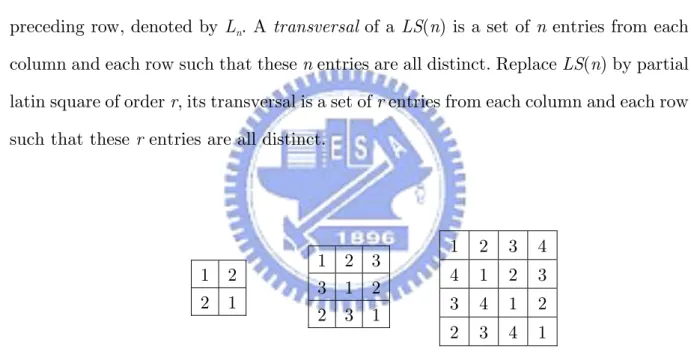
array in which n distinct elements are arranged such that each element occurs at most once in each row and column, denoted by LR(m, n). A partial latin square of order r is an rr array in which n distinct elements are arranged, n > r, such that each element occurs at most once in each row and column. A circulant latin square of order n is a special LS(n) where each row is rotated one element to the right relative to the preceding row, denoted by Ln. A transversal of a LS(n) is a set of n entries from each
column and each row such that these n entries are all distinct. Replace LS(n) by partial latin square of order r, its transversal is a set of r entries from each column and each row such that these r entries are all distinct.
1 2 3 4 4 1 2 3 3 4 1 2 2 3 4 1 1 2 3 3 1 2 2 3 1 1 2 2 1
Figure 1: Circulant latin squares of order 2, 3, and 4
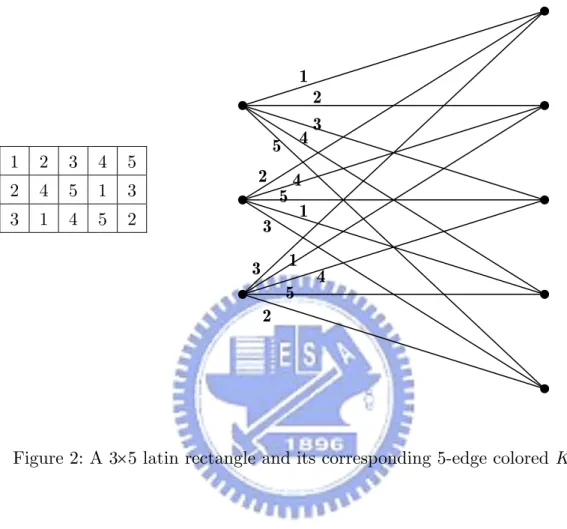
There is a corresponding relationship between an mn latin rectangle and a proper
n-edge-colored Km,n where m n. Let {u1, u2, …, um} and {v1, v2, …, vn} be the two
partite sets of Km,n and the edge uivj be colored with li,j where LR(m, n) = [li,j] mn is an
2 5 4 1 3 3 1 4 5 2 5 3 4 1 2 1 2 3 4 5 2 4 5 1 3 3 1 4 5 2
2 Known Results
In this section, some theorems and conjectures related to multicolored subgraph in an
edge-colored Kn will be reorganized. It can be introduced according to the following four
categories of multicolored subgraph.
2.1 Multicolored Spanning Tree
First, consider a non-proper coloring in Kn. Assume that it uses r colors. The following
two results were proposed by Akbari and Alipour [1] in 2006.
Theorem 2.1. [1] If the complete graph Kn, n 3, is r-edge-colored and r +2,
then Kn has a multicolored spanning tree.
n 2 2
Theorem 2.2. [1] If the complete graph Kn, n 6, is r-edge-colored and r +3,
then Kn has two edge-disjoint multicolored spanning trees.
n 2 2
In the same paper, they also used a different perspective, color distribution, to deal
with this problem as follows.
Theorem 2.3. [1] If the r-edge-colored Kn has a color distribution (a1,…, ar ) with 1 a1 … ar (n+3)/2 and r n 1, then Kn has a multicolored spanning tree.
Theorem 2.4. [1] If the r-edge-colored Kn has a color distribution (a1,…, ar ) with 1 a1 … ar n/2, then Kn has two multicolored spanning trees.
As early as in 1991, however, Alon, Brualdi and Shader [4] discussed the existence
decomposition.
Theorem 2.5. [4] Every Kn having an edge-coloring with complete bipartite decomposition contains a multicolored spanning tree.
On the other hand, the existence of multicolored spanning trees in a proper
edge-colored complete graph was discussed. Since (K2n) = 2n 1, it is natural to ask
if there exists a partition of the edges of an edge-colored K2n into multicolored
subgraphs each has 2n 1 edges. Here are three conjectures related to this problem.
Conjecture 2.6. [11] For n > 2, there exists a proper (2n1)-edge-coloring of K2n such
that all edges can be partitioned into n isomorphic multicolored spanning trees.
Conjecture 2.7. [7] If n > 2, then in any proper edge-coloring of K2n with 2n1 colors, all
edges can be partitioned into n multicolored spanning trees.
Conjecture 2.8. [11] If n > 2, then in any proper edge-coloring of K2n with 2n1 colors, all
edges can be partitioned into n isomorphic multicolored spanning trees.
For the first conjecture, it has been verified by Akbari, Alipour, Fu and Lo [2] in
2006.
Theorem 2.9. [2] For n 3, K2n can be properly edge-colored with 2n1 colors in such a
way that the edges can be partitioned into edge-disjoint multicolored isomorphic spanning trees.
the existence of two multicolored spanning trees in the same paper. Then, the existence
of three multicolored spanning trees has been proven by Krussel, Marshall and Verrall
[19] in 2002.
Theorem 2.10. [7] If n > 2, then in any proper edge-coloring of K2n with 2n 1 colors, there exist two edge-disjoint multicolored spanning trees.
Theorem 2.11. [19] If n > 2, then in any proper edge-coloring of K2n with 2n 1 colors, there exist three edge-disjoint multicolored spanning trees.
Later, Kaneko, Kano and Suzuki [18] extended the above theorem from K2n to Kn in 2003.
Theorem 2.12. [18] Every properly edge-colored Kn (n 6) has three edge-disjoint
multicolored spanning trees.
Conjecture 2.8 can imply Conjecture 2.7 easily; therefore, it has not been
completely solved yet. A partial result, however, was proposed by Fu and Lo [14]
recently.
Theorem 2.13. [14] In any proper edge-coloring of K2n with 2n 1 colors, if n > 2, then there exist two edge-disjoint isomorphic multicolored spanning trees; and if n > 13, then there exist three edge-disjoint isomorphic multicolored spanning trees.
2.2 Multicolored Cycle
is no multicolored C3. Notice that there exists a cycle somewhere in a subgraph of Kn with n edges. Montellano-Ballesteros and Neumann-Lara [20] presented the following
results.
Theorem 2.14. [20] If the edges of Kn are colored by n or more colors actually appearing, then there is a rainbow K3 somewhere.
This theorem infers that there is no edge-coloring of Kn with n or more colors which forbids multicolored cycles. Analogous to the multicolored trees, the existence of
multicolored cycles in a proper edge-colored complete graph was discussed. It is natural
to think about a multicolored Hamiltonian cycle in a proper (2n+1)-edge colored K2n+1.
Theorem 2.15. [10] If 2n+1 is an odd prime, then there exists a proper
(2n+1)-edge-coloring of K2n+1 such that all edges can be partitioned into n multicolored
Hamiltonian cycles.
Above theorem was provided by Constantine [10] in 2005, and he also gave a
relative conjecture.
Conjecture 2.16. [10] Any proper coloring of the edges of a complete graph on an odd
number of vertices allows a partition of the edges into multicolored isomorphic unicyclic subgraphs.
Theorem 2.15 was improved by Fu and Lo [15] in 2009.
of K2n+1 such that all edges can be partitioned into n multicolored Hamiltonian cycles.
Now, we consider a k -bounded coloring. For any positive integer k, the problem is
to find a positive integer n which is large enough so that every k -bounded edge-colored
Kn contains a multicolored Hamiltonian cycle. Here are three relative results. We list them in historical order.
Theorem 2.18. [16] There exists a constant number c such that if n ck3, then every
k-bounded edge-colored Kn has a multicolored Hamiltonian cycle.
Theorem 2.19. [13] There exists a constant number c such that if n is sufficiently large
and k n/(clnn), then every k-bounded edge-colored Kn contains a multicolored Hamiltonian cycle.
Theorem 2.20. [3] Let c < 1/32. If n is sufficiently large and k cn, then every
k-bounded edge-colored Kn contains a multicolored Hamiltonian cycle.
Theorem 2.18 was obtained by Hahn and Thomassen [16] in 1986 and implied that
k could grow as fast as n1/3 to guarantee that a k-bounded edge-colored K
n contains a
multicolored Hamiltonian cycle. In 1993, Frieze and Reed [13] made further progress,
see Theorem 2.19. Few years later, in 1995, Albert, Frieze and Reed [3] improved
Theorem 2.19 and proved the growth rate of k could in fact be linear.
The perfect matching only exists in K2n and the general case has been mentioned in 1998
by Woolbright and Fu [23].
Theorem 2.21. [23] For n 3, every properly (2n 1)-edge-colored K2n has a rainbow
perfect matching.
There is a conjecture concerning matching a long time ago.
Conjecture 2.22. [6, 21] In any proper edge-coloring of Kn,n with n colors,
(1) If n is even, then there exists a multicolored matching M with |M | = n 1.
(2) If n is odd, then there exists a multicolored matching M with |M | = n.
Notice that there is a corresponding relation between a matching in Kn,n and a partial transversal in LS(n). We have the following theorem.
Theorem 2.23. [17] Every latin square has a partial transversal of length at least
n 11.053 log 2n.
2.4 Multicolored Path
The length of a multicolored path will increase along with the number of colors. So we
can get the following.
Theorem 2.24. [12] Every r-edge-colored graph G of order n has a multicolored path of
length at least (2r)/n .
Theorem 2.25. [5] Let G be an edge-colored graph. If degcol(x) ≥ k for every vertex x of G,
then for every vertex v of G, there exists a multicolored path starting at v and of length at least (k+1)/2.
Then Chen and Li [8] improved theorem 2.25.
Theorem 2.26. [8] Let G be an edge-colored graph and k 1 be an integer. If degcol(x) k
for every vertex x of G, then there exists a multicolored path of length at least (3k)/5+1.
Moreover, if 1 k 7, there exists a multicolored path of length at least k 1.
Theorem 2.27. [9] Let G be an edge-colored graph and k 8 be an integer. If degcol(x) k
for every vertex x of G, then there exists a multicolored path of length at least (2k)/3+1. We can get the following corollary by Theorem 2.27.
Corollary 2.28. In any proper coloring of Kn, if n 9, then there exists a multicolored
3 Main Results
Now, we will discuss whether there exists a proper n-edge-coloring in a complete bipartite graph Km,n which forbids multicolored (2k)-cycles. For k 2 and 2 m n, we define the forbidding multicolored (2k)-cycles set, FMC (2k) in short, by (m, n) FMC (2k) if there exists a proper n-edge-coloring of Km,n which forbids multicolored (2k)-cycles. Obviously, (i, j ) FMC (2k) if i < k or j < 2k. In this thesis, we completely determine the two sets FMC (4) and FMC (6). Furthermore, for k is odd, we find several elements in the set FMC (2k). Besides, we denote an mn latin rectangle which forbids multicolored (2k)-cycles in its corresponding Km,n by Lm,n(2k).
3.1 Forbidding Multicolored 4-cycles and 6-cycles
It is impossible to forbid multicolored 4-cycles in any proper n-edge-coloring of Km,n where 2 m n and n 4. Thus we have the following theorem.
Theorem 3.1. FMC (4) = {(2, 2), (2, 3), (3, 3)}.
Proof. It suffices to show that there exists a multicolored C4 in a proper 4-edge-colored
K2,4. Let {u1, u2} and {v1, v2, v3, v4} be the two partite sets of K2,4. Without loss of generality, assume the colors on u1v1, u2v1 are 1 and 2. There must be one vertex vi where
i {2, 3, 4} such that the colors on u1vi, u2vi are different from {1, 2}. Thus we have a multicolored C4.
Then we will have a discussion on forbidding multicolored C6 in a proper
n-edge-colored Km,n where 3 m n and n 6. Notice that every proper n-edge-coloring
of Km,n has its corresponding mn latin rectangle using n distinct entries. In an mn latin rectangle, consider a 33 partial latin square. If there exist 2 disjoint transversals using 6 distinct entries in the 33 partial latin square, then there exists a multicolored
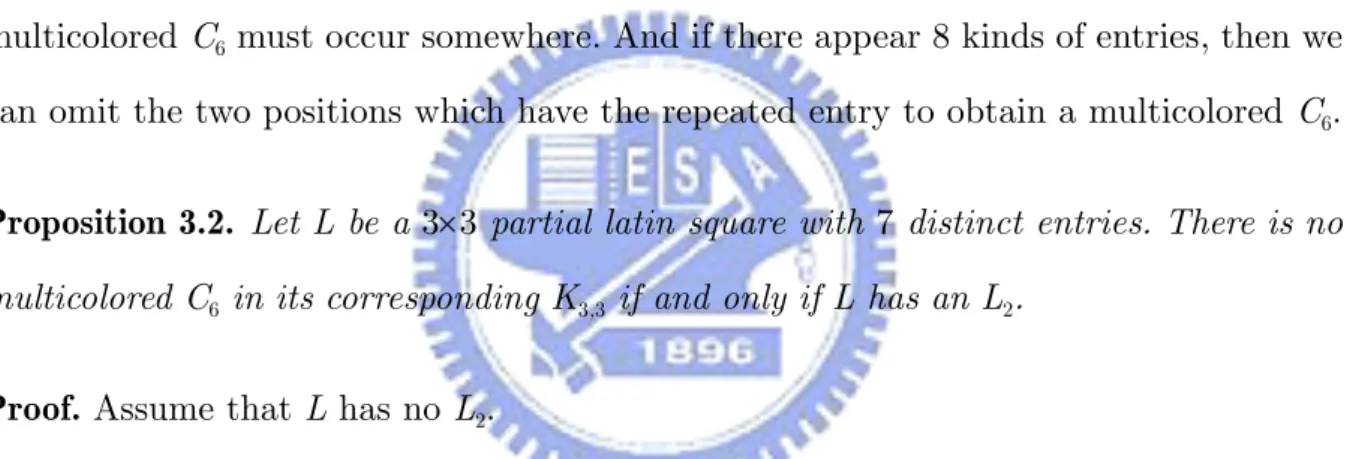
disjoint transversals as omitting three positions that no two of them are in the same row or column. Figure 3 is an example of a 33 partial latin square, and the two disjoint transversals, which can be combined to a multicolored C6, are discovered by omitting the three “gray” positions.
7 3 5 1 4 2
2 8 6
Figure 3: A 33 partial latin square
Obviously, in a 33 partial latin square, if there appear 9 kinds of entries, then a multicolored C6 must occur somewhere. And if there appear 8 kinds of entries, then we
can omit the two positions which have the repeated entry to obtain a multicolored C6.
Proposition 3.2. Let L be a 33 partial latin square with 7 distinct entries. There is no
multicolored C6 in its corresponding K3,3 if and only if L has an L2.
Proof. Assume that L has no L2.
Case 1. If there is one entry appearing 3 times, then omitting these three positions
yields a multicolored C6, a contradiction.
Case 2. There are two entries appeared twice separately. Without loss of generality, let
the two entries be 1 and 2, and let the positions of entry 1 be arranged at the diagonal, see Figure 4.
1 1
Figure 4: Case 2 of Proposition 3.2
must be at least one position which labels entry 2 in the third column or the third row. Name this position be A. Then we just omit position A and one of the positions labeled 1 which is not in the same row and column with A. Thus, we have a multicolored C6.
Conversely, suppose the two entries in L2 be 1 and 2. Since there is none or two 1’s
(or 2’s) in any transversal of L, any two disjoint transversals couldn’t have 6 kinds of entries. Then, there is no multicolored C6 in its corresponding K3,3.
Proposition 3.3. Let L be a 33 partial latin square with 6 distinct entries. There is no
multicolored C6 in its corresponding K3,3 if one of the following conditions occurs:
(i) There exists 2 columns (or rows) in L used exactly 3 distinct entries. (ii) Some entry appears three times in L.
(iii) There is an L2 in L.
Proof. Since there are just 6 kinds of entries, we should keep every kind of entries left
and omit the other repeated ones. Thus we have done.
Consider an n-edge-colored Km,n, m n, the larger n is, the more colors we can use.
Therefore, the possibility to forbid multicolored 6-cycles in an n-edge-colored Km,n gets lower as n increases.
Proposition 3.4. For any proper n-edge-coloring of Km,n where n 9 and m n, there
exists a multicolored C6.
Proof. It is sufficient to consider m = 3. Suppose NOT. There exists a proper
n-edge-coloring of K3,n which forbids multicolored C6’s. Let L3,n(6) be the corresponding
latin rectangle. Without loss of generality, let the three entries of the first column in
L3,n(6)be 1, 2 and 3.
Except the first column, the three entries 1, 2 and 3 can occur in at most 6 columns. So, there is at least one column which has no entries 1, 2 and 3. We can assume the three entries of the second column be 4, 5 and 6. There are n 6 unused entries left and each
3 6 2 16
=1+
n n
of them must appear in the remaining n 2 columns exactly three times. Consider the inequality: > 1, if n 9. By Pigeon-hole principle, there must be one column which has at least two entries disjoint from the set {1, 2, 3, 4, 5, 6}. Combining this column with the first two ones, there will be a multicolored C6 in its
corresponding K3,3. It leads a contradiction.
2 2
n n
So far, we have narrowed the two indices n and m down to 6 n 8 and 3 m n.
Lemma 3.5. For 3 m 6, (m, 6) FMC (6).
Proof. Let L6,6(6) = L3 L2 be composed of four copies of L3, and suppose the entries in
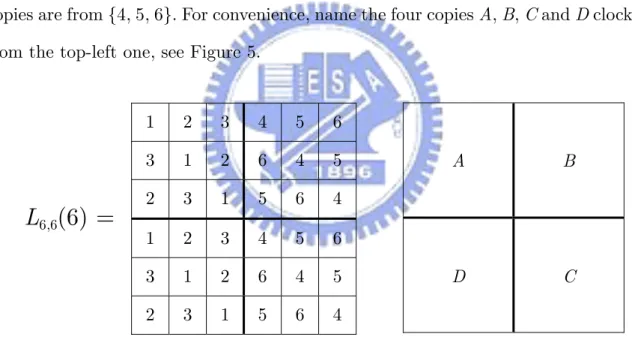
the top-left and bottom-right copies are from {1, 2, 3} while the entries in the other two copies are from {4, 5, 6}. For convenience, name the four copies A, B, C and D clockwise from the top-left one, see Figure 5.
A B D C 1 2 3 4 5 6 3 1 2 6 4 5 2 3 1 5 6 4 1 2 3 4 5 6 3 1 2 6 4 5 2 3 1 5 6 4
L
6,6(6) =
Figure 5: L6,6(6) and the four copies of L3
Suppose that there exist 6 positions somewhere which induce a multicolored C6. Let L be the 33 partial latin square which contains the 6 positions. By Proposition 3.2 (i), we can assume L cross all four copies. Without loss of generality, suppose there are four positions of L locating on A. Since A has only 3 kinds of entries, some entry must appear twice, say a.
b, where b a. Moreover, there is exactly one repeated entry in the other four positions of L in B and D. Recall that we can obtain a multicolored C6 by omitting three positions
that no two of them are in the same row or column. If we omit the position in C, then there must be a repeated entry left in B and D. Otherwise, the two positions having entry a in A will be left. It’s a contradiction.
Lemma 3.6. For 3 m 8, (m, 8) FMC (6).
Proof. Let L8,8(6) = L2 L2 L2 be composed of 8 copies of L2. Similar to the proof of Lemma 3.5, suppose the entries in the top-left and bottom-right copies are from {1, 2, 3, 4} while the entries in the other two copies are from {5, 6, 7, 8}, and the four copies are arranged as following Figure 6. For convenience, let L8,8(6) = [ li,j ] where 1 i, j 8.
A B D C a k d c b h 8 1 2 3 4 5 6 7 2 1 4 3 6 5 8 7 3 4 1 2 7 8 5 6 4 3 2 1 8 7 6 5 5 6 7 8 1 2 3 4 6 5 8 7 2 1 4 3 7 8 5 6 3 4 1 2 8 7 6 5 4 3 2 1
L
8,8(6) =
Figure 6: L8,8(6) and the four copies of (L2 )2
Suppose that there are 6 positions somewhere which induce a multicolored C6. Let
L be the 33 partial latin square which contains the 6 positions. It is easy to see that any 23 partial latin rectangle in L2 L2 contains an L2. By Proposition 3.1, we can
assume L cross all four copies. Without loss of generality, suppose there are four positions of L locating on A. Let the four positions in A be (a, c), (a, d), (b, c), (b, d), and the only one position in C be (h, k), where 1 a, b, c, d 4 and 5 h, k 8.
By Proposition 3.2, la,c lb,d or la,d lb,c. Actually, the four entries la,c, lb,d, la,d, lb,c are distinct. Assume lh,k la,c, then la,k lh,c because of L8,8(6) = (L2 )3. Thus, we have an L2
in L, a contradiction.
Lemma 3.7. (3, 7) FMC (6).
Proof. Let L3,7(6) be the corresponding latin rectangle of the specific proper 7-edge-coloring which forbids multicolored C6’s, see Figure 7.
It is easy to see that any two columns of the first 4 columns have an L2, and any two columns of the last 3 columns used exactly 3 distinct entries. By proposition 3.3 (i) and (iii), we have done.
1 2 3 4 5 6 7 2 1 4 3 6 7 5 3 4 1 2 7 5 6
L
3,7(6) =
Figure 7: L3,7(6)
Lemma 3.8. There exists a 3-edge-colored K3,3 in a proper 7-edge-colored K3,7 which forbids multicolored C6’s.
Proof. Let L3,7(6) be the corresponding latin rectangle of a proper 7-edge-colored K3,7. It suffices to show there must be a latin subsquare of order 3.
Claim 1. There exist two columns having disjoint entries.
Suppose NOT. Let the entries of the first column be 1, 2 and 3. Notice that each entry in {1, 2, 3} must appear twice in the other columns. By our assumption, each remaining column has exactly one position with entry in {1, 2, 3}. Without loss of generality, let the second column contain entries 1, 4, and 5. Except the first two columns, there are at most 4 columns having entries 4 or 5. Therefore, there exists one column having exactly one entry from {1, 2, 3} but no entries from {4, 5}. By
proposition 3.2, this column and the first two columns will create a multicolored C6, a contradiction.
Claim 2. There exists a latin subsquare of order 3.
By Claim 1, we can assume the entries of the first two columns be 1, 2, 3 and 5, 6, 7 respectively. Consider the first two columns and the three columns which have entry 4. By proposition 3.1, the other two entries in the column which has entry 4 must be both from {1, 2, 3} or {5, 6, 7}.
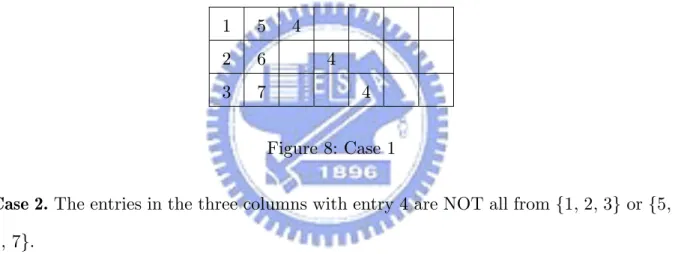
Case 1. The entries in the three columns with entry 4 are all from {1, 2, 3} or {5, 6, 7}.
Assume the six entries are all in {5, 6, 7} by symmetry. Then combining the first column and the last two ones, we have a latin square of order 3, see Figure 8.
1 5 4
2 6 4
3 7 4
Figure 8: Case 1
Case 2. The entries in the three columns with entry 4 are NOT all from {1, 2, 3} or {5,
6, 7}.
We will use Figure 9 and Figure 10 to illustrate our arguments. First, look at Figure 9. Without loss of generality, suppose the entries in position A are from {1, 2, 3} while the entries in position B are from {5, 6, 7}.
1 5 4 A B 2 6 A 4 B 3 7 A A 4
Figure 9: Case 2
By proposition 3.2, since combining the first two columns and one of the columns with entry 4 will form a partial latin square with 7 kinds of entries, the entries in
position A and position B are uniquely determined as Figure 10. Meanwhile, the entries in some positions of the last two columns are determined except positions denoted as C. Note that the entries in position C must be from the set {5, 6}.
1 5 4 3 6 7 2 2 6 3 4 5 1 7 3 7 2 1 4 C C
Figure 10: Case 2
Consider column 1, column 5, and column 6, they use 7 distinct entries but without
L2. By Proposition 3.2, there exists a multicolored C6, a contradiction.
Corollary 3.9. For any proper 7-edge-coloring of Km,7 , 4 m 7, there exists a
multicolored C6.
Proof. It is sufficient to consider the case m = 4. Suppose NOT. There exists some
proper 7-edge-coloring of K4,7 which forbids multicolored C6’s. Consider its corresponding latin rectangle L4,7. By Lemma 3.7, there exists a latin subsquare of order
3 in the first three rows of L4,7(6). Without loss of generality, we put the latin subsquare of order 3 in the last three columns and let the entries be 5, 6 and 7, see Figure 11. Then, consider the last three rows. It’s impossible to find a latin subsquare of order 3. It contradicts Lemma 3.7.
5 6 7 7 5 6 6 7 5
Figure 11: L4,7(6)
Theorem 3.10. For each m, n (m n) satisfying one of the follow conditions, any
n-edge-colored Km,n contains a multicolored C6:
(i) m 3 and n 9; (ii) m 4 and n = 7.
Proof. It can be easily proved by Proposition 3.4, Lemma 3.5, Lemma 3.6, Lemma 3.7,
3.2 Forbidding Multicolored (2k)-cycles
In this subsection, we consider the general version: forbidding multicolored (2k)-cycles. In the followings, we extend the method of Lemma 3.4, which shows a proper 6-edge-coloring of K6,6 that forbids multicolored 6-cycles, to the case that forbids multicolored (2k)-cycles.
Theorem 3.11. If k is odd, then (m, 2k) FMC (2k) for k m 2k.
Proof. It suffices to show (2k, 2k) FMC (2k). Let L2k,2k(2k) = Lk L2, where Lk is the
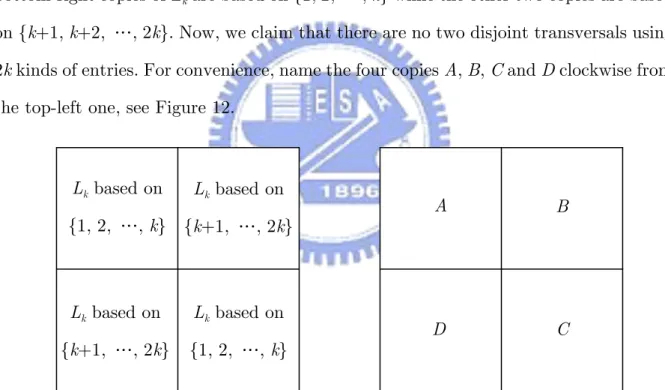
circulant latin square of order k. Similar to above proofs, suppose the top-left and bottom-right copies of Lk are based on {1, 2, …, k} while the other two copies are based
on {k+1, k+2, …, 2k}. Now, we claim that there are no two disjoint transversals using 2k kinds of entries. For convenience, name the four copies A, B, C and D clockwise from the top-left one, see Figure 12.
Lk based on Lk based on
A
Figure 12: L2k,2k(2k) and four copies of Lk
Suppose that there exist two disjoint transversals using 2k kinds of entries. Let
L be the kk partial latin square containing these two transversals. Note here that each column and row contains exactly two entries from the two transversals. If L crosses only two copies of Lk, the two disjoint transversals must contain an even number of entries from [k]. Therefore, we can assume that L crosses all four copies. Let a, b, c and d be the
{1, 2, …, k} Lk based on {1, 2, …, k} Lk based on {k+1, …, 2k} {k+1, …, 2k} C D B
numbers of entries of the two transversals from A, B, C and D respectively. Clearly, a+c is even because a+b and b+c are both even. By the hypothesis, a+c = k is odd, a contradiction. Then we complete the proof.
4 Conclusion
In this thesis, we have obtained the following three main results: 1. FMC (4) = {(2, 2), (2, 3), (3, 3)}.
2. FMC (6) = {(a, b), (c, 8), (3, 7) | 2 a b 6, 2 c 8}. 3. If k is odd, then (m, 2k) FMC (2k) for 2 m 2k.
For the future study, we shall try to find the smallest n such that there always exists a multicolored C2k in an arbitrary proper n-edge-colored Kk,n for k 4. In
order to solve this problem, we may find the smallest t such that there always exists a multicolored C2k in an arbitrary proper t-edge-colored Kk,k for k 4. Hopefully,
References
[1] S. Akbari and A. Alipour, Multicolored trees in complete graphs, J. Graph Theory 54, 221–232. (2006)
[2] S. Akbari, A. Alipour, H. L. Fu and Y. H. Lo, Multicolored parallelism of isomorphic spanning trees, SIAM Discrete Math. (June) (2006) 564–567.
[3] M. Albert, A. Frieze and B. Reed, Multicolored Hamilton cycles, Electronic J.
Combin. 2, R10 (1995)
[4] N. Alon, R. A. Brualdi, B. L. Shader, Multicolored forests in bipartite decompositions of graphs, J. Combin. Theory, Ser. B 53, 143–148 (1991)
[5] H. J. Broersma, X. Li, G. Woeginger and S. Zhang, Paths and cycles in colored
graphs, Australasian J. Combin. 31, 297–309. (2005)
[6] R. A. Brualdi and H. J. Ryser, Combinatorial Matrix Theory, Cambridge Univ. Press, (1992).
[7] R. A. Brualdi and S. Hollingsworth, Multicolored trees in complete graphs, J. Combin. Theory, Ser. B 68, 310–313. (1996)
[8] H. Chen and X. Li, Long heterochromatic paths in edge-colored graphs, Electron. J. Combin. 12, R33 (2005)
[9] H. Chen and X. Li, Color degree and color neighborhood union conditions for long heterochromatic paths in edge-colored graphs, arXiv:math.CO/0512144 v1 7 Dec (2005)
[10] G. M. Constantine, Edge-disjoint isomorphic multicolored trees and cycles in
[11] G. M. Constantine, Multicolored parallelisms of isomorphic spanning trees, Discrete Math. Theor. Comput. Sci. 5 (2002), No. 1, 121-125.
[12] P. Erdös and T. Gallai, On maximal paths and circuits of graphs, Acta. Math. Acad. Sc. Hungar. 10, 337–356. (1959)
[13] A. Frieze and B. Reed, Polychromatic Hamilton cycles. Discrete Math. 118, 69–74. (1993)
[14] H. L. Fu and Y. H. Lo, Multicolored isomorphic spanning trees in complete graphs, in preprints.
[15] H. L. Fu and Y. H. Lo, Multicolored parallelisms of Hamiltonian cycles, Discrete Math. 309 (2009), pp. 4871-4876.
[16] G. Hahn and C. Thomassen, Path and cycle sub-Ramsey numbers and an edge coloring conjecture, Discrete Math. 62, 29–33 (1986)
[17] P. Hatami and P. W. Shor, A lower bound for the length of a partial transversal in a Latin square, J. Combin. Theory, Series A, 115 (2008) 1103–1113.
[18] A. Kaneko, M. Kano and K. Suzuki, Three edge disjoint multicolored spanning trees in complete graphs, Preprint. (2003)
[19] J. Krussel, S. Marshal and H. Verral, Spanning trees orthogonal to one-
factorizations of K2n, Ars Combin. 57 (2002), 77-82.
[20] J.J. Montellano-Ballesteros and V. Neumann-Lara, An Anti-Ramsey Theorem on Cycles, Graphs and Combinatorics, 21 (2005), 343-354.
[21] H.J. Ryser, Neuere Probleme der Kombinatorik, in: Vorträge über Kombinatorik, Oberwolfach, Matematisches Forschungsinstitute Oberwolfach, Germany, 24–29
[22] D. B. West (2001), Introduction to graph theory, Upper Saddle River, NJ :Prentice Hall.
[23] D. E. Woolbright and H. L. Fu, On the existence of rainbows in 1-factorizations of