行政院國家科學委員會專題研究計畫 期中進度報告
雷射技術及時析光譜研究奈米光電材料與結構之研究(第 1
年)
期中進度報告(精簡版)
計 畫 類 別 : 個別型 計 畫 編 號 : NSC 96-2628-E-009-018-MY3 執 行 期 間 : 96 年 08 月 01 日至 97 年 07 月 31 日 執 行 單 位 : 國立交通大學光電工程學系(所) 計 畫 主 持 人 : 謝文峰 計畫參與人員: 教授-主持人(含共同主持人):謝文峰 教授-主持人(含共同主持人):程思誠 博士-兼任助理人員:潘晴如 博士-兼任助理人員:黃同慶 博士-兼任助理人員:劉維仁 博士-兼任助理人員:黃志賢 博士-兼任助理人員:楊松 博士-兼任助理人員:林國峰 博士-兼任助理人員:郭晉嘉 碩士-兼任助理人員:徐偉澤 碩士-兼任助理人員:李岳勳 碩士-兼任助理人員:林易慶 碩士-兼任助理人員:賴盈璇 處 理 方 式 : 期中報告不提供公開查詢中 華 民 國 99 年 08 月 23 日
表 Y04
行政院國家科學委員會補助專題研究計畫
□ 成 果 報 告
□ 期中進度報告
光電奈米材料與結構中激子之控制(1/3)
計畫類別:□ 個別型計畫 □ 整合型計畫
計畫編號:
NSC 96-2628-M-009 -001 -MY3
執行期間: 96 年 08 月 01 日至 99 年 07 月 31 日
計畫主持人:謝文峰
共同主持人:程思誠
計畫參與人員:潘晴如、黃同慶、劉維仁、黃志賢、楊松、鄭信民、林國
峰、郭晉嘉、徐偉澤、李岳勳、林易慶、賴盈璇。
成果報告類型(依經費核定清單規定繳交):□精簡報告 □完整報告
本成果報告包括以下應繳交之附件:
□赴國外出差或研習心得報告一份
□赴大陸地區出差或研習心得報告一份
□出席國際學術會議心得報告及發表之論文各一份
□國際合作研究計畫國外研究報告書一份
處理方式:除產學合作研究計畫、提升產業技術及人才培育研究計畫、列
管計畫及下列情形者外,得立即公開查詢
□涉及專利或其他智慧財產權,□一年■二年後可公開查詢
執行單位:國立交通大學光電工程研究所
中 華 民 國 97 年 5 月 22 日
X X X X行政院國家科學委員會專題研究計畫成果報告
光電奈米材料與結構中激子之控制(3/1)
Toward Control of Excitons in Photonic Nano-materials and Structures (3/1) 計畫編號:NSC 96-2628-M-009 -001 -MY3 執行期限:96 年 8 月 1 日至 97 年 7 月 31 日 主持人:謝文峰教授 國立交通大學光電工程學系 一、中文摘要 我們發現激子與縱聲子交互作用隨著氧化鋅量子點縮小導致其激子半徑變小而降低。從 變溫PL光譜可觀察到較不明顯的自由激子─縱聲子複製發光和較小溫度變化的自由激子發光 譜之平移,以及自由激子發光強度的分析,我們確定Fröhlich交互作用之降低乃是由於量子侷 限效應使得量子點中之激子半徑縮小導致激子極化降低,以至於激子與晶格震盪之庫倫作用 降低。 關鍵詞: 聲子散射、溶膠─凝膠法、II-VI 族半導體、寬能隙半導體、氧化鋅、激子、螢光、 量子侷限。 Abstract
The exciton-longitudinal-optical-phonon (LO-phonon) interaction was observed to decrease with reducing ZnO particle size to its exciton Bohr radius (aB). The unapparent LO-phonon replicas of free exciton (FX) emission and the smaller FX energy difference between 13 and 300 K reveal decreasing weighting of exciton-LO phonon coupling strength. The diminished Fröhlich interaction mainly results from the reducing aB with size due to the quantum confinement effect that
makes the exciton less polar.
Keywords: Phonon scattering; Sol–gel; II-VI semiconductor, wide band gap, ZnO, exciton, quantum confinement.
二、緣由與目的
During the last decade, zinc oxide (ZnO) has received much attention because of its wide band gap and large binding energy (Eb ~ 60 meV).1 Optical and physical properties of semiconductor quantum dots (QDs) have also devoted considerable efforts to study due to their potential applications to light-emitting diodes,2 optically pumped lasers,3 and other electronic devices.4
Although a large number of researches on II-VI QDs and III-V QDs have been published,5,6 the
properties of ZnO QDs have not been studied as completely as other materials. The interaction between exciton and longitudinal-optical (LO) phonon has a great influence on the optical properties of polar semiconductors. Ramvall et al.7 reported a diminishing temperature-dependent shift of the photoluminescence (PL) energy with decreasing GaN QD size caused by a reduction of the LO-phonon coupling. In our previous work,8 the resonant Raman scattering (RRS) of various
表 Y04
ZnO QD sizes reveals that decrease of I2LO/ I1LO with decreasing particle sizes gives an evidence for
the reduction of exciton-LO phonon interaction with decreasing QD size. Chang and Lin9
theoretically reported that the exciton LO-phonon interaction energy (Eex-ph) is evaluated as
functions of electric field strength and the size of the quantum dots. The field enhanced by reducing the separation between electron and hole would increase Eex-ph; whereas, the decrease of
dot size leads to delocalize the wave functions of both electron and hole, in turn, decreases Eex-ph.
However, the size dependence of exciton-LO-phonon coupling is a complicated problem to be investigated. In this report, we qualitatively compared the PL spectra of various ZnO particle sizes and quantitatively deduced the weighting of exciton-LO-phonon coupling strength. We finally obtained the reduction of exciton-LO phonon interaction with decreasing ZnO particle sizes.
三、研究方法與步驟
ZnO QDs and powders were synthesized by sol-gel method, which was published
previously.10,11 Stoichiometric zinc acetate dihydrate (99.5% Zn_OAc_2·2H2O, Riedel–deHaen)
was dissolved into diethylene glycol (99.5% DEG cethylenediamine-tetra-aceticacid). The resultant solution was centrifuged at 3000 rpm for 30 min and a transparent solution was then obtained containing dispersed single crystalline ZnO QDs. Finally, the supernatant was dropped on a Si(001) substrate with native oxide and dried at 150 °C. The samples of 5.3, 7.4, and 12 nm in diameter were obtained for further studies. ZnO micrometer size powders were synthesized by Zn-OAc2·2H2O and methanol. The concentration of Zn2+ was 0.35 mol/ l. The sol was annealed in
a furnace at 900 °C under air atmosphere for 1 h, and then slowly cooled to room temperature. The PL measurement was made using a 40 mW He–Cd laser at a wavelength of 325 nm and the emission light was dispersed by a TRIAX-320 spectrometer and detected by an UV-sensitive photomultiplier tube. A closed cycle refrigerator was used to set the temperature anywhere between 13 and 300 K.
四、結果與討論
Figure 1(a) shows the PL spectrum of different ZnO sizes at 13 K. The spectrum of ZnO
powders consists of the free exciton (FX) and the donor-bound exciton (D0X) emission peaks along
with three obvious LO-phonon replicas.11 The FX emission of ZnO powders is 3.377 eV which
behaves as ZnO bulk. The energy shift (dash line) from 3.377 to 3.475 eV due to quantum confinement effect can be observed. The full width at half maximum which increases as the dot
size decreases may be caused by the contribution of surface-optical phonon,12 surface-bound
acceptor exciton complexes,13 and size distribution. Accordingly, we observed that LO-phonon
replicas are obvious in ZnO powders but are unapparent in other QD samples. Duke and Mahan interpreted that the intensities of LO-phonon replicas depend strongly on their exciton-phonon coupling strengths.14
Figure 1(b) displays the temperature-dependent PL of 7.4 nm QDs; it reveals only a single
band for T=13 -300 K. Due to small binding energy of D0X, it will be ionized as T > 100 K, so we can easily attribute the single band to the FX emission. We also find that the peak energy
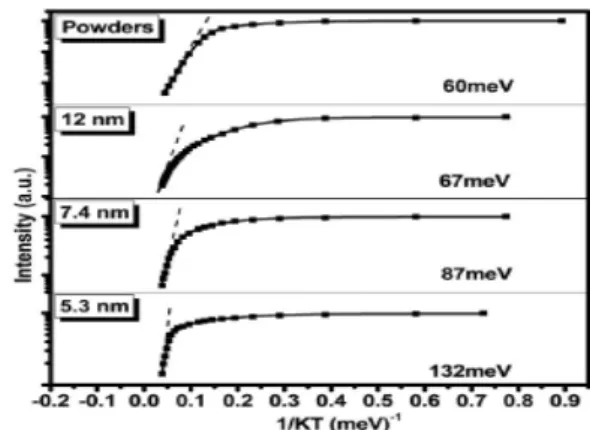
difference of FX between 13 and 300 K is ~ 25 meV, which is smaller than 65 meV of the ZnO powders. It is known that the main contribution to the energy shift is the Fröhlich interaction,15a result of Coulomb interaction. From the temperature-dependent PL, we can obtain the exciton
binding energy (Eb) from the following relation:16 ( ) (0)
1 exp( b/ B )
I I T
A E k T
=
+ − , where I(T) is the
integrated intensity of the peak at a specific temperature, I(0) is the integrated intensity at absolute zero, A is a constant, and kB is Boltzmann’s constant. The fitting results are shown in Fig. 2; Eb of
the ZnO powder is 60 meV, which is close to that of ZnO Bulk. We obtained Eb=67, 87, and 132 meV, respectively, for 12, 7.4, and 5.3 nm QDs. The decreasing particle size would raise the electron-hole interaction as a result of the compressing boundary to cause increasing Coulomb energy. Therefore, the binding energy increases as the particle size decreases. In order to quantitatively investigate the relation between the quantum confinement size and the exciton-LO
phonon interaction, we introduced the temperature dependent exciton energy,17
0 ( ) (0) exp( / ) 1 i ex ex i i B E T E k T α ω = − −
∑
= , where Eex(T) is the exciton energy at a specific temperatureT, Eex(0) is the exciton energy at 0 K, and α0i represents the coupling strength of the optical phonon
with energy = . As our previous RRS (Ref. ωi 8) and PL results, the most promising LO phonon
involve in RRS and PL is the one having energy of 71–72 meV. We therefore take only one of the
summation terms with =ω=72 meV into account to discuss the exciton-LO phonon coupling. Then
the α0 represents the weighting of exciton-LO-phonon coupling. Although the LO-phonon energy
depends on the size of QD, from our fitting result even for 5.3 nm QD, the phonon energy shift is less than 1 meV, it is insufficient (< 44%) to change α0. We plotted the fitting results α0 =0.59,
0.40, 0.21, and 0.19 for powders, 12 nm, 7.4 nm, and 5.3 nm QDs, respectively, in Fig. 3. These results are consistent with the observations of PL spectra, weakening coupling strength of
exciton-LO phonon as decreasing the particle sizes. The increasing Eb gives an indication for
reduction of exciton-LO phonon interaction. The enhancement of Eb or Coulomb potential
indicates a reduction of aB. It makes the exciton less polar capable for efficiently interacting with LO phonon through the Fröhlich interaction.18 To find out the relation between aB and α0, we
calculated aB from our PL spectra including the FX emission energy and Eb for different dot sizes
based on the weak confinement model as follows:19
2 2 2 2 * 0 1.8 ( ) 2 4 g g e E R E eR μ R π πεε ≈ + = − , and 2 2 * / (2 ) B b
a = = μ E ,20 where Eg(R) is the measured FX emission energy plus Eb, Eg=3.43 eV is the
band gap energy of bulk ZnO, e is the charge of electron, = is Planck’s constant divided by 2π, R is the particle radius, μ* is the reduced mass of exciton, ε=3.7 is the relative permittivity,21 and ε
0 is
the permittivity of free space. The calculated exciton Bohr radii aB QD for 5.3, 7.4, and 12 nm
QDs are 0.977, 1.038, and 1.328 nm. The ratios of aB QD to the exciton Bohr radius for bulk ZnO
of aB bulk=2.34 nm are 0.42, 0.46, and 0.57, respectively, which agree well with 0.42, 0.49, and
0.59 obtained by Senger and Bajaj.22 We found similar trends of α0-QD/α0-powders and aB-QD/aB bulk against the dot size. It shows that the exciton formation is attained by Coulomb interaction; as the
表 Y04
particle sizes decrease, the quantum confinement effect causes increase of Eb and decrease of aB. The electric dipole, which is proportional to the distance of electron-hole pair, is then reduced. The exciton formation thus becomes less polar, reducing the coupling strength with the polar lattice via the Fröhlich interaction.18 Consequently, we demonstrated that the reduction of exciton-LO phonon interaction occurs in ZnO-QD system.
五、結論
We presented temperature-dependent PL of different sizes of ZnO particles. The unobvious LO-phonon replicas of FX were observed when the ZnO particle sizes were under 12 nm in diameter. The FX emission energy difference of 13–300 K decreases as the particle size decreases. The increasing exciton Eb with the decreasing quantum dot size can be obtained from temperature-dependent PL. From the temperature-dependent change of FX emission energy, the exciton-LO phonon coupling strength reduces as the particle size decreases. This is consistent
with reducing LO-phonon replica in PL spectra and our previous RRS results.8 The reduced aB
with particle size obtained from Eb and PL spectrum confirms that the exciton becomes less polar,
in turn, reducing the Fröhlich interaction; and the exciton-LO phonon interaction is reduced with decreasing ZnO QDs. 六、自我評估 本年度計畫中我們進行兩部分光電物理之研究,分別為氧化(鎂)鋅薄膜與量子點之成長 與光電性質研究和光子晶體波導之理論探討等。我們利用雷射濺鍍與 sol-gel 法成功地成長 氧化(鎂)鋅薄膜與量子點等。成長之樣品我們分別研究,激子─聲子之交互作用、螢光、受 激輻射與雷射現象、拉曼散射等等。在光子晶體波導研究方面,我們以緊束縛原理首次成功 地解釋光子晶體波導的偶合與不偶合現象。這一年來共發表 12 篇光電材料相關的 SCI 論文, 即雷射動力學相關研究 SCI 論文計 3 篇,成果還算不錯。 七、參考文獻
1. C. R. Ding, S. W. Li, and H. Z. Wang, Appl. Phys. Lett. 90, 241918 (2007).
2. C. Y. Lee, Y. T. Huang, W. F. Su, and C. F. Lin, Appl. Phys. Lett. 89, 231116 (2006).
3. K. Tachibana, T. Someya, Y. Arakawa, R. Werner, and A. Forchel, Appl. Phys. Lett. 75, 2605 (2005). 4. G. Yusa and H. Sakaki, Superlattices Microstruct. 25, 247 (1999).
5. A. Murayama, T. Furuta, K. Hyomi, I. Souma, Y. Oka, D. Dagnelund, I. A. Buyanova, and W. M. Chen, Phys. Rev. B 75, 195308(2007).
6. Y. H. Cho, H. S. Kwack, B. J. Kwon, J. Barjon, J. Brault, B. Daudin, and L. S. Dang, Appl. Phys. Lett. 89, 251914 (2006).
7. P. Ramvall, P. Riblet, S. Nomura, and Y. Aoyagi, J. Appl. Phys. 87, 3883 (2000).
8. H. M. Cheng, K. F. Lin, H. C. Hsu, and W. F. Hsieh, Appl. Phys. Lett. 88, 261909 (2006). 9. R. Chang and S. H. Lin, Phys. Rev. B 68, 045326 (2003).
10. K. F. Lin, H. M. Cheng, H. C. Hsu, and W. F. Hsieh, Appl. Phys. Lett. 88, 263117 (2006). 11. C. J. Pan, K. F. Lin, W. T. Hsu, and W. F. Hsieh, Appl. Phys. Lett. 91, 111907 (2007).
263113 (2007).
13. V. A. Fonoberov and A. A. Balandin, Appl. Phys. Lett. 85, 5971 (2004). 14. C. B. Duke and G. D. Mahan, Phys. Rev. 139, 1965 (1965).
15. S. J. Sheih, K. T. Tsen, D. K. Ferry, A. Botchkarev, B. Sverdlov, A. Salvador, and H. Morkoc, Appl. Phys. Lett. 67, 1757 (1995).
16. D. S. Jiang, H. Jung, and K. Ploog, J. Appl. Phys. 64, 1371 (1988). 17. L. Viña, S. Logothetidis, and M. Cardona, Phys. Rev. B 30, 1979 (1984). 18. J. J. Shiang, S. H. Risbud, and A. P. Alivisatos, J. Chem. Phys. 98, 8432 (1993). 19. L. E. Brus, J. Chem. Phys. 80, 4403 (1984).
20. N. Zettili, Quantum Mechanics, Concepts and Applications _John Wiley & Sons, England, (2004), Vol. 1, p. 31. 21. S. A. Studenikin, N. Golego, and M. Cocivera, J. Appl. Phys. 84, 2287 (1998).
22. R. T. Senger and K. K. Bajaj, Phys. Rev. B 68, 045313 (2003).
FIG. 3. Experimental and calculated (solid line) exciton energies plotted against inverse temperature for different ZnO particle sizes.
FIG. 2. The FX integral intensity as a function of the inverse temperature from 13 to 300 K for different ZnO particle sizes. Squares represent experimental data, while solid lines are the theoretical fitting.
FIG. 1. (a) PL spectra of different ZnO particle sizes at 13 K. The dashed line indicates the FX peak energy shift. (b) Temperature-dependent PL spectra of 7.4 nm of ZnO QDs in the range of 13–300 K. The dashed lines marked the peak energies of 13 and 300 K. Their energy difference is 25 meV.