Perturbative QCD study of the B
˜K
*
␥
decay
Hsiang-nan LiDepartment of Physics, National Cheng-Kung University, Tainan 701, Taiwan, Republic of China Guey-Lin Lin
Institute of Physics, National Chiao-Tung University, Hsinchu 300, Taiwan, Republic of China
共Received 29 December 1998; published 14 July 1999兲
We apply the perturbative QCD factorization theorem developed recently for nonleptonic heavy meson decays to the radiative decay B˜K*␥. In this formalism the evolution of the Wilson coefficients from the W boson mass down to the characteristic scale of the decay process is governed by the effective weak Hamil-tonian. The evolution from the characteristic scale to a lower hadronic scale is formulated by the Sudakov resummation. In addition to computing the dominant contribution arising from the magnetic-penguin operator O7, we also calculate the contributions of four-quark operators. By fitting our prediction for the branching ratio
of the B˜K*␥ decay to the CLEO data, we determine the B meson wave function that possesses a sharp peak at a low momentum fraction.关S0556-2821共99兲01015-2兴
PACS number共s兲: 13.25.Hw, 11.10.Hi, 12.38.Bx
I. INTRODUCTION
The observation of the decay B˜K*␥ five years ago关1兴 opened a new era for particle physics, since the penguin structure of electroweak theory was probed for the first time. Soon after this observation, the inclusive B˜Xs␥ decay关2兴 was also established. The updated branching ratios for both decays are (4.2⫾0.8⫾0.6)⫻10⫺5 关3兴 and (3.14⫾0.48) ⫻10⫺4关4,5兴, respectively. In the recent literature, the
inclu-sive decay B˜Xs␥ has received more attention than the ex-clusive mode B˜K*␥. The branching ratio and the photon energy spectrum of the B˜Xs␥ decay have been used to constrain the parameter space of the new physics beyond the standard model. The preference of studying the inclusive mode is clear in that its hadronic dynamics is much easier to handle as compared to the exclusive mode. It has been shown that, to the leading order in 1/Mb, Mb being the b quark mass, the branching ratio B(B˜Xs␥) is given by the branching ratio B(b˜s␥) of the corresponding quark-level process. Furthermore, the subleading 1/Mb corrections can be parametrized systematically using heavy quark effective theory 关6兴.
The hadronic dynamics of the exclusive decay B˜K*␥ is much more complicated. Specifically, one has to deal with the soft dynamics involved in the B and K* mesons. Since the final states are light compared to the decaying B meson, one anticipates that perturbative QCD共PQCD兲 is applicable to this process because of the large energy release. In fact, the PQCD formalism based upon factorization theorems, which incorporates the Sudakov resummation of soft-gluon effects, has been developed for sometime关7–9兴, and applied to semileptonic关7,8兴, inclusive-radiative 关9兴, and nonleptonic B meson decays 关10兴. This approach has been so far rather successful. In this article, we shall extend this formalism to penguin-induced exclusive processes, such as the B˜K*␥ decay. The satisfactory result with repect to this complicated process, as presented later, provides further confidence in the validity of the PQCD approach to B meson decays.
According to the PQCD factorization theorem, the
amplitude of a heavy meson decay is expressed as the con-volution of a hard subamplitude with meson wave functions. The former, with at least one hard gluon attaching to the spectator quark, is calculable in the usual perturbation theory, while the latter must be extracted from the experi-mental data or derived by nonperturbative methods, such as QCD sum rules. Since the K* meson wave function is known from sum rule analyses 关11,12兴, the B˜K*␥ decay is an ideal process from which the unknown B meson wave function can be determined. With the B meson wave function obtained here, we are able to make predictions for other B meson decay modes, especially for the charmless decays. We shall show that by fitting our prediction for the branching ratio B(B˜K*␥) to the CLEO data, a B meson wave func-tion with a sharp peak at the low momentum fracfunc-tion is obtained.
Comparing our work to others, we remark that most of the previous studies on this decay focus only on the contribution of the magnetic-penguin operator O7, and their approaches are based upon quark models. To ensure that other contribu-tions are indeed negligible, we also calculate the contribution by the current-current operator O2, which arises through the four-point b˜sg*␥ coupling with the off-shell gluon reab-sorbed by a spectator quark. Although such a contribution has been calculated before关13兴, it is, however, obtained in a naive PQCD framework which does not include the Sudakov resummation and the renormalization-group 共RG兲 analysis 关13兴. As a result, the predictions of Ref. 关13兴 are sensitive to the choice of the renormalization scale. In our more com-pleted approach, the sensitivity tocan be avoided. We find that, due to certain cancellations, the contribution by O2 turns out to be rather small.
We also like to comment on a different viewpoint based on the overlap integral of meson wave functions关14兴, which showed that the diagrams without any hard gluon dominate over those we will be considering here. We shall argue that the observation in 关14兴 is due to an underestimation on the value of the strong coupling constant and a choice of a flat B meson wave function. If evaluating the coupling constant at
the characteristic momentum flow involved in the decay pro-cess 关13兴 and employing a sharper B meson wave function, these higher-order contributions may become comparable to the leading-order ones. Hence, the approach in关14兴 does not seem to be self-consistent. In our approach, diagrams with-out hard gluons do not contribute under our parametrization of parton momenta. Therefore, diagrams with a hard gluon attaching to a spectator are leading in our analysis.
This article is organized as follows: In Sec. II, we write down the effective Hamiltonian for the B˜K*␥ decay. In particular, the current-current operator O2 and the magnetic-penguin operators O7 are identified as major sources of the contribution. We then calculate the O2-induced b˜sg*␥ vertex, keeping the gluon line off shell. In Sec. III, we derive the factorization formulas for the B˜K*␥ decay, which in-clude contributions from the various operators. The numeri-cal result is presented in Sec. IV, where the contribution of each operator is compared. Section V is the conclusion.
II. EFFECTIVE HAMILTONIAN
The effective Hamiltonian for the flavor-changing b˜s transition is now standard, which is given by 关15,16兴
Heff共b˜s␥兲⫽⫺ GF
冑
2Vts *Vtb兺
i⫽1 8 Ci共兲Oi共兲, 共1兲 with O1⫽共s¯icj兲V⫺A共c¯jbi兲V⫺A, O2⫽共s¯ici兲V⫺A共c¯jbj兲V⫺A, O3⫽共s¯ibi兲V⫺A兺
q 共q¯j qj兲V⫺A, O4⫽共s¯ibj兲V⫺A兺
q 共q¯j qi兲V⫺A, O5⫽共s¯ibi兲V⫺A兺
q 共q¯j qj兲V⫹A, O6⫽共s¯ibj兲V⫺A兺
q 共q¯j qi兲V⫹A, O7⫽ e 42¯si 共m sPL⫹mbPR兲biF, O8⫽ g 42¯si共msPL⫹mbPR兲Ti j a bjG a , 共2兲i, j being the color indices. In the PQCD picture, the lowest-order diagrams for the B˜K*␥ decay arising from
opera-tors O2, O7, and O8 are depicted in Figs. 1–3. It is not hard to see that contributions other than the above are negligible. For example, the contributions depicted in Fig. 4 are very suppressed, although they are of the same order, O(eGF␣s) 关17兴, as those of Figs. 1–3. We draw this conclusion from a previous experience with B˜D*␥. Indeed, from a diagram similar to Fig. 4 共with s replaced by c, and the q¯ on both sides replaced by d¯ and u¯, respectively兲, one has obtained B(B˜D*␥)⫽10⫺6 关18兴. Since fK*⬇ fD*, and VtbVts is comparable to VcbVud, it is clear that the diagram in Fig. 4 gives B(B˜K*␥)⬇10⫺6⫻C3(4,5,6)2 ⬇10⫺9–10⫺10, and is thus negligible. There is still one more type of contributions of the same order as shown in Fig. 5. By an explicit calcu-lation, one can show that such contributions merely give cor-rections to the Wilson coefficients C3–C6 occurring in Fig. 4. Since the matrix elements of Figs. 4 and 5 have identical
FIG. 1. Contributions to the B˜K*␥ decay from the
current-current operator O2. The diagram with a photon emitted from the
other side of the charm-quark loop is not shown.
FIG. 2. Contributions to the B˜K*␥ decay from the
tensor structures, the branching ratio contributed by the latter figure behaves like 10⫺6⫻C2
2⫻(␣
s/)2⬇10⫺9, which is also negligible. Finally, in Sec. IV, we shall see that the contribution by O8 is negligible as well.
Before implementing the PQCD formalism to evaluate the contributions of Figs. 1–3, we compute the four-point b ˜sg*␥ vertex. Our calculation essentially generalizes the work by Liu and Yao 关19兴 to the off-shell gluon case 关20兴. We first perform a Fierz transformation on O2, i.e.,
O2⬅共s¯ici兲V⫺A共c¯jbj兲V⫺A⫽共s¯ibj兲V⫺A共c¯jci兲V⫺A. 共3兲 The b( p)˜s(p
⬘
)␥(k1)g*(k2) vertex is expressed asIa⫽C2Vts*Vtb¯u共p
⬘
兲 1 2␥ 共1⫺␥ 5兲Tau共p兲I⑀共k1兲, 共4兲 with the structure tensorI⫽A1⑀k1⫹A2⑀k2
⫹A3⑀k1k2k1⫹A4⑀k1k2k2
⫹A5⑀k1k2k2⫹A6⑀k1k2k1. 共5兲 Clearly, the form factor A6 can be discarded because of k1•⑀(k1)⫽0. From the requirement of gauge invariance, i.e., k1I⫽0 and k2I⫽0, we have
A2⫹A4k1•k2⫽0,
A1⫹A3k1•k2⫹A5k2
2⫽0. 共6兲
The invariance of I under the interchanges k1↔k2 and
↔ further requires A3⫽⫺A4. With the above relations, I is simplified into I⫽A4关k1•k2⑀共k1⫺k2兲⫹⑀k1k2k2 ⫺⑀k1k2k1兴⫹A5共⑀k1k2k2⫺k2 2⑀ k1兲, 共7兲 with A4⫽2
冑
2 32egsGFI11共Mc 2兲, 共8兲 A5⫽⫺2冑
2 32egsGF关I10共Mc 2兲⫺I 20共Mc 2兲兴, 共9兲 and Iab共m2兲⫽冕
0 1 dx冕
0 1⫺x dy x ayb x共1⫺x兲k22⫹2xyk1•k2⫺m2⫹i. 共10兲 Carrying out the Feynman-parameter integrations, we obtainI11共m2兲⫽
冋
1 2Q2⫹冕
0 1 dxm 2⫺x共1⫺x兲k 2 2 xQ4 ⫻ln冏
m 2⫺x共1⫺x兲共k 2 2⫹Q2兲 m2⫺x共1⫺x兲k22冏
⫺i⌰共Q2⫹k 2 2⫺4m2兲 ⫻冉
m 2 Q4ln 1⫹ 1⫺⫺ k22 2Q4冊
册
, 共11兲FIG. 5. Contributions to the B˜K*␥ decay from an O2
inser-tion and a bremsstrahlung photon.
FIG. 3. Contributions to the B˜K*␥ decay from the
chromo-magnetic-penguin operator O8.
FIG. 4. Contributions to the B˜K*␥ decay from the
strong-penguin operators O3,O4, . . . ,O6. The dark square denotes
I10共m2兲⫺I20共m2兲⫽
冋
冕
0 1 dx1⫺x Q2 ⫻ln冏
m 2⫺x共1⫺x兲共k 2 2⫹Q2兲 m2⫺x共1⫺x兲k22冏
⫺i⌰共Q2⫹k 2 2⫺4m2兲  2Q2册
, 共12兲 with Q2⫽2k1•k2, and ⫽冑
1⫺4m2/(k2 2⫹Q2). As a side remark, we note that both I11(m2) and I10(m2)⫺I20(m2) have smooth limits as m2˜0. Hence, we can safely neglect the contributions of O4and O6to the b˜sg*␥ vertex, since their Wilson coefficients, C4 and C6, are much smaller than C2.Having determined the b˜sg*␥ vertex, we attach the off-shell gluon line to the spectator quark to form the B ˜K*␥ amplitude as shown in Fig. 1. As mentioned, this amplitude is of the order e␣sGF, the same as the amplitudes induced by O7 and O8 depicted in Figs. 2 and 3, respec-tively. In the next section, we shall compute the contribution of each operator to the B˜K*␥ decay using the PQCD factorization theorem.
III. FACTORIZATION FORMULAS
In this section we first review the PQCD factorization theorem developed for nonleptonic heavy meson decays 关10兴, and then extend it to the B˜K*␥ decay. Nonleptonic heavy meson decays involve three scales: the W boson mass MW, at which the matching conditions of the effective Hamiltonian to the original Hamiltonian are defined, the typical scale t of a hard subamplitude, which reflects the dynamics of heavy meson decays, and the factorization scale 1/b, with b the conjugate variable of parton transverse mo-menta. The dynamics below 1/b is regarded as being com-pletely nonperturbative, and parametrized into a meson wave fucntion (x), x being the momentum fraction. Above the scale 1/b, PQCD is reliable and radiative corrections produce two types of large logarithms: ln(MW/t) and ln(tb). The former are summed by RG equations to give the evolution from MW down to t described by the Wilson coefficients c(t). While the latter are summed to give the evolution from t to 1/b.
There exist also double logarithms ln2(Pb) from the over-lap of collinear and soft divergences, P being the dominant light-cone component of a meson momentum. The resumma-tion of these double logarithms leads to a Sudakov form factor exp关⫺s(P,b)兴, which suppresses the long-distance con-tributions in the large b region, and vanishes as b⫽1/⌳, ⌳ ⬅⌳QCD being the QCD scale. This factor improves the ap-plicability of PQCD around the energy scale of few GeV. The b quark mass scale is located in the range of applicabil-ity. This is the motivation for us to develop the PQCD for-malism for heavy hadron decays. For the detailed derivation of the relevant Sudakov form factors, refer to关7,8兴.
With all the large logarithms organized, the remaining finite contributions are absorbed into a hard b quark decay
subamplitude H(t). Because of Sudakov suppression, the perturbative expansion of H in the coupling constant ␣s makes sense. Therefore, a three-scale factorization formula is given by the typical expression
c共t兲丢H共t兲丢共x兲丢exp
冋
⫺s共P,b兲⫺2冕
1/bt d¯
¯ ␥q„␣s共¯兲…
册
, 共13兲 where the exponential containing the quark anomalous di-mension ␥q⫽⫺␣s/ describes the evolution from t to 1/b mentioned above. The explicit expression of the exponent s is can be found in 关10兴. Since logarithmic corrections have been summed by RG equations, the above factorization for-mula does not depend on the renormalization scale 关10兴. Our formalism then avoids the sensitivity to that appears in关13兴.We now apply the three-scale factorization theorem to the radiative decay B˜K*␥, whose effective Hamiltonian has been given in the previous section. As stated before, only the operators O2, O7, and O8 are crucial, to which the corre-sponding diagrams and hard subamplitudes are shown in Figs. 1–3 and Table I, respectively. We write the momenta of B and K* mesons in light-cone coodinates as PB ⫽(MB/
冑
2)(1,1,0T) and PK⫽(MB/冑
2)(1,r2,0T), respec-tively, with r⫽MK*/ MB. The B meson is at rest with the above choice of momenta. We further parametrize the mo-menta of the light valence quarks in the B and K*mesons as kB and kK, respectively. kB has a minus component kB⫺, giving the momentum fraction xB⫽kB⫺/ PB⫺, and small trans-verse components kBT. kK has a large plus component kK⫹, giving xK⫽kK⫹/ PK⫹, and small kKT. The photon momentum is then P␥⫽PB⫺PK, whose nonvanishing component is only P␥⫺.The B˜K*␥ decay amplitude can be decomposed as M⫽⑀␥*•⑀K
*
* MS⫹i⑀⫹⫺⑀␥*⑀K *
*MP, 共14兲 with⑀␥and⑀K*the polarization vectors of the photon and of the K*meson, respectively. Note that we have neglected the structure ( P␥•⑀K
*
* )( PK•⑀␥*)/( P␥•PK) which should come together with⑀␥*•⑀K
*
* . This is due to our choice of the frame which gives PK•⑀␥*⫽0. From Eq. 共14兲, it is obvious that only the K* mesons with transverse polarizations are pro-duced in the decay.
The total rate of the B˜K*␥ decay is given by
⌫⫽ 1⫺r 2 8MB共兩M
S兩2⫹兩MP兩2兲. 共15兲
We can further decompose MS and MP as
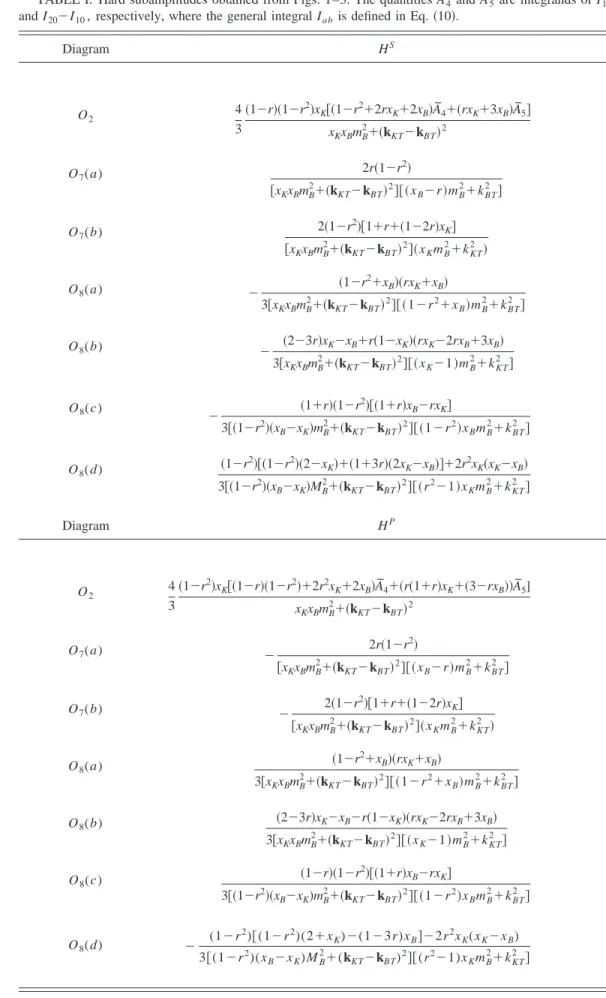
TABLE I. Hard subamplitudes obtained from Figs. 1–3. The quantities A˜4and A˜5are integrands of I11
and I20⫺I10, respectively, where the general integral Iab is defined in Eq.共10兲.
Diagram HS O2 4 3 共1⫺r兲共1⫺r2兲x K关共1⫺r2⫹2rxK⫹2xB兲A˜4⫹共rxK⫹3xB兲A˜5兴 xKxBmB 2⫹共k KT⫺kBT兲2 O7(a) 2r共1⫺r 2兲 关xKxBmB 2 ⫹共kKT⫺kBT兲2兴关共xB⫺r兲mB 2 ⫹kBT 2 兴 O7(b) 2共1⫺r 2兲关1⫹r⫹共1⫺2r兲x K兴 关xKxBmB 2⫹共k KT⫺kBT兲2兴共xKmB 2⫹k KT 2 兲 O8(a) ⫺ 共1⫺r 2⫹x B兲共rxK⫹xB兲 3关xKxBmB 2 ⫹共kKT⫺kBT兲2兴关共1⫺r2⫹xB兲mB 2 ⫹kBT 2 兴 O8(b) ⫺ 共2⫺3r兲xK⫺xB⫹r共1⫺xK兲共rxK⫺2rxB⫹3xB兲 3关xKxBmB 2⫹共k KT⫺kBT兲 2兴关共x K⫺1兲mB 2⫹k KT 2 兴 O8(c) ⫺ 共1⫹r兲共1⫺r 2兲关共1⫹r兲x B⫺rxK兴 3关共1⫺r2兲共xB⫺xK兲mB 2 ⫹共kKT⫺kBT兲2兴关共1⫺r2兲xBmB 2 ⫹kBT 2 兴 O8(d) 共1⫺r 2兲关共1⫺r2兲共2⫺x K兲⫹共1⫹3r兲共2xK⫺xB兲兴⫹2r2xK共xK⫺xB兲 3关共1⫺r2兲共xB⫺xK兲MB 2⫹共k KT⫺kBT兲 2兴关共r2⫺1兲x KmB 2⫹k KT 2 兴 Diagram HP O2 4 3 共1⫺r2兲x K关共1⫺r兲共1⫺r2兲⫹2r2xK⫹2xB兲A˜4⫹共r共1⫹r兲xK⫹共3⫺rxB兲兲A˜5] xKxBmB 2 ⫹共kKT⫺kBT兲2 O7(a) ⫺ 2r共1⫺r 2兲 关xKxBmB 2⫹共k KT⫺kBT兲2兴关共xB⫺r兲mB 2⫹k BT 2 兴 O7(b) ⫺ 2共1⫺r 2兲关1⫹r⫹共1⫺2r兲x K兴 关xKxBmB 2 ⫹共kKT⫺kBT兲2兴共xKmB 2 ⫹kKT 2 兲 O8(a) 共1⫺r 2⫹x B兲共rxK⫹xB兲 3关xKxBmB 2⫹共k KT⫺kBT兲 2兴关共1⫺r2⫹x B兲mB 2⫹k BT 2 兴 O8(b) 共2⫺3r兲xK⫺xB⫺r共1⫺xK兲共rxK⫺2rxB⫹3xB兲 3关xKxBmB 2 ⫹共kKT⫺kBT兲2兴关共xK⫺1兲mB 2 ⫹kKT 2 兴 O8(c) 共1⫺r兲共1⫺r 2兲关共1⫹r兲x B⫺rxK兴 3关共1⫺r2兲共xB⫺xK兲mB 2⫹共k KT⫺kBT兲 2兴关共1⫺r2兲x BmB 2⫹k BT 2 兴 O8(d) ⫺ (1⫺r2)关(1⫺r2)(2⫹x K)⫺(1⫺3r)xB兴⫺2r2xK(xK⫺xB) 3关(1⫺r2)(xB⫺xK) MB 2⫹(k KT⫺kBT)2兴关(r2⫺1)xKmB 2⫹k KT 2 兴
where i⫽S or P, and the terms on the right-hand side repre-sent contributions from operators O2, O7, and O8, respec-tively.
In the following, we write the factorization formulas for Mliin terms of the overall factor
⌫(0)⫽GF
冑
2 e Vts*VtbCFMB 5 , 共17兲where CF⬅4/3 is the group theory factor. The amplitudes contributed by O2 are written as
M2S⫽⌫(0)4 3
冕
0 1 dx冕
0 1⫺x d y冕
0 1 dxBdxK冕
0 1/⌳ bdbB共xB兲K*共xK兲␣s共t2兲c2共t2兲exp关⫺S共xB,xK,t2,b,b兲兴 ⫻关共1⫺r2⫹2rx K⫹2xB兲y⫺共rxK⫹3xB兲共1⫺x兲兴 共1⫺r兲共1⫺r2兲x Kx x y共1⫺r2兲xKMB 2⫺M c 2H2共Ab,冑
兩B2 2兩b兲, 共18兲 M2 P⫽⌫(0)4 3冕
0 1 dx冕
0 1⫺x d y冕
0 1 dxBdxK冕
0 1/⌳ bdbB共xB兲K*共xK兲␣s共t2兲c2共t2兲exp关⫺S共xB,xK,t2,b,b兲兴 ⫻兵关共1⫺r兲共1⫺r2兲⫹2r2x K⫹2xB兴y⫺关r共1⫹r兲xK⫹共3⫺r兲xB兴共1⫺x兲其 共1⫺r2兲x Kx xy共1⫺r2兲xKMB 2⫺M c 2H2共Ab,冑
兩B2 2兩b兲, 共19兲 with A2⫽xKxBMB2, B22⫽xKxBMB 2⫺ y 1⫺x 共1⫺r 2兲x KMB 2⫹ Mc 2 x共1⫺x兲, t2⫽max共A,冑
兩B2 2兩,1/b兲. 共20兲To arrive at the above expressions, we have employed Eq.共10兲 for the charm loop integral, instead of Eqs. 共11兲 and 共12兲. The variable bB (bK), conjugate to the parton transverse momentum kBT (kKT), represents the transverse extent of the B (K*) meson; t2 is the characteristic scale of the hard subamplitude
H2共Ab,
冑
兩B2 2兩b兲⫽K 0共Ab兲⫺K0共冑
兩B2 2兩b兲 共B 2 2⬎0兲 共21兲 ⫽K0共Ab兲⫺i 2H0 (1)共冑
兩B 2 2兩b兲 共B 2 2⬍0兲,which comes from the Fourier transform of the corresponding expressions in Table I to the b space. Note that, for simplicity in the notation, we have used H2 to denote hard subamplitudes in both M2
S
and M2P. In Table I, these two amplitudes are distinguished.
There are two diagrams, Figs. 2共a兲 and 2共b兲, associated with the operator O7, where the hard gluon connects both quarks of the B meson or those of the K*meson. The amplitudes from the two diagrams are
M7S⫽⫺M7P⫽⌫(0)2
冕
0 1 dxBdxK冕
0 1/⌳ bBdbBbKdbKB共xB兲K*共xK兲共1⫺r2兲 ⫻兵rH7(a)共AbK,冑
兩B7 2兩b B,冑
兩B7 2兩b K兲F7共t7a兲⫹关1⫹r⫹共1⫺2r兲xK兴H7 (b)共Ab B,C7bB,C7bK兲F7共t7b兲其, 共22兲 with B7 2 ⫽共xB⫺r2兲MB 2 , C7 2⫽x KMB 2 , t7a⫽max共A,冑
兩B7 2兩,1/b B,1/bK兲, t7b⫽max共A,C7,1/bB,1/bK兲, 共23兲F7共t兲⫽␣s共t兲c7共t兲exp关⫺S共xB,xK,t,bB,bK兲兴. 共24兲 The hard functions
H7(a)共AbK,
冑
兩B7 2兩b B,冑
兩B7 2兩b K兲⫽K0共AbK兲h共冑
兩B7 2兩b B,冑
兩B7 2兩b K兲 共B7 2⬎0兲, K0共AbK兲h⬘
共冑
兩B7 2兩b B,冑
兩B7 2兩b K兲 共B7 2⬍0兲, 共25兲 with h⫽共bB⫺bK兲K0共冑
兩B7 2兩b B兲I0共冑
兩B7 2兩b K兲⫹共bB↔bK兲, h⬘
⫽i 2关共bB⫺bK兲H0 (1)共冑
兩B 7 2兩b B兲J0共冑
兩B7 2兩b K兲⫹共bB↔bK兲兴, 共26兲 and H7(b)共AbB,C7bB,C7bK兲⫽K0共AbB兲h共C7bB,C7bK兲, 共27兲 are derived from Figs. 2共a兲 and 2共b兲, respectively. The relation M7S⫽⫺M7P reflects the equality of the parity-conserving and parity-violating contributions induced by O7.Four diagrams, Figs. 3共a兲–3共d兲, are associated with the operator O8, where the photon is radiated by each quark in the B or K*mesons. The corresponding amplitudes are
M8S⫽⫺⌫(0)1 3
冕
0 1 dxBdxK冕
0 1/⌳ bBdbBbKdbKB共xB兲K*共xK兲„共1⫺r2⫹xB兲共rxK⫹xB兲H8(a)共AbK,B8bB,B8bK兲F8共t8a兲 ⫹关共2⫺3r兲xK⫺xB⫹r共1⫺xK兲共rxK⫺2rxB⫹3xB兲兴H8 (b)共Ab B,C8bB,C8bK兲F8共t8b兲 ⫹共1⫹r兲共1⫺r2兲关共1⫹r兲x B⫺rxK兴H8 (c) 共冑
兩A⬘
2兩b K,D8bB,D8bK兲F8共t8c兲 ⫺兵共1⫺r2兲关共1⫺r2兲共2⫺x K兲⫹共1⫹3r兲共2xK⫺xB兲兴⫹2r2xK共xK⫺xB兲其H8 (d)共冑
兩A⬘
2兩b B,E8bB,E8bK兲F8共t8d兲…, 共28兲 M8P⫽⌫(0)1 3冕
0 1 dxBdxK冕
0 1/⌳ bBdbBbKdbKB共xB兲K*共xK兲„共1⫺r2⫹xB兲共rxK⫹xB兲H8 (a)共Ab K,B8bB,B8bK兲F8共t8a兲 ⫹关共2⫺3r兲xK⫺xB⫺r共1⫺xK兲共rxK⫺2rxB⫹3xB兲兴H8 (b)共Ab B,C8bB,C8bK兲F8共t8b兲 ⫹共1⫺r兲共1⫺r2兲关共1⫹r兲x B⫺rxK兴H8 (c)共冑
兩A⬘
2兩b K,D8bB,D8bK兲F共t8c兲 ⫺兵共1⫺r2兲关共1⫺r2兲共2⫹x K兲⫺共1⫺3r兲xB兴⫺2r2xK共xK⫺xB兲其H8 (d)共冑
兩A⬘
2兩b B,E8bB,E8bK兲F共t8d兲…, 共29兲 with A⬘2⫽共1⫺r2兲共xB⫺xK兲MB2, B82⫽共1⫺r2⫹xB兲MB2, C82⫽共1⫺xK兲MB 2 , D82⫽共1⫺r2兲xBMB 2 , E82⫽共1⫺r2兲xKMB 2, t8a⫽max共A,B8,1/bB,1/bK兲, t8b⫽max共A,C8,1/bB,1/bK兲, t8c⫽max共冑
兩A⬘
2兩,D 8,1/bB,1/bK兲,t8d⫽max共
冑
兩A⬘
2兩,E8,1/bB,1/bK兲, 共30兲 and the function F8:F8共t兲⫽␣s共t兲c8共t兲exp关⫺S共xB,xK,t,bB,bK兲兴. 共31兲 The hard functions
H8(a)共AbK,B8bB,B8bK兲⫽H7 (b) 共AbK,B8bB,B8bK兲, H8(b)共AbB,C8bB,C8bK兲⫽K0共AbB兲h
⬘
共C8bB,C8bK兲, H8 (c)共冑
兩A⬘
2兩b K,D8bB,D8bK兲 ⫽K0共冑
兩A⬘
2兩b K兲h共D8bB,D8bK兲 共A⬘
2⭓0兲, ⫽i 2H0 (1)共冑
兩A⬘
2兩b K兲h共D8bB,D8bK兲 共A⬘
2⬍0兲,H8(d)共
冑
兩A⬘
2兩bB,E8bB,E8bK兲⫽K0共
冑
兩A⬘
2兩bB兲h⬘
共E8bB,E8bK兲 共A⬘
2⭓0兲, ⫽i2 H0
(1)共
冑
兩A⬘
2兩bB兲h
⬘
共E8bB,E8bK兲 共A⬘
2⬍0兲 共32兲 are derived from Figs. 3共a兲–3共d兲, respectively. It is obvious that the above factorization formulas bear the features of Eq. 共13兲.The exponentials exp(⫺S) appearing in Mli are the com-plete Sudakov form factors with the exponent
S⫽s共xBPB⫺,bB兲⫹2
冕
1/bB t d ␥q„␣s共兲…⫹s共xKPK⫹,bK兲 ⫹s„共1⫺xK兲PK⫹,bK…⫹2冕
1/bK t d ␥q„␣s共兲…. 共33兲 The wave functionsB andK*satisfy the normalization冕
0 1i共x兲dx⫽ fi
2
冑
6, 共34兲with the decay constant fi, i⫽B and K*. The wave function for the K*meson with transverse polarizations has been de-rived using QCD sum rules关12兴, which is given by
K*⫽ fK*
冑
6 15 4 共1⫺ 2兲 ⫻关0.267共1⫺2兲2 ⫹0.017⫹0.213⫹0.07兴, 共35兲 with⫽1⫺2x. As to the B meson wave functions, we em-ploy two models 关21,22兴B (I)共x兲⫽ NBx共1⫺x兲 2 MB2⫹CB共1⫺x兲, 共36兲 B (II)共x兲⫽N B
⬘
冑
x共1⫺x兲 exp冋
⫺1 2冉
x MB 冊
2册
, 共37兲 where NB and NB⬘
are normalization constants, while CB and are shape parameters.
IV. RESULTS AND DISCUSSIONS
In the evaluation of the various form factors and ampli-tudes, we adopt GF⫽1.16639⫻10⫺5GeV⫺2, the flavor number nf⫽5, the decay constants fB⫽200 MeV and fK* ⫽220 MeV, the Cabibbo-Kobayashi-Maskawa 共CKM兲 ma-trix elements兩Vts*Vtb兩⫽0.04, the masses Mc⫽1.5 GeV, MB ⫽5.28 GeV, and MK*⫽0.892 GeV, the B¯0 meson lifetime
B0⫽1.53 ps, and the QCD scale ⌳⫽0.2 GeV 关10兴. We find
that, no matter what value of the shape parameter CB is chosen, the modelB(I)in Eq.共36兲 with a flat profile leads to results smaller than the CLEO data which give B(B ˜K*␥)⫽(4.2⫾0.8⫾0.6)⫻10⫺5 关3兴. In fact, the maximal prediction from B(I), corresponding to the shape parameter CB⫽⫺MB
2
, is about 3.0⫻10⫺5, close to the lower bound of the data.
On the other hand, using model B(II) in Eq.共37兲 with a sharp peak at small x, we obtain a prediction much closer to the experimental data. It is indeed found that, as ⫽0.795 GeV, a prediction 4.204⫻10⫺5 for the branching ratio is reached, which is equal to the central value of the experi-mental data. If varying the shape parameter to both ⫽0.79 GeV and⫽0.80 GeV, we obtain the branching ra-tios 4.25⫻10⫺5 and 4.14⫻10⫺5, respectively. It indicates that the allowed range for is wide due to the yet large uncertainties of the data.
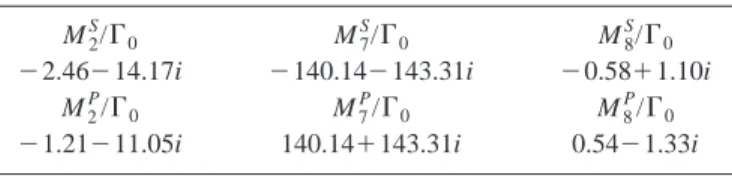
The detailed contributions from each amplitude Mli are listed in Table II in units of 10⫺6 GeV⫺2. It is clear that M7S and M7P together give dominant contributions to the decay width. One also sees that M2Sand M2Pare smaller by an order of magnitude, while the amplitudes associated with O8 are highly suppressed. In Table II, it is interesting to note that M2S adds constructively to M7S, i.e.,兩M2S⫹M7S兩2⬎兩M
7 S兩2. On the contrary, M2P is destructive to M7P. Because of this can-cellation effect, the inclusion of O2 contributions only en-hances the total rate by 2% 共this result is basically consistent with the estimation obtained in关13兴兲. This result is not sen-sitive to the choice of . We obtain the same enhancement for the total rate with chosen to be 0.79 GeV and 0.80 GeV, respectively.
By fitting our prediction for the branching ratio B(B ˜K*␥) to the CLEO data, we determine the B meson wave function B共x兲⫽0.740079
冑
x共1⫺x兲exp冋
⫺ 1 2冉
x MB 0.795 GeV冊
2册
, 共38兲 which possesses a sharp peak at the low momentum fraction x. We stress that, however, Eq. 共38兲 is not conclusive be-cause of the large allowed range of the shape parameter. A more precise B meson wave function can be obtained by considering a global fit to the data of various decay modes, including B˜D(*)() 关23兴. Once the B meson wave func-tion is fixed, we shall employ it in the evaluafunc-tion of the nonleptonic charmless decays.Finally, as mentioned in the Introduction, the authors of Ref. 关14兴 found that the diagrams without hard-gluon
ex-TABLE II. The amplitudes Ml i in units of 10⫺6GeV⫺2. M2S/⌫0 M7 S /⌫0 M8 S /⌫0 ⫺2.46⫺14.17i ⫺140.14⫺143.31i ⫺0.58⫹1.10i
M2P/⌫0 M7
P
/⌫0 M8
P
/⌫0 ⫺1.21⫺11.05i 140.14⫹143.31i 0.54⫺1.33i
changes dominate over Figs. 2共a兲 and 2共b兲 we have evaluated 关only the operator O7 was considered in the calculation of the branching ratio B(B˜K*␥) in关14兴兴: the latter contrib-ute at most 23% to the branching ratio, or 12% to the decay amplitude. However, in that analysis,␣sis set to 0.2, which is even smaller than␣s( MB)⫽0.23 evaluated at the B meson mass. We argue that such a small coupling constant is inap-propriate, since the momentum flow involved in the decay process is most likely less than the b quark mass Mb, say, roughly 1–2 GeV, which corresponds to ␣s⬇0.4. The K* meson mass was neglected in关14兴, such that Fig. 2共a兲 does not contribute. In our analysis we did not make this approxi-mation, and observed that the contribution from Fig. 2共a兲 is about MK*/ MB⬇1/5 of that from Fig. 2共b兲. Moreover, a flat B meson wave function corresponding to the shape param-eter ⬇1.3 GeV was adopted in the computation of the higher-order contributions in 关14兴, which is far beyond ⬇0.4 GeV specified in 关22兴. If a sharper B meson wave function is employed, these contributions will be enhanced at least by a factor of 3. Note that the leading-order contribu-tions considered in 关14兴 are less sensitive to the variation of
in the wave function. Adding up the above enhancements, the amplitude for O(␣s) corrections becomes approximately equal to the leading-order contribution. In this sense the analysis in关14兴 does not seem to be self-consistent.
In our approach, the momentum of the spectator quark in the B meson is parametrized into the minus direction, while the momentum of the spectator quark in the K* meson is parametrized in the plus direction. This parametrization is appropriate because of the hard-gluon exchange. Note that the factorization formulas presented in Sec. III are con-structed based on the diagrams with at least one-hard-gluon exchange. For example, the infrared divergences from self-energy corrections to the spectator quark are factorized into the B meson wave function, if they occur before the hard-gluon exchange, and into the K* meson wave function, if they occur after the hard-gluon exchange. Without hard glu-ons to distinguish the initial and final states, factorization of self-energy corrections to the spectator quark is ambiguous. Therefore, the diagrams without hard gluons do not appear in the regime of PQCD factorization theorems, and those with one hard gluon are indeed leading. If we ignore the validity of the factorization, we may proceed with evaluating the contribution of O7 from the diagram without hard gluons in the PQCD framework. It is trivial to obtain the hard subam-plitude in momentum space,
H7(0)⫽共1⫹r兲共1⫺r 2兲 2 MB ␦
3共k
1⫺k2兲, 共39兲
where the␦ function requires that the longitudinal momenta of the spectrator quarks in the B and K* mesons be in the same direction. Fourier transforming the above expression into b space, and convoluting it with the wave functions in Eqs. 共35兲 and 共38兲 and with the Sudakov factor, we derive the amplitudes M7S(0)⫽⫺M7P(0)⫽⌫(0)
冕
0 1 dx冕
0 1/⌳ bdbB共x兲K*共x兲 ⫻共1⫹r兲共1⫺r 2兲 42MB2CF c7共1/b兲exp关⫺S共x,x,1/b,b,b兲兴. 共40兲 Without hard gluons, the momentum fraction x and the trans-verse extent b are equal for the B and K*mesons. We have set the hard scale t to 1/b due to the lack of gluon momentum transfer. A simple numerical work on Eq. 共40兲 gives M7S(0)/⌫(0)⫽⫺2.51⫻10⫺6 GeV⫺2, which is of the same or-der as the contributions from O2 and O8. One of the reasons for the smallness of M7S(0), compared to the values obtained in 关14兴, is the additional strong Sudakov suppression. Re-ferred to M7Slisted in Table II, M7S(0)is negligible. If includ-ing M7S(0) and M7P(0), the branching ratio B(B˜K*␥) will increase by only 1.7%.V. CONCLUSION
In this paper we have extended the PQCD three-scale fac-torization theorem to the penguin-induced radiative decay B˜K*␥, which takes into account the Sudakov resumma-tion for large logarithmic correcresumma-tions to this process. We have included the nonspectator contribution from the current-current operator O2besides the standard contribution given by magnetic-penguin operators O7and O8. It turns out that the contribution by O2 is negligible due to certain can-cellations. The contributions from O8 and other operators in the effective Hamiltonian are also quite small. Finally, we have determined the B meson wave function from the best fit to the experimental data ofB(B˜K*␥), which will be em-ployed to make predictions of other B meson decays.
ACKNOWLEDGMENTS
We thank X.-G. He and W.-S. Hou for discussions. This work was supported in part by the National Science Council of R.O.C. under the Grants Nos. NSC-88-2112-M-006-013 and NSC-88-2112-M-009-002.
关1兴 CLEO Collaboration, R. Ammar et al., Phys. Rev. Lett. 71,
674共1993兲.
关2兴 CLEO Collaboration, M. S. Alam et al., Phys. Rev. Lett. 74,
2885共1995兲.
关3兴 CLEO Collaboration, R. Ammar et al., ‘‘Radiative Penguin
Decays of the B Meson,’’ Report No. CONF 96-5, ICHEP-96 PA05-9, 1996.
关4兴 CLEO Collaboration, S. Glenn et al., ‘‘Improved
Measure-ment of B(b˜s␥),’’ submitted to XXIX International Confer-ence on High Energy Physics, Vancouver, Canada, 1998.
关5兴 ALEPH Collaboration, B. Barate et al., ‘‘A Measurement of
the Inclusive b˜s␥ Branching Ratio,’’ Report No. CERN-EP/ 98-044, 1998.
关6兴 A. Falk, M. Luke, and M. Savage, Phys. Rev. D 49, 3367 共1994兲.
关7兴 H-n. Li and H.L. Yu, Phys. Rev. Lett. 74, 4388 共1995兲; Phys.
Lett. B 353, 301共1995兲; Phys. Rev. D 53, 2480 共1996兲.
关8兴 H-n. Li, Phys. Rev. D 52, 3958 共1995兲.
关9兴 H-n. Li and H.L. Yu, Phys. Rev. D 53, 4970 共1996兲. 关10兴 C.H. Chang and H-n. Li, Phys. Rev. D 55, 5577 共1997兲; T.W.
Yeh and H-n. Li, ibid. 56, 1615共1997兲.
关11兴 V.L. Chernyak and A.R. Zhitnitsky, Phys. Rep. 112, 173 共1984兲.
关12兴 M. Benayoun and V.L. Chernyak, Nucl. Phys. B329, 285 共1990兲.
关13兴 J. Milana, Phys. Rev. D 53, 1403 共1996兲.
关14兴 C. Greub, H. Simma, and D. Wyler, Nucl. Phys. B434, 39 共1995兲.
关15兴 For a review of earlier literature, see G. Buchalla, A. J. Buras,
and M. E. Lautenbacher, Rev. Mod. Phys. 68, 1125共1996兲.
关16兴 The signs of O7and O8are consistent with the covariant
de-rivative D⫽⫹igTaA
a
⫹ieQA, where Aa and Adenote gluon and photon fields, respectively.
关17兴 Strictly speaking, the order of this diagram is
eGF关A1␣sln(MW/)⫹B1␣s⫹A2␣s
2
ln2(MW/)⫹B2␣s
2
ln(MW/)
⫹•••], where coefficients Ai and Bi represent contributions
from leading and next-to-leading logarithms. We simply count the order according to the first two terms in the series, A1␣sln(MW/) and B1␣s. Same rule of counting applies to
diagrams in Fig. 1–3.
关18兴 H.-Y. Cheng, C.-Y. Cheung, G.-L. Lin, Y.-C. Lin, T.-M. Yan,
and H.-L. Yu, Phys. Rev. D 51, 1199共1995兲.
关19兴 J. Liu and Y.-P. Yao, Phys. Rev. D 42, 1485 共1990兲. 关20兴 The off-shell b˜sg*␥ vertex was also calculated by H.
Simma and D. Wyler, Nucl. Phys. B344, 283 共1990兲, and by Milana关13兴. Here we follow the convention of Ref. 关19兴.
关21兴 F. Schlumpf, Ph.D. thesis, hep-ph/9211255; R. Akhoury, G.
Sterman, and Y.-P. Yao, Phys. Rev. D 50, 358共1994兲.
关22兴 M. Bauer and M. Wirbel, Z. Phys. C 42, 671 共1989兲. 关23兴 H-n. Li and B. Melic, hep-ph/9902205.