Observation of unusual optical transitions in
thin-film Cu(In,Ga)Se
2
solar cells
Yu-Kuang Liao,1,4 Shou-Yi Kuo,2,* Woei-Tyng Lin,3 Fang-I Lai,3 Dan-Hua Hsieh,5 Min-An Tsai,6 Shih-Chen Chen,1 Ding-Wen Chiou,4 Jen-Chuang Chang,4Kaung-Hsiung Wu,1
Shun-Jen Cheng1, and Hao-Chung Kuo5,7
1Department of Electro-Physics, National Chiao-Tung University, Hsinchu, Taiwan 2Department of Electronic Engineering, Chang-Gung University,Taoyuan, Taiwan
3Department of Photonic Engineering, Yuan-Ze University, Taoyuan, Taiwan
4Compound Semiconductor Solar Cell Department, Next Generation Solar Cell Division, Green Energy and
Environment Research Laboratories, Industrial Technology Research Institute, Hsinchu, Taiwan
5Department of Photonics and Institute of Electro-Optical Engineering, National Chiao-Tung University, Hsinchu,
Taiwan
6Photovoltaic Metrology Laboratory, Energy & Environment Metrology Division, Center for Measurement
Standards, Industrial Technology Research Institute, Hsinchu, Taiwan
Abstract: In this paper, we examine photoluminescence spectra of Cu(In,Ga)Se2 (CIGS) via temperature-dependent and power-dependent photoluminescence (PL). Donor-acceptor pair (DAP) transition, near-band-edge transition were identified by their activation energies. S-shaped displacement of peak position was observed and was attributed to carrier confinement caused by potential fluctuation. This coincides well with the obtained activation energy at low temperature. We also present a model for transition from VSe to VIn and to VCu which illustrates competing mechanisms between DAPs recombinations.
©2012 Optical Society of America
OCIS codes: (160.5335) Photosensitive materials; (350.6050) Solar energy. References and links
1. P. Jackson, D. Hariskos, E. Lotter, S. Paetel, R. Wuerz, R. Menner, W. Wischmann, and M. Powalla, “New world record efficiency for Cu(In,Ga)Se2 thin-film solar cells beyond 20%,” Prog. Photovolt. Res. Appl. 19(7),
894–897 (2011).
2. S. B. Zhang, S. H. Wei, A. Zunger, and H. Katayama-Yoshida, “Defect physics of the CuInSe2 chalcopyrite
semiconductor,” Phys. Rev. B 57(16), 9642–9656 (1998).
3. S. C. Chen, Y. K. Liao, H. J. Chen, C. H. Chen, C. H. Lai, Y. L. Chueh, H. C. Kuo, K. H. Wu, J. Y. Juang, S. J. Cheng, T. P. Hsieh, and T. Kobayashi, “Ultrafast carrier dynamics in Cu(In,Ga)Se2 thin films probed by
femtosecond pump-probe spectroscopy,” Opt. Express 20(12), 12675–12681 (2012).
4. S. Shirakata, K. Ohkubo, Y. Ishii, and T. Nakada, “Effects of CdS buffer layers on photoluminescence properties of Cu(In,Ga)Se2 solar cells,” Sol. Energy Mater. Sol. Cells 93(6-7), 988–992 (2009).
5. S. I. Jung, K. H. Yoon, S. Ahn, J. Gwak, and J. H. Yun, “Fabrication and characterization of wide band-gap CuGaSe2 thin films for tandem structure,” Curr. Appl. Phys. 10(3), S395–S398 (2010).
6. M. A. Contreras, A. M. Gabor, A. L. Tennant, S. Asher, J. Tuttle, and R. Noufi, “16.4% total-area conversion efficiency thin-film polycrystalline MgF2/ZnO/CdS/Cu(In,Ga)Se2/Mo solar cell,” Prog. Photovolt. Res. Appl. 2(4), 287–292 (1994).
7. K. Romannathan, M. A. Contreras, C. L. Perkins, S. Asher, F. S. Hasoon, J. Keane, D. Young, M. Romero, W. Metzger, R. Noufi, J. Ward, and A. Duda, “Properties of 19.2% efficiency ZnO/CdS/CuInGaSe2 thin-film solar
cells,” Prog. Photovolt. Res. Appl. 11(4), 225–230 (2003).
8. T. P. Hsieh, C. C. Chuang, C. S. Wu, J. C. Chang, J. W. Guo, and W. C. Chen, “Effects of residual copper selenide on CuInGaSe2 solar cells,” Solid-State Electron. 56(1), 175–178 (2011).
9. N. Rega, S. Siebentritt, J. Albert, S. Nishiwaki, A. Zajogin, M. Ch. Lux-Steiner, R. Kniese, and M. J. Romero, “Excitonic luminescence of Cu(In,Ga)Se2,” Thin Solid Films 480–481, 286–290 (2005).
10. K. Töpper, J. Bruns, R. Scheer, M. Weber, A. Weidinger, and D. Bräunig, “Photoluminescence of CuInS2 thin
films and solar cells modified by postdeposition treatments,” Appl. Phys. Lett. 71(4), 482–484 (1997). 11. S. Shirakata and T. Nakada, “Photoluminescence and time-resolved photoluminescence in Cu(In,Ga)Se2 thin
12. M. Wagner, I. Dirnstorfer, D. M. Hofmann, M. D. Lampert, F. Karg, and B. K. Meyer, “Characterization of Cu(In,Ga)Se2 thin films I. Cu-rich layers,” Phys. Status Solidi, A Appl. Res. 167(1), 131–142 (1998). 13. B. M. Keyes, P. Dippo, W. Metzger, J. AbuShama, and R. Noufi, “Cu(In,Ga)Se2 thin films evolution during
growth – a photoluminescence study,” Proceeding of the 29th IEEE Phot. Spec. Conf., 511–514 (2002). 14. Y. P. Varshni, “Temperature dependence of the energy gap in semiconductors,” Physica 34(1), 149–154 (1967). 15. E. Kuokstis, W. H. Sun, M. Shatalov, J. W. Yang, and M. Asif Khan, “Role of alloy fluctuations in
photoluminescence dynamics of AlGaN epilayers,” Appl. Phys. Lett. 88(26), 261905 (2006).
16. M. J. Romero, H. Du, G. Teeter, Y. Yan, and M. M. Al-Jassin, “Comparative study of luminescence and intrinsic point defects in kesterite Cu2ZnSnS4 and chalcopyrite Cu(In,Ga)Se2 thin films used in photovoltaic applications,”
Phys. Rev. B 84(16), 165324 (2011).
17. J. Mattheis, U. Rau, and J. H. Werner, “Light absorption and emission in semiconductors with band gap fluctuations-A study on Cu(In,Ga)Se2 thin films,” J. Appl. Phys. 101(11), 113519 (2007).
18. S. Siebentritt, “What limits the efficiency of chalcopyrite solar cells?” Sol. Energy Sol. Cells. 95(6), 1471–1476 (2011).
19. Y. H. Cho, G. H. Gainer, A. J. Fischer, J. J. Song, S. Keller, U. K. Mishra, and S. P. DenBaars, ““S-shaped” temperature dependent emission shift and carrier dynamics in InGaN/GaN multiple quantum wells,” Appl. Phys. Lett. 73(10), 1370–1372 (1998).
20. J. Wu, W. Walukiewicz, K. M. Yu, J. W. Ager III, E. E. Haller, H. Lu, W. J. Schaff, Y. Saito, and Y. Nanishi, “Unusual properties of fundamental band gap of InN,” Appl. Phys. Lett. 80(21), 3967–3969 (2002).
21. A. Bell, S. Srinivasan, C. Plumlee, H. Omiya, F. A. Ponce, J. Christen, S. Tanaka, A. Fujioka, and Y. Nakagawa, “Exciton freeze-out and thermally activated relaxation at local potential fluctuations in thick AlxGa1xN layers,”
J. Appl. Phys. 95(9), 4670–4674 (2004).
22. T. Yamaguchi, J. Matsufusa, and A. Yoshida, “Optical properties in RF sputtered CuInxGa1xSe2 thin films,”
Appl. Surf. Sci. 70-71, 669–674 (1993).
23. K. Yoshino, H. Yokoyama, K. Maeda, T. Ikari, A. Fukuyama, P. J. Fons, A. Yamada, and S. Niki, “Optical characterizations of CuInSe2 epitaxial layers grown by molecular beam epitaxy,” J. Appl. Phys. 86(8), 4354–
4359 (1999).
24. M. Leroux, N. Grandjean, B. Beaumont, G. Nataf, F. Semond, J. Massies, and P. Gibart, “Temperature quenching of photoluminescence intensities in undoped and doped GaN,” J. Appl. Phys. 86(7), 3721–3728 (1999).
25. K. Töpper, J. Bruns, R. Scheer, M. Weber, A. Weidinger, and D. Bräunig, “Photoluminescence of CuInS2 thin
films and solar cells modified by post deposition treatments,” Appl. Phys. Lett. 71(4), 482–484 (1997). 26. I. Dirnstorfer, D. M. Hofmann, D. Meister, B. K. Meyer, W. Riedl, and F. Karg, “Postgrowth thermal treatment
of CuIn(Ga)Se2: Characterization of doping levels in In-rich thin films,” J. Appl. Phys. 85(3), 1423–1428 (1999).
27. A. V. Mudryi, V. F. Gremenok, I. A. Victorov, V. B. Zalesski, F. V. Kurdesov, V. I. Kovalevski, M. V. Yakushev, and R. W. Martin, “Optical characterisation of high-quality CuInSe2 thin films synthesised by
two-stage selenisation process,” Thin Solid Films 431–432, 193–196 (2003).
28. J. H. Schon and E. Bucher, “Comparison of point defects in CuInSe2 and CuGaSe2 single crystals,” Sol. Energy
Mater. Sol. Cells 57(3), 229–237 (1999).
29. D. G. Thomas, J. J. Hopfield, and W. M. Augustyniak, “Kinetics of radiative recombination at randomly distributed donors and acceptors,” Phys. Rev. 140(1A), A202–A220 (1965).
30. U. Rau, “Tunneling-enhanced recombination in CuInGaSe2 heterojunction solar cells,” Appl. Phys. Lett. 74(1),
111–113 (1999).
31. U. Raw, A. Jasenek, H. W. Schock, F. Engelhardt, and Th. Meyer, “Electronic loss mechanisms in chalcopyrite based heterojunction solar cells,” Thin Solid Films 361–362, 298–302 (2000).
1. Introduction
Lately, Cu(In,Ga)Se2 (CIGS) has been proposed as a promising material for thin film solar cells with potential to replace silicon-based solar cells. CIGS solar cells have achieved a high photovoltaic efficiency of 20.3% in laboratory experiments [1]. This is the highest among all types of thin film solar cells. There are abundant point defects in the CIGS absorber layer which behave as acceptor/donor sites dominating the electrical characteristics [2]. To improve the film quality and reduce carrier recombination, understanding of these point defects in CIGS is required [3]. A great deal of work on defect properties in CIGS has been carried out in this decade. However, defect features in CIGS films are not yet clearly understood owing to the fluctuation in its optoelectronic properties, complex device structures, and complex composition of CIGS solar cells. Therefore, investigating fundamental physics of defects in CIGS is crucial to understand the carrier transport mechanism in CIGS solar cells and make improvement in cell efficiency.
Among available characterization techniques, photoluminescence (PL) is a technique commonly used for the analysis of crystal quality, impurity, alloy composition and intrinsic
recombination in semiconductors. PL spectrum is extremely sensitive to point defects and deviation of stoichiometry making it suitable to analyze the defects in the absorber layer [4,5]. In this study, we have examined and characterized a CIGS thin film via temperature-dependent and power-temperature-dependent PL measurements. A model of emission competition between donor-acceptor pairs has been proposed.
2. Experiments
The CIGS thin film was prepared on a Mo-coated soda-lime glass (SLG) substrate via three stage co-evaporation method with [Cu]/[Ga] + [In] ratio around 0.7 and [Ga]/([Ga] + [In]) (GGI) ratio around 0.2. Gradient Ga-concentration was applied for a conventional v-shaped gradient bandgap of CIGS [6,7]. One as-deposited CIGS thin film had been further fabricated into a CIGS solar cell with structure of ZnO:Al (AZO)/ZnO/CdS/CIGS/Mo/SLG and an efficiency of 12%. More details of CIGS thin film deposition can be found elsewhere [8]. A 635 nm diode laser was used for PL measurements. Temperature-dependence PL measurements were made over the range 10 K to 300 K under a constant excitation power of 50 mW. Power dependent PL was measured at a constant temperature of 10K with excitation powers ranging from 5 mW to 50 mW. The PL signal emitted from the CIGS sample was transferred to a monochromator with a 600 groove/mm grating and detected by an infrared photomultiplier tube. All PL measurements were taken from a bare CIGS absorber layer. 3. Carrier localization
Figure 1(a) shows the PL spectra of the CIGS thin film in the temperature range 10-260K, where four individual emission peaks were observed. These four peaks are labeled P1, P2, P3 and P4 from low photon energy to high photon energy as indicated in Fig. 1(a). Four distinguishable peaks exist across all temperatures, implying that there are different recombination processes in the CIGS film. The inset of Fig. 1(a) shows the experimental data (black line) and the results of fitting to Gaussian distribution at 10K (green lines). According to the Gaussian tting results, the photon energies of these PL emission peaks related to P1, P2, P3 and P4 are 0.974 eV, 1.054 eV, 1.130 eV and 1.191 eV respectively. Due to the 0.2 GGI ratio of our CIGS thin film, a bandgap of 1.14 eV was expected and accords with the 1.130 eV photon energy of P3 [9]. Additionally, photon energy of P3 was found to be very sensitive to variation of temperature and is possibly a response to bandgap shrinkage. It is therefore very likely to be due to band-to-band transition. P1 and P2 are consequently assigned to the donor–acceptor pair (DAP) transition [10,11]. P4 is related to a consequent result of v-shaped gradient bandgap, in which a PL emission with larger photon energy can be observed due to the wider part of gradient bandgap [12,13]. The corresponding PL emission shift of P1, P2, P3 and P4 are illustrated in Fig. 1(b). S-shaped emission shift, a behavior deviates from bandgap shrinkage upon temperature rise illustrated by Varshni empirical Eq [14], has been revealed from all recombination processes, indicating localization of carrier occurring upon both DAPs recombination and band-to-band transition, which is caused by bandgap fluctuation and is very much possible to be observed in CIGS due to its characteristic of highly-compensated semiconductor [15–17].
Fluctuation of band gap energy is particularly of interest in this study, since it is an important factor limiting the efficiency of a CIGS solar cell: energy difference smaller than the average bandgap can locally construct band tail and induce recombination current and limits device performance [16,18]. The PL peak position dependence of P3 on temperature between 10K to 270K is shown in Fig. 2(a). Sixteen temperatures were chosen for PL measurements: 10K, 20K, 30K, 40K, 50K, 60K, 80K, 100K, 120K, 140K, 160K, 180K, 200K, 220K, 240K and 260K. Intensity of PL at temperatures above 260K was too weak for analysis. It shows redshift in the temperature range of 10–70K, blueshifts in 70–120K, and then redshifts as temperature increased to 260K. The S-shaped peak position was attributed to the recombination of excited electron-hole pair on the fluctuation band edge [19]. The redshift
in the range of 10-70K was affected by energy gap shrinkage as carriers become confined at potential minimum in band tail. As the rising temperature exceeded 70K, localized carriers obtained enough thermal energy to cause band-filling within the band tail and resulted in recombination of degenerate electrons that leaded to a greater energy of emitted photons [20]. Band-filling became more severe as the temperature kept rising and resulted in the observed blueshift over the range 70-120K. As the temperature exceeds 120K, most excited carriers acquired adequate thermal energy to overcome the potential barrier and escaped from confinement. Therefore the luminescence emission was once again dominated by bandgap shrinkage and showed the observed redshift in 120K-260K. The anomalous S-shaped temperature-induced emission shift is attributed to the inhomogeneous composition over the CIGS thin film [17]. The inhomogeneous distribution of In and Ga atoms or point defects can lead to the band fluctuation and consequently resulted in localization phenomenon.
Fig. 1. (a) The PL spectra of the CIGS thin film under temperatures from 10 K to 300 K. Inset is the fitting result of PL spectrum at 10 K using Gaussian distribution, and (b) plots of the four PL emission peak positions at different temperatures.
In order to confirm whether P3 is band-to-band recombination and the existence of localization, we fitted the temperature-dependent PL peak position as a function of temperature for the case of fluctuation potential illustrated below [15,21]:
0 2 2 , peak g B T E T E T k T (1)where Eg(0) is the bandgap energy at 0K, and are Varshni thermal coefficients for bandgap shrinkage with temperature, and is a standard deviation of the most probable Gaussian distribution of potential fluctuations. Here, we’ve dropped the PL intensity above 260K as it was too weak for analysis. The above equation measures potential fluctuation by assuming carrier localization effect dominates. Fitting range was chosen to start at the point where blueshift first occurred [15,21]. The fitting curve is shown in Fig. 2(a). The resultant values of fitting parameters are = 1.02 × 10⁴ eV/K, = 272 K and = 7.7 meV. The values of and are close to those reported by T. Yamaguchi et al. [22] and Yoshino et al [23] that shows certain accuracy of fitting results. The slight deviation might be due to a difference in film quality and deposition method. A PL emission of P3 due to band-to-band transition with fluctuation of band edge is consequently confirmed.
Furthermore, the temperature-dependent integrated PL intensity of P3 (band-to-band recombination), as shown in Fig. 2(b), can be fitted by the two-channel model of Arrhenius plot function [24]: 0 , 1 exp a exp b B B I I T E E A B k T k T (2)
Fig. 2. (a) Peak position versus temperature of p3 with result of fitting to modified Varshni Eq. and (b) the Arrhenius plot of p3 and both of their corresponding fitting curves. (c) The energy level diagram of the CIGS thin film.
where I(0) is the PL intensity at 0 K, the coefficients A and B are related to the strengths of two quenching mechanisms, kB is Boltzmann constant, Ea and Eb are the thermal activation energies in the low temperature and high temperature regions, respectively. The red line in Fig. 2(b) shows the fitting result which corresponds well with the experimental data. The values of activation energy were found to be 8.3 meV and 105.8 meV for Ea and Eb respectively. In particular, Ea is correlated to photoluminescence under low temperature therefore presents the thermal energy for carriers to escape from band tail. This value of Ea well-agreed with = 7.7 meV acquired from Eq. (1) which represents the average depth of band tail. According to these results, we speculate that the nonuniform composition in CIGS results in carrier localization with confinement energy of about 8 meV in the CIGS thin film.
According to activation energies of P1 (Ea = 4 meV, Eb = 199 meV) and P2 (Ea = 5 meV, Eb = 76 meV), and also the bandgap value obtained from analysis of temperature dependent PL, the donor level shared by transitions of DA1P and DA2P was found to be located at around 5 meV below conduction band, while A1 and A2 located at 195 meV and 71 meV above valence band, respectively [25]. The donor at 5 meV is very likely to be VSe, of which the value is smaller than what commonly observed (10 meV) is due to fluctuation of conduction band edge. As for the acceptors, A1 and A2 are VIn and VCu, respectively [26–28]. An energy level diagram is shown in Fig. 2(c) for interpretation. The observed photon energy 0.974 eV of P1 related to VSe-VIn transition is of 43 meV larger than the difference between energy levels of VSe and VIn obtained from activation energy, which is 0.931 eV. The blueshift is attributed to Coulomb interaction of DAP, which can be interpreted as below [29]:
0 , 4 g A D E E E R e2 (3)where Eg is band gap, EA and ED are acceptor and donor energy level respectively, R is the distance between the ionized DAP. Meanwhile, the difference between energy levels of VSe and VCu corresponds well with the observed photon energy of P2.
4. Unusual photoluminescence emission
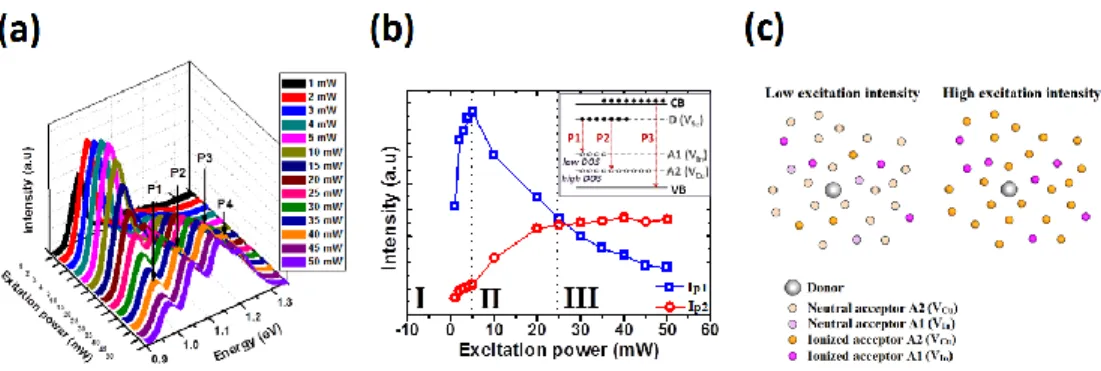
Power-dependent PL spectrum with variation of excitation power from 1 mW to 50 mW at 10K is shown in Fig. 3(a). It is noteworthy that the intensity of P1 first increases with the increasing excitation power and then started to decrease as the excitation power goes above 5 mW up to 50mW. The intensity of P2 increases monotonically with the rising excitation power. The evolution in PL intensity of P1 and P2 according to the deconvolution results are displayed in Fig. 3(b). This phenomenon is significantly distinct from the general knowledge, and implies competition between recombination mechanisms of P1 and P2. To clarify the transition mechanisms, we propose a model taking consideration of a competition in transitions between DA1P and DA2P due to their different transition rates under different
excitation conditions, which is caused by a great difference in concentration of A1 and A2 acceptors and a limited concentration of donors, as schematically illustrated in inset of Fig. 3(b).
When the excitation power is weaker than 5 mW, (as shown in region I of Fig. 3(b)), acceptor A1 dominates DAP recombination with the single-existing donor so that P1 is the main PL emission peak under this condition. Consequently a Coulomb interaction was observed in DA1P recombination, which was absent in DA2P recombination. Therefore the transition tendency of carriers from ionized donors toward acceptor A1 may be attributed to an enhanced transition rate of DA1P due to Coulomb force.
Fig. 3. (a) The PL spectrum of the CIGS thin film under excitation powers from 1 mW to 50 mW. (b) PL intensity of p1 (blue line) and p2 (red line) with temperature. Inset shows the schematic representation of proposed DAP transition. (c) A schematic illustration for conditions under low excitation and high excitation.
When the rising excitation power exceeds 5 mW, P1 and P2 show an unusual rise and fall in their intensity: the intensity of P1 decreases dramatically while the intensity P2 continues rising, as shown in region II of Fig. 3(b). We have deduced that this is due to a larger concentration of acceptor A2 which significantly surpasses that of acceptor A1. Such difference results in a rising transition rate of DA2P and a falling transition rate of DA1P and therefore switches the carrier transition tendency around.
Fermi’s golden rule has been utilized to describe the transition rate of spontaneous emission:
2 1 2 , e f f d E r i (4)where f is the density of state (DOS) of the final state in transition, here namely DOS belonging to one certain kind of acceptor among two, and f d•E re i is the dipole emission
matrix element. We have assumed that acceptors of the same kind possess an identical energy level. For acceptor A2, its higher DOS at its own energy level caused a higher transition rate of DA2P than that of DA1P. As the excitation power exceeded 5 mW, the transition rate of DA2P become more dominant compared to Coulomb interaction of DA1P. Consequently, the limited donor electrons were being removed more and more severely by acceptor A2. The transition tendency of carriers from the limited donors had been turned to acceptor A2 rather than acceptor A1 so that the PL intensity of P2 had gradually grown stronger and eventually surpassed the decreasing PL intensity of P1 (see region III in Fig. 3(b)). Due to the reason that the PL intensity of P1 showed decline rather than saturation, the donor must be insufficient for fulfilling both transitions to acceptor A1 and to acceptor A2 so that either one of them can be suppressed under different conditions. This is quite reasonable since CIGS is a p-type semiconductor. Another schematic diagram (Fig. 3(c)) indicates that difference in concentrations of the two acceptors could be more significantly affected under high excitation intensity since each acceptor has equal chance to be excited at all excitation intensities.
CIGS thin films providing good efficiency (including our sample), are of Cu-poor type. VCu is therefore expected to be abundant, as widely reported [25–28]. On the contrary, VIn is not much expected in our sample due to its GGI ratio of 0.2, which is pretty much an In-rich type. Moreover, the formation energy of VCu is very low, whereas the formation energy of VIn is a lot larger than that of VCu [2]. These facts reflect that the concentration of VCu is significantly higher than that of VIn.
An as-deposited CIGS thin film was fabricated into a CIGS solar cell and found to possess an efficiency of 12%, which is adaptable for applications. Although composition of point defects in CIGS thin films varies widely across literature, the characteristic of highly-compensated semiconductor remains universal, which has a good chance of inducing competition between optical transitions. CIGS-based solar cells can be affected by such phenomenon in performance especially as a concentrated photovoltaic. As the intensity of incident light can induce selective recombination between DAPs and results in significant change in their recombination rate, extraction of photo-current can be severely affected due to DAP-related carrier dynamics in CIGS, such as carrier extraction from ionized donors/acceptors, or tunneling-enhanced recombination in CIGS [30,31].Further study in competition between optical transitions is needed, yet it may be important for understanding CIGS-based solar cells.
5. Conclusion
In this work, we have measured PL of a CIGS thin film at different temperatures and excitation powers. According to the temperature-dependence PL spectra, we have identified these emission peaks as DA transitions and band-to-band transitions. Furthermore, we have observed obvious S-shape displacement of peak position in both DA transition and band-to-band transition. Analysis shows the parameter in modified Varshni empirical Eq. measuring potential fluctuation has found to be 7.7 eV, and is very close to the activation energy of 8.3 meV obtained from Arrhenius plot. The consistence strongly shows the existence of band fluctuation with potential depth around 8 meV which causes localization effect at low temperature. In addition, an unusual rise and fall has been observed in photoluminescence emission, and we conclude that this is due to transition competition between two DAPs, which are correlated to VSe – VCu transition and VSe – VIn transition. It is caused by concentration difference of the two acceptors and Coulomb force in between. Carrier localization and the new-discovered recombination competition may be affected to recombination current in a CIGS solar cell such as tunneling-enhanced recombination. Therefore they can be affected to efficiency as well and is important for understanding a CIGS solar cell.
Acknowledgments
The authors would like to thank Dr. Martin Charlton, Prof. Takayoshi Kobayashi and his group for their advices and help. The authors would also like to thank Compound Semiconductor Solar Cell Department, Next Generation solar cell Division, Green Energy and Environment Research Laboratories, Industrial Technology Research Institute of Taiwan for technical supports. This work was also supported by the Green Technology Research Center of Chang Gung University and the National Science Council (NSC) of Taiwan under contract no.s NSC97-2112-M-182-004-MY3 and NSC-100-2112-M-182 004.