This article was downloaded by: [National Chiao Tung University 國立交通大學] On: 27 April 2014, At: 23:57
Publisher: Taylor & Francis
Informa Ltd Registered in England and Wales Registered Number: 1072954 Registered office: Mortimer House, 37-41 Mortimer Street, London W1T 3JH, UK
Liquid Crystals
Publication details, including instructions for authors and subscription information: http://www.tandfonline.com/loi/tlct20
Synthesis and characterization of
naphthalene-substituted triphenylene discotic liquid crystals
Long-Hai Wu a , N. Janarthanan a & Chain-Shu Hsu aa
Department of Applied Chemistry, National Chiao Tung University Hsinchu, Taiwan 30050, Taiwan ROC
Published online: 06 Aug 2010.
To cite this article: Long-Hai Wu , N. Janarthanan & Chain-Shu Hsu (2001) Synthesis and characterization of naphthalene-substituted triphenylene discotic liquid crystals, Liquid Crystals, 28:1, 17-24, DOI: 10.1080/026782901462337
To link to this article: http://dx.doi.org/10.1080/026782901462337
PLEASE SCROLL DOWN FOR ARTICLE
Taylor & Francis makes every effort to ensure the accuracy of all the information (the “Content”) contained in the publications on our platform. However, Taylor & Francis, our agents, and our licensors make no representations or warranties whatsoever as to the accuracy, completeness, or suitability for any purpose of the Content. Any opinions and views expressed in this publication are the opinions and views of the authors, and are not the views of or endorsed by Taylor & Francis. The accuracy of the Content should not be relied upon and should be independently verified with primary sources of information. Taylor and Francis shall not be liable for any losses, actions, claims, proceedings, demands, costs, expenses, damages, and other liabilities whatsoever or howsoever caused arising directly or indirectly in connection with, in relation to or arising out of the use of the Content.
This article may be used for research, teaching, and private study purposes. Any substantial or
systematic reproduction, redistribution, reselling, loan, sub-licensing, systematic supply, or distribution in any form to anyone is expressly forbidden. Terms & Conditions of access and use can be found at http://www.tandfonline.com/page/terms-and-conditions
Synthesis and characterization of naphthalene-substituted
triphenylene discotic liquid crystals
LONG-HAI WU, N. JANARTHANAN and CHAIN-SHU HSU* Department of Applied Chemistry, National Chiao Tung University Hsinchu,
Taiwan 30050, Taiwan ROC (Received 2 March 2000; accepted 23 May 2000)
A series of naphthalene-substituted triphenylene liquid crystals (LCs), viz. triphenylene-2,3,6,7,10,11-hexay l hexakis(6-alkenyloxy-2-naphthoate)s (HTPnN compounds) were syn-thesized and characterized. Alkenyloxy groups containing three to eleven carbon atoms were used as peripheral spacers in these liquid crystals. The discotic liquid crystals synthesized trap one to three water molecules depending on the length of their peripheral spacers. DiŒerential scanning calorimetry, polarizing optical microscopy and X-ray diŒraction measurements con rm both nematic (Nd) and rectangular disordered columnar (Colrd) phases for most of the synthesized discotic LCs. The clearing temperatures of these discotic LCs increase with increasing peripheral spacer length. A hybrid aligned HTP9N sample was investigated to evaluate its optical performance. Retardation values of this hybrid sample decrease with increasing wavelength and increase with increasing measuring angle.
1. Introduction (2) an ideal phase match with the LC employed so that good compensation results can be achieved over the Discotic liquid crystals were rst reported by
entire visible region; (3) high optical transparency; and
Chandrasekhar et al. in 1977 [1]. Since then, many
(4) good uniformity [16]. In order to achieve the above liquid crystalline materials having disc-like shapes
requirements, various kinds of discotic LC with diŒerent have been synthesized and the eld was reviewed by
birefringences are needed. Furthermore, according to the Chandrasekhar in 1993 [2]. Generally, traditional
literature [13–15], a uniform discotic compensation lm hexa-alkyl substituted triphenylene discotic compounds
can only be prepared by aligning a discotic LC material [3–7] have the tendency to become polycrystalline at
below its Nd phase. Therefore, an ideal discotic LC
room temperature and form a columnar mesophase in
material should exhibit a wide Ndtemperature range so
which the disc-like mesogens are stacked closely and
as to have a wide processing window. So far, there are regularly within columns [8, 9] at elevated temperatures.
only a very limited number of discotic LCs that exhibit The situation changed in 1981 when
triphenylene-Nd phases and their Nd phase temperature ranges are
2,3,6,7,10,11-hexay l hexakis(4-n-alkoxy benzoate)s were
rather narrow.
found to exhibit Nd phases [10]. The eŒects of bulky
The aim of this study was to synthesize a new series lateral substituents on the mesomorphism of these
tri-of naphthalene-substitute d triphenylene derivatives, the phenylene benzoates were thoroughly investigated by
triphenylene-2,3,6,7,10,11-hexay l
hexakis(6-alkenyloxy-Goodby et al. [11, 12].
2-naphthoate )s. The naphthalene groups were intro-Recently nematic discotic liquid crystalline materials,
duced into the triphenylene core to alter the birefringence which exhibit negative birefringence, have demonstrate d
and facilitate the formation of the Nd phase [17].
their potential for applications as compensation lm
The alkenyloxy groups were used as peripheral spacers for wide viewing angle liquid crystal displays (LCDs)
to manipulate the phase transitions and provide the [13–15]. Some of the desired properties for an ideal
possibility for further oxidation of the terminal vinyl optical compensation lm for LCDs are: (1) an
appro-groups to form epoxy derivatives which can then be
priate phase retardation value,dDn (where d denotes the
photopolymerized to yield crosslinked networks. The
lm thickness and Dn represents the lm birefringence) mesomorphic properties were characterized by diŒerential
ranging from l/8 to l/2, depending on the application;
scanning calorimetry (DSC), polarizing optical micro-scopy (POM) and X-ray diŒraction. The sample of HTP9N synthesized was aligned as a monodomain and * Author for correspondence;
e-mail: [email protected] its optical properties were also investigated. L iquid Crystals ISSN 0267-829 2 print/ISSN 1366-585 5 online © 2001 Taylor & Francis Ltd
http://www.tandf.co.uk/journals
18 L.-H. Wuet al.
2. Experimental (TMS) as internal standard. A Seiko/SSC/5200 diŒer-ential scanning calorimeter was used for determining 2.1. Materials
Allyl bromide, 6-hydroxy-2-naphthoi c acid, veratrole thermal transitions. Heating and cooling rates were
10ßC minÕ 1. A Carl-Zeiss Axiophot polarizing
micro-and all other reagents were obtained from Aldrich micro-and
used as received. 3-Bromo-1-butene , 4-bromo-1-pentene , scope equipped with a Mettler FP 82 hot stage and a
Mettler FP 80 central processor was used to analyse the 5-bromo-1-hexe ne, 6-bromo-1-hept ene, 7-bromo-1-octe ne
8-bromo-1-nonene , 9-bromo-1-decen e and 10-undecen- thermal transitions and observe the mesomorphase
textures. X-ray diŒraction measurements were made with 1-yl tosylate were prepared according to literature
pro-cedures [18, 19]. 6-Alkenyloxy-2-naphthoi c acids (nNA a Rigaku powder diŒractometer using nickel- ltered
CuK
a radiation. Optical properties were studied using
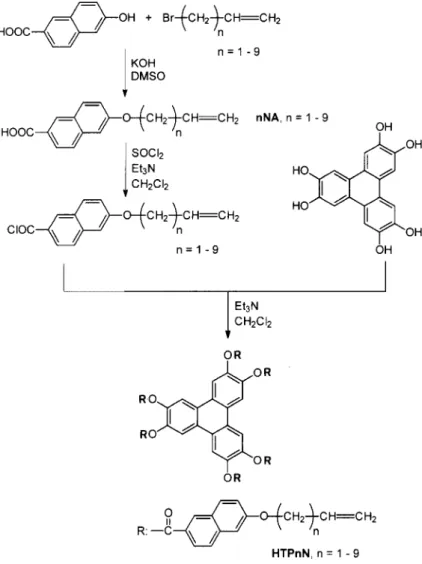
compounds, n5 1–9) were synthesized by esteri cation
of 6-hydroxy-2-n aphthoic acid with alkenyl halide accord- an Otsuka Multichannel retardation measuring system,
RETS-2000 (Osaka, Japan). ing to a literature procedure reported by our laboratories
[20]. 2,3,6,7,10,11-Hexahydroxytriphenylen e was
pre-pared according to the literature method reported by 2.3. Synthesis of triphenylene-2,3,6,7,10,11-hexay l
hexakis (6-alkenyloxy-2-naphthoate) s (HT PnN
Frederiket al. [21].
compounds, n5 1–9)
All HTPnN compounds were synthesized by the
2.2. T echniques
1H NMR spectra of all the compounds synthesized esteri cation of 2,3,6,7,10,11-hexahydroxytriphenylen e
with the corresponding 6-alkenyloxy-2-naphthoi c acids. were recorded on a Varian VXR-300 NMR spectrometer
(300 MHz) using CDC13as solvent and tetramethylsilan e An example for the synthesis of HTP9N is given below.
Figure 1. Synthetic routes to the naphthalene-substituted discotic liquid crystals HTPnN.
6-10-Undecenyloxy-2-naphthoi c acid (5 g, 0.015 mol ) 3. Results and discussion
3.1. Mesomorphic behaviour of 6-alkenyloxy-2-naphthoi c
was allowed to react with a two-fold excess of thionyl
chloride containing 5 drops of N,N-dimethylformamide acids (nNA compounds, n5 1–9)
Phase transition temperatures and phase transition in 50 ml of methylene chloride at room temperature for
2 h. The solvent and excess of thionyl chloride were enthalpies of the nNA compounds are summarized in
table 1. All the 6-(alkenyloxy)-2-naphthoi c acids syn-removed under reduced pressure to furnish the crude
acid chloride. The crude product was then dissolved in thesized have hydrogen bonded dimeric structures.
Compounds with short spacer lengths (1NA and 2NA) 50 ml of methylene chloride and added slowly to an
ice-cold solution of 2,3,6,7,10,11-hexahydroxytriphenylen e exhibit only a monotropic nematic phase. The ve
compounds with medium spacer lengths (3NA–7NA) (0.661 g, 0.025 mol) and triethylamine (2.23 g, 0.022 mol)
in 50 ml of methylene chloride. The mixture was stirred give enantiotropi c nematic phases, and the other two
compounds with longer spacers (8NA and 9NA) give a for 12 h and then the solvent was removed by rotary
evaporation. The solid obtained was dissolved in ethyl smectic A phase besides a nematic phase. Figure 2
depicts the DSC thermogram s of 8NA. As can be seen,
acetate and washed with 5% aqueous K2CO3and water
and dried with anhydrous MgSO4. Ethyl acetate was compound 8NA displays enantiotropi c nematic and
smectic phases. The clearing temperature decreases as removed under reduced pressure and the crude product
was puri ed by column chromatograph y (silica gel, the number of carbon atoms increases as shown in
gure 3, and a typical odd–even eŒect is also evident.
CH2Cl2as eluent) to yield 4.0 g (85%) of yellowish solid.
1H NMR (CDC1
3, 300 MHz) d (ppm)5 1.32 (m, 72H,
( CH2)6 ) 1.76 (m, 12H, O CH2 CH2 ); 2.03 (m, 12H, 3.2. Characterization and thermal behaviour of
triphenylene-2,3,6,7,10,11-hexay l hexakis
(6-alkenyloxy-CH2 CH CH2 ); 3.89 (t, J5 6.3 Hz, 12H, O CH2 );
4.94 (m, 12H, CH2 CH ); 5.80 (m, 6H, CH2 CH ); 6.59 2-naphthoate) s (HT PnN compounds, n5 1–9)
The1H NMR spectrum of HTP8N was representative
(s, 6H, Harom); 6.76 (d, J5 8.9 Hz, 16H, Harom); 7.01
(d,J5 8.8 Hz, 6H, Harom); 7.15 (d,J5 9.0 Hz, 6H, Harom); and showed a peak at 1.6 ppm which belongs to the
protons of the included water molecules. This peak did
7.76 (d, J5 9.2 Hz, 6H, Harom); 8.24 (s, 6H, core); 8.54
(s, 6H, Harom). not disappear when distilled, dry CDC13 was used as
Table 1. Phase transitions and transition enthalpy changes fornNA compounds: Cr5 crystalline, SmA5 smectic A, N5 nematic, I5 isotropic.
2nd heating Compound Transition temp./ßC (enthalpy change/kcal molÕ 1) 1st cooling
1NA Cr 206.6 (24.8) I I 206.4 (Õ 0.05) N 152.4 (Õ 28.5) Cr 2NA Cr 199.9 (33.1) I I 187.5 (Õ 1.8) N 179.9 (Õ 28.5 ) Cr 3NA Cr 151.5 (20.5) N 197.7 (3.3) I I 194.9 (Õ 2.7) N 134.2 (Õ 20.4 ) Cr 4NA Cr1 30.0 (0.7) Cr2148.0 (12.1) N 191.1 (2.0) I I 184.7 (Õ 2.3) N 133.7 (Õ 16.9 ) Cr 2 122.4aCr1 5NA Cr1 34.0 (4.4) Cr2148.0 (12.1) N 191.2 (2.0) I I 188.0 (Õ 2.0) N 133.5 (Õ 11.2 ) Cr 2 3.8 (Õ 4.3 ) Cr1 6NA Cr1 57.9 (6.5) Cr2105.7 (0.2) Cr3 147.6 (15.3) N 180.9 (1.9) I I 178.0 (Õ 2.2) N 133.9 (Õ 14.9 ) Cr 3 94.2 (Õ 0.1 ) Cr2 43.7 (Õ 7.3 ) Cr1 7NA Cr1 34.0 (1.4) Cr2102.4 (13.7) Cr3139/1 (13.0) N 181.2 (2.2) I I 178.0 (Õ 2.2) N 128.8 (Õ 12.7 ) Cr 3 26.4 (Õ 13.6 ) Cr2 Õ 0.2 (Õ 0.3 ) Cr1 8NA Cr 129.5 (12.0) SmA 133.9 ( 0.8) N 174.2 (2.1) I I 172.2 (Õ 1.8) N 131.3 (Õ 0.8) SmA 115.7 (Õ 3.9) Cr 9NA Cr1 120.6 (30.2) Cr2126.5a SmA 137.2 (0.4) N 171.0 (1.9) I I 168.3 (Õ 2.0) N 133.4 (Õ 0.6) SmA 104.9 (Õ 10.3) Cr 3101.7aCr259.3 (Õ 3.4) Cr1 aOverlapped transitions.
20 L.-H. Wuet al.
Table 2. Elemental analysis data for HTPnN compounds. Compound Formula Calculated/% Found/%
HTP1N C102H72O18H2O C: 76.49 a H: 4.66 HTP2N C108H84O18H2O C: 76.85 C: 76.50 H: 5.14 H: 5.04 HTP3N C114H96O182H2O C: 77.27 C: 77.10 H: 5.57 H: 5.77 HTP4N C120H108O182H2O C: 76.90 C: 77.82 H: 6.02 H: 5.91 HTP5N C126H120O182H2O C: 77.28 C: 77.46 H: 6.38 H: 6.40 HTP6N C132H132O183H2O C: 77.62 C: 77.81 H: 6.71 H: 6.80 HTP7N C138H144O183H2O C: 77.28 C: 77.21 H: 7.05 H: 7.01 HTP8N C144H156O183H2O C: 77.60 C: 77.70 H: 7.33 H: 7.24 HTP9N C150H168O182H2O C: 78.50 C: 78.38 H: 7.55 H: 7.53 Figure 2. DSC traces for 8NA (from top to bottom: rst
cooling, second heating runs). a
No satisfactory data are available.
Colrd mesophases except for HTN1N, which shows no
mesophase on melting with decomposition. It is found that the clearing temperatures generally decrease with increasing number of carbon atoms in the peripheral alkenyl chains.
Compounds HTP2N–HTP6N present a similar thermal behaviour. Figure 4 depicts a representative DSC thermogram for compound HTP6N. The rst
heating curve shows a melting transition at 170.3ßC, a
Colrdto Nd transition at 201.0ßC and a Nd to isotropic
transition at 273.3ßC. The rst cooling scan reveals an
isotropic to Ndtransition at 270.1ß C, and an Ndto Colrd
transition at 131.2ß C, but no crystallization transition is
shown. When the sample was further cooled to room
temperature, the Colrdtexture was frozen in and did not
Figure 3. Clearing temperatures ofnNAs as a function of n. change for more than one week. The second heating
scan shows only a Colrdto Nd transition at 198.2ßC and
an Ndto isotropic transition at 273.1ßC. Figure 5 depicts
solvent. The elemental analysis results for the HTPnN
compounds listed in table 2 con rmed the inclusion of the Nd and Colrdtextures shown by HTP6N.
HTP7N–HTP9N reveal similar thermal behaviours.
the water molecules. It is clear that the HTPnN
com-pounds include one to three water molecules depending Figure 6 presents the representativ e DSC thermogram for
HTP8N. The rst heating scan shows a recrystallization on their spacer length. As a general trend, the number
of included water molecules rst increases and then transition at 155.2ßC, a Colrdto Nd phase transition at
174.2ßC and an Nd to isotropic phase transition of low
decreases as the carbon number of the peripheral alkenyl
chain increases. Frederik et al. [21] also reported this enthalpy at 224.9ßC, whereas the rst cooling scan shows
only an isotropic to Ndphase transition at 223.6ßC. The
water-inclusion phenomenon.
Table 3 summarizes the phase transition temperatures second heating scan looks very similar to the rst
heat-ing scan except for its broader recrystallization peak.
and phase transition enthalpies for the HTPnN
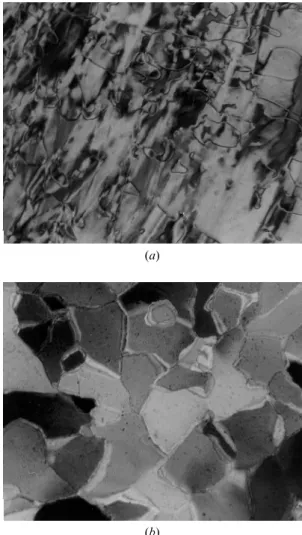
com-pounds. All these discotic compounds exhibit Nd and Figure 7 (a) shows the typical nematic schlieren texture
Table 3. Phase transitions and transition enthalpy changes for HTPnN compounds: Colrd 5 rectangular disorder and columnar mesophase, Nd 5 discotic nematic mesophase, I5 isotropic phase.
2nd heating Compound Transition temp./ßC (enthalpy change/kcal molÕ 1) 1st cooling
HTP1N No transition was observed before decomposition. HTP2N Colrd249.9 (1.67) Nd330.1aI I 325.1aNd214.8 (Õ 0.1 ) Col rd HTP3N Colrd227.4 (1.67) Nd327.5aI I 324.2aN d178.6 (Õ 2.00 ) Colrd HTP4N Colrd227.4 (0.86) Nd288.8aI I 285.7aNd146.8 (Õ 1.08 ) Col rd HTP5N Colrd222.0 (2.15) Nd286.5 (0.04) I I 280.1 (Õ 0.04 ) N d164.2 (Õ 2.37 ) Colrd HTP6N Colrd198.2 (2.24) Nd273.1 (0.05) I I 270.1 (Õ 0.04 ) N d131.2 (Õ 2.89 ) Colrd HTP7N Colrd174.2 (1.84) Nd235.7 (0.05) I I 233.8aNd HTP8N Colrd174.2 (1.84) Nd224.9 (0.05) I 233.6aNd HTP9N Colrd155.5 (0.45) Nd217.6 (0.05) I I 214.2aN d aTransition observed via POM.
peak in the small angle region. The wide angle diŒraction peak relates to the lateral distance between triphenylene cores, while the small angle diŒraction peak is attributed to the diameter of the triphenylene core. This con rms
the formation of an Nd phase. By lowering the
temper-ature from 210 to 170ßC, the small angle diŒraction
peak splits into two peaks at 29.1 and 35.4 AÃ as shown
in curve B. In addition, the large angle region shows only a very broad diŒusion peak. This provides evidence for the formation of a rectangular disordered columnar phase [21].
In comparison with triphenylene-2,3,6,7,10,11-hexay l
hexakis (4-n-alkoxybenzoate )s, it is obvious that the
incorporation of six naphthalene moieties facilitates the Figure 4. DSC traces for HTP6N.
formation of the discotic nematic mesophase. Tinhet al.
[10] reported that triphenylene-2,3,6,7,10,11-hexay l exhibited by HTP8N. Upon cooling to room
temper-hexakis(4-decyloxybenzoate ) gave an Nd phase for a
ature, the nematic texture was frozen and recrystallized
range of only 21.0ßC. However, the corresponding
hexa-during the second heating scan, see gure 7 (b). The high
naphthalene substituted triphylene discotic material molecular mass, which makes these discotic compounds
HTP8N gives a much broader Ndrange of over 250.0ß C
turn into glassy states, may be responsible for the
as shown by the cooling scan process. inhibition of columnar mesophase formation during the
cooling processes.
The phase assignments for the HTPnN compounds
3.3. Optical anisotropy measurement
were con rmed by X-ray diŒraction. Figure 8 shows the
Some optically anisotropic properties of HTP9N were temperature dependent X-ray diŒraction patterns obtained
next investigated. A small amount (0.1 g) of HTP9N was from a powder sample of HTP8N. Curve A, which was
dissolved in 0.5 ml of methyl ethyl ketone and
spin-obtained at 210ßC, shows a very broad diŒraction peak
in the wide angle region and a very strong diŒraction coated onto a rubbed polyimide surface. The sample
22 L.-H. Wuet al.
(a)
(b) (a)
(b)
Figure 7. Optical textures of HTP8N at (a) 187ßC, Nd; Figure 5. Optical textures of HTP6N at (a) 257ßC, Nd;
(b) 160ßC, frozen Nd(crossed polarizers, magni cationÖ 200). (b) 160ßC, Colrd(crossed polarizers, magni cationÖ 200 ).
and azimuthal angles (0–Ô 50ß ). This monodomain
hybrid arrangement remained unchanged at room
tem-perature (about 25ß C) for over two months even though
it was not a crosslinked network.
Figures 11 and 12 depict, respectively, the
angle-dependent and wavelength-dependen t retardations
measured for the hybrid aligned HTP9N sample (with
azimuthal angle5 0ß ). Its retardation values are in the
range 20–90 nm. The retardation values increase with increasing measuring angle and decrease with increasing wavelength.
This mono-domai n aligned HTP9N sample shows diŒerent retardation values at a xed angle from diŒerent directions. Figure 13 shows that the retardation value Figure 6. DSC traces for HTP8N. decreases gradually from 0 to Ô 50ß azimuthal angle
(with measuring angle5 50ß ). This indicates that the
HTP9N molecules are arranged in a biaxial way in
was annealed at 180ß C for 5 min to achieve a
mono-domain hybrid arrangement as shown in gure 9. This which the discotic molecule has its plane inclined from
the plane of polyimide substrate at an angle varying hybrid structure was con rmed by optical measurements
(see gure 10) at several diŒerent viewing angles (10–60ß ) along the direction of the depth of the anisotropic layer.
Figure 10. Experimental set-up for measurement of optical properties.
Figure 8. X-ray power diŒractograms of HTP8N at (A) 210ßC, Nd; (B) 170ßC, Colrd.
Figure 11. Retardation values of HTP9N for diŒerent wavelengths as a function of measuring angle.
Figure 9. Optical texture of monodomain prepared from HTP9N (crossed polarizers, magni cationÖ 200).
From the above results, it is clear that these naphthalene-containing discotic liquid crystals can be used in pre-paring optical retardation lms for improving the viewing angle of LCDs.
In order to form a cross-linked network, the HTPnN
compounds were oxidized with m-chloroperoxybenzoic
acid (MCPBA) to yield the epoxy derivatives which might then be photopolymerized to form a crosslinked network. Unfortunately, we only obtained mixtures of
the epoxy derivatives, and pure materials could not be Figure 12. Retardation values of HTP9N for diŒerent
measuring angles as a function of wavelength. obtained from these epoxide mixtures.
24 Naphthalene-substitute d triphenylene L Cs
References
[1] Chandrasekhar, S., Sadashiva, B. K., and Saresh, K. A., 1977,Pramana, 9, 471.
[2] Chandrasekhar, S., 1993, L iq. Cryst., 14, 3.
[3] Collard, D. M., and Lillya, C. P., 1991, J. org. Chem.,
56, 6064.
[4] Boden, N., Bushby, R. J., Cammidge, A. N., and Martin, P. S., 1995, J. mater. Chem., 5, 1857.
[5] Rego, J. A., Kumar, S., Dmochowski, I. J., and Ringsdorf, H., 1996, Chem. Commun., 1031.
[6] Boden, N., Bushby, R. J., Cammidge, A. N., Duckworth, S., and Headdock, G., 1997, J. mater. Chem., 7, 601.
[7] Closs, F., Haubling, L., Henderson, H., Ringsdorf, H., and Schuhmacher, P., 1995, J. chem. Soc., Perkin T rans., I, 829.
[8] Levelut, A. W., 1979, J. Phys. L ett., 40, L81.
[9] Destrade, C., Tinh, N. H., Gasproux, G., Figure 13. Retardation values of HTP9N measured from diŒer- Malthete, J., and Levelut, A. M., 1981, Mol. Cryst.
ent azimuthal angles (measuring angle: 50ß, wavelength: liq. Cryst., 71, 111.
550 nm). [10] Tinh, N. H., Gasparous, H., and Destrade, C., 1981, Mol. Cryst. liq. Cryst., 68, 101.
[11] Hindmarsh, P., Hird, M., Styring, P., and
4. Conclusion
Goodby, J. W., 1993, J. mater. Chem., 3, 1117. A new series of naphthalene-substitute d LCs, viz.
[12] Hindmarsh, P., Watson, M. J., Hird, M., and
triphenylene-2,3,6,7,10,11-hexay l hexakis(6-alkenyloxy- Goodby, J. W., 1995, J. mater. Chem., 5, 2111.
2-naphthoate )s were synthesized and characterized. All [13] Favre-Nicolin, C. D., and Lub, J., 1996,
Macromolecules, 29, 6143.
the HTPnN compounds prepared, except HTP1N, gave
[14] Mori, H., and Bos, P. J., 1998, SID, 98, Dig., 830.
Nd and Colrd phases. The results demonstrate that
[15] Mori, H., Itoh, Y., Nishiura, Y., Nakamura, T., and introducing six naphthalene groups into the triphenylene
Shinagawa, Y., 1997,SID, 97, Dig., 941.
core widens the mesomorphic temperature range. Most [16] Wu, S. T., 1995, Mater. Chem. Phys., 42, 163.
of the HTPnN compounds obtained have very wide tem- [17] Praefcke, K., Kohne, B., and Singer, D., 1990, L iq.
Cryst., 7, 589.
perature range Nd phases. They could be easily aligned
[18] Percec, V., and Hahn, B., 1989, J. polym., Sci: polym. on glass substrate s which were coated with unidirectionall y
Chem., 27, 2367.
rubbed polyimide; a mono-domai n hybrid arrangement [19] Percec, V., Hsu, C. S., and Tomazos, D., 1988, J. polym.,
was then obtained. These HTPnN compounds can be Sci: polym. Chem., 26, 2047.
mixed with other UV-curable discotic monomers to [20] Lin, J. L., and Hsu, C. S., 1993, Polym. J., 25, 153.
[21] Frederik, C. K., Niels, C. S., Walther, B., and form mixtures for the fabrication of compensation lms
Klaus, B., 1997, Synthesis, 1285. with desired retardation values.
[22] Zamir, S., Wachtel, E. J., Zimmermann, H. Z., and Dai, S., 1997, L iq. Cryst., 5, 689.
The authors are grateful to the National Science [23] Collings, P. C., and Hird, M., 1997, Introduction to
Council of the Republic of China for nancial support. L iquid Crystals (London: Taylor & Francis), pp. 79–92.