國
立
交
通
大
學
資訊學院 資訊學程
碩
士
論
文
在 SDN 網路下滿足服務品質之適應式路由機制
Adaptive Routing for Video Streaming with QoS Support over
SDN Networks
研 究 生:余宗峰
指導教授:王國禎 教授
在 SDN 網路下滿足服務品質之適應式路由機制
Adaptive Routing for Video Streaming with QoS Support over
SDN Networks
研 究 生:余宗峰 Student:Tsung-Feng Yu
指導教授:王國禎 Advisor:Kuochen Wang
國 立 交 通 大 學
資 訊 學 院 資 訊 學 程
碩 士 論 文
A ThesisSubmitted to College of Computer Science National Chiao Tung University in Partial Fulfillment of the Requirements
for the Degree of Master of Science
in
Computer Science
June 2013
Hsinchu, Taiwan, Republic of China
i
在SDN網路下滿足服務品質之適應式路由機制
學生:余宗峰 指導教授:王國禎 博士
國立交通大學資訊學院資訊學程
摘 要
於傳統網路上,由於缺乏對於整體網路資源的掌握,所以難以針
對多媒體應用程式,如視訊串流,提供服務品質(QoS)保證的服務。 軟
體定義網路提供了一個創新的方法,利用將控制層與轉送層分開來實
現集中控制與管理工作。在本論文中,我們提出一個在軟體定義網路
上,對於視訊串流提供服務品質保證的動態路由方法。透過可適性編
碼視訊 (scalable encoded videos),將其中的基礎層與加強層的封
包做分類,並賦予基礎層有重新找路由的最高優先權,使能在最短路
徑不符合延遲差異的限制下,重新找路由直到有可用頻寬充足的路徑。
相反地,若此路徑可用頻寬不足時,則讓加強層封包重新導路由至此
ii
礎層的封包遺失率(Packet Loss Rate),可以改善最高達 77.3%,並
針對最短路徑與可行路由路徑,在不同網路負載情況下,提供至少
51.4%的覆蓋率。
iii
Adaptive Routing for Video Streaming
with QoS Support over SDN Networks
Student: Tsung-Feng Yu Advisor: Dr. Kuochen Wang
Degree Program of Computer Science National Chiao Tung University
Abstract
For multimedia applications, such as video streaming applications, with the need of Quality of Service (QoS) support, it is difficult to successfully implement QoS architectures in traditional networks which lack a global view of overall network resources. Software Defined Networking (SDN) provides an innovative architecture to realize central management among networks. In this paper, we propose an adaptive routing approach for video streaming with QoS support over SDN networks, called ARVS. In our approach, base layer packets and enhancement layer packets of video bit streams are treated separately as two levels of QoS flows. During video streaming, if the shortest path does not satisfy the delay variation constraint, the base layer packets have the first priority to be rerouted to a calculated feasible path based on available bandwidth of this path, and the enhancement layer packets will stay on the shortest path. However, if there is no available bandwidth in this path, the base layer packets will stay on the shortest path while the enhancement layer packets will be rerouted to this path. Therefore, the video quality would be guaranteed easily due to the congestion of the shortest path has been mitigated. Simulation results have shown
iv
that compared with OpenQoS, our approach can reduce up to 77.3% of the packet loss rate for the base layer packets of video bit streams, and also enhance at least 51.4% coverage under various network loads of the shortest path and the feasible path.
v
Acknowledgements
Many people have helped me with this thesis. I deeply appreciate my thesis advisor, Dr. Kuochen Wang, for his intensive advice and guidance. I would like to thank all the members of the Mobile Computing and Broadband Networking
Laboratory (MBL) for their invaluable assistance and suggestions. Finally, I thank my
vi
Contents
Abstract (in Chinese)……….………...i
Abstract ... iii
Contents ... vi
List of Figures ... vii
List of Tables ... viii
Chapter 1 Introduction ... 1
Chapter 2 Related Work ... 4
Chapter 3 Proposed Adaptive routing for Video Streaming with QoS Support .... 9
3.1 Related notations and LARAC algorithm ... 9
3.2 Dynamic and adaptive routing ... 10
3.3 The flowchart for the proposed ARVS ... 13
Chapter 4 Simulation Results and Discussion ... 16
4.1 Simulation environment ... 16
4.2 Comparison of packet loss rates between the proposed ARVS and OpenQoS ... 17
4.3 Packet loss rate comparison of QoS level-1 flows under different network load levels of the shortest path and the feasible path ... 20
Chapter 5 Conclusion ... 22
5.1 Concluding remarks ... 22
5.2 Future work ... 22
vii
List of Figures
Figure 1. Software-defined networking architecture [6] ... 2
Figure 2. OpenFlow controller and interfaces [13] ... 6
Figure 3. LARAC algorithm [11] ... 11
Figure 4. QoS level-2 flow rerouting. ... 12
Figure 5. QoS level-1 flow rerouting. ... 13
Figure 6. The flowchart for the proposed ARVS. ... 15
Figure 7(a). Comparison of packet loss rates between the proposed ARVS and OpenQoS [13] (rbe = 1: 1) ... 18
Figure 7(b). Comparison of packet loss rates between the proposed ARVS and OpenQoS [13] (rbe = 1: 3.6). ... 19
Figure 8(a). The packet loss rates comparison of QoS level-1 flows under different network load levels of the shortest path and the feasible path (rbe = 1: 1). ... 20
Figure 8(b). The packet loss rates comparison of QoS level-1 flows under different network load levels of the shortest path and the feasible path (rbe = 1: 3.6) ... 21
viii
List of Tables
Table 1. Comparison of related work with the proposed ARVS on QoS routing ... 8 Table 2. Adaptive routing simulation parameters. ... 17
1
Chapter 1
Introduction
The traditional design of computer networks is not able to meet the current requirements of services adequately, such as traffic flow control, intermediate network processing and quality of service (QoS). The architecture of computer networks needs to be revised entirely, and transform itself to suit in future Internet [1].
The QoS-adaptive mechanism plays a key role in packet-switched networks since the advent of streaming multimedia applications, such as IPTV (Internet Protocol Television) and video-on-demand. With QoS support, service providers can offer users with QoS provisioning to meet even strict service demands, and guarantee a certain level of performance (e.g., low packet loss rate) about data flows, for example, high bit rate (throughput) for real-time multimedia services, low latency (delay) for voice over IP (VoIP), or online gaming with low jitter (delay variation) for video conferencing or VoIP. However, because of existing QoS architectures such as IntServ [2] and Diffserv [3] are based on best-effort networks [4] and they lack a global vision on overall network resources, QoS architectures still have not been implemented successfully, and many works on QoS routing are still in process.
For streaming media applications, offering video services with the best QoS is inefficient and costly for providers. In contrast, the quality cannot be guaranteed while video streaming is sent via a best-effort stream, especially for those videos that are encoded in a single layer, such as H264/MPEG-4 AVC. Scalable Video Coding (SVC) standardizes the high-quality video encoding which contains one or more subset bit streams, such as MPEG-4 SVC [5], which encodes a video into a base layer and one
2
or more enhancement layers. The video in the base layer should be streamed without any packet loss or delay variation for a reasonable quality, and the video in the enhancement layer can be regarded as either best-effort or QoS flows. Therefore, it supports providers to guarantee a different level of video quality and reasonable cost at the same time.
Today the emerging Software-Defined Networking (SDN) provides an innovative way to let network administrators have central and programmable control of overall network traffic. SDN separates the control plane from the data plane, which provides abstractions in building computer networking systems, and thus one can take advantage of common APIs (Application Programming Interfaces) and controllers to manage the traffic flow, as shown in Figure 1 [6]. OpenFlow is the first standardized protocol defined between control and forwarder layers of SDN architecture, and it allows network administrators to make decisions about how data flows should be routed between network devices and switches along the optimizing paths in networks.
Figure 1.Software-defined networking architecture [6] Application Layer
Infrastructure Layer
Application Application Application
SDN Control Software Network Service Network Service Network Service
Network Device Network Device
Network Device
API API API
Control Data Plane Interface (OpenFlow) Control Layer
3
With the characteristics of central management and flexibility property in SDN architecture, OpenFlow can help service providers to achieve better QoS performance by offering traffic differentiation.
In this paper, we design an adaptive routing approach with QoS support to improve the quality of video streaming over SDN networks. The introduction to QoS provision in traditional and SDN networks are reviewed in Chapter 2. In Chapter 3, we detail our adaptive routing approach for video streaming with QoS support over SDN networks. The simulation setup and results are presented in Chapter 4. Chapter 5 concludes this paper and gives future work.
4
Chapter 2
Related Work
In traditional routing, only one metric, such as packet loss, delay, and delay variation, needs to be considered when making routing decisions. In QoS routing, there are multiple metrics (constraints), such as packet loss, delay, and delay variation, which are expected to be satisfied simultaneously for a path selection from source s to destination t. Thus the cost of optimized paths for QoS routing should consider not only the shortest paths between end-to-end nodes but also the additive metrics that mentioned above [7]. However, it has been proved that a routing problem is NP-complete if the number of QoS related metrics is more than two [8].
Some QoS routing algorithms are proposed to solve Constrained Shortest Path (CSP) and Multi Constrained Path (MCP) problems. Wang and Crowcroft [9] and Xue et al. [10] both focused on MCP problems and came up with improved path selection algorithms. Juttner et al. [11] proposed one method for delay-constrained least cost (DCLC) problem using LARAC (Lagrange Relaxation based Aggregated Cost) algorithm and found a theoretical lower bound along with the solution. Chen et al. [12] provided two algorithms for the CSP problem, but the performance was not better than that in [11] due to the slower running time. Hilmi et al. [13] presented an optimized framework for QoS routing with the help of SDN which collectes information about the network state to calculate routing paths and dynamically change network routing. This is the reason why the performance in [13] is superior to [9]– [12].
5
switches by the controller, and one can define different routing rules for specific data flows while the network state or topology is always changing. Hilmi et al. [13] employed such a special scheme to classify data flows into three types, QoS level-1, QoS level-2 flows and best-effort flow, and gave different routing rule for each of them. In order to meet the certain level of QoS requirements, the data flows are able to be rerouted apart from the current path in networks. Thus the load level of the original path would be mitigated in this way.
With the help of OpenFlow-based SDN architecture, as shown in Figure 2, OpenQoS [13] can manage and control all types of data flows in the control layer, so it provides flexible policy to perform any routing rules in the network. Furthermore, the centralized scheme of SDN has the ability to entirely monitor the network topology and routing status, and timely modify the path selection according to the changes of network state. Applying SDN is also the major reason why OpenQoS [13] outperforms the previous work [9]–[12].
6
Although QoS routing on video streaming in [13] is determined by different flow types and can be rerouted dynamically with minimal impact on best-effort flows, it is still possible that these QoS flows will not have enough available paths to be rerouted. It may result in poor performance of QoS-enabled transmission. There are two approaches presented in [13]; the first one is to treat all data flows as QoS flows and best-effort flows, while the other one is to treat all traffic flow as QoS level-1flows, QoS level-2 flows and best-effort flows. According to the simulation result in [13], both approaches are barely satisfied with the performance on high bit rate video streaming, the Peak Signal to Noise Ratio (PSNR) value degrades seriously especially in high traffic congestion of the network. This is because when the network load increases, the rerouting scheme in [13] can’t work elaborately. Besides, it only considers the congestion level of the shortest path while the first priority for rerouting always belongs to the base layer packets of video bit streams. This may lead to poor
Figure 2. OpenFlow controller and interfaces [13] Video Service Controller Service Management Topology Management SLA Management Route Management Route Calculation Traffic Policing Service Reservation Controller – Application Interface
Controller – Forwarder Interface Forwarders Flow Table
7
performance for the base layer packets when the other paths are not fully capable to transfer the base layer packets.
The routing policy could be designed more cautiously and adequately, the traffic conditions of all paths, such as the original path and the rerouted path, should be considered comprehensively if the data flows of video streaming start to be rerouted. The base or enhancement layer packets can be chosen to be transferred on other paths since it is important to stream the base layer video without any packet loss or delay variation. This is what we proposed in this paper, to improve the performance of QoS-enabled video streaming under various loads of the original path and the rerouted path, then guarantee the quality of the base layer packets. The comparison of related work and our proposed ARVS approach is shown in Table 1.
8
Table 1. Comparison of related work with the proposed ARVS on QoS routing.
Approach Wang and Crowcroft [9]、 Xue et al. [10]、 Juttner et al. [11]、 Chen et al. [12]
Hilmi E. et al. [13] The Proposed Approach
Topology Management
No, lack of central control
Yes, with central control
Yes, with central control
Route Management
No, lack of central control
Yes, with central control
Yes, with central control
Route Calculation
Yes, with proposed algorithms
Yes, with central control
Yes, with central control
Dynamic No, the routing paths are fixed
Yes, with rerouting mechanism
Yes, with flexible rerouting mechanism Performance – Received Video Quality Depends on link capacity as best-effort flows Improved with rerouting base layer packets Improved more with rerouting base/enhancement layer packets Loading Balance
No, lack of rerouting mechanism
No, only consider the congestion level of shortest path links
Yes, consider the congestion level of all links
9
Chapter 3
Proposed Adaptive Routing for Video
Streaming with QoS Support
In this chapter, we present the proposed adaptive routing for video streaming with QoS (ARVS) to support various load levels in SDN network.
3.1 Related Notations and LARAC Algorithm
For streaming multimedia applications, Quality of Service (QoS) is mostly affected by flowing indicators: packet loss, delay, and delay variation (jitter). Video streaming applications demand stable packet delivery in networks, so we take the delay variation (jitter) as a given constraint to the CSP problem in this thesis.
The network that we present here is denoted as a directed graph G (N, A), where
N is a set of nodes and A is a set of paths. R(s, t) represents a set of all routes between
source node s and destination node t, so the CSP problem is to minimize the path cost function fC (r) of the routing path r subject to a given constraint (maximum delay
variation, ∆D) as below,
𝑚𝑖𝑛 { 𝑓C (𝑟) | 𝑟 ∈ 𝑅(𝑠, 𝑡), 𝑓D (𝑟) ≤ ∆D } (1)
where fD (r) is the function to calculate the delay variation of r, and the path cost c we
set here is the weighted sum of the delay variation and the packet loss rate on a path. The goal in the CSP problem is to find the least cost path among those that satisfy only one constraint, as mentioned above. We take the delay variation (jitter) as the constraint. For solving the CSP problem, we also employ the LARAC (Lagrange Relaxation based Aggregated Cost) algorithm. The reason that we choose LARAC is
10
mentioned in Chapter 2. LARAC can find the best lower bound to problem (1) [11][13]. The LARAC algorithm is shown in Figure 3. First, LARAC finds the shortest path (rC) based on path cost. If a shortest path satisfies the constraint which is
delay variation, this path will be the optimal path; otherwise, LARAC checks if a feasible path exists or not. The feasible path (rD) is the shortest path that is calculated
based on path delay variation. If this path does not satisfy the delay variation constraint, there will no feasible solution and the algorithm will stop.
3.2 Dynamic and Adaptive Routing
In SDN networks, different routing rules are able to be defined simultaneously for different types of data flows. Thus, we classify two different data flow types accordingly: QoS level-1 and QoS level-2 flows. A QoS level-1 flow belongs to the
Figure 3. LARAC algorithm [11]
procedure LARAC (G, s, t, c, d, ∆ D)
rC ← Dijkstra (G, s, t, c)
if fD (rC) ≤ ∆ D then return rC
else rD ← Dijkstra (G, s, t, d)
if fD (rD) > ∆ D then return “No feasible solution.”
else while true do λ ← (fC (rC) – fC (rD)) / (fD (rD) - fD (rC)) r ← Dijkstra (G, s, t, cλ) if fλ (r) = fλ (rC) then return rD else if fD (r) ≤ ∆ D then rD ← r else rC ← r end if end while end if end if end procedure
11
base layer packets of video bit streams, and a QoS level-2 flow belongs to the enhancement layer packets of video bit streams. It is important to keep stable base layer packets of video bit streams in receiving video quality, so a QoS level-1 flow possess the highest priority to be rerouted through another available path or it monopolizes the current routing path. Whether a QoS level-2 flow needs to be rerouted from the current routing path or not is according to the opposite decision that a QoS level-1 flow has made.
In SDN networks, one video is streaming between two end nodes s and t through the shortest path (rC) which is calculated from the controller based on path cost. That
is, QoS level-1 and QoS level-2 flows are routed on the shortest path at the beginning. If the shortest path does not satisfy the delay variation constraint (∆D), a QoS level-1
flow or QoS level-2 flow will have an opportunity to be rerouted on the feasible path (rD) which is the second path that is found by the LARAC algorithm based on path
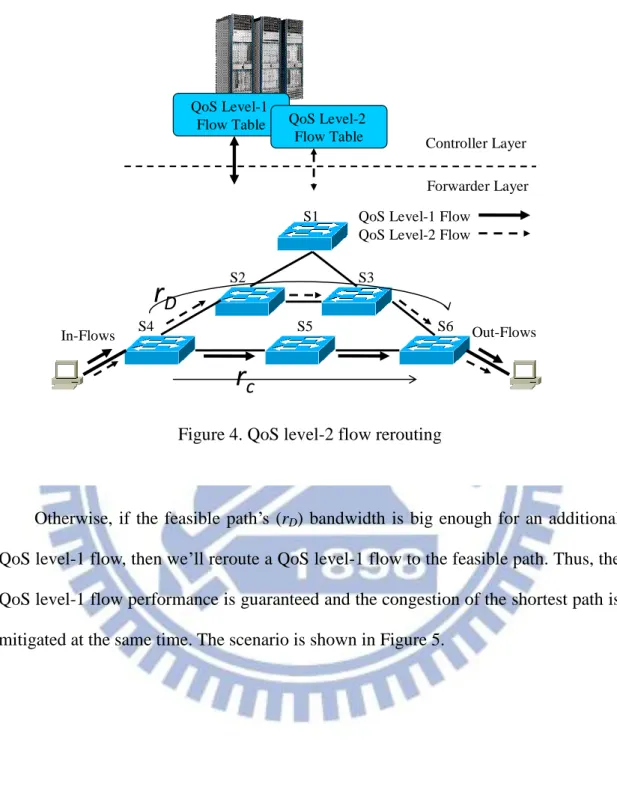
delay variation. It is important to guarantee the performance of QoS level-1 flow transmission since a QoS level-1 flow belongs to the base layer packets of video bit streams. Thus, the feasible path’s condition needs to be examined before starting rerouting the current data flow. If a QoS level-1 flow is rerouted to the feasible path which has no available bandwidth, it will result in a high packet loss rate for QoS level-1 flow transmission. The advantage of the rerouting scheme will not be revealed due to the poor performance of rerouting the QoS level-1 flow. Thus, we propose an adaptive routing for video streaming with QoS support to reroute a QoS level-1 flow or a QoS level-2 flow alternatively as follows. To this effect, if the amount of best-effort traffic (T) and QoS level-1 flow (Q1) exceeds the bandwidth (B) of the feasible path, then we’ll choose a QoS level-2 flow to be rerouted. It’s because that a QoS level-2 flow is less important than a QoS level-1 flow. The scenario is shown in Figure 4.
12
Otherwise, if the feasible path’s (rD) bandwidth is big enough for an additional
QoS level-1 flow, then we’ll reroute a QoS level-1 flow to the feasible path. Thus, the QoS level-1 flow performance is guaranteed and the congestion of the shortest path is mitigated at the same time. The scenario is shown in Figure 5.
Figure 4. QoS level-2 flow rerouting
Controller Layer Forwarder Layer
Out-Flows In-Flows
QoS Level-1
Flow Table QoS Level-2 Flow Table S1 S2 S4 S3 S5 S6
QoS Level-1 Flow QoS Level-2 Flow
r
c
r
D
13
3.3 The Flowchart for the proposed ARVS
Since SDN architecture is a design that assists in managing the data flows in networks, we employ its mechanism to implement the control of QoS level-1 and QoS level-2 flows as shown in Figure 2.
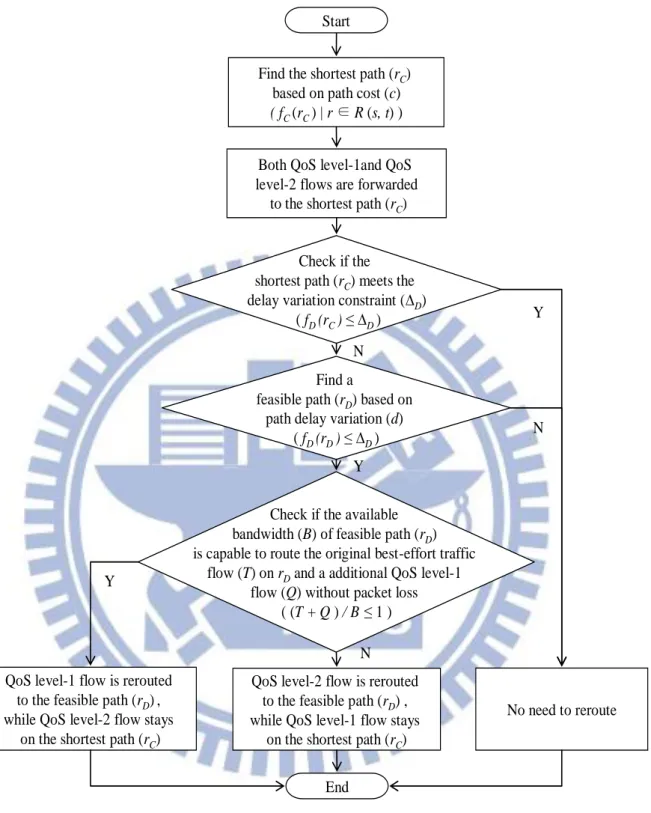
In the control layer, there are several modules to perform a set of general functionalities to control data flows in SDN networks. One video service from the application layer may send a request to the controller for video streaming, and the service management module would handle this request first. If this request is accepted, it will pass the request to topology management and route management modules to calculate the shortest path (rC) by the LARAC algorithm. The controller would update
the flow table downward to the forwarder layer, then the video streaming with QoS level-1 and QoS level-2 flows start to be routed on the shortest path (rC).
If the shortest path satisfies the delay variation constraint, it will be the optimal Figure 5. QoS level-1 flow rerouting
Controller Layer Forwarder Layer
In-Flows
QoS Level-1 Flow QoS Level-2 Flow QoS Level-1
Flow Table QoS Level-2 Flow Table S1 S2 S4 S3 S5 S6
r
c
r
D
14
path and the flows of video streaming will not be rerouted. Otherwise, the controller needs to find the feasible path (rD) by the LARAC algorithm. If a feasible path does
not exist because there is no path which satisfies the delay variation constraint (∆D),
we won’t reroute any of them. Otherwise, if a feasible path exists, the controller will check if the available bandwidth of the feasible path is big enough for an additional QoS level-1 flow. If yes, the QoS level-1 flow will be rerouted to the feasible path, and the QoS level-2 flow will stay on the shortest path. If the available bandwidth of the feasible path is not enough for the QoS level-1 flow, it means packet loss may occur, then the QoS level-2 flow will be rerouted to the feasible path and the QoS level-1 flow will stay on the shortest path. The flowchart of the proposed ARVS is shown in Figure 6.
15
Figure 6. The flowchart for the proposed ARVS
No need to reroute N
Y
N
QoS level-2 flow is rerouted to the feasible path (rD) , while QoS level-1 flow stays
on the shortest path (rC) Check if the shortest path (rC) meets the delay variation constraint (∆D)
( fD(rC) ≤ ∆D ) Find the shortest path (rC)
based on path cost (c)
( fC(rC) | r ∈ R (s, t) ) Both QoS level-1and QoS level-2 flows are forwarded
to the shortest path (rC)
Check if the available bandwidth (B) of feasible path (rD) is capable to route the original best-effort traffic
flow (T) on rDand a additional QoS level-1 flow (Q) without packet loss
( (T + Q ) / B ≤ 1 ) QoS level-1 flow is rerouted
to the feasible path (rD) , while QoS level-2 flow stays
on the shortest path (rC)
Find a
feasible path (rD) based on path delay variation (d)
( fD(rD) ≤ ∆D ) N Y Y Start End
16
Chapter 4
Simulation Results and Discussion
4.1 Simulation environment
We used Mininet [14] to create our network topology, which has 30 nodes, then these nodes were connected to a remote controller – Foodlight [15]. The controller takes the jobs of flow control, such as route calculation and rerouting decision. We set all link capacities as 20 Mbps and link delay as 10 ms and 20 ms randomly. The ratio (rbe) for base layer packets and enhancement layer packets is 1:1 and 1:3.6. For
network load levels in the simulation, we modeled various link utilization with three types of flows where 𝑄𝑖𝑗1 , 𝑄𝑖𝑗2 and 𝑇𝑖𝑗 are the amounts of QoS level-1 flow, QoS level-2 flow, and best-effort traffic. The original load level of each path is between 0.1 and 1.0. The maximum delay variation tolerance ∆D is set to 200 ms. Our simulation
17
4.2 Comparison of packet loss rates between the
proposed ARVS and OpenQoS
Our objective is to reduce the packet loss rate of base layer packets of video bit streams with QoS support under various network load levels, especially when rerouting of QoS level-2 flow. Therefore, we focus on these two cases of QoS level-1 flow and QoS level-2 flow rerouting. In the case of QoS level-1 flow rerouting, QoS level-1 flow will be rerouted to the feasible path (rD)from the original shortest path
(rC). So we still can keep a good level of received video quality and there is no
adverse effect on QoS level-2 flow. Thus, the overall video streaming will be rerouted on different paths in parallel, and this is similar to the case in [13].
However, as to the case of QoS level-2 flow rerouting, which was not handled in [13], QoS level-2 flow will be rerouted to a feasible path and may suffer from a certain extent of packet loss. However because enhancement layer packets can be
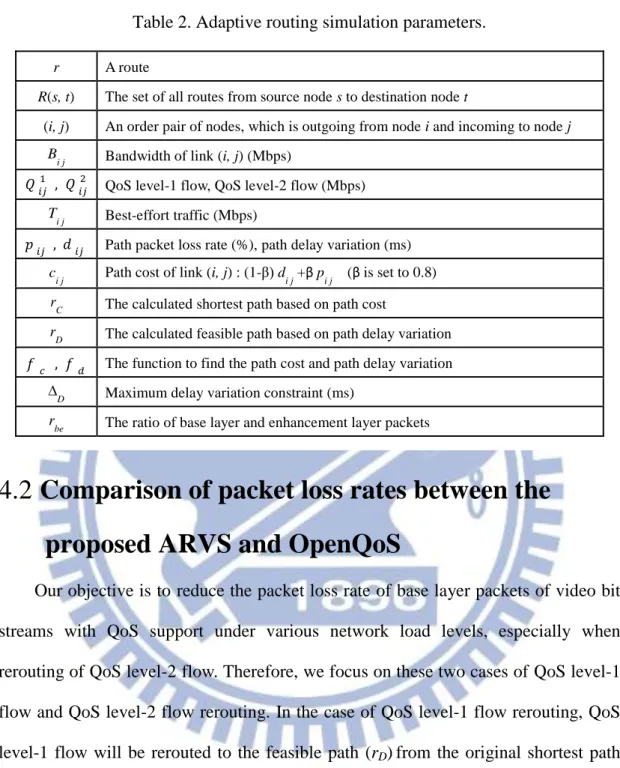
Table 2. Adaptive routing simulation parameters.
r A route
R(s, t) The set of all routes from source node s to destination node t
(i, j) An order pair of nodes, which is outgoing from node i and incoming to node j
B
i j Bandwidth of link (i, j) (Mbps)
𝑄𝑖𝑗1 , 𝑄𝑖𝑗2 QoS level-1 flow, QoS level-2 flow (Mbps)
T
i j Best-effort traffic (Mbps)
𝑝𝑖𝑗 , 𝑑𝑖𝑗 Path packet loss rate (%), path delay variation (ms)
c
i j Path cost of link (i, j) : (1-β) di j +β pi j (β is set to 0.8)
r
C The calculated shortest path based on path cost
r
D The calculated feasible path based on path delay variation
𝑓𝑐 , 𝑓𝑑 The function to find the path cost and path delay variation
∆
D Maximum delay variation constraint (ms)
r
18
served with the best-effort stream, the sacrifice of QoS level-2 flow transmission is still acceptable. On the other hand, the QoS level-1 flow would benefit from the departure of the QoS level-2 flow, and the link utilization of the shortest path may reduce and make more available bandwidth for the QoS level-1 flow. Therefore, if the feasible path is in high load level, we are still able to guarantee the performance of the QoS level-1 flow. The simulation results for the case of QoS level-2 rerouting are depicted in Figures 7(a) (rbe = 1:1) and 7(b) (rbe = 1:3.6). Figure 7(a) shows that when
the network load level of the shortest path is between 0.1 and 0.7, the packet loss rate of the QoS level-1 flow of the proposed ARVS is 18.4% ~ 77.3% lower than that of OpenQoS [13]. By using LARAC algorithm in the simulation, it is unable to find a shortest path when the network load is over 0.7. When the packet loss rate increases to 20%, the PSNR will drop dramatically and be regarded as not acceptable [13], so the proposed ARVS and OpenQoS [13] can support to load level up to 0.55 and less than 0.1 of the shortest path, respectively.
Figure 7(a). Comparison of packet loss rates between the proposed ARVS and OpenQoS [13] (rbe = 1: 1) 0 5 10 15 20 25 30 35 40 0.1 0.2 0.3 0.4 0.5 0.6 0.7 P ac ke t loss r ate ( %)
Network load level of the shortest path (rC)
19
Figure 7(b) shows that when the network load level of the shortest path between 0.1 and 0.7, the packet loss rate of the QoS level-1 flow of the proposed ARVS is 30% ~ 64.3% lower than that of OpenQoS [13]. The same reason as mentioned above, when the network load of the shortest path is over 0.7, it would not be found a shortest path using the LARAC algorithm in the simulation. Regarding to rbe in this
case, since the amount of the QoS level-1 flow is less than that of the QoS level-2 flow, it has more opportunities for the QoS level-1 flow to be rerouted. Therefore, the rerouting scheme is more suitable especially in high traffic loads. The proposed ARVS and OpenQoS [13] can support the load level up to 0.64 and 0.28 of the shortest path, respectively, while the packet loss rate is less than 20%.
Figure 7(b). Comparison of packet loss rates between the proposed ARVS and OpenQoS [13] (rbe = 1: 3.6) 0 5 10 15 20 25 30 35 0.1 0.2 0.3 0.4 0.5 0.6 0.7 P ac ke t loss r ate ( %)
Network load level of the shortest path (rC)
20
4.3 The packet loss rates comparison of QoS level-1
flow under different network load levels of the
shortest path and the feasible path
Figure 8(a) shows that compared with OpenQoS [13], our proposed ARVS can improve the QoS performance of base layer packets with 79.4% better cases and 20.6% even cases under different network load levels of the shortest path and the feasible path for rbe = 1:1. When network load levels of the shortest path and the
feasible path are 0.1 and 1.0, respectively, the packet loss rate of the QoS level-1 flow is 77.3% lower than that of OpenQoS [13].
Figure 8(a). The packet loss rates comparison of QoS level-1 flow under different network load levels of the shortest path and the feasible path (rbe = 1:1)
0 0.10.2 0.30.4 0.50.6 0.70.8 0.9 1 0 10 20 30 40 50 60 70 80 0 0.1 0.2 0.3 0.4 0.5 0.6 0.7 70-80 60-70 50-60 40-50 30-40 20-30 10-20 0-10 Re duce d pac ke t lo ss rat e ( % )
21
Figure 8(b) shows that compared with OpenQoS [13], ARVS can improve the QoS performance of base layer packets with 51.4% better cases and 48.6% even cases under different network load levels of the shortest path and the feasible path for rbe =
1:3.6. When the network load levels of the shortest path and the feasible path are 0.1 and 1.0, respectively, the packet loss rate of QoS level-1 flow is 64.3% lower than that of OpenQoS [13].
Figure 8(b). The packet loss rates comparison of QoS level-1 flow under different network load levels of the shortest path and the feasible path (rbe = 1:3.6)
00.1 0.20.3 0.40.5 0.60.7 0.80.9 1 0 10 20 30 40 50 60 70 0 0.1 0.2 0.3 0.4 0.5 0.6 0.7 60-70 50-60 40-50 30-40 20-30 10-20 0-10
Network load level of the shortest path (rC)
Redu ced p acke t lo ss rate (% )
22
Chapter 5
Conclusion
5.1 Concluding remarks
In this paper, we have presented an adaptive routing approach for video streaming with QoS support, called ARVS, over SDN networks. Simulation results have shown that that the proposed ARVS can provide improvement of the packet loss rate of base layer packets up to 77.3% when the shortest path is in load level from 0.1 to 0.7. In addition, it enhances at least 51.4% coverage under various network loads for the shortest path and the feasible path. By our adaptive routing scheme, it may not guarantee the performance of enhancement layer packets, but it can be still served with the best-effort stream.
5.2 Future work
In our current design, the ratio (rbe) of base layer and enhancement layer packets
is pre-defined at the beginning of the simulation, and the rerouting decision is always beneficial to base layer packets. This may lead to certain overhead for enhancement layer packets. Therefore, we will find a trade-off solution which is beneficial to both QoS level-1 and QoS level-2 flows under different ratios of base layer and enhancement layer packets (rbe). In addition to supporting video streaming, we will
extend this work to other types of streaming multimedia applications, such as video conferencing and video-on-demand, and evaluate with different QoS indicators, such as delay constraint and out-of-order delivery of packets.
23
References
[1] F. de Oliveira Silva; J.H. de Souza Pereira; P.F. Rosa; S.T. Kofuji, “Enabling Future Internet Architecture Research and Experimentation by Using Software Defined Networking,” in European Workshop on Software Defined Networking
(EWSDN), pp. 73-78, 2012
[2] R. Braden, D. Clark, and S. Shenker,“Integrated services in the internet architecture: an overview,” RFC 1633, Internet Engineering Task Force, June 1994.
[3] S. Blake, D. Black, M. Carlson, E. Davies, Z. Wang, and W. Weiss,“An architecture for differentiated services,” RFC 2475, Internet Engineering Task Force, Dec. 1998.
[4] A. Campbell, G. Coulson, and D. Hutchison, “A quality of service architecture,”
ACM SIGCOMM Computer Communication Review, vol. 24, no. 2, pp. 6–27, Apr.
1994.
[5] H. Schwarz, D. Marpe, and T. Wiegand, “Overview of the scalable video coding extension of the H.264/AVC standard,” IEEE Transactions on Circuits and
Systems for Video Technology, vol. 17, no. 9, pp. 1103–1120, Sep. 2007.
[6] "Software-Defined Networking: The New Norm for Networks - Open Networking
Foundation,” [Online]. Available:
https://www.opennetworking.org/images/stories/downloads/sdn-resources/white-p apers/wp-sdn-newnorm.pdf.
[7] Li Zhenjiang, J.J. Garcia-Luna-Aceves, "Solving the multi-constrained path selection problem by using depth first search," in International Conference on
24
[8] "Computers and intractability: A guide to the theory of NP-completeness -
Wikipedia," [Online]. Available:
http://en.wikipedia.org/wiki/Computers_and_Intractability:_A_Guide_to_the_The ory_of_NP-Completeness.
[9] Z. Wang and J. Crowcroft, “Quality-of-service routing for supporting multimedia applications,” IEEE Journal on Selected Areas in Communications, vol. 14, no. 7, pp. 1228–1234, Sep. 1996.
[10] G. Xue, W. Zhang, J. Tang, and K. Thulasiraman, “Polynomial time approximation algorithms for multi-constrained QoS routing,” IEEE/ACM
Transactions on Networking, vol. 16, no. 3, pp. 656–669, Jun. 2008.
[11] A. Juttner, B. Szviatovski, I. Mecs, and Z. Rajko, “Lagrange relaxation based method for the QoS routing problem,” in Proceedings of the IEEE Computer and
Communications Societies, vol. 2, pp. 859–868, 2001.
[12] S. Chen, M. Song, and S. Sahni, “Two techniques for fast computation of constrained shortest paths,” IEEE/ACM Transactions on Networking, vol. 16, no. 1, pp. 105–115, Feb. 2008.
[13] Egilmez, H., Civanlar, S., Tekalp, M., "An optimization framework for QoS-enabled adaptive video streaming over OpenFlow networks," IEEE
Transactions on Multimedia, vol. 15, no. 3, pp. 710–715, 2013.
[14] “Mininet” [Online]. Available: http://mininet.github.io/.

![Figure 1. Software-defined networking architecture [6]](https://thumb-ap.123doks.com/thumbv2/9libinfo/8378491.178062/12.892.133.721.322.955/figure-software-defined-networking-architecture.webp)
![Figure 2. OpenFlow controller and interfaces [13]](https://thumb-ap.123doks.com/thumbv2/9libinfo/8378491.178062/16.892.132.738.128.931/figure-openflow-controller-interfaces.webp)
![Figure 3. LARAC algorithm [11] procedure LARAC (G, s, t, c, d, ∆ D)](https://thumb-ap.123doks.com/thumbv2/9libinfo/8378491.178062/20.892.136.760.386.954/figure-larac-algorithm-procedure-larac-g-s-d.webp)