Property Evaluation of Polypropylene/ Glass Fiber Complex Braids
under a Base/ Salt Environment
Ching Wen Lou
1*, Jin Mao Chen
2, Ching Wen Lin
3, Wen Hao Hsing
4, Hsien
Chang Liao
2and Jia Horng Lin
2,5*1Institute of Biomedical Engineering and Material Science, Central Taiwan University of Science and
Technology, Taichung City 406, Taiwan (R.O.C.)
2Laboratory of Fiber Application and Manufacturing, Department of Fiber and Composite Materials,
Feng Chia University, Taichung City 407, Taiwan (R.O.C.)
3Department of Fashion Design, Asia University, Taichung City 413, Taiwan (R.O.C.) 4The Department of Textile Engineering, Chinese Culture University, Taipei City 111, Taiwan
(R.O.C.)
5School of Chinese Medicine, China Medical University, Taichung City 404, Taiwan (R.O.C.)
*corresponding email: [email protected], [email protected]
Keywords: glass fiber, polypropylene (PP), heat-setting, sodium hydroxide (NaOH), sodium
chloride (NaCl)
Abstract
The earth can be strengthened by embeding geogrids within. Glass fibers, used in geogrids, are heat-resistant and have stable size and chemistry; however, they tend to break from the clefts on the surface. This project created complex braids for geogrids by wrapping glass fibers (GF) with polypropylene (PP) filaments, preventing the geogrids’ outer friction and combining two materials as a bind. An 8-spindle braid machine and a 16-spindle braid machine were employed for braiding process. The experimental group was divided into two subjects, one was PP/ GF complex braids heat-set and the other non-heat-set. Then PP/ GF complex braids were measured with tensile strength after being immersed in sodium hydroxide (NaOH) solutions and sodium chloride (NaCl) solutions.
Introduction
Geogrids were embedded in the earth to strengthen and harden the earth. The geogrid has a flat grid-like configuration and there are rigid geogrids and soft geogrids. The rigid geogrid is made by stretching a porous plastic membrane while the soft one by immersing the high-strength braiding material in the gum [1, 2]. The embedded steel/ PP geogrids provided the main concrete structure with a 300 kg loading as concrete pieces could attach onto the geogrid when the structure broke [3]. GF was pitch compatible and strengthened concretes, too. Surface modification advanced its wear-ability and impact resistance. GF geogrid has good tensile strength, low extensibility, high stability, good load-bearing ability and long-term creep [4, 5]. The geogrid is usually embedded in concrete and breakwater, which provide a base environment, damaging GF [6]. Industrial-grade functional textiles are the one of the major productive goals for textile industry in the application fields. From 2006 to 2010, Lin et al. have utilized fiber materials, braids and nonwoven in geogrids [7-10].This study prepared the PP/ GF complex braids with GF braided with PP filaments, avoiding abrasions during the braiding process. Then, the complex braids were heat-set or non-heat-set, after which they were measured with tensile strength. Finally, the complex braids were measured with the tensile strength again after being immersed in a base solution or a salt solution.
Experimental
A total of four samples, i.e., GF yarns, PP braids, hot-set PP/ GF complex braids, and non-hot-set PP/ GF complex braids, were used in this study. GF (TGFR-P1200; diameter: 17μ diameter; fineness :1200±120 tex; ignition loss: 0.42±0.10; moisture contention: <0.06), served as
core material, were supplied by Taiwan glass In. Corp. PP filaments (100 D) were braided with GF on an 8-spindle and a 16-spindle braid machine, after which the braids were either non-hot-set or hot-set in an oven. Samples’ diameters were observed by a microscope, and subsequently tensile strength test measured the samples based on CNS 11263. Finally, GF yarns, hot-set PP/ GF complex braids, and non-hot-set PP/ GF complex braids were immersed in the 10 wt% NaOH solution and the 10 wt% crude salt solution for 1, 7 and 14 days to determine the effects of solutions on the tensile strength of the samples.
Results and Discussion
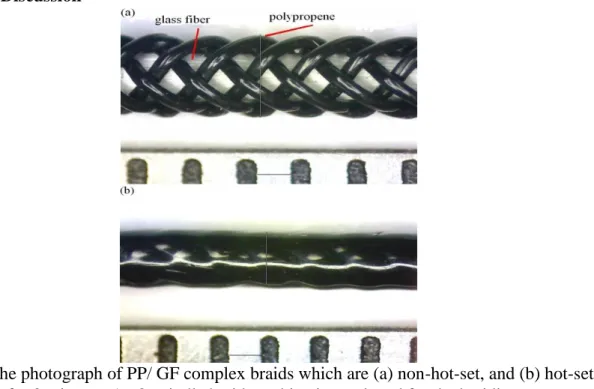
Figure 1 The photograph of PP/ GF complex braids which are (a) non-hot-set, and (b) hot-set at 180 ℃ for 3 minutes. An 8-spindle braid machine is employed for the braiding process. Figure 1 (a) shows the non-heat-set PP/ GF complex braid in the form of grid. The wefts were perpendicular to the woofs. Figure 1 (b) illustrates the heat-set PP/ GF complex braids. The pp filaments were melted and jointed together after the heat-setting at 180 ℃ for 3 minutes.
Shown in Figure 2, 16-spindle braided samples display a greater diameter than that of 8-spindle braided ones; and PP/GF complex braids’ diameters are greater than that of PP braids. In addition, heat-set complex braids exhibited a smaller diameter than that of non-heat-set ones, which was ascribed to the heat-setting process. Figure 3 reveals that regardless of heat-setting, both 8-spindle-braided and 16-spindle-braided complex braids exhibit a tensile strength of around 30 kgf. But heat-set 16-spindle-braided complex braids displays a tensile strength of around 10 kgf, which is three times lower that of non-heat-braided 16-spidle-braided ones (around 30 kgf). It may be because that the melted PP did not have an even structure; therefore, the tensile strength results were very different. The 8-sprindles yarn was thus determined the optimum parameter.
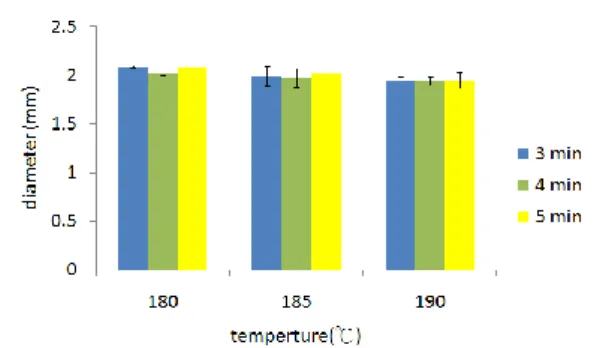
Figure 4 shows that regardless of the heat-setting temperature (180, 185, and 190 ℃) and heat-setting duration (3, 4, and 5 minutes), the PP/ GF complex braids have a similar diameter of around 2 mm. High temperatures led to stronger complex braids’ fiber packing; however, diameters did not change noticeably with the temperature. In Figure 5, according to the tensile strength, the optimum parameter of the heat-setting for the PP/ GF complex braids is 180 ℃ for 3 minutes. High temperatures improved the complex braiding yarn’s fiber packing and its tensile strength. However, the tensile strength declined at 190 ℃. It was also a trend observed that the longer the heat-setting duration, the lower the tensile strength. Higher temperature or longer heat-setting duration exposed the glass fiber hidden inside, decreasing the tensile strength accordingly.
Figure 2 The diameters of PP braids, heat-set and non-heat-set PP/GF complex braids by 8-spindle and 16-spindle braid machines.
Figure 3 The tensile strengh of heat-set and non-heat-set PP/GF complex braids by 8-spindle and 16-spindle braid machines.
Figure 4 The diameters of the complex braids with different heat-setting duration.
Figure 5 The tensile strength of the complex braids with different heat-setting duration. Figure 6 (a) demonstrates the tensile strength of the GF yarns, non-heat-set PP/ GF complex braids, and heat-set PP/ GF complex braids, which are immersed in 10 wt% NaOH solution for zero to fourteen days. The tensile strength of all three samples declined dramatically with the immersion days, which resulted from the NaOH solution. Not until Day 14, did the tensile strength start to ascend because the reactants began to attach on the GF yarns’ flaws, enhancing the
GF yarns’ outer friction and tensile strength. Meanwhile, after being immersed in NaOH solution, two complex braids (heat-set and non-heat-set) displayed lower tensile strength than that of GF yarns.
The NaOH solution made the pp outer layer brittle so the outer pp layer crash in its flaws, after which the inner GF yarns broke into pieces, decreasing tensile strength of the complex braids sharply. In Figure 6 (b), samples are immersed in NaCl solution, which decreases tensile strength of GF yarns and tensile strength of PP/ GF complex braids from Day 7. As a whole, the complex braids surpassed the GF yarns after being immersed in NaCl, simulating the geogrid soaked in the sea water.
Figure 6: The tensile strength of the complex braids immersed in (a) the 10 wt% NaOH solution and (b) the 10 wt% NaCl solution.
Conclusion
In this study, we successfully manufactured the PP/GF Complex Braids with polypropylene fibers and glass fibers. On Day 7, the NaOH solution lowered the tensile strength of GF yarns to 39 % and the tensile strength of heat-set PP/ GF complex braids to 13%. The NaCl decreased the tensile strength of both samples less and NaCl decreased the former to 87 % and the latter to 85 %.
Acknowledgement
This work would especially like to thank National Science Council of the Republic of China, Taiwan, for financially supporting this research under Contract NSC 93-2622-E-035-026-CC3.
References
[1] B.V.S. Viswanadham and D. König: Geotext. Geomembranes Vol. 22 (2004), p. 307-328. [2] M. Shinoda and R.J. Bathurst: Geotext. Geomembranes Vol. 22(2004), p. 205-222. [3] J.M. Chen, S.H. Chiang and J.H. Lin: Text. Res. J Vol. 78(2008), p. 1098-1109. [4] J. Péra and J. Ambroise: Cement and Concrete Composites Vol. 20 (1998), p. 31-39. [5] Bi-You Li, West-China Exploration, Vol. 19 (2007), p. 168-169.
[6] Gu Huang, Text. Res. J Vol. 27 (2006) p. 64-67.
[7] J.H. Lin, C.W. Lou and S.H Chiang: J. Adv. Mater-Covina 2006, p. 78-82. [8] J.M. Chen, S.H. Chiang and J.H. Lin : Text. Res. J Vol.78(2008), p. 1098-1109. [9] J.H. Lin : J. Adv. Mater-Covina, Vol. 38(2006), p. 63-67.
[10] J.H. Lin, C.M.Lin, C.Y. Kuo, C.W. Lin, C.T. Hsieh and C.W. Lou: Advanced Materials Research, Vol. 123-125(2010), p. 137-140.