The Contribution of Interleukin-10 Promoter Genotypes to Susceptibility to Asthma in Adults
Te-Chun Hsia1,2,3*, Wen-Shin Chang2,4*, Shengyu Wang5*, Te-Chun Shen1,4, Wan-Yun Hsiao3, Chin-Jung Liu3, Shinn-Jye Liang1,3, Wei-Chun Chen1,3, Chih-Yen Tu1, Chia-Wen Tsai2, Chin-Mu Hsu2 and Da-Tian Bau2,4,6
1Department of Internal Medicine, 2Terry Fox Cancer Research Laboratory, China Medical University Hospital, Taichung, Taiwan, R.O.C.;
3Department of Respiratory Therapy, and 4Graduate Institute of Clinical Medical Science, China Medical University, Taichung, Taiwan, R.O.C.;
5Department of Respiratory Medicine, the First Affiliated Hospital of Xi'an Medical University, Xi'an, PR China;
6Department of Bioinformatics and Medical Engineering, Asia University, Taichung, Taiwan, R.O.C.
*These Authors contributed equally to this work
Correspondence to: Da-Tian Bau, Terry Fox Cancer Research Laboratory, China
Medical University Hospital, 2 Yuh-Der Road, Taichung, 404 Taiwan, R.O.C. Tel: +886 422052121 Ext. 7534, e-mail: [email protected]; [email protected]
Running title: Hsia et al: IL10 Genotypes in Asthma
Abstract. Aim: Accumulating evidence suggests that inflammatory processes play a role in asthma etiology, and interleukin-10 (IL10) is an important immunosuppressive cytokine. This study aimed to evaluate the contribution of IL10 promoter A-1082G (rs1800896), T-819C (rs3021097), A-592C (rs1800872) genetic polymorphisms to the risk of asthma in Taiwan. Materials and Methods: Associations of three IL10 polymorphic genotypes with the risk of asthma were investigated among 198 patients with asthma and 453 non-asthmatic healthy controls by polymerase chain reaction-restriction fragment length polymorphism genotyping method. Results: The results showed that the percentages of TT, TC and CC for IL-10 T-819C genotypes were differentially represented at 63.1%, 32.3% and 4.6%, respectively, in the patient group and 53.0%, 36.4% and 10.6%, respectively, in the healthy control group (p for trend=0.0114). The CC genotype carriers were at lower risk for asthma (odds ratio=0.36, 95% confidence interval=0.17-0.76, p=0.0055). There was no difference in the distribution of A-1082G or A-592C genotype between the asthma and non-asthma groups. The protective effects of CC genotype were obvious among males, but not females, and those aged 25 up to 40 years but not those aged over 40 years. Conclusion: The CC genotype of IL10 T-819C compared to the TT genotype may have a protective effect on asthma risk in younger adults (25-40 years old), and males in Taiwan.
Asthma is a complex allergic disease and asthma is the consequence of the interaction of genetic predisposition and environmental factors (1, 2). According to the Global Initiative for Asthma guidelines 2015, asthma is defined as a chronic inflammatory disorder of the conducting airways and is characterized by airway hyper-responsiveness which results in recurrent episodes of wheezing, breathlessness, chest tightness, and coughing, particularly at night or early morning (1).
Interleukin-10 (IL10) is produced mainly by marcrophages and T-lymphocytes, and plays a central role in both anti-inflammation and immunosuppression. Thus, genetic polymorphisms found in the regulatory sites especially the promoter region of
IL-10 gene, are believed to affect the expression of IL10 protein and possibly be
associated with asthma susceptibility and prognosis. In literature, IL10 as a candidate gene for adult asthma susceptibility has been investigated in Iran, Macedonia and Finland (3-5), but the findings are inconclusive.
In an updated survey of the Taiwanese population, the highest incidences of asthma were found to occur at the age up to 12 years and 36-40 years. The incidence of asthma was higher in males before puberty, and higher in females after puberty, with overall incidences of 1.00 and 0.77 per 1000 person-years for females and males, respectively. The death rate also increased with age (6). To validate
whether IL10 genotype is a risk factor for adult-onset asthma, we sought to investigate the association of polymorphisms in the promoter region of IL10, A-1082G, T-819C, A-592C, and asthma in an adult Taiwanese population. We also determined whether the significant variants contribute to asthma susceptibility in people of different ages and genders.
Materials and Methods
Included population. The study consisted of 198 asthmatic cases and 453
non-asthmatic healthy controls. Among them, 198 adult patients diagnosed with asthma were recruited at the China Medical University Hospital. The clinical characteristics of the patients were defined and recorded by expert doctors at the Department of Internal Medicine under Dr Hsia's leadership. All participants voluntarily completed a self-administered questionnaire and provided 5 ml of their peripheral blood. Four hundred and fifty-three non-asthmatic healthy volunteers as controls were selected by matching for age and gender after initial random sampling from the Health Examination Cohort of our hospital. The diagnosis of asthma was based on the following inclusion criteria: (i) more than two or three episodes of wheezing and shortness of breath during the past year; (ii) diagnosis of asthma according to the treating physician together with the demonstration of reversible and variable airflow
obstruction by spirometry; (iii) symptoms; and (iv) prescription of medications for asthma. The age span of the cases was 25 to 86 years. The inclusion criteria for controls were: (i) no past or present physician’s diagnosis of asthma and other pulmonary diseases such as lung cancer; (ii) no history of wheezing, shortness of breath, or other symptoms of allergic diseases such as nasal and skin symptoms; (iii) no use of medications for asthma; and (iv) absence of first-degree relatives with a history of asthma; (v) greater than 25 years old. Our study was approved by the Institutional Review Board of the China Medical University Hospital (DMR100-IRB-284) and written-informed consent was obtained from all participants. Details of the study participants are given in Table I.
Polymerase chain reaction–restriction fragment length polymorphism genotyping conditions. Genomic DNA of each participant was prepared from peripheral blood
leucocytes using a QIAamp Blood Mini Kit (Blossom, Taipei, Taiwan, ROC). The polymerase chain reaction (PCR) cycling conditions were: one cycle at 94°C for 5 min; 35 cycles of 94°C for 30 s, 55°C for 30 s, and 72°C for 30 s; and a final extension at 72°C for 10 min. The sequences of primers for PCR and the specific restriction enzymes for each DNA product are listed in Table II. The genotypic analysis was performed by two researchers independently and blindly. Five percent
of the samples were randomly selected for direct sequencing and the results were 100% concordant.
Statistical analyses. All of the 453 of the controls and 198 cases with genotypic data
were analyzed. To ensure that the controls used were representative of the general population and to exclude the possibility of genotyping error, the deviation of the genotype frequencies of IL10 single nucleotide polymorphisms in the controls from those expected under the Hardy–Weinberg equilibrium was assessed using the goodness-of-fit test. Pearson’s Chi-square test or Fisher’s exact test (when the expected number in any cell was less than five) was used to compare the distribution of the IL10 genotypes between cases and controls. The associations between the
IL10 polymorphisms and asthma risk were estimated by computing odds ratios
(ORs) and their 95% confidence intervals (CIs) from logistic regression analysis with the adjustment for possible confounders. A value of p<0.05 was considered statistically significant, and all statistical tests were two-sided.
Results
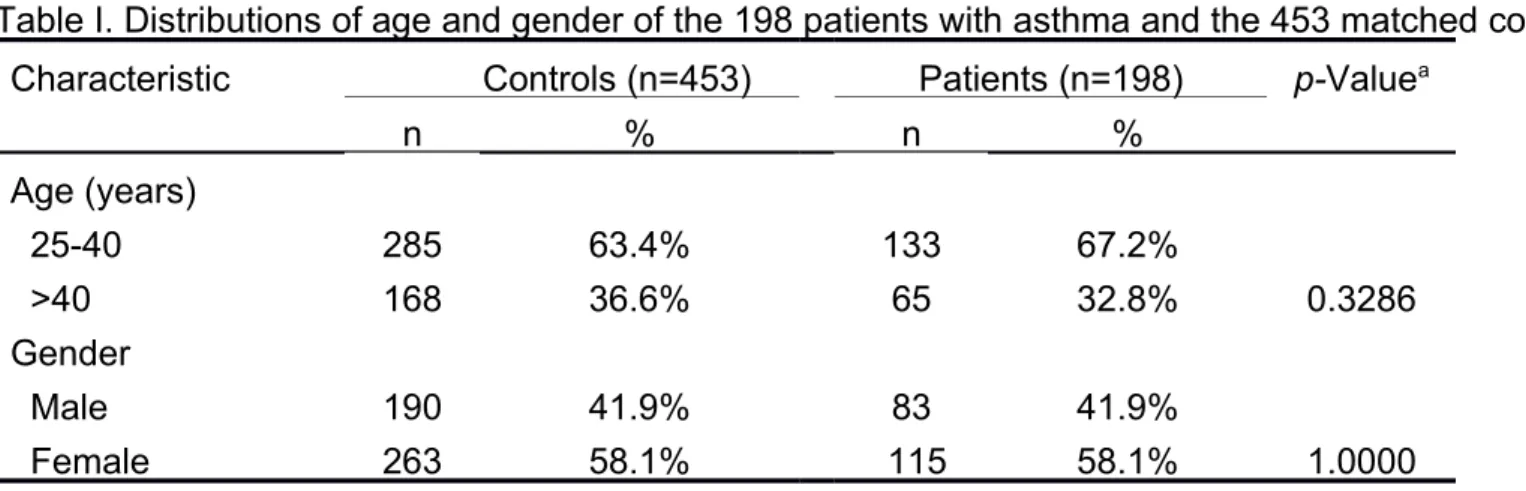
The frequency distributions of age and gender for the 198 patients with asthma and 453 non-asthmatic healthy controls are presented in Table I. Since we applied frequency matching to recruit the non-asthmatic healthy controls, the distributions of
age and gender were comparable between the two groups (p=0.3286 and 1.0000, respectively) (Table I).
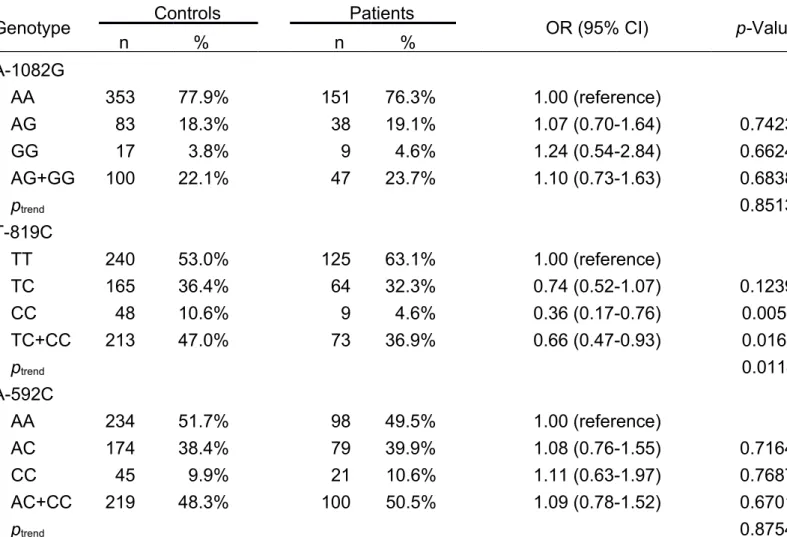
The distributions of the IL10 genotypes at A-1082G (rs1800896), T-819C (rs3021097), A-592C (rs1800872) among the non-asthmatic healthy controls and the patients are presented and analyzed in Table III. There was no association between the genotype of either A-1082G or A-592C with asthma susceptibility. However, the genotypes of IL10 T-819C were differently distributed between the asthma and
non-asthma groups (p for trend=0.0114) (Table III). In detail, the IL10 T-819C heterozygous TC and homozygous CC genotypes seemed to be associated with reduced asthma risk (OR=0.74, 95% CI=0.52-1.07, p=0.1239; OR=0.36, 95% CI=0.17-0.76, p=0.0055, respectively), the latter being statistically significant (Table III). We combined the IL10 T-819C heterozygous TC and homozygous CC genotypes, finding that C allele-carrying genotypes have a significantly protective effect on asthma susceptibility (OR=0.66, 95% CI=0.47-0.93, p=0.0165) (Table III).
We were interested in the interactions between the genotype of IL10 T-819C and age or gender for asthma susceptibility. After the stratification by age, it was found that the TC and CC genotypes of IL10 T-819C were protective for asthma
among those aged 25 to 40 years (p=0.0058), but not those aged more than 40 years (p=0.7998) (Table IV). After the stratification by gender, it was found that the
genotypes of IL10 T-819C were differently distributed among males (p=0.0110) but
not females (p=0.3649) (Table V). The TC and CC genotypes of IL10 T-819C were
therefore protective only for males not for females of this study.
Discussion
IL10 plays an important role in cell immunology. In the present investigation, the contribution of three single nucleotide polymorphisms at the promoter region of IL10 (A-1082G, T-819C and A-592C) with asthma risk was firstly evaluated in a Taiwanese population. No obvious differential distribution in the genotypes of A-1082G or A-592C was found. However, the CC genotype of IL10 T-819C was significantly associated with a reduced risk of asthma (Table III). In 2005, the CC genotype of IL10 T-819C was found to be associated with higher risk of type 2 diabetes mellitus and higher level of IL10 production (7). In 2014, the CC genotype of IL10 T-819C was found to be associated with lower risk of lung cancer among Taiwanese (8). In addition, the haplotypes of IL10 A-1082G, T-819C and A-592C were determined among patients with lung cancer and IL10 mRNA levels were found to be significantly higher in tumors with the non-ATA haplotype than those with the ATA haplotype (9). All the evidence above shows that the C allele at IL10 T-819C is closely related to a higher level of IL10 mRNA and protein, which may be a
protective factor against human diseases such as type 2 diabetes mellitus, asthma and lung cancer.
The age and gender play very important roles in asthma progression in Taiwan and other countries. Before puberty, asthma prevalence and severity are higher among boys than girls. During teenage years, the prevalence and severity are almost the same in both sexes. Thereafter, asthma was found to be dominant among females and this pattern continues until menopause, when asthma incidence among women decreases to become equal to that of men (6, 10-12). From the epidemiological viewpoint, asthma severity has been shown to vary during the menstrual cycle and pregnancy (13).
The present study also examined the interaction of IL10 genotypes with age and gender on asthma risk in Taiwan. All of those investigated were adults, and we found that the association between IL10 T-819C genotype with asthma risk was obvious among males but not among females (Table V). For the age, the association of IL10 T-819C genotype with asthma risk was obvious, especially among those between the age of 25 to 40 years (Table IV). However, there was no such differential genotypic distribution for those more than 40 years old (Table IV). The sample size of those with CC genotype was only nine, limiting a further evaluation of the interaction among genotype, gender and age. In the future, further investigation
of estrogen exposure status may help us in revealing asthma risk for females. Estrogen in the serum of females increases markedly during their teenage years, and females with early menarche have higher estrogen levels and are exposed to a greater cumulative estrogen and progesterone concentrations than those with later onset of menarche (14). Higher exposure of estrogens has been shown to activate endothelial nitric oxide synthase (15, 16) and its α and β receptors in lung tissues (17). In literature, nitric oxide has been implicated in the pathogenesis of asthma (18) and the levels of nitric oxide may vary with the menstrual cycle (19).
In conclusion, our findings suggested that the C allele of IL10 T-819C is associated with lower asthma risk, especially among males and younger people (25 to 40 years old) in Taiwan.
Acknowledgements
We appreciate Hong-Xue Ji and Chieh-Lun Hsiao and the Tissue Bank of China Medical University Hospital for their excellent technical assistance. This study was supported by research grants from Terry Fox Cancer Research Foundation and Taiwan Ministry of Health and Welfare Clinical Trial and Research Center of Excellence (MOHW104-TDU-B-212-113002).
The Authors declare no interest conflict with any person or company in regard to this study.
References
1 Reddel HK: Treatment of overlapping asthma-chronic obstructive pulmonary disease: Can guidelines contribute in an evidence-free zone? J Allergy Clin Immunol 136: 546-552, 2015.
2 Moffatt MF, Kabesch M, Liang L, Dixon AL, Strachan D, Heath S, Depner M, von Berg A, Bufe A, Rietschel E, Heinzmann A, Simma B, Frischer T, Willis-Owen SA, Wong KC, Illig T, Vogelberg C, Weiland SK, von Mutius E, Abecasis GR, Farrall M, Gut IG, Lathrop GM and Cookson WO: Genetic variants regulating ORMDL3 expression contribute to the risk of childhood asthma. Nature 448: 470-473, 2007.
3 Karjalainen J, Hulkkonen J, Nieminen MM, Huhtala H, Aromaa A, Klaukka T and Hurme M: Interleukin-10 gene promoter region polymorphism is associated with eosinophil count and circulating immunoglobulin E in adult asthma. Clin Exp Allergy 33: 78-83, 2003.
4 Hakimizadeh E, Arababadi MK, Hassanshahi G, Ahmadabadi BN, Hakimi H, Rezaeian M, Salehabadi VA, Yousefidaredor H, Abousaidi H and Kennedy D: Association of -592 region of IL10 polymorphisms with asthma in south-eastern Iranian patients. Clin Lab 58: 267-271, 2012.
5 Trajkov D, Mirkovska-Stojkovikj J, Petlichkovski A, Strezova A, Efinska-Mladenovska O, Sandevska E, Sibinovska O, Hristomanova S, Djulejic E,
Petrov J, Gogusev J and Spiroski M: Association of cytokine gene polymorphisms with chronic obstructive pulmonary disease in Macedonians. Iran J Allergy Asthma Immunol 8: 31-42, 2009.
6 Wu TJ, Wu CF, Lee YL, Hsiue TR and Guo YL: Asthma incidence, remission, relapse and persistence: a population-based study in southern Taiwan. Respir Res 15: 135, 2014.
7 Chang YH, Huang CN, Wu CY and Shiau MY: Association of interleukin-10 A-592C and T-819C polymorphisms with type 2 diabetes mellitus. Hum Immunol
66: 1258-1263, 2005.
8 Hsia TC, Chang WS, Liang SJ, Chen WC, Tu CY, Chen HJ, Yang MD, Tsai CW, Hsu CM, Tsai CH and Bau DT: Interleukin-10 (IL10) promoter genotypes are associated with lung cancer risk in Taiwan males and smokers. Anticancer Res 34: 7039-7044, 2014.
9 Wang YC, Sung WW, Wu TC, Wang L, Chien WP, Cheng YW, Chen CY, Shieh SH and Lee H: Interleukin-10 haplotype may predict survival and relapse in resected non-small cell lung cancer. PLoS One 7: e39525, 2012. 10 de Marco R, Locatelli F, Sunyer J and Burney P: Differences in incidence of
reported asthma related to age in men and women. A retrospective analysis of the data of the European Respiratory Health Survey. Am J Respir Crit Care
11 Becklake MR and Kauffmann F: Gender differences in airway behaviour over the human life span. Thorax 54: 1119-1138, 1999.
12 Troisi RJ, Speizer FE, Willett WC, Trichopoulos D and Rosner B: Menopause, postmenopausal estrogen preparations, and the risk of adult-onset asthma. A prospective cohort study. Am J Respir Crit Care Med 152: 1183-1188, 1995. 13 Postma DS: Gender differences in asthma development and progression.
Gend Med 4 Suppl B: S133-146, 2007.
14 Apter D, Reinila M and Vihko R: Some endocrine characteristics of early menarche, a risk factor for breast cancer, are preserved into adulthood. Int J Cancer 44: 783-787, 1989.
15 Kirsch EA, Yuhanna IS, Chen Z, German Z, Sherman TS and Shaul PW: Estrogen acutely stimulates endothelial nitric oxide synthase in H441 human airway epithelial cells. Am J Respir Cell Mol Biol 20: 658-666, 1999.
16 Chambliss KL and Shaul PW: Estrogen modulation of endothelial nitric oxide synthase. Endocr Rev 23: 665-686, 2002.
17 Carey MA, Card JW, Bradbury JA, Moorman MP, Haykal-Coates N, Gavett SH, Graves JP, Walker VR, Flake GP, Voltz JW, Zhu D, Jacobs ER, Dakhama A, Larsen GL, Loader JE, Gelfand EW, Germolec DR, Korach KS and Zeldin DC: Spontaneous airway hyperresponsiveness in estrogen receptor-alpha-deficient mice. Am J Respir Crit Care Med 175: 126-135,
2007.
18 Alving K, Weitzberg E and Lundberg JM: Increased amount of nitric oxide in exhaled air of asthmatics. Eur Respir J 6: 1368-1370, 1993.
19 Kharitonov SA, Logan-Sinclair RB, Busset CM and Shinebourne EA: Peak expiratory nitric oxide differences in men and women: relation to the menstrual cycle. Br Heart J 72: 243-245, 1994.
Table I. Distributions of age and gender of the 198 patients with asthma and the 453 matched controls. Characteristic Controls (n=453) Patients (n=198) p-Valuea
n % n % Age (years) 25-40 285 63.4% 133 67.2% >40 168 36.6% 65 32.8% 0.3286 Gender Male 190 41.9% 83 41.9% Female 263 58.1% 115 58.1% 1.0000
Table II. The primer sequences, polymerase chain reaction and restriction fragment length polymorphism conditions for identifying the interleukin-10 (IL10) A-1082G, T-819C and A-592C genotypes among the investigated individuals.
Polymorphism (locations)
Primer sequences Restriction
enzyme
SNP sequence
DNA fragment size (bp) A-1082G (rs1800896) F: 5’-CTCGCTGCAACCCAACTGGC-3’ R: 5’-TCTTACCTATCCCTACTTCC-3’ Mnl I A G 139 106 + 33 T-819C (rs3021097) F: 5’-TCATTCTATGTGCTGGAGAT-3’ R: 5’-TGGGGGAAGTGGGTAAGAGT-3’ Mae III T C 209 125 + 84 A-592C (rs1800872) F: 5’-GGTGAGCACTACCTGACTAG-3’ R: 5’-CCTAGGTCACAGTGACGTGG-3’ Rsa I C A 412 236 + 176 *F and R indicate forward and reverse primers, respectively.
Table III. Distribution of interleukin-10 (IL10) genotypes among the 198 patients with asthma and the 453 controls.
Genotype Controls Patients OR (95% CI) p-Valuea
n % n % A-1082G AA 353 77.9% 151 76.3% 1.00 (reference) AG 83 18.3% 38 19.1% 1.07 (0.70-1.64) 0.7423 GG 17 3.8% 9 4.6% 1.24 (0.54-2.84) 0.6624 AG+GG 100 22.1% 47 23.7% 1.10 (0.73-1.63) 0.6838 ptrend 0.8513 T-819C TT 240 53.0% 125 63.1% 1.00 (reference) TC 165 36.4% 64 32.3% 0.74 (0.52-1.07) 0.1239 CC 48 10.6% 9 4.6% 0.36 (0.17-0.76) 0.0055* TC+CC 213 47.0% 73 36.9% 0.66 (0.47-0.93) 0.0165* ptrend 0.0114* A-592C AA 234 51.7% 98 49.5% 1.00 (reference) AC 174 38.4% 79 39.9% 1.08 (0.76-1.55) 0.7164 CC 45 9.9% 21 10.6% 1.11 (0.63-1.97) 0.7687 AC+CC 219 48.3% 100 50.5% 1.09 (0.78-1.52) 0.6701 ptrend 0.8754