Materials: Precious and Modest,
Luxuries and Necessities
Brass Consumption in the Qing Empire*
Lai Hui-min and Su Te-ChengIntroduction
With the conquest of Zungharia in 1758, the Qianlong emperor (r. 1736–1796) expanded the Qing Empire’s borders and came to govern large portions of Inner Asian territories. A strategy of imperial rule was to strengthen the court’s rela-tionship with Mongolia and Tibet through religious and commercial exchange. Brass objects played a crucial role in this relationship. The Mongols, believers in Tibetan Buddhism, visited Tibet on pilgrimage and donated large amounts of money to monasteries. In an effort to foster the loyalty of the Tibetan and Mongolian elites of the Qing Empire, Qianlong ordered the construction of 32 Tibetan Buddhist temples in Beijing and 8 in Rehe (Jehol), in which brass (an alloy of copper and zinc) was used extensively.1 When pilgrims arrived in Beijing—the capital of the Qing Empire—they did not only participate in re-ligious and political rituals, but also purchased brass artifacts in droves, con-tributing to the transformation of the capital into a major market for brassware traders and manufacturers. Demand for brass reached such an extent that in the second half of the eighteenth century the Qing copper mines in Yunnan province annually yielded more than 10 million catties, and the zinc mines in Guizhou province yielded 6 million catties.
In the early Qing period, the government used brass to mint coins, and in an effort to control counterfeiting, it prohibited the possession of brassware throughout the empire. But an exception was made for the Mongolian princes and Tibetan religious leaders who received imperial gifts of brass Buddhist statues and other religious paraphernalia during their diplomatic mission and pilgrimage in Beijing. After the ban was lifted in 1736 brass objects became available to more members of the Qing society—provincial elites and to a
* Translated from the original Chinese by Evan Lampe. Evan Lampe received his PhD in inter-national history from the State University of New York at Albany. He is the author of Work, Class, and Power in the Borderlands of the Early American Pacific and is currently working on the role of formal and informal power in Pacific maritime history.
1 Rehe was the Qing summer capital, northeast of Beijing, where the residences of the Manchu emperors and various Buddhist temples were located.
certain extent, town and city dwellers of moderate means. This chapter dis-cusses how the circulation of brass artifacts facilitated imperial strategies of rule over Tibet and Mongolia and led to the growing circulation of brass objects within China; both were related developments that strengthened Qing rule in the peripheries, while contributing to commercial dynamism within China.
Although metal formed a significant part of the Qing court’s material cul-ture, studies on the subject have been scarce. Past research on the history of Chinese metallurgy mostly revolved around a discussion of metal coins. Moreover, historians have often focused on the Kangxi emperor (r. 1661–1722), singling him out as the leading contributor to scientific and technological development in the history of the Qing dynasty; in 1713 he established the Studio for the Cultivation of the Youth (Mengyang zhai) and the Academy of Mathematics (Suanxue guan), which was known by Jesuits scholars as “The Chinese Academy of Sciences”; and it was during his reign that the most im-portant collections in China’s history of science and technology were com-piled: The Complete Maps of the Empire (Huang yu quanlan tu) in 1719 and The Source of Pitch-pipes and Calendar (Lüli yuanyuan) in 1722.2
But the Qianlong emperor placed as much importance on science and technology, especially metallurgy; he frequently ordered the artisans of the Imperial Household Department Workshop (Zaobanchu, hereafter Imperial Workshop) to produce brass objects. Through experimentation, these artisans learned that increasing the ratio of zinc to copper would produce brass with higher rigidity. The brass water jars at the Baoyun Pavilion (Precious Cloud Pavilion) of Beijing’s Summer Palace (these artifacts are now located in the Palace Museum) all contain more than 40% zinc. In fact, the Chinese technol-ogy of brass-making even spread to the West. According to Keith Pinn, much of the Chinese Paktong (baitong, white copper) imported by Europe was a copper alloy (40–55 wt% copper, 5–15 wt% nickel, and 35–45 wt% zinc), with trace amounts of strengthening elements such as iron, lead, arsenic, cobalt, and silver. Europeans soon learned to make white copper (called Cupronickel). German metallurgists produced silver coins made with 55–65 wt% copper,
2 The Kangxi emperor was interested in mathematics and promoted scientific research and the popularization of science. He also imported many mathematical instruments, such as calculators, slide rules, and proportional compasses. Many of these instruments survive today and have the inscribed marks of four characters Kangxi yuzhi (commissioned by the Kangxi emperor). By contrast, the Yongzheng and Qianlong emperors did not promote math-ematical research. See Shen Yi, Zhongguo Qingdai kejishi (Beijing: Renmin chubanshe, 1994), 109–115.
15–20 wt% nickel, and 20–25 wt% zinc.3 Walter Renton Ingalls noted that in England in 1721 there were about 30,000 artisans producing brass and that much of the zinc-making technology they used came from China. Indeed, in the eighteenth century the famous metallurgist and chemist Doctor Isaac Lawson traveled to China to study this technology.4
Brass technology in China thus reached a high level of sophistication, and the knowledge was borrowed by Western scientists; and yet, the history of brass consumption and production in China remains an unchartered territory today. In fact, the prevalence of brass as a source material in the Qing palaces was even overlooked by a Western Sinologist who visited these palaces in person; at the beginning of the twentieth century, when Ferdinand Diederich Lessing (1882–1961) surveyed the metal objects at the Yonghe Palace (The Palace of Peace and Harmony), he categorized them under the rubric of bronze objects, even though many were made of brass and copper.5 In view of such oversights, our paper draws attention to this “forgotten” metal, which did not only form a significant part of the imperial court’s material culture, but also played a criti-cal role in the internal diplomacy of the Qing multiethnic empire.
Brass objects were so much in demand and were produced in such high quantities that the government had to hire artisans from Shanxi province, in addition to the many artisans that it already employed at court. Beijing thus became the center of brass production in the Qing Empire, drawing on the skills of artisans from across China. The techniques of metalwork employed by these artisans were recorded in the numerous governmental documents of the time, which today are housed at the First Historical Archives in Beijing, under the catalogue title “The General Collection of Archival Records from the Qing Imperial Household Department Workshops” (Qinggong Neiwufu Zaobanchu dang’an zonghui).
Beijing also became the main supplier of brass objects for consumers; the brass utensils and statues that Inner Asian pilgrims and emissaries bought at the Beijing markets ended up and circulated in Tibet and Mongolia. The trade and tribute of brass objects represented an important feature of the Qing em-perors’ strategy of rule in Inner Asia.
3 Keith Pinn, Paktong: The Chinese Alloy in Europe, 1680–1820 (Woodbridge, UK and Wappingers Falls, NY: Antique Collectors’ Club, 1999), 182–84.
4 Walter Renton Ingalls, Production and Properties of Zinc (New York and London: The Engineering and Mining Journal, 1902), 3.
5 The Yonghe Palace was built in 1694 as a residence for the Kangxi emperor. It was used as a palace during the Yongzheng reign and was transformed into a Buddhist temple by the Qianlong emperor in 1744.
Brass Production in Qing China
In the early Qing dynasty, brass was used for minting coins; but because China possessed only meager quantities of copper—a metal that was necessary for the production of brass—the government relied on metal imports from Japan. After the Open Trade Policy of 1684, imports of Japanese copper increased rap-idly, reaching 4 million catties by 1695 and 7 million catties by 1710. However, with shrinking production in Japan, imports declined to 1.5 million catties be-tween 1715 and 1742, 1.3 million catties in 1765, and 1 million in 1791.
As copper imports from Japan decreased by the middle of the eighteenth century, the Qing state increasingly relied on the Yunnan copper mines in the southwest of the empire. According to Yan Zhongping, Wei Qingyuan and Lu Su, production in Yunnan province gradually replaced Japanese imports. Between 1740 and 1810 the annual output at the Yunnan mines was over 10 mil-lion catties, reaching even 14 milmil-lion in some years.6 Starting in 1739, Yunnan
copper annually delivered to Beijing increased to 6,330,000 catties. During the Qianlong reign, the state also established zinc mines in order to meet the high
6 Yan Zhongping, Qingdai Yunnan tongzheng kao (Shanghai: Zhonghua shuju, 1948); Wei Qingyuan and Lu Su, “Qingdai qianqi de shangban kuangye ji qi zibenzhuyi mengya,” in Wei Qingyuan, Dangfang lunshi wenbian (Fuzhou: Fujian renmin chubanshe, 1984), 169. Table 13.1 Imports of copper from Japana
Year Annual average in catties ( jin)
(1 catty = 0.6 kilograms or 1.3 pounds)
1684–1695 3–4 million
1696–1710 4–7 million
1715–1742 1.5 million
1765 1.3 million
1791 1 million
a Liu Xufeng, “Qing Kangxi Qianlong nianjian yangtong de jinkou yu liutong wenti” in Zhongguo haiyang fazhan shilun wenji, vol. 7, edited by Tang Xiyong (Taibei: Zhongyang yan-jiuyuan zhongshan renwen shehui kexue yanjiusuo, 1999), 93–144.
demand for brass. The domestic production of zinc increased from 2 million catties in 1736 to 6 million in 1796.7
Imported and domestic copper were not the only sources for procuring brass. The Imperial Workshop documents reveal that the government turned to three major sources. First, from 1673 to 1679 and then again in 1726, the gov-ernment prohibited the melting of brass utensils and forced the populace to hand in their brass objects to local officials in exchange for cash payments. In 1728, the stocks of the Baoquan Department (Baoquan ju) reached 1 mil-lion catties.8 Second, artisans at the Qing court were able to produce brass by melting copper clocks and utensils and by mixing the extracted pure copper with zinc. In 1734, the Yongzheng emperor issued a new regulation in which 5 ounces (liang) of pure copper (around 187.5 grams) were to be extracted from each catty of waste copper (1 catty equaled 16 ounces).9 Decommissioned copper cannons were also recycled. During the late Ming and the early Qing periods, Chinese engineers had constructed Western style cannons (hongyi pao, or “red-haired barbarian” cannons) with the help of missionaries. During the Qianlong reign, the old or damaged ones were melted and cast to make other objects. In 1746, Manchu official Haiwang received an imperial order to melt 34 copper cannons; he was able to extract more than 55,740 catties of pure copper to which he added 16,722 catties of zinc (30% of total copper).10 The addition of 30% zinc suggests that these copper cannons had low rigidity and could easily be damaged.
A third source for copper was foreign tribute goods. In 1745, the officials working at the Imperial Workshop submitted a report on the copper objects
7 Da Qing Gaozong chun huangdi shilu, in vol. 9, juan 10-vol. 27 of Qing Shilu (Beijing: Zhonghua shuju, 1986), vol. 17, 99 ( juan 635, 28), (QL 26/4/29, wuxu); vol. 25, 691 ( juan 1311, 31), (QL 53/8/29, wuwu).
8 The Collection of Laws and Precedents of the Qing Dynasty (Da Qing huidian shili) notes that people were not allowed to keep brass objects and that the highest officials were exempt from this restriction. Kun Gang et al., eds., Da Qing huidian shili (Beijing: Zhonghua shuju, 1991), vol. 9, 346a ( juan 757). For official reports detailing the amount bought in the provinces, see Kun Gang et al., eds., Da Qing huidian shili, vol. 3, 587b ( juan 220), and Neige daku dang’an (Institute of History and Philology, Academia Sinica, Taibei), doc. nos. 009367-001 (YZ 8/4/3), 010388-001 (YZ 10/11/12), 009243-001 (YZ 10/2/24), 055025-001 (QL 1/3/13).
9 Zongguan neiwufu xianxing tiaoli (guangchusi), reproduced in Jindai Zhongguo shiliao congkan, vol. 86, edited by Shen Yunlong (Taibei: Wenhai chubanshe, 1972), juan 3, 145. 10 Zhongguo Diyi Lishi Dang’anguan and Xianggang Zhongwen Daxue Wenwuguan eds.,
Qinggong neiwufu zaobanchu dang’an zonghui [hereafter QNZDZ] (Beijing: Renmin chu-banshe, 2005), vol. 14, 103–4 (QL 10/4/no day), Paoqiang chu (Department of Weapons).
that had been melted down, among which were included copper candlesticks, boxes, tea bowls with lids, and spoons from Korea. The report also listed tribute goods from the West, such as locks, hanging tablets decorated with Western glass and strings of pearls, ornamental fountains, hairpins, and chime clocks.11 The process of melting and mixing metals could not have been completed suc-cessfully without a sophisticated knowledge of metallurgy. With the matura-tion of the alloy technology as well as the opening of copper and zinc mines in Yunnan province during the Qianlong reign, the volume and variety of brass objects produced at the palace workshops increased. Moreover, once the tech-nology diffused beyond the court, brass objects became available in wider society in larger quantities, even reaching as far as the frontiers of the empire.
Brass Objects at the Qing Court
Brass possesses characteristics that made it useful in the Qing palace; com-pared with iron, it is shiny, malleable, and slow to rust. Moreover, especially during the Qing period it was more abundant than steel—the latter a metal that was only beginning to be imported at the time.12 The Qianlong emperor favored brass in the crafting of several objects, but two particular areas where he persistently displayed a preference for the use of this alloy were in the construction of Buddhist temples and in the sculpting of decorative animal figurines.
Brass was manufactured in two workshops at the Qing court, one that spe-cialized in brass artifacts, Buddhist statues, and large Buddhist pagodas, and the other in small brass stationary. To be able to produce a large variety of brassware, artisans had to be knowledgeable about the properties and cast-ing techniques of brass. For example, for Buddhist statues the alloy of copper and zinc had to be 7:3; but for the manufacturing of brass water jars used in firefighting, the copper concentration was reduced to 60%. Only through ex-perience could a casting artisan learn how to handle the particular techniques and find the best ratio of copper and zinc in order to manipulate the hardness, ductility and corrosion resistance of the products for different requirements.
11 QNZDZ, vol. 13, 512–4 (QL 10/11/no day), Zhulu chu (Casting Workshop).
12 In the first year of the Qianlong reign, prices recorded by officials were 1.8 mace per catty for unprocessed copper, 2.3 mace per catty for refined cooper, 2.3 mace per leaf for brass, 5.4 candareen per catty for iron, 8.5 candareen per catty for steel. Mai Zhu et al., Jiuqing yiding wuliao jiazhi (Hainan chubanshe, 2000), juan 4, 26.1.
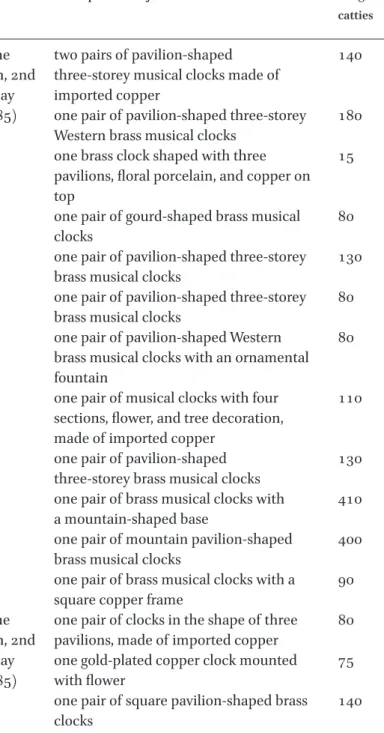
Table 13.2 Western metal objects melted down in March 1785a
Date Description of object Weight in
catties
56th year of the Qianlong reign, 2nd month, 15th day (25 March 1785)
two pairs of pavilion-shaped three-storey musical clocks made of imported copper
one pair of pavilion-shaped three-storey Western brass musical clocks
140 180 one brass clock shaped with three
pavilions, floral porcelain, and copper on top
15 one pair of gourd-shaped brass musical
clocks 80
one pair of pavilion-shaped three-storey
brass musical clocks 130
one pair of pavilion-shaped three-storey
brass musical clocks 80
one pair of pavilion-shaped Western brass musical clocks with an ornamental fountain
80 one pair of musical clocks with four
sections, flower, and tree decoration, made of imported copper
110 one pair of pavilion-shaped
three-storey brass musical clocks 130 one pair of brass musical clocks with
a mountain-shaped base 410
one pair of mountain pavilion-shaped
brass musical clocks 400
one pair of brass musical clocks with a
square copper frame 90
56th year of the Qianlong reign, 2nd month, 20th day (30 March 1785)
one pair of clocks in the shape of three pavilions, made of imported copper one gold-plated copper clock mounted with flower
80 75 one pair of square pavilion-shaped brass
The standardization and mass production of brass artifacts during the Qing dynasty is corroborated by the Tibetan text Sutra on Iconometry (Pratimalaksana), translated by the Mongolian prince Gonpokyab. The Sutra was published in 1742 under the title Explanation of the Buddha’s Teaching of the Sutra on Iconometry (Foshuo zaoxiang liangdu jingjie).13 The standardization of Buddhist figures meant that artisans developed a routine technical proce-dure and created a uniform artistic style in order to adapt to changing demand. Before the fifteenth century, Nepalese artisans had produced Tibetan Buddhist brass statues mainly through the solid mold process. As demand increased, these artisans adopted the lost-wax casting technique. After the sixteenth
13 Gongbuchabu, Zaoxiang liangdu jing (Taibei: Taiwan yinjing chu, 1956). For related stud-ies, please see Charles Willemen (Wei Chali) “Zaoxiang liangdu jing yanjiu zongshu,” translated by Luo Wenhua, Gugong bowuyuan yuankan 2 (2004), 60–76.
Date Description of object Weight in
catties
one pair of clocks in the shape of three
pavilions, made of imported copper 80 one pair of gold-plated copper clocks
mounted with flower 90
one pair of pavilion-shaped hexagonal
clocks made of imported copper 60 one pair of pavilion-shaped brass clocks 120 one pair of drum-shaped frame with two elephants, made of imported copper 80 one pair of pavilion-shaped brass clocks 130 one pair of clocks with a
mountain-shaped square frame, made of imported copper
170 one pair of round drum-shaped clocks,
made of imported copper 13
28 “movements” of copper clocks
(“movement” jixin refers to the machinery inside the clock)
87
Table 13.2 Western metal objects melted down in March 1785 (cont.)
century, however, Nepalese artisans embraced the forging technique and par-ticularly became renowned for their skills in assembling and installing large size Buddha figures. Recognizing Nepalese artisans’ experience and knowl-edge, in 1744 the Qianlong emperor hired a group of these artisans at court. The forging technique had various advantages; first and foremost, it allowed artisans more flexibility regarding the dimension of the statues, as they could now manufacture statues whose heights ranged from 1.0 to 98.4 feet tall (whereas with the lost-wax method, statues did not even reach 3.3 feet). The forging method made it possible, moreover, to create complex designs and decorations, enhancing the viewers’ aesthetic pleasure; and finally, it enabled the government to save on raw materials. The adoption of this method at the Qing court illustrated a growing sophistication in the production process in the eighteenth century and facilitated the Qianlong emperor’s policy to ex-pand religious exchange with Inner Asia.14
The archival documents of the Qing Imperial Workshop are particularly useful for the historians of technology and consumption, for they meticulously list the cost and amount of raw materials (copper and zinc). Accuracy at every level of production was characteristic of artisanal practices at the Qing court. For example, in 1761 court artisans produced 900 brass statues of Amitayus Buddha. The raw materials used for each statue were valued at 11.73 taels (liang) of silver; the cost of the 3,000 catties of copper and 2,000 catties of zinc used in the production of the 900 brass statues added up to 10,554.48 taels.15 In the same year, artisans manufactured five statues of the yogatantra deities for the third floor of the Yuhua Pavilion (Raining Flowers Pavilion); each one of these statues was 2 feet tall and cost 41.98 taels of silver. To these were added eighteen more statues—nine of the caryatantra (action-based practice) deity for the second floor and nine of the kriyatantra (performance-based practice) deity for the first floor—each 1 foot and 6 inches tall and valued at 34.98 taels of silver.16 The cost of the 1,800 catties of copper and 1,200 catties of zinc that were used in the production of these 23 statues amounted to 839.43 taels of
14 Yuan Kaizheng, “Xizang dongbu zangchuan fojiao tongfoxiang zhizuo gongyi yanjiu” (PhD diss., Beijing Keji Daxue, 2010), 81–2.
15 Qianlong chao neiwufu zouxiao dang [hereafter QCNZD] (First Historical Archives of China, Beijing), ce 255, 341–43 (QL 26/1/17). For the cost of raw materials paid to the artisans and workers, see Qianlong chao neiwufu yinku yongxiang yuezhe dang (First Historical Archives of China, Beijing), QL 26/1/no day.
16 Each floor of the Yuhua Pavilion had a unique name. The First floor was called “Zhizhu xinyin” (“Bead of Wisdom and Seal of the Mind”), the second floor “Xianlou” (“The Floor of the Immortals”), and the third floor “Puming yuanjue” (“Universally Bright Perfect Illumination”).
silver.17 In 1760, artisans produced 9 sets of embellished “five offerings” (wu-gong, i.e. one censer, two goblets with patterns, and two candle holders) in the newly built hall of Amitayus Buddha on the eastern side of the Hongren Temple (Temple of Great Benevolence); each was 1.6 foot tall and each set cost 177.34 taels of silver; as for the raw materials—2,000 catties of copper and 1,000 catties of zinc—the expenses reached 1,590 taels of silver, which were covered by the Office of Privy Purse.18
The archival documents of the Qing Imperial Workshop also provide details on the construction of buildings. In 1755, during the construction of the Brass Pagoda of the Great Pure Land (Daxitian tongta), the casting workshop used 50,000 catties of brass in the building of one podium, three towers, and one roof and in the casting of 279 statues of Amitayus Buddha; and between 1756 and 1759, artisans produced an additional 433 statues of Amitayus Buddha. Altogether the construction of the Brass Pagoda of the Great Pure Land cost 920,000 taels.19 During the Qianlong reign, two brass halls, the Zongjing Pavilion and the Baoyun Pavilion were built in Rehe and in Beijing’s Qingyi Garden (Garden of Clear Ripples) respectively. The Baoyun Pavilion was con-structed in 1761; its two floors were 24.8 feet high and were made of 485,000 catties of brass.20 The total salary paid to artisans to build the ten thousand statues of Amitayus Buddha for the Renshou Temple (Temple of Humane Longevity) and the workers to repair the buildings, including the Hongren Temple, reached 8,433.58 taels of silver.21 Every year, thousands of pilgrims from Tibet and Mongolia came to Beijing to visit the Hongren Temple and the Renshou Temple. In 1769, three brass statues of Gautama Buddha, Manjusri Bodhisattva and Avalokiteśvara Bodhisattva made for the Hall of Central Uprightness (Zhongzheng dian) consumed 761 catties and 6 ounces of brass. These three statues followed the alloy property used in the casting of the statue of Cakrasamvara Buddha (Shangle fo), with the raw materials valued at 139.6 taels of silver per foot.22 In 1770, the expenses for the labor and the raw
17 The casting workshop had 5,600 catties of copper in stock and there was, therefore, no need to request additional raw materials from the Office of Privy Purse. See QCNZD, ce 256, 149–52 (QL 26/4/16).
18 QCNZD, ce 251, 295–303 (QL 25/3/13). The Hongren Temple was also known with the name Zhantan Temple (Sandalwood Buddha Temple).
19 Lai Hui-min, Qianlong huangdi de hebao (Taibei: Zhonyang yanjiuyuan jindaishi yanji-usuo, 2014), 272–74.
20 Neiwufu zou’an (First Historical Archives of China, Beijing), doc. no. 5–194–36 (QL 26/11/23).
21 Qianlong chao neiwufu yinku yongxiang yuezhe dang, QL 26/7/no day. 22 QCNZD, ce 293, 284–316 (QL 34/3/4).
materials used in the construction of the new Tower of Ten Thousand Buddhas (Wanfo lou) were 264,249 taels of silver. The 36 large Buddhist statues and the 11,118 statues of Amitayus Buddha in the new Tower cost 140,749 taels of silver.23
The Qianlong emperor revived Beijing as a center of Buddhism outside of Tibet in order to attract his Mongolian subjects to the center of political power and to forge a strong alliance with them. The visits of Mongolian envoys and pilgrims to the capital were thus political events embedded with symbolism, during which the emperor projected himself as a religious and political lead-er. The Hall of Central Uprightness and the Tower of Ten Thousand Buddhas were the centers of attraction in these events; Mongolian visitors must have immediately noticed the elaborate architecture and shining brass temples and statues, for the material culture was different from what they were used to: the temples of the nomadic Mongols were made of wood, covered with felt, and modestly furnished24
The Qing summer capital Rehe was an equally important religious hub for Tibetan Buddhism and welcomed Mongolian pilgrims in the summers. Like their counterparts in Beijing, temples in Rehe were constructed with an exten-sive use of brass as building material. The Baoyun Pavilion at Beijing’s Summer Palace and the Zongjing Pavilion of the Zhuyuan Temple (Temple of Water Drops), which was located at the imperial residence in Rehe (called bishu shanzhuang, “Mountain Villa to Escape the Heat”) were built at the same time. In 1853, Wang Maoyin, circuit-intendant and investigating censor in Shaanxi province, memorialized that if demolished and melted, the Zongjing Pavilion could subsidize the expenses of the Ministries of Revenue and Works for two or three years.25 Ito Sukenobu noted that the Baoyun Pavilion and the Zongjing Pavilion were called the “twin brass halls.” In 1944, the Zhuyuan Temple was broken up and sent to the Shenyang arsenal by the Japanese army with the pretext of assisting the war efforts. The Zongjing Pavilion was the main hall of the Zhuyuan Temple, and its entire floor was made of brass, weighing 207 tons
23 QCNZD, ce 296, 282–299 (QL 35/4/4). Small gold-plated brass Amitayus Buddha statues were made for the emperor’s birthday. Every statue, including the podium, was 6 cun and 6 fen tall (about 8.3 inches tall). The raw materials for each statue cost 9.68 taels of silver. Of the 9.68 taels of silver, 2.75 taels were spent on 0.182 ounces of pure gold, 0.48 taels on 43 ounces of pure copper, and 6.45 taels on other materials.
24 Aleksei Matveevich Pozdneev, Mongolia and the Mongols, translated by John Roger Shaw and Dale Plank (Bloomington: Indiana University, 1971), vol. 1, 53–54.
25 Gongzhongdang Xianfengchao zouzhe (The Palace Museum, Taibei), doc. no. 406003871 (XF3/4/18).
(hence the name “brass hall”).26 During the Qing dynasty, both the Baoyun Pavilion and the Zhuyuan Temple, with their spectacular brass halls, were major pilgrimage sites for the Mongols.
Besides making statues and constructing buildings, artisans at the casting workshop made brass water jars for fire emergencies, using tens of thousands of catties of brass. In 1771, 28 brass water jars were placed around the Ningshou Palace (Palace of Tranquil Longevity), including 8 jars of 5 feet in diameter, 3.9 feet tall, and 1.4 inches thick; and 20 jars 4 feet in diameter, 3.28 feet tall, and 1.2 inches thick. The total salary paid to artisans for casting and polishing was 9,705.41 taels of silver. The raw materials cost 1,055.9 taels of silver, with 126.825 catties of wasted copper collected by the workshop.27 Moreover, 996 catties of wires, 227,270 catties of cinder coals, and 22,727 catties of black charcoal were purchased with money from the Office of Privy Purse. These 28 jars were made of 30,669 catties of copper and 30,000 catties of zinc in the ratio of 5:5.28
As for the background of the artisans, the population registers of the Upper Three Banners at the Imperial Household Department are revealing. The court hired more than ten thousand contract artisans, paying them salaries of more than two million copper cash. Most of these artisans were from Shanxi prov-ince. Equipped with the knowledge of brass-making that they had learned at the court workshops, they opened their own shops in Beijing, manufacturing brass objects for use in daily life.29
Since at least the Ming dynasty, Shanxi artisans had specialized in copper-ware, partly as a response to changes in Sino-Mongol relations at the time. During the Ming dynasty, Mongol tribes posed a constant threat at the bor-ders. One of the policies adopted by the government was to prohibit the sale of ironware to Mongolia in order to prevent the production of iron weaponry. Faced with this prohibition, Shanxi artisans and merchants instead found a source of income in copper objects. The stele inscriptions of the merchant guilds in Beijing provide evidence that the objects sold by Shanxi merchants to the Mongols during the Ming dynasty were all of pure copper.
However, it is well known that copper is a highly malleable and flexible metal. Objects made of pure copper are prone to distortion and susceptible to corrosive attacks especially in the harsh environment of the nomadic
26 Ito Sukenobu, Nekka koseki: Hisho sansou to gaihachibyou no chousa to hozon (Tokyo: Ito Chieko, 1994), 9.
27 QCNZD, ce 324, 18–26 (QL 38/12/4).
28 QCNZD, ce 300, 53–58 (QL 36/1/23); ce 321, 65–66 (QL 38/8/22).
29 Lai Hui-min, “Tie gan zhuang jia: Qing mo neiwufu xinzheku ren de jiahu yu shengji” Zhongyang Yanjiuyuan Jindaishi Yanjiusuo jikan 38 (2002), 71–128.
Mongols. By contrast, brass is a metal characterized by high rigidity and low corrosiveness; hence the reason why Mongolian demand for brassware in-creased and Shanxi artisans came to specialize in brass. In the Qing dynasty, Shanxi artisans adopted the technology of brass-making from the Qing court and produced exquisite brass objects, including a variety of Beijing-made brass objects, such as Buddhist statues, everyday goods, musical instruments, obla-tions, cases, lamps, and traditional Mongolian objects, such as stirrups, scoops, tobacco pipes, locks, and buttons, which were sold in Kulun in Mongolia.30 The Mongols also liked brass because it was as shiny as gold, but much cheaper. As for the trade of brass in the capital, in 1744 high official Ortai reported that in the areas of Beijing where the inner and outer eight banners and the three military camps were stationed, there were 432 brassware shops; among these shops, 68 sold exclusively brassware, and the remainder had also set up fur-naces in addition to selling brassware.31
In conclusion, the growing production of brass at the Qing court during the Qianlong reign transformed Beijing into a center of brassware manufacturing and consumption in the empire. Brass objects were not only enjoyed by the courtiers and the members of high society of Beijing, but also by the people of the borderlands. Shanxi merchants and artisans played a pivotal role in the cir-culation of knowledge and in the increase of brass consumption: Shanxi mer-chants, whose trading routes covered Xinjiang and Mongolia, introduced the court designs and styles of brass objects to the new territories, while Shanxi ar-tisans who learned the technology developed at the Qing court, brought their technical know-how with them to the other regions of the empire.
Qing Elites and Their Brass Objects
In her study on the trade and consumption of furs in the Qing dynasty, Lai Hui-min revealed that the Qing government established sumptuary rules for the im-perial house, princes and nobles, and civil and military officials. Fur garments, in particular, symbolized the hierarchies at court and in the bureaucracy. This constant demand by the ruling elites transformed Beijing into a center of fur manufacturing in the Qing Empire. However, even though fur clothing served to establish status and hierarchies, as time went by they became accessible to the wider society of Beijing, a development that led to the blurring of social
30 Pozdneev, Mongolia, vol. 1, 67.
31 Peng Zeyi, ed., Zhongguo jindai shougongyeshi ziliao (Beijing: Zhonghua shuju, 1962), 422–23.
differences.32 A similar trickle-down process took place in the consumption of brassware. Exquisite brass objects made at the Qing court, which were gifted by the emperors to the tributary emissaries, found their way in the commoner households of Mongolia, Xinjiang, and Tibet.
The Qing government remodeled Tibetan Buddhist temples in Beijing, turning some into important religious sites and others into market places. The Huang Temple (The Yellow Temple) and the Hei Temple (The Black Temple) housed the envoys that were annually commissioned by the Dalai Lama and Panchen Lama to deliver tribute to the emperor, and these two temples to-gether with the Yonghe Palace continued to be sites of religious activity every January. During their visits, Khalkha Mongolian princes were housed in nearby sites. As trade continued to flourish, the Qing government converted a large area of Beijing into a space for the establishment of shops and warehouses; the capital became the primary destination of Mongolian traders.
As we noted previously, Shanxi merchants played an active role in the trade and circulation of brass objects in the Inner Asian territories of the empire. Tibetan pilgrims, emissaries, and traders, who obtained large numbers of brassware during their visits in Beijing, also were instrumental in the popular-ization of brassware in Tibet. When the Dalai Lama and Panchen Lama visited the Qing court during the lunar New Year celebrations, they were presented with several gifts of brass objects. For instance, in 1764 the Qianlong emperor offered the Dalai Lama a brass enameled snuff bottle and five brass enameled bowls, and the Panchen Lama a couple of brass enameled plates. In the same year, Duke Pandida, Duke Kunga Tenzin, and Duke Gyumey Namgyel each re-ceived two brass enameled plates.33 However, we should note that these gifts were small in quantity, and many of the brass objects that ended up in Tibet were acquired by the envoys of the Dalai and Panchen Lamas at the Beijing markets. Indeed, in Beijing the Tibetan envoys stayed in the Xihuang Lamasery (West Yellow Lamasery) right outside of the Anding Gate, in close proximity and with easy access to the brass shops famous for their Buddhist statues and everyday brass objects.
The relationship between the Qing government and Mongol princes and Tibetan Lamas was cemented in 1792 when the Qianlong emperor initiated the Golden Urn procedure at the Yonghe Palace: the emperor ordered that the re-incarnation of a deceased Dalai or Panchen Lama would be chosen by drawing lots from a golden urn. The names of the proposed candidates were placed in
32 Lai Hui-min and Wang Shih-ming, “Qing zhongye qi minchu de maopi maoyi yu jingcheng xiaofei,” Gugong xueshu jikan 31.2 (2013), 139–78.
an urn in Beijing, and the selection process took place in Lhasa under the su-pervision of the local Qing officials and Tibetan religious hierarchy. The Living Buddhas of Mongolia (Khutukhtu) were also chosen through a similar proce-dure. By shifting the power to choose reincarnations away from the Tibetan and Mongolian leaders to the Qing emperor, the Golden Urn policy increased the religious authority of the Qing court.34
Mongol princes and Tibetan Lamas on their part patronized various Buddhist temples in Beijing; and with increased cultural contact, the technol-ogy of casting Buddhist figures refined at the Qing court was disseminated among artisans in Khalkha Mongolia. For example, after the Jiaqing emperor (r. 1796–1820) ordered the execution of Heshen in 1799, Zhebuzundanba, the Mongolian Living Buddha (Khutukhtu) eulogized the imperial virtue, but indi-rectly expressed his resentment about the emperor’s execution of the famous official. In order to atone for the emperor’s crime, he ordered the production of “ten thousand Buddha statues of virtue and misfortune.”35 He also built the Maidali Temple in Kunlun between 1820 and 1836. The Buddha statue in the temple was 53.7 feet tall and according to hearsay, it weighed 11,000 catties and was one vershok (1.7 inches) thick. It was made of brass and was plated with a thick layer of gold. Behind the main statue were lined up five additional Buddha statues, each 4 chi tall (approximately 4.6 feet), and on the left and right stood 10 thousand Buddha figurines.36
The Yonghe Palace, near the casting workshop of the Imperial Workshop, was the center of Tibetan Buddhism in Beijing; it welcomed Mongolian pil-grims and provided religious training and education to Mongolian lamas. Next to the palace there were seven famous shops that sold Buddhist statues and paraphernalia, and according to a survey conducted by the Municipal Council of Beijing during the Republican period, every year the owners of these seven shops earned 12,000 to 13,000 yuan from the sale of Buddhist statues.37 Moreover, more than 200 stores located near the Outer Lodge (waiguan), which sold religious brass objects, such as Buddhist statues, candlesticks, cen-sers, offering bowls and offering plates, served the needs of the Mongol del-egations. Russian scholar Aleksei Matveevich Pozdneev noted that Buddhist statues were first produced in Dolon Nor (modern Inner Mongolia) and were
34 Peter C. Perdue, China Marches West: The Qing Conquest of Central Eurasia (Cambridge, MA: The Belknap Press of Harvard University Press, 2005), 440.
35 Pozdneev, Mongolia, vol. l, 574–75.
36 Chen Lu, Zhi shi biji (Taibei: Wenhai chubanshe, 1968), 95.
37 Kōkan Nakano, Pekin hanjōki (Pekin: Shina Fūbutsu Kenkyūkai, Taishō, 1925), vol. 1, 96–101.
much valued by the Mongols, but that statues produced in Beijing were more popular, because they were cheaper.38 They were sold to Mongolia, Zungharia, Qinghai, and Tibet.
Beijing also lured Mongolian visitors with its everyday goods of a secu-lar and religious nature, which were sold in specialized shops, including the “Shuangshun Shop for Brass Utensils.” The inns outside the Desheng Gate provided sheds for the customers’ horses and sold equestrian supplies, such as brass stirrups and brass enameled saddles. Living in a severely cold region, the Mongols used brass buttons on their fur coats; brass milk jars, brass bowls and brass plates for serving food; brass pots for cooking; and brass pipes for smoking tobacco. They decorated their homes with brass enameled vases and statues. They used brass locks on their doors. They kept warm with brass bra-ziers, brass hand warmers, and brass leg warmers.39 The Qianlong emperor once declared that “Begs from Altishahr coming for an imperial audience in their proper year bring a few things with them to sell—what is wrong with that?”40 The emperor’s approach to Mongolian visitors was the same; the latter visited Beijing to sell their products and purchase local specialties to take back to Mongolia.
During the Yongzheng reign (1722–1735), the use and possession of brass ob-jects had been restricted to officials of the highest rank; but when brass pro-duction increased, in 1736 the ban was lifted with a proposal from the minister of revenue, a policy change that contributed to the wider use of brass and an increase in the construction of Buddhist statues. At court, brass was integrated into the material culture of banqueting and food consumption; at least 1500 plates out of 1800 were made of brass, and the utensils store of the Imperial Household Department contained 700 brass bowls.41 Every lunar January, the Qianlong emperor invited the Mongolian princes, the Xinjiang begs, the Tibetan lamas, as well as envoys from Korea and Ryukyu for a feast in the Hall of Purple Light (Ziguang ge). Brass utensils used in the feast created additional dazzling effect. On the imperial winter menu, there was often a course of hot pot served on a set of brass pots, brass burners and brass spoons.42 The tea
38 Pozdneev, Mongolia, vol. 2, 335.
39 Wang Yongbin, Beijing de guanxiang xiangzhen he laozihao (Beijing: Dongfang chuban-she, 2003), 66–7.
40 James A. Millward, Beyond the Pass: Economy, Ethnicity, and Empire in Qing Central Asia, 1759–1864 (Stanford: Stanford University Press, 1998), 156–57.
41 Kun Gang et al., eds., Da Qing huidian shili, vol. 12, 877a ( juan 1193).
42 Neiwufu xianxing zeli, thread-bound book (The Palace Museum, Taibei), Office of Palace Ceremonies 2 (Zhangyi si er).
sets used in the feast included brass teapots, brass burners, and brass gilded teacups with lids. The roofs of the carriages and palanquins that carried the emperor and empress were also decorated with beautiful brass ornaments. Remarkably, while in the early Qing period the containers used to hold the of-ferings for ancestors were made of gold, during the Qianlong reign they were replaced with bowls and plates coated with brass. Using brass for such feasts and festivals saved the court money; one ounce of gold was worth 15 taels of silver, whereas a catty of brass was only worth around 0.5 taels of silver (1 catty equaled 16 ounces).
Due to its resistance to corrosion, brass was also used, during the Qianlong reign, to manufacture measuring tools, including the “Capital Dry Measure for Grain issued by the Ministry of Works” in 1758, which was a scale to mea-sure the volume of grain, and other equipments, such as weighs, scales, and dengzi scales (for small measurement).43 The Qianlong emperor required the Ministry of Works to use brass in the production of square official seals (Guanyin) and oblong official seals (guanfang) for the central, local and mili-tary magistrates. In the meantime, the Ministry of Works also produced brass locks for the gates of the imperial city and palace.44 In 1771, the Qianlong em-peror bestowed brass bells and vajras to Tibetan Buddhist temples all over the empire, including those in “Front” and “Back” Tibet (qian Zang and hou Zang referred to the territories in Tibet under the jurisdiction of the Dalai lama and Panchen lama respectively). These bells were manufactured at the Qing court with a brass formula acquired from Western missionaries, one that improved the resonance of the bells.45 In sum, Qianlong utilized brass to make units, seals and musical instruments in order to standardize laws and regulations across the empire.
The Qianlong emperor emphasized the “Manchu language, riding and ar-chery” (guoyu qishe) as the founding principles of Manchu culture; however, throughout the eighteenth century, these celebrated virtues were on the de-cline among the Manchu bannermen. As part of a general policy to revive the traditional Manchu way of life, the emperor therefore promoted military arts and held large-scale military parades. Dressed in full armor, he inspected the eight banner troops and reformed their armory. For example, in the early Qing period soldiers had worn iron helmets and mail armors, which during the Qianlong reign were replaced with leather helmets and cotton-lined
brigan-43 Qiu Guangming, ed., Zhongguo lidai duliangheng kao (Beijing: Kexue chubanshe, 1992), 196, 266–67.
44 Kun Gang et al., eds., Da Qing huidian shili, vol. 10, 910–11 ( juan 954). 45 QNZDZ, vol. 36, 527–536 (QL 36/9/24), Zhulu chu (Casting Workshop).
dines. Officers were protected with brigandines made of silk and satin and fastened with brass rivets, whereas the rank-and-files wore cotton brigandines with white-copper rivets.
In 1766, Yongtai, the superintendent of the imperial textile factory in Nanjing, received an edict from the Qianlong emperor, ordering the three imperial textile factories of Nanjing, Hangzhou, and Suzhou to produce ar-mors for a parade. The Nanjing factory was to produce 3,760 arar-mors in three years, using the surplus from the tax quotas. During the first year, the Nanjing, Hangzhou, and Suzhou factories produced 1,250, 1,870, and 2,000 suits of armor respectively. According to Sazai, the superintendent of the imperial textile fac-tory in Suzhou, out of the 2,000 suits, 80 were for the lieutenant of the Guards brigade (hujunxiao), 1,600 for the common soldiers, and 320 for the deer-horn soldiers.46 The heads and shafts of the rivets used on the armors were made of white copper and brass.
Using brass in armors provided certain advantages. A chemist hypothe-sized that one of the reasons why Napoleon Bonaparte’s army was defeated by the Russians in 1812 was that the buttons on the coat, pants and boots of the French soldiers were made of tin. Tin buttons lost their shine and even dissolved into powder in cold temperature. This decreased the morale in the French army already confronting a harsh Russian winter.47 By contrast, as early as the eighteenth century Qing soldiers had already adopted the more resilient brass buttons.
In the eighteenth century, brass objects also figured prominently in the daily lives of the elites, as evidenced by the confiscation inventories; these documents listed the household goods and properties of high officials, which were confiscated by the state as punishment for corruption or other malprac-tices. For example, governor Wang Danwang’s inventories included 434 brass objects, and those of governor-general Chen Huizu, which are analyzed by Yan Yun in this volume, listed 347 brass objects weighing a total of 547 catties. Even Chen’s servants—Du Tai and Zhang Cheng—owned a total of 101 brass ob-jects. In other famous corruption cases, 142 brass items were confiscated from Guo Deping’s household, 417 from Wulana’s household, and 71 objects weigh-ing 237 catties and 8 ounces from Pulin’s household.48 The list of confiscated
46 QCNZD, ce 278, 36–43 (QL 31/1/9).
47 Penny Le-Couteur and Jay Burreson, Napoleon’s Buttons: How 17 Molecules Changed History (New York: Jeremy P. Tarcher/Putnam, 2003), 14–15.
48 Zhongguo Diyi Lishi Dang’anguan, ed., Qianlong chao chengban tanwu dang’an xuanbian (Beijing: Zhonghua shuju, 1994), vol. 2, 1821; vol. 3, 2431, 2803–4; vol. 4, 3481–95.
household items of the above disgraced officials included a variety of brass objects, such as “five offerings (wugong) for ancestral worship,” utensils for holding offerings (including bowls, plates and scoops), cooking pots, hotpots, serving plates, burners and furnaces, reading lamps, spittoons, buttons, and brass coated hat knobs. Judging from the type and variety of the brass objects in the confiscation inventories, it is apparent that these officials imitated the consumption patterns of the imperial court in the way they incorporated brass objects in their daily life.
Brass objects were also popular items for women’s dowries in elite families. Due to its resistance to heat, brass was ideal as a source material for the pro-duction of braziers and censers, and the rigidity of this metal also made it suit-able for containers of different sizes, such as basins and kettles, which were a necessary part of dowries. Moreover, the gold-like dazzling color of brass added more value to these dowry objects, providing a source of pride for the bride’s parents.
As for the Qing gentlemen who were fastidious about the interior design of their study rooms, brass objects became a symbol of good taste. In his Treatise on Superfluous Things (Zhang wu zhi), Wen Zhenheng (1585–1645) wrote: “Place a small Japanese-style stand on a common desk, and on top of this stand put a censer, a big incense box for raw incense and mature incense, and two small incense boxes for agarwood incense and incense cakes. A porcelain censer should be used in the summer, and a brass censer in the winter.”49 In the Jiangnan region, brass objects modeled on archaic styles were commonly found in the houses of the literati. The most popular ones were the tripod rit-ual vessels (dingyi) and vases of the gu, zun and zhi styles.50 Brass vases were called zun, lei, gu, or hu, depending on their sizes. The vases modeled on the Han square-style and the Longquan and Junzhou styles sometimes could be as tall as 2 to 3 feet, and were perfect for plum blossoms.51
In short, during the Qianlong reign, brassware became an inseparable part of the daily lives of courtiers, high officials and the literati. The popularity of brass as everyday objects and as dowry items in elite households paralleled the growing importance of brass as a tool of imperial control over the Inner Asian territories. Workshops churned out a diverse array of brass objects to
49 Wen Zhenheng, Zhangwuzhi tushuo, with commentary by Hai Jun and Tian Jun (Jinan: Shandong huabao chubanshe, 2004), 418.
50 Hsu Ya-hwei, “Wan Ming de gutong zhishi yu fanggu tongqi,” Gugong wenwu yuekan 250 (2004), 53–63.
impress visiting dignitaries from Mongolia and Tibet. The techniques of brass production expanded and diffused throughout the empire, making it possible for the Mongolian and Tibetan elites to emulate the Qing court fashions in their homes. Brass became an empire-wide phenomenon, revealing not only the importance of material culture in diplomacy, but also the centrality of this diplomatic tool in the formation of elite tastes.
Conclusion
In the field of Chinese metallurgy, Western scholars writing in the twenti-eth century knew more about bronze than any other metal, probably be-cause China has a long history of and is famous for its bronze technology and manufacturing. Through an analysis of the archival materials of the Imperial Workshop, this paper has shown that brass, and not bronze, was the major cop-per alloy used in the Qing dynasty.
During the Kangxi and Yongzheng reigns, the Chinese subjects of the em-pire, except first-ranking officials, were prohibited from casting brass or using brass utensils. At the same time, however, the total amount of brass stocked at the imperial court reached millions of catties, the majority of which was used in the manufacturing of utensils; and while the ban was still in effect for the Chinese subjects of the empire, the emperors conferred brass objects as gifts to Tibetan and Mongolian envoys in Beijing and promoted the trade of brass in Tibet and Mongolia. How can we explain this exclusive use of brass objects? Evelyn S. Rawski pointed to the multifaceted nature of Qing rulership, arguing that the Qing emperors ruled the Manchus with shamanism, the Mongols with Tibetan Buddhism, and the Chinese with Confucianism.52 Clearly, this strategy was not limited to religion, but also involved the selective deployment of mate-rial objects.
With the lifting of the ban in 1736, brass consumption in China proper in-creased. The imperial government produced large quantities of brass mea-suring tools, official seals, and locks, in order to establish common weights and measures and to improve the efficiency of administrative operations in the Qing bureaucracy. Brass was also used in military equipment, includ-ing in the decoration of armors and swords, in an effort to strengthen the spirit of Manchu style riding and archery in the eight banner armies. In the
52 Evelyn S. Rawski, The Last Emperors: A Social History of Qing Imperial Institutions (Berkeley: University of California Press, 1998), 208.
eighteenth century, brass everyday objects featured prominently in the houses of the elites and commoners alike; brass burners and furnaces heated homes in winter; brass hotpots filled dining tables; brass vases and censers decorated the studios of the literati; and brass basins and kettles formed a significant part of brides’ dowries. The widespread consumption of brass objects reflect-ed the commercial prosperity of the empire, even as brass became a tool of imperial power.
The constant production of brass objects at court was partly fueled by Qianlong’s deep religious involvement in Tibetan Buddhism. Millions of cat-ties of brass were used in the manufacturing of Buddhist statues and temples, and the construction of brass roofs for temples and pagodas reached an un-precedented level. Chun-he Huang suggested that the production of Buddhist statues during the Qianlong reign was standardized, generating patterns that became increasingly formulaic, and that artistic standards were much lower compared to those in the Kangxi reign.53 Yet from the perspective of modern-ization, standardization means a stable manufacturing process, greater cost control, and increased productivity and production. Even if artistic standards declined, brass came to play an important role: it served as a symbolic and eco-nomic tool in the working of the Qing Empire, by linking the imperial center to the Inner Asian territories.
Brass objects circulated both as imperial gifts and as commodities, but the quantity of brass objects presented as gifts to the Lamas and princes of Tibet and Mongolia was insignificant compared with those that were traded in the empire. A market mechanism was established to popularize brass in the bor-derlands of the Qing Empire, and the famous Shanxi artisans and merchants carried the mission of manufacturing and marketing brass products across the empire. The circulation of brass in China increased during the Qianlong reign, and Beijing became a center for the trade of brass Buddhist statues and utensils, attracting Mongolian and Tibetan pilgrims, merchants, and envoys every year. Scholars in the past discussed how the Qing court succeeded in transforming Beijing into a center of Tibetan Buddhism; the trade and pro-duction of brass objects reflected a similar story of success, perhaps achieved unintentionally.
53 Huang Chunhe, “Yuan Ming Qing Beijing gongting de cang chuan fojiao: zaoxiang yishu fengge ji tezheng,” Fayin 1 (2001), 31–36.
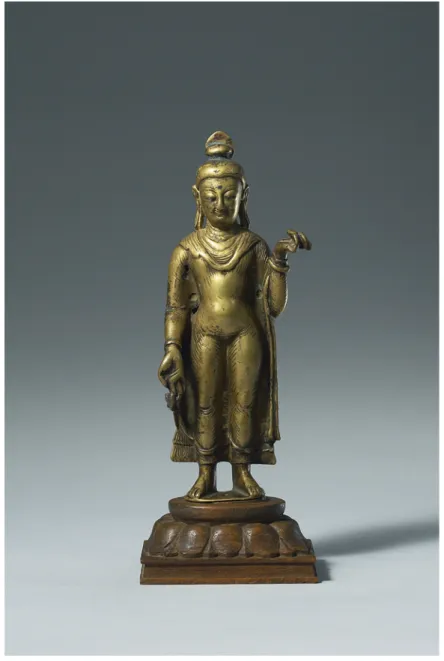
Figure 13.1 Standing Buddha (8–9th century), Kashmir, India.
Its body is mainly made of brass with silver-inlaid sclera and copper-inlaid lips. It is possible that the wooden lotus seat was installed afterwards.
Reprinted with permission from National Palace Museum, Taiwan.
Figure 13.2 Small brass vase with relief sculpture, Ming Dynasty, China.
Reprinted with permission from National Palace Museum, Taiwan.
Figure 13.3 Brass incense burner with inlaid flowers, Qing Dynasty, China. The cover of this burner is made of wood with inlaid red coral.
Reprinted with permission from National Palace Museum, Taiwan.