對自閉症兒童之行為改變效果:一個使用超越基線階段中數
率法之後設分析
研究成果報告(精簡版)
計 畫 類 別 : 個別型 計 畫 編 號 : NSC 95-2413-H-004-010- 執 行 期 間 : 95 年 08 月 01 日至 96 年 10 月 31 日 執 行 單 位 : 國立政治大學教育學系 計 畫 主 持 人 : 馬信行 計畫參與人員: 碩士班研究生-兼任助理:張琦、胡慧君 處 理 方 式 : 本計畫可公開查詢中 華 民 國 97 年 01 月 24 日
Running head: Meta-analysis on autism with PEM approach
The Effectiveness of Intervention on the Behavior of Participants with autism: A Meta Analysis Using Percentage of Data Points Exceeding the Median of Baseline
Phase (PEM) Hsen-hsing Ma
Department of Education, National Chengchi University, Taiwan. Abstract
The purposes of the present study is to use PEM approach to compare the
effectiveness of different interventions on the problem behaviors of the individuals with autism and to find out which problem behaviors are more difficult to be changed. Electronic databases, such as The ProQuest and Google were searched. Totally 164 articles were located, which produced 1502 effect sizes. The results demonstrate that PEM approach had higher validity than the PND approach did. The five highly effective intervention strategies were priming, self control, training, positive reinforcement and punishment, and presenting preferential activities or reinforcers. The least effective was to teach perspective-taking skills. Theoretical and practical implication of the findings are discussed.
Key words: Autism; Meta-analysis; PEM (Percentage of Data Points Exceeding the Median of Baseline Phase) approach
摘要 本研究目的在使用PEM 方法比較對自閉者行為不同的處理方法在效果上的 差異。樣本是取自電子資料庫,如ProQuest 及 Google,共找出 164 篇研究,從 中取得1502 個效應量。結果顯出 PEM 方法比 PND 方法更具效度,達到高度有 效的處理方法是協助事前準備、自我控制、訓練、正增強與處罰,及呈現自閉症 者所喜歡的活動或增強物。效應量最低的依變項是角色取替能力的培養,最後討 論研究結果在理論上與實用上的涵義。 關鍵字: 後設分析; 自閉症; 超趆中數線率(PEM)
The Effectiveness of Intervention on the Behavior of Participants with autism: A Meta Analysis Using Percentage of Data Points Exceeding the Median of Baseline
Phase (PEM)
Mastropieri and Scruggs (1985-86) used PND (percentage of non-overlapping data) as a tool to calculate the effect size of experimental treatment for for the
meta-analysis of the within-subject experimental designs. The PND is the percentage of data points in the treatment phase over the highest point of the distribution in the baseline phase (or below the lowest point of data points in the baseline phase if the undesirable behavior is expected to decrease after the intervention is introduced). However the PND approach has a serious problem that if one or more data points in the baseline phase have reached ceiling/floor level, then the PND scores will be 0%, although by visual inspection the treatment effect did exist. Ma (2006) has suggested the PEM (percentage of data points exceeding the median of baseline phase) approach to improve the weakness of the PND. Ma’s study showed that PEM had higher
Spearman correlation with original author(s)’ judgment than PND did. This result was also confirmed by Gao and Ma (2006) and Chen (2004). To compute the PEM scores, one needs only to draw a horizontal median line in the baseline phase. This horizontal median line will hit the median when the number of data points in the baseline phase is odd, and go between the two middle points if the number of data points is even. This median line will stretch out horizontally to the treatment phase. Then the
percentage of data points of treatment phase above the median line can be calculated. If the undesired behavior is expected to decrease after the intervention is introduced, then the PEM score will be the percentage of data points below the median line in the treatment phase.
As early as in 1970's, at least seven states in the USA had begun lawsuits against the Department of Education for failure to provide school programs for participants with autism (Koegel & Rincover, 1974). This fact implied the importance of
intervention of autism in the school. Because of relative lack of appropriate behavior and relative abundance of inappropriate behaviors, the typical fate of participants with autism was and is the exclusion from the school system.
Participants were diagnosed as autistic according to a certain criterion, such as DSM-IV (American Psychiatric Association, 1994), National Society for Participants with autism (Ritvo & Freeman, 1978), or the Childhood Autism Rating Scale
(Schopler, Reichler, & Renner, 1988). The typical syndromes of participants with autism are:
others, lack of imitation of social behaviors, lack of active participation in social interactions or plays
2. Deficits in verbal behavior: lack of normal development of language; echolalia; pronoun reversal; lack of eye contact, making initiative, and feedback during conversation.
3. Stereotyped/self-stimulatory/ritualistic behaviors: meaningless repetitive movement of certain part of the body, persistent preoccupation with parts of objects, or adherence to nonfunctional routines or rituals (American
Psychiatric Association, 1987, P. 38-39)
Additionally, some participants with autism also emitted disruptive behaviors, such as aggression, noncompliance, tantrums, property destruction, and self-injury.
Interventions of autistic behaviors including verbal and social skills training in clinical therapeutic situations or in community situations, behavior modifications in special education classroom situations, as well as integration program into the normal school situations. Three kinds of integrating the participants with autism into the normal school are: (a) one-to one therapy procedures, (b) a special class in a normal school, (c) integrating participants with autism into a normal school classroom. The rationale of integration of participants with autism into the normal school is that the normal peers would provide more appropriate role models (Russo & Koegel, 1977). McLaughlin-Cheng (1998) utilized meta-analysis to synthesize 10 studies using between-group designs and found that participants with Asperger syndrome had a better overall performance on intelligence and cognitive measures as well as measures of adaptive behavior abilities, such as communication, self-care skills, social appropriateness, and emotional self-regulation than those with autism.
Hitherto, there is still no meta-analysis analyzing the data of within-subject designs to investigate the relative effectiveness of different interventions on the problem behaviors of individuals with autism. The purposes of the present study is to use PEM approach to (a) compare the effectiveness of different interventions, (b) to find out which problem behaviors are easier to be improved and which are more difficult to be changed, and finally (c) to discern whether study characteristics, such as mental development, sex, and age of the participants; setting of intervention; intervener; type of experimental design, influence the effectiveness of intervention.
Method
Data collection of the pilot study.
Electronic databases, such as The ProQuest Educational Journal, ProQuest Dissertation Consortium, ERIC, and Google were searched for researches
investigating the effectiveness of interventions intending to improve behaviors of participants with autism. The key word for searching is “autism.” A hand search of
the Journal of Applied Behavior Analysis was also conducted. Additionally, usable empirical articles were traced from the references of the located studies.
Coding of data
The data to be coded were author(s) and publication year; categories of
independent variable and dependent variable; name, age, intelligence, and gender of participant; treatment agent; setting, design, and first or second pair of
baseline-treatment phase of experiment. The categorizations of independent and dependent variables are presented in Table 1 and Table 2, respectively.
Reversal design within the multiple-baseline design was treated as reversal design. In a BAB design, the baseline phase (A) was used to calculate the median line, and the data points of the first treatment phase (B) above the median line were
calculated to form the PEM and PND scores.
Author(s)’ conclusion of overall effectiveness of treatment (2 = effective or highly effective, 1 = moderately effective, and 0 = questionably or not effective). Because it is hard to distinguish between questionable and no effect, they were pooled together.
Settings. Intervention settings were classified as home, institution (including clinic, psychiatric hospital, rehabilitation institute, residents' living unit,
teaching-family model group home, Learning Center, autism research and training center, adult service program for people with developmental and behavioral disorder, and therapy room), school (including classroom, experimental room, laboratory or cafeteria in an university, and after school behavior management program), and other places (including, community, and convenience store, museum).
Agents. The agents who implemented the treatments were classified into eight categories: (a) staff (including caretaker, caregiver, and supervisor); (b) author (including trainer and researcher); (c) parent (including adult promoter, mother, and teaching parents), (d) electronic teaching aids (including computer and video); teacher (including instructor, special education teacher); (e) peer (including non-disable child, sibling, and tutor); , therapist (including treatment provider, and clinician); and
research assistant (including teaching assistant, experimenter, and undergraduate or graduate students.
The intelligence of a participant with autism was coded as mental retardation or normal.
Ages of participants were coded in year as unit with two decimals, e.g., four year and six month was coded as 4.5 year. By the coding of age, if there was no information about the ages of the individual participants but only the mean age of the group, then the mean age was coded for each participant. Ages were then divided into five groups: below 7, 7-12, 13-15, 16-18, and beyond 18 years old.
Table 1
Categorization and Definition of Independent Variables
Intervention Definition of each category
1 Systema- tic desensiti- zation
A strategy to reduce fears for participants with autism during common experiences; gradual exposing to fearful situations
2 Priming Priming (helping the child prepare the upcoming activities); parent or special education staff member previewed the classroom assignments done by the child and gave reinforcement before they were presented in class); measuring physical appearance and personal care with the personal appearance index; video priming to the upcoming events or activities, such as transition;
3 Self control Including self-instruction, self recording, and self reinforcement; self-management
4 Training Training package includes normally four steps: instruction, modeling/demonstration, practice/exercise, and
feedback/reinforcement. The steps can be repeated if necessary. This category includes categorization strategy training (sorting
laundries); training gesture and verbal responses; functional
communication training; training sign language; conversation skills training; switch training (training participants with autism to use switches to activate prerecorded messages to communicate their requests); incidental teaching, enhanced milieu teaching, or embedded instruction (This kind of teaching begins with child’s verbal or nonverbal requests, followed by a specific sequence of prompts (models, mands, or time delay procedures) and corrective prompts as needed and ends with positive feedback, expansion of the child's utterance, and accessing to the child's requested object; pivotal response training for symbolic play; naturalistic teaching coupling with voice output communication aid which provides messages to be chosen for initiation or responding; dry bed training (consisting of hourly awakenings, urine alarm electrode-sheet, praise for dry bed and reprimand for bed-wetting) to eliminate nocturnal bed-wetting; joint attention training;
5 Positive reinforce- ment and punish- ment
Positive reinforcement for desirable behaviors coupling with punishment for undesirable behaviors, e.g., praise and edible reinforcement for eye contact and punishment with functional movement (the child was required to sustain each posture of
head-up, -down, or -straight for 15 second if he avoided eye-contact. This category includes rewarding with preferred activities without work if the child did not ingest lethal pills and punishing with shoe polishing work if the child ingested lethal pills; using obsessions as reinforcers for appropriate behaviors and time out as punishment
6 Presen- ting preferen
-tial
activities or reinfor- cers
Presenting the activities, tasks, or reinforcers that the participant with autism child prefers in order to elicit his (her) willingness and interests to engage social interaction. This category includes interspersing with varied tasks, presenting varied reinforcers in the training of academic tasks; incorporating thematic ritualistic behaviors preferred by the participant with autism into games to facilitate social play; allowing the participant to make choices through picture exchange for preferred items during typical classroom play routines; providing choice opportunities for game play; using obsessions as reinforcers (obsessions are defined as objects or concepts the children intense preoccupied with,
continually sought out, requested, talked about, or wrote about at home, in the after-school program of the clinic, and school, such as plastic toy helicopters); using obsessions as token; incorporating echolalia into task response (the experimenter (E) asked the child to echo an object's label and then placed two objects before the child and asked the child to hand the E that labeled object); power card strategy (synthesizing what a favorite hero/heroine did if he/she lost or wan a game and encouraging the child to generalize this strategic information across settings and events); naturalistic language teaching approach (selecting stimulus items of high interest to child); non-contingent reinforcement (allowing the child
continuously access to his preferred video) as a treatment for food refusal; incident teaching (when a child initiated an interaction in a natural environment, the teacher required an elaboration of the child's request, then elaborated request of the child was followed by teacher's approval and the child was then allowed to access to the requested materials, activity, or information); augmentative
communication (the child was demanded to hand a picture to exchange a preferred edible reinforcer and the reinforcement was paired with a model of a natural verbal response); presenting
preferential activity schedule (demand, no activity, preferred activity (play), and then demand); presenting entertainment music to
eliminate disruptive behavior (head-jerking and screaming); musical therapy consisting of listening to song, playing rhythmic instruments and then singing a song which was prescribed according to the guidelines of social stories
7 Respon- se delay
A few seconds of delay were permitted for the child to respond 8 Compu- ter- based interven- tion program for language training
Computer-animated tutor for vocabulary and language that provide pre-test, tutorials (presenting a language lesson involving
association of pictures and spoken words) and post-test; using computer animation for enhancing communication functions (providing the children with opportunities to interact in different activities);
9 Agent- mediated intervention
Training parents, peer etc. behavior modification techniques to implement treatments: peer-tutoring (tutor gave instructions or commands to the participant with autism, prompted as necessary, and reinforced correct responses with edibles and praise; peer buddy approach (each day, the participant with autism was assigned a different buddy to stay with, play with and talk to); peer was instructed to initiate a play or to respond to the initiation made by the participant with autism to play; peer incidental instruction; peer initiating and responding in the play with the participant with autism; rapport-building (training caregiver to improve rapport with the child and then to improve the child's behaviors;
peer-implemented pivotal response training consisting of modeling, role playing, and didactic instruction; cooperative learning groups (This strategy includes grouping, assignment of team roles, group activities, and group social skill training); training peer how to play with the participant with autism
10 Stimulus control
Using stimulus to guide appropriate behaviors, This category includes variable intermittent schedule of supervision; gradual delaying the presence of treatment agent; providing a schedule of events or visually cued instruction; script (consisting of statements and questions to guide the child to verbalize initiations or responses); picture exchange communication system; visual cues (presenting flash card with the target word to elicit self-initiated verbalizations; signaling changes in activities; scheduled awakenings;
11 Social story A story consisting of four types of sentences that are (a) descriptive (defining a social setting and what people typically do in a particular situation), (b) directive (directing an individual to engage in an appropriate response in a defined situation), (c) perspective
(describing the perspective or reaction of others to a given situation, (d) control (providing analogies with similar actions and responses using nonhuman subjects). It is written to help individuals with autism to have insight about what others are thinking or feeling and to teach specific social skills as alternatives to problem behaviors, e.g., to use quiet language to ask for help rather than crying, screaming etc. in a frustrated situation
12 Punish- ment
Imposing aversive stimulus on the participant or withdrawing positive reinforcer from the participant. This category includes sharply saying "No,” and if necessary slapping the participant briskly on the hands when he began to engage in self-stimulatory behavior; time out (letting the child facing away from the
reinforcing environment); over-correction (asking the participant to repeat exaggeratedly the self-stimulatory part of his body for a certain period); response-blocking; response cost; attention extinction; sensory extinction
13 Mode- ling Modeling the desirable behavior so that the participant can imitate that behavior. This category includes video modeling (presenting scripted video conversations to the child); demonstration; video self-modeling (video was created from a role-playing movie, in which a participant with autism was shown socially interacting with peers in accordance with a script, then the typical and positive social interactions were selected and edited for a 3-minutes video and presented to the participant with autism); vivo modeling (observing another person engaging in a target behavior and subsequently imitating); peer modeling;
14 Positive reinforce- ment
Reinforcing the appropriate behavior with primary reinforcers, secondary reinforcers or preferred activities; intermittent reinforcement; gradually fading reinforcement;
15 Differen- tial reinforce- ment of others (DRO)
Differential reinforcement of behavior other than the problem
behavior. This category includes reinforcing alternative appropriate play if the child did not engage in self-stimulation (DRA); the package consisting of DRO, response cost, and diaphragmatic breathing to relax; differential reinforcement of alternative
appropriate verbal responses and extinction of perseverative verbal response
Table 2
Categorization and Definition of dependent Variables
Variables Definition of each category
1 Social interaction skills
Social interaction skills (initiating, responding, keeping interaction going, verbal interactions). This category includes community skills, such as shopping; engaging in social play; cooperative play; social
communication skills including appropriate eye gaze, facial expression and affect, nonverbal mannerisms, voice volume, and perseveration of topic
2 Language abilities
Language abilities or behaviors including conversation speech (answering the question and providing an appropriate question of his own). This category includes language comprehension; expressive labeling; receptive labeling; vocabulary learning; sign language (as the signs appeared in a standard sign language dictionary; instruction following; expressive use of preposition; reading skills
3 Attentions Making eye contacts and paying attentions to others during conversation. This category includes listening; showing enthusiastic affect during engaging in tasks; time spent in shared interest during conversation; 4 Stereotyped
behaviors
Markedly restricted, repetitive and stereotyped patterns of behavior, interests, and activities. This category includes self-stimulations
(repetitive movements that do not appear to serve an adaptive function, such as rocking, stereotyped gazing, flapping, hand-mouthing, and object stimulation); repetitive thematic ritualistic activities with a certain object, topic, or theme
5 Abilities other than language ability
Abilities or behaviors other than language ability. This category includes educational task completed; imitation; academic performances;
appropriate play with toy including role playing, make-believe
transformation in imaginary play, and persistence during playing; on-task behavior engaging in the assigned task; toilet use; sorting laundry; on-schedule (engaging in transition from one schedule to another); daily living skills; independent play; tasks from school curriculum;
hand-washing task; discrimination learning; self-initiations of urination; self-care skills for personal appearance; pre-academic behavior
6 Social responses
Social responses to others. This category includes feedback or responding to questions; compliments; giving social reinforcements to others;
appropriate perseveration of topic; appropriate voice volume; appropriate affective responses (displaying contextually appropriate facial, verbal, postural, and gesture responses during the interaction);
7 Echolalia Meaningless repetition or echoing of verbal utterances made by a communication partner Inappropriate verbal behaviors echolalia. This category also includes irrelevant speech
8 Other
inappropria-te behaviors
Undesirable behaviors other than stereotyped, repetitive behaviors. This category includes pill ingestion; self-injury; off task; tantrum;
aggressions; social avoidance behavior; non-engagement; disruptive behavior including crying, screaming, hitting, falling off chair with force; not following instructions; sleep terror (episode of sudden arousal from slow wave sleep and usually accompanied by upsetting, piercing cream, sweating, and rapid heartbeat); accidents of urinary incontinence; phobic behaviors; talk-out; ruminating/vomiting
9 Making initiative
Making initiation to begin a social interaction, This category includes asking questions; verbally or nonverbally making requests; inviting others to do something; offering or sharing with others; offering assistance; greeting others; unsolicited verbalization; initiated touch; commenting about a game or activity; securing attention of partner
10 Perspec- tive taking
That is the so called theory of mind, which depict the ability to determine mental states to explain and predict behavior of other person
Calculation of effect size
The effect size was only calculated when a baseline immediately before the treatment was available. If a phase, no matter whether it was effective or not, was inserted between baseline and treatment phase, the effect size was abandoned because the effect of treatment has been contaminated by the inserted phase. Pairs of
baseline-treatment after the second pair in a reversal design were treated as a second pair. The effect of follow-up or generalization phase was neglected. However, if the generalization phase was included in the training and was preceded by a baseline phase, such as the Experiment 3 in Taylor & Harris’s (1995) study, its effect sizes were calculated. The multiple treatment designs, such as BCBC-design, where B and C denoted different treatments, were excluded from the calculation of effect size because of effect confounding. However, the conventional routine treatment phase was regarded as baseline phase, if the effect of a new treatment was tested.
Only the effect sizes of treatment on the target behaviors of the participants with autism were calculated. Behaviors that were ancillary or unrelated to the target
behavior of the participant with autism as well as the target behaviors of normal peers during the interactions with the participants with autism were excluded from the calculation of effect size. Although the generalization of the treatment effect to the natural situations is important for the participants with autism to conduct real life practices, the effect of generalization, maintenance, or follow-up phase was ignored in the present study because of absence of baseline phase.
Results
Two effect sizes with a mean of .85 in an article (Luiselli, 1994) were excluded from further analysis because they were resulted from the treatment of ruminative vomiting by means of several procedures (dietary control, satiation, mealtime
arrangement, pacing, ruminating- and vomiting-contingent consequences, weigh-ins, and medication) implemented concurrently in a multi-component program, which was hard to be classified into a category of independent variables in the present study.
In the present study, 164 articles were located, which produced 1502 effect sizes. The grand mean of 1502 effect sizes was .87 (SD = .25). According to the criterion of Scruggs, Mastropieri, Cook, & Escobar (1986), a PND (percentage of nonoverlapping data) above 90 is considered as highly effective, 70 to 90 as moderately effective, 50 to 69 as mildly or questionable, and below 50 as ineffective. The present study adopted this criterion and judged the grand mean of .87 of the 1502 effect sizes as near highly effective treatment for improving the behaviors of participants with autism.
Normally, effect sizes measured from a single study are usually not independent. To test whether the residuals of the outcome 1502 effect sizes were independently distributed, lag 1 autocorrelation was calculated and found to be significant, r = .36, standard error = .03, t (1500) = 13.81. It indicated that the data had serial dependence, and hence, the assumption of independent distribution of residuals was violated. Therefore, it was suitable to apply nonparametric instead of parametric statistics to test the significance of differences between categories.
However, if the effect sizes of each located study were averaged to form an averaged effect size to represent the effect size of that study, it was found that the mean PEM scores of the 164 studies is .90 with a standard deviation of .15. Because the residuals of the 164 effect sizes were independently distributed (lag 1
autocorrelation of residuals was -.01, with a standard error of .08, t (162) = .08), a t-test for a sample of single group showed t (163) = 34.80, p< .001. It depicted that a mean PEM scores of .90 of the 164 studies was significantly different from the null hypothesis of .5.
Reliability of coding
About one third of located studies including 497 effect sizes were randomly selected as samples for the calculation of coding reliability. Reliability was calculated by the formula: ((Sum of agreement and disagreement) – number of disagreement)) / Sum of agreement and disagreement. Reliability of PEM scores = (497 - 64) / 497 = .87. Reliability of PND scores = (497 - 81) / 497 = .84. Reliability of judgment of original authors = (497 - 123) / 497 = .75. In order to let the reliability of coding approach 1.00, two assistants were then asked to code independently the PEM scores, the PND scores, and the judgments of original authors all the 1502 effect sizes and the author made the last checking.
Testing the validity of PEM approach
Table 3 demonstrates that PEM scores had higher correlation with the judgments of the original authors than the PND scores did. Furthermore, it can be seen in the Table 4 that the three means of PEM scores of each category of judgment all fell into the range of the criterion set by Scruggs et al. (1986), but that the means of PND scores
were underestimated. Table 3
Intercorrelations between original author(s)’ judgment, PND scores, and PEM scores
PEM PND Judge .40*** .36***
PEM .63***
PND -
Note. The coefficients between judgments of original authors and PND scores or with PEM scores are Spearmen’s rank correlation, but the coefficients between PND and PEM are Pearson’s product-moment correlation, because the judgment scores are coded with ordinal scale. The sample sizes of all correlations are 1502.
*** p < .001 Table 4
Comparisons of Means of PEM and PND Scores with Criteria Suggested by Scruggs et al. (1986) at Each Level of Effectiveness Judged by Original Authors
Judgement of
oringinal author(s)
PEM PND The criterion of
Scruggs et al., 1986) Effectiveness N % M SD M SD Not effective 58 3.9 .12 .18 .04 .12 <.7 Moderately effective 129 8.6 .75 .27 .49 .38 ≥ .7 < .9 Highly effective 1315 87.5 .92 18 .77 .34 ≥ .9
The Mean Effect Size of Independent Variables
Table 5 lists the mean, and Standard deviation and mean rank of the effect sizes of independent variables (interventions). In addition to the violation of the
independence of the residuals, a Levene statistic also shows that the assumption of the homogeneity of the residuals was violated, F (14, 1487) = 19.39, p < .001.
Throughout the present study, the nonparametric statistics were used to test the significance of the difference between multiple group means (by means of Kruskal Wallis Test) and that of post hoc comparisons (by means of Mann-Whitney U Test).
Six categories of interventions had large effectiveness (i.e. the mean effect size was larger than .9) on the problem behaviors of the participants with autism. They were systematic desensitization, priming, self-control, training, positive reinforcement and punishment, and presenting preferential activities or reinforcers. The remaining independent variables had moderate effectiveness. The result of the Kruskal-Wallis Test, χP
2
P
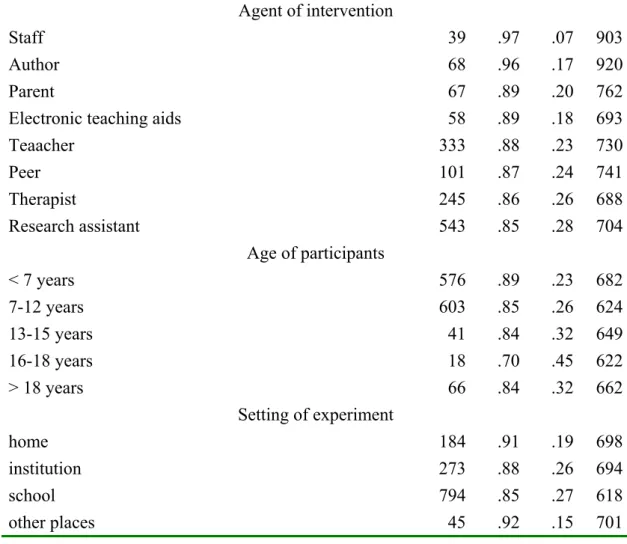
(14, N =1502) = 37.73, p < .001, showed that the difference between the mean rank of effect sizes of different independent variables was significant. Post hoc comparisons of independent variables using Mann-Whitney U test have the following results: 2 > (4, 7, 8, 10, 11, 13, 14, 15); (3, 4, 5, 6) > 14; (4, 5, 6) > 7; (5, 6) > (10, 11); (4, 5) > (8, 13, 15); 6 > (13, 15). Where the numbers are the labeling number standing before each independent variable in Table 5, for example, “6” stands for “presenting preferential activities or reinforcers”. The numbers within a parenthesis signify that there were no significant differences between the mean ranks of effect sizes of these variables. For instance, 6) > (13, 15) means that the mean rank of effect sizes of “presenting preferential activities or reinforcers” was significantly larger (more effective) than that of “modeling” and “differential reinforcement of other behaviors”, while the difference between that of “modeling” and “differential reinforcement of other behaviors” were not significant. It exhibits that the interventions of modeling, positive reinforcement and differential reinforcement of other behaviors were less effective in comparison with other interventions.
Normally is the larger the mean effect size, the larger the mean rank of effect size. However, sometimes there was inconsistency between the mean rank and the mean, for example, the mean effect size of systematic desensitization was higher than that of priming, but its mean rank was lower that that of priming. This phenomenon may be due to the heterogeneity of variance of residuals or outliers of effect sizes. It is similar to the fact that sometimes inconsistency of significance is found when different parametric statistics, such as Scheffé and Duncan, are used to make post hoc multiple comparisons.
Systematic desensitization had a large mean effect size of .98. Nevertheless, its mean rank of effect sizes was not significantly different from that of other
independent variables. It may be owing to the fact that it had only 10 effect sizes. Table 5
Mean Effect Size of PEM Scores by Variables and Study Characteristics
Study characteristics N M SD Mr
Independent variables
1 Systematic desensitization 10 .98 .04 870
3 Self control 45 .93 .16 801
4 Training 472 .92 .18 773
5 Positive reinforcement and punishment 55 .92 .18 854
6 Presenting preferential activities or reinforcers 157 .91 .19 810
7 Response delay 49 .89 .15 658
8 Computer based intervention program for language
training 45 .87 .19 686 9 Agent-mediated intervention 111 .85 .29 763 10 Stimulus control 149 .84 .29 722 11 Social story 49 .84 .23 688 12 Punishment 54 .82 .35 800 13 Modeling 139 .79 .33 688 14 Positive reinforcement 93 .77 .34 653
15 Differential reinforcement of other behaviors 37 .73 .38 635 Dependent Variables
1 Social interactions 134 .93 .16 815
2 Language abilities 388 .93 .16 819
3 Attention 20 .92 .17 845
4 Stereotyped behaviors 75 .88 .26 803
5 Abilities other than language abilities 355 .87 .25 749
6 Social responses 95 .86 .27 661
7 Inappropriate verbal behaviors 28 .84 .22 586
8 Inappropriate behavior other than stereotyped
behaviors 222 .83 .30 717 9 Making initiatives 168 .79 .32 679 10 Perspective taking 17 .67 .29 387 IQ of the participants Retarded 984 .85 .27 538 Normal 221 .92 .19 637
Sex of the participants
Female 315 .86 .28 687
Male 1092 .87 .24 709
Type of experimental designs
Reversal 395 .81 .31 689
Multiple baseline 1107 .90 .22 774
Order of pairs in the reversal design
First pair 213 .82 .29 199
Agent of intervention
Staff 39 .97 .07 903
Author 68 .96 .17 920
Parent 67 .89 .20 762
Electronic teaching aids 58 .89 .18 693
Teaacher 333 .88 .23 730 Peer 101 .87 .24 741 Therapist 245 .86 .26 688 Research assistant 543 .85 .28 704 Age of participants < 7 years 576 .89 .23 682 7-12 years 603 .85 .26 624 13-15 years 41 .84 .32 649 16-18 years 18 .70 .45 622 > 18 years 66 .84 .32 662 Setting of experiment home 184 .91 .19 698 institution 273 .88 .26 694 school 794 .85 .27 618 other places 45 .92 .15 701
Note. N = Number of effect sizes; M = Mean; SD = Standard deviation; Mr = Mean rank (decimals were truncated)
The Mean Effect Size on the Dependent Variables
Table 5 shows that interventions were highly effective in improving the desirable behaviors of social interactions, language abilities and attention of the participants with autism. The mean effect sizes of these three dependent variables were all above .90. The effectiveness on the remaining variables was moderate. A Levene statistic also shows that the variances of the residuals was not homogeneous, F (9, 1492) = 17.52, p < .001. The result of the Kruskal-Wallis Test, χP
2
P
(9, N = 1502) = 53.67, p < .001, showed that significant difference was found between the mean rank of effect sizes of different dependent variables. Post hoc comparisons of dependent variables using Mann-Whitney U test have the following results: (1, 3) > 6; (1, 2, 3, 4, 5) > 7; (1, 2) > 8; 2 > (5, 6, 9); 4 > (6, 9); (1, 5) > 9; (1, 2, 3, 4, 5, 6, 7, 8, 9) > 10. It was relatively difficult to improve the ability of perspective taking of the participants with autism,. Table 5 also demonstrates that it was more effective to train the
participants with autism to establish the ability of social interaction as a whole than to improve the components of social interaction separately, such as making initiative or
making social responses alone.
The Effect of Other Moderators
The influence of intelligence (IQ) of the participants with autism on the effectiveness of intervention. Mann-Whitney U Test of influence of IQ on the
effectiveness of intervention reveals a significant difference, Z = -4.66, P = .001, depicting that the interventions were more effective on the normal participants with autism than on the retarded ones.
The influence of sex on the effectiveness of intervention.
No significant difference was found in the influence of sex of participants on the effectiveness of interventions. A Mann-Whitney U Test resulted in no significance, Z = -.96, P = .34.
The influence of length of treatment on the effectiveness of treatment. The
average length of treatments was 12.78 sessions with a standard deviation of 14.68. The Pearson correlation between the length of treatment and the PEM score was .034,
p = .19, depicting that the longer the treatment had not necessarily the larger effect. The influence of type of experimental designs on the effectiveness of treatment.
Treatment with a multiple baseline design had a mean effect size of .90 while that with a reversal design had only a mean effect size of .81. A Mann-Whitney U Test reveals a significant difference, Z = -3.88, p < .001.
The influence of pair order of reversal designs on the effectiveness of treatment.
Treatment of the first pair in a reversal design had a mean effect size of .82, while that of the second pair had only .79. A Mann-Whitney U Test exhibits no significant difference, Z = -.22, P = .82.
The influence of agents of intervention on the effectiveness of intervention. A
Levene statistic demonstrates that the variances of the residuals was not homogeneous,
F (7, 1446) =9.17, p < .001. The result of the Kruskal-Wallis Test, χP
2
P
(7, N = 1454) = 34.12, p < .001, showed that significant difference was found between the mean rank of effect sizes of different agents. Post hoc comparisons of agents using Mann-Whitney U test resulted in (1,2) > (3, 4, 5, 6, 7, 8), depicting that the
interventions were relatively more effective if they were implemented by the staffs of institutions or the authors themselves than by other agents.
The influence of age of participants on the effectiveness of intervention.
A Levene statistic reveals that the variances of the residuals was not homogeneous,
F (4, 1299) = 11.04, p < .001. The result of the Kruskal-Wallis Test, χP
2
P
(4, N = 1304) = 9.29, p = .054, showed that no significant difference was found between the mean rank of effect sizes of different ages of participants, signifying that the
effectiveness of intervention was not dependent upon age of the participants.
Levene statistic reveals that the variances of the residuals was not homogeneous, F (3, 1292) = 9.29, p < .001. The result of the Kruskal-Wallis Test, χP
2
P
(3, N = 1296) =17.37, p = .001, showed that setting had significant influence on the effectiveness of intervention. Post hoc comparisons of using Mann-Whitney U test reveals that
interventions carried out in the homes of the participants and in the institutions were more effective that in other places.
Discussion
The main purposes of the present study are to find out which intervention strategies are more effective and which problem behaviors are more difficult to be modified, so that the individuals with autism can be helped to eliminate their
undesirable behaviors and establish desirable behaviors and abilities needed for social adaptation. Under the condition that the averaged effect size of each located study was used to represent the effect size of that study, a grand mean effect size of .90 of the 164 located studies displayed a highly effectiveness of the interventions. The grand mean effect size of .87 averaged from the 1502 effect sizes of the 164 studies exhibited also approaching the highly effectiveness.
First of all, the results show that PEM approach proposed by Ma (2006) is more suitable to be applied to the meta-analysis of the within-subject designs because the PEM scores had higher correlation with the judgments of the original authors. Besides, the three means of PEM scores of each category of judgment of original authors all fell into the range of the criterion set by Scruggs et al. (1986), however, that of the PND scores were not the case.
The five highly effective intervention strategies were priming, self control, training, positive reinforcement for desirable behavior plus punishment for undesirable behavior, and presenting preferential activities or reinforcers.
Koegel, Koegel, Frea, and Gree-Hopkins (2003) found that the occurrence of problem behavior decreased and academic performance increased when priming preceded curricular activities. They explained the success of priming in terms of the rationale that because high-demand activities often lead to avoidance and
escape-driven behavior, and priming can identify and address the problem behavior linked with the level of difficulty, time for completion, and inability to perform accurately on assignments, hence the activities become low-demand and embrace potential for reinforcement. In completing the activities, particularly those involving complex language use, the individuals with autism may build confidence and
heighten the motivation to engage in the similar activities at a later time.
Self-control incorporates self-instruction, self-monitoring, self-recording, and self-reinforcement. It can be effective in reducing inappropriate behaviors, especially the stereotypic (repetitive) behaviors; and the process of teaching the individuals with
autism to self-control may require longer duration (Mancina et al., 2000). However, once the habit of self-control has been built up, the treatment effect will also last longer because even the treatment provider is absent, the participant with autism can monitor his/her own behavior and keep the self-control on going.
Training chiefly consists of four steps: instruction, demonstrating/modeling, practicing, and reinforcement. Sometimes, correction, feedback, or prompting is necessary and then gradually faded out. In the present investigation, about one third of effect sizes came from training (472 out of 1502). It was widely used to reduce the inappropriate behaviors as well as to establish desirable behaviors or abilities. For example, LeBlanc, Carr, Crossett, Bennett, and Detweiler (2005) employed a training package to train children with autism to make initiation for urination and to avoid wet pants.
A package of reinforcing the desirable behavior and concurrently punishing the undesirable behavior is more similar to the natural consequences, and can lead to more desirable outcome than the intervention with single component of positive reinforcement or punishment. It can be seen in Table 5 that the package of positive reinforcement and punishment was more effective (M = .92) than punishment (M = .82) and positive reinforcement (M = .77) alone. In the study conducted by Pelios, MacDuff, and Axelrod (2003), token economy was successfully employed that the on-task and on-schedule behaviors were reinforced with tokens and simultaneously the inappropriate behaviors (e.g. off-task, aggression, tantrums, stereotypies) of the children with autism were punished with response-cost. Particularly by the
individuals with autism, self-stimulation is one of the main syndromes, and may be a kind of self-reinforcement. Aggression is a kind of negative reinforcement.
Individuals with autism may emit aggression to escape demand (Carr, Newsom, & Binkoff, 1980). It is sometimes necessary to block the self-stimulation of the individual and then to guide him/her to emit desirable behavior for reinforcement.
Preferential activities or reinforcers can be identified through a functional analysis (e.g. O’Reilly, Sigfoos, Lacioni, Edrisinha, & Andrews, 2005; Wilder, Normand, & Atwell, 2005). Because each individual has different deprivations, the reinforcing power of activity or reinforcer depends individually on the match of the specific need and the reinforcer. O’Reilly et al. (2005) demonstrated that a preferred activity schedule could effectively reduce self-injury and maintain high levels of classroom engagement of a student with severe autism. Wilder et al. (2005) displayed that presentation of the video preferred by the children with autism who exhibited food refusal could successfully ameliorate the aversiveness of stimulus (food), decrease the rate of self-injury which reinforced the escape behavior from demand, and increase the acceptance of the food.
Dependent variables, of which the effect size were larger that .9 were social interactions, language abilities, and attention. The finding that it was more effective to train social interaction as a whole of the individuals with autism than to train single component, such as making initiatives of making responses has practical implication. Social interaction is a continuous process and sometimes with cyclic nature. The responses would reinforce the initiatives of the interaction partner mutually. It is preferable to train the social interaction as a whole instead of single component. The result that the difference between the mean effect size of the first pair of baseline and that of the second pair was not significant implies that the orthogonal effect as mentioned by Scruggs and Mastropieri (1998) was not significant and would not influence the effect size of the second treatment phase of a reversal design.
The fact that the perspective taking was the most difficult behavior of the children with autism to be taught, as shown in Table 5 that the mean of effect size was only .67, is worthy of mention here. Perspective taking is an abstract and sophisticated
behavior. It is defined as an ability to determine mental states of others in order to explain or predict behavior (Charlop-Christy & Deneshvar, 2003). Children with autism have difficulty in making second order belief attributions, for example, “person A thinks that person B thinks ...” (Baron-Cohen, 1989b). Tager-Flusberg’s (1992) study confirmed the experimental evidence that children with autism below eight years old do not understand sources of knowledge, beliefs, mental entities, pretence, and deceit. The deficit in the acquisition of a theory of mind may account for their problems in communication and social interaction (Baron-Cohen, 1988). However, the children with autism have relatively good performance on visual perspective taking tasks (Baron-Cohen, 1989a). Charlop-Christy and Daneshvar (2003) and LeBlanc, Coates, Daneshvar, Charlop-Christy, and Morris (2003) had demonstrated that video modeling could be used to teach effectively
perspective-taking skills mutually to the children with autism, but enough exemplars have to be trained, if generalization to untrained tasks are expected. In the Table 5, there were only 17 effect sizes on the perspective taking teaching. Future research should pay more attention on this topic.
References
References marked with an asterisk indicate studies included in the meta-analysis.
*Adams, L., Gouvousis, A., VanLue, M., & Waldron, C. (2004). Social Story Intervention: Improving Communication Skills in a Child with an Autism Spectrum Disorder. Focus on Autism and Other Developmental Disabilities, 19(2), 87-94.
American Psychiatric Association. (1994). Diagnostic and statistical manual of mental disorders (4th ed.). Washington, DC: American Psychiatric Association. *Bainbridge, N., & Myles, B. S. (1999). The use of priming to introduce toilet
training to a child with autism. Focus on Autism and Other Developmental
Disabilities, 14(2), 106-109.
*Baker, M. J. (2000). Incorporating the thematic ritualistic behaviors of children with autism into games: Increasing social play interactions with siblings. Journal of
Positive Behavior Interventions, 2, 66-84.
Baron-Cohen, S. (1988) Social and pragmatic deficits in autism. Cognitive or affective? Journal of Autism and Developmental Disorders, 18, 379-402. Baron-Cohen, S. (1989a) Perceptual role-taking and proto -declarative pointing in
autism. British Journal of Developmental Psychology, 7, 113-127.
Baron-Cohen, S. (1989b). The autistic child’s theory of mind: A case of specific developmental delay. Journal of Child Psychology and Psychiatry, 30, 285-298. *Barry, L. M., & Singer, G. H. S. (2001). A family in crisis: Replacing the aggressive
behavior of a child with autism toward an infant sibling. Journal of Positive
Behavior Interventions, 3(1), 28-38.
*Barry, L. M., & Burlew, S. B. (2004). Using social stories to teach choice and play skills to children with autism. Focus on Autism and Other Developmental
Disabilities, 19, 45–51.
*Blew, P. A., Schwartz, I. S., & Luce, S. C. (1985). Teaching functional community skills to children with autism using nonhandicapped peer tutors. Journal of
Behavior Analysis, 18, 337-342.
Browder, D. M. & Xin, Y. P. (1998). A meta-analysis and review of sight word research and its implications for teaching functional reading to individuals with moderate and severe disabilities. The Journal of Special Education, 32(3), 130-153.
*Bosseler, A., & Massaro, D. W. (2003). Development and evaluation of a
computer-animated for vocabulary and language learning in children with autism.
*Bock, M. A. (1994). Acquisition, maintenance, and generalization of a categorization strategy by young children with autism. Journal of Autism and Developmental
Disorders, 24, 39-51.
*Bock, M. A. (1999). Sorting laundry: Categorization strategy application to an authentic learning activity by children with autism. Focus on Autism and
Developmental Disabilities, 14, 220-230.
*Bryan, L. C., & Gast, D. L. (2000). Teaching on-task and on-schedule behaviors to higher functioning children with autism via picture activity schedules. Journal of
Autism and Developmental Disorders, 30, 553–567.
*Buffington, D. M., Krantz, P. J., McClannahan, L. E., & Poulson, C. L.
(1998). Procedures for teaching appropriate gestural communication skills to children with autism. Journal of Autism and Developmental Disorders, 28, 535-545.
*Buggey, T. (2005). Video self-modeling applications with students with autism spectrum disorder in a small private school setting. Focus on Autism and Other
Developmental Disabilities, 20, 52-63.
*Carr, E. G., Binkoff, J. A., Kologinsky, E, & Eddy, M. (1978). Acquisition of sign language by autistic. Journal of Applied Behavior Analysis, 11, 489-501.
*Carr, E. G. & Kologinsky, E. (1983). Acquisition of sign language by children with autism II: spontaneity and generalization effects. Journal of Applied Behavior Analysis, 16, 297-314.
Carr, E. G., Newsom, C. D., and Binkoff, J. A. (1980). Escape as a factor in the aggressive behavior of two retarded children. Journal of Applied Behavior
Analysis, 13, 101-117.
Carter, Cynthia, M. (2001). Using choice with game play to increase language skills and interactive behaviors in children with autism. Journal of Positive Behavior
Interventions, 3, 131-151.
*Chapman, S., Fisher, W., Piazza, C. C., & Kurtz, P. F. (1993). Functional assessment and treatment of life-threatening drug ingestion in a dually diagnosed youth.
Journal of Applied Behavior Analysis, 26, 255-256.
*Charlop, M. H. (1983). The effects of echolalia on acquisition and generalization of receptive labeling in children with autism. Journal of Applied Behavior Analysis,
16, 111-126.
*Charlop, M. H., Schreibman, L., & Thibodeau, M. G. (1985). Increasing spontaneous verbal responding in children with autism using a time delay procedure. Journal
of Applied Behavior Analysis, 18, 155-166.
*Charlop, M.H., & Milstein, J.P. (1989). Teaching autistic children conversational speech using video modeling. Journal of Applied Behavior Analysis. 22, 275-286.
*Charlop, M. H., Kurtz, P. F., & Milstein, J. P. (1992). Too much reinforcement, too little behavior: assessing task interspersal procedures in conjunction with different reinforcement schedules with children with autism. Journal of Applied Behavior
Analysis, 25, 795-808.
Charlop, M. H., and Walsh, M. (1986). Increasing autistic children's spontaneous verbalizations of affection through time delay and modeling procedures. Journal
of Applied Behavior Analysis, 19, 307-314.
Charlop-Christy, M.H., & Haymes, L.K. (1998). Using objects of obsession as token reinforcers for children with autism. Journal of Autism and Developmental
Disorders, 28, 189-198.
*Charlop-Christy, M. & Haymes, L. (1996). Using obsessions as reinforcers with and without mild reductive procedures to decrease inappropriate behaviors of children with autism. Journal of Autism and Developmental Disorders, 26(5), 527-545. *Charlop-Christy, M. H., & Daneshvar, S. (2003). Using video modeling to teach
perspective taking to children with autism. Journal of Positive Behavior
Interventions, 5, 12-21.
*Charlop-Christy, M. H., Le, L., & Freeman, K. A. (2000). A comparison of video modeling with in-vivo modeling for teaching children with autism. Journal of
Autism and Developmental Disorders, 30, 537-552.
Charlop-Christy, M. H., & Kelso, S. E. (2003). Teaching children with autism conversational speech using a cue card/written script program. Education and
Treatment of Children, 26, 108–127
Chen, C-W. (2004). Effect of treatment on disruptive behaviors: a quantitative
synthesis of single-subject researches. Unpublished doctoral dissertation, National
Cheng-Chi University, Taiwan.
* Chin, H. Y. & Bernard-Opitz, V. (2000). Teaching conversational skills to children with autism: Effect on the development of a theory of mind. Journal of Autism
and Developmental Disorders, 30, 6, 569-583.
* Coyle, C., & Cole, P. (2004). A videotaped self-modeling and self-monitoring treatment program to decrease off-task behavior in children with autism. Journal
of Intellectual & Developmental Disability, 29, 3-15.
* Crozier, S., Tincani, M. J. (2005). Using a modified social story to decrease disruptive behavior of a child with autism. Focus on Autism and Other
Developmental Disabilities, 20,150-157.
*D’ Ateno, P., Mangiapanello, K. y Taylor, B.A. (2003). Using video modeling to teach complex play sequences to a preschooler with autism. Journal of Positive
Behavior Interventions, 5, 5-15.
supports to facilitate transitions of students with Autism. Focus on Autism and
Other Developmental Disabilities, 15, 163-170.
* DiDomenico, J. A. (2003). Decreasing Aggressive and Non-compliant Behaviors of Students with Autism Through the Use of an “Elapsation of Time” Stimulus. The
behavior analyst today, 4(2), 134-140.
* Dyches, T. T.(1998). Effects of switch training on the communication of children with autism and severe disabilities. Focus on Autism and Other Developmental
Disabilities, 13, 151-162.
* Dyer, K., Christian, W. P., & Luce, S. C. (1982). The role of response delay in improving the discrimination performance of autistic children. Journal of Applied
Behavior Analysis, 15, 231-240.
* Dyer, K., Dunlap, G., & Winterling, V. (1990). Effects of choice making on the serious problem behavior of students with severe handicaps. Journal of Applied
Behavior Analysis, 23, 515-524.
* Dunlap, G. & Johnson, J. (1985). Increasing the independent responding of autistic children with unpredictable supervision. Journal of Applied Behavior Analysis,
18, 227-236.
* Dunlap, G., Koegel, R., & Johnson, J. (1987). Maintaining performance of autistic children in community settings using delayed contingencies. Journal of Applied
Behavior Analysis, 20, 185-191.
*Dugan, E., Kamps, D., Leonard, B., Watkins, N., Rheinberger, A., & Stackhaus, J. (1995). Effects of cooperative learning groups during social studies for students with autism and fourth-grade peers. Journal of Applied Behavior Analysis, 28, 175-188.
*Dunlap, G. & Johnson, J. (1985). Increasing the independent responding of children with autism with unpredictable supervision. Journal of Applied Behavior Analysis,
18,
227-236.
*Dunlap, G. & Koegel, R. L.(1980). Motivating children with autism through stimulus variation. Journal of Applied Behavior Analysis, 13, 619-627.
*Dunlap, G., Koegel, R. L., Johnson, J., & O'Neill R. E. (1987). Maintaining
performance of autistic clients in community settings with delayed contingencies.
Journal of Applied Behavior Analysis, 20, 185-191.
* Durand, V. M. (2002). Treating sleep terrors in children with autism. Journal of
Positive Behavior Interventions, 4, 66-72.
*Dyer, K., Dunlap, G., & Winterling, V. (1990). Effects of choice making on the serious problem behaviors of students with severe handicaps. Journal of Applied
*Dyer, K.,Christian, W. P., & Luce S. C. (1982). The role of response delay improving the discrimination performance of children with autism. Journal of Applied
Behavior Analysis, 15, 231-240.
*Egel, A. L. (1981). Reinforcer variation: implications for motivating
developmentally disabled children. Journal of Applied Behavior Analysis, 14, 345-350.
*English, C. L., & Anderson, C. M. (2006). Evaluation of the treatment utility of the analog functional analysis and the structured descriptive assessment. Journal of
Positive Behavior Interventions, 8, 212-229.
*Foxx, R. M. (1977). Attention training: the use of overcorrection avoidance to increase the eye contact of autistic and retarded children. Journal of Applied
Behavior Analysis, 10, 489-499.
* Frea, W. D., Arnold, C. L. and Vittimberga, G. L. (2001). A demonstration of the effects of augmentative communication on the extreme aggressive behavior of a child with autism within an integrated preschool setting. Journal of Positive
Behavior Interventions, 3(4), 194-198.
Gao, Y. J. (2004). A quantitative synthesis of single-subject researches into the effect
of behavioral modification on academic behaviors. Unpublished doctoral
dissertation, National Cheng-Chi University, Taiwan.
Gao, Y. J. & Ma, H. H. (2006). Effectiveness of interventions influencing academic behaviors: A quantitative synthesis of single-subject researches using the PEM approach. Behavior Analysts Today, 4, 572-594.
*Gaylord-Ross, R. J., Haring, T. G., Breen C., & Pitts-Conway, V. (1984). The
training and generalization of social interaction skills with autistic youth. Journal
of Applied Behavior Analysis, 17, 229-247.
*Gena, A., Krantz, P. J., McClannahan, L. E., & Poulson, C. L. (1996). Training and generalization of affective behavior displayed by youth with autism. Journal of
Applied Behavior Analysis, 29, 291-304.
*Hagiwara, T., & Myles, B. S.(1999). A multimedia social story intervention: teaching skills to children with autism. Focus on Autism and Other Developmental
Disabilities, 14(2), 82-95.
* Hancock, T. B., & Kaiser, A. P. (2002). The effects of trainer-implemented enhanced milieu teaching on the
social communication of children who have autism. Topics in Early Childhood
Special Education, 22, 39-54.
*Haring, T. G., Kennedy, C. H., Adams, M. J., & Pitts-Conway V. (1987). Teaching generalization purchasing skills across community settings to autistic youth using videotape modeling. Journal of Applied Behavior Analysis, 20, 89-96.
*Harris, S. L. & Wolchik, S. A. (1979). Suppression of self-stimulation: three alternative strategies. Journal of Applied Behavior Analysis, 12, 185-198. *Harris, S. L., Handleman, J. S., & Alessandri, M. (1990). Teaching youths with
autism to offer assistance. Journal of Applied Behavior Analysis, 23, 297-305. *Harris, T. A., Peterson, S. L., Filliben, T. L., Glassberg, M., & Favell, J. E. (1998).
Evaluating a more cost-efficient alternative to providing in-home feedback to parents: the use of spousal feedback. Journal of Applied Behavior Analysis, 31, 131-134.
* Hetzroni, O. E., & Tannous, J. (2004). Effects of a computer-based intervention program on the communicative functions of children with autism. Journal of
Autism and Developmental Disorders, 34, 95–113.
*Horner, R. H., Day, H. M., & Day, J. R. (1997). Using neutralizing routines to reduce problem behaviors. Journal of Applied Behavior Analysis, 30, 601-614.
*Houten, R. V. & Rolider, A. (1988). Recreating the scene: an effective way to provide delayed punishment for inappropriate motor behavior. Journal of Applied
Behavior Analysis, 21, 187-192.
* Jones, C. D., & Schwartz, I. S. (2004). Siblings, peers, and adults: Differential effects of models for children with autism. Topics in Early Childhood Special
Education, 24(4), 187-198.
*Kamps, D. M., Barbetta, P. M., Leonard, B. R., & Delquadri, J. (1994). Classwide peer tutoring: an integration strategy to improve reading skills and promote peer interactions among students with autism and general education peers. Journal of
Applied Behavior Analysis, 27, 49-61.
*Kamps, D. M., Leonard, B. R., Vernon, S., Dugan, E. P., Delquadri, J. C. Gershon, B., Wade, L., & Folk, L. (1992). Teaching social skills to students with autism to increase peer interactions in an integrated first-grade classroom. Journal of
Applied Behavior Analysis, 25, 281-288.
* Keeling, K., Myles, B. S., Gagnon, E. & Simpson, R. L. (2003). Using the power card strategy to teach sportsmanship skills to a child with autism [Electronic version]. Focus on Autism and Other Developmental Disabilities, 18, 103-109. *Kennedy, C. H., Meyer, K. A., Knowles, T., & Shukla, S. (2000). Analyzing the
multiple functions of stereotypical behavior for students with autism: implications for assessment and treatment. Journal of Applied Behavior Analysis, 33, 559-571. *Koegel, L. K., Koegel, R. L., Hurley, C., & Frea, W. D. (1992). Improving social
skills and disruptive behavior in children with autism through self-management.
Journal of Applied Behavior Analysis, 25, 341-353.
*Koegel, R. L. & Covert, A. (1972). The relationship of self-stimulation to learning in children with autism. Journal of Applied Behavior Analysis, 5, 381-387.
*Koegel, R. L. & Rincover, A. (1974). Treatment of psychotic children in a classroom environment: I. Learning in a large group. Journal of Applied Behavior Analysis,
7, 45-59.
*Koegel, R. L. Firestone, P. B., Kramme, K. W., & Dunlap, G. (1974). Increasing spontaneous play by suppressing self-stimulation in children with autism. Journal
of Applied Behavior Analysis, 7, 521-528.
*Koegel, R. L., Russo, D. C., & Rincover, A. (1977). Assessing and training teachers in the generalized use of behavior modification with children with autism. Journal
of Applied Behavior Analysis, 10, 197-205.
*Koegel, R. L., Glahn, T. J., & Nieminen, G. S. (1978). Generalization of parent-training results. Journal of Applied Behavior Analysis, 11, 95-109. *Koegel, R. L., Dyer, K., & Bell, L. K. (1987). The influence of child-preferred
activities on autistic children's social behavior. Journal of Applied Behavior
Analysis, 20,
243-252.
*Koegel, R. L., Dyer, K., & Bell, L.K. (1987). The influence of child-preferred activities on children with autism's social behavior. Journal of Applied Behavior
Analysis, 20, 243-252.
*Koegel, R. L. & Koegel, L. K. (1990). Extended reductions in stereotypic behavior of students with autism through a self-management treatment package. Journal of
Applied Behavior Analysis, 23, 119-127.
*Koegel, L. K., Koegel, R. L., Hurley, C., & Frea, W. D. (1992). Improving social skills and disruptive behavior in children with autism through self-management.
Journal of Applied Behavior Analysis, 25, 341-353.
*Koegel, R. L. & Frea, W. D. (1993). Treatment of social behavior in autism through the modification of pivotal social skills. Journal of Applied Behavior Analysis, 26, 369-377.
*Koegel, R. L., Camarata, S., Koegel, L. K., Ben-Tall, A., & Smith, A. (1998). Increasing speech intelligibility in children with autism. Journal of Autism and
Developmental Disorders, 28, 241-251.
*Koegel, R., Symon, J. & Koegel, L. (2002). Parent education for families of children with autism. living in geographically distant areas. Journal of positive behavior
interventions, 4(2), 88-103.
*Koegel, L. K., Carter, C. M., & Koegel, R. L. (2003). Teaching children with autism self initations as a pivotal response. Topics in Language Disorders, 25(2),
134-145.
*Koegel, L., Koegel, R., Frea, W., & Green-Hopkins, I. (2003). Priming as a Method of Coordinating Educational Services for Students With Autism. Language
Speech and Hearing Services in Schools, 34, 228-236.
*Krantz, P. J., & McClannahan, L. E. (1998). Social interaction skills for children with autism: A script-fading procedure for beginning readers. Journal of Applied
Behavior Analysis, 31, 191-202.
*Krantz, P. J., & McClannahan, L. E. (1993). Teaching children with autism to initiate to peers: Effects of a script-fading procedure, Journal of Applied Behavior
Analysis, 26, 121-132.
*Kravits, T. R., Kamps, D. M., Kemmerer, K., & Potucek, J.(2002). Brief report: Increasing communication skills for an elementary-aged student with autism using the picture exchange communication system. Journal of Autism and
Developmental Disorders, 32(3), 225-300.
*Kuoch, H., & Mirenda, P. (2003). Social Story interventions for young children with autism spectrum disorders. Focus on Autism and Other Developmental Disorders,
18, 219–227.
*Kuttler, S., Smith Myles, B. and Carlson, J. (1998). The Use of Social Stories to Reduce Precursors to Tantrum Behaviour in a Student with Autism. Focus on
Autism and Other Developmental Disorders, 12, 176-182.
*Laski, K. E., Charlop, M. H., & Schreibman, L. (1988). Training parents to use the natural language paradigm to increase their autistic children's speech. Journal of
Applied Behavior Analysis, 21, 391-400.
*Laushey, K. M., & Heflin, L. J. (2000). Enhancing social skills of kindergarten children with autism through the training of multiple peers as tutors. Journal of
Autism and Developmental Disorders, 30, 183-193.
*LeBlanc, L. A., Coates, A. M., Daneshvar, S., Charlop-Christy, M. H., Morris, C., & Lancaster, B. M. (2003). Using video modeling and reinforcement to teach perspective-taking skills to children with autism. Journal of Applied Behavior
Analysis, 36(2), 253-257.
* Leblank, L. A., Carr, J. E., Crossett, S. E., Bennet, C. M., & Detweiler, D. D. (2005). Focus on autism and other developmental disability, 20(2), 98-105. * Lerman, D. C. Vorndran, C., Addison, L., & Kuhn, S. A. C. (2004). A rapid
assessment of skills in young children with autism. Journal of Applied Behavior
Analysis, 37, 11-26.
* Leung, J. & Wu, K. (1997) Teaching receptive naming of Chinese characters to children with autism by incorporating echolalia. Journal of Applied Behavior
Analysis, 30, 59-68.
* Lorimer, P., Simpson, R., Myles, B., & Gantz, J. (2002). The use of social stories as a preventive behavioral intervention in a home setting with a child with autism.
* Love, S. R., Matson, J. L., & West, D. (1990). Mothers as Effective Therapists for Autistic Children's Phobias. Journal of Applied Behaviour Analysis, 23,379-385. * Luscre, D., & Center, D. (1996). Procedures for reducing dental fear in children
with autism. Journal of Autism and Developmental Disorders, 26, 547-556. *Luiselli, J. K., Medeiros, J., Jasinowski, C., Smith, A., & Cameron, M. J. (1994).
Behavioral medicine treatment of ruminative vomiting and associated weight loss in an adolescent with autism. Journal of autism and developmental disorders,
24(5), 619-629.
Ma, H.-H. (in press). An alternative method for quantitative synthesis of
single-subject researches: Percentage of data points exceeding the median.
Behavior Modification, 30 (5), 598-617.
Mastropieri, M. A. & Scruggs, T. E. (1985-86). Early intervention for socially withdrawn children. The Journal of Special Education, 19(4), 429-441. *McEvoy, M. A., Nordquist, V. M., Twardosz, S., Heckaman, K., Wehby, J. H., &
Denny, R. K. (1988). Promoting autistic children's peer interaction in an integrated early childhood setting using affection activities. Journal of Applied
Behavior Analysis, 21, 193-200.
*McClannahan, L. E., McGee, G. G., MacDuff, G. S., & Krantz, P. J. (1990). Assessing and improving child care: A personal appearance index for children with autism. Journal of Applied Behavior Analysis, 23, 149-210.
*McGee, G. G., Krantz, P. J., Mason, D., & McClannahan, L. E. (1983). A modified incidental-teaching procedure for autistic youth: Acquisition and generalization of receptive object labels. Journal of Applied Behavior Analysis, 16, 329-338.
*McGee, G. G., Krantz, P. J., & McClannahan, L. E. (1985). The facilitative effects of incidental teaching on preposition use by autistic children. Journal of Applied
Behavior Analysis, 18, 17-31.
*McGee, G. G., Krantz, P. J., & McClannahan, L. E. (1986). An extension of
incidental teaching procedures to reading instruction for autistic youth. Journal of
Applied Behavior Analysis, 19, 147-157.
*McGee, G. G., Almeida, M.C., Azaroff, B. S., & Feldman, R. S. (1992). Promoting reciprocal interactions via peer incidental teaching. Journal of Applied Behavior
Analysis, 25, 117-126.
* Mace, A. B., Shapiro, E. S., & Mace, F. C. (1998). Effects of warning stimuli for reinforcer withdrawal and task onset on self-injury. Journal of Applied Behavior
Analysis, 31, 679-682.
*Magito McLaughlin, D., & Carr, E. G. (2005). Quality of rapport as a setting event for problem behavior: Assessment and intervention. Journal of Positive Behavior