國立交通大學
電子工程學系電子研究所
博士論文
光激砷化鎵中之全量子動力學
Carrier Quantum Kinetics
in Photoexcited GaAs
研究生:李漢傑
指導教授:李建平博士
CARRIER QUANTUM KINETICS
IN PHOTOEXCITED GaAs
Han-Chieh Lee
A DISSERTATION
SUBMITTED TO THE COLLEGE
OF ELECTRICAL ENGINEERING
AND COMPUTER SCIENCE OF
NATIONAL CHIAO TUNG UNIVERSITY
ACCEPTANCE BY
THE DEPARTMENT OF
ELECTRONICS ENGINEERING
AND INSTITUTE OF ELECTRONICS
中文摘要
本論文理論地探討光激砷化鎵中之非熱平衡電子-電子碰撞及超快熱電子藉極性 縱光聲子釋能的現象,其中的方法包括使用非熱平衡格林函數所建立的全量子動 力理論及量子相位解調後的半古典波茲曼理論。庫倫碰撞率之奇異點在全量子動 力理論的消失有助於比較動態遮蔽強度在不同維度空間的表現。迥於以往的研究 結論,低維度空間的遮蔽強度應較高維度的空間強。該現象不僅在電子-電子碰 撞成立,電子-極光聲子作用亦有相同的表現。這原因與低維度的庫倫作用力較 強有關。此外,量子相位的存在也將使得電子分佈函數隨時間的演化具有記憶的 行為。本論文首度發現在量子動力區間內,電子分佈函數將會由於電子-電子碰 撞而有振盪的現象。該結果可成功地解釋過去超快同調光子解相時間隨電子濃度 關係在量子井及塊材所得不同實驗結果的矛盾。 雖然過去超快熱電子釋能的研究已漸趨飽和,但關於釋能現象在不同空間維 度的差異一直沒有一致的結論。本論文使用準二維的聲子模型精確地估計並比較 熱電子能量損耗率在量子井及塊材的差別,並發現當電子濃度高於一臨界值 2×1018cm-3時,塊材的熱電子釋能速率將明顯快於量子井。該維度的關係在電子 -電子碰撞亦有相同的結論,根據計算的結果,非熱平衡的電子在塊材比量子井 更快達到準熱平衡的狀態。這是由於電子在高維度的空間具有較多的碰撞路徑使 然。另外,過去的認知一向認為熱聲子效應是抑制熱電子釋能的主因。然而,本 研究發現量子井中高電子濃度下的動態遮蔽亦有相同抑制熱電子釋能的能力。電 漿子-聲子耦合的效應也在計算中考慮,並發現在面電荷密度 1011 cm-2附近會明 顯加速熱電子釋能速率,該現象與電子-電漿子碰撞有關。電子-極光聲子作用隨 量子井結構改變的影響也將討論並與過去實驗的結果比較且有相當吻合的趨勢。 李漢傑 指導教授:李建平博士Abstract
We theoretically studied the non-equilibrium carrier-carrier scattering in the quantum kinetic regime and the ultrafast hot-carrier relaxation through the Fröhlich interaction in photoexcited GaAs by solving the Generalized Kadanoff-Baym equation and the semi-classical Boltzmann equation, respectively. The singularity of scattering rate at the vanishing wave vector can be eliminated in the quantum kinetic theory. With the advantage, the difference of screening strength between a bulk and a quantum well can be compared. In contrast to the earlier understanding, the screening strength is shown to be stronger in a lower dimensional structure and this is an evidence for a stronger Coulomb interaction in a quantum well. The screening dependence is also held for the Fröhlich interaction. In the quantum kinetic regime, the Markovian approximation for the scattering process is no longer available due to the carrier’s quantum coherence. The resulting memory effect is firstly demonstrated to be impact on the carrier’s evolution. The carrier-carrier scattering leading to a burning hole on the carrier’s distribution is shown at the early stage and is suggested to oscillate as the time further evolves. The theoretical result can successfully explain an earlier contradiction from the distinct measured power laws of the density dependence of photon-echo dephasing time in two different sample’s dimensions.
Among the plenty of investigation on the hot carrier relaxation, the discrepancy from the dimensionality is clarified. With the dielectric continuum model, the hot carrier’s energy-loss rate in a quasi-two dimensional structure was strictly calculated. Above the density of 2×1018cm-3, the hot carrier is shown to be significantly faster in a bulk than a 10nm-wide quantum well due to the higher density of states. The
dimensional dependence is also in consistent with the carrier-carrier scattering which shows a faster thermalization in a bulk. In addition, the dynamical screening in a quantum well on the shielding carrier-phonon interaction is demonstrated to be as important as the hot phonon effect when the carrier density is high. This rebuts the earlier argument where the dynamical screening can be neglected. The plasmon-phonon coupling was considered in the calculation and is shown to enhance the energy-loss rate around the density of 1011cm-2 due to the carrier-plasmon scattering. The structure effect on the Fröhlich interaction was also presented and compared to earlier experimental results where a very good agreement can be obtained.
誌謝辭
耶和華有恩典有憐憫不輕易發怒並有豐盛的慈愛,祂萬不以有罪的為無 罪,有罪的必追討他的罪自父及子直到三四代,愛祂守祂誡命的,必向他 發慈愛憐憫直到千代(出 34:6-8、申 5:9-10)。感謝神賜給我這些年來所 受的訓練,不斷藉著祂的話鼓勵安慰我使我有盼望(羅 15:13),疲乏的祂 賜能力、輭弱的祂加力量(賽 40:29),祂是在曠野開道路在沙漠開江河的 神(賽 43:19),願一切的頌讚都歸給祂(弗 1:3)。感謝李建平老師在研究 上的批判、初期經費的支持和博士論文的修改、孫建文老師在修改英語寫 作上的協助和晚期經費的支持、桂正楣老師在藉複變分析簡化二維電子氣 介電函數計算的建議、林留玉仁老師在古典離子體的討論、教會中弟兄姐 妹持續的代禱和關心以及父親在教育上長期的支持。 詩篇二十三篇 耶和華是我的牧者,我必不至缺乏, 他使我躺臥在青草地上,領我在可安歇的水邊, 他使我的靈魂甦醒,為自己的名引導我走義路, 我雖然行過死蔭的幽谷也不怕遭害, 因為你與我同在,你的杖你的竿都安慰我, 在我敵人面前你為我擺設筵席,你用油膏了我的頭使我的福杯滿溢, 我一生一世必有恩惠慈愛隨著我,我且要住在耶和華的殿中直到永遠。Contents
Recommendation . . . . iii Committees . . . iv Authorization . . . vi Abstract . . . viii Acknowledgment . . . xiList of Figures and Tables . . . xv
Vita . . . xviii
Publication list . . . xix
1 Introduction 1
References . . . 7
2 Non-equilibrium Carrier-Carrier Scattering 9
2.1 Introduction . . . 9
2.1.1 Dynamical Screening and Dimensionality . . . 9
2.1.2 Memory Effect . . . 15
2.2 Quantum Kinetic Equation . . . 17
2.3 Results and Discussion . . . 20
2.3.1 2D versus 3D Dynamical Screening . . . 20
2.3.2 Quantum Coherence on Carrier’s Evolution . . . 22
2.3.3 Scattering among Dense Fermi Sea . . . 25
2.4 Summary . . . 27
3 Hot Carrier Relaxation 30
3.1 Introduction . . . 30
3.2 Semiclassical Boltzmann Equation . . . 33
3.3 Results and Discussion . . . 38
3.3.1 Reduced Dimensionality . . . . . . . 39
3.3.2 Dynamical Screening versus Hot Phonon Effect . . . 42
3.3.3 Well-Width Dependence . . . 44
3.4 Summary . . . 46
References . . . 47
4 Plasmon-Phonon Coupling 50
4.1 Introduction . . . 50
4.2 Renormalized Phonon Propagator . . . 52
4.3 Results and Discussion . . . 54
4.3.1 Dispersion Relation . . . 54
4.3.2 Average Energy-Loss Rate . . . 55
4.3.3 Carrier Temperature Effect . . . 59
4.4 Summary . . . 62
References . . . 63
5 Structure Effect on Fröhlich Interaction 66
5.1 Introduction . . . 66
5.2 Dielectric Continuum Model . . . 67
5.2.1 Phonon Energy in GaAs/AlxGa1-xAs Quantum Wells . . . . 67
5.2.2 Electron-Phonon Scattering Rates . . . 72
5.4 Intersubband Scattering . . . 84
References . . . 87
6 Conclusion and Direction 89
References . . . 91
A Calculating Interband Coulomb Quantum Kinetics 92
B Calculating Building up of Screening 95
C G Factor for Intersubband Scattering 98
List of Figures and Tables
Figure 2.1: Density dependence of photon-echo dephasing time in GaAs wells . 10 Figure 2.2: Density dependence of photon-echo dephasing time in bulk GaAs . 11 Figure 2.3: Comparison of photon-echo dephasing time between experimental and theoretical results . . . . 13 Figure 2.4: Time-resolved differential transmission spectra in an undoped, n-type doped and p-type doped quantum wells . . . . 16 Figure 2.5: Comparison of non-equilibrium carrier-carrier scattering in the quantum kinetic regime between a quantum well and a bulk . . . . 21 Figure 2.6: Comparison of non-equilibrium carrier’s distribution at distinct excitation densities between a quantum well and a bulk . . . 23 Figure 2.7: Comparison of 2D and 3D average relaxation time between the quantum and Boltzmann kinetic regimes . . . 24 Figure 2.8: Comparison of non-equilibrium carrier-carrier scattering among dense Fermi sea between the quantum and Boltzmann kinetic regimes . . . . 26 Figure 3.1: Time-resolved photoluminescence in quantum wells and bulk GaAs . 31 Figure 3.2: Comparison of hot-carrier cooling behavior between quantum wells and bulk . . . . 32 Figure 3.3: Average energy-loss rate with distinct conditions in a bulk GaAs and a 10nm GaAs/Al0.24Ga0.76As quantum well . . . . 40
Figure 3.4: Illustration of reduced dimensionality on hot carrier relaxation . . . 41 Figure 3.5: Dynamical screening and hot phonon effect on average energy-loss rate in bulk GaAs and a 10nm GaAs/Al0.24Ga0.76As quantum well . . . . 43
Figure 3.6: Well-width dependence of average energy-loss rate in a GaAs/AlxGa1-xAs
quantum well . . . . 45 Figure 4.1: Dispersion curves of plasmon-phonon coupled mode in a 10nm GaAs/Al0.24Ga0.76As quantum well . . . . 56
Figure 4.2: Net plasmon-phonon generation rate in a 10nm GaAs/Al0.24Ga0.76As
quantum well . . . . 57 Figure 4.3 Illustration of plasmon-phonon coupling on average energy-loss rate in a 10nm GaAs/Al0.24Ga0.76As quantum well . . . . 60
Figure 4.3 Illustration of carrier temperature on plasmon-phonon coupling in a 10nm GaAs/Al0.24Ga0.76As quantum well . . . . 61
Figure 5.1: Schematic diagram of hot-electron acceptor photoluminescence . . 68 Figure 5.2: Dispersion curves of interface phonon modes in a 50nm GaAs/Al0.3Ga0.7As quantum well . . . . 71
Figure 5.3: Dependence of phonon energy of S+ and S- interface modes on the Al composition at minimum and maximum in-plane phonon wave vectors . . . . 77 Figure 5.4: Dependence of electron-phonon scattering rate of S+ mode, confined mode, and S- mode on the Al composition . . . . 78 Figure 5.5: Dependence of H and G factors on the in-plane phonon wave vector for interface phonon modes . . . . 79 Figure 5.6: Experimental and calculated results for dependence of effective phonon energy on the Al composition . . . . 81 Figure 5.7: Dependence of electron-optical phonon scattering rates on the well width in a quantum well . . . 83 Figure 5.8: Structure dependence of intersubband scattering rate in a two-state quantum well . . . . 85
width and 0.3 Al composition . . . . 86 Table I: The electron-optical phonon interaction strengths in a quantum well . 36 Table II: Used parameters for GaAs, AlAs and AlxGa1-xAs materials . . . . 70
Chapter 1
Introduction
Kinetic theory is of fundamental importance in many branches of physics such as in the condensed matter, nuclear, astronomy, etc., and is of strong dependence on the many subjects of applied mathematics such as the statistics, analysis, and geometry, etc. The goal of kinetic theory is to understand the dynamics of a many-particle system and to construct a bridge linking the macroscopic and microscopic variables in a substance. The preliminary step in the theory is to deal with the equilibrium statistical mechanics, where the notion of the ensemble is introduced. Ensemble is a very useful concept in statistical mechanics and it represents repeatedly mathematical experiments conducted on a system consisting of particles and fundamental interactions with the same conditions. The purpose of the experiments is to obtain a many-particle equilibrium distribution by averaging all undetermined factors such as the thermal fluctuation. Based on the Birkhoff-Khinchin ergodic theorem1, the distribution function will reach an asymptotic solution when the number of experiments is large enough. By the particle’s property, the solution for the distinguishable particle is the Maxwell-Boltzmann distribution and the solutions for the indistinguishable particle can be further classified into the Fermi-Dirac and Bose-Einstein distributions for Fermions and Bosons, respectively. When the given system is out of equilibrium, the existence of an asymptotic solution for the ensemble experiment is the most central problem in statistical mechanics. To hold the validity of the ergodic theorem, the time resolution in the non-equilibrium region must be long
enough so that there is an asymptotic solution however it is still in the interesting time scale.
In the classical kinetic theory, the time evolution of a many-particle distribution function can be obtained by solving the Bogoliubov-Born-Kirkwood-Green-Yvon (BBKGY) equation2. The equation is based on the Liouville theorem where the density flux in a differential volume of the space-momentum coordinate is conserved for the distinguishable particles. The subsequent degree of approximations for the equation can be made to obtain a variety of the kinetic equations. Using one-particle distribution could be the most important approximation in the kinetic theory because it significantly reduces the huge calculations where the distribution functions of every particle in the given system should be considered. The approximation is valid for the dilute-enough particle density where the coupling among distinct particles disappears so that the many-particle distribution function can be simplified by the product of a one-particle distribution. The result is the well-known Boltzmann equation. When a perturbation is turned on, the non-equilibrium distribution will evolve due to a variety of scattering mechanisms in the given system. These scatterings cause the disturbed particles to lose their excess energies inputted by the external excitation or to exchange energies among themselves or with the surrounding until the equilibrium state is reached. Quasi-thermal equilibrium is an intermediate stage between the non-thermal and the equilibrium states where the distribution function can be approximately characterized by specific parameters and where further simplifications can be made for the Boltzmann equation. By comparing the mean-free path of scatterings to the length of local quasi-equilibrium, the Chapman-Enskog expansion and the Maxwell-Grad method3 can be used to derive the so-called Navier-stokes and the Burnett equations, where they have different levels to approximate the deviated-equilibrium distribution by using parameters such as temperatures, chemical
potentials, hydrodynamic velocities, etc. and their gradients. By solving the equations, the solutions can show the time evolution of the spatial non-uniformity for the deviated distribution, which is very useful to analyze various fluid motions such as the Laminar and turbulent flows.
In the quantum kinetic theory (QKT), the notion of the distribution function in the space-momentum phase space can be no longer available because the state vector for the description of a particle in the spatial coordinate has been generalized to the Hilbert space, where the uncertainty principle arises. The distinct statistical algorithm for identical particles from distinguishable particles causes that the accompanying kinetic equation must be reconstructed to satisfy the updated particle’s property. In the Schrödinger picture, the non-equilibrium Green function can be used to derive the so-called generalized Kadannoff-Baym equation4 and the Schwinger-Keldysh formulation5, that were built up in the early 1960s. In the Heisenburg picture, von Neumann and Dirac used the density matrix method to explore the quantum kinetic theory6 independently in the 1930s. The Master equation derived from the method is now frequently used in the quantum statistics of optics7. The intermediate stage between the classical and the quantum kinetic theory includes using the Wigner function and the semiclassical Boltzmann equation. The Wigner function proposed by Wigner in 1932 is a created function quantum analogical to the space-momentum phase space for the statistical requirements8. Although the functional concept is principally classical, the applications are still effective for partial situations of high-energy particles. Starting from the Klein-Gordon equation for spinless particles or the Dirac equation for spin particles9, the relativistic kinetic theory has been well constructed in the present day10. By using the technique of the quantum field theory11 the weak and strong interactions12 are included in the kinetic equation where the applications have been widely used in the astronomical and nuclear circumstances
such as the neutrino13 and the pion particles14, respectively. Another simplified formalism before the QKT is to use the semiclassical Boltzmann equation. With the classical notion of the phase space, the distribution function in the space-momentum coordinate is still used while the inside collisional integrals are derived in quantum mechanics. A number of applications in condensed matters can be derived from the semi-classical method such as the Cooper pair dynamics in superconductors, the charge-density-wave dynamics in one-dimensional metal chains15, and the carrier dynamics in semiconductors16. During the last two decades, there is a new approach to the QKT due to the advantage of the rapid progress in the computing ability on the workstation and it is the so-called quantum Monte Carlo method. The Monte Carlo method is a mathematical game to simply determine the outcomes by using a random-number generator and was initially used to simulate the reaction and the trajectory of nuclear substances inside the reactor and to design the reactor structure where the wall can shield the outgoing radiations. The quantum Monte Carlo method is the improvement considering the statistical property of identical particles and can be appropriated to model the time evolution of the many-particle quantum states by using the simulation where fewer particles as compared to the actual numbers in the given system are performed.
The primary features in the QKT are due to the non-Markovian process and the energy (momentum) non-conservation. The Markovian process is a non-memorial scattering effect, where the earlier scattering information is not saved in the dynamical system so that the time evolution of a distribution function is as a scattering result with the instantaneous moment, and is often assumed in the classical kinetic theory. However, the assumption of the Markovian process is not held longer in the QKT because the evolution of the quantum state is a continuous process from the perturbation is turned on to the quantum coherence is broken. An atom oscillates
between the two states where a coherent and resonant light source is incident, the Rabi oscillation, is a clear example17. Another feature, the energy (momentum) non-conservation, is as a result of the uncertainty principle. This is not surprised because at the time (space) scale where the energy (momentum) uncertainty is comparable to the exchanged energy (wave vector) in a scattering process, the energy (momentum) distribution, not due to the ensemble average, covers a wide range and the conservation becomes meaningless in the ultrashort scale. Unless the time (length) evolves long enough, the conservation rule may recover. The Fermi golden rule is an example, where the energy conserve as the time goes to the infinity.
The quantum kinetic effects in semiconductors have attracted a lot of attention because of the fundamental interest and device applications (in the near future). In semiconductors, the time and length scales where the kinetic effects mentioned above arises are in the femtosecond and the nanometer, respectively, and the ranges are also called the quantum kinetic regime. With the advantage in semiconductor manufacturing technology, the semiconductor sample can be prepared with a very high quality, which makes the possible measurement of quantum kinetic effects, because the external dephasing scatterings from the lattice imperfection or the impurity can be significantly avoided. By using the ultrafast spectroscopy18, a non-equilibrium carrier’s distribution in semiconductors can be generated by illuminating a femtosecond laser pulse with a photon energy higher than the bandgap and the following carrier’s time evolution can be measured by using the pump-probe or the four-wave-mixing techniques. Several reports have demonstrated the memory effect19,20 and the energy non-conserving event21,22 on the carrier-phonon interaction in the recent years. The validity of the quantum kinetic theory has also been examined. On the other hand, for device applications, the current models in semiconductor devices such as the current-voltage characteristic still stand at the level of
semi-classical Boltzmann theory. However, as the integrated-circuit technology evolves rapidly, the next generation of electronic devices with dimensions in the nano-meter scale would require the use of the QKT because the wave interference in the spatial scale becomes increasingly important.
In the thesis, the quantum kinetic carrier-carrier scattering in photoexcited GaAs is studied. The non-equilibrium Green function was used to derive the quantum kinetic equation. By solving the equation, the carrier’s evolution was obtained and was found the memory effect. Another interesting fact in the QKT is the absent singularity of scattering rate at the vanishing wave vector23. With the advantage, the screening strength in different sample’s dimensions was studied. In contrast to earlier understanding24, a stronger screening in a quantum well than a bulk is demonstrated. The result is also in good agreement with the carrier-polar-optical phonon scattering, which has a similar dimensional dependence of the interaction Hamiltonian. Hot carrier relaxation through the several phonon types simply governed by the semiclassical Boltzmann equation was presented. The discrepancies including the dynamical screening, the dimensionality, and the well-width dependence from earlier experiments25,26 can be clarified. Re-normailzed phonon propagator due to the plasmon coupling was also considered and is shown to have an important effect on the hot carrier’s energy-loss rate around intermediate carrier densities. The outline of the thesis is as follows. In chapter 2 we present the non-equilibrium carrier-carrier scattering in the quantum kinetic regime. In chapter 3 the hot carrier relaxation and the relevant derivation including the net phonon generation rate, the hot phonon effect, etc. is discussed. The plasmon-phonon coupling is in Chapter 4. In chapter 5 we discussed the structure effect on the Fröhlich interaction, where the fundamental of phonon types in a double heterostructure and material parameters used in the thesis are also shown. In chapter 6 we give a conclusion and a direction of the work.
References
1. R. Balescu, Equilibrium and Nonequilibrium Statistical Mechanics (1975).
2. R. Liboff, Kinetic Theory: classical, quantum, and relativistic descriptions (John Wiley & Sons, New York, 1990).
3. S. Chapman and T. G. Cowling, The Mathematical Theory of Non-uniform Gases, 3rd ed. (Cambridge University Press, Cambridge, 1970); H. Grad, Comm. Pure Appl. Math. 2, 331 (1949).
4. L. P. Kadanoff and G. Baym, Quantum Statistical Mechanics (Benjamin, New Tork, 1962).
5. J. Schwinger, J. Math. Phys. 2, 407 (1961) and L. V. Keldysh, Sov. Phys. JETP 20, 1018 (1965).
6. J. von Neumann, Mathematische Grundlagen der Quantenmechanik, Berlin (1932) and P. A. M. Dirac, The Principles of Quantum Mechanics, (Clarendon, Oxford, 1930).
7. Y. Yamamoto, Mesoscopic quantum optics (John Wiley & Sons, New York, 1999). 8. E. P. Wigner, Phys. Rev. 40, 749 (1932).
9. P. Strange, Relativistic Quantum Mechanics: with applications in condensed matter and atomic physics (Cambridge University Press, New York, 1998).
10. S. R. de Groot, W. A. van Leeuwen, Ch. G. van Weert, Relativistic Kinetic Theory: Principles and Applications (North-Holland, Amsterdam, 1980).
11. F. Mandl and G. Shaw, Quantum Field Theory (Wiley, New York, 1984).
12. Q. Ho-Kim, X. Y. Pham, Elementary Particles and Their Interactions: Concepts and Phenomena (Springer, Berlin, 1998).
13. R. N. Mohapatra and P. B. Pal, Massive Neutrinos in Physics and Astrophysics (World Scientific, Singapore, 1991).
14. T. Ericson and W. Weise, Pions and Nuclei (Oxford University Press, New York, 1988).
15. G. Gruner, Density Waves in Solids (Addison-Wesley, Massachusetts, 1994); J. Demsar, K. Biljakovic, and D. Mihailović, Phys. Rev. Lett. 83, 800 (1999); H. W. Yeom, S. Takeda, E. Rotenberg, I. Matsuda, K. Horikoshi, J. Schaefer, C. M. Lee, S. D. Kevan, T. Ohta, T.Nagao, and S. Hasegawa, Phys. Rev. Lett., 82 4898 (1999).
16. B. K. Ridley, Quantum Processes in Semiconductors (Oxford University Press, New York, 1988).
17. H. Haken, Light: waves, photons, atoms, (North-Holland, Amsterdam, 1981).
18. J. Shah, Ultrafast Spectroscopy of Semiconductors and Semiconductor Nanostructures (Springer, Berlin, 1996).
19. L. Bányai, D. B. Tran Thoai, E. Reitsamer, H. Haug, D. Steinbach, M. U. Wehner, M. Wegener, T. Marschner and W. Stolz, Phys. Rev. Lett. 75, 2188 (1995).
20. J. Schilp, T. Kuhn, and G. Mahler, Phys. Rev. B 50, 5435 (1994).
21. M. Betz, G. Göger, A. Laubereau, P. Gartner, L. Bányai, H. Haug, K. Ortner, C. R. Becker, and A. Leitenstorfer, Phys. Rev. Lett. 86, 4684 (2001).
22. C. Fürst, A. Leitenstorfer, A. Laubereau, and R. Zimmermann, Phys. Rev. Lett. 78, 3733 (1997).
23. K. El Sayed, L. Bányai, and H. Haug, Phys. Rev. B 50, 1541 (1994).
24. J. –Y. Bigot, M. T. Portella, R. W. Schoenlein, J. E. Cunningham, and C. V. Shank, Phys. Rev. Lett. 67, 636 (1991).
25. K. Leo, W. W. Rühle, and K. Ploog, Phys. Rev. B 38, 1947 (1988).
26. W. S. Pelouch, R. J. Ellingson, P. E. Powers, C. L. Tang, D. M. Szmyd, and A. J. Nozik, Phys. Rev. B 45, 1450 (1992).
Chapter 2
Non-equilibrium Carrier-Carrier
Scattering
2.1 Introduction
2.1.1
Dynamical Screening and Dimensionality
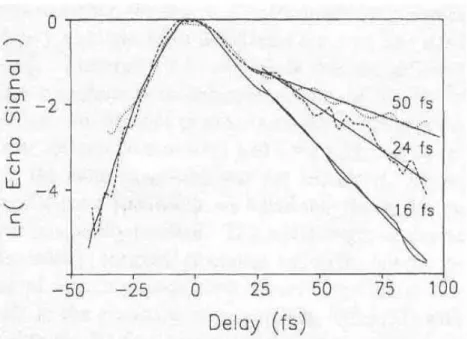
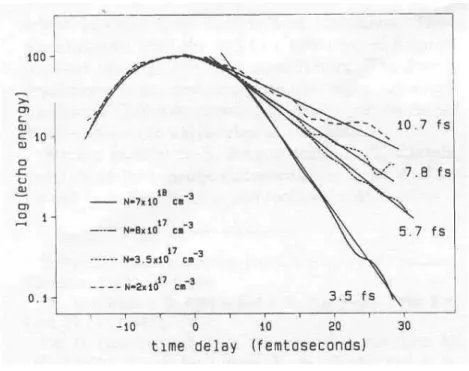
Dynamical screening is of fundamental interest in semiconductors and is also an important effect on the carrier-carrier and the carrier-phonon interactions. Since the ultrafast four-wave-mixing (FWM) experiment1 was introduced, the dependence of dynamical screening on the sample’s dimension has been further investigated. In the earlier report2,3, the photon-echo dephasing time at different excited carrier densities (n) had been measured and the dependence was found to be governed by the power law of D
1
n− , where D represents the dimension, shown in Fig. 2.1 and 2.2. The reason for the photon-echo dephasing was attributed to the carrier-carrier scattering (CCS), which leads the non-equilibrium carrier distribution spreading out so that the photon-echo’s coherence is broken. In their assumption, the shielding potential in the CCS had built up at the measured time interval and thus the power law is as a result of screened scattering rate. If the shielding potential was not developed, the dephasing process would become more quickly due to a faster CCS, and the power law would also change, in principal, to satisfy the dependence ofn−1 for both sample’s structures. By comparing the two kinds of power law, the dynamical screening was found to be
Figure 2.1: Time-resolved four-wave mixing results from Bigot’s experiment in GaAs quantum wells. (a) Extraction of photon-echo dephasing time. (b) Density dependence of photon-echo dephasing time. Solid line: the fitting curve for the measured result. Dash line: the curve of unscreened carrier-carrier scattering rate. (quoted from Phys. Rev. Lett. 67, 636 (1991))
(a)
Figure 2.2: Time-resolved four-wave mixing results from Becker’s experiment in bulk GaAs. (a) Extraction of photon-echo dephasing time. (b) Density dependence of photon-echo dephasing time. Solid line: the fitting curve for the measured result. (quoted from the Phys. Rev. Lett. 61, 1647 (1988))
(a)
weaker in a quantum well because the variation from n−1 to D 1
n− in a two dimension (2D) is smaller.
The screening dependence was, in general, accepted for more than one decade until a conflicting result was demonstrated experimentally and theoretically4. Under the same experiment of ultrafast FWM in GaAs, the photon-echo dephasing times at different excited carrier densities were re-measured; however, the significant power law D
1
n− cannot be repeated. Unexpectedly, the dephasing time as a function of the carrier density was satisfied the 3
1
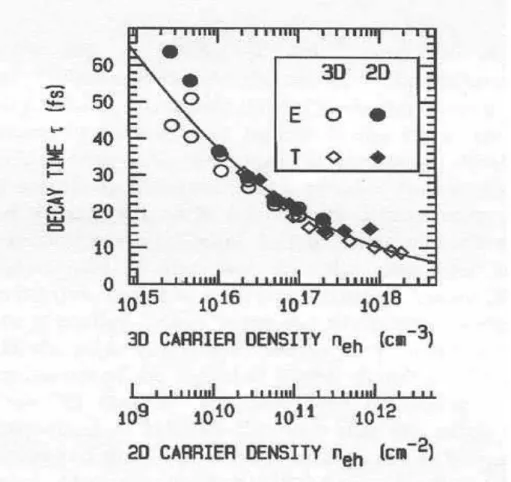
n− dependence for both a quantum well and a bulk. For a further examination, the time evolution of optical polarization field coupled to the CCS at different carrier densities was calculated with using the quantum kinetic theory. By extracting the dephasing time from the polarization field, the function of dephasing time on the carrier density can be obtained and also shows the dependence4, shown in Fig. 2.3. Thus, from the result one cannot determine which structure the carrier has a stronger or weaker screening strength in. In addition, according to the estimation of screening buildup5, for a low carrier density the shielding potential has been not completely developed at the measured time interval. Thus, the conventional method is also weak in the comparison of screening strength between the two sample’s structures.
Recently, the screening dependence for the Fröhlich interaction6 was discovered. Although the scattering mechanism between the Fröhlich and the carrier-carrier interactions is different, the result is still meaningful because their unscreened Coulomb interactions in the Fourier space (∝1/qL2 in 2D and ∝1/q2L3 in 3D) are very similar, where q and L denotes the exchanged wave vector and the sample’s length, respectively. Nevertheless, for the Fröhlich interaction, the dynamical screening was shown to be stronger in a quantum well than a bulk. This is opposite to
Figure 2.3: Density dependence of photon-echo dephasing time from Mieck’s results in a quantum well and a bulk. E: experiment. T: theory. (quoted from Phys. Rev. B 62, 2686 (2000))
the earlier understanding but is in agreement with the electrodynamics. In a lower dimension the electric flux has a stronger confinement so that has a stronger electric flux density than that in a higher dimension. Because the screening is a many-particle effect to shield an external charge source, it acts as a sub-Coulomb interaction and would also follow the dependence. The static screening (abbreviated as s.s.) is a verification. As the exchanged wave vector large enough (q>>κ2D,κ3D), where κ denotes the screening wave vector, the screened Coulomb interaction in the two distinct dimensions can be written as a series.
where ε∞ denotes a high-frequency dielectric constant. In the series the next leading term κ2D/q and 2
D 3 /q)
(κ stands for the screening factor. Although κ2D and
D 3
κ have different values, the 3D screening factor is generally smaller due to the square power. This dependence is also held for the opposite limit (q<<κ2D,κ3D).
Dynamical screening is more complex because it is a time-dependent interaction, and should be studied with using the non-equilibrium carrier’s evolution. The carrier’s evolution can be obtained by solving the kinetic equation. In the semiclassical Boltzmann equation, there is a singular point at the vanishing exchanged wave vector where the unscreened scattering rate is divergent. One must consider the screening effect to eliminate the singularity so that the scattering rate becomes finite. However, the divergence can be avoided in the quantum kinetic theory7 (QKT) because the state vector in Hilbert space leading to the energy uncertainty can smooth it. This is an advantage because one can obtain two kinds of non-equilibrium carrier’s evolution (2.1a) (2.1b) ) ( ) ( ) ( . . +L κ − ε ≅ ε κ + = ∞ ∞ q 1 qL e L q e q V 2D 2 2 2 D 2 2 D 2 s s ) ) q ( 1 ( L q e L ) q ( e ) q ( V 3D 2 3 2 2 3 2 D 3 2 2 D 3 . s . s +L κ − ε ≅ ε κ + = ∞ ∞
(screened and unscreened) and then compare the difference to show the screening strength. In the report, the non-equilibrium Green function was used to derive the quantum kinetic equation and the solution therein also verifies the screening dependence as the Fröhlich interaction as we mentioned above.
2.1.2 Memory Effect
The carrier’s quantum coherence not only smoothes the singularity but also relaxes the conservation of energy (or momentum) and the Markovian approximation for a scattering event. In the last decade, the energy non-conservation has been demonstrated in semiconductors experimentally and theoretically8,9 but the non-Markovian effect is still not well understood10. The Markovian approximation is valid for the carrier’s scattering is instantaneous and independent on the past carrier’s distribution. This is no longer held for the carrier’s quantum kinetics because the evolution of quantum state is a continuous process with respect to the time from the excitation turned on to the coherence broken down. In this thesis, we discover that the relaxed Markovian approximation would cause an impact effect on the carrier’s evolution. Since the non-equilibrium carrier is generated, the carrier begins to scatter with each other and spreads out. As the time evolves, the past carrier’s distribution would increase the scattering rate and causes a burning hole in the carrier’s evolution.
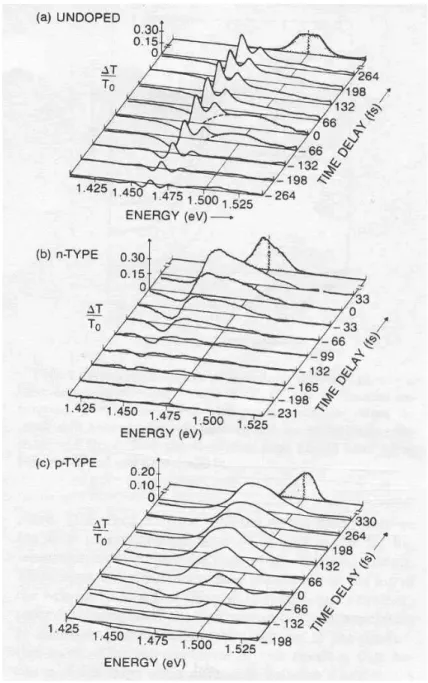
Earlier, Knox experimentally found a very rapid thermalization (less than 10fs) of non-equilibrium carrier among a cold electron’s background in a quantum well11, shown in Fig. 2.4. The carrier’s evolution has a strong dependence on the cold electron and the specific dimension. However, up to now, the physical mechanism is still not understood. Kane theoretically obtained the carrier’s evolution12 by solving the Boltzmann equation but cannot repeat the result. We go further to the problem within the quantum kinetic regime. With the absent singularity, the effect of 2D cold
Figure 2.4: Time-resolved differential transmission spectra from Knox’s experiments in GaAs quantum wells. (a) Undoped sample at excitation density of 5×1011 cm-2. (b) Sample with n-modulation doping of 3×1011 cm-2 , excited with density of 3×1011 cm-2 (c) Sample with n-modulation doping of 3×1011 cm-2 , excited with density of 3×1011 cm-2. The excitation energy had about 20meV above edge of ground subband. (quoted
electron on the non-equilibrium carrier’s evolution can be divided into that on the unscreened carrier’s evolution and the screening strength. By the benefit, one can demonstrate the difference of screening strength caused by the non-equilibrium and the cold carriers. The Knox’s result11 is in a very short time scale so that the memory effect is important. The memory effect leading to a faster carrier’s evolution is similar to the result11. Nevertheless, the 2D cold electron is not shown to cause a significant difference and the carrier is also not shown to reach the thermalization in a less than 10fs time scale.
2.2 Quantum Kinetic Equation
In this section, we introduce the derivation and approximations of scattering term. By using the close-time-path non-equilibrium Green function, the Dyson equation can be extended to the generalized Kadanoff-Baym equation13 (GKBE). The GKBE was chosen as the quantum kinetic equation in the investigation. A non-equilibrium carrier’s distribution is generated on the band structures and the carrier’s evolution via the electron-electron interaction can be obtained by solving the equation. Because the femtosecond scale is concerned, the carrier-phonon and other scatterings were omitted. The electron-hole interaction was also not considered because their different Bloch functions lead a lower scattering rate than that of electron-electron interaction. Generalized Kadanoff-Baym Ansatz14 (GKBA) was used to simplify the memorial integral of scattering term and the random phase approximation15 (RPA) was to the screening behavior. The scattering terms were strictly derived in the distinct dimensions and the 2D formulations (including the scattering term and RPA dielectric function) are firstly demonstrated in the thesis. The carrier’s distribution can be in terms of equal-time lesser Green function (fk(t)= h−i Gk<(t,t)). In the GKBE, the scattering term of k-state particle can be written as16
where Gk>(<)(t,t')and )Σ>k(<)(t,t' denote a greater (lesser) two-time Green function and a Coulomb scattering self energy. By using the analytic continuation17, the Coulomb scattering self energy in the RPA can be rearranged as16
where Vr (t,t1)
,
s q represents a retarded shielding potential. Before the screening builds up, the shielding potential is given byVqδ(t−t1), whereV denotes the q
Coulomb interaction in Fourier space. The shielding potential almost takes a plasma forming time to build up5. In the calculation, the screening was assumed to be built up instantaneously because it can significant shorten the simulating time but not changes the dependence of screening strength on the sample’s dimension. The retarded shielding potential18 was modeled by Vqδ(t−t1)/εRPA(q,ω) , where εRPA(q,ω) denotes the RPA dielectric function.
Substitute the Coulomb scattering self energy into the eq.(2.2), after an algebraic arrangement by using the GKBA, the scattering term can be written as16
where ∆ denotes the non-conserving energy and Γ denotes the dephasing factor. Change the notation of k, '
k , k-q, and k'+ by kq
1, k2, k3, and k4, respectively, and
(2.4)
[
]
) t , t ( ) t , t ( G ) t , t ( ) t , t ( G ) t , t ( G ) t , t ( ) t , t ( G ) t , t ( dt t ) t ( f ' ' ' ' t ' ' ' ' ' . scatt > < < > ∞ − > < < > Σ + Σ − Σ − Σ − = ∂ ∂∫
k k k k k k k k k(
)
∑
∫
∫
>< <> + ∞ − ∞ − < > − < > = Σ ' k q k q k q q q k k , 1 2 ) ( 2 1 ) ( * 2 ' r , s 1 r , s t 2 t 1 ' ) ( 2 ' ) ( (t,t ) 2 G (t,t ) dt dt V (t,t ) V (t ,t ) G (t ,t )G (t ,t ) ' ' h{
f (t )f (t )[1 f (t )][1 f (t )] [1 f (t )][1 f (t )]f (t )f (t )}
e ] ) t t ( cos[ ) t ( V ) t ( V dt 4 t ) t ( f ' ' ' ' ' ' ' ' ) t t ( t ' ' , s , s ' 2 ' ' q k q k k k q k q k k k k q, q q k ' ' − + − + − Γ − ∞ − − − − − − × − ∆ − = ∂ ∂∑ ∫
h h h (2.2) (2.3)derive the scattering terms in distinct dimensions that with screening can be shown as
where the parabolic band is used. The unscreened scattering term is the formulation without the 2D,3D ' 2
RPA ( , ,t ) −
ω
ε q . ∆max and ∆min denote the maximum and minimum
non-conserving energy and are equal to 2
2 e 2 e 2 3 2 e 2 2 2 e 2 1 2 k q m 2 m 2 k m 2 k m 2 k ) ( − − − +h h h h and 2 2 e 2 e 2 3 2 e 2 2 2 e 2 1 2 k q m 2 m 2 k m 2 k m 2 k ) ( + − − +h h h
h . The form factor in 2D term is set to be unity19.
The RPA dielectric functions in distinct dimensions can be expressed as
(2.5b) (2.6b)
{
f (t )f (t )[1 f (t )][1 f (t )] [1 f (t )][1 f (t )]f (t )f (t )}
e )) t t ( cos( ) t , , ( 1 d dk k q dq dk k dt k e m t ) t ( f ' k ' k ' k ' k ' k ' k ' k ' k ) t t ( ' 2 ' D 3 RPA 0 2 2 k k k k 4 0 3 3 t ' 2 1 4 4 4 e D 3 k 4 3 2 1 4 3 2 1 ' max min 3 1 3 1 1 − − − − − × − ∆ ω ε ∆ ε π − = ∂ ∂ − Γ − ∆ ∆ ∞ + − ∞ ∞ − ∞∫
∫
∫
∫
∫
h h h q(
)(
)
(
)(
)
∫
∞ ⎥ ⎥ ⎦ ⎤ ⎢ ⎢ ⎣ ⎡ δ + ω + β − δ − ω − β − δ + ω + β + δ − ω − β + ε π + = ω ε ' k 3 2 2 2 e ' D 3 RPA i 2 / E i 2 / E i 2 / E i 2 / E ln ) t ( kdkf q 2 e m 1 ) t , , ( h h h h h q q q(
)
(
)
(
)
(
)
(
)
(
)
(
)
2 2 2(
)
1 1 2 2 2 1 2 2 2 1 2 2 2 1 z 0 ' k 2 2 2 2 e ' D 2 RPA E i 2 E i ) E ( 1 z E i 2 E i ) E ( 1 z E i 2 E i ) E ( 1 z E i 2 E i ) E ( 1 z idz ) t ( dkf q 2 e m 1 ) t , , ( − − − − = ∞ ∞ ⎥ ⎦ ⎤ ⎢ ⎣ ⎡ ⎟ ⎠ ⎞ ⎜ ⎝ ⎛ ω− + δ− ω− −δ −β + δ ω− β − × ⎥ ⎦ ⎤ ⎢ ⎣ ⎡ ⎟ ⎠ ⎞ ⎜ ⎝ ⎛ ω− + δ+ ω− −δ −β + δ ω− β − − ⎥ ⎦ ⎤ ⎢ ⎣ ⎡ ⎟ ⎠ ⎞ ⎜ ⎝ ⎛ ω+ + δ− ω+ −δ −β + δ ω+ β − × ⎥ ⎦ ⎤ ⎢ ⎣ ⎡ ⎟ ⎠ ⎞ ⎜ ⎝ ⎛ ω+ + δ+ ω+ −δ −β + δ ω+ β − × ε π + = ω ε∫
∫
q q q q q q q q q q q q q h h h h h h h h h h h h h (2.5a){
f (t )f (t )[1 f (t )][1 f (t )] [1 f (t )][1 f (t )]f (t )f (t )}
2qk ∆ 2m q k k 1 k 2k q k k 1 e )) t t ( cos( ) t ω, , ( ε 1 d dk q dq dk dt k e m t ) t ( f ' k ' k ' k ' k ' k ' k ' k ' k 2 2 2 e 2 2 3 2 1 2 3 1 2 2 3 2 1 ) t t ( ' 2 ' 2D RPA 0 2 k k k k 2 0 3 t ' 2 1 4 4 4 e D 2 k 4 3 2 1 4 3 2 1 ' max min 3 1 3 1 1 − − − − − × ⎟ ⎟ ⎟ ⎟ ⎠ ⎞ ⎜ ⎜ ⎜ ⎜ ⎝ ⎛ − − − − ⎟⎟ ⎠ ⎞ ⎜⎜ ⎝ ⎛ + − − − ∆ × ∆ ε π − = ∂ ∂ − Γ − ∆ ∆ ∞ + − ∞ ∞ − ∞∫
∫
∫
∫
∫
h h h h q (2.6a)where ω denotes the oscillating frequency of dynamical screening and is equal to ∆ − − e 2 3 2 e 2 1 2 m 2 k m 2 k h h . q E and β are e 2 2 m 2 q h and e 2 m kq h , respectively.
2.3 Results and Discussion
In the investigation, the parameters of GaAs were taken from the Adachi’s report20 and the structure of a quantum well was chosen as a 10-nm well width (L ) and 0.3 w Al fractions. The initial carrier’s distribution was the Gaussian function with a center of 25meV above the ground state and a full width half maximum (FWHM) of 15meV around the center. Before the carrier exchanges the energy with phonons, the lattice temperature of 15K was used. 0.8 Rydberg energy5 was used for the dephasing factor. Partial scattering terms were integrated by using the Gaussian quadratures21. The calculation was performed on the momentum space but the result will change to the electron’s energy in the plots.
2.3.1 2D versus 3D Dynamical Screening
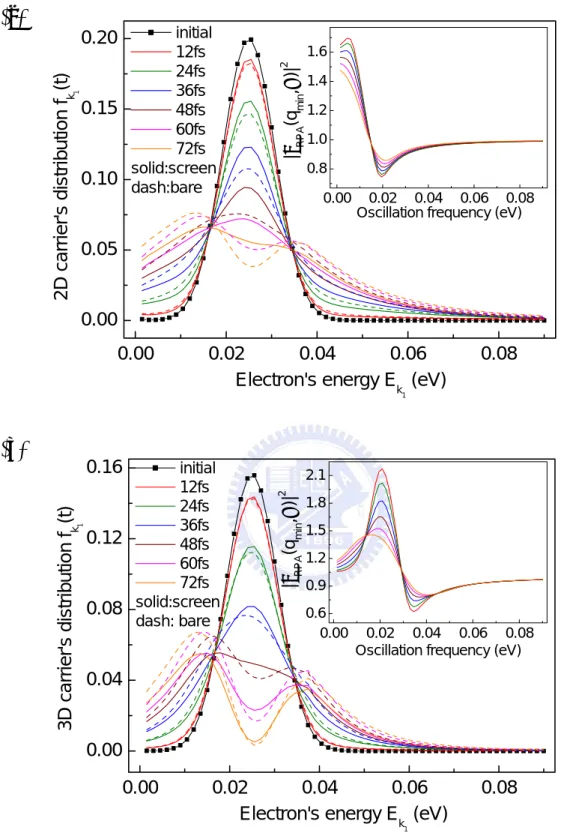
Fig. 2.5(a) and 2.5(b) show the 2D and 3D GKBE solutions at the carrier density of 8×1010cm-2 and 8×1016cm-3, respectively. Distinct colors represent different delayed times. Solid and dash curves denote the screened and unscreened results, respectively. At the beginning, a non-thermal carrier’s distribution is generated and carriers start to scatter with each other. The unscreened carrier’s evolution is faster than the screened one. Their difference is enlarged as the time evolves and is more considerable in a quantum well. Thus, the screening dependence is verified and can be understood in a simple picture. In a 2D structure, due to a stronger confinement, the electric field is larger than that in a 3D structure and the stronger dynamical screening is as a result of larger difference between the unscreened and screened electric fields. The screening
0.00 0.02 0.04 0.06 0.08 0.00 0.05 0.10 0.15 0.20 initial 12fs 24fs 36fs 48fs 60fs 72fs solid:screen dash:bare 2D carrier's distribution f k1 (t) Electron's energy E k 1 (eV) 0.00 0.02 0.04 0.06 0.08 0.00 0.04 0.08 0.12 0.16 3D carrier's distribut ion f k1 (t ) Electron's energy Ek 1 (eV) initial 12fs 24fs 36fs 48fs 60fs 72fs solid:screen dash: bare 0.00 0.02 0.04 0.06 0.08 0.6 0.9 1.2 1.5 1.8 2.1 | ε RP A (q mi n ,ω )| 2
Oscillation frequency (eV)
0.00 0.02 0.04 0.06 0.08 0.8 1.0 1.2 1.4 1.6 | ε RPA (q mi n ,ω )| 2
Oscillation frequency (eV)
(a)
Figure 2.5: GKBE solutions for the screened and the unscreened (bare) non-equilibrium CCS. (a) in a 10nm-width GaAa/Al0.3Ga0.7As quantum well at the non-equilibrium
density of 8×1010 cm-2. (b) in bulk GaAs at the non-equilibrium denisty of 8×1016 cm-3. The initial distribution was modeled by the Gaussian function with the center of 25meV above the ground state and the FWHM of 15meV around the center. Inset figures show the transient screening strength at the minimum wave vector q of CCS.
strength is shown in the inset figure where a larger magnitude around the center of non-equilibrium carrier’s distribution in 2D than 3D structures is demonstrated. Although the (unscreened and screened) electric field is weaker in a bulk than a quantum well (respectively), the carrier in a higher dimension has a larger density of states so that the scattering rate becomes larger and the carrier has a faster evolution. The dependence is in good agreement with the experiment where the photon-echo dephasing time is shorter in a bulk2,3. In addition, the distinct density of states causes an increased and a flat scattering rate with an increased carrier’s energy in a bulk and a quantum well respectively so that the former has a quick scattering to the lower energy state while the later has a uniformly spreading distribution along the energy.
2.3.2 Quantum Coherence on Carrier’s Evolution
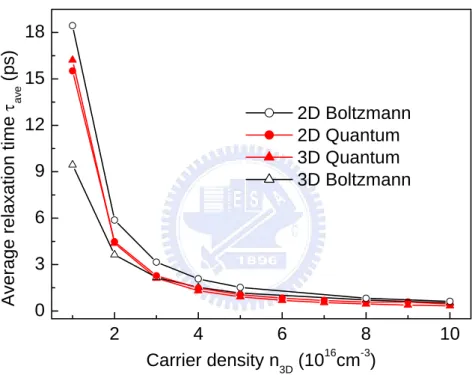
Because the carrier’s quantum coherence breaks the Markovian approximation, the past carrier’s distribution is taken into account the scattering so that the carrier’s evolution has the memory effect. The scattering rate is enhanced at the early stage. As the time evolves, the enhancement becomes energy dependent so that a burning hole is demonstrated on the carrier’s distribution. The memory effect can give a reasonable explanation for the contradiction of power laws of photon-echo dephasing time2-4. Fig. 2.6(a) and 2.6(b) show the 2D and 3D screened GKBE solutions at 90fs and 60fs for the density from 1010cm-2 to 1011cm-2 and 1016cm-3 to 1017cm-3, respectively. Inset figure shows the Boltzmann solution. The average relaxation time is defined by
1 k f t ∆ ∆ , where 1 k f
∆ is the difference of occupations at 25meV in a time interval ∆t. Changing n2D to n2D/Lw, the relaxation time is shown in Fig. 2.7. The density dependence in distinct regimes is quite different. In the Boltzman regime, it is slightly stronger in a quantum well than a bulk and is in consistent with the experimental
0.00 0.02 0.04 0.06 0.08 0.00 0.02 0.04 0.06 0.08 carrier density from 1010 to 1011cm-2 with step 1010cm-2 2D carrier's distri bution f k1 (t =90 fs ) Electron's energy E k1 (eV) 0.00 0.02 0.04 0.06 0.08 0.00 0.02 0.04 0.06 carrier density from 1016 to 1017cm-3 with step 1016cm-3 Electron's energy Ek 1 (eV) 3D car rier's distr ibution f k1 (t=60fs) 0.00 0.02 0.04 0.06 0.08 0.00 0.02 0.04 0.06 0.08 0.10 8 5 4 3 2 1 Unit: 1010cm-2 2D distributi on Energy (eV) 0.00 0.02 0.04 0.06 0.08 0.00 0.02 0.04 0.06 0.08 0.10 8 5 4 3 2 1 Unit: 1016cm-3 3D di stribu tio n Energy (eV)
Figure 2.6: GKBE solutions for the screened CCS at distinct non-equilibrium densities. (a) in a 10nm-width GaAa/Al0.3Ga0.7As quantum well at the delayed time of 90fs. (b) in
bulk GaAs at the delayed time of 60fs. Inset figures show the Boltzmann solutions. The center and the FWHM of initial Gaussian distribution are 25meV and 15meV, respectively.
(a)
2 4 6 8 10 0 3 6 9 12 15 18 2D Boltzmann 2D Quantum 3D Quantum 3D Boltzmann
Average relaxation time
τ av e (p s) Carrier density n 3D (10 16 cm-3)
Figure 2.7: Comparison of 2D and 3D average relaxation times as a function of the non-equilibrium carrier density between the quantum and the Boltmann kinetic regimes. The results were extracted from the Fig. 2.6. The sheet density in a quantum well was converted to the volume density by dividing the Lw of 10nm.
power law of D 1
n− . The power law also can be obtained by using the estimation of average interparticle distance2,3 and a strict derivationin the Boltzmann theory22. Thus, the earlier experimental result2,3 should be valid and was measured from a dephasing non-equilibrium carrier. In the quantum regime, the dependence in the two sample’s structures becomes almost indistinguishable and is in surprisingly good agreement with the report4. Although the semiconductor Bloch equation was used there4, the two theoretical approaches give the same dependence. Thus, the experiment result4 should be measured from a coherent non-equilibrium carrier and the memory effect is the reason for the change of power law from the Boltzmann to the quantum regimes.
2.3.3 Scattering among Dense Fermi Sea
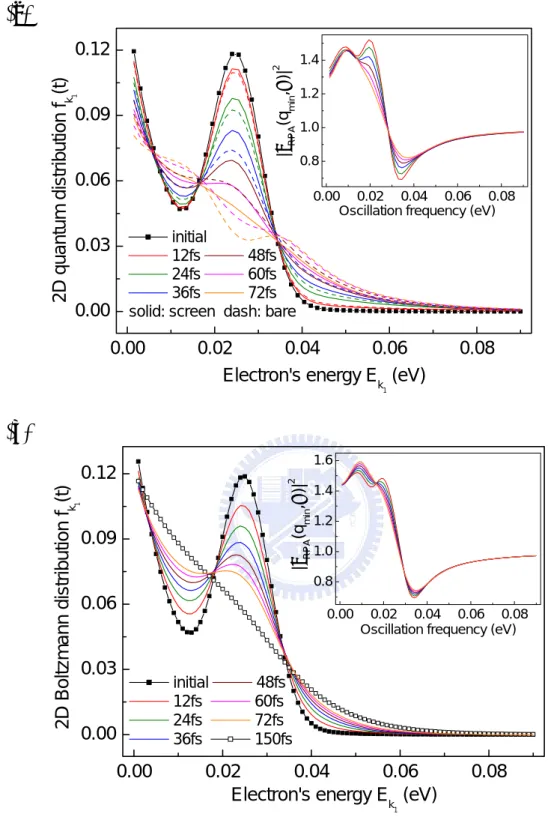
Fig. 2.8(a) shows the 2D GKBE solution at the density of 8×1010 cm-2, where 55 % is partitioned to the non-equilibrium carrier and 45% is to a 100K electron’s background. Fig. 2.8(b) shows the Boltzmann solution. In the absent screening, the carrier’s evolution is shown to evolve as normal as that with the non-equilibrium carrier alone. The non-equilibrium carrier has a weak interaction with the cold electron because their exchanged wave vector is large. Thus, the non-equilibrium carrier has a very slow scattering to the cold electron and most scattering among the non-equilibrium carrier is due to itself. Comparing the Fig. 2.8(a) and 2.5(a), the screening strength caused by the 2D cold electron is shown to have a very small difference from that caused by the non-equilibrium carrier although their dielectric functions are a little different. Thus, the effect of 2D cold electron can be rule out from the possibility of Knox’s result. The memory effect leads the carrier with a faster scattering rate and a shorter thermalization time as compared to the Boltzmann solution. Nevertheless, the thermalization is not shown to become so rapid in a less than 10fs time scale. In addition, this is independent of the 2D cold electron. Thus, the
0.00 0.02 0.04 0.06 0.08 0.00 0.03 0.06 0.09 0.12 2D quantum distribution f k1 (t) Electron's energy Ek 1 (eV) initial 12fs 48fs 24fs 60fs 36fs 72fs solid: screen dash: bare
0.00 0.02 0.04 0.06 0.08 0.00 0.03 0.06 0.09 0.12 initial 48fs 12fs 60fs 24fs 72fs 36fs 150fs 2D Boltzmann distribution f k1 (t) Electron's energy E k1 (eV) 0.00 0.02 0.04 0.06 0.08 0.8 1.0 1.2 1.4 |ε RP A (q mi n ,ω )| 2
Oscillation frequency (eV)
0.00 0.02 0.04 0.06 0.08 0.8 1.0 1.2 1.4 1.6 |ε RP A (q mi n ,ω )| 2
Oscillation frequency (eV)
Figure 2.8: Time evolution of non-equilibrium carrier among a 100K electron’s background in a 10nm-width GaAa/Al0.3Ga0.7As quantum well. (a) GKBE solution. (b)
Boltzmann solution. The non-equilibrium and the cold electron’s densities are 0.55×8× 1010 cm-2 and 0.45×8×1010 cm-2, respectively. Inset plots show the screening strength at the minimum wave vector qmin. The center and the FWHM of initial Gaussian
distribution are 25meV and 15meV, respectively.
(a)
memory effect also can be ruled out. In the earlier experiment11, the 2D cold carrier is generated from the modulation dopants in the barrier, where Si and Be were used as the n-type and p-type dopants. The ionized impurities would build an electric field so that increases the scattering rate. Because the Si has electrons in orbit (Z=14) three times more than the Be (Z=4), the building electric field of Si enhances the scattering more considerably. After ruling out all possibilities, the rapid thermailzation in the presence of 2D cold electron should be due to the electric field induced from barrier’s modulation dopants.
2.4 Summary
Although the dynamical screening on the CCS is a complex Coulomb interaction, the dimensional dependence can be understood in a simple picture and the picture is also valid on the Fröhlich interaction and the static-screened interaction. The memory effect is as a result of quantum coherence and would cause a burning hole on the carrier’s distribution at the early stage. As the time further goes, the two hills aside the burning hole is expected to continue to evolve to two burning holes and three hills due to the memory effect and go on until the carrier dephases or thermalizes. The non-equilibrium carrier’s evolution is normal in the presence of 2D cold electron and the Knox’s result should be due to the effect of wafer’s preparation.
References
1. J. Shah, Ultrafast Spectroscopy of Semiconductors and Semiconductor Nanostructures (Springer, Berlin, 1996).
2. J. –Y. Bigot, M. T. Portella, R. W. Schoenlein, J. E. Cunningham, and C. V. Shank, Phys. Rev. Lett. 67, 636 (1991).
3. P. C. Becker, H. L. Fragnito, C. H. Brito Cruz, R. L. Fork, J. E. Cunningham, J. E. Henry, and C. V. Shank, Phys. Rev. Lett. 61, 1647 (1988).
4. B. Mieck, H. Haug, W. A. Hügel, M. F. Heinrich, and M. Wegener, Phys. Rev. B 62, 2686 (2000).
5. K. El Sayed, S. Schuster, H. Haug, F. Herzel, and K. Henneberger, Phys. Rev. B 49, 7337 (1994).
6. H. C. Lee, K. W. Sun, andC. P. Lee, Solid State Comm. 128, 245 (2003). 7. K. El Sayed, L. Bányai, and H. Haug, Phys. Rev. B 50, 1541 (1994).
8. M. Betz, G. Göger, A. Laubereau, P. Gartner, L. Bányai, H. Haug, K. Ortner, C. R. Becker, and A. Leitenstorfer, Phys. Rev. Lett. 86, 4684 (2001).
9. C. Fürst, A. Leitenstorfer, A. Laubereau, and R. Zimmermann, Phys. Rev. Lett. 78, 3733 (1997).
10. L. Bányai, D. B. Tran Thoai, E. Reitsamer, H. Haug, D. Steinbach, M. U. Wehner, M. Wegener, T. Marschner and W. Stolz, Phys. Rev. Lett. 75, 2188 (1995).
11. W. H. Knox, D. S. Chemla, G. Livescu, J. E. Cunningham, and J. E. Henry, Phys. Rev. Lett. 61, 1290 (1988).
12. M. G. Kane, Phys. Rev. B 54, 16345 (1996) and Carrier-Carrier Scattering among Photoexcited Nonequilibrium Carriers in GaAs (Dissertation of Princeton University, 1994).
Tork, 1962).
14. P. Lipavský, V. Špička, and B. Velický, Phys. Rev. B 34, 6933 (1986). 15. G. Mahan, “Many Particle Physics” (Plenum, New York, 2000).
16. H. Haug and A. -P Jauho, Quantum Kinetics in Transport and Optics of Semiconductors, 2nd ed. (Springer, Berlin, 1998).
17. D. C. Langreth, Linear and Nonlinear Electron Transport in Solids, ed. By J. T. Devreese and E. Van Doren (Plenum, New York, 1976).
18. L. Bányai, Q. T. Vu, B. Mieck, and H. Haug, Phys. Rev. Lett. 81, 882 (1998). 19. The form factor is given by
where ϕ(z) denotes the electron’s wave function and lower subscript indicates the subband of initial and final states. The form factor of intrasubband scattering in the ground state can be expressed as
20. S. Adachi, J. Appl. Phys. 58, R1 (1985).
21. M. Abramowitz and A. Stegun, Handbook of Mathematical Functions, p.916, 917 (Dover, New York, 1964).
22. D. W. Snoke, Phys. Rev. B 50, 11583 (1994).
∫
∫
∞ ∞ − − − ∞ ∞ − ϕ ϕ ϕ ϕ = * ' qz z' n * m ' j i ' ijmn(q) dz dz (z) (z ) (z) (z)e F[
]
⎥ ⎦ ⎤ ⎢ ⎣ ⎡ + π + − π − π π + = −2 2 w w 2 w qL 4 w 2 2 2 w 1111 qL 2 1 ) 2 ( ) qL ( ) qL ( ) e 1 ( 4 qL ) 2 ( ) qL ( 8 ) q ( F wChapter 3
Hot Carrier Relaxation
3.1 Introduction
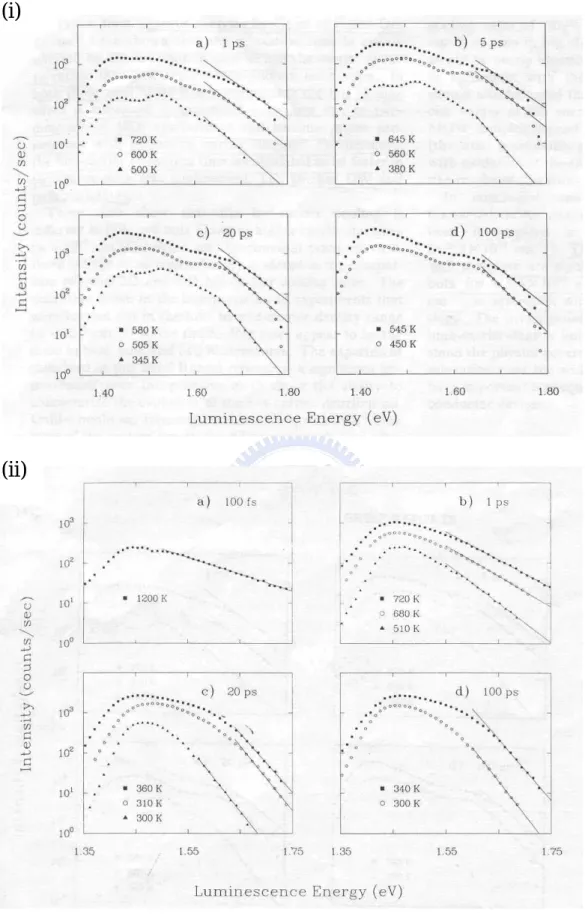
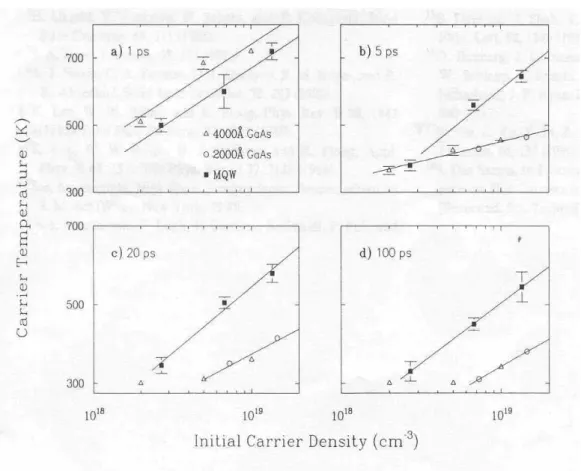
Although hot carrier relaxations in a bulk GaAs and quantum wells have been studied experimentally1-11 and theoretically12-14 for more than one decade, the dependence of the dynamical screening in hot carrier relaxations on the sample’s dimensionality is still not well understood. The screening behavior caught less attention on hot carrier relaxations in GaAs probably attributes that the hot phonon effect was primarily considered to be responsible for the great drop of energy-loss rates via Fröhlich interaction2,5,11, and hot carrier relaxations seem not to depend on the dimensionality experimentally4,5,6. However, the deduction could not hold on the overall carrier densities. Because more recent experimental results indicated that there is a clear difference in energy-loss rates between a bulk GaAs and quantum wells when the carrier density is above a certain critical value7,8,9, shown in Fig. 3.1 and 3.2. Though the critical carrier densities determined in those experiments are not consistent, the results imply that the dimensionality and the dynamical screening may have a significant effect on hot carrier relaxations in a bulk GaAs and quantum wells.
To theoretically study the difference of hot carrier relaxations between the two different dimensional systems, it is important to consider the optical phonon modes in a quantum well. Many improved models were developed to give a better description for atomic vibrations and the interaction Hamiltonians with electrons in the quasi two-dimensional structure15-26. In our calculations, we use the dielectric continuum
Figure 3.1: Time-resolved luminescence spectra at room temperature from Pelouch’s results. (i) for 400nm bulk GaAs. (ii) for multiple quantum well. square: 1019cm-3;
18 -3 18 -3
(i)
Figure 3.2: Comparison of carrier temperature versus initial carrier density between different sample’s structures. (quoted from Phys. Rev. B 45, 1450 (1992))
model15-17,20 (DCM) because the model has provided a good agreement with many earlier experimental results27-33. Although the interaction Hamiltonians of phonon modes in a quantum well are strongly dependent on the well width, many experimental results4,5,6 demonstrated the less well-width dependence of hot carrier relaxations except few report shown the contrary results34,35. This discrepancy also stimulates us to study the structural dependence of energy-loss rates in a quantum well.
In the thesis, the significance of the dimensionality and the dynamical screening on hot carrier relaxations in a bulk GaAs and quantum wells is investigated. The distinct dimensionality and the dynamical screening indeed cause that hot carriers in quantum wells relax significantly slower than that in a bulk GaAs above the critical carrier density of 2×1018cm-3. We attribute this to the smaller density of state in quantum wells and the strong 2D dynamical screening. The dynamical screening in quantum wells appears to be much stronger than that in the bulk and considerable as compared to the hot phonon effect. The critical carrier density determined in our studied is in very good agreement with the earlier experiments of Pelouch and co-researchers7. We also found that the average energy-loss rate in quantum wells depends on the well width more appreciably when Al compositions are high.
3.2 Semiclassical Boltzmann Equation
The average energy-loss rate (AELR) is calculated in order to compare the difference of hot carrier relaxations between the two different dimensional systems. In this section, we describe the derivations of the AELR in a bulk GaAs and a quantum well where the net phonon generation rate, and the treatments of hot phonon effect and the dynamical screening are included. The dynamical screening is dealt with the RPA36.
dynamical screenings. In our calculations, the electron-phonon scattering is through Fröhlich interaction and only intrasubband scattering is considered in the calculation of the AELR in quantum wells. The hole-phonon interaction is neglected. The plasmon-phonon coupling (PPC) is not considered here because the significant enhancement of energy-loss rates37,38 induced by the PPC does not appear above the critical carrier density of 2×1018cm-3.
The AELR is determined by the net phonon generation rate and the phonon energy. The net phonon generation rate represents the subtracting difference between phonon’s generation rates and absorption rates. In a bulk GaAs, the 3D net phonon generation rate is given by39
where q and ω denote phonon’s wave vector and phonon’s energy, respectively. q )
(
f ζ is the electron’s distribution. With the thermalized assumption for carriers, Fermi-Dirac distribution is used where T is the carrier temperature. C N represents q phonon population. kB and V have their usual meanings. The quantity Nq(TC) can be written as39
ζ , a dimensionless quantity, represents the normalized energy (energy divided by thermal energy kBTC). ζmin is the minimum normalized energy required for an electron to kick out a phonon of wave vector. It is given by39
2 e 2 2 C B 2 2 e min m 2 q T k q 2 m q ω − = ζ h h h (3.1) (3.2) (3.3)
[
]
∫
∞ ζ ζ ⎥ ⎦ ⎤ ⎢ ⎣ ⎡ ω + ζ − ζ − π = ∂ ∂ min d ) T k ( f ) ( f N ) T ( N M q V T k m t N C B C 2 5 C B 2 e q q q q q h h 1 ) T k exp( 1 ) T ( N C B C − ω = q q h2
Mq , Fröhlich interaction strength, is given by
39 ) 1 1 ( Vq 2 e M S 2 2 2 ε − ε ω = ∞ q q h
where ε∞ and εS are high frequency and static dielectric constants.
In a quantum well, based on the DCM15-17,20, the confined (C), the symmetric plus interface (S+), symmetric minus (S-) interface and the half-space (HS) phonon modes are considered in our calculations. Anti-symmetric interface modes are excluded due to the selection rule for the intra-subband scattering. The dispersion relations for the S+ and the S- interface modes are shown in the sec. 5.240. The noun “half-space” in double heterojunctions originates from the report of Mori and Ando20 where the same name as the case of a single heterojunction is used. The 2D net phonon generation rate can be written as
where q// and (C,S ,HS)
//
±
ωq denote the in-plane phonon wave vector and the phonon energies of various modes. m is the nen th layer effective electron’s mass while 1 represents GaAs and 2 represents AlGaAs layers. A denotes the area. ζ1 is the normalized ground state energy to the thermal energy. (C,S ,HS) 2
//
Mq ± represents the electron-phonon interaction strength of various modes shown in Table I. The used Hamiltonians are taken from the report of Mori and Ando20.
The quantity of (C(,S),HS)
//
Nqq± is to be determined. When the hot phonon effect is excluded, the phonon population satisfies the Bose-Einstein relation with a lattice temperature TL. In general, the hot phonon effect plays an important role in hot
(3.4)
∫
∞ ζ ± ± ± ± ± ζ ω + ζ + ζ − ζ + ζ ζ × − π = ∂ ∂ min d )] T k ( f ) ( f [ 1 ] N ) T ( N [ M q A T k m 2 t N C B ) HS , S , C ( 1 1 ) HS , S , C ( C ) HS , S , C ( 2 ) HS , S , C ( // 4 C B 3 en ) HS , S , C ( // // // // // q q q q q h h (3.5)TABLE I. The electron-optical-phonon interaction strengths in a quantum well structure Optical-phonon mode Interaction strength
Symmetric ± interface modesa
Confined modea,b
Half-space modea,b,c
a n
S
G ± is <ϕ1|φS± |ϕ1>, where ϕ1 is the electron’s ground state and φS± is potential for interface modes, and the factors p HS
C,G
G are the overlap integral for the pth confined mode and the half-space mode respectively. Their expressions and hn(.) are shown in the
sec. 5.2.
b
Sn n,ε
ε∞ are nth layer high frequency and static dielectric constants.
c
z
q is the phonon wave vector paralleled to the crystal’s growth direction. ⎩ ⎨ ⎧ = ω + ω ε ω = − ± − ± − ± ± ± regions barrier : 2 region well the : 1 n where G )] ( h ) L q 2 1 tanh( ) ( h [ Aq 4 e M 11 S // w 21 S 1 nS 2 0 S q 2 2 S // // // // q q q v h 2 p C 2 w 2 // 1 S 1 C 2 2 C G ) L / p ( q 1 ) 1 1 ( V e M π + ε − ε ω = ∞ // // q q h
∫
∞ ∞ ε + − ε π ω = 0 z 2 HS 2 z 2 // 2 S 2 HS 2 2 HS dq G q q 1 ) 1 1 ( A 2 e M // // q q hcarrier relaxations. The phonon dynamics can be governed by the phonon Boltzmann equation. At the steady state, the phonon’s population can be given by the following equation with using eq.(3.1) for bulk (eq.(3.5) for quantum wells)39.
where τ is the phonon life time. ph
The dynamical screening on hot carrier relaxations is handled with the electronic dielectric function. Based on the RPA, the dielectric function is given by36
where V is q 2 3 2 L q e ∞ ε in 3D and 2 // 2 L q 2 e ∞
ε in 2D. The damping coefficientγ ranges from 0.2 to 0.3 times of the plasma frequency41.
According to the result from the derivation of Haug and Koch42 with the RPA, the effective screened electron-phonon interaction strength Meffq 2can be expressed as
2 RPA 2 eff ) , ( M M ω ε = q q q
The 3D and 2D zero-temperature dielectric functionsare, respectively, given by43 (3.6) (3.7) ⎪ ⎪ ⎭ ⎪ ⎪ ⎬ ⎫ ⎪ ⎪ ⎭ ⎪ ⎪ ⎬ ⎫ − − γ + ω + − γ + ω ⎥ ⎦ ⎤ ⎢ ⎣ ⎡ − γ + ω − − ⎪ ⎪ ⎩ ⎪ ⎪ ⎨ ⎧ ⎪ ⎪ ⎩ ⎪ ⎪ ⎨ ⎧ − + γ + ω + + γ + ω ⎥ ⎦ ⎤ ⎢ ⎣ ⎡ ω + γ+ − + ε + = ω ε ∞ 1 k 2 q qv i 1 k 2 q qv i ln ) k 2 q qv i ( 1 1 k 2 q qv i 1 k 2 q qv i ln ) k 2 q qv i ( 1 q 2 k 1 E q 4 e n 3 1 ) , ( F F F F 2 F F F F F F 2 F F F F 2 2 D 3 D 3 RPA q q q q q q q q (3.9a) (3.8) ph L ) HS , S , C ( ) ( ) HS , S , C ( ) ( ) HS , S , C ( ) ( N N (T ) t N // // // τ − = ∂ ∂ ± ± ± q q q q q q