IEEE ELECTRON DEVICE LETTERS, VOL. 30, NO. 9, SEPTEMBER 2009 969
Electrostatic Discharge Robustness of Si
Nanowire Field-Effect Transistors
Wen Liu, Juin J. Liou, Andy Chung, Yoon-Ha Jeong, Wei-Chen Chen, and Horng-Chih Lin
Abstract—Electrostatic discharge (ESD) performance of N-type double-gated Si nanowire (NW) thin-film transistors is investi-gated, for the first time, using the transmission line pulsing tech-nique. The ESD robustness of these devices depends on the NW dimension, number of channels, plasma treatment, and layout topology. The failure currents, leakage currents, and ON-state resistances are characterized, and possible ESD protection appli-cations of these devices for future NW field-effect-transistor-based integrated circuits are also discussed.
Index Terms—Electrostatic discharge (ESD), failure current It2, nanowire (NW) field-effect transistor,ON-state resistance.
I. INTRODUCTION
A
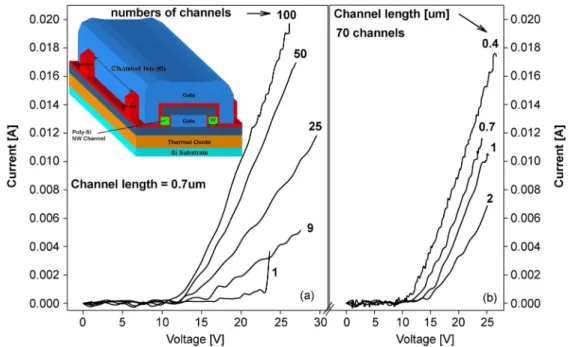
S THE scaling of silicon devices continues, nanowire (NW) structures have received increasing attention [1], [2]. The availability of electrostatic discharge (ESD) protection solutions is known to be a serious problem for integrated circuits (ICs) fabricated using advanced deep-submicrometer technologies [3], and this is particularly true for future NW-based ICs. As such, evaluating and understanding the ESD robustness of NW devices are urgently needed in preparation for the next-generation electronics for commercial applications. A promising NW device being proposed is the poly-Si NW thin-film transistor (NWTFT) [4], and the schematic of an NWTFT with two square-shaped NWs (i.e., two channels) is shown in the inset of Fig. 1(a). The NWTFT possesses several advantages, including simple fabrication flow, reliable drain/source contact, low cost, and precise alignment of the NWs [5]. In this letter, the suitability of such devices for ESD protection applications will be characterized based on theManuscript received May 17, 2009. First published July 21, 2009; current version published August 27, 2009. This work was supported in part by a research grant provided by the National Center for Nanomaterials Technology, Pohang University of Science and Technology, Korea, and in part by the Chunhui Scholar Program, Ministry of Education, China. The review of this letter was arranged by Editor C. Bulucea.
W. Liu and J. J. Liou are with the School of Electrical Engineering and Computer Science, University of Central Florida, Orlando, FL 32816 USA (e-mail: [email protected]; [email protected]).
A. Chung and Y.-H. Jeong are with the National Center for Nanoma-terials Technology, Department of Electronic and Electrical Engineering, Pohang University of Science and Technology, Pohang 790-784, Korea (e-mail: [email protected]; [email protected]).
W.-C. Chen is with the Department of Electronics Engineering and Institute of Electronics, National Chiao Tung University, Hsinchu 300, Taiwan (e-mail: [email protected]).
H.-C. Lin is with the Department of Electronics Engineering and Institute of Electronics, National Chiao Tung University, Hsinchu 300, Taiwan, and also with the National Nano Device Laboratories, Hsinchu 300, Taiwan (e-mail: [email protected]).
Color versions of one or more of the figures in this letter are available online at http://ieeexplore.ieee.org.
Digital Object Identifier 10.1109/LED.2009.2025610
transmission line pulsing (TLP) technique. To the best of our knowledge, this is the first time that TLP results are presented and analyzed for the NW field-effect transistor.
II. MEASUREMENTRESULTS ANDDISCUSSIONS
N-channel NWTFTs (N-NWTFTs) having different channel numbers (NW numbers), different channel lengths, an NW width of 43 nm, and an NW spacing of 500 nm were fabri-cated at the National Chiao-Tung University, Taiwan [4]. Only the bipolar mode (gate grounded) was fully characterized, as it is a configuration commonly employed in ESD protection applications. The Barth 4002 TLP tester was used, which generates pulses equivalent to those associated with the human body model. The experimental TLP results shown in Fig. 1(a) and (b) can be summarized as follows: 1) N-NWTFTs turn on in the voltage range of 10–15 V without the snapback due to the fact that the base terminal of the parasitic bipolar transistor imbedded in the N-NWTFT is floating; 2) a shorter channel length results in a higher failure current It2 (i.e., the currents where the I–V curves end) and smaller on-resistance Ron(i.e.,
the slopes of the I–V curves after the devices are turned on); and 3) while It2and Ronincrease and decrease with increasing
channel number, they do not scale linearly with the number of channels.
It is worth mentioning that when the gate is connected to the drain (diode mode), the NWTFT triggers at around 0.7 V and exhibits a linear I–V behavior after it is triggered. In addition, its failure current is about four times higher than that of the bipolar mode NWTFT due to the smaller trigger voltage.
To further investigate the ESD robustness, N-NWTFTs hav-ing wide and narrow NWs (W = 43 and 18 nm) and with and without the plasma treatment were measured and com-pared in terms of It2, failure current density Jt2 (Jt2= It2/(nanowire width× number of nanowires)), and leak-age current (measured at 1 V) as functions of the channel number and length, as shown in Fig. 2(a)–(f). Plasma treat-ment is typically used to passivate the inherent intergrain and intragrain boundary defects located in the poly-Si to achieve better electrical characteristics [6]. However, the results in Fig. 2 suggest that the ESD robustness of the N-NWTFT does not benefit from having the plasma treatment, except for the reduced leakage current for large channel number devices. This may result from the possibility that the NWs become more fragile after the treatment. Clearly, the narrower the NW, the higher is the Jt2. In addition, increasing the channel number increases the overall It2 but, to a lesser extent, decreases Jt2, a trend confirming that It2 does not scale linearly with the
970 IEEE ELECTRON DEVICE LETTERS, VOL. 30, NO. 9, SEPTEMBER 2009
Fig. 1. TLP I–V curves of bipolar mode N-NWTFTs with (a) 0.7-μm channel length and different numbers of channels, and (b) 70 channels and various channel lengths. The inset in (a) shows the structure of a two-NW N-NWTFT.
Fig. 2. Comparisons of (a) failure current It2, (b) failure current density Jt2, (c) leakage current versus channel number, (d) It2, (e) Jt2, and (f) leakage current
versus channel length for the gate-grounded N-NWTFTs having wide and narrow NWs (width W = 43 and 18 nm) and (red lines) with and (black and blue lines) without the plasma treatment.
channel number. When the channel length is increased, both the narrow and wide N-NWTFTs become less robust, but their leakage currents decreased.
The preceding analysis has indicated that the gate-grounded N-NWTFTs with a relatively short channel length and large channel number can be triggered at a moderate voltage and
possess an acceptable It2. This can be attributed to the fact that fewer grains existed in the shorter NWs. Fewer grains lead to a larger voltage drop in each depletion region and, consequently, a higher electric field under the same drain voltage, which allows for the impact ionization to be activated at a smaller volt-age (i.e., smaller trigger voltvolt-age). Fewer grains can also lower
LIU et al.: ELECTROSTATIC DISCHARGE ROBUSTNESS OF Si NANOWIRE 971
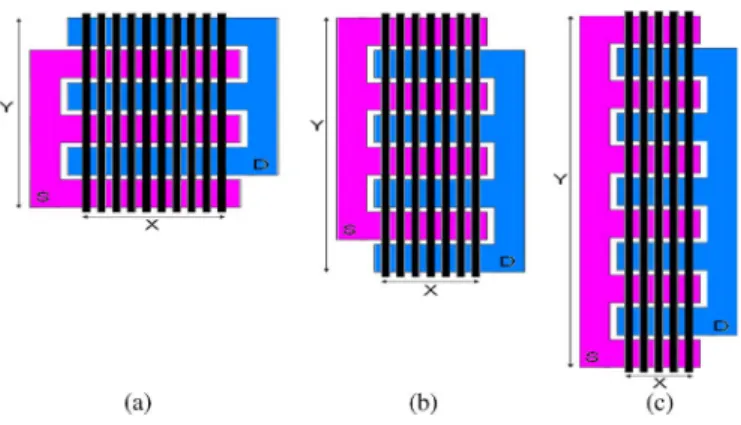
Fig. 3. N-NWTFTs having the same total channel number of 50 but with (a) three drain/source fingers, (b) four drain/source fingers, and (c) five drain and six source fingers. Black lines denote the NW channels.
TABLE I
SUMMARY OFTLP RESULTS OFMULTIPLE-CHANNELN-NWTFTS
HAVING THETHREEDIFFERENTLAYOUTSSHOWN INFIG. 3(a)–(c)
the source barrier potential and cause the current conduction to take place deeper in the junction [7], thus giving rise to a higher It2. The higher It2 is also due, in part, to the smaller trigger voltage when the channel length is reduced [see Fig. 1(b)].
The narrower NW device exhibits a higher Jt2 due to the presence of the relatively high resistivity in these narrow chan-nels, a mechanism similar to that of MOS device imbedded with a ballast resistor [8], in which the increased voltage drop across the spreading resistance minimizes the likelihood of filamentation. Note that, for the same channel number, using wider NWs gives rise to a larger device size and, hence, a larger It2even though Jt2is smaller.
The decreasing Jt2 versus channel number characteristics [Fig. 2(b)] are resulted from the nonuniform turn-on among the multiple channels of N-NWTFTs. This undesirable effect can be minimized by choosing a proper drain/source layout topology. Fig. 3(a)–(c) shows devices having three different drain/source layouts but the same total channel number of 50, and their TLP measurement results are compared in Table I. In the direction shown in Fig. 3(a)–(c), while the drain and source finger number is increased (from three to five), the channel number for each drain/source pair is decreased (from ten to five). It is evident that the layout in Fig. 3(c) yields the highest It2, lowest leakage current, and smallest area un-der the NWs, followed by the layout in Fig. 3(b), and the layout in Fig. 3(a) renders the worst performance. Therefore, in addition to increasing the total channel number, decreasing the channel length, and decreasing the NW width, increasing
the drain and source finger number would be an excellent approach for enhancing the ESD robustness of multiple-channel N-NWTFTs. Nonetheless, the relatively high trigger voltage and low robustness of the grounded-gate NWTFT can impose a great difficulty in implementing ESD protection for future low-power NWTFT-based ICs operating at relatively low operating voltages (i.e., around or below 1 V). More research work is definitely needed to address these issues, and the diode-mode NWTFT having a trigger voltage of about 0.7 V appears to be more attractive for such applications.
III. CONLUSION
This letter presented, for the first time, valuable and inter-esting data pertinent to the ESD robustness of a promising NW device called the poly-Si NWTFT. The TLP measurement results revealed that these devices are, in general, suitable for serving as ESD protection elements. The study further suggested that a higher ESD robustness can be obtained by decreasing the channel length and increasing the number of channels. For NWTFTs having a fixed number of channels, improved ESD robustness and smaller area consumption can be achieved using a multiple drain/source layout. Plasma treatment commonly used to enhance the electrical performance of poly-Si-based devices did not seem to improve the NWTFT’s ESD current handling capability. The finding should provide useful insight into the design of ESD protection solutions for the next-generation NW-based ICs.
REFERENCES
[1] K. H. Yeo, S. D. Suk, M. Li, Y. Y. Yeoh, K. H. Cho, K. H. Hong, S. Yun, M. S. Lee, N. Cho, K. Lee, D. Hwang, B. Park, D. W. Kim, D. Park, and B. Ryu, “Gate-all-around (GAA) twin silicon nanowire MOSFET (TSNWFET) with 15 nm length gate and 4 nm radius nanowires,” in IEDM Tech. Dig., Dec. 11–13, 2006, pp. 1–4.
[2] N. Singh, A. Agarwal, L. K. Bera, T. Y. Liow, R. Yang, S. C. Rustagi, C. H. Tung, R. Kumar, G. Q. Lo, N. Balasubramanian, and D.-L. Kwong, “High-performance fully depleted silicon nanowire (diameter ≤ 5 nm) gate-all-around CMOS devices,” IEEE Electron Device Lett., vol. 27, no. 5, pp. 383–386, May 2006.
[3] C. Russ, “ESD issues in advanced CMOS bulk and FinFET technolo-gies: Processing, protection devices and circuit strategies,” in Proc. Eur.
Symp. Rel. Electron Devices, Failure Phys. Anal., Aug./Sep. 2008, vol. 48,
pp. 1403–1411.
[4] H. C. Lin, W. C. Chen, C. D. Lin, and T. Y. Huang, “Performance enhance-ment in double-gated poly-Si nanowire transistors with reduced nanowire channel thickness,” IEEE Electron Device Lett., vol. 30, no. 6, pp. 644–646, Jun. 2009.
[5] C. J. Su, H. C. Lin, H. H. Tsai, T. Y. Huang, and W. X. Ni, “Fabrication and characterization of poly-Si nanowire devices with performance enhance-ment techniques,” in Proc. VLSI Technol., Syst. Appl., Apr. 2007, pp. 1–2. [6] F. S. Wang, M. J. Tsai, and H. C. Cheng, “The effects of NH3 plasma
passivation on polysilicon thin-film transistors,” IEEE Electron Device
Lett., vol. 16, no. 11, pp. 503–505, Nov. 1995.
[7] A. Amerasekera and C. Duvvury, “The impact of technology scaling on ESD robustness and protection circuit design,” IEEE Trans. Compon.,
Packag., Manuf. Technol. A, vol. 18, no. 2, pp. 314–320, Jun. 1995.
[8] M. Okushima, T. Shinzawa, and Y. Morishita, “Layout technique to alleviate soft failure for short pitch multi finger ESD protection devices,” in Proc. 29th Elect. Overstress/Electrostatic Discharge Symp., Sep. 2007, pp. 1A.5-1–1A.5-10.