Compact efficient eye-safe intracavity optical parametric
oscillator with a shared cavity configuration
Y. F. Chen,1,* K. W. Su,1 Y. T. Chang,1 and W. C. Yen2 1Department of Electrophysics, National Chiao Tung University, Hsinchu, Taiwan 2Chung-Shan Institute of Science and Technology, Lung-Tan, Tao-Yuan, Taiwan
*Corresponding author: [email protected]
Received 12 October 2006; revised 3 December 2006; accepted 7 December 2006; posted 11 December 2006 (Doc. ID 76051); published 18 May 2007
We present a compact efficient eye-safe intracavity optical parametric oscillator pumped by a passively
Q-switched Nd:YAG laser in a shared cavity configuration. A signal pulse of 3.3 mJ energy at a 1573 nm
wavelength with a peak power of 150 kW was achieved. The effective conversion efficiency with respective to the optimized 1064 nm Q-switched pulse energy was as high as 51%. © 2007 Optical Society of America
OCIS codes: 140.3580, 140.5560.
1. Introduction
Compact nanosecond pulsed lasers operating with emission at the eye-safe wavelength region (1.5–1.6m) are of great interest for many applications such as laser radar, active imaging, and remote sensing [1,2]. The methods for generating eye-safe lasers include the solid-state lasers with Er3⫹-doped or Cr4⫹-doped media [3– 6] and the Raman lasers pumped by Nd-doped lasers [7–10]. Another promising approach for high-peak-power eye-safe laser sources is based on intracavity optical parametric oscillators (OPO) [11–16]. The advent of high damage threshold non-linear crystals and diode-pumped Nd-doped lasers leads to a renaissance of interest in intracavity OPOs. Recently we demonstrated a compact efficient eye-safe OPO pumped by a diode-pumped passively
Q-switched Nd:GVO4laser to produce peak powers at
1573 nm higher than 10 kW [17]. However, the ap-plications for long-distance laser rangefinders re-quire pulse energies in the millijoule range and peak powers greater than 100 kW [2].
The conventional configurations for intracavity OPO pumped by Q-switched Nd-doped lasers [11–17] are based on the coupled cavity configuration in which there are separate resonators for the signal
and fundamental optical fields. However, the ampli-tude stability of the signal outputs for the coupled cavity configuration is severely dependent on the cav-ity alignment because the resonator lengths and the longitudinal-mode spacing are different for the pump and signal beams. Recently it was confirmed [18] that the shared cavity configuration in which the pump and signal beams share the same resonator provides a substantially superior amplitude stability in com-parison with the coupled cavity configuration. There-fore it is of practical interest to develop the eye-safe intracavity OPO in the millijoule range with the shared cavity configuration.
In this work we use a shared resonator configura-tion to construct a compact intracavity OPO in the millijoule range. A lens duct is designed to be an efficient coupling lens for the diode-pumped passively
Q-switched Nd:YAG兾Cr4⫹:YAG laser. With the pas-sively Q-switched laser to pump the intracavity OPO, 3.3 mJ pulses with 150 kW peak power at 1573 nm are generated. The effective conversion efficiency with respective to the optimized pulse energy form the passively Q-switched 1064 nm laser is up to 51%.
2. Experimental Setup of Intracavity Optical Parametric Oscillator
The pump source is a quasi-cw high-power diode stack (Coherent G-stack package, Santa Clara, Calif.,
0003-6935/07/173597-05$15.00/0 © 2007 Optical Society of America
USA) that consists of six 10 mm long diode bars gen-erating 80 W per bar, for a total of 480 W at the central wavelength of 808 nm. The diode stack is de-signed with 0.4 mm spacing between the diode bars so the overall area of emission is approximately 10 mm (slow axis)⫻ 2.4 mm (fast axis). The full di-vergence angles in the fast and slow axes are approx-imately 35° and 10°, respectively. A lens duct was designed to efficiently couple the pump radiation from the diode stack into the laser crystal. As shown in Fig. 1, there are five geometric parameters, r, L,
H1, H2, and H3, for a lens duct, where r is the radius
of the input surface, L is the length of the duct, H1 is the width of the input surface, H2 is the width of
the output surface, and H3is the thickness of the duct
[19,20]. With the ray-tracing analysis [20], the
cou-pling efficiency was found to be up to 87% for a lens duct with the parameters of r ⫽ 10 mm, L ⫽ 32 mm, H1 ⫽ 12 mm, H2 ⫽ 2.7 mm, and H3 ⫽ 3
mm. Based on the theoretical result, a lens duct was manufactured and used in the experiment.
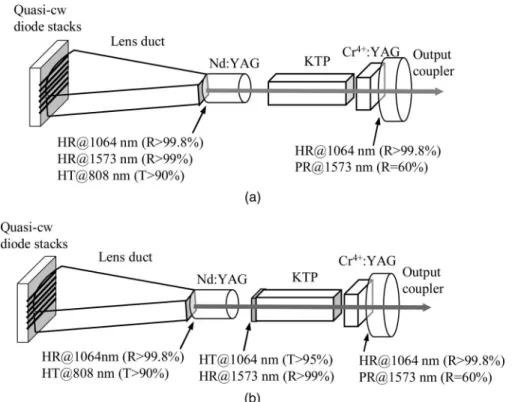
Figure 2(a) shows the experimental setup of the intracavity OPO pumped by a diode-pumped pas-sively Q-switched Nd:YAG兾Cr4⫹:YAG laser in a shared cavity configuration. The fundamental laser cavity was formed by a coated Nd:YAG crystal and an output coupler. The OPO cavity entirely overlapped with the fundamental laser cavity. The Nd:YAG crys-tal had a 1.0 at. % Nd3⫹doping concentration, a di-ameter of 5 mm, and a length of 10 mm. To set up the shared cavity, the incident side of the laser crystal was coated to be highly reflective at 1064 and 1573 nm共R ⬎ 99.8%兲 and highly transmitted at the pump wavelength of 808 nm共T ⬎ 90%兲. The other side of the laser crystal was coated to be antireflective at 1064 and 1573 nm共R ⬍ 0.2%兲. A KTP crystal was used to be the nonlinear crystal of the OPO. The KTP crystal, 4 mm ⫻ 4 mm ⫻ 20 mm, was employed in a type II noncritical phase-matching configuration along the x axis ( ⫽ 90°, and ⫽ 0°) to have both a maximum effective nonlinear coefficient and no walk off between the pump, signal, and idler beams. On the other hand, a Cr4⫹:YAG crystal was used to serve as a saturable absorber for passive Q-switching. The Cr4⫹:YAG crystal had a thickness of 3 mm with 60% initial transmission at 1064 nm. Both sides of the KTP and Cr4⫹:YAG crystals were coated for antireflec-tion at 1573 and 1064 nm. The output coupler had a dichroic coating that was highly reflective at 1064
Fig. 1. Schematic of a lens duct in which r is the radius of the input surface, L is the length of the duct, H1is the width of the input
surface, H2is the width of the output surface, and H3is the
thick-ness of the duct.
Fig. 2. Schematic of the intracavity OPO pumped by a diode-pumped passively Q-switched Nd:YAG兾Cr4⫹:YAG laser. (a) Shared cavity, (b) coupled cavity.
nm共R ⬎ 99.8%兲 and partially reflective at 1573 nm 共R ⫽ 60%兲. All crystals were wrapped with indium foil and mounted in conductively cooled copper blocks. The total cavity length was approximately 50 mm.
For comparison, the conventional coupled cavity configuration is depicted in Fig. 2(b). It can be seen that the OPO cavity in the coupled resonator config-uration was formed by a coated KTP crystal and an output coupler and the OPO cavity length was ap-proximately 25 mm. One side of the KTP crystal was coated to have high reflection at the signal wave-length of 1573 nm共R ⬎ 99.8%兲 and high transmission at the pump wavelength of 10643 nm共T ⬎ 95%兲. The other side of the KTP crystal was coated for antire-flection at 1573 and 1063 nm.
The pulse temporal behavior at 1063 and 1571 nm was recorded by a LeCroy digital oscilloscope (Wave-pro 7100; 10 G samples兾s, 1 GHz bandwidth) with a fast InGaAs photodiode. The spectral information of the laser was monitored by an optical spectrum analyzer (Advantest Q8381A, Tokyo, Japan). The spectrum analyzer employing diffraction grating monochromator can be used for high-speed measure-ment of pulse light with the resolution of 0.1 nm.
3. Experimental Results
First, the quasi-cw free-running operation without KTP and Cr4⫹:YAG crystals was performed to con-firm the pumping efficiency of the lens duct and the quality of the laser crystal. For this investigation the diode stack was derived to emit optical pulses 200s long, at a repetition rate of 100 Hz with a maximum duty cycle of 2%. Furthermore an output coupler with 96% reflectivity at 1064 nm was used instead of the above-mentioned OPO output coupler. Figure 3 plots the experimental results of the free-running
opera-tion for the output average power as a funcopera-tion of the diode pump power. It can be seen that the output power of 160 W was achieved at an incident pump power of 360 W. The overall slope efficiency was found to be as high as 45%. The fairly good efficiency affirms the pump scheme to be practical.
We estimated the performance of the passively
Q-switched Nd:YAG兾Cr4⫹:YAG laser before the in-tracavity OPO experiment. For this investigation an output coupler with partial reflection at 1064 nm was used, and the diode stack was derived to emit optical pulses 250s long at a repetition rate of 10 Hz. The optimum Q-switched performance at 1064 nm provides the baseline for evaluating the con-version efficiency of the intracavity OPO. The opti-mum reflectivity of the output coupler was found to be approximately 60%. The threshold of the Q-switched laser operation was found to be approximately 102 mJ, and the output pulse energy at 1064 nm was mea-sured to be 6.5 mJ. As shown in Fig. 4, the effective pulse width was found to be approximately 19 ns; consequently, the peak power was up to 330 kW.
With an OPO output coupler, the intracavity OPO experiment was performed. The threshold of the in-tracavity OPO was found to be nearly the same as that of the passively Q-switched laser. The output
Fig. 3. Output power at 1064 nm with respect to the incident
pump power at 808 nm for quasi-cw free-running operation. Fig. 5. Optical spectrum measurement for the intracavity OPO. Fig. 4. Temporal shape for the passively Q-switched Nd:YAG兾 Cr4⫹:YAG laser at 1064 nm.
pulse energy of the signal wave at 1573 nm was mea-sured to be 3.3 mJ. The effective conversion efficiency with respect to the optimized pulse energy from the passively Q-switched laser is up to 51%. For the cou-pled cavity [12], the conversion efficiency was found to be approximately 26%. In other words, the conversion efficiency of the shared cavity configuration is signif-icantly superior to that of the coupled cavity configu-ration. The OPO performance of the shared cavity basically depends on the total laser power of all longi-tudinal modes not on the explicit distribution of the laser power among the longitudinal modes. The small
perturbations in the stable resonators usually lead to considerable variations in the power distribution among the longitudinal modes and do not significantly affect the total laser power. On the other hand, in the coupled cavity configuration the OPO and laser reso-nators have different longitudinal mode spacings; mostly only one longitudinal laser mode is utilized to pump the OPO, and only one signal longitudinal mode builds up. Therefore the overall conversion efficiency of the shared cavity configuration is substantially supe-rior to that of the coupled cavity configuration.
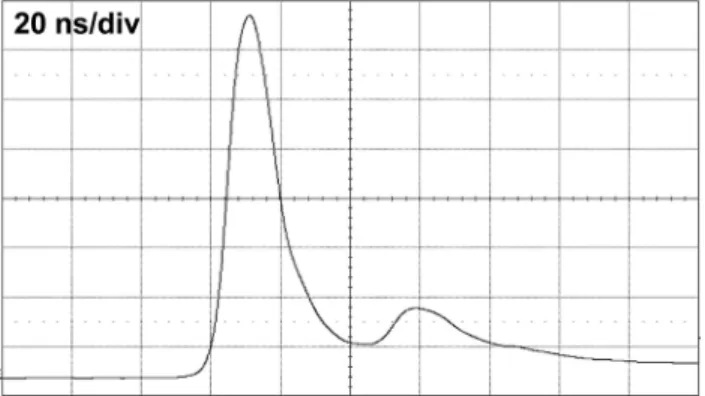
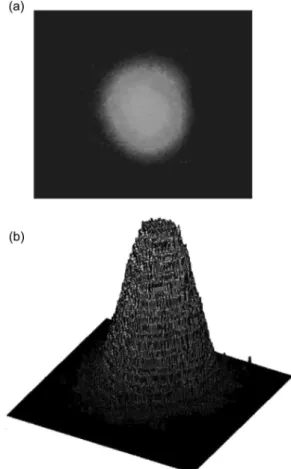
The typical result for the optical spectrum mea-surement is depicted in Fig. 5. Figure 6 shows the temporal shapes of the laser and signal pulses. It can be seen that the signal output consisted of a short intensive leading peak accompanied by a long weak ripple. The long weak ripple may come from the in-teraction between different longitudinal modes; thus far, the mechanism of its appearance is still unknown and needs further investigation. With the numerical integration, the signal peak power was calculated and found to be approximately 150 kW. The signal peak power is expected to be enhanced by the use of an output coupler with a lower reflectivity at the signal wavelength. The spatial distribution of the sig-nal output was recorded with an infrared CCD and displayed in Fig. 7. The beam quality M2factor was estimated to be approximately 1.5.
4. Conclusions
We have employed a diode-pumped passively Q-switched Nd:YAG laser to pump an intracavity OPO in a shared cavity configuration. A lens duct has been designed to efficiently couple the pump radiation from the diode stack into the laser crystal. A slope efficiency of 45% has been obtained for the quasi-cw free-running operation in the fundamental mode las-ing. For the Q-switching operation at 1064 nm, the cavity produced 6.5 mJ pulses with 330 kW peak power. With the Q-switched laser to pump the OPO at 1573 nm, 3.3 mJ pulses with 150 kW peak power have been achieved, corresponding to an effective conversion efficiency of 51% with respect to the opti-mized pulse energy at 1064 nm.
References
1. E. Gregor, D. E. Nieuwsma, and R. D. Stultz, “20 Hz eye-safe laser rangefinder for air defense,” in Proc. SPIE 1207, 124 –134 (1990).
2. J. E. Nettleton, B. W. Schilling, D. N. Barr, and J. S. Lei, “Monoblock laser for a low-cost, eyesafe, microlaser range finder,” Appl. Opt. 39, 2428 –2432 (2000).
3. S. Kück, K. Petermann, U. Pohlmann, U. Schönhoff, and G. Huber, “Tunable room-temperature laser action of Cr4⫹-doped Y3ScxAl5-xO12,” Appl. Phys. B 58, 153–156 (1994).
4. N. V. Kuleshov, A. A. Lagatsky, A. V. Podlipensky, V. P. Mikhailov, A. A. Kornienko, E. B. Dunina, S. Hartung, and G. Huber, “Fluorescence dynamics, excited-state absorption and stimulated emission of Er3⫹in KY(WO4)2,” J. Opt. Soc. Am. B 15, 1205–1212 (1998).
5. I. Sokólska, E. Heumann S. Kück, and T. Łukasiewicz, “Laser oscillation of Er3⫹:YVO4and Er3⫹, Yb3⫹:YVO4crystals in the
Fig. 6. Typical temporal shapes for the laser and signal pulses.
Fig. 7. Experimental far-field pattern of the signal output pulse. (a) 2D image, (b) 3D representation.
spectral range around 1.6m,” Appl. Phys. B 71, 893–896 (2000).
6. A. Sennaroglu, “Broadly tunable Cr4⫹-doped solid-state lasers in the near infrared and visible,” Prog. Quantum Electron. 26, 287–352 (2002).
7. P. Cˇ erny´, H. Jelínkova, P. Zverev, and T. T. Basiev, “Solid-state lasers with Raman frequency conversion,” Prog. Quan-tum Electron. 28, 113–143 (2004).
8. Y. F. Chen, “Compact efficient all-solid-state eye-safe laser with self-frequency Raman conversion in a Nd:YVO4 crystal,” Opt. Lett. 29, 2172–2174 (2004).
9. Y. F. Chen, “Efficient 1521 nm Nd:GdVO4Raman laser,” Opt.
Lett. 29, 2632–2634 (2004).
10. J. T. Murray, R. C. Powell, D. Smith, W. Austin, and R. A. Stolzenberger, “Generation of 1.5m radiation through intra-cavity solid-state Raman shifting in Ba(NO3)2nonlinear
crys-tals,” Opt. Lett. 20, 1017–1019 (1995).
11. Y. Yashkir and H. M. van Driel, “Passively Q-switched 1.57m intracavity optical parametric oscillator,” Appl. Opt. 38, 2554 – 2559 (1999).
12. A. Agnesi, S. Dell’Acqua, and G. Reali, “Diode-pumped quasi-cw intracavity optical parametric oscillator at 1.57m with efficient pulse shortening,” Appl. Phys. B 70, 751–753 (2000).
13. R. Dabu, C. Fenic, and A. Stratan, “Intracavity pumped
nano-second optical parametric oscillator emitting in the eye-safe range,” Appl. Opt. 40, 4334 – 4340 (2001).
14. W. Zendzian, J. K. Jabczyn´ ski, and J. Kwiatkowski, “Intracav-ity optical parametric oscillator at 1572 nm wavelength pumped by passively Q-switched diode-pumped Nd:YAG laser,” Appl. Phys. B 76, 355–358 (2003).
15. Y. F. Chen, S. W. Chen, Y. C. Chen, Y. P. Lan, and S. W. Tsai, “Compact efficient intracavity optical parametric oscillator with a passively Q-switched Nd:YVO4兾Cr4⫹:YAG laser in a
hemispherical cavity,” Appl. Phys. B 77, 493– 495 (2003). 16. B. W. Schilling, S. R. Chinn, A. D. Hays, L. Goldberg, and C. W.
Trussell, “End-pumped 1.5m monoblock laser for broad tem-perature operation,” Appl. Opt. 45, 6607– 6615 (2006). 17. Y. F. Chen, S. W. Chen, L. Y. Tsai, Y. C. Chen, and C. H. Chien,
“Efficient subnanosecond intracavity optical parametric oscil-lator pumped with a passively Q-switched Nd:GdVO4laser,”
Appl. Phys. B 79, 823– 825 (2004).
18. Y. F. Chen and L. Y. Tsai, “Comparison between shared and coupled resonators for passively Q-switched Nd:GdVO4 intra-cavity optical parametric oscillators,” Appl. Phys. B 82, 403– 406 (2006).
19. R. J. Beach, “Theory and optimization of lens ducts,” Appl. Opt.
35, 2005–2015 (1996).
20. R. Fu, G. Wang, Z. Wang, E. Ba, G. Mu, and X. Hu, “Design of efficient lens ducts,” Appl. Opt. 37, 4000 – 4003 (1998).