C. Aykanat et al. (Eds.): ISCIS 2004, LNCS 3280, pp. 311−320, 2004. © Springer-Verlag Berlin Heidelberg 2004
Real-Time Admission Control Supporting Prioritized
Soft Handoff Calls in Cellular DS-CDMA Systems
Kuo-Chung Chu1, 2 and Frank Yeong-Sung Lin1
1Department of Information Management, National Taiwan University
2 Department of Information Management, Jin-Wen Institute of Technology
Taipei, Taiwan [email protected]
Abstract. This paper proposes a prioritized real-time admission control algo-rithm to support soft handoff calls with QoS assurance in both uplink and downlink signal to interference ratio (SIR) requirement. Admission control is formulated as a performance optimization model, in which the objective is to minimize handoff forced termination probability. The algorithm is based upon dynamic reserved channels (guard channels) scheme for prioritized calls, it adapts to changes in handoff traffics where associated parameters (guard chan-nels, new and handoff call arrival rates) can be varied. To solving the optimiza-tion model, iteraoptimiza-tion-based Lagrangian relaxaoptimiza-tion approach is applied by allo-cating a time budget. We analyze the system performance, and computational
experiments indicate that proposed dynamic guard channel approach
outper-forms other schemes.
1 Introduction
Demand for wireless communications and Internet applications is continuously grow-ing. Due to the advantages in system capacity and soft handoff, direct sequence code division multiple access (DS-CDMA) provides a high-capacity mobile communica-tions service. Capacity analysis by call admission control (CAC) has been conducted for the uplink connection, because the non-orthogonality leads to the limited capacity is in the uplink [1]. However, asymmetric Internet traffic has increased, and power allocation in a downlink is an important issue. Theoretically, capacity is unbalanced on the downlink and uplink [2]. Thus, both links analysis are required in admission control.
Soft handoff is another characteristic in DS-CDMA system. Admitting a call re-quest with soft handoff consideration, mobile station (MS) maintains simultaneous connections with more than one base station (BS). The MS is allocated a downlink channel at each BS, and the information transmitted on each channel is the same. The MS performs diversity combining of the downlink paths, regardless of their origin. Rejection of a soft handoff request results in forced termination of an ongoing service. To reducing the blocking of handoff calls, several channel reservation researches have been conducted [3−5]. These researches focused on general cellular mobile networks but not CDMA system. For CDMA, the admission control problem has been proposed in literature [6−9], these articles are based on uplink analysis. Al-though [7,9] consider channel reservation for handoff calls, a fixed number of chan-nel at each BS is reserved. Generally, these schemes give priority to handoff call over
new call, so-called cutoff priority scheme (CPS), and do not adapt to changes in the handoff traffics. Unlike [7,9], Huang and Ho [5] proposed a dynamic guard channel approach which adapts the number of guard channels in each BS according to the estimate of the handoff calls arrival rate. In [5] non-CDMA admission control was considered.
In this paper, considering integrated voice/data traffics in CDMA system we pro-pose a prioritized real-time admission control model for supporting soft handoff calls with QoS assurance in both uplink and downlink signal to interference ratio (SIR) requirement. For simplicity, we only focus on voice call requests to optimize the handoff call performance. To effectively manage system performance, a real-time admission control algorithm conducted by Lagrangian relaxation approach and sub-gradient-based method is proposed. The remainder of this paper is organized as fol-lows. In Section 2, the background of DS-CDMA admission control is reviewed which consists of soft handoff, SIR models, as well as problem formulation. Solution approach is described in Section 3. Section 4 illustrates the computational experi-ments. Finally, Section 5 concludes this paper.
2 Prioritized Real-Time Admission Control
2.1 Soft Handoff
Considering the MS in soft-handoff zone, it applies maximum ratio combining (MRC) of contributions coming from the involved BSs, the addition of energy to interference
(
E Ib 0)
coming from involved BSs must be larger than the(
E Ib 0)
target at the MS.A diversity gain has to be taken into account for those MSs in soft handoff zone. Two assumptions are possible to representing handoff gain. First one assumes the same transmission power from each involved BS, while the other considering those
(
E Ib 0)
contributions from involved BSs are the same [10−12]. For example, if MS t is in the handoff zone in which two BSs (BS 1 and 2) are involved, the first assump-tion denote Pjt the transmitted power from BS j to MS t in soft handoff situation, thenP1t =P2t is assigned by each BS. For second one, the total(
E Ib 0)
calculated at MS t is expressed as(
E Ib 0) (
= E Ib 0) (
1+ E Ib 0)
2 and(
E Ib 0) (
1 = E Ib 0)
2 where(
E Ib 0 1)
and(
E Ib 0 2)
is contributed from BS 1 and 2, respectively. In this paper,both assumptions are applied. Denote Λt the soft handoff factor (SHOF), which is number of base stations involved in soft handoff process for mobile station t. With perfect power control, it is required that P should be proportional to the interference. jt The transmitted power Pjt for MS t from BS j can be adjusted to have the same shape
as the total interference. Then P changes by power adjustment factor as interference jt changes with high Pjt for large interference.
2.2 SIR Model
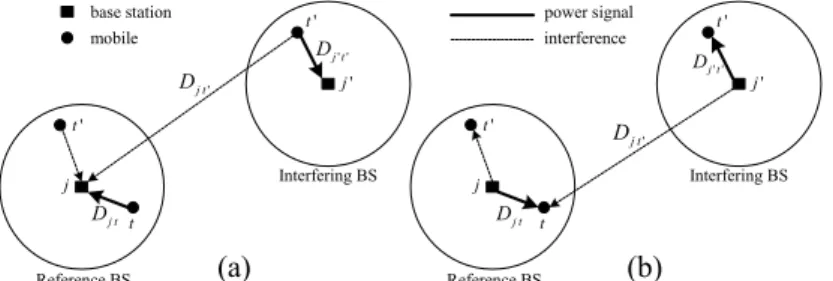
In CDMA environment, since all users communicate at the same time and same fre-quency, each user’s transmission power is regarded as a part of other users’ interfer-ence. CDMA is a kind of power-constrained or interference-limited system. With perfect power control and the interference-dominated system, we ignore background noise. The signal to interference ratio (SIR) to be considered is uplink (UL) and
downlink (DL) interference, as shown in Fig. 1, which is coming from MS to BS and
from BS to MS, respectively. j ' j j t D Reference BS base station mobile t ' t ' ' j t D ' j t D Interfering BS power signal interference j ' j Reference BS t ' t ' ' j t D ' j t D Interfering BS ' t t' j t D (a) (b)
Fig. 1. The interference scenario: (a) uplink interference; (b) downlink interference Let WUL(WDL) and dUL (dDL) be the system bandwidth and the traffic data rate for uplink (downlink), respectively. Given N
jt z and H jt z (zjt= N jt z + H jt z ) is decision variable of new and handoff calls, respectively, which is 1 if mobile station t is
admit-ted by base station j and 0 otherwise. We assume that the uplink power is perfectly
controlled, it assures the received power at the BS j, ∀ ∈j B where B is the BS set, is the same (constant value) for all MSs in the same traffic class-c. Denote UL( )
c t
S the received uplink power signal at BS from MS t with traffic class c(t), ∀ ∈t T where T
is the MS set. And denote D the distance from MS t to BS j. The received SIR jt
, ( )
UL j c t
SIR in uplink is given by (1), where θ is the uplink orthogonality factor and UL
( )
UL c t
α is uplink activity factor of traffic class-c(t), and attenuation factor τ =4. The uplink processing gain is given GUL WUL dUL
= . The first and second term of de-nominator is intra-cell and inter-cell interference, respectively. A very large constant value V in numerator is to satisfying constraint requirement if MS t is rejected (zjt=0).
(
)
( ) , ( ) ( ) ' ' ' ( ') ( ') ' ' ' ( ') ( ') ' ' ' ' ' ' (1 ) (1 ) UL UL c t jt UL j c t UL c t UL UL UL UL UL j t t T c t c t jt j B t T c t c t j t t t j j t t jt S z V W SIR d D S z S z D τ α θ ∈ ∈ ∈α ≠ ≠ ≠ + − = − + ∑
∑ ∑
(1)In downlink case, notations used are similar to uplink model. Applying soft hand-off factor (SHOF) Λ =t H
jt j B∈ δ
∑
and downlink perfect power control is assumed, the received SIR SIRULj c t, ( ) in uplink is given by (2).( ) , ( ) ( ) ' ' ' ' ( ') ( ') ' ' ' ( ') ( ') ' ' ' ' ' ' (1 ) (1 ) DL DL t c t jt DL j c t DL c t DL DL DL jt DL DL j t t T c t c t jt j B t T c t c t j t t t jt j j t t j t S z V W SIR d D D S z S z D D τ τ θ ∈α ∈ ∈α ≠ ≠ ≠ Λ + − = − +
∑
∑ ∑
(2)2.3 Traffic Model and Performance Measure
In this paper, we focus on voice traffic which consists of new and handoff call type. For each BS j, denote λ =j N
j λ + H
j
λ total arrivals, where the arrivals of new and hand-off calls are Poisson distributed with rates N
j
λ and H j
λ , respectively. The call holding time of both types is assumed to be exponentially distributed with mean µ. Location of MSs is generated in uniform distribution. Thus, the traffic intensity (in Erlangs) of new and handoff call is given N N
j j
ϕ =λ × and µ H H j j
ϕ =λ × , respectively. To investigating the µ effect of traffic intensity on performance analysis, denote ξj the ratio of N
j ϕ to H
j ϕ in BS
j. Admission control is based on SIR measurement. Providing guaranteed QoS for ongoing calls is more important than admitting new call requests. Due to the soft handoff advantage in CDMA system, we would like to focus on minimization of handoff/ongoing call forced termination (blocking) probability subject to given new call blocking probability. For each admission control architecture in Fig. 2, admission control applying dynamic guard channel (DGC) approach is useful since it gives priority to handoff requests. The proposed approach dynamically reserves channels for prioritized handoff calls, it not only reserves different number of guard channels for each BS in terms of BS scenario (heterogeneous handoff arrival rate), but also provides runtime channel reservation. The reserved channels g
j
C (=Cj⋅fj , a ceil-ing function) among available channels Cj in BS j are referred to as the guard chan-nels, where fj is a reserved fraction of Cj and it is be determined. The remaining
o j
C (=Cj-Cgj ) channels, called the ordinary channels, are shared by both call types. When a new call attempt is generated in BS j, it is blocked if the number of free
channels is less than or equal to g j
C . Then the blocking probabilities of new and hand-off calls in the BS j are given by ( N, H, o, g)
j j j j j BN g g C C and ( N, H, o, g) j j j j j BH g g C C [3,4], respectively, where N N jt j t Tz g µ
∑
∈ = and H H jt j t Tz g µ∑
∈ = , and N H j j j g =g +g . N j λ H j λ Base Station j Ordinary Channels Dynamic Guard Channels New call Handoff call Admission Controller N j H j g g ( )SIREvaluation o j C g j CFig. 2. Admission control architecture 2.4 Problem Formulation
In this section, we propose a prioritized real-time admission control algorithm to support soft handoff calls with QoS assurance in both uplink and downlink signal to interference ratio (SIR) requirement. The objective function (IP) is to minimize the weighted handoff call blocking probability, where the weighted probability is given
by H H j j j j B w g g ∈ =
∑
.Objective function: min ( N, H, o, g) IP j B j j j j j j Z =
∑
∈ w BH g g C C (IP) s.t. , ( ) 0 ( ) UL UL b j c t c t E SIR I ≤ ∀ ∈j B t T, ∈ (3) , ( ) 0 ( ) DL DL b j c t c t E SIR I ≤ ∀ ∈j B t T, ∈ (4) N N jt j t Tz g µ∑
∈ = ∀ ∈j B(5) H H jt j t Tz g µ∑
∈ = ∀ ∈j B(6) N N jt jt jt j z D ≤δ R ∀ ∈j B t T, ∈ (7) H H jt jt jt j z D ≤δ R ∀ ∈j B t T, ∈ (8) 1 N H jt jt z +z ≤ ∀ ∈j B t T, ∈ (9) ' ' (1 ) N H H jt jt jt z ≤ −δ +z ∀ ∈j B t t, , '∈T t t, ≠ '(10) ( N, H, o, g) j j j j j j BN g g C C ≤β ∀ ∈j B(11) N j t T j N j t T z δ ∈ ∈ Ω ≤∑
∑
∀ ∈j B(12) H j t T j H j t T z δ ∈ ∈ Φ ≤∑
∑
∀ ∈ (13) j B o g j j j C +C ≤C ∀ ∈ (14) j B j f ∈F ∀ ∈ (15)j B or N jt z =0 1 ∀ ∈j B t T, ∈ (16) or H jt z =0 1 ∀ ∈j B t T, ∈ (17) In CDMA system, each traffic demand is served with base station in the required QoS in both uplink and downlink connections. For uplink connection with perfect power control, the SIR value UL, ( )j c t
SIR of each call class-c in its homing BS j must be
greater than the pre-defined threshold ( 0)UL b c
E I , as shown in constraint (3). Again perfect power control is assumed in downlink, for each call request t in BS j QoS is
required with threshold ( 0)DL( ) b c t
E I in (4). Constraint (5) and (6) check aggregate flow (in Erlangs) of new and handoff calls for BS j, which is based upon all granting
mo-bile stations. Constraint (7) and (8) require that the MS would be in the coverage (power transmission radius Rj) area of a base station it is to be served by that base station. For each call request zjt in BS j, in constraint (9), it must belong to only one
of call types, either new ( N jt
z ) or handoff call ( H jt
z ). Constraint (10) guarantees the prioritized handoff calls. For each BS j, any new call N
jt
handoff calls H' jt
z are admitted if it initiates ( H jt
δ =1 which is indicator function if MS t initiates a call request to BS j), or N
jt
z is admitted directly if there is no more handoff call initiates ( H
jt
δ =0). Constraint (11) requires that any base station can serve its slave MS under pre-defined new call blocking probability β . Constraint (12) and (13) j require that the service rate for new and handoff calls is fulfilled in BS j. For channel
reservation, total available channel is bounded by (14), and decision variable fj is applied which belongs to the set F in (15). Constraint (16) and (17) are to enforce the
integer property of the decision variables.
3 Solution Approach
3.1 Lagrangian Relaxation
The approach to solving problem (IP) is Lagrangian relaxation [13], which including the procedure that relax complicating constraints, multiple the relaxed constraints by corresponding Lagrangian multipliers, and add them to the primal objective function. Based on above procedure, the primal optimization problem (IP) can be transferred to Lagrangian relaxation problem (LR) where constraints (3)-(6), (10) are relaxed. LR can be further decomposed into two independent subproblems. All of them can be optimally solved by proposed algorithms. In summary, problem (IP) is transferred to be a dual problem (D) by multiplying the relaxed constraints with corresponding Lagrangian multipliers 1 jt v , 2 jt v , 3 j v , 4 j v , 5 ' jtt
v and add them to the primal objective function. According to the weak Lagrangian duality theorem, for any 1
jt v , 2 jt v , 3 j v , 4 j v , 5 ' jtt
v ≥ , the objective value of 0 ZD(v1jt, v2jt, v3j, v4j, v5jtt') is a lower bound of ZIP. Thus, the following dual problem (D) is constructed to calculate the tightest lower bound by adjusting multipliers.
1 2 3 4 5 ' max ( , , , , ) D D jt jt j j jtt Z = Z v v v v v (D) subject to: 1 jt v , 2 jt v , 3 j v , 4 j v , 5 ' jtt v ≥ . 0
Then, subgradient method is applied to solving the dual problem. Let the vector S
is a subgradient of ZD( 1 jt v , 2 jt v , 3 j v , 4 j v , 5 ' jtt v ) at 1 jt v , 2 jt v , 3 j v , 4 j v , 5 ' jtt v ≥ . In itera-0 tion k of subgradient optimization procedure, the multiplier vector π is updated by
1
k k kSk
π + =π +ζ , the step size ζk is determined by
(
*)
2( k) k IP D Z Z S ε − π , where * IP
Z is an upper bound on the primal objective function value after iteration k, and ε is a constant where 0≤ ≤ε 2. Solutions calculated in dual problems need to be checked if solutions satisfy all constraints relaxed in (LR). A heuristic for getting primal feasible solutions is also developed†.
3.2 Real-Time Admission Control Algorithm
Based upon Lagrangian relaxation approach, a predefined time budget η , 5 seconds is given to solving Lagrangian dual problem and getting primal feasible solutions
† Associated algorithms to solving the subproblems and to getting primal feasible solutions are omitted due to the length limitation of the paper. A complete version of the paper is available upon request.
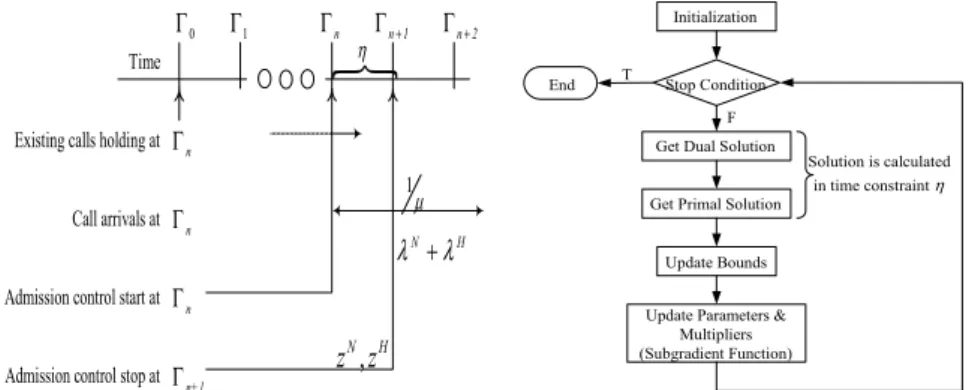
iteratively. Number of call request admitted is depended on the time budget, as illus-trated in Fig. 3. Assuming existing calls (in Erlangs) are still held after time Γn, at the same time call admission control starts when both calls arrived ( N
j λ + H
j
λ ). After time budget η is used up, admission control is also well done, i.e. N
jt
z and H jt
z are decided. On the other hand, initial value of Lagrangian multipliers and upper bound affects the solution quality on algorithm convergence. If we appropriately assign initial values, algorithm will be speeded up to converge in stead of more iterations are required. Fortunately, Lagrangian multipliers associated with users left can also be reused in next time interval. Besides, updating ε in the iteration process is carefully controlled by the error gap in previous iteration. The tighter gap is calculated, the smaller ε is assigned. For each real-time processing is on behalf of changing the number of both users arrived and users left in next time period. Overall procedure of real-time admis-sion control is shown in Fig. 4.
}
η 0 1 Γ Γ Γn Γn 1+ Γn 2+ N H λ λ+ , N H z z Time
Existing calls holding at
Call arrivals at
Admission control start at
Admission control stop at
n n n n+1 Γ Γ Γ Γ 1 µ
Fig. 3. The timing diagram of real-time admission control
Initialization
Stop Condition
Get Dual Solution Get Primal Solution End
Solution is calculated in time constraint η
Update Parameters & Multipliers (Subgradient Function)
Update Bounds T
F
Fig. 4. Procedure of Lagrangian relaxation based real-time admission control
4 Experiment Analysis
For simplicity, we consider a cellular consisting of 9 BSs arranged as a two-dimensional array, and the voice call requests are analyzed. For statistic analysis, 500 time slots are experimented. After first 100 of them, the system is expected in the steady state. Final analysis report is based upon last 400 time slots. All experiments are coded in C. Given λ =12 per η , the analysis is to examine the effect of traffic load j ξ on hand-j off call blocking probability (ZIP ) with respect to several channel reservation schemes.
The system bandwidth allocated to both uplink (WUL) and downlink (WDL) is 6 MHZ, and the voice activity (α ,UL αDL) and orthogonality (θ ,UL θDL)for both link is (0.3, 0.3) and (0.7, 1), respectively. It assumes (Sc tUL( ),Sc tDL( )) = (7dB, 10dB), available channel
j
C =120, as well as R =5km. The required bit energy-to-noise density j E Ib 0 for
both links is 5 dB. The bit rate of both links is 9.6KHZ. The requirements of service rate Φ and j Ω are given 0.3. For comparison purpose, traditional complete sharing j scheme (CSS) [9] and cutoff priority scheme (CPS) with fixed number of guard chan-nels are implemented.
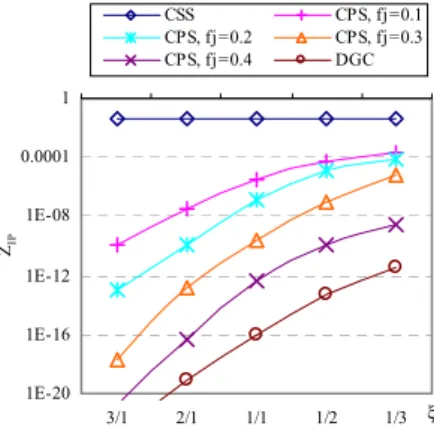
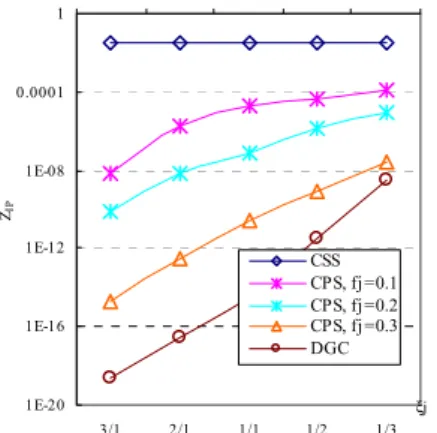
The effects of traffic load on handoff call blocking probability with β =0.01, 0.02, j and 0.03 are shown in Fig. 5, 6, and 7, respectively. They all illustrate that the num-ber of reserved channel significantly affects the performance with respect to pre-defined thresholdβ . Theoretically, the more channels are reserved, the less blocking j
IP
Z is calculated. However, the minimization of ZIP is constrained byβ . As we can j see, if we apply CPS with fixed number of reserved channels, the fraction ( fj) of reserved channel is up to 0.2, 0.3, and 0.4 in case of β =0.01, 0.02, and 0.03, respec-j tively. In summary, proposed dynamic guard channel (DGC) approach outperforms other schemes. For the analysis of performance improvement, under constraint of
j
β =0.01, DGC is compared to CSS and CPS with fj=0.4. Fig. 8 shows the reduc-tion of blocking probability is up to 20% with CPS in ξ =1/3, and up to 90% with j CSS in the case of ξ =3/1. j
Applying Lagrangian relaxation and subgradient method to solve the problem (IP), the better primal feasible solution is an upper bound (UB) of the problem (IP) while Lagrangian dual problem solution guarantees the lower bound (LB). Iteratively, both solving Lagrangian dual problem and getting primal feasible solution, we get the LB and UB, respectively. The error gap is defined by (UB-LB)/LB*100%. Concerning about the solution quality of Lagrangian relaxation approach, we list the statistic of error gap in Table 1. All gaps are less than 10%. Actually, we also calculated the solution quality without applying multipliers technique as described in section 3.2, in most cases the gaps are larger than 80%. Experiments show that the proposed admis-sion control scheme jointly considers real-time processing and dynamic channel res-ervation is valuable for further associated investigation.
1E-20 1E-16 1E-12 1E-08 0.0001 1 3/1 2/1 1/1 1/2 1/3 ξj ZIP CSS CPS, fj=0.1 CPS, fj=0.2 DGC
Fig. 5. Effect of traffic loads on handoff call blocking probability with βj=0.01
1E-20 1E-16 1E-12 1E-08 0.0001 1 3/1 2/1 1/1 1/2 1/3 ξj ZIP CSS CPS, fj=0.1 CPS, fj=0.2 CPS, fj=0.3 CPS, fj=0.4 DGC
Fig. 7. Effect of traffic loads on handoff call blocking probability with βj=0.05
1E-20 1E-16 1E-12 1E-08 0.0001 1 3/1 2/1 1/1 1/2 1/3 ξj ZIP CSS CPS, fj=0.1 CPS, fj=0.2 CPS, fj=0.3 DGC
Fig.6. Effect of traffic loads on handoff call blocking probability with βj=0.03
0% 20% 40% 60% 80% 100% 3/1 2/1 1 1/2 1/3 ξj R educ ti on of H andof f B loc ki ng CCS CPS, fj=0.4
Fig. 8. Reduction of handoff blocking prob-ability compared with two schemes in
j
β =0.01
Table 1. Statistic of error gap with different traffic loads in βj=0.01 j ξ Scheme 3/1 2/1 1/1 1/2 1/3 CSS 7.81% 8.50% 8.05% 7.70% 7.76% CPS, f =0.1 j 8.73% 9.48% 7.78% 7.67% 9.12% CPS, f =0.2 j 9.54% 9.97% 8.32% 9.27% 6.70% CPS, f =0.3 j 8.59% 7.94% 7.98% 8.85% 7.05% CPS, f =0.4 j 8.79% 9.47% 9.42% 6.99% 8.26% DGC 8.82% 9.65% 8.19% 8.14% 8.86%
5 Conclusion
This paper proposes a prioritized real-time admission control model for DS-CDMA system. We jointly consider uplink/downlink, new/handoff calls. The algorithm is based upon dynamic reserved channels (guard channels) scheme for prioritized calls, it adapts to changes in handoff traffics where associated parameters (guard channels, new and handoff call arrival rates) can be varied. We express our achievements in terms of formulation and performance. Experiment analyzes the performance of ad-mission control algorithm in terms of real-time manner. Computational results illus-trate that proposed algorithm is calculated with better solution quality. To fitting real world scenario, jointly analysis of voice/data traffic and sectorization are considerable. They will be investigated in the future research.
References
1. Vitervi, A.M., Vitervi, A.J.: Erlang Capacity of a Power Controlled CDMA System. IEEE
J. Select. Area Commun. 11(6) (1993) 892–900
2. Jeon, W.S., Jeong, D.G.: Call Admission Control for Mobile Multimedia Communications
with Traffic Asymmetry Between Uplink and Downlink. IEEE Trans. Veh. Technol. 59(1) (2001) 59–66
3. Oh S.-H., Tcha D.-W.: Prioritized Channel Assignment in a Cellular Radio Network. IEEE
Trans. Commun. 40 (1992) 1259–1269
4. Chang, K.-N., Kim, D.: Optimal Prioritized Channel Allocation in Cellular Mobile Systems. Computers & Operations Research 28 (2001) 345–356
5. Haung, Y.-R., Ho, J.-M.: Distributed Call Admission Control for a Heterogeneous PCS Network. IEEE Trans. Comput. 51(12) (2002) 1400–1409
6. Soleimanipour, M., Zhung, W., Freeman, G.H.: Optimal Resource Management in Wire-less Multimedia Wideband CDMA Systems. IEEE Trans. Mobile Computing 1(2) (2002) 143–160
7. Chang, J.W., Chung J.H., Sung, D.K.: Admission Control Scheme for Soft Handoff in DS-CDMA Cellular Systems Supporting Voice and Stream-Type Data Services. IEEE Trans. Veh. Technol. 51(6) (2002) 1445–1459
8. Singh, S., Krishnamurthy, V., Vincent P.H..: Integrated Voice/Data Call Admission Con-trol for Wireless DS-CDMA Systems. IEEE Trans. Signal Processing 50(6) (2002) 1483– 1495
9. Liu Z., Zarki M. E.: SIR-Based Call Admission Control for DS-CDMA Cellular Systems. IEEE J. Select. Areas Commun. 12 (1994) 638–644
10. De Hoz A., Cordier C.: W-CDMA Downlink Performance Analysis. In: Proc. IEEE VTC. (1999) 968–972
11. Pistelli, W.-U., Verdone R.: Power Allocation Strategies for the Downlink in a W-CDMA System with Soft and Softer Handover: The Impact on Capacity. In: Proc. IEEE PIMRC. (2002) 5–10
12. Lee C.-C., Steele R.: Effect of Soft and Softer Handoffs on CDMA System Capacity, IEEE Trans. Veh. Technol. 47(3) (1998) 830–841
13. Fisher M. L.: The Lagrangian Relaxation Method for Solving Integer Programming Prob-lems. Management Science 27 (1981) 1–18