
An Improved EDCAF for Multirate Cross-layer Design in Wireless Networks
6
0
0
全文
(2) Fig. 2 shows how IEDCAF works in the cross-layer design, while Fig. 3 illustrates the IEDCAF process. AP periodically broadcasts beacon frames to all stations, where the beacon frame contains the priority matrix of IEDCAF and all communication information. The contention parameters of all traffics are decided by the priority matrix which is updated by AP according to the network conditions. In order to have a stable QoS guarantee, a station sends AP the minimum bandwidth requirement for each traffic before transmission.. LLC Sublayer. MAC Layer. MAC Sublayer (IEEE 802.11e CSMA/CA). PHY Rate Selector. Baseband Physical Layer. (encoder/decoder, modulate/demodulate). bandwidth utilization ratio and the traffic access categories. PM(r,i) is the element of priority matrix, where r (0≤ r ≤N-1) and i (0≤ i ≤M-1) present the priority of bandwidth utilization and the access category, respectively, as shown in Fig. 4. That is, each station may have up to N priorities of bandwidth utilization and M access categories, e.g., there are five categories, AC(0)~AC(4), and five priorities for each category, r(0)~r(4), in the priority matrix. The contention parameters include AIFS, CW and PF. Each packet contains a different AIFS number (AIFSN) corresponding to the different AIFS interval and distinguishing its priority shown as Eq. (1), where TSlot and SIFS represent the slot time and the interval of short interframe space (SIFS). Generally the smaller AIFS and CW represent the shorter channel access delay and higher priority. In EDCAF, a backoff time, TB, can be obtained by randomly selecting a number between 0 and CW, where a new CW is calculated depending upon the old CW and PF shown as Eq. (2). AIFS[PM(r,i)] = AIFSN[PM(r,i)] × TSlot + SIFS TB = random[0, CW] × TSlot where CWmin ≤ CW ≤ CWmax and CWnew = (CWold +1) × PF -1. SNR detector Radio Front End. (1) (2). Wireless Medium. Fig. 2 The cross layer design for IEDCAF.. Fig. 4 The format of the priority matrix According to the transmission rate decided by the physical layer, we define a parameter, called dynamic tuning (DT), to realize the bandwidth utilization in the wireless channel shown as Eq. (3), where Rphy and BWreq denote the transmission rate and the bandwidth requirement, respectively. The smaller DT value presents having enough bandwidth, the shorter channel occupied time and better QoS guarantee, e.g., DT=1 presents the transmission rate of a station just satisfies its bandwidth requirement; DT>1 presents the transmission rate cannot satisfy the bandwidth requirement and the QoS guarantee; DT<1 represents the transmission rate can satisfy the bandwidth requirement well.. DT = Fig. 3 The block diagram of the IEDCAF process Priority matrix is an N×M matrix constructed by the. - 581 -. BWreq R phy. (3). A multirate station uses a set of suitable categories.
(3) with PM(r,i) parameters to contend the wireless channel based on the selected physical rate, where the contention parameters are dynamically tuned and broadcasted by AP. Fig. 5 shows an example of priority matrix, where AP classifies the DT parameters to 5 priorities and 4 access categories, e.g., r(0)~r(4) present 0<DT<0.5, 0.5≦DT<1, DT=1, 1<DT<2, 2≦DT, respectively, with the priorities of r(0)> r(1)> r(2)> r(3)> r(4) for each category. For example, in the IEEE 802.11b environment, a station is to build up a new connection AC(0) with the bandwidth requirement 3Mbps. The station may select the contention parameters of PM(0,0), PM(1,0), PM(3,0) or PM(4,0) for DT=0.27 at r(0) with the rate 11Mbps, DT=0.54 at r(1) with the rate 5.5Mbps, DT=1.5 at r(3) with the rate 2Mbps or DT=3 at r(4) with the rate 1Mbps, respectively. Therefore, AP can dynamically tune the contention parameters to reduce the impact of throughput and QoS induced by the lower rate stations.. parameters. To simplify calculation, we assume that all stations operate in the basic access mode under the IEEE 802.11e protocol [1] and there are two types of stations: fixed and mobile. Each station has one active AC with the same packet size and operates at the saturation mode, i.e., the transmission queue is always nonempty and every station always has a packet available for transmission. The fixed station always connects to AP at the range of 11Mbps; and based on the IEEE 802.11b mode, the mobile station (MS) is far away from AP and selects a suitable rate (11/5.5/2/1 Mbps) according to the received signal strength. We evaluate throughputs for two cases depending on different assumptions that case 1 and case 2 consider the same and the different contention parameters under different physical rates, respectively, where the related parameters are listed in Table 1.. Table 1 parameters used in the analysis Parameters CWmin. Fig. 5 An example of priority matrix by the order of 5×4. 3: IEDCAF SYSTEM MODEL In this section, the analytical model for the multirate EDCAF is established and analyzed. The wireless channel is assumed to be ideal without considering the issues of path loss, propagation delay, bit error rate and hidden nodes; each traffic category transmits packets under saturation mode, i.e., the transmission queue for each category is always nonempty. The analytical model of IEDCAF is obtained by extending the original discrete Markov chain model of EDCAF [13], called the multirate discrete Markov chain model, whose state transition diagram is shown as Fig. 6. In Fig. 6, each state represents a category with PM(r,i) in a slot time and a state transits at the end of a slot time. Each state contains six parameters (L, i, r, j, k, d), where L, i, and r indicate the location and physical rate of a station, the type of access category, and the DT value and priority of bandwidth utilization, respectively; j denotes the current backoff stage for the jth retry; k denotes the current value of backoff counter after taking the value from [0, WL,i,r,j-1]; and d denotes the remaining frozen time (AIFSN slots) before the deferred access finished. To validate the multirate Markov chain model, we compare the results obtained by simulation and numerical method to investigate how the performance is affected by the different physical rates and contention. Case 1 Fixed MS STA 3. CWmax. 15. AIFSN PF Retry limit Packet size Physical rate. 2 2 3 8184 bits 11 11/5.5/2 Mbps /1 Mbps. Case 2 Fixed STA. MS. 3 15/31/63/ 15 127 2 2/2/3/3 2 3 8184 bits 11 11/5.5/2/1 Mbps Mbps. Figs. 7 and 8 compare the throughputs obtained by simulation and numerical under different physical rates in case 1 and case 2, respectively. It is obvious that these results obtained by simulation and numerical are very close under the acceptable errors. Table 2 shows the probabilities of transmission attempt to contend communication channel at the first backoff stage for fixed and mobile stations in case 2. Table 2 The probabilities of transmission attempt at the first backoff stage in case 2. - 582 -. i=0&r=0 L=0 (11 Mbps) L=1 (5.5 Mbps) L=2 (2 Mbps) L=3 (1 Mbps). Fixed Mobile Fixed Mobile Fixed Mobile Fixed Mobile. Stationary prob. of the initial state (L,i,r,0,0,0) 0.0092675 0.0092675 0.0082179 0.0063485 0.0132376 0.0012145 0.0096685 0.0010629.
(4) Fig. 6 The state transition diagram of multirate discrete Markov chain model. Fig. 7 The throughput comparison for case 1. Fig. 8 The throughput comparison for case 2 According to the previous results, we simply made a. - 583 -.
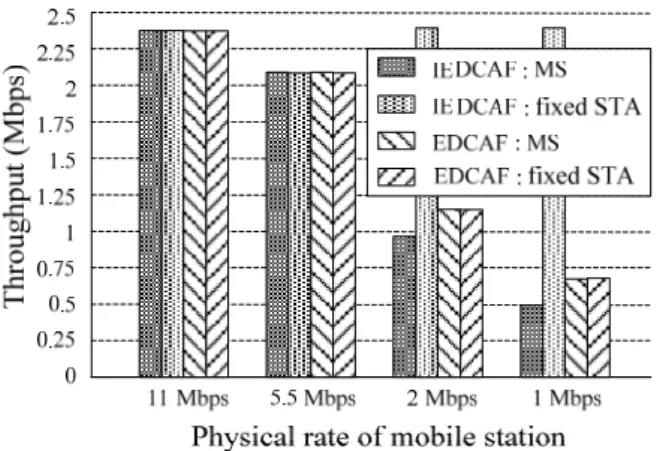
(5) summary as follows. In case 1 with the same contention parameters, a lower rate station needs a longer transmission time to transmit the same size packet, which increases the channel occupied probabilities of successful transmission and collision detection. In addition, it reduces the probability of transmission attempt and increases the probabilities of occupying channel and backoff stage in higher rate station. In case 2, the different values of AIFSN, CWmin, and CWmax will impact the frozen probability of AIFS, the idle probability of backoff stage, the transmission probability, the collision probability, and even the normalized throughput. Therefore the lower rate station will cause the unfairness of bandwidth usage and dominate the system throughput. In order to guarantee the QoS requirements, the multirate stations must be dynamically allocated different contention parameters and priorities.. Category. AC0. Traffic Bandwidth requirement i t Packet size. Stream 1 2.4 Mbps 1024 bytes. Physical header (including preamble). 192 bits. MAC header (including CRC). 272 bits. Slot time. 20 μs. SIFS. 10 μs. DIFS. 50 μs. Persistence factor. 2. Retry limit. 5. Physical layer rate. 1/2/5.5/11 Mbps. STA moving speed. 0.5 m/s. 4: SIMULATION EXPERIMENTS Table 4 The assumed priority matrix in the simulation. The SNR of the receiving signal will be degraded with the increase of the distance, when a station moves away AP. In order to maintain the signal quality, the station has to use the lower transmission rate for the longer distance. We consider the situation of stations moving with different bandwidth requirements and physical rates for simulation in this section. Based on the IEEE 802.11b specification, a station selects a suitable transmission rate (11Mbps, 5.5Mbps, 2Mbps and 1Mbps) depending on the distance from AP shown as Fig. 9. Furthermore, we ignore the problems of path loss, propagation delay, BER and hidden nodes; we assume each station operates at the saturation mode as mentioned before.. Fig. 9 A suitable transmission rate is selected depending on the distance from AP.. Table 3 The related parameters used in simulation. Parameters r(0). r(1). r(2). 0 < DT < 1. DT = 1. 1 < DT. AC (0) PM(0,0). PM(1,0). PM(2,0). AIFSN. 2. CWmin. 7. CWmax. 31. AIFSN. 2. CWmin. 15. CWmax. 63. AIFSN. 2. CWmin. 31. CWmax. 127. We consider there are two stations located in the region of the physical rate 11 Mbps. One station is fixed and always transmits at 11Mbps, while another station is mobile and moves away from the AP at the speed of 0.5 m/s when the simulation starts. The related parameters used in simulation are listed in Table 3. Both stations are assumed to have only one access category AC0 and one traffic type of stream 1, whose priority matrix is shown as Table 4. Fig. 10 shows the throughput for each station against different physical rates from the aspect of mobile station. The legacy 802.11e EDCAF can provide QoS if the physical rate satisfies the bandwidth requirement. However, EDCAF makes the throughputs of both fixed and mobile stations drop to 0.67 Mbps, when the physical rate (especially at 1Mbps) cannot provide the QoS requirements; even if the fixed station has the physical rate 11Mbps to provide its own QoS requirement; consequently the two stations cannot obtain the guaranteed QoS. For the lack of bandwidth, IEDCAF slightly reduces the throughput of mobile station to guarantee the QoS of the fixed station when. - 584 -.
(6) mobile station cannot satisfy the bandwidth requirement. IEDCAF can still guarantee the bandwidth requirement of 2.4 Mbps to the fixed station whose physical rate meets the bandwidth requirement. It is clearly that a lower rate station results in a larger degradation of throughput under the same contention parameters. An appropriate tuning of contention parameter can improve the bandwidth utilization of WLAN.. Fig. 10 Throughput of a station against different physical rates for mobile station. According to the above shown results, IEDCAF considers the multirate effect and improves performance in the multirate wireless environment. IEDCAF keeps the simple architecture of the legacy EDCAF and maximizes the effective bandwidth utilization. IEDCAF dynamically adjusts the range of DT parameter in the priority matrix to control the priority of streams and benefit the bandwidth utilization in the multirate WLAN. In summary, IEDCAF can provide more stable and more efficient QoS guarantee than the legacy EDCAF.. 5: CONCLUSION Based on the cross-layer concept, the algorithm of MAC layer can be improved by the information of the transmission rate at physical layer. The stations can choose the appropriate contention parameters in priority matrix to contend the wireless channel according to the conditions of wireless network. IEEE 802.11e EDCAF configures the contention parameters to provide the different QoS requirements based on the assumption of the same physical rate, which will easily cause the channel unfair especially for communicating with lower rate station. IEDCAF uses the DT parameters to adjust its own contention parameters to decide its own priority and to maximize the bandwidth utilization and throughput. In the meanwhile, AP can be implemented to immediately adjust the priority matrix to get the maximum bandwidth utilization and the QoS guarantee according to the condition of wireless channel.. [1] IEEE. Part 11, “Wireless LAN Medium Access Control (MAC) and Physical Layer (PHY) Specifications: Medium Access Control (MAC) Enhancements for Quality of Service (QoS), ANSI/IEEE Std. 802.11e,” Draft 13.0, Jan. 2005. [2] J. Hui and M. Devestsikiotis, “Designing improved MAC packet scheduler for 802.11e WLAN,” in Proc. of IEEE GLOBECOM, vol. 1, pp. 184–189, Dec. 2003. [3] L. Romdhani, Q. Ni, T. Turletti, “Adaptive EDCF: enhanced service differentiation for IEEE 802.11 wireless Ad-Hoc networks,” in Proc. of IEEE Wireless Communications and Networking Conference (WCNC’2003), vol. 2, pp. 1373–1378, March 2003. [4] F. Cali, M. Conti and E. Gregori, “IEEE 802.11 wireless LAN: Capacity analysis and protocol enhancement,” in Proc. of IEEE INFOCOM, vol. 1, pp. 142–149, March 1998. [5] C. Wang, W. Tang, K. Sohraby, and B. Li, “A simple mechanism on MAC layer to improve the performance of IEEE 802.11 DCF,” in Proc. of BROADNETS 2004, pp. 365–374, Oct. 2004. [6] Y. Xiao, “Backoff-based priority schemes for IEEE 802.11,” in Proc. of International Conference on Communications (ICC2003), vol. 3, pp. 1568–1572, May 2003. [7] J. Prado Pavon and S. N. Shankar, “Impact of Frame Size, number of stations and mobility on the throughput Performance of IEEE 802.11e,” in Proc. of IEEE Wireless Communications and Networking Conference (WCNC’2004), vol. 2, pp. 789–795, March 2004. [8] G. Bianchi, “IEEE 802.11 Saturation throughput Analysis,” IEEE Communications Letters, vol. 2, no. 12, pp. 318–320, Dec. 1998. [9] G. Bianchi, “Performance Analysis of the IEEE 802.11 Distributed Coordination Function,” IEEE Journal on Selected Areas in Communications, vol. 18, no. 3, pp. 535–547, March 2000. [10] Z. Tao, S. Panwar, “An analytical model for the IEEE 802.11e enhanced distributed coordination function,” in Proc. of International Conference on Communications (ICC2004), vol. 7, no. 1, pp. 4111–4117, June 2004. [11] Y. Xiao, “Performance Analysis of IEEE 802.11e EDCF under Saturation Condition,” in Proc. of International Conference on Communications (ICC2004), vol. 1, pp. 170–174, June 2004. [12] H. Zhu and I. Chlamtac, “An Analytical Model for IEEE 802.11e EDCF Differential Services,” in Proc. of ICCCN, pp. 163–168, Oct. 2003. [13] Z. Kong, D. H. K. Tsang, B. Bensaou, and D. Gao, “Performance Analysis of IEEE 802.11e ContentionBased Channel Access,” IEEE Journal on Selected Areas in Communications, vol. 22, no. 10, pp 2095–2106, Dec. 2004. [14] J. Hui and M. Devetsikiotis, “A Unified Model for the Performance Analysis of IEEE 802.11e EDCA,” IEEE Transactions on Communications, vol. 53, no. 9, pp. 1498–1510, Sept. 2005. [15] IEEE Std. IEEE 802.11b-1999, “Part 11: Wireless LAN Medium Access Control (MAC) and Physical Layer (PHY) specifications: Higher-Speed Physical Layer Extension in the 2.4 GHz Band”.. REFERENCES - 585 -.
(7)
數據


+3

相關文件
了⼀一個方案,用以尋找滿足 Calabi 方程的空 間,這些空間現在通稱為 Calabi-Yau 空間。.
Robinson Crusoe is an Englishman from the 1) t_______ of York in the seventeenth century, the youngest son of a merchant of German origin. This trip is financially successful,
fostering independent application of reading strategies Strategy 7: Provide opportunities for students to track, reflect on, and share their learning progress (destination). •
Now, nearly all of the current flows through wire S since it has a much lower resistance than the light bulb. The light bulb does not glow because the current flowing through it
Part 2 To provide suggestions on improving the design of the writing tasks based on the learning outcomes articulated in the LPF to enhance writing skills and foster
volume suppressed mass: (TeV) 2 /M P ∼ 10 −4 eV → mm range can be experimentally tested for any number of extra dimensions - Light U(1) gauge bosons: no derivative couplings. =>
• Formation of massive primordial stars as origin of objects in the early universe. • Supernova explosions might be visible to the most
• A put gives its holder the right to sell a number of the underlying asset for the strike price.. • An embedded option has to be traded along with the
