Date 2012/Sep/15 Title page
Type of manuscript: Letter to editor
Manuscript title: Use of proton pump inhibitors correlates with increased risk of colorectal cancer in Taiwan
Running head: proton pump inhibitors and colorectal cancer Shih-Wei Lai, MD1,2; Kuan-Fu Liao, MD and MS3,4,5;
Hsueh-Chou Lai, MDand MS6,7; Cheng-Li Lin, MS 8,9;
Fung-Chang Sung, PhD, MPH 8,9
(The first three authors contributed equally to this study.)
1School of Medicine, 6School of Chinese Medicine, and 8Department of Public
Health, China Medical University, Taichung, 404, Taiwan
2Department of Family Medicine, 7Department of Internal Medicine, and
9Management Office for Health Data, China Medical University Hospital, Taichung,
404, Taiwan
3Department of Internal Medicine, Taichung Tzu Chi General Hospital, Taichung,
427, Taiwan
4School of Medicine, Tzu Chi University, Hualien, 970, Taiwan
5Department of Health Care Administration, Central Taiwan University of Science
and Technology, Taichung, 406, Taiwan Corresponding author:
Fung-Chang Sung, PhD, MPH Professor
Department of Public Health, China Medical University No. 91, Hsueh-Shih Road, Taichung, 404, Taiwan Phone: 886-4-2205-4070
Fax: 886-4-2201-9901
To editor,
To date, there has been extensive evidence suggesting that use of proton pump inhibitors (PPIs) would cause acid suppression and hypochlorhydria, which further lead to elevated gastrin level and high gastrin level would be associated with colorectal cell proliferation and associated with colorectal cancer risk 1-3 . Till now,
only few clinical studies explore the association between use of PPIs and the risk of colorectal cancer in Taiwan. Therefore, we conducted a nested case-control study using database from the Taiwan National Health Insurance program to investigate this issue. The details of insurance program can be found in the previous study 4. This
study included 3989 patients aged 20 years or older with new diagnosis of colorectal cancer as the case group (2281 men and 1708 women, mean age 65.8 years and standard deviation 13.7 years) (based on International Classification of Diseases 9th Revision-Clinical Modification and code, ICD-9 codes 153 and 154, and A code A-093 and A-094), and 15956 subjects without colorectal cancer as the control group (9124 men and 6832 women, mean age 65.2 years and standard deviation 13.9 years). Both groups were matched with sex, age and index date in the database from 2000 to 2010. The index date was defined as the date of diagnosing colorectal cancer.
Subjects with colorectal cancer or any other cancer (ICD-9 codes 140-208 and A-code A08x-A14x) before index date were excluded. We measured the association between
the risk of colorectal cancer and commercially available PPIs in Taiwan, including omeprazole, pantoprazole, lansoprazole, rabeprazole, and esomeprazole. In order to explore the effect of other medications potentially associated with colorectal cancer risk, prescription of histamine-2 receptor antagonists, statins, aspirin, other non-steroidal anti-inflammatory drugs (NSAIDs), and cyclooxygenase-2 inhibitors before index date were also included.
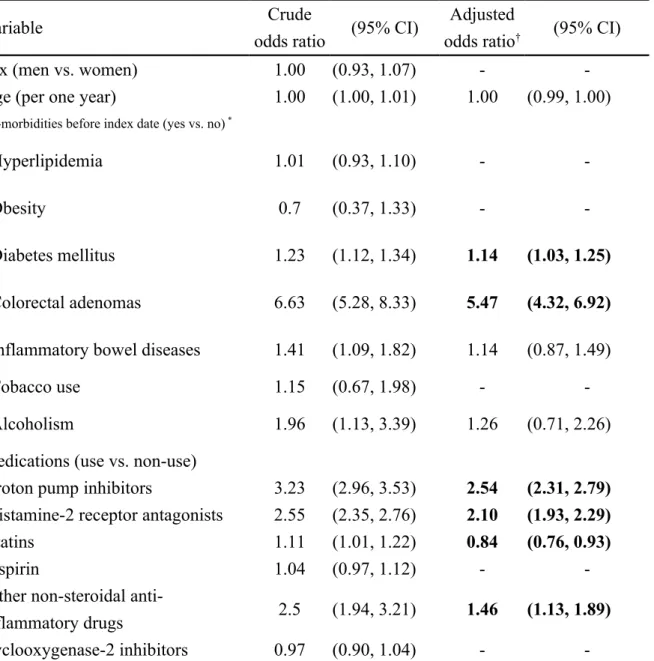
We compared the demographic information and co-morbidities between the colorectal cancer case group and the control group. The colorectal cancer cases were more likely to have diabetes mellitus (19.6% vs 16.6%, P < 0.0001), colorectal adenomas (4.94% vs 0.78%, P < 0.0001), inflammatory bowel diseases (2.03% vs 1.45%, P = 0.008), alcoholism (0.48% vs 0.24%, P = 0.02), use of PPIs (24.9% vs 9.3%, P < 0.0001), use of histamine-2 receptor antagonists (77.6% vs 57.7%, P < 0.0001), use of statins (15.5% vs 14.2%, P = 0.03) and use of other NSAIDs (98.3% vs 95.9% P < 0.0001). However, the duration of exposure to PPIs was longer in the control group than the case group (mean ± standard deviation, 121.3 ± 264.1 vs 75.3 ± 153.2 days, P < 0.0001). After adjustment for confounding factors, multivariate regression analysis showed the adjusted odds ratio (OR) of colorectal cancer was 2.54 (95% CI 2.31, 2.79) for the PPIs-use group, when compared to the group with non-use of PPIs. Diabetes mellitus (OR 1.14, 95% CI 1.03, 1.25), colorectal adenomas (OR 5.47, 95%
CI 4.32, 6.92), use of histamine-2 receptor antagonists (OR 2.10, 95% CI 1.93, 2.29), and use of other non-steroidal anti-inflammatory drugs (OR 1.46, 95% CI 1.13, 1.89) were also significantly associated with colorectal cancer. Use of statins (OR 0.84, 95% CI 0.76, 0.93) was negatively associated with colorectal cancer (Table 1).
One case-control study in Netherlands showed no association was detected between PPIs use and colorectal cancer risk 5. Moreover, in this present study, the overall risk
of colorectal cancer was increased to 2.5-fold among the PPIs use group. This finding is compatible with the previous hypothesis that use of PPIs is associated with
colorectal cancer risk 1-3. In this present study, while it was statistically significant that cases had a mean duration of exposure to PPIs of 75 days prior to the diagnosis of colorectal cancer, it is clinically not logical that such a short duration of only 2.5 months would contribute to a potential cause of a disease with such a long latent period. It seems more plausible that those with occult colorectal cancer who initially presented with reflux or upper gastro-intestinal symptoms and received PPIs
treatment. Thus, use of PPIs only led to earlier detection of occult colorectal cancer than might otherwise have occurred. Because the role of PPIs on colorectal cancer risk is not well established, further prospective trials of PPIs are required to comprehensively understand this issue.
Funding: This study was supported in part by grants from Taiwan Department of Health Clinical Trial and Research Center of Excellence (DOH 101-TD-B-111-004), the Cancer Research Center of Excellence (DOH 101-TD-C-111-005), and the National Science Council (NSC 100-2621-M-039-001). The funding agencies did not influence the study design, data collection and analysis, decision to publish, or
preparation of the manuscript.
Acknowledgements: The authors thank the National Health Research Institute in Taiwan for providing the insurance claims data.
REFERENCES
[1] Ligumsky M, Lysy J, Siguencia G, Friedlander Y. Effect of long-term, continuous versus alternate-day omeprazole therapy on serum gastrin in patients treated for reflux esophagitis. J Clin Gastroenterol 2001; 33: 32-5.
[2] Renga M, Brandi G, Paganelli GM, et al. Rectal cell proliferation and colon cancer risk in patients with hypergastrinaemia. Gut 1997; 41: 330-2.
[3] Thorburn CM, Friedman GD, Dickinson CJ, Vogelman JH, Orentreich N, Parsonnet J. Gastrin and colorectal cancer: a prospective study. Gastroenterology 1998; 115: 275-80.
[4] Lai SW, Liao KF, Chen PC, Tsai PY, Hsieh DP, Chen CC. Antidiabetes drugs correlate with decreased risk of lung cancer: a population-based observation in taiwan. Clin Lung Cancer 2012; 13: 143-8.
[5] van Soest EM, van Rossum LG, Dieleman JP, et al. Proton pump inhibitors and the risk of colorectal cancer. Am J Gastroenterol 2008; 103: 966-73.
Table 1. Crude and adjusted odds ratios and 95% confidence intervals of colorectal cancer associated with proton pump inhibitors and covariates
Variable Crude
odds ratio (95% CI)
Adjusted
odds ratio† (95% CI)
Sex (men vs. women) 1.00 (0.93, 1.07) -
-Age (per one year) 1.00 (1.00, 1.01) 1.00 (0.99, 1.00)
Co-morbidities before index date (yes vs. no) *
Hyperlipidemia 1.01 (0.93, 1.10) -
-Obesity 0.7 (0.37, 1.33) -
-Diabetes mellitus 1.23 (1.12, 1.34) 1.14 (1.03, 1.25) Colorectal adenomas 6.63 (5.28, 8.33) 5.47 (4.32, 6.92) Inflammatory bowel diseases 1.41 (1.09, 1.82) 1.14 (0.87, 1.49)
Tobacco use 1.15 (0.67, 1.98) -
-Alcoholism 1.96 (1.13, 3.39) 1.26 (0.71, 2.26)
Medications (use vs. non-use)
Proton pump inhibitors 3.23 (2.96, 3.53) 2.54 (2.31, 2.79) Histamine-2 receptor antagonists 2.55 (2.35, 2.76) 2.10 (1.93, 2.29)
Statins 1.11 (1.01, 1.22) 0.84 (0.76, 0.93)
Aspirin 1.04 (0.97, 1.12) -
Other non-steroidal
anti-inflammatory drugs 2.5 (1.94, 3.21) 1.46 (1.13, 1.89)
Cyclooxygenase-2 inhibitors 0.97 (0.90, 1.04) -
-*The co-morbidities potentially associated with colorectal cancer risk were as follows: hyperlipidemia (ICD-9
codes 272.0, 272.1, 272.2, 272.3 and 272.4), obesity (ICD-9 codes 278.00 and 278.01, and A-code A183), diabetes mellitus (ICD-9 codes 250, and A-code A-181), colorectal adenomas (ICD-9 codes 211.3 and 211.4), Inflammatory bowel diseases (ICD-9 codes 555.X and 556.X), tobacco use (ICD-9 codes 305.1) and
alcoholism (ICD-9 codes 303, 305.00, 305.01, 305.02, 305.03 and V11.3).
†Adjusted for age, diabetes mellitus, colorectal adenomas, inflammatory bowel diseases, alcoholism,