1016 OPTICS LETTERS / Vol. 25, No. 14 / July 15, 2000
Efficient high-power diode-end-pumped TEM
00
Nd:YVO
4
laser
with a planar cavity
Yung-Fu Chen
Department of Electrophysics, National Chiao Tung University, Hsinchu 30050, Taiwan
Y. P. Lan and S. C. Wang
Institute of Electro-Optical Engineering, National Chiao Tung University, Hsinchu 30050, Taiwan
Received March 16, 2000
We demonstrate a compact and efficient diode-end-pumped TEM00 laser with output power of 30 W for 48 W
of incident pump power by use of two coated Nd:YVO4crystals to form a thermally stabilized f lat – f lat cavity.
In Q-switched operation 25 W of average power at a pulse-repetition rate of 100 kHz and ⬃0.9-mJ pulse energy at a pulse-repetition rate of 10 kHz were produced. © 2000 Optical Society of America
OCIS codes: 140.3480, 140.3540.
Although diode-end-pumped lasers are already avail-able in commercial products employed in a variety of applications, scaling to higher power with good efficiency is still plagued by thermal aberrations and thermally induced fracture.1,2
In particular, scaling to the 30-W level with 50% efficiency is diff icult in diode-end-pumped Nd-doped lasers. Recently Nighan et al.3 employed two Z building blocks with a cavity
length of ⬃50 cm to generate 35 W of average power with a total of 56.5 W of pump power. Their laser system consisted of four f iber-coupled 20-W diode bars, two Nd:YVO4 crystals, and six cavity mirrors.
Previously the thermal-lasing effect was integrated into a cavity design, resulting in a compact device with good beam quality and high eff iciency.4,5
In this Letter we demonstrate a compact and efficient diode-pumped laser with a cw TEM00 output of 30 W by use of a symmetrical, thermally stabilized f lat – f lat cavity formed by two coated Nd:YVO4 crystals. The performance of this laser in Q-switched operation is also reported.
Figure 1 is a schematic of the two-crystal laser cavity utilized in the experiment. The pump power consists of two 30-W f iber-coupled diode-laser arrays (FAP-81-30C-800-B) with the output wavelength of the lasers at 25±C ranging from 807 to 810 nm. The fibers were drawn into round bundles of 0.8-mm diame-ter and a numerical aperture of 0.18. A focusing lens with 12.5-mm focal length and 87% coupling efficiency was used to reimage the pump beam into the laser crystal. The waist diameter of the pump beam was approximately 400 mm. The Nd31 concentration of the Nd:YVO4 crystals was 0.3 at. %, and the length was 9 mm. Nd:YVO4 crystals with low doping con-centration were used to prevent thermally induced fracturing. Both laser crystals were a cut, which yielded a high-gain p transition. The Nd:YVO4 crystal was wrapped with indium foil and mounted in a water-cooled copper block. The water temperature was maintained at 17±C. One side of one Nd:YVO4 crystal was coated to be nominally highly ref lecting (HR) at 1064 nm共R . 99.9%兲 and highly transmitting (HT) at 808 nm 共T . 95%兲. The other side was antiref lecting at 1064 nm 共R , 0.2%兲. One side of the other Nd:YVO4crystal was coated to be an output
coupler with 80% ref lection at 1064 nm. The other side was also antiref lecting at the laser wavelength 共R , 0.2%兲. The 20-mm-long Q switcher (Gooch and Housego) had antiref lection coatings at 1064 nm on both faces and was driven at a 40.7-MHz center frequency with 3.0 W of rf power.
The thermally induced lens in the laser crystal brings the f lat – f lat cavity into geometric stability. This concept was found at nearly the same time by Zayhowski and Mooradian6
and by Dixon et al.7
For a paraxial coherent beam propagating in the z direction over an inf initesimal distance dz, the differential optical path difference is given by8,9
dw共r, z兲 dz 苷 ≠n ≠T DT共r, z兲 1 共n 2 1兲 ≠u共r, z兲 ≠z 1 3 X i, j苷1 ≠n ≠eij eij, (1)
where the f irst term results from the thermal dis-persion ≠n兾≠T and the steady-state temperature difference DT共r, z兲, the second term is caused by the thermally induced relative axial expansion ≠u共r, z兲兾≠z of the crystal, and the third term rep-resents the strain-induced birefringence with strain tensor eij. In most cases the contribution from
thermal stress-induced birefringence is small. Note that the factor 共n 2 1兲 in Eq. (1) has to be replaced with n in the case of end-pumped resonators with a high-ref lectivity coating on one end surface of the rod. This is required because for an internal ref lection the total refractive index of the laser rod has to be taken into account. In the case of a conventional edge-cooled crystal with a top-hat pump intensity
Fig. 1. Conf iguration of the diode-end-pumped Nd:YVO4
laser.
July 15, 2000 / Vol. 25, No. 14 / OPTICS LETTERS 1017 prof ile, the steady-state temperature distribution is
given by9,10 DT共r, z兲 苷 T共r, z兲 2 T共rb, z兲 苷 jPabs 4pKc a 1 2 exp共2al兲 3 exp共2az兲 √√√Ω∑ 1 2 r 2 vp2共z兲 ∏ 1 ln ∑ rb2 vp2共z兲 ∏æ Q关vp2共z兲 2 r2兴 1 ln µ rb2 r2 ∂ Q关r22 vp2共z兲兴 !!! , (2)
where j is the fractional thermal loading, Kc is the
thermal conductivity, Pabsis the absorbed pump power, a is the absorption coefficient at the pumping wave-length, l is the crystal wave-length, and vp共z兲 is the pump
size in the active medium. Using the usual M2 propa-gation law, we find that the pump beam is given by
vp2共z兲 苷 vpo2 Ω 1 1 ∑l pMp2 npvpo2共z 2 z 0兲 ∏2æ , (3) where vpo is the radius at the waist, lp is the pump
wavelength, Mp2 is the pump-beam quality factor,
and zo is focal plane of the pump beam in the active
medium.
The inhomogeneous temperature distribution leads to stresses, strains, and displacement. The thermally induced strains for a nonuniformly heated solid can be solved from the equilibrium equation11
1 2 n
1 1 n=共= ? u兲 2 1 2 2n
1 1 n = 3 = 3 u苷 aT=共T兲 , (4) where n is the Poisson ratio, aT is the
thermal-expansion coeff icient, and u is the displacement vector. A computer code that is part of the ANSYS thermal-analysis package was employed to f ind the numerical solution. The simulation results show that the mag-nitude of ≠u共r, z兲兾≠z is 10–20% larger than aTDT
on average. Substituting the simulation result into Eq. (1) and carrying out the integration along the crystal axis, we then calculated the total optical path difference. Following the procedure of Ref. 8, we determined the focal length of the thermally induced lens, fth, by fitting the calculated optical path differ-ence with an equivalent spherical lens over the extent of the pump region with a least-squares fit.
Taking the thermal-lensing effect into account, we find the mode size at the input face of the laser crystal:
vl苷 √ lfth p s L 2fth2 L !1兾2 , (5) L苷 Lⴱ 1 l ∑µ 1 n ∂ 2 1 ∏ 1 lQ ∑µ 1 nQ ∂ 2 1 ∏ , (6) where Lⴱ is the cavity length, lKTP is the length of the KTP crystal, lQis the length of the Q-switched crystal,
and nQis the refractive index of the Q-switched crystal
for the output laser beam. Equation (5) indicates that the mode size depends on the thermal lens and the effective cavity length.
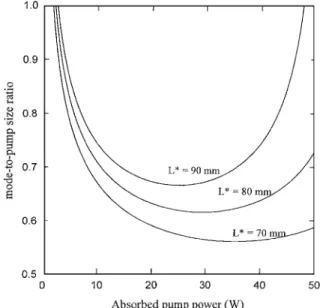
An end-pump-induced thermal lens is not a per-fect lens but rather an aberrated lens. It has been found that the thermally induced diffraction loss at a given pump power is a rapidly increasing function of mode-size– pump-size ratio. Practically, the trade-off between overlapping eff iciency and thermally induced losses limits the mode-size– pump-size ratio to the range of approximately 0.6 –1.0 when the incident pump power is greater than 5 W. The dependence of the mode-size– pump-size ratio on the pump power for the present cavity was calculated by use of Eqs. (5) and (6) and the following parameters: j 苷 0.24, Kc 苷 0.0523 W兾K cm, vpo 苷 0.2 mm, Mp2 艐 310,
n 苷 2.165, nQ 苷 2.33, l 苷 9 mm, lQ 苷 20 mm, n 苷
0.28, ≠n兾≠T 苷 3.0 3 1026兾K, and a
T 苷 4.43 3 1026兾K.
The calculation results for several cavity lengths are shown in Fig. 2. It is clear from Fig. 2 that the mode-size– pump-size ratio is approximately 0.7 at Lⴱ 苷 80 90 mm for pump powers in the range 10 –50 W, leading to a good compromise between overlapping eff iciency and thermal effect.
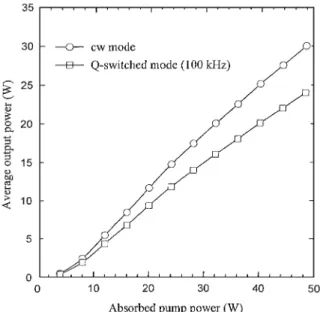
Figure 3 shows the average output power in cw mode and Q-switched mode at a repetition rate of 100 kHz as a function of the absorbed pump power. The output power in cw mode was measured before insertion of the Q switch into the resonator. The highest output power of 30 W was achieved at the absorbed pump power of 48 W. The average slope efficiency with respect to the absorbed pump power was 66.6%. To our knowledge these are the highest efficiency and power ever reported for a thermally stabilized f lat –f lat cavity. The M2 parameter was measured to be ,1.5 over the complete output power range. Recently a composite crystal structure,1
which was fabricated by diffusion bonding of a doped crystal to an undoped piece of the same cross section, was used to reduce thermally induced stress. We believe
Fig. 2. Dependence of the mode-size –pump-size ratio on the absorbed pump power for several cavity lengths.
1018 OPTICS LETTERS / Vol. 25, No. 14 / July 15, 2000
Fig. 3. Average green output power as a function of the absorbed pump power.
Fig. 4. Average green output power and pulse width as functions of Q-switched pulse-repetition frequency at a pump power of 48 W.
that higher output power with better beam quality can be achieved with a composite crystal structure. With the Q switch in the cavity, stable Q-switched mode operation at a pulse-repetition rate of up to 100 kHz was accomplished. As shown in Fig. 3, the highest average output power obtained at a 100-kHz pulse-repetition rate was 25 W at a pump power of 48 W.
Figure 4 shows the average output power and pulse width at a pump power of 48 W as a function of the pulse-repetition rate. To avoid damage to the intracavity optical components we operated the repetition rate at greater than 10 kHz. It can be seen from Fig. 4 that at low pulse-repetition rates the pulse width is short and the energy per pulse
is high, whereas at higher pulse-repetition rates the energy per pulse is low and the pulse width is long but the average power is high. The highest Q-switched pulse energy of 0.9 mJ was achieved at 10 kHz. At less than 10 kHz, no further increase of the pulse energy was observable, owing to the 90 100-ms lifetime of the upper laser level of the Nd:YVO4 crystal. The major advantage of the Nd:YVO4crystal is its ability to retain a short pulse width even at very high pulse-repetition rates. At full pump power the pulse width varies from 12 ns at 10 kHz to 20 ns at 100 kHz. With a Nd:YAG crystal in the present cavity, the pulse width increases from 20 ns at 10 kHz to 50 ns at 100 kHz. The pulse width in the Nd:YVO4 crystal is approximately 2 –3 times shorter than that in Nd:YAG, owing to the shorter lifetime in the Nd:YVO4crystal. For high pulse-repetition rates 共.30 kHz兲, the output performance of the Nd:YVO4 system is generally better than that of the Nd:YAG or the Nd:YLF system, owing to higher optical-to-optical conversion eff iciency.
We have demonstrated the use of a thermal lens to obtain a highly eff icient, high-power solid-state laser in cw and Q-switched modes. The laser cavity was directly formed by two coated 0.3-at. % Nd:YVO4 crys-tals. An YVO4 crystal of low Nd concentration was used to avoid thermally induced fracture. With the thermally induced lensing effect, the cavity length was adjusted to yield the optimal mode-size matching for the maximum output power. 30 W of TEM00cw mode output power with good beam quality was obtained at 48-W pump power. In Q-switched operation, we demonstrated the potential of the YVO4crystal to gen-erate pulse energy in the millijoule range with high pulse-repetition rates. Such a laser source will be in-teresting for micromaterials processing applications.
References
1. M. Tsunekane, N. Taguchi, T. Kasamatsu, and H. In-aba, IEEE J. Sel. Top. Quantum Electron. 3, 9 (1997). 2. L. Gonzalez, K. Kleine, and L. R. Marshall, in
Confer-ence on Lasers and Electro-Optics, 1999 OSA Technical
Digest Series (Optical Society of America, Washington, D.C., 1999), p. 1.
3. W. L. Nighan, Jr., N. Hodgson, E. Cheng, and D. Dud-ley, in Conference on Lasers and Electro-Optics, 1999 OSA Technical Digest Series (Optical Society of Amer-ica, Washington, D.C., 1999), p. 1.
4. Y. F. Chen, Opt. Lett. 24, 1032 (1999).
5. Y. F. Chen, IEEE Photon. Technol. Lett. 9, 669 (1998). 6. J. J. Zayhowski and A. Mooradian, Opt. Lett. 14, 1989
(1989).
7. G. J. Dixon, L. S. Lingvay, and R. H. Jarman, Proc. SPIE 1104, 107 (1989).
8. C. Pf istner, R. Weber, and H. P. Weber, IEEE J. Quan-tum Electron. 30, 1605 (1994).
9. A. K. Cousins, IEEE J. Quantum Electron. 28, 1057 (1992).
10. A. K. Cousins, Appl. Opt. 31, 7259 (1992).
11. L. D. Landau and E. M. Lifshitz, Theory of Elasticity (Pergamon, New York, 1986), p. 16.