MANIPULATION
OF WHOLE BLOOD USING TRAVELING WAVE
DLELECTROPHORESIS
U.
Lo,
A.M.
WO, and
U.
Lei
Institute of Applied Mechanics, National Taiwan University, Taipei, Taiwan
ABSTRACT
This paper presents new results on manipulation of undiluted whole blood using traveling wave dielectrophoresis (twDEP). Although twDEP is not new, data on whole blood manipulation is rare. The twDEP in this work consists of four 2D electrodes of 20pm width operating at 1OMHz sinusoidal wave with 90 degree phase apart. Results show that whole blood bulk flow can be manipulated at-will in either direction. Moreover, simultaneous bi-direction motion is also observed at different height of the 2 5 p flow channel. This flow feature might be utilized for separation purpose.
1.
INTRODUCTION
As is well known, a dielectrophoretic (DEP) force is induced in a non-uniform electric field to achieve manipulation of particles within a medium, accounting for dielectric and conductive properties of both particles and the medium. Many researchers have explored DEP and, its counterpart, twDEP for manipulation and separation of biological particles, cells, protein, virus, and even DNA [l-61. Although twDEP is not new, data on whole blood manipulation is rare. This paper presents manipulation of whole blood using twDEP as shown in Fig. 1.
Figure 2 sketches the micro-channel with inter-digitated, parallel electrode at electro-potential of 90 degrees
apart - either 0,90, 180, and 270 degrees or 270, 1 SO, 90,
and 0 degrees. Three electrode configurations were tested: (1) 2 0 p width and 20pm gap, (2) 20pm width and 30pm
gap, and (3) 20pm width and 5 0 gap. The channel, ~
with height of 25pm, was fabricated using SU-8 as photoresist and soft lithographic technique. The electrodes were e-beam deposited using chromium. A fixed frequency of lOMHz is applied to all electrodes,
which corresponds to non-negligible contributions from both conventional DEP and twDEP on the Clausius Mossotti diagram.
2.
THEORY
Physical Model
When a dielectric particle is immersed in a dielectric medium under the influence of a non-uniform electric field, a particle and the medium are polarized to a different degree. Therefore, a force exerting on the
particle is induced as a result of the phenomenon of the
induced dipole interacting with electric field. The
time-mean force [ 13 is described as
where &, is the permittivity of vacuum, E, the relative permittivity of medium, E,, the root-mean-square of the electTic field, r the radius of cells,
and K ( ~ ) the so-called Clausius-Mossotti factor (C.M.
factor).
Fig. I. Sketch of twDEP force on a cell. The twDEP force is due to spatial variation of the phase of electro-potential acting on the cell.
-4
20 pmt4-
4
20-50 piliI+
ElectrodeFig. 2. Sketch of the present device. Traveling
wave
DEP pumps undiluted whole blood through the micro-channel with 90 degrees Dhase shift between adiacent electrodes.This factor related with cell and medium electric properties as follows,
K ( w ) =
[
-) ,
E -I 2 E ,
where the superscript
*
is the complex permittivity( E '
=
E - j a /w ,
cr is the conductivity of material, andKI the angular velocity), and subscript p and m denote
particle and medium respectively. Through a double layer
method, the electric field acting on a RBC can be acquired. Thus, the Clausius-Mossotti factor aIso can be calculated and is shown in Fig. 3. The equation has two
parts: the first term resulted called conventional dielectrophoresis (cDEP) is associated with real part of Clausius-Mossotti factor and non-uniformly spatial electric field intensity. The second term attributed to
imaginary part of Clausius-Mossotti facto1 and non-uniform phase distribution is named after traveling wave dielectrophoresis (twDEP). The Clausius-Mossotti diagram suggests that cDEP effect exists at all frequencies but not twDEP. The twDEP contributes merely at frequency ranging from 1 Mhz to EGhz.
System Interpretation
The relationship between the applied electric field and the
induced dipole moment
k(0.1)
is presented in Fig. 4afor the amplitude and Fig. 4b for the phase. Its physical for frequency meaning can be understood as follows. From the figure 4b. it can be seen that the dipole moment
changes sign. from 1 MHz to IGHz, In the other words, the cDEP force changes direction; the system possess a 1x0 degree phase lag. In the same frequency range, twDEP works due to the non-uniformly spatial phase
distribution with the 180 degree transition of dipole moment. Thus, these two phenomena can be exploited for cell manipulation.
A .
0.4
Res1 Part Of CM. fector 0.3 -
-
Imaginary Part of C.M. factor 0.2 ----
:::I
-0.3
J
Fig. 3.
Calculated
result ofClausius-Mossotti
factor obtained from
considering
of theelectric
double layer of a
celf.
-121
lo0 IO' IO' lo8 ioa 10'O i o i 2
Frequenq(W)
b
Fig.
4. The (a)amplitude and (b)
phase of theCiausius-Mossotti factor,
as
shown in Fig.3.
3.
Fabrication
Electrode
Fabrication of the electrodes is as follow. The first step is
to clean the glass ( 1 5 m length and 5 2 m width) and
substrate surface with a mixture of sulfuric acid and hydrogen peroxide with the proportion of 1:3.
Well-preparation substrates are loaded into the e-beam evaporator for a 20008. chromium or gold deposition. A
two-step deposition program is used to ensure good conductive and adhesion property of film. Development
transforms the latent image formed during exposure into a
relief image, and thus, it dominates the photolithography process. Then, immerse the exposed elements in MF-3 19 for 1 minute. Afterwards, it is placed into a hrnace120C
for 5 minutes. After cooling, the substrate is immersed in the Cr etchant for 5 to 6 minutes depending, on the
uniformity of deposited Cr. Finally, the protective PR layer is removed using acetone.
Micro-channel
The micro-channel is fabricated with SUX-50 and replica
molded with PDMS. The fabrication of SUB mold is
similar to that of electrode. In order to coerce all the cells with sufficient electric field strength, we design a 25pm
height channel which is larger than the cell size ranging from 5 to 15pm. In this requirement, SUS layer is achieved by spinning 4000 RPM for 30 seconds, which achieves a 2 5 p n thickness.
Device bonding
After the fabrication of micro-channel and electrodes, oxygen plasma bonding is used to integrate the two independent sub-devices. First, the surfaces are cleaned far bond, and DI water and acetone are used to wash the surfaces and
dry
via compressed air. Then, the cleaned surfaces are placed horizontally inside the plasma cleaner, outer door closed, and the suction pump is activated with the plasma cleaner off. After about 2 minutes, the pressure within the plasma cleaner reaches about 300 milli-torr. Then we turn the plasma cleaner (Harrick Scientific) on high power, and a white-colored glow will appear. Air is allowed to flow into the plasma chamber through a fine valve connect to the lid until the pressure rises to I to 2 torr, then the valve is closed. A bright reddish glow will result. After about 30 seconds, theplasma cleaner is turned off and air is allowed to flow into the chamber until atmospheric pressure is reached. Open plasma chamber and pick up the two sub-devices. Bond them together in a microscope in a minute and the
integration is completed.
4.
Results
and
Discussion
Cell velocity
Figure 3 presents micrographs of steady-state motion of the whole blood cells under two sets of spatial phase vanation. Figures 5a, with electro-potential phase at 270,
180, 90, and 0 degrees, shows the cells are moving, as a bulk, towards the direction of increasing. Figure 5b also
confirms ihis effect by reversing the phase - 0, 90, 180,
and 270 degrees - and the motion of the cells reverse.
Figure 4 presents the averaged cell velocity, obtained by tracking 15 cells over an uniformly spaced domain, with
variation in electrode gap at different applied voltages.
Results confirm that cell velocity increases with stronger electro-potential gradient (smaller gap). In a low Reynolds number, drag varies linearly with cell velocity, and lwDEP force is related to square of applied voltage.
The curve of average cell velocity to applied voltage is parabolic correspondent to the theoretic analysis.
Bi-directional manipulation
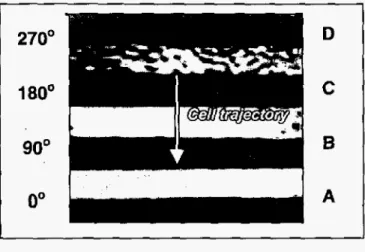
Traveling wave DEP can give rise to simultaneous bi-direction motion on cells, as shown in Fig. 7. The cells
exhibit a motion where they move in opposite direction depending on the height normal to the electrodes. This can be understood from the spatial force distribution, due
to twDEP alone, computed by solving the time averaged force equation. Figure 8 shows the time-averaged twDEP
force vectors along (x-dir.) and normal to the electrodes (z-dir.), with expanded view shown (blue vectors).
Results show at height less than approximately 5pm from
the plane of the electrodes, the net force is in the opposite direction from that at further distance away. However, in
our experiment, after some time (steady state),
conventional DEP (negative) force causes the cells to be sufficiently repelled from the electrodes so that they
exhibits behavjor as shown in Fig. 3. Nevertheless, at higher frequency, twDEP dominates over conventional DEP and would result in steady-state bi-directional
motion, which might be harvested as a new method of sorting particlesicells.
A
180'
8
goo
c
I
O0
Fig. 5a. Micrograph of steady-state motion
of
whole blood cells being pumped by twDEP with phasing between electrodes as shown on right.
I I
I
O"
8
L
Fig. 5b. Micrograph of steady-state motion of
whole blood cells being pumped by twDEP with phasing between electrodes as shown on right.
14.0 I 1
P
I
a. I 5 10.0 .- U 2 8.0 V 6.0&
4.0e
-
U2
2.0 0.0/
+
gapdopm 0 5 10 15 20 25 Voltage (V)Fig. 6. Effect of
electrode
gap and voltage on average cell velocity. The width of each270'
180"
90'
O0
Fig. 7. Bi.directional cell motion due to spatial variation of twDEP force normal to the plane of electrode (see Fig. 8).
4
+ * + * - I
Fig. 8. Computational result of twDEP force vectors (x: along the electrodes parallels to cell motion; z: normal to the plane of electrode). Blues arrows on
the
right show enlarged view. Below Zc: 5pm (approx.), force vectors {blue arrows)are
to the e/J (except for single vector on the far right due to edge effect). Above Z > 5pm (approx.), force vectors (blue arrows) are ta the&&t. This directional variation of twDEP force
causes bi-directional cell motion.
5.
Conclusion
This work studied manipulation of undiluted whole blood ,
using traveling wave dielectrophoresis (twDEP). The twDEP in this work consists of four 2D electrodes of 20pm width operating at loMHz sinusoidal wave with 90 degree phase apart. The effect of different gap distance
between electrodes and variation in electrode voltages are also studied.
Results show that whole blood bulk flow
can
be manipulated at-will in either direction. The average cell velocity depends on the electrode gap distance and voltage - the smaller the gap and the larger the voltage give rise to greater cell veIocity. Moreover, simultaneous bi-direction motion is also observed at different height ofthe 25pm flow channel. This flow feature might be
utilized for separation purpose.
Reference:
[ 11 T,B. Jones, Electrornechanics of Particles, Cambridge University Press, 1995.
121 Michael Pycrafl Hughes, "Micro- and
Nanoelectrokinetics in Medicine," IEEE Engineering in Medicine and BioIogv Magazine, Nov.-Dec. 2003, p. 3.
[3] Muller, T, "Potential of Dielectrophoresis for Single Cell Experiment," IEEE Engineering in Medicine and
Biology Mugazine, Nov.-Dec. 2003, pp. 51-61.
[4]
N. G.
Green, and H. Morgan, "Microdevices €orDielectropharetic Flow- through Cell Separation," 1EE.E'
Engineering in Medicine and Eiohgv Magazine, Nov.-Dec. 2003, pp. 85-90.
[5] K. Pant, J. Feng, G. Wang, S. Krishnamoorthy, and S.
Sundaram, "Separation of Bioparticulate Matter Using
Traveling Wave Dielectrophoresis," Proceedings of Micro TAS2003, pp. 1207-1210.
[6J M.P. Hughes, "Dielectrophoresis in ~aboratories-on-a-Chip," (invited review)
Electrophoresis, Vol. 23, pp. 2569-2582,2002,