行政院國家科學委員會專題研究計畫 成果報告
植基於多重描述向量量化及多重描述變換編碼之數位浮水
印技術
研究成果報告(精簡版)
計 畫 類 別 : 個別型 計 畫 編 號 : NSC 94-2213-E-151-005- 執 行 期 間 : 94 年 08 月 01 日至 95 年 09 月 30 日 執 行 單 位 : 國立高雄應用科技大學電子工程系 計 畫 主 持 人 : 潘正祥 共 同 主 持 人 : 陳聰毅、謝欽旭 計畫參與人員: 碩士班研究生-兼任助理:蔡沛緯 報 告 附 件 : 出席國際會議研究心得報告及發表論文 處 理 方 式 : 本計畫可公開查詢中 華 民 國 95 年 11 月 12 日
行政院國家科學委員會專題研究計畫成果報告
植基於多重描述向量量化及多重描述變換編碼之數位浮水印技術
Digital Watermarking Based on Multiple Description Vector
Quantization and Multiple Description Transform Coding
計畫編號:NSC 94-2213-E-151-005
執行期限:94 年 8 月 1 日至 95 年 7 月 31 日
主持人:潘正祥
國立高雄應用科技大學電子工程系
E-mail : [email protected]
一、 中文摘要 由於電腦與通訊網路的進步,使得電 子文件交換、電子商務、隨選視訊、數 位圖書館等數位服務蔚為風尚。但是, 由於數位化資料具有容易且精確地被複 製的特性,所以需要有效的保護機制來 防止竊取或篡改,數位浮水印(digital watermarking)因此成為產學界高度重視 的技術之一。數位浮水印將不容易被移 除或破解的數碼隱密地嵌入原始影像 中,以做為確認版權歸屬的依據。本計 劃將數位浮水印技術,與通訊系統中的 多重描述向量量化壓縮,以及多重描述 變換編碼進行結合,利用多通道傳輸的 特性,可以達成數位浮水印的錯誤補償 與回復機制,藉以提升其強健性。應用 範圍可以包含從傳統的影像浮水印,到 進一步各項傳輸系統如網際網路的資料 傳輸等,皆可藉由多通道模型的建立, 並使用本計畫所提出的方式,建構高效 能的浮水印系統。 本計畫更提出了最佳化技術,針對不 同的訊號進行適應性的學習與修改,另一 方面也可將不同的浮水印攻擊也納入最 佳化的目標之一。預期可以抵抗許多傳統 的壓縮與濾波器的破壞,並且維持相當程 度的影像品質。綜合以上主要的成果,本 計畫將在多重描述傳輸系統與浮水印整 合的領域開創一新的研究課題,另外也能 為傳統的浮水印領域開創新的思維和研 究的方向。 關鍵詞:資訊隠藏、數位浮水印、多重 描述向量量化、多重描述變換 編碼 AbstractWith the rapid development of multimedia and the fast growth of using Internet, the World Wide Webs, electronic commerce, video on demand, and the digital library are very popular nowadays. Due to the ease of multimedia delivery leads to the result that these digital multimedia contents suffer from infringing upon the intellectual properties with their digital natures and advantages. Digital watermarking techniques, which have been proved to have the functions for solving these problems, have given considerable amount of attention in recent years.
techniques will combine with the Multiple Description Vector Quantization (MDVQ) and the Multiple Description Transform Coding (MDTC) for reliable watermarking communication. By utilizing the
multi-channel communication characteristics in MDVQ or MDTC, the loss
of the watermark can be recovered. By applying this concept, the new digital watermarking can be created by the proposed multi-channel model.
We also apply the optimization techniques for the digital watermarking based on the multi-channel model so as to improve both the quality of the watermarked image and the robustness. In this project, we develop a new research issue for watermarking on the multi-channel communication system.
Keywords : Information Hiding、Digital
Watermarkin, Multiple Description Vector Quantization, Multiple Description Transform Coding
二、 緣由與目的
Digital watermarking is one of the useful solutions for copyright protection. It embeds secret information into digital contents to protect intellectual properties. There might be no or little perceptible differences between the original media content and the watermarked one. After transmitting the watermarked media via the Internet or the mobile channels, the embedded watermarks can later be extracted or detected from the watermarked multimedia and/or the secret keys for authentication or identification.
During transmission or delivery, the watermarked media may experience some intentional or unintentional processing on the watermarked media, called attacks. Most watermarking researches concentrated on robust and imperceptible watermarking. In this project, we focus the multimedia formats on digital images. Among the watermarking researches in literature, vector quantization (VQ) based watermarking [1-6] is a newly developed branch that can be further explored for researches and applications. In spite of the conventional viewpoints to apply intentional attacks on watermarked media, the error induced during the transmission of watermarked contents is another typical issue that needs to be considered. Therefore, we propose an innovative algorithm concentrating on vector quantization based image watermarking, suitable for error-resilient transmission over noisy channels in this paper. By incorporating watermarking algorithm with multiple description coding (MDC), our proposed schemes can efficiently overcome channel impairments while retaining the capability for copyright protection. By the way, we also applied the related techniques to hide the secrete information based on the multiple description transform coding.
MDC is an error resilient coding technique that uses diversity to overcome channel impairments such that a decoder, which receives an arbitrary subset of the channels, may re-produce a useful reconstruction. Information-theoretic issues of MDC have been studied extensively since early eighties.
In multiple description (MD) coders, the same source material is coded into several chunks of data, called descriptions, such that each description can be decoded independently to obtain a minimum fidelity; while combining with other descriptions to achieve the better quality. Applications of MDC focus on error concealment and error resilience. For transmission, MDC is suitable for noisy channels with long bursts of errors. Fig. 1 depicts the typical scenario for MD source coding with two channels and three decoders, where Decoder 0 is called the central decoder, and Decoders 1 and 2 are the side decoders. It suggests a situation in which there are three separate users or three classes of users, which could arise in broadcasting on two channels. The same abstraction holds if there is a single user that can be in one of three states depending on which descriptions are received. Generally speaking, if we extend the number of transmission channels in Fig. 1 to K, there will be 2K −1 receivers that
decode with different number of descriptions received, and obtain different qualities of the reconstructed image.
Fig. 1 Scenario for MD source coding with
two channels and three receivers. The general case has K channels and
1
2K− receivers.
Fig. 1 depicts a generic structure of MDC, and in addition to making theoretic
researches, it is also important to devise practical designs to make MDC applicable. Practical applications of MDC emerged in the nineties. Two major categories for MDC applications are: (i) quantization based schemes, such as Multiple Description Scalar Quantization (MDSQ) [8] and Multiple Description Vector Quantization (MDVQ) [9], and (ii) transform-domain based schemes, called Multiple Description Transform Coding (MDTC)[10-11]. In this project, we focus on quantization based MD schemes for watermarking.
Fig. 1 is a general structure for quantization based MD. Taking scalar quantization for example because MDSQ is the first practical design of MDC, employing different quantization levels into the MD structure is a straightforward solution. Also, MDSQ is flexible in that it allows a designer to choose the relative importance of the central distortion and each side distortion. In Fig. 1, encoder produces from each scalar sample
X a pair of quantization indices (i1, i2). In
[7], the author described in detail how to perform quantization with an invertible function, and to turn the scalar sample into the indices by carrying out the index assignment process. After transmission of indices over different channels, the three decoders produce estimates from received indices, that is, (i1, i2) for Decoder 0, i1 for Decoder 1, and i2 for Decoder 2,
respectively. By performing the inverse quantization process, the central decoder outputs the reconstructed sample ˆ(0)
X with
low central distortion, while the side decoders output the reconstructions ˆ(1)
and ˆ(2)
X with somewhat higher side
distortions.
Fig. 2 The structure for MDVQ with two
descriptions.
It is easy and straightforward to extend MDSQ to MDVQ. However, the index assignment of MDVQ becomes more difficult than MDSQ. Fig. 2 demonstrates the structure with two descriptions. Here the input Xk denotes the small block for VQ
operation. Again, the reconstruction ˆ(0) k
X
from the central decoder has less distortion than that from each of the side decoder, ˆ(1)
k
X
or ˆ(2) k
X . In this paper, we follow the MDSQ
in [7] and MDVQ algorithm in [8], and devise a robust watermarking algorithm suitable for both error resilient transmission and copyright protection.
三、 結果與討論
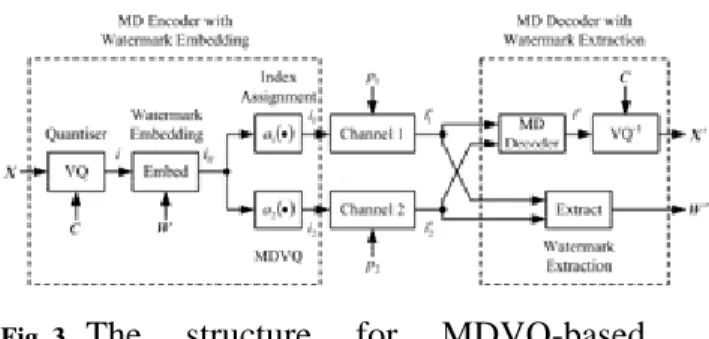
We demonstrate the structure of our watermarking system with MDVQ in Fig. 3, by introducing the watermark embedding and extraction components into Fig. 2, hence modifying the MDVQ algorithm and index assignment process in 7 and 8. Our watermarking structure can be divided into three parts: (i) MD encoder with watermark embedding, (ii) multiple channels for transmission, and (iii) MD decoder with
watermark extraction. And our goal is to focus on using MDVQ to incorporate with robust watermarking techniques. Our scheme provides both the error-resilient transmission of watermarked image over different channels with independent breakdown probabilities, and the capability for copyright protection.
Fig. 3 The structure for MDVQ-based
watermarking with two descriptions.
Let the input image be X with size M×N.
In the left part of Fig. 3, we perform the VQ operation first 錯誤! 找不到參照來源。 to train the codebook for X, and obtain the
codebook with length L, C={c0,c1,L,cL−1}. Each index in C is represented by a
⎡log2L⎤-bit binary string, where ⎡ ⎤• means a
ceiling function. X is divided into
non-overlapping blocks xb with size
W W N N M M × , W W N M b< ⋅ ≤
0 , then each xb finds
its nearest codeword ci in the codebook C,
and the index i is assigned to xb.
Let the watermark for embedding be
{
0, 1, , ⋅ −1}
= W WN M w w w L W , having size MW×NW. Each element in W, wb∈{ }0,1, 0≤b<MW⋅NW, represents one watermark bit to be embedded into the corresponding index ofb
x . For watermarking purposes, the new
index iW for representing xb is generated from two parts: to shift the original index i
to the left by one bit, and to tag watermark bit wb to the end of the shifted index. That
is,
( ) b
W i w
i = <<1+ . (1)
Next, we make use of the MDSQ algorithms in [7] for index assignment. The index assignments in Fig. 3, i1=a1( )iW and
( )iW
a
i2= 2 , map the quantizer output index iW to two descriptions i1 and i2.
Then, referring to the middle part of Fig. 3, 1
i and i2 are transmitted over two memoryless and mutually independent channels, or the lossy packet networks, with erasure probabilities p1 for Channel 1, and
2
p for Channel 2, respectively.
Finally, referring to the right side of Fig. 3, both the transmitted indices need to be reconstructed, and the embedded watermark needs to be extracted. At the MD decoder, it first shifts received binary indices i′1 and i′2 to the right by one bit to smooth away the effects from watermark embedding, and determines the outcome i′ from received
indices with MDSQ decoder. Next, it performs a table look-up process on the determined i′ with codebook C to
obtain c′i and then obtain the reconstructed
block x′b. After gathering all the blocks, we
obtain the reconstruction image X ′.
In watermark extraction, we carry out the estimation criterion from received indices for determining the value of the watermark bits. With MDC, if both descriptions for one block xb are received, then the resulting
index decoded by MDSQ can be determined uniquely, and watermark bit is extracted by taking out the last bit. Besides, because of the error concealment capability for index
assignment, when only one description is received, the block can be partly reconstructed, and the watermark bit need to be determined from several possible indices assigned in MDSQ row or column matrix [7]. We first use majority vote to determine the watermark bit ‘0’ or ‘1’. However, if there are equal numbers of 0’s and 1’s obtained in MDSQ decoding process, we assign the watermark bit randomly. Furthermore, if none of the description is received, the watermark bit is randomly assigned. By gathering all extracted watermark bits w′b, we obtain the extracted
watermark W ′.
In our simulations, we take the test image, Lena, with size 512×512, as the original
source. We have the embedded watermark with size 128×128. The watermark capacity
is within the permissible ranges. The original source is divided into 4×4 blocks
for VQ compression, which also meets the number of bits for watermark embedding. The codebook size is L=512, and indices
therein are represented by ⎡log2512⎤-bit, or
9-bit strings. We perform a series of examples under different channel conditions to demonstrate the usefulness and effectiveness of the proposed robust watermarking algorithm with MDVQ.
Two quantities are considered for evaluating the proposed algorithm. One is Peak Signal-to-Noise Ratio (PSNR), for measuring the watermarked image quality and the imperceptibility of the watermark, and the other is Bit Error Rate (BER) between the extracted watermark and the embedded one for measuring the robustness
of the watermarking algorithm: ( ) 100% 1 BER 1 ⋅ ⎟⎟ ⎠ ⎞ ⎜⎜ ⎝ ⎛ ′ ⊕ ⋅ ⋅ = ∑⋅ = W W N M b b b W W w w N M (2)
where wb and w′b represent the embedded
watermark bit and the extracted one, W
W N
M ⋅ denotes the watermark size, and ⊕
indicates the exclusive-or operation. Generally speaking, the desirable results are to obtain (i) watermarked image quality with higher PSNR value, and (ii) extracted watermark with lower BER value.
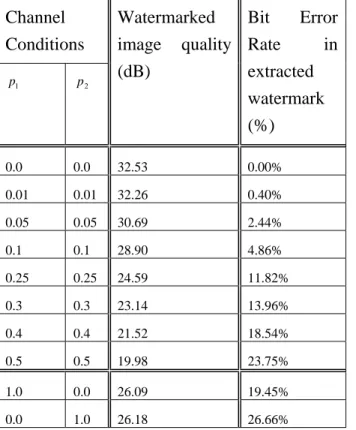
MDC is suitable for coping with severe channel conditions. We simulate the instances when one of the channels is totally broken down with the results in Table I. Table I. Simulation results with different erasure probabilities. Channel Conditions 1 p p2 Watermarked image quality (dB) Bit Error Rate in extracted watermark (%) 0.0 0.0 32.53 0.00% 0.01 0.01 32.26 0.40% 0.05 0.05 30.69 2.44% 0.1 0.1 28.90 4.86% 0.25 0.25 24.59 11.82% 0.3 0.3 23.14 13.96% 0.4 0.4 21.52 18.54% 0.5 0.5 19.98 23.75% 1.0 0.0 26.09 19.45% 0.0 1.0 26.18 26.66% 四、 計畫成果自評
We propose an innovative scheme for VQ-based image watermarking with multiple description coding in this paper. The proposed algorithm is suitable for transmitting over noisy channels, while retaining the capability for copyright protection. We modified the MDVQ and MDSQ index assignments for watermark embedding and extraction. Channel impairments can be overcome, and the watermarked reconstruction with the error resilient capability of MDC has acceptable image quality even when part of the information is lost during transmission. By incorporating with MDC, simulation results also presented both the better robustness of the watermarking algorithm due to the ability for recognizing the extracted watermark, and the more resilience to combat with channel noise under lightly to heavily erased channels. Capabilities for copyright protection are assured with our proposed algorithm. Due to the support from this project, 10 conference papers and 8 journal papers are published.
五、 參考文獻
1. J. S. Pan, H.-C. Huang, and L. C. Jain (editors), Intelligent Watermarking Techniques, World Scientific Publishing
Company, Singapore, Feb. 2004.
2. Z. M. Lu and S. H. Sun, “Digital Image Watermarking Technique Based on Vector Quantisation,” IEE Electronics
Letters, vol. 36, no. 4, pp. 303 – 305,
Feb. 2000.
3. Z. M. Lu, J. S. Pan, and S. H. Sun, “VQ-Based Digital Image Watermarking Method,” IEE
Electronics Letters, vol. 36, no. 14, pp.
4. H.-C. Huang, F. H. Wang and J. S. Pan, “Efficient and Robust Watermarking Algorithm with Vector Quantisation,”
IEE Electronics Letters, vol. 37, no. 13,
pp. 826–828, Jun. 2001.
5. H.-C. Huang, F. H. Wang and J. S. Pan,
“A VQ-Based Robust Multi-Watermarking Algorithm,” IEICE
Trans. Fundamentals, vol. 85-A, no. 7,
pp. 1719 – 1726, Jul. 2002.
6. J. S. Pan, M. T. Sung, H.-C. Huang, and B. Y. Liao, “Robust VQ-Based Digital Watermarking for the Memoryless Binary Symmetric Channel,” IEICE
Trans. on Fundamentals, vol. E-87A, no.
7, pp. 1839 – 1841, Jul. 2004.
7. V. K. Goyal, “Multiple Description Coding: Compression Meets the Network,” IEEE Signal Processing
Magazine, vol. 18, no. 5, pp. 74 – 93,
Sep. 2001.
8. V. A. Vaishampayan, “Design of Multiple Description Scalar Quantizers,” IEEE Trans. Inf. Theory, vol. 39, no. 3, pp. 821 – 834, May 1993. 9. N. Görtz and P. Leelapornchai,
“Optimization of the Index Assignments for Multiple Description Vector Quantizers,” IEEE Trans. Commun, vol. 51, no. 3, pp. 336 – 340, Mar. 2003. 10. Y. Wang, M. T. Orchard, V. A.
Vaishampayan, and A. R. Reibman, “Multiple Description Coding Using Pairwise Correlating Transforms,” IEEE
Trans. Image Processing, vol. 10, no. 3,
pp. 351 – 366, Mar. 2001.
11. Y. Wang, A. R. Reibman, M. T. Orchard, and H. Jafarkhani, “An Improvement to Multiple Description Transform Coding,” IEEE Trans. Signal Processing, vol. 50, no. 11, pp. 2843 – 2854, Nov. 2002.
出席 2005 年
International Workshop on
Intelligent Information Hiding and Multimedia
Signal Processing
(IIHMSP’05)
in conjunction with
Ninth International Conference on
Knowledge-Based Intelligent Information &
Engineering Systems
研討會報告
報告人 潘正祥
國立高雄應用科技大學
電子工程系
中華民國 94 年 10 月 1 日
出席 2005 年資訊隱藏與多媒體信號處理國際會議報告
一、 參加會議經過:
筆者搭機於 9 月 11 日前往雪梨,參訪雪梨科技大學,與 Chengqi Zhang 恰談可能之合作,再轉機到墨爾本,並於 9 月 17 日回到高雄。本會議自 2005 年 9 月 14 日至 2005 年 5 月 16 日,於澳大利亞墨爾本市之希爾頓大飯店行。 筆者於此次會議中,擔任會議主席,亦為此會議之創辦者,並同時以口頭報告 方式,協同報告論文一篇;本次會議本人共發表八篇論文如下:1. Bin Yan, Zhe-Ming Lu, Sheng-He Sun and Jeng-Shyang Pan, 2005, “Speech authentication by semi-fragile watermarking”, International Workshop on Intelligent Information Hiding and Multimedia Signal Processing, LNAI 3683 , pp. 497-504 (SCI expanded)
2. Meiying Wang, Yao Zhao, Jeng-Shyang Pan and Shaowei Weng, 2005, “A Reversible Watermark Scheme Combined with Hash Function and Lossless Compression”, International Workshop on Intelligent Information Hiding and Multimedia Signal Processing, LNAI 3682 , pp. 1168-1174 (SCI expanded)
3. Yu-Long Qiao, Sheng-He Sun and Jeng-Shyang Pan, 2005, “An Experimental Comparison on Gabor Wavelet and Wavelet Frame Based Features for Image Retrieval”, International Workshop on Intelligent Information Hiding and Multimedia Signal Processing, LNAI 3683 , pp. 353-358 (SCI expanded)
4. Shaowei Weng, Yao Zhao and Jeng-Shyang Pan, 2005, “Reversible Watermarking Based on Improved Patch-work Algorithm and Symmetric Modulo Operation”, International Workshop on Intelligent Information Hiding and Multimedia Signal Processing, LNAI 3684 , pp. 317-323 (SCI expanded)
5. Ping Chen, Kagenori Nagao, Yao Zhao and Jeng-Shyang Pan, 2005, “Print and Generation Copy Image Watermarking Based on Spread Spectrum Technique”, International Workshop on Intelligent Information Hiding and Multimedia Signal Processing, LNAI 3682, pp. 1076-1082 (SCI expanded)
6. Feng-Hsing Wang, Kang K. Yen, Jeng-Shyang Pan, Lakhmi C. Jain, 2005, “Shadow Watermark Extraction System”, International Workshop on Intelligent Information Hiding and Multimedia Signal Processing, LNAI 3682 , pp. 1115-1121 (SCI expanded)
Lossless Watermarking Technique for Halftone Images”, International Workshop on Intelligent Information Hiding and Multimedia Signal Processing, LNAI 3682 , pp. 593-599 (SCI expanded)
8. Hsiang-Cheh Huang, Kang K. Yen, Jeng-Shyang Pan and Kuang-Chih Huang,2005, “Improved Image Coding with Classified VQ and Side-Match VQ”, International Workshop on Intelligent Information Hiding and Multimedia Signal Processing, LNAI 3683, 411-417 (SCI expanded)
會議亦邀請兩個 Keynote Speech:
1. Professor Peter (Chung-Yu) Wu, National Chiao Tung Univ., Taiwan, R.O.C. 主題: Vision and Cognition in Intelligent Signal Processing, Circuits, and Systems 2. Professor Chin-Chen Chang, Feng-Chia University
主題: An Adaptive Data Hiding Scheme for Palette Images
並 邀請 6 個 Invited Talk:
1. Dr. Zhen Liu, C4 Technology Inc.
主題: Technology of Print-to-Web Linking Using Mobile Camera and its New Trends in Japan
2. Professor Eiji Kawaguchi, Keio University
主題: BPCS-Steganography - Principle and applications
3. Dr. Oscar Au, Hong Kong University of Science and Technology (HKUST) 主題: An Overview of the AVS-M Video Coding Standard
4. Professor Hsueh-Ming Hang, Chiao-Tung University
主題: Advances of MPEG Scalable Video Coding Standard
5. Professor Hong-Yuan Mark Liao, Institute of Information Science, Academia Sinica, Taiwan
主題: Human Behaviour Analysis and Its Applications in Surveillance Systems 6. Professor Wai-Chi Fang, NASA Jet Propulsion Laboratory, California Institute of
Technology, U.S.A.
主題: Low-Power VLSI System-on-Chip Architecture Design with Embedded Information Processing and Wireless Communication System for Intelligent Sensor Networks
KES05 國際會議共有約 700 篇論文發表, 其中包含 IIHMSP05 國際會議之
96 篇論文。IIHMSP06 即將由 Professor Wai-Chi Fang 在美國 Pasadena
二、 與會心得
在此次會議中可以發現,雖然 Call For Papers 只宣傳兩個月,亦收到 150 多篇論
文,可見從事資訊隱藏及多媒體信號處理之研究人員很多。此次會議認識諸多在
圖像,語音 多媒體及 Data hiding 相關領域之學者,會議期間與 Prof Wai-Chi
Fang、 Prof Eiji Kawaguchi、Dr. Zhen Liu 等討論頗多,收獲亦良多。
三、 建議
本次會議於澳大利亞墨爾本舉行,明年 IIHMSP06 由 IEEE Circuits and
Systems Society 主辦,即將於美國 Pasadena Conventional Center 舉行。因會議
內容充實,效果良好,誠摯建議往後對參加此會議人員能多加補助以提升我國的 學術競爭力。