行政院國家科學委員會專題研究計畫 成果報告
具有鹼性與具有氧空缺觸媒對二氧化碳的吸附活化作用研 究
研究成果報告(精簡版)
計 畫 類 別 : 個別型
計 畫 編 號 : NSC 100-2221-E-011-073-
執 行 期 間 : 100 年 08 月 01 日至 101 年 07 月 31 日 執 行 單 位 : 國立臺灣科技大學化學工程系
計 畫 主 持 人 : 林昇佃
計畫參與人員: 博士班研究生-兼任助理人員:陳立鈞 博士班研究生-兼任助理人員:王啟翰
報 告 附 件 : 出席國際會議研究心得報告及發表論文
公 開 資 訊 : 本計畫可公開查詢
中 華 民 國 101 年 11 月 01 日
中 文 摘 要 : 本實驗採用水熱合成製備出不同形狀氧化鈰進行二氧化碳吸 附及活化作用,從 TEM 實驗中觀察到氧化鈰不同型狀分別為 棒狀、正方體及多邊體三種,由 HR-TEM 得知晶面組成受氧化 鈰形狀影響為:棒狀由(100)及(110)面所組成、多邊體則由 (111)及(100)組成、正方體則僅由(100)面組成。由 TPR- TPO-TPR 實驗觀察得知氧空缺可分為可逆及不可逆二種,每 單位重量的可逆氧空缺含量不受顆粒形狀影響;BET 分析得 到氧化鈰表面積分別為棒狀(40 m2/g)、多邊形(50 m2/g)及 正方形(5 m2/g),整合二者結果得知形狀變化及表面積大小 並不影響可逆氧空缺之數量。經由程溫 CO2 實驗觀察氧空缺 在不同溫度下對 CO2 進行脫氧反應之效果,雖然三種形狀氧 化鈰都能生成 CO,但僅有多邊體氧化鈰可在 CO2 分離中釋放 出氧氣,O K-edge 的 XANES 光譜顯示多邊體氧化鈰具有良好 的氧移動性,可以解釋其在反應中釋氧之原因。CO2 Pluse 活性測試顯示在 700 0C 下不同形狀氧化鈰對 CO2 最高轉化率 為:棒狀(87%) > 正方體(58%) >多邊體(49%),但氧空缺隨 著 CO2 脫氧反應進行而減少,最後導致所有形狀氧化鈰轉化 率都下降至 0。研究結果顯示 CO2 脫氧分離反應活性與晶面 種類相關,為(110)>(100)>(111),但脫出的氧原子會填補 可逆氧空缺位置,最終導致活性衰退。
中文關鍵詞: 氧化鈰、氧空缺、CO2 分離反應、水熱法
英 文 摘 要 : CeO2 nanocrystals of different particle shapes, namely, polycrystalline, rod, and cube, were
synthesized by hydrothermal method and characterized by BET, TEM, TPD, TPR-TPO-TPR and X-ray absorption techniques. TPR-TPO-TPR experiments indicated that polycrystalline CeO2 contained both reversible and irreversible H2 consumption but cubic and rod-like CeO2 contained mainly reversible H2 consumption. The reversible hydrogen-consumption capacity of CeO2 was found independent of particle shape. Although TPR indicated H2 consumption at temperatures below 600 0C, CeO2 requires high-temperature reduction to
induce the activity for the oxygen striping from CO2.
Both constant-temperature-CO2-pulse and temperature- programmed-CO2 reaction experiments showed the production of CO over all three CeO2 samples. The rod-like CeO2 seemed the most active for the oxygen stripping from CO2, resulting in the highest CO2 conversion of 87% per pulse at 700 0C. However, only
polycrystalline CeO2 showed the production of O2 in effluents. The stripped oxygen from CO2 clearly saturated the oxygen vacancies of CeO2 which caused decay in CO2 conversion with increasing number of CO2 pulse. The XANES of oxygen K-edge contained three main peaks, corresponding to electronic transitions from O 1s core levels into the empty O 2p hole states hybridized with the Ce 4f, 5d-eg and 5d-t2g,
respectively. The two principal peaks, 5d-eg and 5d- t2g, of polycrystalline CeO2 shifted to lower energy.
This implies that the polycrystalline CeO2 has higher oxygen mobility than the other CeO2 samples and may consequently resulted in O2 evolution. In our study confirm that crystal plane contribution of the oxygen-stripping from CO2 were (110)>(100)>(111).
英文關鍵詞: CeO2、hydrothermal method、stripped oxygen from CO2
行政院國家科學委員會補助專題研究計畫 ■成果報告
□期中進度報告
具有鹼性與具有氧空缺觸媒對二氧化碳的吸附活化作用研究
計畫類別:■個別型計畫 □整合型計畫 計畫編號:NSC 100-2221-E-011- 073-
執行期間: 100 年 8 月 1 日至 101 年 7 月 31 日
執行機構及系所:台灣科技大學化工系
計畫主持人:林昇佃 共同主持人:
計畫參與人員:王啟翰、陳立鈞
成果報告類型(依經費核定清單規定繳交):□精簡報告 ■完整報告
本計畫除繳交成果報告外,另須繳交以下出國心得報告:
□赴國外出差或研習心得報告
□赴大陸地區出差或研習心得報告
■出席國際學術會議心得報告
□國際合作研究計畫國外研究報告
處理方式:除列管計畫及下列情形者外,得立即公開查詢
□涉及專利或其他智慧財產權,□一年□二年後可公開查詢 中 華 民 國 年 月 日
目錄
1. 中英文摘要及關詞………Ⅱ
2. 前言……… 1
3. 研究目的……… 3
4. 文獻探討……… 4
5. 研究方法……… 6
6. 結果討論……… 8
7. 參考文獻……… 11
8. 圖表附錄……… 13
9. 成果自評……… 22
摘要
本實驗採用水熱合成製備出不同形狀氧化鈰進行二氧化碳吸附及活化作用,
從 TEM 實驗中觀察到氧化鈰不同型狀分別為棒狀、正方體及多邊體三種,由
HR-TEM 得知晶面組成受氧化鈰形狀影響為:棒狀由(100)及(110)面所組成、多 邊體則由(111)及(100)組成、正方體則僅由(100)面組成。由 TPR-TPO-TPR 實驗 觀察得知氧空缺可分為可逆及不可逆二種,每單位重量的可逆氧空缺含量不受 顆粒形狀影響;BET 分析得到氧化鈰表面積分別為棒狀(40 m2/g)、多邊形(50 m2/g)及正方形(5 m2/g),整合二者結果得知形狀變化及表面積大小並不影響可 逆氧空缺之數量。經由程溫CO2實驗觀察氧空缺在不同溫度下對CO2進行脫氧
反應之效果,雖然三種形狀氧化鈰都能生成CO,但僅有多邊體氧化鈰可在 CO2
分離中釋放出氧氣,O K-edge 的 XANES 光譜顯示多邊體氧化鈰具有良好的氧 移動性,可以解釋其在反應中釋氧之原因。CO2 Pluse 活性測試顯示在 700 0C 下不同形狀氧化鈰對 CO2最高轉化率為:棒狀(87%) > 正方體(58%) >多邊體
(49%),但氧空缺隨著 CO2 脫氧反應進行而減少,最後導致所有形狀氧化鈰轉
化率都下降至0。研究結果顯示 CO2脫氧分離反應活性與晶面種類相關,為(110)
>(100)>(111),但脫出的氧原子會填補可逆氧空缺位置,最終導致活性衰退。
關鍵詞:氧化鈰、氧空缺、CO2分離反應、水熱法
Abstract
CeO2 nanocrystals of different particle shapes, namely, polycrystalline, rod, and cube, were synthesized by hydrothermal method and characterized by BET, TEM, TPD, TPR-TPO-TPR and X-ray absorption techniques. TPR-TPO-TPR experiments indicated that polycrystalline CeO2 contained both reversible and irreversible H2
consumption but cubic and rod-like CeO2 contained mainly reversible H2
consumption. The reversible hydrogen-consumption capacity of CeO2 was found independent of particle shape. Although TPR indicated H2 consumption at temperatures below 600 0C, CeO2 requires high-temperature reduction to induce the activity for the oxygen striping from CO2. Both constant-temperature-CO2-pulse and temperature-programmed-CO2 reaction experiments showed the production of CO over all three CeO2 samples. The rod-like CeO2 seemed the most active for the oxygen stripping from CO2, resulting in the highest CO2 conversion of 87% per pulse at 700 0C. However, only polycrystalline CeO2 showed the production of O2 in effluents. The stripped oxygen from CO2 clearly saturated the oxygen vacancies of CeO2 which caused decay in CO2 conversion with increasing number of CO2 pulse.
The XANES of oxygen K-edge contained three main peaks, corresponding to electronic transitions from O 1s core levels into the empty O 2p hole states hybridized with the Ce 4f, 5d-eg and 5d-t2g, respectively. The two principal peaks, 5d-eg and 5d-t2g, of polycrystalline CeO2 shifted to lower energy. This implies that the polycrystalline CeO2 has higher oxygen mobility than the other CeO2 samples and may consequently resulted in O2 evolution. In our study confirm that crystal plane contribution of the oxygen-stripping from CO2 were (110)>(100)>(111).
Keywords:CeO2、hydrothermal method、stripped oxygen from CO2
前言
溫室效應帶來全球性氣候變遷,已是不爭之事實,在四類溫室效應氣體當 中,二氧化碳之GHP(green house potential)雖然不是最高,但因其在大氣層中的 排放量最大,對溫室效應的貢獻最多(達到 63.5 % [1]),所以幾次全球環境會 議,都以減少二氧化碳之排放量為主要訴求。
二氧化碳排放量增加是由於人類所使用的化石能源,能源使用提供生活的 便利性,隨著人類文明發展與生活水準提升,能源使用的消耗量隨著上升,當 化石燃料(oil, natural gas, and coal)被用來供應生活需要的能量,對應的二氧化碳 的排放量將會持續增加。雖然已開發國家有共識且努力逐年降低二氧化碳排放 量,但開發中國家(尤其是人口眾多的中國、印度、巴西等國)的經濟持續發展,
對能源需求的增加量,勢將造成二氧化碳排放量逐步推升,因此,國際間的政 治角力可能才是決定二氧化碳減排能否成功的主要因素。
由科技發展的角度來看二氧化碳溫室效應的解決之道,再生能源如太陽 能、風力、水力等的使用,是一個排除化石燃料的能源供應方式,但仍有環境 限制與技術實用性的因素需克服,另一個可以採用的作法為二氧化碳的捕捉與 轉化,藉由吸附與吸收技術,目前是可以有效的捕捉二氧化碳,但是二氧化碳 的轉化再利用,則尚無一技術可以適當廣泛的應用,因此目前有二氧化碳長期 儲存的討論,將所捕捉的二氧化碳往地底與海洋深處儲存,但此儲存技術仍有 許多地質條件的限制與爭議。
二氧化碳的轉化再利用技術現況,可以依其驅動力為熱、光、電或使用生 物方法來區分,其中光合作用是自然界最有效率的二氧化碳轉化作用,利用光 能與生物作用將二氧化碳與水合成葡萄糖,以此開發的仿生化學作用,利用光 能將二氧化碳與水轉化的研究,統稱為人工光合作用(artificial photosynthesis),
例如2009 年 12 月出版的 Account of Chemical Research 就集結一整期的文章討 論人工光合作用,這是屬於光觸媒應用研究,強調光能的轉化,尤其是光觸媒 材料的量子效應,美國Penn State Univ.的 Grimes 教授在 2009[2]所發表「高效 率」人工光合作用光觸媒,在自然陽光環境下將二氧化碳與水轉化為碳氫化合 物(以甲烷為主)的速率僅約為 111 ppm/cm2 hr (0.81 l/cm2 hr or 32.1 nmol/cm2 hr),由此可見其轉化效率仍不具實用性。也有研究探討光觸媒催化二氧化碳加 氫生成甲醇的反應,根據台大吳紀聖教授與荷蘭 Delft 大學 Mul 教授合作研究 結果[3]顯示,甲醇的生成可能是二氧化碳導致的觸媒表面積碳的後續反應,不 過甲醇的生成速率仍低;在目前以光或電驅動的二氧化碳轉化反應中,效率都 不高[4]。
相較之下,以熱能驅動的二氧化碳轉化可以有較高的轉化效率,不過其中 的共進料對反應的進行有相當大的影響,例如二氧化碳加氫的反應,是熟知甲 醇生成反應中的一員,此外,二氧化碳常被用於甲烷的重組反應(包括 dry
reforming 與 tri reforming)以產生合成氣,逆水氣轉移(RWGS)也是二氧化碳轉化 為合成氣的可行返應;除此之外,近期文獻中有愈多的二氧化碳參與的反應報 導,不外是以二氧化碳進行carbonation 反應的或是以二氧化碳作為氧化劑的反 應,前者如CO2與甲醇生成DMC (dimethyl carbonate)的反應[5],後者如 CO2
與乙基苯生成苯乙烯的反應[6] ,表 1 摘要整理這些二氧化碳參與的熱化學反
應,這些反應多數都牽涉到 CO2 斷鍵反應,故都以高溫反應為主,其中僅有
carbination 反應可以在較低溫度下進行,若比較 DMC 製作的二個路徑:(i) CH3OH + CO + O2 Æ DMC 與(ii) CH3OH + CO2 Æ DMC,前者在 CuCl2觸媒催 化下的反應溫度在140 oC[7],後者在 Cu-KF/MgSiO 觸媒催化下的反應溫度在 80-140 oC[5],可見 CO2參與的反應通常是需要較高的反應溫度,這應該是由於 CO2的分子較安定所致,不過只要CO2參與反應的產物具有經濟效益,即使反 應會耗能,也是一個可行的CO2轉化反應[8],再加上可以促成降低溫室效應的
碳循環的效益,CO2的熱化學轉化反應似乎是一個可以深入探討的方向。
研究目的
CO2熱化學反應的進行必需先降低其分子中的C-O 鍵強度,這應該是活化
CO2進行反應的關鍵步驟,由觸媒催化反應的基本作用原理,經由吸附作用可
以改變反應物分子的鍵結特性,而在吸附強度適中的條件下,吸附分子即可以 進行轉化,由此論點,本研究計畫擬探討 CO2 的吸附活化作用,以促成 CO2
的轉化再利用。
計畫預計進行CO2的吸附活化作用探討,以探討材料改質對CO2的吸附與 活化作用為主要目的,預計研究的觸媒系統基材包括(i)具有高溫穩定性的混合 氧化物鹼性材料,(ii)具有表面氧空缺材料,將對這些基材進行金屬添加改質,
探討觸媒中的結構改質與金屬奈米粒子添加對CO2吸附活化作用的影響。
現階段研究目的則是以氧空缺材料做為研究基礎,探討以不同形狀晶面氧 化鈰之氧空缺對CO2吸附轉化的影響。
文獻探討
Pacchioni[9]稱氧空缺為隱形的重要角色,指出氧空缺對材料的電子組態有 所影響,因而可以導致材料的光學、電子、化學性質的改變。利用具有氧空缺 材料進行反應的研究已有許多報導,主要是利用氧化物表面可以允許有氧空缺 存在,讓氧化物表面的動態氧化還原(redox)作用,在反應過程中作為一個氧的 活化、儲存與供應(即 oxygen mediator)的角色。例如 Boreave 等[10]提出 La2NiO4
(LN)觸媒在 230℃時可有高度的氧移動性,在 300℃時可有效氧化丙烷。Liotta 等[11]製備 Co3O4/CeO2運用在甲烷燃燒上,發現適當摻雜 Co3O4可降低 CeO2
之還原溫度,因此增加晶格氧移動性(mobility)並促進反應進行。Imamura 等[12]
發現在 Mn2O3觸媒中摻雜 CeO2,可有效幫助 CO 氧化反應,是因鈰可提供氧 給錳使其提升氧活動性所造成。Song 等[13]發現運用富含氧空缺之觸媒材料當 載體,在乙醇蒸氣重組反應中可抑制積碳(Coke)生成,認為其原因是氧化物載 體易提供晶格氧使積碳氧化,讓活性金屬表面積碳易繼續反應。
這些文獻結果清楚顯示含氧空缺材料可以幫助氧化反應的進行,影響氧空 缺表現性質的參數包含氧空缺的濃度、氧的遷移能力、氧空缺的生成條件如溫 度等,文獻中通常會藉由二種方法來改變這些材料參數以調控氧空缺的表現性 質,一是藉由材料的表面積與暴露晶面的控制,例如Sutthisripok 等[14]提出表 面積越大可有效增加CeO2氧空缺之含量;且從TPR-TPO-TPR 實驗中發現 CeO2
有很高效能氧的移動性及可逆性。另一常見的方法是結構摻雜的方式,例如 Wu 等[15]在 CeO2中摻雜ZrO2以提升氧空缺及Ce3+存在量,主要是因Zr4+擠入 氧化鈰晶格中所造成。外在成分也可以藉由與氧空缺材料間之相互作用力進而
提升氧空缺之移動性與活性,如圖1 所示為金屬顆粒在氧空缺材料上,藉由吸
附 CO 再經 spillover 到氧化物表面的作用,可以提升 CO 氧化反應活性。Yao 等[16]鍍金屬在 CeO2上,發現可提升氧空缺及晶格氧之移動性,Descorme 等 [17]以 CO 氧化探討不同金屬(Rh、Pt、Pd)鍍在金屬氧化物(CeO2-Al2O3)上對氧
空缺的影響,從中明白添加金屬可提升晶格氧移動性進而促進CO 氧化反應,
其金屬影響效果為Rh>Pt>Pd。Indrakanti 等[18]的理論計算顯示 MgO 的氧空 缺可以吸附 CO2,對於不同添加金屬(Rh、Pt、Pd、Ni、Cu 及 Zn)也有不同的 交互作用程度。Yi 等[19]發現在 CaO 摻入具有氧空缺材料,對 CO2吸附吸收的 量無提升,但對其吸脫附循環的穩定性有顯著提升。以上這些結果都顯示具有 氧空缺材料可以與添加成分產生交互作用,對表現的物理與化學作用產生影 響。
目前文獻中已有氧空缺吸附CO2之探討[20,18,21,22],Pan 等[22]以理論 計算分析CO2可以吸附在Ga2O3的氧空缺上,Indrakanti 等[20]即提出光誘導可 有效活化CO2,並證明TiO2之氧空缺可以吸附CO2。Staudt 等[21]提出 CeO2
可有效活化CO2,並由XPS 實驗分析 Ce3+及Ce4+對活化CO2所扮演之角色,
認為Ce3+為CO2活化之主要活性位置,可將CO2解離成CO 而自身氧化成 Ce4+, 越多Ce3+存在對CO2活化反應越有幫助。William C 等[23]以自製太陽能反應器 將光轉換成熱配合氧化鈰觸媒在高溫下轉化CO2及H2O。現今探討 CO2活化最
常見的氧空缺材料就是TiO2及CeO2,而CeO2[21,23]的氧空缺具有活化 CO2
直接分解的作用,因此是本研究初期探討的材料。
綜合上述文獻整理,可見具有表面氧空缺的材料,在CO2之活化應用具有
極大潛力,藉由材料製備與金屬顆粒的交互作用,可能可以適當調控材料對CO2
的吸附強弱進行活化,所以也是本研究擬探討的觸媒系統之一。
研究方法
Catalysts preparation:The CeO
2 with different morphology was prepared by the hydrothermal method. Then 1.95 g of Ce(NO3)3‧6H2O and an appropriate amount of NaOH (0.36 – 21.6 g) were dissolved in 90 ml of deionized water. Then these solutions were mixed and stirring in a Teflon bottle. Subsequently, the Teflon bottle was held in a stainless steel vessel autoclave, and autoclave was sealed tightly.Finally, the autoclave was transferred into a temperature-controlled electric oven, and was subjected to hydrothermal treatment at temperature in the range of 100-180
°C for 24 h (Table 2 ). After the hydrothermal treatment, fresh white precipitates were separated by centrifugation, followed by drying at vacuum oven in air
overnight, then calcination at 400 0C in air for 4 hr obtain CeO2 of different particle shape (polyhedral, rod and cube).
Catalyst structure characterization:Nitrogen adsorption and desorption
isothermal were determined on a ASAP2010 apparatus at -196 °C. The surface areas were calculated by the BET method. Powder X-ray diffraction (XRD) patterns were recorded on a Shimadzu XRD-6000 diffractometer using CuKα radiation in the range of 200≦2Θ 80≦ 0.TEM images were obtain using Philips TEM ( Tecnai F20 G2 FEI-TEM) instrument with an operating voltage of 200 KV.X-ray absorption measurements were carried out at the National Synchrotron Radiation Research Center (NSRRC), Taiwan. The XANES spectra at O K-edge were recorded at HSGM beamline 20A by using the total electron-yield mode.The energy resolution was set to 0.2 EV.The TPR-TPO-TPR experimental was investigative to OSC (oxygen storage capacity) and redox property. Hydrogen temperature-programmed reduction (TPR) and Oxidation temperature-programmed (TPO) was conducted with a conventional apparatus equipped with a TCD detector. A molecular sieve trap was placed beforethe detector to adsorb the water produced. TPR was performed by heating of the sample (50 mg) at 7 0C/min to 9000C in a 10% H2–Ar mixtureflowing at 30 ml/min. TPO was by heating of the sample (50 mg) at 7 0C/min to 900
0C in a 5% O2–Ar mixture flowing at 30 ml/min.The temperature program CO2
experimental measurement was using mass spectrometer (SMART-IQ). In each run, 50 mg of catalyst was pretreated at 7 ◦C/min to 900 ◦C in the flow of 10%H2-Ar (30 ml/min), cooling down to room temperature, then the sample was heated to 900 0C with a ramp of 7 0C /min in the 10 % CO2/Ar (30 ml/min).
Catalytic activity evaluation:The catalytic activities for CO
2 dissociate were evaluated in a fixed-bed quartz reactor. 100 mg of catalyst was used in the reaction, the samples were pretreated at 7 ◦C/min to 900 0C in the flow of 10%H2-Ar (30ml/min). Then CO2 dissociate reaction was used in CO2 (10% CO2-Ar mixture) pulse (loop was 0.1 ml) at 700 0C. In each time pulse was used carrier gas (He, 30 ml/min) to injection in a fixed-bed quartz reactor, then CO2 dissociate were conducted with a conventional apparatus equipped with a mass spectrometer (SMART-IQ) detector.
結果討論
TEM, XRD and BET analysis of CeO
2with different morphology:
The shape of ceria particles was altered by managing hydrothermal synthesis conditions to be rod, cube and polyhedral. [24-26] The as-obtained CeO2 rods were 400-800 nm in length and about 10-40 nm in diameter (Fig. 2 (a)), the CeO2 cubes were of two size ranges of 150-300 and of 800-1000 nm (Fig. 2 (b)), and the CeO2
polyhedrals agglomerates in TEM (Fig. 2 (c)) with an average, size of about 13 nm, calculated from XRD with the Scherrer’sequation. XRD analysis (Fig. 3) confirmed that all three CeO2samples can be indexed to pure fluorite cubic structures (space group Fm3m) with a lattice constant a = 5.411 Å (JCPDS 34-0394).The BET surface area of these three CeO2 samples was 40, 5, and 50 m2/g, respectively, for rod, cube, and polyhedral sample.
HRTEM analysis of CeO
2with different morphology:
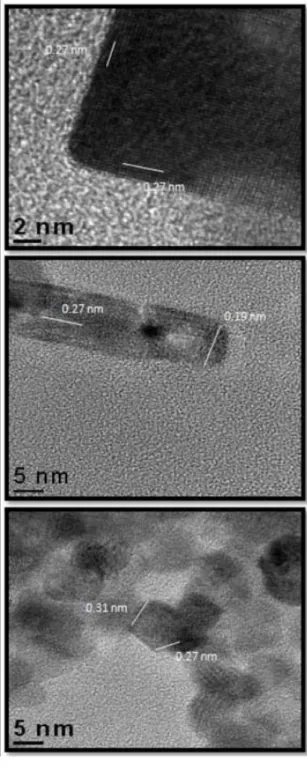
The HR-TEM image of CeO2 rods (Fig. 4 (a)) reveals (110) and (100) lattice fringes with an interplanar spacing of 0.19 and 0.27, respectively. The CeO2 rods had a preferred 1-D growth direction along [110], with exposed side surfaces
constituting of (110) and (100) planes. The CeO2 cubes (Fig. 4 (b)) showed only (100) lattice fringes with an interplanar spacing of 0.27, indicating that the cubes were enclosed by {100} planes. Three kinds of lattice fringes attributable to (111), (110) and (100) were observed in CeO2 polyhedrals (Fig. 4 (c)), with an interplanar spacing of 0.31, 0.19 and 0.27, respectively. The CeO2 polyhedrals were dominated by a truncated octahedral shape enclose mainly by {111} and {100} facets.
TPR-TPO-TPR analysis of CeO
2with different morphology:
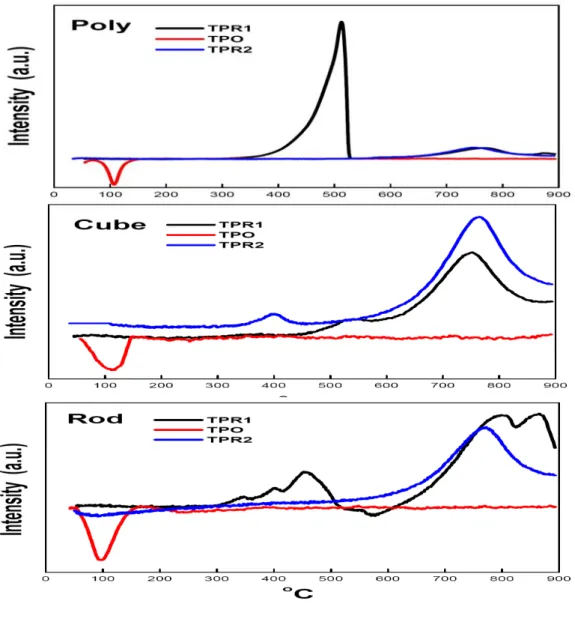
Sequential TPR-TPO-TPR was applied to analyze the redox property of ceria and the results are shown in (Fig. 5). All samples exhibited two ranges of reduction at 300-500 and at 500-900 oC in the first TPR. The CeO2 cubes had mainly the high temperature reduction peak. TPO indicated that re-oxidation occurred at about 50-150 0C over all three CeO2 samples. Afterwards, the second TPR showed that reduction occurred only at above 500 oC for all three CeO2 samples. This indicates that only the high-temperature reduction had oxidation-reduction reversibility, in consistent with previous reports [27]. Putna et al suggested that this may be due to changes in the structure of some very fine ceria clusters. [28]. Table 3 lists the quantitative evaluation of both reduction and oxidation capacity and the results show that reversible oxidation-reduction capacity was similar for all three CeO2 samples.
This suggests that, the OSC per gram of CeO2 is a bulk property, not specific with
respect to particle shape and exposed crystal plane.
Catalysts activity evaluation and XANES of O K-edge results:
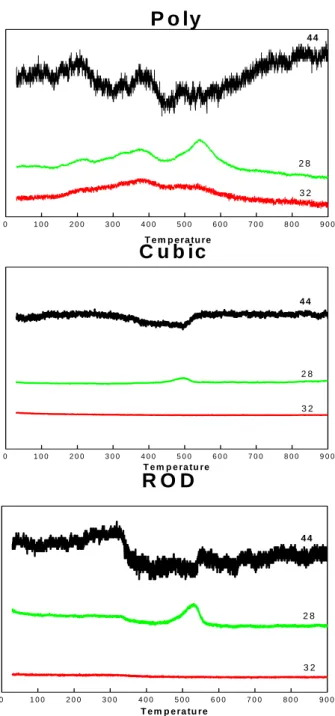
The oxygen-stripping from CO2(2CO2 → 2CO + O2) was examined by monitoring fixed bed effluent with mass spectrometer (@ m/z = 28 (CO), 32 (O2) and 44 (CO2)).The temperature program reaction with 100% CO2 feed (Fig. 6) showed that the reaction occurred over CeO2 rods, cubes, and polyhedrals at different temperature. This suggests that the reaction is surface structure sensitive.
All three CeO2 samples exhibited broad CO evolution profile at around 500 0C.
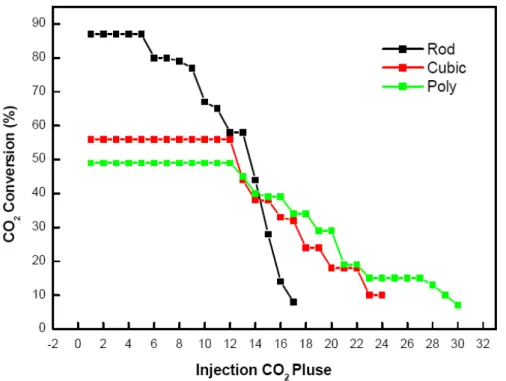
However, CeO2 polyhedrals was the only sample that evolved CO signal at low temperature (150 – 400 0C) and the only one that released oxygen. Fig. 7 presents the CO2 conversion during pulse injections of CO2 at 700 0C. The CeO2 rods showed the highest conversions (87% per pulse) initially but the activity decreased after 18 pulses. The CeO2 cubes and polyhedrals had lower initial conversions but the activity lasted with more pulses. It seems the lower the initial conversion was the more pulses the activity lasted. Based on O-balance analysis, the amount of missing oxygen in pulse reaction experiments was calculated. It seems that the activity dropped to zero after the bulk oxygen vacancies were completely filled. This suggests that the OSC determined the total amount of CO2 that was converted, although the initial per-pulseCO2 conversion differed with different shape of CeO2
particles. It implies that the O-stripping of CO2 occurring on different crystal planes shifted the stripped oxygen to the bulk oxygen vacancies. It also suggests that an oxygen transfer mechanism is needed to maintain the O-stripping activity.
In the XANES of oxygen K-edge (Fig. 8), the first three peaks are associated to electronic transitions from the O 1s core levels into the empty O 2p hole states hybridized with Ce 4f, 5d-eg and 5d-t2g, respectively. The first (4f) two peaks (5d-eg
and 5d-t2g) of CeO2 polyhedrals shifted to lower energy. This implies that CeO2
polyhedrals had lower oxygen binding energy and consequently higher oxygen mobility than the other two CeO2 samples. This may explain why O2 evolution was observed only on CeO2 polyhedrals during the O-stripping reaction of CO2. From HR-TEM only the CeO2 polyhedral had exposed (111) crystal planes, this suggests that (111) crystal plane had higher oxygen mobility. Table 4 summarizes the
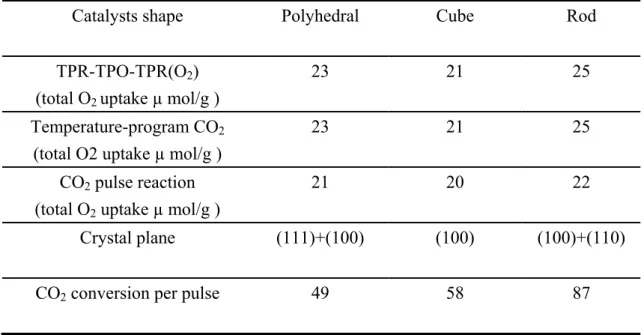
quantitative evaluation of OSC by different experimental methods, crystal plane and CO2 conversion with different CeO2 morphology. Three different experiments revealed similar reversible OSC for CeO2 samples of different shape. The results of this study indicate that the OSC is important for oxygen-stripping from CO2, but the initial activity was different with different exposed crystal planes. (110) plane had best active for CO2 dissociation reaction, subsequently (100) and (111) plane.
Although (111) plane showed the lowest activivity for CO2 dissociation, the (111) plane had higher oxygen mobility, that can lead to oxygen release probably via recombination, than (110) and (100) plane.
Conclusion:
Using Ce(NO3)3‧6H2Osalt as the cerium source, uniform CeO2 polyhedral, rod and cube were selectively synthesized via a hydrothermal method by changing the NaOH concentration and there action temperature. The CeO2 showed different exposed crystal planes: {111} and {100} for polyhedral, {110} and {100} for rod, and {100} for cube. According to the OSC investigation, the oxygen storage takes place both at the low temperature(300-500 0C) and high temperature (500-900 0C) reduction, but only high temperature reduction could reversible. In our study were demonstrates that the real OSC of the CeO2 independence on the morphology and surface area, and high temperature reduction act important role of real OSC value.
According to the temperature-program CO2 experimental and XANES of O K-edge observation, the polyhedral CeO2 could reaction at low temperature of
oxygen-stripping from CO2, and confirm that polyhedral CeO2 had high oxygen release from CO2 dissociation. In this work, the CeO2 exhibited different CO2
conversion: 87% per pulse for rod, 58% per pulse for cube, and 49% per pulse for polyhedral, then confirm that crystal plane contribution of the oxygen-stripping from CO2 were (110)>(100)>(111).
參考文獻
[1] http://www.niea.gov.tw/analysis/publish/month/31/31th3-3.htm
[2] O.K. Varghese, M. Paulose, T. J. LaTempa and C.A. Grimes, Nano Lett. 9 (2009) 731–737.
[3] C.C. Yang, Y.H. Yu, B. van der Linden, J.C.S. Wu, G. Mul, J. Am. Chem. Soc.
132 (2010) 8398–8406.
[4] S.C. Roy, O.K. Varghese, M. Paulose, C.A. Grimes, ACS Nano 4 (2010) 1259–1278.
[5] C.F. Li, S.H. Zhong, Catalysis Today 82 (2003) 83–90
[6] M. Ji, G. Chena, J. Wangb, X. Wanga, T. Zhangb, Catalysis Today 158 (2010) 464–469.
[7] Y. Sato, M. Kagotani, Y. Souma, Journal of Molecular Catalysis A:
Chemical 151(2000)79–85.
[8] C. Song, Catal. Today 115 (2006) 2–32.
[9] G. Pacchioni, ChemPhysChem 4 (2003) 1041 – 1047.
[10] A. Boreave, H. Tan, V. Roche, P. Vernoux , J.P. Deloume, Solid State Ionics 179 (2008) 1071–1075.
[11] L.F. Liotta, G. Di Carlo, G. Pantaleo, G. Deganello,Catalysis Communications 6 (2005) 329–336.
[12] S. Imamur, M. Shono, N. Okamoto, A. Hamada, S. Ishida, Applied Catalysis A:
General 142 (1996) 279-288.
[13] H. Song, U. S. Ozkan, Journal of Catalysis 261 (2009) 66–74.
[14] W. Sutthisripok S. Sattayanurak L. Sikong, J Porous Mater (2008) 15:519–525.
[15] Wu X., Liang Q., Wu X., Weng D., J. RARE EARTHS 25 (2007) 416 – 421.
[16] H. C. YAO,Y. F. YU YAO, J. CATAL. 86 (1984)254-265.
[17] C. Descorme , R. Taha, N. Mouaddib-Moral, D. Duprez, Appl. Catal. A: Gen.
223 (2002) 287–299.
[18] E. Florez, P. Fuentealba, F. Mondrago´n, Catal. Today 133–135 (2008) 216–222.
[19] K. B. Yi, C. H. Ko, J.-H. Park, J.-N. Kim, Catal. Today 146 (2009) 241–247.
[20] Venkata Pradeep Indrakanti, James D. Kubicki, Harold H. Schobert, Fuel Processing Technology (2010)(in press)
[21] T. Staudt, Y. Lykhach, N. Tsud, T. Skala, K.C. Prince, V. Matolin, J. Libuda, Journal of Catalysis 275 (2010) 181–185
[22] Y.X. Pan, C.J. Liu, D. Mei, Q. Ge, Langmuir 26 (2010) 5551-5558.
[23] William C. Chueh, Science 330,(2010) 1797 [24] J. Phys. Chem. B 2005, 109, 24380-24385 [25] J. Phys. Chem. B 2003, 107, 13563-13566 [26] Angew. Chem. Int. Ed. 2008, 47, 2884 –2887 [27] Journal of Catalysis 229 (2005) 206–212
[28] H. Cordatos, D. Ford, and R. J. Gorte, J. Phys. Chem 100(1996) 18128-18132
圖表附錄
表1. CO2參與的熱化學反應與其反應條件
反應 Reaction formula T (oC) Catalysts Ref.
Methanol
synthesis CO2+H2ÆCH3OH 200 – 350 205 - 265
Cu/ZrO2, YBa2Cu3O7 Cu/ZnO/A12O3
Ma(2000) Gao(2000) Li(1996) Reverse
water gas shift
CO2+H2ÆCO+H2O 225 -240 CuO/ZnO/A12O3
Pt/CeO2
ERNST(1992) Gine’s (1997) Goguet(2004)
Dry
reforming CO2+CH4Æ2CO+2H2 600 - 850
Perovskites, Ni/Al2O3, Ni/NaY, Ni/CeZrO, Ni/MgO, Rh/Na-Y, Rh/Al2O3
Valderrama(2010) Song (2002)
Tri-reforming CO2+CH4+H2OÆCO+H2650 - 750
Ni/Na-Y, Ni/Al2O3 Ni/MgO-Al2O3
Song (2002) Song (2004) Koo(2009)
Carbonation
1.CO2+CH3OHÆDMC 2.CO2+epoxideÆcyclic carbonate
1.80-140 2.135-150
1.Cu-KF/MgSiO 2.MgO、CaO、
ZrO2、La2O3、 Nb2O5
1. Li (2003) 2.Dai (2009)
Selective oxidation
1.CO2+EtBzÆ styrene+H2O
2.CO2+phenolÆ salicylic acid
3.CO2+CÆ2CO
1. 580 2. 20-80 3.700-1100
1.Fe2O3–MgO/γ- Al2O3
2.MgFe0.1Al1.9O4、 Fe2O3/MgAl2O4、 AlBr3
3.MgCO3、CaCO3
1. Ji(2010) 2. Iijima(2008) 3.Mckee(1979)
表2. Crystal Structures, color and Shapes of Several CeO2 Samples
no CNaOH(mol L-1) T(°C) t (h) structure shape color
1 6M 100 24h cubic rod white
2 6M 180 24h cubic cube white
3 0.1M 100 24h cubic polyhedral yellow
表3. summarizes the quantitative evaluation of the redox property, OSC and surface area with different CeO2 morphology (rod、cube and polyhedral)
Catalysts shape
Total H2 uptake (μ mol/g)
TPR-1
Total O2 uptake (μ mol/g)
TPO
Total H2 uptake (μ mol/g)
TPR-2
OSC (μ mol O2/g)
SBET (m2/g)
Polyhedral 72 23 46 23 50
Rod 66 25 50 25 40 Cube 41 21 42 21 5
表4. summarizes of all experimental result with different CeO2 morphology (rod、
cube and polyhedral)
Catalysts shape Polyhedral Cube Rod
TPR-TPO-TPR(O2) (total O2 uptake µ mol/g )
23 21 25 Temperature-program CO2
(total O2 uptake µ mol/g )
23 21 25 CO2 pulse reaction
(total O2 uptake µ mol/g )
21 20 22 Crystal plane (111)+(100) (100) (100)+(110)
CO2 conversion per pulse 49 58 87
圖1.金屬顆粒在氧空缺材料上藉由吸附 CO 再經 spillover 到氧化物表面的作 用,可以提升CO 氧化反應
圖2. TEM images for CeO2 from different shape (a) rod (b) cube (c) polyhedral
圖3.XRD patterns (a) rod (b) cube (c) polyhedral
圖4.HR-TEM images for CeO2 from different shape (a) rod (b) cube (c) polyhedral
圖5. TPR-TPO-TPR profiles of different CeO2 morphology
圖6. Temperature program CO2 profiles of different CeO2 morphology
0 1 0 0 2 0 0 3 0 0 4 0 0 5 0 0 6 0 0 7 0 0 8 0 0 9 0 0
3 2 2 8 4 4
R O D
T e m p e ra tu re
0 1 0 0 2 0 0 3 0 0 4 0 0 5 0 0 6 0 0 7 0 0 8 0 0 9 0 0
C u b ic
2 8
3 2 4 4
T e m p e ra tu re
0 1 0 0 2 0 0 3 0 0 4 0 0 5 0 0 6 0 0 7 0 0 8 0 0 9 0 0
T e m p e ra tu re
P o ly
3 2 2 8 4 4
圖7. CO2 conversion with each time pulse of different CeO2 morphology
圖8. XANES of O K-edgeof CeO2 with different morphology
國科會補助專題研究計畫成果報告自評表
請就研究內容與原計畫相符程度、達成預期目標情況、研究成果之學術或應用價 值(簡要敘述成果所代表之意義、價值、影響或進一步發展之可能性)、是否適 合在學術期刊發表或申請專利、主要發現或其他有關價值等,作一綜合評估。
1. 請就研究內容與原計畫相符程度、達成預期目標情況作一綜合評估
■達成目標
□未達成目標(請說明,以 100 字為限)
□實驗失敗
□ 因故實驗中斷
□ 其他原因 說明:
2. 研究成果在學術期刊發表或申請專利等情形:
論文:□已發表 □未發表之文稿 ■撰寫中 □無 專利:□已獲得 □申請中 ■無
技轉:□已技轉 □洽談中 ■無 其他:(以 100 字為限)
3. 請依學術成就、技術創新、社會影響等方面,評估研究成果之學術或應用價 值(簡要敘述成果所代表之意義、價值、影響或進一步發展之可能性)(以 500 字為限)
本研究之成果已證實氧空缺材料對二氧化碳轉化可行性,以及了解晶面對二 氧化碳轉化之影響,未來氧空缺材料將可應用在降低二氧化碳之生成及能源 上之應用。由上述得知在溫室效應及能源缺乏的世代中氧空缺材料將扮演重 要不可或缺之角色。
國科會補助專題研究計畫項下出席國際學術會議心得報告
日期: 年 月 日
一、參加會議經過
本屆會議在德國南部的慕尼黑舉行,會議地點為近郊的慕尼黑會議中心(Congress
Center)。國際觸媒聯盟大會四年舉辦一次,是觸媒領域最大型的國際會議,與會者
來自世界各國、參與人數可達二、三千人以上,邀請發表演講的講員都是觸媒領域
重量級的研究學者,會議強調傳承,每次會議都會選出一個較年輕研究學者頒與
International Catalysis Award,今年得獎的是荷蘭 Ultrecht 大學 B.M. Weckhuysen
教授,他在發表演講時也自嘲已經 40 好幾,不算年輕了,他以深入的光譜研究分析,
計畫編號 NSC 100-2221-E-011-073
計畫名稱 具有鹼性與具有氧空缺觸媒對二氧化碳的吸附活化作用研究 出國人員
姓名 林昇佃 服務機構
及職稱 台灣科技大學化工系教授
會議時間
2012 年 7 月 1 日 至 2012 年 7 月 6 日
會議地點 Munich, Germany
會議名稱
(中文)第 15 屆國際觸媒聯盟觸媒研討會
(英文)15th International Congress on Catalysis 2012
發表論文 題目
(中文)前處理條件對 CuNi/SiO2觸媒結構與其乙醇蒸汽重組反應活性
的影響
(英文)Influence of the morphology of CuNi/SiO2 on ethanol steam
reforming: effect of pretreatment
受到重視。
此次會議由德國化學學會(DECHEMA)主辦,慕尼黑大學的 J.A.Lercher 教授是大會
主席,會議報到處就有一個新的特點,大會為了因應來自大陸的眾多與會者(約五、
六百人),特別在報到櫃臺設置一個中文報到窗口,專門服務大陸與會者,其餘國家
與會者仍依慣例按姓氏在各對應窗口報到,這也算是大陸的一種人海戰術,讓主辦
單位採取些因應之道。本次會議也充分展現德國人紀律嚴明的做事風格,我帶了些
明年在台灣舉辦的亞太觸媒大會 APCAT 會議宣傳資料,這類宣傳資料若未交與主辦
單位而私自擺置在會場,都會被工作人員移除棄置,主辦單位嚴格管制這類宣傳資
料都集中在報到區的櫃臺上,當然這也相對減少了宣傳的效果,此為其一。另一個
德國嚴明紀律的例子是在會場人數的管制上,工作人員以安全理由嚴格管制各會場
的聽眾人數,禁止有聽眾站在會場側邊與後方走道上,但是有些熱門主題演講場次
的演說場地座位又不足以容納所有想參與的聽眾,導致有許多人被拒於會場門外,
無法聆聽想聽的演講,惹得許多與會者不停抱怨,在經過二天這般的紛擾混亂之後,
主辦單位才調整場地安排,讓各場次的場地可以容納更多聽眾,但似乎為時已晚,
出現在會場的與會者人數顯著的低於前二天的人數。 此外,會議地點無法提供中午
的餐點,與會者都需要走到相距會場約 10-15 分鐘的商業區用餐,也因此有許多與
會者乾脆搭地鐵到市中心用餐,用餐之餘順便觀光,也導致下午會場人數較少。
此次會議大會只安排四個 parallel sessions 的口頭報告,以三千人規模的會議
而言,口頭報告論文的篇數相對少,在會場也確實可以看到篇數非常多的壁報論文,
而在壁報論文的展示上,又無法做很清楚的分類,很難找到自己真正關心的相關論
文,只能瀏覽標題,再隨機與作者交換些意見。此次會議另有一個特別安排,可能由
於所安排的口頭報告篇數所佔比例較低,大會再由數千篇的壁報論文中歸納出四十四
個主題,各主題分別找二位學者邀請約十篇相關壁報論文,進行各 3 分鐘口頭發表並
一同參與討論,稱做 Poster symposium,這算是新的作法,但統合的難度甚高,所邀
請的壁報論文雖然都相關,但各自所討論的重點往往南轅北策,還是難有交集可以激
盪出討論的熱度與深度。本次投稿與會的二篇壁報論文中,有關乙醇重組的壁報論文
就獲選入一場 Poster symposium,但感覺收穫有限;除此之外,也以共同作者身份,
協助台大化學系牟中原教授實驗室張貼一份金觸媒研究的壁報論文。
二、與會心得
此次會議主題訂為「From fundamental understanding to catalyst design and
novel processes」,所安排的口頭報告,發表演講的歐洲講員似乎也有較高的比例,
各分組場次主題部分,在綠色化學相關與工業界製程應用二方面有較重的份量,其
中綠色化學部分涵蓋廣泛,包括清淨化石燃料、生質原料轉換、生物觸媒、綠色合
成、選擇性氧化、燃料電池、光觸媒、合成氣製造與利用、CO2 處理與利用、到其他
環境污染物的處理等等,雖然都是文獻中可見的研究潮流主題,但是在一個國際觸
媒會議中所佔的口頭報告論文比例之高,卻是我第一次見到,也許是在歐盟推動下,
歐洲國家有較多此類研究,而此次德國主辦會議,又邀請了較多歐洲講員發表論文
的結果,不過這些研究,都指向一個方向,就是開始多方嘗試新的能源與新的化學
品製造的平台,以探尋一個適合作為新的化學工業基礎平台的架構。此類新的化學
工業基礎平台架構也許是在未來的能源與化學品產業發展中的重要角色,誰先掌握
技術也許就能扮演舉足輕重的角色,可惜國內較少見有統整討論這些領域的嘗試。
本人此次代表明年台灣主辦 APCAT-6 會議籌備會,來此會議中宣傳,並參與 APCAT
聯席理事會報告籌備進度, 對於這類國際觸媒聯盟組織的運作與會議運籌模式,能
有較深入的領受,在目前的洲際觸媒聯盟組織之中,我們還是應該要能積極參與並
能有效的展現實力,才有利於國內觸媒領域的發展。
三、考察參觀活動(無是項活動者略)
無
四、建議
無
五、攜回資料名稱及內容
議程與大會會議手冊。
六、其他
國科會補助計畫衍生研發成果推廣資料表
日期:2012/11/01
國科會補助計畫
計畫名稱: 具有鹼性與具有氧空缺觸媒對二氧化碳的吸附活化作用研究 計畫主持人: 林昇佃
計畫編號: 100-2221-E-011-073- 學門領域: 觸媒及反應工程
無研發成果推廣資料
100 年度專題研究計畫研究成果彙整表
計畫主持人:林昇佃 計畫編號:100-2221-E-011-073- 計畫名稱:具有鹼性與具有氧空缺觸媒對二氧化碳的吸附活化作用研究
量化
成果項目 實際已達成
數(被接受 或已發表)
預期總達成 數(含實際已
達成數)
本計畫實 際貢獻百
分比
單位
備 註 ( 質 化 說 明:如 數 個 計 畫 共 同 成 果、成 果 列 為 該 期 刊 之 封 面 故 事 ...
等)
期刊論文 0 0 100%
研究報告/技術報告 0 0 100%
研討會論文 3 3 100%
論文著作 篇
專書 0 0 100%
申請中件數 0 0 100%
專利 已獲得件數 0 0 100% 件
件數 0 0 100% 件
技術移轉
權利金 0 0 100% 千元
碩士生 1 1 100%
博士生 2 1 100%
博士後研究員 0 0 100%
國內
參與計畫人力
(本國籍)
專任助理 0 0 100%
人次
期刊論文 0 0 100%
研究報告/技術報告 0 0 100%
研討會論文 4 4 50%
論文著作 篇
專書 0 0 100% 章/本
申請中件數 0 0 100%
專利 已獲得件數 0 0 100% 件
件數 0 0 100% 件
技術移轉
權利金 0 0 100% 千元
碩士生 0 0 100%
博士生 0 0 100%
博士後研究員 0 0 100%
國外
參與計畫人力
(外國籍)
專任助理 0 0 100%
人次
其他成果
(無法以量化表達之成
果如辦理學術活動、獲 得獎項、重要國際合 作、研究成果國際影響 力及其他協助產業技 術發展之具體效益事 項等,請以文字敘述填 列。)
無
成果項目 量化 名稱或內容性質簡述
測驗工具(含質性與量性) 0
課程/模組 0
電腦及網路系統或工具 0
教材 0
舉辦之活動/競賽 0
研討會/工作坊 0
電子報、網站 0
科 教 處 計 畫 加 填 項
目 計畫成果推廣之參與(閱聽)人數 0
國科會補助專題研究計畫成果報告自評表
請就研究內容與原計畫相符程度、達成預期目標情況、研究成果之學術或應用價 值(簡要敘述成果所代表之意義、價值、影響或進一步發展之可能性)、是否適 合在學術期刊發表或申請專利、主要發現或其他有關價值等,作一綜合評估。
1. 請就研究內容與原計畫相符程度、達成預期目標情況作一綜合評估
■達成目標
□未達成目標(請說明,以 100 字為限)
□實驗失敗
□因故實驗中斷
□其他原因 說明:
2. 研究成果在學術期刊發表或申請專利等情形:
論文:□已發表 □未發表之文稿 ■撰寫中 □無 專利:□已獲得 □申請中 ■無
技轉:□已技轉 □洽談中 ■無 其他:(以 100 字為限)
3. 請依學術成就、技術創新、社會影響等方面,評估研究成果之學術或應用價 值(簡要敘述成果所代表之意義、價值、影響或進一步發展之可能性)(以 500 字為限)
本研究成果證實具有氧空缺的二氧化鈰材料可以將二氧化碳轉化為 CO 的可行性,晶面種 類對二氧化碳轉化有所影響,可據以設計更具實用價值的二氧化碳轉化觸媒,預期未來氧 空缺材料將可應用在轉化二氧化碳生成有用資源的應用,對於溫室效應及能源匱乏的問題 提出可能的解決方案。