行政院國家科學委員會補助專題研究計畫 ■ 成 果 報 告
□期中進度報告
數位學習融入性,使用意向,使用效能之探討:從理論到應用
Immersion, intention, and improvement on e-learning environments: From theories to application
計畫類別:■個別型計畫 □整合型計畫 計畫編號:NSC97-2511-s-039-001-MY3 執行期間: 97 年 8 月 1 日至 100 年 7 月 31 日 執行機構及系所:中國醫藥大學通識教育中心
計畫主持人:廖述盛 共同主持人:黃秀美
計畫參與人員:施秀燕, 賴崇閔
成果報告類型(依經費核定清單規定繳交):□精簡報告 ■完整報告
本計畫除繳交成果報告外,另須繳交以下出國心得報告:
□赴國外出差或研習心得報告
□赴大陸地區出差或研習心得報告
□出席國際學術會議心得報告
□國際合作研究計畫國外研究報告
處理方式:除列管計畫及下列情形者外,得立即公開查詢
□涉及專利或其他智慧財產權,□一年□二年後可公開查詢 中 華 民 國 100 年 10 月
1. Introduction
Learning is a phenomenally complex process, and much more complex than the stimulus–response connections envisioned by psychologists. Researchers have argued for learning to be situated in rich contexts because useable and robust knowledge can be appropriated by engaging in tasks and situations that are authentic (Collins, 1996). Moreover, learning which begins in rich, situated contexts those can be transferred if intentions to decontextualize or generalize knowledge constructions or meaning-making across situations are made.
During the past 20 years of Web technology development, e-learning systems have been widely used in higher education (Kim & Bonk, 2006). As the use of e-learning has increased, so has research into those factors affecting learners’ attitudes toward e-learning (Lee, Tseng, Liu & Liu, 2007; Wang, 2003). Although the benefits of e-learning have been discussed in various previous studies; these benefits are a critical aspect of learners’ perception of the value of their e-learning experience. In general, e-learning refers to the use of Internet technologies to deliver a broad array of solutions that enhance knowledge and performance. Virtual reality (VR) is an e-learning technology that has become extremely popular in recent years. VR technology has been successfully employed in educational applications and is at the core of what is known as Virtual Reality learning environments. The use of animation and multimedia for learning is now further extended by the provision of entire Virtual Reality Learning Environments (VRLE). This highlights a shift in Web-based learning from a conventional multimedia to a more immersive, interactive, intuitive and exciting VR learning environment.
2. Research purposes
The research purposes are to understanding immersion, intention, and improvement on Virtual Reality Learning Environments. Based on research purposes, the research structure is presented in Figure 1.
VR learning environments
Theory-based VR learning environment
Enhance immersion and intention
Experimental study for revise research model
Learning improvement
Learning theories
Figure 1: The research structure
3. Literature review
3.1 Education theories
Activity theory is a cross-disciplinary framework for studying different forms of human practices, factoring in the processes of context as developmental process, both at the individual and social levels at the same time, including the use of artifacts (Kuutti, 1997). Activity theory claims activity and consciousness are the central mechanisms of learning because conscious learning and activity (performance) are interactive and interdependent (Jonassen, 2002). Activity theory is a form of sociocultural analysis that focuses on the activity system as the unit of analysis, rather than the learner. Activity systems are collective human constructions that are not reducible to discrete individual actions (Leont’ev, 1972). Vygotsky (1978) points out that mind
emerges through interactions with others and environment, mediated by artifacts, signs, and language.
Through a process of internalization of external activity, artifacts affect the kinds of mental processes learners develop (Hung & Wong, 2000). An activity system is any system of ongoing, object-directed, historically conditioned, dialectically structured, and tool-mediated human interactions (Russell, 1997).
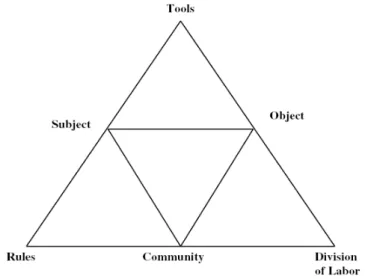
Activity theory contains interacting components and is organized to accomplish the activities of the activity subsystems (Engestrom, 1999; Jonassen, 2002). Interacting components include subject, tools, object, outcome, division of labor, community, and rules (Figure 2).
Figure 2: The activity theory
In an activity theory, the subject means the individual or group of members engaged in the activity.
Objects in activity theory are artifacts those produced by the system. Tools are that the subject uses them for acting on the object. Rules operate in any context or community refers to the explicit regulations, policies, and conventions that constrain activity as well as the implicit social norms, standards, and relationships among members of the community (Jonassen, 2002). The community consists of the individuals and subgroups that focus at least some of their effort on the object. Division of labor refers both to the horizontal division of tasks
between cooperating members of the community and also to the vertical division of power and status
(Engestrom, 1999). The exchange subsystem includes three components: subject, rules, and community. The exchange subsystem engaged the subject and rules that constrain the activity and the community with the subject interacts. The exchange of individual, social, and culture norm in any work community also
determines the nature of the work culture and the climate for those who involved in any activity system. The distribution subsystem includes three components: subject, rules, and community. The distribution subsystem ties the object of activity to the community by defining a division of labor. According to the community characteristics and the outcome expectations, labors are divided to be achieved in the community work through the object.
A growing body of research notes that constructivist principles are fundamental and underlying our understanding of learning in e-learning environments (Virvou & Katsionis, 2008). As Burdea and Coiffet (2003) noted, (a) constructivist learning involves exploration and discovery of prebuilt artificial real worlds, and (b) constructivist learning process provided by learning technology requires educators to examine the learning models and how the technological features support learning.
In general, constructivist approach more focuses on problem solving and thinking skills. Additionally, it also emphasizes the learners’ ability to solve real-life and practical problems. Based on human cognitive, the innovation educational computer programs, like e-learning, can be developed on constructivist paradigm. If we employed e-learning in appropriate ways, it is a revolutionary tool for education. However it is a confusing technology for beginning computer users because it can be used in so many different ways. Thus, if there is a mismatch in the use of the e-learning for training, it can lead to loss of the learner's attention, boredom, information overload, and frustration (Berge, 1998).
Constructivist models of computer programs have emerged from the work of such developmental theorists as Jerome Bruner, Jean Piaget, and Lev Vygotsky. One strand might be called cognitive constructivist.
It states that learners construct their own knowledge of the world through assimilation and accommodation.
Another strand might be called social constructivist. It places more emphasis on the social context of learning (Maddux, Johnson, & Willis, 1997).
Actually, the focus of constructivism is not unique to psychology; instead, it has roots in several areas, such as linguistics, society, and philosophy (Ornstein & Hunkins, 1998). Essentially, individuals actively construct knowledge within social realms that serve to shape the very knowledge constructed. Constructivists believe that the task for learners is not to passively accept information by mimicking the wording or
conclusions of others, but instead to encourage themselves in internalizing and reshaping or transforming information through active consideration (Brooks & Brooks, 1993). Up to this point, meaning is imposed on the world by those who reflect and those who think about the world. But since people view reality differently from the same vantage point or bring identical personal histories to the process of learning and thinking, there can never be total agreement as to the outcome.
Jonassen (1994) described seven characteristics of Constructivist Learning Environments (CLEs):
first, CLEs provide multiple representations of reality. The multiple representations avoid oversimplification and represent the complexity of the real world. Second, CLEs emphasize knowledge construction instead of knowledge reproduction. Third, CLEs emphasize authentic tasks in a meaningful context rather than abstract instruction out of context. Fourth, CLEs provide learning environments such as real-world settings or
case-based learning instead of predetermined sequences of instruction. Fifth, CLEs encourage thoughtful
reflection on experience. Sixth, CLEs enable context-dependent and content-dependent knowledge
construction. And seventh, CLEs support collaborative construction of knowledge through social negotiation, instead of competition among learners for recognition.
3.2 Virtual Reality learning environments
The use of animation and 2D multimedia for learning is now further extended by the provision of entire 3D Virtual Reality learning environments (VRLE) This highlights a shift in Web-based learning from a conventional multimedia to a more immersive and interactive, intuitive and exciting VR learning environment (Chittaro & Ranon, 2007; John, 2007; Monahan, McArdle & Bertolotto, 2008; Rauch, 2007). VRLEs simulate the real world through the application of 3D models that initiates interaction, immersion and trigger the
imagination of the learner. These characteristics make VRLE a superior learning environment over a two dimensional multimedia learning environment. Since emerging technology such as VRLE become popular in education, the question of use of technology innovations comes into focus once again.
For Sherman and Craig (2003), immersion can be classified into mental immersion and physical (or sensory) immersion. Thus, these two types of immersion play an important part in creating a successful personal experience with a VR world. When the user moves, the visual, auditory, or haptic devices that establish physical immersion in the scene change in response (Sherman & Craig, 2003). Users can interpret visual, auditory, and haptic cues to gather information while using their proprioceptive systems to navigate and control objects in the synthetic environment to accomplish physical immersion. On the other hand, mental immersion refers to the “state of being deeply engaged” within a VR environment (Sherman & Craig, 2003, p.7). For example, if a VR world is designed for entertainment purpose, the success in mental immersion is based on how involved the user becomes (Sherman & Craig, 2003). As a result, educators would like to take advantage of VR technology’s immersive power which induces learners’ intention to engage in learning activities (Hanson & Shelton, 2008).
4. Research methodology and results
4.1 Case study 1: Web-based 3D VR interactive learning system
4.1.1 Web-based 3D VR interactive learning system
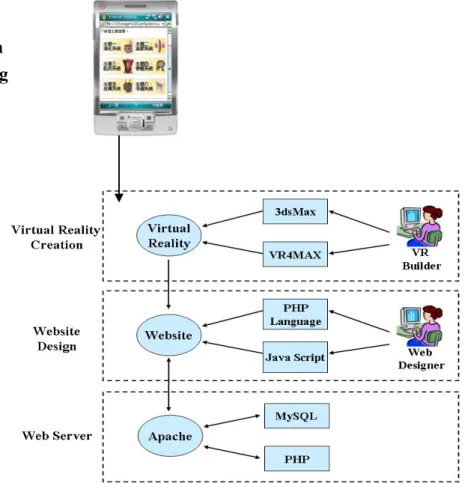
WVBS-ATS, Web-based Virtual Body Structures Auxiliary Teaching System, is a Web-based 3D VR interactive learning system that is designed for undergraduate medical students to obtain knowledge about the structure of human body. The Web-based VR learning system is designed in three parts: Web pages, Web server and Database. The developer used PHP, Java Script to design the web page and utilizes Autodesk 3dsMax and VR4MAX to build the 3D body organ modules. 3dsMax is a commercial software package used to create 3D models. With 3dsMax, users can quickly and easily visualize the 3D objects without knowing any special computer language or having to export application-specific files. VR4MAX provides high
performance real-time interactive virtual reality environment. For the Web server part, the website
administrator used Apache and PHP to establish a web server and the MySQL database to access text data. In addition, we built an FTP Server to store the 3D module files. Students feel free to study any medical subjects by using the mobile VR learning system as they wanted. Moreover, learners can discuss with others by using discussion boards in the VR learning system. Figure 3 shows the structure of VBS-ATS.
Figure 3: Structure of VBS-ATS
4.1.2. Research hypotheses
The three critical factors of VR applications for motivating students’ learning are the intuitive interaction, the sense of physical imagination, and the feeling of immersion. VR applications should aim to simulate reality as faithfully as possible. Sutcliffe (2003) stated that successful VR application should have the following characteristics: (a), natural engagement. Interaction should approach the user’s expectation of interaction in the real world as far as possible. (b), natural expression of action. The representation of the imagination in the VR should allow users to act and explore in a natural manner and not restrict normal physical actions. (c), realistic feedback. The effect of the user’s actions on virtual world should be
immediately visible and conform to the laws of physics and the user’s perceptual expectations. It means that realistic feedback provides effective interaction. (d), navigation and orientation support. The users should always be able to find where they are in the VR environment and return to known, preset positions. In other words, navigation and orientation support high immersion. And (e), sense of imagination. The user’s perception of engagement and being in a ‘real’ world should be as natural as possible.
Therefore, based on immersion, interaction, and imagination, we propose the following hypotheses:
H1: With the increase immersion, interaction, and imagination of a VR environment provides, the motivation of the environment increases.
H2: With the increase immersion, interaction, and imagination of a VR environment provides, the problem-solving capability of the environment increases.
PDA as an m-learning tool
4.1.3 Participants and measurement
This study conducts a survey for understanding learner attitudes toward the VR leaning environments.
A total of 190 university students were taught on how to use the system. Students were allowed to use the system anytime for a period of one month. After that, a questionnaire survey was distributed to participants during class to understand VR leaning environments. Participants were invited to complete the questionnaire.
All subjects were asked to respond to the questionnaire and their responses were guaranteed to be confidential.
All 190 students filled the questionnaire survey. However, 23 missing responses were eliminated. Therefore, the study group comprised of 167 students which includes 68 male students and 99 female students.
The data for this study were gathered by means of a paper-and-pencil survey. Regarding to Attitudes towards VR, Participants were asked to indicate their attitudes. These 16 questions were adopting a 7-point Likert scale (ranging from 1 which means ‘‘strongly disagree’’ to 7 which means ‘‘strongly agree’’).
4.1.4. Results
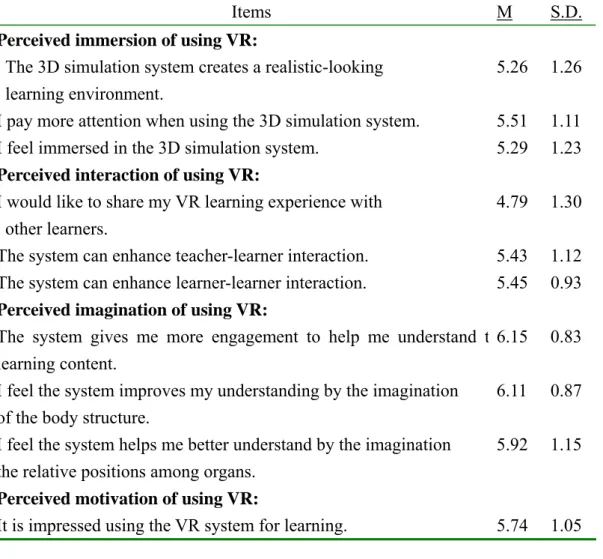
The internal consistency reliability was assessed by computing Cronbach's αs. The alpha reliability was highly accepted (α=0.94) and coefficients of questionnaire items are presented in Table 1. Given the exploratory nature of the study, reliability of the scales was deemed adequate.
Table 1: The Mean, Standard Deviation, item-total correlations of VR from 1 which means “strongly disagree” to 7 which means “strongly agree”)
Items M S.D.
Perceived immersion of using VR:
The 3D simulation system creates a realistic-looking learning environment.
5.26 1.26
I pay more attention when using the 3D simulation system. 5.51 1.11 I feel immersed in the 3D simulation system. 5.29 1.23 Perceived interaction of using VR:
I would like to share my VR learning experience with other learners.
4.79 1.30
The system can enhance teacher-learner interaction. 5.43 1.12 The system can enhance learner-learner interaction. 5.45 0.93 Perceived imagination of using VR:
The system gives me more engagement to help me understand t learning content.
6.15 0.83
I feel the system improves my understanding by the imagination of the body structure.
6.11 0.87
I feel the system helps me better understand by the imagination the relative positions among organs.
5.92 1.15
Perceived motivation of using VR:
It is impressed using the VR system for learning. 5.74 1.05
The system can enhance my learning interest. 5.58 1.19
The system can enhance my learning motivation. 5.67 1.07 Enhanced problem-solving capability after using VR:
The system can enhance my learning capability. 5.40 1.20 The system can enhance my problem-solving capability. 5.50 1.12 The system can enhance my capability of knowledge
construction.
5.38 1.14
The system can enhance my capability of knowledge management.
5.24 1.21
For investigating hypotheses H1 and H2, the predictive model is an available statistical method. The results of stepwise multiple regressions for the path associated with the variables are presented in Table 2. To investigate H1, a regression analysis was performed to check the effects of perceived immersion of using VR, perceived interaction of using VR, and perceived imagination of using VR on perceived motivation of using VR.
The result showed that three factors were all predictors and perceived immersion of using VR had more contribution than other two (F(3, 164)=69.72, p<0.001, R2=0.55). To examine H2, a regression analysis was performed to check the effects of perceived immersion of using VR, perceived interaction of using VR, and perceived imagination of using VR on enhanced problem-solving capability after using VR. The result showed that three factors were all predictors and perceived interaction of using VR had more prediction than other two (F(3, 164)=142.87, p<0.001, R2=0.72).
Table 2: Regression results of VR
H* Dependent variable Independent variables β R2 P H1 Perceived motivation Perceived immersion 0.32 0.46 <0.001
Perceived interaction 0.31 0.07 <0.001 Perceived imagination 0.24 0.02 =0.001 H2 Enhanced problem-
Solving capability
Perceived interaction 0.49 0.60 <0.001
Perceived immersion 0.26 0.10 <0.001
Perceived imagination 0.24 0.02 <0.001
H*: hypothesis.
4.2. Case study 2: Collaborative virtual reality learning environment
4.2.1 Collaborative virtual reality environment for medical education
The learning system, a Java-based program, is named 3D Human Organ Learning System – 3D-HOLS.
With Java’s cross-platform capability, 3D-HOLS runs in various system platforms. 3D-HOLS was being developed under both Windows and Linux environments. 3D-HOLS has been tested to be compatible with Windows XP, Vista, Mac OS X, and Red Hat Linux. 3D-HOLS provides two operating modes. The first mode is single user self-learning mode. In this mode, individual learners interact with 3D organs and read course
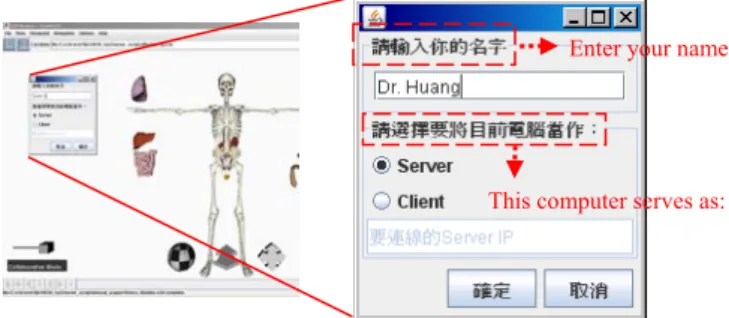
web pages. The second mode is collaborative learning mode. This mode allows multiple learners to interact, practice and discuss in a virtual space. Figure 2 through Figure 4 depicts a typical classroom scenario. To begin collaborative learning, the instructor may initiate a 3D-HOLS server instance. Learners input
instructor’s IP address to connect to the server. The server instance has power to assign control privilege to a learner. These operations are shown in Figure 4, 5, and 6.
Figure 4: Collaborative set up in a typical classroom setting. The instructor initiates a 3D-HOL server instance.
Figure 5: Students enter their names and server’s IP address.
Figure 6: The server instance maintains a list of participants.
Server assigns control privilege by clicking radio button next to user name.
4.2.2. Research hypotheses
In order to examine users’ attitudes and intentions of using 3D-HOLS system, the three features (immersion, interaction and imagination) of VR should be considered. The research model served as a guideline for formulating questionnaire and systematically performing statistical analyses to test the hypotheses. First, the three features were investigated to see whether they have positive influence on the collaborative learning. Thus, the hypothesis was proposed as follows:
Participant list Enter your name
This computer serves as:
H3: When using the 3D-HOLS system, the three features of interaction, immersion, and imagination will have positive impacts on collaborative learning.
Having investigated the relationships between the three features of interaction, immersion, and imagination and collaborative learning, the predictive relationship between collaborative learning and behavioral intention of using 3D-HOLS system was then examined. Therefore, a hypothesis was proposed:
H4. There is a positive correlation between collaborative learning and students’ behavioral intention to the 3D-HOLS system.
4.2.3. Participants and measurement
Participants included students from school of Medicine, school of Pharmacy, college of Chinese Medicine and college of Health Care. All participants have taken at least one medical informatics course. A total of 76 valid responses were collected that including 48 are males and 28 are females. The data for this study were gathered by means of a paper-and-pencil survey. The questionnaire included two major
components: (a) demographic information, (b) attitudes toward collaborative learning. These 25 questions all adopted 7-point Likert scales (from 1 which means ‘‘strongly disagree’’ to 7 which means ‘‘strongly agree’’).
4.2.4. Results
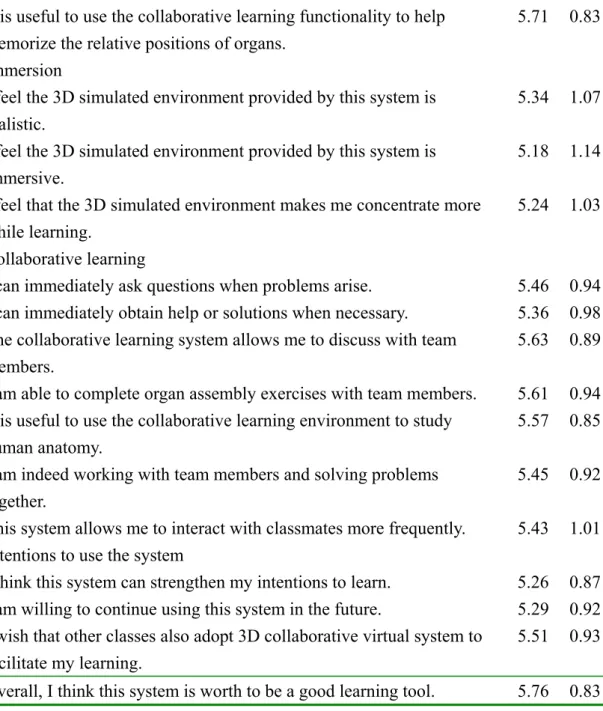
The internal consistency reliability was assessed by computing Cronbach's αs. The alpha reliability was highly accepted (α=0.92) and coefficients of questionnaire items are presented in Table 3.
Table3 –The means, standard deviations of each question.
Items M S.D.
Interaction By using this system, I can easily translate and move 3D objects. 5.97 0.94
By using this system, I can easily rotate 3D objects. 6.00 0.92 By using this system, I can easily zoom in or zoom out 3D objects. 6.08 0.90 By using this system, I can easily observe 3D objects from various
perspectives.
5.96 1.03
It is easy to interact with other team members by using this system. 5.47 1.04
Imagination I feel that it is easier to understand anatomical structures by using this
system.
6.11 0.81
I feel that I have developed better understanding of structures and orientations of organs by using this system.
6.12 0.78
I feel that I have developed better understanding of relative positions of organs by using this system.
5.99 0.77
Using this system has helped me develop better understanding of shapes of every organ.
5.82 0.88
It is easy to use the collaborative learning functionality to help 5.67 0.86
memorize the relative positions of organs.
It is useful to use the collaborative learning functionality to help memorize the relative positions of organs.
5.71 0.83
Immersion I feel the 3D simulated environment provided by this system is
realistic.
5.34 1.07
I feel the 3D simulated environment provided by this system is immersive.
5.18 1.14
I feel that the 3D simulated environment makes me concentrate more while learning.
5.24 1.03
Collaborative learning
I can immediately ask questions when problems arise. 5.46 0.94 I can immediately obtain help or solutions when necessary. 5.36 0.98 The collaborative learning system allows me to discuss with team
members.
5.63 0.89
I am able to complete organ assembly exercises with team members. 5.61 0.94 It is useful to use the collaborative learning environment to study
human anatomy.
5.57 0.85
I am indeed working with team members and solving problems together.
5.45 0.92
This system allows me to interact with classmates more frequently. 5.43 1.01 Intentions to use the system
I think this system can strengthen my intentions to learn. 5.26 0.87 I am willing to continue using this system in the future. 5.29 0.92 I wish that other classes also adopt 3D collaborative virtual system to
facilitate my learning.
5.51 0.93
Overall, I think this system is worth to be a good learning tool. 5.76 0.83
Multiple regression analysis has been widely adopted for empirically examining sets of linear causal relationships. For testing H3, a regression analysis was conducted to check the effect of interaction,
immersion, and imagination on collaborative learning. The results explained that imagination, interaction and immersion variables were all predictors for the collaborative learning (F(3,72)=21.32, p=0.000, R2=.47). The imagination was the biggest contributor (37%). On the other hand, the result of testing H4 was collaborative learning can predict intention to use the VR learning system (F(1,74)=105.71, p=0.000, R2=.59) as shown in Table 4. The factnor of collaborative learning by itself provides 59% of contributions for students’ intention to use the 3D-HOLS. In addition, all p-values are below 0.1% significance levels.
Table4 – Regression analysis result
Dependent variables Independent Variable β R 2 P
Collaborative Imagination 0.38 0.37 <0.001
Immersion 0.25 0.07 <0.001 learning
Interaction 0.18 0.03 <0.001
Intention to use Collaborative learning 0.77 0.59 <0.001
5. Conclusions
Based on these two cases, we provide evidence that VRLEs have positive effects on learning purpose if we apply those learning environments appropriately. These two case studies propose VRLEs could assist collaborative learning and problem-based learning; furthermore, those learning environments also could enhancing learners’ motivation.
As more theories and disciplines focus on VR technology, VR applications for education will get easier to use and create. In order to widely deploy VR for learning, educators need to understand the
challenges of using VR technology for instruction rather than counting on the novelty of the approach. There are five issues to consider when employing VRLEs.
First, the usability of the VR interface design. As with many emerging technologies, VRLEs may be designed from a functionality point of view rather than ease of use in practical educational applications. The most common difficulties are VR navigation in using a 3D interface. Learners may easily get lost or unable to navigate their VRLEs (Chittaro & Ranon, 2007). Poor usability severely limits the effectiveness to deliver instruction, since VR applications may have problems ranging from creating motion sickness to users getting lost inside the application (Sutcliffe, 2003). Therefore, it is necessary to research why some user responses lead to simulation sickness, what their causes are, and what can be done to minimize their effects (Burdea &
Coiffet, 2003).
Secondly, educators may be challenged by the skill levels required to design a VR course. VR tools require higher programming skills than traditional 2D tools. The educators may lack experience in using VR-based course design or having the difficulties in classroom practice (Chittaro & Ranon, 2007). In particular, an immersive VR learning systems requires high level of programming skills. For educators who lack a programming background, the process to create a VR learning system for educational application has been extremely challenging. Although there are an increasing number of applications that support teaching and learning in a VR space, perhaps the largest determining factor for user acceptance is how easily accessible a VR interface is for non-technical instructors. Thus, institutional support is necessary for educators without programming backgrounds.
Thirdly, a simulated world is not a real world. Learners may have a negative attitude toward learning in a VRLE since current VRs only approximate reality (Chittaro & Ranon, 2007). Recent advances in the design of interactive technologies have allowed the possibility of designing mixed reality environments in which realty is augmented by a virtual element. These mixed reality spaces provide exciting opportunities for designing innovative learning environments that hopefully make learning more interactive, effective, relevant and powerful especially for younger learners.
6. References:
Berge, Z. L. (1998). Interaction in post-secondary Web-based learning. Educational Technology, 39(1), 5-11.
Burdea, G. C., & Coiffet, P. (2003). Virtual reality technology (2nd ed.). , New York: John Wiley & Sons.
Brooks, J. G.,& Brooks, M. G. (1993). The Case of Constructivist Classrooms. Alexandria, VA: Association for Supervision and Curriculum Development.
Chittaro, L., & Ranon, R. (2007). Web3D technologies in learning, education and training: Motivations, issues, opportunities, Computers & Education,49, 3-18.
Collins, A. (1996). Designing issues for learning environments. In S. Vosniadou, E. De Corte, R. Glast, & H.
Mandl (Eds.), International perspectives on the design of technology supported learning environments.
Hillsdale, NJ: Lawrence Erlbaum Associates.
Engestrom, Y. (1999). Activity theory as individual and social transformation. In Y. Engestrom, R. Miettinen,
& R. L. Punamaki (Eds.), Perspectives on activity theory (pp. 19–38). Cambridge University Press.
Hanson, K., & Shelton, B. E. (2008). Design and development of virtual reality: analysis of challenges faced by educators. Educational Technology & Society, 11(1), 118–131.
Hung, D. W., & Wong, A. F. L. (2000). Activity theory as a framework for project work in learning environments. Educational Technology, 40(2), 33–37.
John, N. W. (2007). The impact of Web3D technologies on medical education and training,Computers &
Education, 49,19-31.
Jonassen, D. H. (1994). Towards a constructivist design model. Educational Technology, 34(4), 34-37.
Jonassen, D. H. (2002). Learning as activity. Educational Technology, 42(2), 45–51.
Joyce, B., & Weil, M. (1996). Model of teaching (5th ed.). Needham Heights, MA: Allyn & Bacon.
Kim, K.J. & Bonk, C. J. (2006). The future of online teaching and learning in higher education: the survey says ... . Educause Quarterly, 29, 22–30.
Lee, Y. K., Tseng, S. P., Liu, F. J. & Liu, S. C. (2007). Antecedents of learner satisfaction toward e-learning.
The Journal of American Academy of Business, Cambridge, 11, 161–168.
Leont’ev, A. N. (1972). Activity, consciousness, and personality. Englewood Cliffs, NJ: Prentice-Hall.
Maddux, C. D., Johnson, D. L., & Willis, J. W. (1997). Educational Computing, Learning with Tomorrow’s Technologies. (2nd ed.). Needham Height, MA: Allyn & Bacon.
Monahan, T., McArdle, G., & Bertolotto, M. (2008). Virtual reality for collaborative e-learning, Computers &
Education, 50, 1339-1353.
Ornstein, A. C. & Hunkins, F. P. (1998). Curriculum: Foundations, principles, and issues, (3rd ed.). Needham Heights, MA: Allyn & Bacon.
Rauch, U. (2007). Who owns this space anyway? The Arts 3D VL Metaverse as a network of imagination, In Proceedings of ED-MEDIA 2007, 4249-4253.
Russell, D. R. (1997). Rethinking genre in school and society: An activity theory analysis. Written Communication, 14, 504–554.
Sherman, W. R., & Craig, A. B. (2003). Understanding virtual reality. New York: Morgan Kaufmann Publishers.
Sutcliffe, A. (2003). Multimedia and Virtual Reality, New York: Lawrence Erlbaum Associates.
Virvou, M., & Katsionis, G. (2008). On the usability and likeability of virtual reality games for education: the case of VR-ENGAGE. Computers & Education, 50(1), 154–178.
Vygotsky, L. S. (1978). Mind in society: The development of higher psychological processes. Cambridge, MA: Harvard University Press.
國科會補助專題研究計畫成果報告自評表
請就研究內容與原計畫相符程度、達成預期目標情況、研究成果之學術或應用價 值(簡要敘述成果所代表之意義、價值、影響或進一步發展之可能性)、是否適 合在學術期刊發表或申請專利、主要發現或其他有關價值等,作一綜合評估。
1. 請就研究內容與原計畫相符程度、達成預期目標情況作一綜合評估
■ 達成目標
□ 未達成目標(請說明,以 100 字為限)
□ 實驗失敗
□ 因故實驗中斷
□ 其他原因 說明:
2. 研究成果在學術期刊發表或申請專利等情形:
論文:■已發表 □未發表之文稿 □撰寫中 □無 專利:□已獲得 □申請中 ■無
技轉:□已技轉 □洽談中 ■無 其他:(以 100 字為限)
目前已發表 2 篇 SSCI 期刊論文,2 篇 TSSCI,1 篇 book chapter, 與 7 篇國際研討會論文.
附件一
3. 請依學術成就、技術創新、社會影響等方面,評估研究成果之學術或應用價 值(簡要敘述成果所代表之意義、價值、影響或進一步發展之可能性)(以 500 字為限)
本研究計畫的重點在於數位學習之多媒體數位化教材之融入性與使用意向探討. 而計畫重點 先在於將探討學習相關理論探討,第二年設計之虛擬實境多媒體數位化教材讓學生使用,第三 年在探討融入性, 互動性與想像力對於使用意向的影響.目前已發表 2 篇 SSCI 期刊論文,2 篇 TSSCI,1 篇 book chapter, 與 7 篇國際研討會論文.
廖述盛,黃秀美,賴崇閔 (2011). 虛擬實境結合問題導向學習應用於行動化醫學教育之研究.
科學教育學刊, 19(3). (TSSCI)
Liaw, S. S., Huang, H. M. (2011). Exploring learners’ acceptance toward mobile learning. In T. Teo (Ed.), Technology acceptance in education: Research and issues. 145-157, Rotterdam: Sense
Publishers. (Book Chapter)
Huang, H. M., Rauch, U, & Liaw, S. S. (2010). Investigating Learners’ Attitudes toward Virtual Reality Learning Environments: Based on Constructivist Approach. Computers & Education.
(SSCI, SCI) (Corresponding author)
Liaw, S.S., Hatala, M., & Huang, H.M. (2010). Investigating acceptance toward mobile learning to Assist Individual knowledge management: based on activity theory approach, Computers &
Education, 54(2), 446-454. (SSCI, SCI).
賴崇閔,黃秀美,廖述盛,黃雯雯(2009). 3D虛擬實境應用於醫學教育接受度之研究, 台師大教育 心理學報, 40(3), 341-362. (TSSCI)
Liaw, S. S., & Huang, H. M. (2011). A study of investigating learners attitudes toward e-learning.
The 2011 5th International Conference on Distance Learning and Education (ICDLE 2011), 16-18, September, Singapore.
Huang, H. M., & Liaw, S. S. (2011). Exporng factors toward a virtual hospital situated learning system. The 2011 5th International Conference on Distance Learning and Education (ICDLE 2011), 16-18, September, Singapore.
Liaw, S. S., & Huang, H. M. (2011). Investigating Users’ Acceptance Toward Mobile Learning.
DEIT 2011-- International Conference on Data Engineering and Internet Technology, 15-17, March, 2011, Bali, Indonesia.
Liaw, S. S., & Huang, H. M. (2010). The Effects of Virtual Reality Learning Environments: Two Case Studies. ED-MEDIA 2010--World Conference on Educational Multimedia, Hypermedia &
Telecommunications, Toronto, Canada, June 28-July 2, 2010.
Liaw, S. S., & Huang, H. M. (2009). Gender difference, computer experience, self-efficacy,
motivation and intention toward e-learning: a case study of the Blackboard system. AACE, October, 26-30, 2009, Vancouver, Canada.
Liaw, S.S., Liao, Y.T., Hao, H.S., Huang, H.M., & Teng, Y. C. (2009). A study of Medical Information Portal: Investigating user’s willingness and intention. AACE, October, 26-30, 2009, Vancouver, Canada.
Huang, H.M., Chen, W. T., Teng, Y. C., & Liaw, S. S. (2009). Developing a Virtual Reality Learning Environment for Medical Education. AACE, October, 26-30, 2009, Vancouver, Canada.