Solid-State Reactions at the Sn-9Zn-xAg Lead-Free Solders
ÕCu
Interface
Tao-Chih Chang,a,zMin-Hsiung Hon,aand Moo-Chin Wangb a
Department of Materials Science and Engineering, National Cheng Kung University, Tainan 70101, Taiwan bDepartment of Mechanical Engineering, National Kaohsiung University of Applied Sciences, 80782 Kaohsiung, Taiwan
The solid-state reactions at the interface of Sn-9Zn-xAg lead-free solders/Cu have been investigated by X-ray diffractometer 共XRD兲, scanning electron microscope 共SEM兲, transmission electron microscope 共TEM兲, and energy dispersive spectrometer 共EDS兲. The XRD pattern shows that ␥-Cu5Zn8, Cu6Sn5, and Ag3Sn intermetallic compounds 共IMCs兲 were formed at the Sn-9Zn-xAg/Cu interface and the quantity increased during long-term aging. The SEM, TEM, and EDS results indicate that Cu interdiffused to the solder and reacted with Sn to form Cu6Sn5at the interface after aging at 150°C for 750 h. Cu3Sn IMC formed in the matrix of the Sn-9Zn-1.5Ag solder alloy after aging.
© 2003 The Electrochemical Society. 关DOI: 10.1149/1.1566534兴 All rights reserved. Manuscript received August 19, 2002. Available electronically March 25, 2003.
Because of improvements of technology, electronic devices are used not only in normal environment but also in some strict sur-roundings, such as high temperature occasion. Therefore, solid-state reactions between solder alloys and substrate are important for sol-der joints because the quality, morphology, and distribution of inter-metallic compounds 共IMCs兲 affect the solder joint reliability seriously.1
The solid-state reactions of 6337Pb, 9Zn, 3.5Ag, Sn-0.7Cu, and Sn-Zn-Al solder alloys with Cu substrate have been dis-cussed widely in the literature.2-6Lee et al. have pointed out that the Cu6Sn5formed at 63Sn-37Pb/Cu interface changed from a scalloped to a layered-type during aging,2Yu et al. have pointed out that the scallop ␥-Cu5Zn8 and inverted trigonal-shaped -Cu6Sn5 were found at Sn-9Zn/Cu interface after heating at 150°C for 300 h.3Ahat
et al. indicated that the interdiffusion coefficient of Sn and Cu in an
intermetallic compound at Sn-3.5Ag/Cu interface is smaller than that at Sn-Ag-Pb/Cu interface at 150°C.4The solid-state reactions at Sn-9Zn-xAg/Cu interface are discussed in this study.
The Sn-9Zn-xAg lead-free solders were melted with pure Sn, Zn, and Ag metals共purity of 99.9%兲, where x was 0.5, 1.5, 2.5, and 3.5 wt %, respectively. The pure metals were pretreated with 5 vol % HCl and 5 wt % NaOH solutions to degrease and deoxidize, respectively, then mixed and melted at 600°C in a stainless steel crucible, and stirred to homogenize.
The substrate used here was oxygen-free, high conductivity 共OFHC兲 Cu and pretreated by the procedure like metals as men-tioned above. After pretreatment, the Cu substrate was hot-dipped in a molten solder alloy at 350°C for 30 s and cooled in air. The hot-dipped samples were aged at 150 and 180°C for 100, 250, 400, 750, and 1000 h, respectively. The unreacted Sn was removed with sandpaper and etching solution. An X-ray diffractometer共XRD兲 was utilized to identify the IMCs formed at the Sn-9Zn-xAg/Cu inter-face after long-term aging. Scanning electron microscope 共SEM兲 and transmission electron microscope共TEM兲 were used to observe the Sn-9Zn-xAg/Cu interface and energy dispersive spectrometer 共EDS兲 was used to determine the chemical compositions of the IMCs.
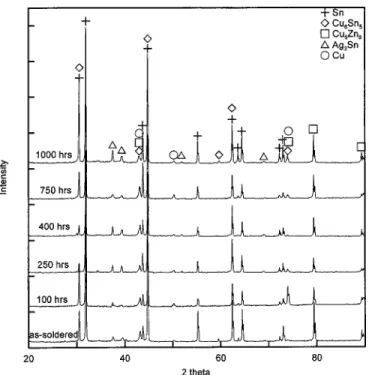
Figure 1 shows the XRD pattern of the Sn-9Zn-1.5Ag/Cu inter-face after different aging times, which indicates that Cu6Sn5, Cu5Zn8, and Ag3Sn formed at the Sn-9Zn-1.5Ag/Cu interface. The Ag3Sn appeared at the interface between the substrate and the solder alloy when the Ag content was above 0.1 wt % because of the low solubility of Ag in Sn.7Chang et al. found that Ag3Sn formed at the Cu/Cu5Zn8 interface in the Sn-9Zn-0.5Ag solder alloy system by TEM.8In this study, Ag3Sn was observed in the XRD pattern of the
as-soldered sample when the Ag content was 1.5 wt %, showing that a higher dipping temperature is beneficial to the formation of Ag3Sn. During long-term aging, the Ag3Sn increased rapidly be-cause of the high diffusion coefficient of Ag in Sn via the interstitial mechanism.
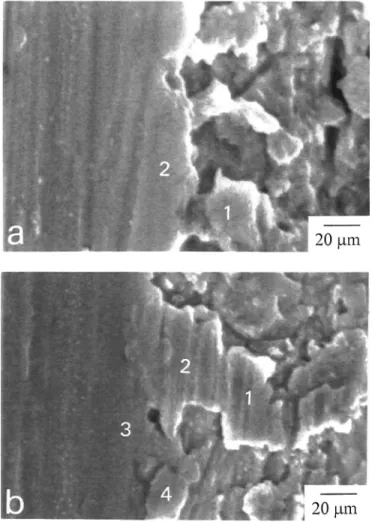
Scallop-shaped Cu5Zn8formed at the Sn-9Zn/Cu interface after aging at 150°C for 600 h and was located close to the solder alloy.3 It also formed at the Sn-Zn-Al/Cu interface as aged at 150°C for 1000 h and the formation site was at the interface of Sn-Zn-Al solder alloy and␥⬘-Cu9Al4IMC layer. Kirkendall voids were found at the Cu5Zn8/Sn-Zn-Al interface.6Figure 2a shows the interfacial morphology of the Sn-9Zn-0.5Ag/Cu interfaces as aged at 150°C for 750 h. The chemical compositions of IMC layers were determined at points 1 and 2 and results are listed in Table I. From the micro-graphs, it is observed that a plate-like phase formed close to the Cu substrate and was determined to be Cu5Zn8by EDS analysis, which is different from that found in the Sn-9Zn and Sn-Zn-Al systems.
zE-mail: [email protected]
Figure 1. XRD pattern of the Sn-9Zn-1.5Ag/Cu interface after 150°C for
different aging times.
Electrochemical and Solid-State Letters, 6共6兲 C82-C84 共2003兲 0013-4651/2003/6共6兲/C82/3/$7.00 © The Electrochemical Society, Inc.
C82
Another peninsular shape IMC layer located close to Sn-9Zn-0.5Ag solder alloy was found and determined as Cu6Sn5 by EDS analysis, which was similar to the published result of Suganuma and Nakamura.9 The Cu6Sn5 is often detected IMC layer at 63Sn-37Pb/Cu and Sn-base solders/Cu interfaces,3-5which enhances the wettability of solders and improves bonding strength.10 It is also used to manufacture composite solder alloys because it refines the
Figure 2. SEM micrographs for interface of共a兲 Sn-9Zn-0.5Ag/Cu and 共b兲
Sn-9Zn-1.5Ag/Cu after aging at 150°C for 750 h.
Figure 3. 共a兲 TEM micrograph of Cu6Sn5 at the interface of Sn-9Zn-3.5Ag/Cu as aged at 180°C for 1000 h,共b兲 ED pattern of the Cu6Sn5layer with关2¯42¯3兴 zone axis, and 共c兲 ED pattern of the Cu6Sn5layer with关12¯13¯兴 zone axis.
Table I. Chemical composition of the IMC layers formed at the Sn-9Zn-0.5AgÕCu interface after aging at 150°C for 750 h.
Position
Chemical composition共atom %兲
Cu Sn Ag Zn Phase
1 53.62 44.06 0.25 2.07 Cu6Sn5
2 39.02 5.64 1.30 54.03 ␥-Cu5Zn8
Table II. Chemical composition of the IMC layers formed at the Sn-9Zn-1.5AgÕCu interface after aging at 150°C for 750 h.
Position
Chemical composition共atom %兲
Cu Sn Ag Zn Phase
1 72.80 26.25 0.61 0.35 Cu3Sn
2 2.86 25.52 68.87 2.75 Ag3Sn
3 41.85 3.14 1.49 53.52 ␥-Cu5Zn8
4 52.71 42.25 0.86 4.18 Cu6Sn5
Electrochemical and Solid-State Letters, 6共6兲 C82-C84 共2003兲 C83
microstructure of solder alloys.11Lee et al.2have pointed out that the Cu6Sn5 formed in the 63Sn-37Pb/Cu interface was scallop-shaped and changed to faceted after aging. Our previous study also showed that the Cu6Sn5 IMC layer was a scallop-shaped phase formed at the Sn-9Zn-0.5Ag/Cu interface and located close to the solder alloy.8
Figure 2b shows the interfacial morphology of Sn-9Zn-1.5Ag/Cu after aging at 150°C for 750 h. The chemical compositions of the IMC layers for points 1, 2, 3, and 4 are listed in Table II. Thin Cu3Sn layer was detected at the 63Sn-37Pb/Cu interface after re-flowing and long-term aging.2 Figure 2b shows that the Cu3Sn formed in the Sn-9Zn-1.5Ag solder matrix by Cu interdiffusing to the Sn matrix and reacting with Sn, which was different from other solder systems in that the Cu3Sn was located close to Cu substrate. The planar phase was detected as Cu5Zn8by EDS analysis, which was similar to that obtained in the Sn-9Zn-0.5Ag system. The Cu6Sn5and Ag3Sn were identified at the Sn-9Zn-1.5Ag/Cu interface and with grains of 20 and 45m, respectively.
Chang et al.12pointed out that the solubility of Ag in Cu6Sn5 increased with the Ag content of solder alloy, which was obtained as 10.66 atom % when Sn-9Zn-3.5Ag solder alloy was hot-dipped on Cu substrate. Figure 3a shows the TEM micrograph of Cu6Sn5at the Sn-9Zn-3.5Ag/Cu interface as aged at 180°C for 1000 h, and the Ag contents of points 1, 2, and 3 were 0.07, 0.26, and 0.54 atom %, respectively, which shows that Ag was repelled during heat-treatment and reacted with Sn to increase Ag3Sn with aging time. The ED patterns of the Cu6Sn5 layer are shown in Fig. 3b and c, showing that the Cu6Sn5 has a hexagonal structure and is corre-sponding to the 63Sn-37Pb solder system.13It was pointed out that a bistructural Cu6Sn5layer formed at the Sn-9Zn-xAg/Cu interface in soldering process due to Ag dissolved to the Cu6Sn5 layer.14 Therefore, the monoclinic structural Cu6Sn5 transforms to the hex-agonal structural -Cu6Sn5 during aging because Ag is repelled from Cu6Sn5and the Cu6Sn5layer tends to have an ordered struc-ture.
Kirkendall void was not found at the Sn-9Zn-xAg/Cu interface in this study, which proposed that Ag occupied the Zn site and formed Ag3Sn with Sn, acting as a compensation element.
From the XRD pattern, the Cu5Zn8, Cu6Sn5, and Ag3Sn IMC layers were detected at the Sn-9Zn-xAg/Cu interface, which shows that the quantity of IMCs increased with increasing aging time. Cu6Sn5 layer transformed from scallop-shaped to peninsular after long-term aging and Cu5Zn8maintained plate-like in the as-soldered state and Ag3Sn formed at the Cu5Zn8/Sn-9Zn-1.5Ag interface in particulate shape. Ag was repelled from the Cu6Sn5 layer during aging and the hexagonal structured-Cu6Sn5formed at the Sn-9Zn-3.5Ag/Cu interface.
Acknowledgments
The authors thank the National Science Council of Taiwan for financial support共NSC89-2216-E-151-011兲. The suggestions on the XRD and SEM analyses from J. M. Chen and H. Y. Hwang are appreciated.
National Cheng Kung University assisted in meeting the publication costs of this article.
References
1. P. G. Harris and K. S. Chaggar, Soldering and Surface Mount Technology, 10Õ3, 38
共1998兲.
2. T. Y. Lee, W. J. Choi, K. N. Tu, J. W. Jang, S. M. Kuo, J. K. Lin, D. R. Frear, K. Zeng, and J. K. Kivilahti, J. Mater. Res., 17, 291共2002兲.
3. S. P. Yu, H. J. Lin, M. H. Hon, and M. C. Wang, J. Mater. Sci.: Mater. Electron., 11, 461共2000兲.
4. S. Ahat, M. Sheng, and L. Luo, J. Electron. Mater., 30, 1317共2001兲. 5. K. S. Bae and S. J. Kim, J. Mater. Res., 17, 743共2002兲.
6. S. P. Yu, M. C. Wang, and M. H. Hon, J. Mater. Res., 16, 76共2001兲. 7. S. H. Huh, K. S. Kim, and K. Suganuma, Mater. Trans., JIM, 42, 741共2001兲. 8. T. C. Chang, M. H. Hon, and M. C. Wang, Metall. Mater. Trans. A, Submitted. 9. K. Suganuma and Y. Nakamura, J. Jpn. Inst. Met., 59, 1299共1995兲. 10. G. L. Bailey and H. C. Watkins, J. Inst. Met., 80, 57共1951兲.
11. J. Sigelko, S. Choi, K. N. Subramanian, J. P. Lucas, and T. R. Bieler, J. Electron. Mater., 28, 1184共1999兲.
12. T. C. Chang, M. H. Hon, and M. C. Wang, J. Crystal Growth 250, 236共2003兲. 13. T. Y. Lee, W. J. Choi, and K. N. Tu, J. Mater. Res., 17, 291共2002兲. 14. T. C. Chang, M. H. Hon, and M. C. Wang, Appl. Phys. Lett., In press.
Electrochemical and Solid-State Letters, 6共6兲 C82-C84 共2003兲
C84