An Overview of the Project for Next Generation Infomation Communication Networks
Wen-Tsuen Chen’, Wen-Hsiang Tsai’, Chung-Ta King’, Yaw-Chung Chen’
Department of Computer and Information Science National Chiao Tung University
Hsinchu, Taiwan, 300 Department of Computer Science 2
National Tsing Hua University Hsinchu, Taiwan, 300
1
Absrkuct---The project, “Advanced Technologies and Applica- tions of Next Generation Information Communication Net- worb,” is a four-year, multi-disciplinary research project sponsored by the Ministry of Education, RO.C., under the
“Program ror Promoting Academic Excellence of Universities”
The project started in January 2000 and completed in March 2004. In this paper, we give an overview of the project and high- light some of the major achievements.
Index Terms-high-speed switch, wireless network, middle- ware, security, multimodal retrieval, digital learning and society
I. INTRODUCTION
he phenomenal growth of the Internet has made net-
T
working an essential part of our daily life. People can access information and obtain quality services through wired and wireless communications. As we become increasingly“networked”, new applications and technologies will emerge, new possibilities become clear, and the network will be sure to change its face. These willof course challenge us to react with new views and ways of thinking. The key to success in this emerging new era lies in technology innovation and integration in every aspect of networking.
In year 2000, the Ministry of Education, Republic of China, established the “Program for Promoting Academic Excellence of Universities” to promote effective integration of the re- sources of universities for research and education excellence.
In view of the importance of information communication networks, researchers in National Tsing Hua University and National Chiao Tung University jointly proposed a four-year research project to that program. The project, entitled “Ad- vanced Technologies and Applications of Next Generation Information Communication Networks,” was subsequently approved with a total budget of US$!4 million for four years.
The project started in January 2000 and ended in March 2004. It gathered together experts of various disciplines to react to the challenges of next generation networking with a purpose of carrying out related research into international excellence.
After lbur years, novel technologies and applications have been
This research was supported by the Program for Promoting Academic Excel- lence of Universities, Ministry ofEducation, R.O.C., under Grant 89-E-FA04- 1 4 .
developed. In this paper, research results from this project will be highlighted.
The project consists of eight subprojects. Five of them are conducted in National Tsing Hua University and the other three in the National Chiao Tung university:
Subproject 1 : Network Switching Technologies for Next Generation Internet
Subproject 2: Internet Mobile Computing Technology Subproject 3: Advanced Technologies for Network Mid- dleware and Platform
Subproject 4: Technologies and Applications for Next-generation Media
Subproject 5 : A Web-based Educational Park
Subproject 6: NGI Enabling Network and System Tech- nologies
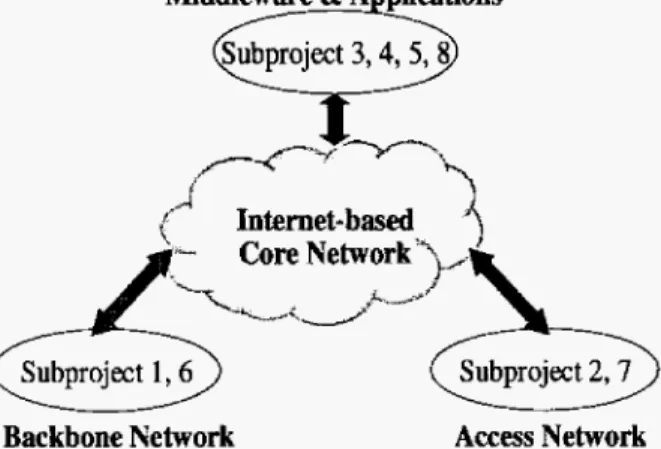
Subproject 7: Wireless Internet Technologies Subproject 8: High Confidence Information System These eight subprojects can be generally categorized into three research areas: core networks, wireless networks, and network applications and services. Fig. 1 shows their rela- tionship. Subprojects 1 and 6 focus on techniques related to the backbone network. Subprojects 2 and 7 work on wireless net- works. The remaining four subprojects study various network applications and services. In the following, the research results in each area over the four years are summarized and high- lighted.
Middleware & A plications Subproject 3,4,5,8
.
0
d- i
LnZ-Z> Core
Network‘?,&
Backbone Network Access Network
Figure 1. Organization of the project
II. BACKBONE NETWORKS
The ever-growing demand for Internet bandwidth and recent advances in transmission and switching technologies brings about fundamental changes in the design and implementation of the next generation Internet. In such networks, r d - t i m e applications and services such as voice over IP, videophone, teleconferencing, etc., gradually become the major part of the network traffic. To support such real-time traffic, it becomes indispensable for the next-generation broadband networks to encompass the following three keytechnologies: (1) high speed, high bandwidth, and low delay switching techniques; (2) quality of service (QoS) techniques; and (3) network security.
Subproject 1 aims to develop key technologies for new gen- eration Internet switching, including theories and techniques for core switching, multiple gigabit service switching and video steaming techniques. We have developed novel Load Balanced Birkhoff-von Neumann Switching technologies [I, 21. The switch architecture consists of two crossbar switch fabrics and parallel buffers between them. The architecture has attracted much attention in the research community in the world and has k e n referred to by a Stanford University research team to further develop 100 Tera Bps optical switches.
For the multiple gigabit Internet switching technology, we have developed leading layer 4-7 packet classification and inspection technologies and implemented a chassis-based, network processor-based, multiple gigabit Ethernet service switch with a 16Gbps capacity. It is also the first chassis-based gigabit Ethernet service switches (GESS) with 16 Gbps in Taiwan. The system contains backplane modules with 16Gbps and multi-function service modules, e.g., bandwidth man- agement for QoS, network security, W c o n t e n t filtering, and mobility management. Fig. 2 shows the prototype system and the linecard. We have also designed and implemented a leading mobile agent platform and an agent-based network manage- ment system. A novel video streaming delivering system based on a peer-tepeer and proxy video streaming platform has also been developed.
__ll___f
(a) Prototype
Figure 2. The prototype ser
(b) Linecard vice switch and linecard
Figure 3. Prototype of the all-optical IPava-WDM network
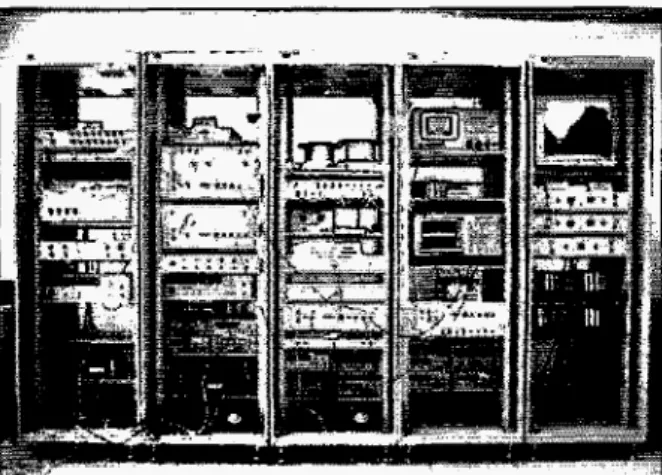
Subproject 6 focuses primarily on the design and Construc- tion of an experimental all-optical E’-over-WDM network (OPSINET), and the research of its underlying bandwidth allocation technology [3]. A prototype system has been de- veloped (see Fig. 3), which is joint work between our project team in National Chiao Tung University and the Computer and Communication Laboratory, Industrial Technology Research Institute. This prototype, as shown in Fig. 3, is the world’s first GMPLS-controlled (Generalized Multi-Protocol Label Switching) all-optical IP-over-WDM network. The subproject also performs the architectural design and traffic management in broadband network switches.
HI. WIRELESS NETWORKS
Mobile telecommunication services are becoming very popular and important. Consider Taiwan as an example. The population of mobile service subscribers has reached 23 million, with the penetration rate over 1 10%. The mobile telecommu- nication technologies have evolved from voice and circuit switched data into packet switched data. As Internet tech- nologies become a major trend in data networks, wireless Internet is also an important direction for advanced research in mobile networks. In the area of wireless and access networks, the project aims to provide an integrated framework of het- erogeneous wireless networks, which mainly integrates cellular communication networks like GPRS, wireless local area net- works, and mobile ad hoc networks.
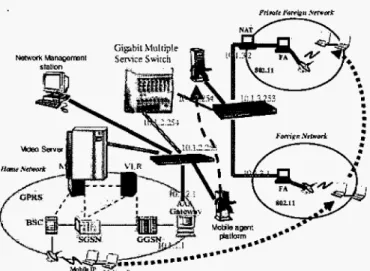
In subproject 2, a number of research fronts have teen in- vestigated and important results have been achieved. The first is mobility management, where we enable the roaming service across different networks by using Mobile IP. The second is quality-of-service guarantee, where we combine resource management protocols like RSVP and DiffServ with the con- nection management protocols like SIP. The third i s security and authentication, where we provide a universal authentica- tion method using AAA servers for both cellular communica-
Figure 4. An integrated phtform for heterogeneous wireless networks
tion networks and wireless local area networks.
We have implemented a testing framework, as shown in Fig.
4, to show our research results. The mechanism of mobility management has been verified on a commercial system pro- vided by Taiwan Cellular Corp. Also, the security mechanism has boen deployed on the campus-wide wireless networks, which is the first try in universities of Taiwan.
Subproject 7 has achieved a number of major research results as outlined below. The first is wireless data service. We have investigated wireless Internet protocols, and developed loca- tion-based services and wireless Internet applications. In ad- dition, we consider a network architecture that provides any- time and anywhere Internet access services. The second area is in mobiIe core networks. We use GSM/GPRS/UMTS networks as vehicles to investigate mobility and session management, with emphasis on GPRS and WLAN integration.
The third area investigated in this subproject is wireless VoIP. Based on a wireless Internet architecture, we integrate VoIP protocols including H.323, SIP, MGCP, and MEGACO.
ITDS (Internet Telephony Directory Service) has been devel- oped to support IP telephony routing for mobile users. In ad- dition, an RTP forwardmg server has been designed to support fast handoff of VoIP communications. The fourth area is in wireless resource management. We have developed a network simulator NCTUns to study many research issues about mobile ad-hoc networks and wireless LANs. Based on the user mo- bility patterns and call traffic, we investigate how to manage radio resources in wireless Internet. We have also established a WLAN and GPRS integration platform, and the research re- sults of this subproject were implemented on this platform.
these subprojects briefly.
Subproject 3 aims to support multiple nomadic users on top of heterogeneous wiredwireless networks in a pervasive computing environment. There are three research areas:
peer-to-peer based pervasive computing platforms, smart de- vices for multiple nomadic users, and multi-agent platforms and technologies. We have developed P2P platforms to exploit the heterogeneity in the underlying environment and support node mobility. We have also designed algorithms for advanced searches in P2P networks, mobile agents on top of the platform, and transparent working environment support,
In the area of smart devices, we have developed optimization techniques for system software and component specification using ontology. With this technique, devices can adapt to the underlying network interfaces and conditions by binding to different software components. This is very useful, for example, for supporting seamless roaming in heterogeneous wireless network environments.
In the area of multi-agent platform, we have developed theories and techniques related to agent-based platforms for dynamic e-commerce and ontology- and semantic-based in- formation retrieval. This technique has been combined with the research efforts in subproject 5 to support semantic searches of Chinese poems.
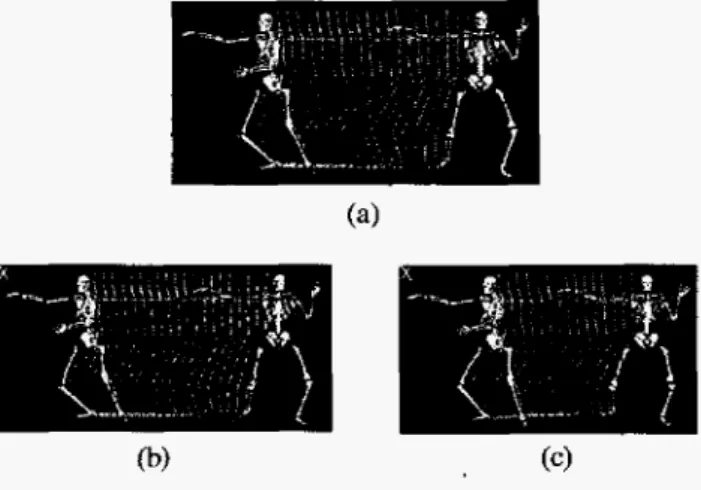
Subproject 4 studies multi-modal content-based multimedia retrieval technologies. Different abstraction levels of multi- media representation such as the conceptual level and the feature level are investigated. Then mechanisms for trans- forming the high-leve1 conceptual structure to the low-level feature structure are devised. We have developed various multimodal content-based retrieval techniques for images, video, music and animation respectively. One achievement i s to allow the query for animation. As shown in Fig. 5 , we can use the query in Fig. 5(a) to search an animation. We will obtain the results similar to those in Figs. 5(b) and (c). Another achievement is to develop techniques for retrieving songs by singing. This technique has been implemented into 8-bit and 16-bit microcontrollers, which are then used in staffed toys.
Iv. NETWORK APPLICATIONS AND SERVICES
The remaining four subprojects concentrates on applications and services over the networks. In this section, we describe
Adaptive display techniques are studied in this subproject for designing multi-modal user interfaces over varies network platforms. We have implemented a multi-modal content-based video retrieval system to demonstrate the effectiveness of the developed techniques. To facilitate mobile retrieval, subsys- tems for displaying media objects on mobile devices were also developed.
Subproject 5 focuses on the use of networking technologies for Iearning and studying their social impacts. The subproject has built a lot of interesting contents, including science edu- cation and literature for teachers and students of elementary and junior high schools [4]. One achievement is to build a very comprehensive web site for Chinese literature study. A number of techniques developed in the other subprojects have been applied here, e.g., retrieval ofpmms by semantics and speeches, poem recitation using speeches, etc. We have also held many activities to extend our research results to reach general public.
The potential issues and new social problems in the informa- tion society have been studied with many interesting findings.
The major goal of subproject 8 is to design and implement a high confidence information system (HiCIS) that ensures the requirements of system availability, reliability, security, sur- vivability, and restorability. This subproject integrates ad- v a n d technologies of information hiding, encryption, intel- ligent monitoring, self-adaptation, fast inference, and recon- figuration to protect and secure the information storage and transmission to sustain high survivability of the system, to avoid malfunction of the components of the system, and to prevent the destruction from malicious intentions.
This subproject has the following achievements. (1) We have developed a certificateless signature scheme using the ID as a public key to reduce the effort of requesting a certificate. We also design an efficient k-out-of-n oblivious transfer scheme for providing the privacy of users and servers. (2) A new ob- ject-oriented rule model (NORM) and knowledge fusion tech- nologies to enhance the fast inference engine are designed for monitoring network behaviors. (3) In order to handle the huge
messages in the NGI environment, a flexible asynchronous message exchanging mechanism, the PFJM (Persistent Fast Java Message Service), with high performance, reliability, and restorability is also designed in this project. This mechanism provides an easy and unified interface to all lands of applica- tions in the HiCZS system. (4) In the application level, to ensure the confidentiality of the embedded information with low dis- tortion of binary images and high capacity in multimedia ap- plications, hierarchical secrete sharing, information hiding and watermarking technologies are used to protect multimedia information. Furthermore, these technologies can be applied to protecting of digital content and intellectual property rights including web pages. With these technologies, the HiCIS sys- tem can be built to provide concrete solutions with security and reliability from the system level to the application level.
V. SUMMARY AND FUTURE
This project joins together researchers from different uni- versities, National Tsing Hua University and National Chiao Tung University, with different disciplines, computer science as well as humanities and social sciences, to study the tech- nologies and applications of next generation information networks. There were about 400 professors, post-doctorate researchers, graduate students, and full-time staffs participated in the project. To manage a project of this scale and let p r e fessors with different disciplines to communicate and col- laborate, these tasks are formidable. We were able to overcome these difficulties and many other obstacles, and develop many advanced technologies. The four-year project has published over 400 journal papers and about 570 conference papers.
About 80 patent applications have been fired and at the end of the project, about 35 were granted.
During the course, we have cooperated closely with several research institutions, such as the Computer and Communica- tion Laboratory of the Industrial Technology Research Institute and Institute for Information Industry, and local industries.
This allows us to transfer the developed technologies to the research institutes and industry to help promote their research and development capabilities. The total number of technology transfers is about 150 cases. .
With the success of this project, the research team has been granted the phasetwo project under the “Program for P r e moting Academic Excellence of Universities (Phase II),” which is now managed by the National Science Council, R.O.C. The
Subproject 4: Wireless Ad Hoc and Sensor Networking
Figure 5. Querying a n i m a h n Technologies
0 Subproject 5: Network Security
Subproject 6: Techniques and Applications of Overlay Networks
The six subprojects aim at three major themes: electronic- and optical-switching backbone networks, wireless core and access networks, and network securityloverlay networks.
Among them, Subprojects 1,4, and 6 are conducted at National Tsing Hua University, and subprojects 2, 3, and 5 are at Na- tional Chiao Tung University. With the continuing funding and the excellent researchers, we believe the phase-two project will extend the success achieved in the phase-one project and reach an even higher ground.
REFERENCFS
C.S. Chmg, D.S. Lee, and Y.S. Jou. “Load Balanced Birkhoff-von Neu- mann Switches, Part I: One-Stage Buffering,” Computer Communicaions, Vol. 25, pp. 61 1622,2002.
C.S. Chng, D.S. Lee, and C.M. Lien. “Load Balanced Birkhoff-van Neumann Switch, Part 11: Multi-Stage Buffering,” Compufer CommuniCa-
lions, Vol. 25, pp. 623434,2002.
M.C. Yuang, J . Shih, and P.L. Tien. “QoS Scheduler/Shaper for Optical Coarse Packet Switching 1Paver-WDM Networks,” IEEE J o d on Se- lected Areas in Commrutimfwns, 2004.
TEENS, http://vm.nt.hu.edu.t.