Research Express@NCKU - Articles Digest
Research Express@NCKU Volume 5 Issue 2 - July 4, 2008 [ http://research.ncku.edu.tw/re/articles/e/20080704/5.html ]
Growth of CNTs on Fe-Si catalyst prepared on Si and Al coated Si substrate
F.-Y. Teng, Jyh-Ming Ting * , Sahendra P. Sharma, Kun-Hou Liao
Department of Materials Science and Engineering, College of Engineering, National Cheng Kung University
*
Corresponding Author. Email address: [email protected]
Nanotechnology 19, 095607 (6pp) Issue 9 (2008)
C arbon nanotubes (CNTs) continue to draw tremendous
attentions from the entire research community since its discovery in 1991 [1]. These fascinating properties of CNTs depend on their structures, which are strongly influenced by the synthesis methods and parameters. Among the parameters, characteristics of the catalyst play a key role in controlling the structure of CNTs at molecular or nano scale. Typical catalysts that are widely employed in CNT synthesis include transition metals such as Co, Fe, Ni, Mo, and their combination such as Fe/Ni, Co/Ni, Y/Ni [2-4]. It is also known that when the formation of silicide between a catalyst and Si substrate, e.g., iron silicide, is highly undesirable. Various types of
thin film materials have therefore used as an interlayer to prevent silicide formation [5-8]. In this paper, the use of a thin Al layer, ranging from 2 nm to 12 nm, between a 24-nm thick Fe-Si catalyst and a silicon substrate is reported. We show that the Al interlay not only prevents the silicide formation but also greatly enhanced the CNT growth rate at growth temperature of only 370 ℃ in a microwave plasma enhanced chemical vapor deposition (MPCVD) reactor. Furthermore, the use of such an Al interlayer is so effective as normally required catalyst etching prior to the growth is waived.
Fig. 1. TEM cross sectional image of an etched Fe-Si catalyst.
Fig. 1 shows a TEM cross sectional image of an etched Fe-Si catalyst which is bounded by the two dotted lines. It is seen that only the region near the surface become particles, adjacent to which there is a flat region. It is noted that the thickness of the catalyst layer increases from 24 nm for its as-deposited state
1 of 4
Research Express@NCKU - Articles Digest
to 42 nm for its etched state. The flat region alone has a thickness of 12 nm. The catalyst obviously swells after the hydrogen bombardment during the etching. The surface of Al/Fe-Si catalyst also becomes particle-like after the hydrogen etching as mentioned above. However, the swelling is more severe due to the addition of an Al interlayer. For example, the thickness increases from 2 nm (Al) + 24 nm (Fe-Si) = 26 nm for its as-deposited state to 46 nm for its etched state. Notably is that the flat region alone has a thickness of 18 nm, which is almost 50% thicker than that of etched Fe-Si catalyst, i.e., 12 nm as mentioned above. Also, the Al interlayer is no longer seen. The Al is not seen in these images as it has diffused into the Fe-Si. Al was found to diffuse up to a depth of 35nm into the Fe-Si film. Most of the Al atoms were diffused over a region of ~20 nm, limited between ~18 nm and 38 nm. For Al/Fe-Si having thicker Al interlayers, i.e., 4 nm, 6 nm, 8 nm, and 12 nm, the cross sectional morphologies and
microstructure are similar to that of 2-nm-Al/Fe-Si except that the Al interlayers are visible in the 6-nm- Al, 8-nm-Al, and 12-nm-Al/Fe-Si catalysts.
Fig. 2. SEM cross-sectional images of CNTs grown on etched Fe-Si catalysts having (A) 0-nm, (B) 2-nm, (C) 8-nm, and (D) 12-nm Al interlayers.
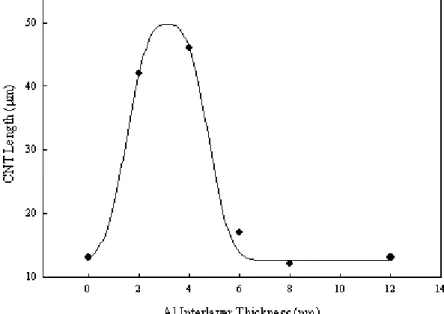
Figs. 2A, 2B, 2C, and 2D show SEM cross-sectional images of CNTs grown on various etched Fe-Si catalysts having 0-nm, 2-nm, 8-nm, and 12-nm Al interlayers, respectively. The methane/hydrogen ratio was 4/9. The relationship between the CNT length and the Al interlayer thickness is further shown in Fig. 3. The length of CNT increases and then decreases with the thickness of the Al interlayer. In particular, the average lengths of the CNTs grown on the Al/Fe-Si catalysts having ~3±1 nm think Al interlayers are more than 3 times longer than that grown on the Al/Fe-Si catalysts having no Al or thicker Al interlayers. Similar effects of Al interlayer were also observed at lower methane/hydrogen ratios of 3/9, 2/9, and 1/9. Apparently there is an optimal thickness range of Al interlayer that greatly enhances the growth of CNTs. Furthermore, within this thickness range, the use of an Al interlayer is in fact so effective such that normally required catalyst etching is waived. Without the hydrogen etching, no CNT growth was observed when as-deposited Fe-Si thin films are used as the catalyst. Less effective etching of a catalyst normally occurs during the early stage of CNT growth. This allows the
aforementioned swelling of the catalyst to take place and therefore the growth is enhanced. The enhanced CNT growth due to the use of a very thin Al interlayer is explained by considering the structural changes of the catalyst as mentioned above.
2 of 4
Research Express@NCKU - Articles Digest
Fig. 3. CNT length increases and then decreases with the Al interlayer thickness. The methane/hydrogen ratio was 4/9.
Fig. 4. Raman spectra of CNTs grown on etched Fe-Si, as-deposited Al/Fe-Si, and etched Al/Fe-Si. The methane/hydrogen ratio was 4/9.
Fig. 4 shows the Raman spectra of CNTs grown on etched Fe-Si, as-deposited 2-nm-Al/Fe-Si, and etched 2-nm-Al/Fe-Si at a methane concentration of 4/9. The Raman signatures spectra are in general similar.
Commonly observed D-band and G-band are seen. However, their I
D/I
Gratios suggest that these CNTs
3 of 4
Research Express@NCKU - Articles Digest
contains different amount of defects. The CNTs grown on the un-etched or as-deposited catalyst of Fe-Si contain the highest amount of such disorders (I
D/I
G= 1.95); while the defect levels of the CNTs grown on etched catalysts of both Fe-Si (I
D/I
G= 1.50) and 2-nm-Al/Fe-Si (I
D/I
G= 1.55) are less and similar.
In other words, the presence of a thin layer of Al greatly enhances the growth rate of CNTs while maintaining similar microstructures for the resulting CNTs.
Conclusions
Vertically aligned CNTs have been synthesized using Fe-Si catalysts deposited on Si substrates with and without an Al underlayer at a low temperature of 370 °C. The average lengths of the CNTs grown on Al/
Fe-Si catalysts having ~3±1 nm thick Al are more than 3 times higher than that grown on Al/Fe-Si catalysts having no Al or thicker Al. Within this thickness range, the use of an Al interlayer is in fact so effective such that normally required catalyst etching is waived. Such beneficial effects were observed regardless of the methane concentration used. The effects are attributed to the diffusion of appropriate amount of Al into Fe-Si catalyst which causes swelling of the catalyst, i.e., making the catalyst porous.
Also, the presence of a thin layer of Al greatly enhances the growth rate of CNTs while maintaining similar microstructures for the resulting CNTs.
References
●
Iijima S 1991 Nature 354 56
●
Cassel A M, Raymakers J A, Kong J and Hongjie D 1999 J. Phys. Chem. B 103 6484
●
Chen P, Zhang H B, Lin G D, Hong Q and Tsai K R 1997 Carbon 35 1495
●
Thess A, Lee R, Nikolaev P, Dai H, Petit P, Robert J, Xu C, Lee Y H, Kim S G, Rinzler AG, Colbert
D T, Scuseria G E, Tománek D, Fischer J.E and Smalley R E 1996 Science 273 483
●
Arcos T de los, Vonau F, Garnier M G, Thommen V, Oelhafen P, Düggelin M, Mathis D and
Guggenheim R 2002 Appl. Phys. Lett. 80 2383
●
Delzeit L, McAninch I, Cruden B A, Hash D, Chen B, Han J and Meyyappan M 2002 J. Appl. Phys.
B 91 6027
●
Cui H, Eres G, Howe J Y, Puretkzy A, Varela M, Geohegan D B and Lowndes D H 2003 Chem.
Phys. Lett. 374 222
●
Delzeit L, Chen B, Cassell A, Stevens R, Nguyen C and Meyyappan M 2001 Chem. Phys. Lett. 348
368
4 of 4