行政院國家科學委員會專題研究計畫 成果報告
結構分解模式字幕翻譯課程設計與執行之個案研究
計畫類別: 個別型計畫
計畫編號: NSC91-2516-S-011-002-
執行期間: 91 年 08 月 01 日至 92 年 07 月 31 日 執行單位: 國立臺灣科技大學應用外語系
計畫主持人: 陳聖傑
報告類型: 精簡報告
處理方式: 本計畫可公開查詢
中 華 民 國 92 年 12 月 29 日
The Implementation and Development of A Subtitling Program Using the
Decomposition Model
Sheng-Jie Chen
National Taiwan University of Science and Technology
ABSTRACT
This paper studies the implementation and development of training activities for subtitlers into Chinese of English-language motion pictures on the basis of the behavior involved in such subtitling. In a qualitative approach that makes use of the Action Research Paradigm, the researcher gathers and analyzes data stemming from my
experience in subtitling over 300 English-language films, supplemented by observation of the subtitling behavior exhibited by my colleagues and myself working at translation agencies, as well as my students in the classroom. I will present research backgrounds and methodologies along with the behavior of subtitling. In addition, I will identify relevant subskills and propose learning activities. Finally, I will introduce the subtitling program designed by using the decomposition model. Results of the study indicate that subtitlers should be trained systematically in accordance with skill-training theories; these include such concepts as teaching easier skills before proceeding to more complex ones and overcoming difficulties by subdividing the tasks to make them more manageable.
1. INTRODUCTION
This report investigates the development of training activities for subtitlers based on the behavior of subtitling English movies for Chinese. In following the action research paradigm, I have used qualitative research methods to collect and analyze data, that consist mainly of reflection of my own experience in subtitling more than 300 English movies for Chinese; my observation of subtitling behavior exhibited by my colleagues and myself working at translation agencies and by my students in the classroom, along with my students’ oral and written feedback. I will introduce the research background, research methods, behaviors of subtitling, as well as identify subtitling subskills and propose learning activities. Finally, I will introduce the subtitling program, which is designed by using the decomposition model.
Based on the belief that training tasks be rooted on subskills identified in the behavior of subtitling, I would recommend that the following major training components be included in a subtitling program: becoming familiar with subtitling norms, script translation and Chinese character inputting speed enhancement, active listening, becoming familiar with different modes of subtitling, revising to meet subtitling norms, and computer skills.
I would also propose that subtitling and translation differ in the following ways:
different input, different output, different translation processes and characteristics.
Therefore, different training is required. I will discuss how to integrate them into subtitler training further on in this article.
2. BACKGROUND
Since the ROC government has mandated that all foreign films released to the public be subtitled or dubbed in Mandarin Chinese (Article 23, Film Law), subtitling probably has the largest number of consumers in the translation market next to journalistic English translation in Taiwan. After the lifting of martial law, foreign movies (English language movies in particular) have inundated cable channels and movie theaters throughout the island. However, subtitling quality remains dubious, mainly because subtitlers have not been systematically trained (Chen, 2003). Many schools have started offering subtitling programs; however, no research has been available that systematically investigates how to design or implement such courses.
This study attempts to bridge the gaps.
3. RESEARCH SITE
This study was implemented in a language laboratory in the Department of Applied Foreign Languages at the National Taiwan University of Science and Technology in Taiwan, in the spring semester of 2003. The language laboratory was equipped with the instructor’s control panel and a multimedia computer as well as the 40 multimedia computers for the students. All the computers have been installed with Microsoft Office XP, a DVD player, headsets, microphones, and access to the Internet.
The instructor’s control panel also consisted of an electronic projector, a VCR, a DVD player, and a language lab machine.
4. RESEARCH PROCEDURES
I followed the procedures below to complete the study:
1. Introducing a subtitling quality checklist (see Chen, 2002).
2. Administering a pre-test.
3. Developing and implementing the subtitling course.
4. Playing seven movie DVDs in the course following these procedures:
Playing the movie with both the source and target language subtitles turned on.
Pausing occasionally to critique the subtitles of the segments of the movie.
Playing a new segment of the movie with the Chinese subtitles turned off and requiring students to provide the Chinese subtitles.
Playing the segment again and asking students to take turns reading aloud the Chinese subtitles they have created.
5. Requiring each student to collect two correct examples and two faulty examples of subtitles from the movies they have watched based on the ten parameters in the subtitling quality checklist based on the movie DVDs provided.
6. Administering the post-test.
7. Reflecting on the implementation of the course to develop the subtitler-training program using the decomposition model.
5. PARTICIPANTS
The participants of this study consisted of myself (I have subtitled over 300 English movies into Chinese) serving as instructor-researcher and 36 students (8 male and 28 female; mean age: 21). The students all had Mandarin Chinese as their mother language and English as their foreign language.
None of the students had previous subtitling experience. Half of them had majored in English and the other half had majored in the other subjects in five-year colleges before they were admitted to the BA program of the department. They had all taken a required translation course before they took this elective subtitling course.
6. RESEARCH METHODS
I have used three research methods to develop the subtitler-training program:
1. Self-reflection on my own subtitling experience
2. Observation of my students’ and colleagues’ subtitling behavior.
3. The development of a series of training tasks based on the result of the study.
Data collection
I have used the following methods to collect data:
1. My reflection of my subtitling experience and observation of the subtitling processes of my colleagues working at translation agencies and my students subtitling in the classroom.
2. My head notes on the implementation of the course.
3. Lesson plans, field notes, and the design of this program.
4. My students’ written and oral feedback.
Research Questions
This study attempts to answer the following questions:
1. What are the behavior of subtitling?
2. What are subtitling subskills and how can these subskills be sequenced systematically for subtitler training?
3. What are the errors that students made?
4. How did the students react in the course?
5. What are the implications for pedagogy?
7. BEHAVIOR INVOLVED IN SUBTITLING
Since subtitlers in Taiwan are paid meagerly for their work, they tend to translate in the most efficient way in order to make a profit. Depending on their experience, they generally follow one of the following four, sometimes overlapping, processes:
Translate the subtitles based on the script. The subtitlers translate based on the script downloaded with a password from the Internet. Then they watch the movie on a VCR, or a DVD player (if they burn the movie on a DVD disk), to check for translation accuracy between the source and target languages, and revise accordingly. I noticed that my students used this method when they subtitled a movie for a translation agency for the first time.
Watch a movie played on a VCR and listen to the soundtrack. When watching the movie, subtitlers pause the VCR momentarily after one or two sentences, translate, and then input the Chinese characters on the computer. They return to the previous segment to revise, proofread, and edit before continuing on to the next one. Using this
method, scripts are rarely consulted, partly to save time and partly because they are sometimes unavailable. Thus, subtitlers have learned to rely mainly on their aural skills. When the original language is incomprehensible, the subtitler can consult native speakers of English or adapt, paraphrase, or summarize based on the context.
For example, I used this mode to subtitle over 300 movies. I wrote down the subtitles on a pad because I started subtitling before the personal computers were widely available. This is a very efficient way to subtitle, but it is sometimes difficult, particularly when the original language is incomprehensible due to slang, unusual manners of articulation, poor recording and/or exotic accents.
Watch the movie played on a VCR, listen to the sound track, stop momentarily to
consult the script, translate, and input the Chinese characters on the computer. This
mode is used by novice subtitlers who can translate based on the script and whose listening comprehension ability is proficient enough to distinguish the discrepancies between the script and the soundtrack. Without the script, the subtitler cannot work efficiently with this method. I observed at least two translators, who had an MA degree in translation and interpretation from a major U.S. university, use this method when they subtitled TV programs and movies for the first times.Interpret consecutively. The subtitlers watch the movie played on a VCR, listen to the soundtrack, pause at thought or meaning units, and interpret consecutively while another individual inputs the Chinese characters on the computer In this case, subtitling is similar to consecutive interpretation without note taking. The only difference is that the subtitler must be very accurate and concise in wording. This is the fastest mode because the subtitler and computer operator can each focus on their jobs.
Listen to the soundtrack recorded on a tape played on a tape player and translate;
consult the script if available. This method is probably the most difficult and
inaccurate partly because the subtitler may or may not have watched the movie before subtitling and partly because the subtitler relies mainly on audio input. Watching the movie at least once, proofreading, and editing may enhance the accuracy. I saw a bilingual translator using this method when she was subtitling an American soap opera for a local TV company.
In summary, subtitlers follow different behavior, depending partly on their competence and partly on their experience. Experienced subtitlers rely more on their aural skills than do novices, who tend to rely on the scripts. The latter often need to go back and forth between the script, the computer screen, and the TV.
8. SUBTITNING SUBSKILLS
Based on the behavior delineated above, subtitling subskills may be identified as follows:
Becoming familiar with the linguistic norms of subtitling. Individuals should first become familiar with the linguistic norms related to subtitling. These include clarity, conciseness, omission and synchronization between subtitles and the original
information, etc. (see Chen, 2002).
Translating the script and enhancing Chinese character inputting speed. Since nowadays most movies come with a script that may be downloaded on the Internet with a password, students need to learn to translate the script. Translators whose English listening ability is not good enough to comprehend the movie soundtrack tend to rely heavily on the script. All the subtitling jobs are done on the computer, so they must also develop very fast and accurate Chinese character inputting speed.
Listening comprehension. A subtitler needs to be able to understand the audio information on the soundtrack. Listening ability is fundamental since the subtitler may not always have a script available. Individuals whose listening ability is limited would not be able to subtitle movies that do not come with a script.
Identifying the discrepancies between the script and the soundtrack. The script often carries lines that are different from the information on the original soundtrack.
Translating the script sentence by sentence will result in subtitles that do not match the original soundtrack. Therefore, students need to learn how to match the script with the original soundtrack and revise the subtitles accordingly.
Checking slang, jargons, special terms, collocations, etc. in the source language
dictionaries. The meaning of most of these expressions is context-dependent, so they
often cannot be located in bilingual dictionaries. Students need to learn to consult an unabridged English dictionary and then subtitle based on the context of the movie.Adapting, abstracting, summarizing and condensing. Since subtitles should be as concise and short as possible to avoid straining the eyes of the viewers, the subtitler must learn to adapt, abstract, summarize and condense when the information in the source language is dense, redundant, complicated, or incomprehensible.
Revising and editing. To save time, subtitlers usually do not revise, proofread, or edit after the entire project is finished. However, all subtitlers monitor themselves and rely on both the top-down (their background knowledge) and the bottom up strategies (the context of the movie) when revisiting and they revise previous segments of their work throughout the entire subtitling process.
Computer skills. Subtitlers must have good computer skills because they nowadays work exclusively on computer and depend heavily on computer aided translation tools, computer dictionaries, and the Internet.
In summary, the subskills of subtitling consist of the followings: becoming familiar with the linguistic norms of subtitling; translating the script and enhancing Chinese character inputting speed, listening comprehension, identifying the
discrepancies between the script and the soundtrack; checking slang, jargons, special terms, collocation, etc. in the source language dictionaries; adapting, abstracting, summarizing, and condensing; revising and editing; and computer skills.
9. LEARNING ACTIVITIES
The following classroom activities may help systematically prepare students to become professional subtitlers:
Becoming familiar with the norms of subtitling, parameters for evaluating
subtitling. The basic norms of subtitling may be summarized as follows: clarity and
ease of comprehension; conciseness and omissions without disrupting the fluency and continuity; using Chinese language syntactic structures without sounding liketranslation; chunking with right timing and context, using double-lined subtitles when the subtitle becomes too long, using punctuation marks economically, synchronizing subtitles with source language information, assessment based on subtitles as a piece of writing independent of its source language information; other linguistic aspects, including registers, foreign languages, personal names, and swearwords (Chen 2002).
Phrased reading of the script. Students are instructed to watch a movie played on a VCR or DVD player and pause the machine at a thought / meaning / phrase unit. This seemingly easy task may take a long time to master.
Phrased listening. Students listen to the DVD with the subtitles of both languages turned off, and pause the machine at a phrase/meaning/thought unit.
Repeating after the message heard. Students are required to watch a movie with the subtitles turned off and repeat after the message and pause at thought units. If the students can repeat correctly, they tend to be able to understand the source language and know how to look up unfamiliar words in the dictionary based on how the words sound.
Enhancing Chinese character inputting speed. Because all subtitling work is finished on the computer, students should develop the skills required to input Chinese characters at a rapid speed. Obviously, this skill takes a lot of practice and can be developed by requiring students to turn in assignments on computer diskettes.
Identifying the discrepancies between the source and target languages. This seemingly easy task is probably the most difficult one to master because it is often
hard for beginners to distinguish between a translation error, abstraction, adaptation, condensing, and omission.
Translating the scripts. Because most movies come with scripts downloadable on the Internet, subtitlers need to learn to translate the scripts.
Consecutive interpretation (CI). Students listen to the source language and pause momentarily to interpret into the target language. This form of CI usually does not require note taking, but it should be extremely precise and concise.
Listening to an audio tape recording of a movie and providing subtitles. The more advanced students may be required to listen to an audiotape and provide subtitles based on the information heard.
10. PLAY THE DVD MOVIE IN DIFFERENT MODES
Movies on DVDs may be played in different modes using Power DVD software and Microsoft Office XP.
Turn on both the source and the target language subtitles. Pause at each
thought unit to compare the original subtitles with the target language subtitles, and critique. This mode may increase input in the source language and familiarize students with the linguistic norms for subtitling. It should be used first because it enhances students’ abilities in listening comprehension, reading, and critiquing. This in turn will enhance the students’ ability to revise and edit subtitles. Students can also enhance their general English skills by enhancing their listening comprehension ability and expanding their vocabulary, idioms, slang, register, etc.Turn on the source language subtitles. Pause momentarily at thought units and
ask beginning students to provide subtitles. More advanced students may be required to perform sight translation—reading the subtitles in the source language and orally rendering them in the target language.Turn off both the source and the target language subtitles. Turn off the
subtitles of both the source and target languages and require advanced students to create subtitles, or do consecutive interpretation—listening to the source language soundtrack and orally rendering them in the target language.In summary, the process of training subtitlers should imitate that of actual subtitling.
11. THE PRETEST AND THE POSTTEST
To assess the effectiveness of the course, a pretest was administered at the
beginning of the course, and a posttest was given at the end. To administer the pretest,
the students were each given a copy of a segment of the English subtitles of a movie;
and to administer the posttest, the students were given another copy of a segment of the English subtitles of another movie. In both tests, the students watched the movie once, and then they watched it again, (the DVD player was paused at thought units), listened to the soundtrack, read the English subtitles, and provided Chinese subtitles.
The purpose of the tests was to find out whether the students have made progress after completing this subtitling course. The results indicated that in the pretest, students had made significantly more mistakes and more variety of mistakes than they did in the posttest. According to the results of the pretest, the students tended to make the following types of errors; some of which were interrelated.
Context: Ignoring the context, the students tended to translate word by word. For instance, the characters are talking about pushing a button to turn on a coffee machine. The woman says, “Did you push it?” which should be translated into “你按了沒有” rather than “ 你推了它嗎?”.
Common sense: Some students did not know common foreign words or phrases, which are part of English, such as “sushi”, which should be translated into “壽.司” instead of “蘇西.
Cultural knowledge: “Although he (the dog) likes to eat pizza and bagels off the sidewalk// and I prefer to buy them” were translated into “牠喜歡吃 被丟在人行道上的比薩和貝果//我喜歡用買的” instead of “牠喜歡在人 行道上吃比薩和貝果//而我喜歡買給牠吃”. Some students seemed to ignore that, generally speaking, in the U.S., nobody would let their dogs eat bits of pizza littered on the sidewalk because dogs are considered their best friends.
Exceeding subtitle length: Subtitles that exceed 14 Chinese characters in length should be turned into a double-lined subtitle. Many students did not do that. Thus, “I would send you a bouquet of newly sharpened pencils// if I knew your name and address”, was translated into”如果我知道你的名字和 地址,我會寄給你一份削好的鉛筆包裹” instead of ”如果我知道你的名 字和地址,//我會寄給你一包削好的鉛筆”.
Target language syntactic errors: Instead of using the target syntactic structures, some students used the source language structures instead, thus
“Because they hadn’t done any work in six weeks” was translated into “因 為他們未完成任何工作在六週之中”, instead of “他們在六個星期裡什麼 也沒做”。
Colloquial expressions: Students had difficulties comprehending colloquial expressions, e.g. “Name one thing.” should be translated into “舉出一件事
情”, but quite a few students did not know how to translate it.
Terminology: Quite a few students either failed to translate or mistranslated terminology commonly seen on a computer screen. For instance, (Select screen name) and (Shop girl), which should be translated into: (請選擇你想 用的名稱) and (女店員), were either not translated or mistranslated.
12. HOW DID THE STUDENTS REACT?
Data about the students’ reaction derived from my interviews of the students during the class breaks and their written feedback. Their feedback focused on three aspects: teaching effectiveness, teaching methods, and teaching materials.
Teaching Effectiveness
The students commented that generally speaking, this course had enhanced their English skills and target culture awareness. They said that the subtitler-training course had enhanced their awareness of the source-language culture and society. In addition, it had also expanded their English vocabulary, slang, and colloquial expressions.
Finally, it had enhanced their English listening, reading, and translation skills.
Teaching Methods
The students in this course had mixed language abilities, as mentioned earlier, so I had to take that into account and sequence the teaching components in terms of difficulty.
The advanced students commented that more training should be provided for them to translate with both the Chinese and English subtitles turned off. This, they said, would allow them to learn consecutive interpretation, a skill that subtitlers should acquire. On the other hand, some commented that it is a good idea to play a small segment of the movie at a time and critique the target language subtitles, but requiring students to provide subtitlers for one hour after one or two sessions is too difficult for them. On the other hand, however, some students commented that the pace of the class was too slow and that instead of pausing at a regularly basis, the instructor should avoid pausing at the parts when the content was quite easy. The vocabulary list provided at the class was helpful. However, some students commented that at the end of every two sessions, during which the students were asked to
translate, the instructor should play the part of the movie again that the students had
translated, and turn on the Chinese subtitles to compare and critique. A student commented that the course should have provided information about the subtitling market. Professional subtitlers should be invited to talk about their subtitling
experience. In addition, different versions of the subtitle of the same movie should be used for comparison and analysis. Some students suggested that a movie should be played from the beginning to the end without interruptions and that when it is viewed the second time around to discuss the translation, the easier parts should be skipped.
Materials
Students commented that some of the movies played in the course were interesting, but some were boring. On the other hand, some did not like too many action movies and old movies. Some suggested that the movies played in the classroom should be chosen by the students themselves.
13. IMPLICATION FOR PEDAGOGY
Students should be allowed to choose the movies to be played in the classroom based on their preferences. However, the following basic principles may facilitate training:
Input Before Output. Students should receive a lot of input by watching many movies and critiquing their subtitling techniques. In addition, they should be exposed to movies of a variety of genres. Learning subtitling is just like putting money in the bank. What you put into the bank is what you get out of it. That is to say, if students get very little input, they are unlikely to be very proficient in creating subtitles for movies. On the other hand, if they receive a lot of input by watching a lot of movies, reading their subtitles, and comparing them with the soundtrack carefully, it will be easier for them to become familiar with the norms of subtitling and the different parameters used for evaluating subtitles. Critiquing and discussing movie subtitling in the classroom may increase input. Movies may be critiqued in the classroom, and students may be required to watch movies and critique their subtitles as assignments.
This includes identifying subtitling errors and making sure that the subtitles meet the norms of subtitling.
Movies should be sequenced in terms of difficulty. Movies should be selected and sequenced based on their level of difficulty. Although movies from all genres should be used, easier ones in each genre should be used before more difficult ones.
Movies played in the classroom should be interesting and fun. Avoid tedious and boring movies, particularly when young learners are involved.
Avoid movies that are sexually explicit or too bloody and violent. Whatever is inappropriate for regular classrooms is also inappropriate in a subtitling course.
Movies played in the course should cover as many genres as possible. In real situations, individuals are required to provide subtitles to whatever movies available.
Do not play a movie from beginning to end. Due to time constraints, and the need to cover movies of as many genres as possible, only representative sections of each movie should be played and discussed in the classroom. Most important of all, each segment of a movie should be played more than once. In real situations, subtitlers listen to each segment at least once, then backtrack to verify what they have heard and/or to proofread and edit before proceeding to the next segment. The students may be assigned to watch the entire movie on their own before attending the class.
14. CONCLUSION
In conclusion, this article first introduced the background of the study. Second, it introduced the research method. Third, it delineated the behavior involved in
subtitling. Fourth, it outlined the background and behavior of subtitling. Fifth, it identified subskills involved in subtitling, explained how to play DVD movies in different modes, and developed a sequence of training activities. Sixth, it suggested a sequence of modes for playing the DVD movies in the classroom. Seventh, it offers suggestions for teaching a subtitling course. Finally, it reports how the students reacted throughout the course. The appendix introduces the subtitler-training program in the decomposition model based on the results of this study. This study is limited in that the students only learned to provide subtitles to Chinese movies. Other
researchers are encouraged to implement subtitling courses involving different languages and for different proposes, such as dubbing, radio and television, etc.
APPENDIX A
THE DESIGN OF THE SUBTITLING COURSE IN THE DECOMPOSITION MODEL
This subtitling course is designed in the decomposition model (also called conceptual modeling, and program modeling), an approach of course design developed by Professor Gary Borich of the University of Texas at Austin (Chen, 1998). The decomposition model has been used for designing training programs such as teacher training programs (Klinzing & Borich, 1984), the San Antonio youth literacy program (Borich & Nance, 1986), and a non-language specific
interpreter-training program (Chen, 1988; Chen & Hensey, 2000). Two fundamental concepts underlie the implementation of the subtitling course. First, a subtitling course consists of hierarchically structured training components and sub-components that interact to produce clearly defined outcomes—the competence to provide
subtitles to movies, television programs, and documentary films. Second, subtitling skills are generated through the development of specific tasks, such as translating scripts and distinguishing the discrepancies between the script and the soundtrack. In addition, a mastery of these tasks develops more global subtitling skills at the
completion of the course.
1. HIERARCHY AND INTERRELATIONS
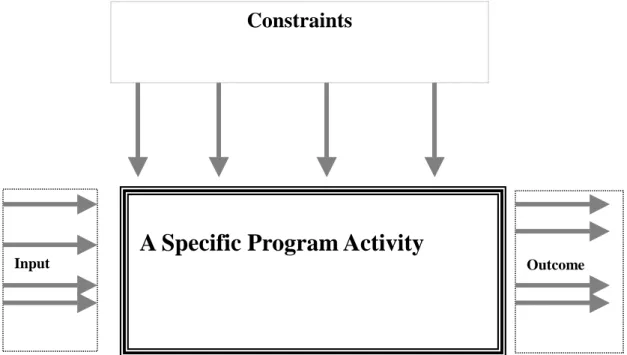
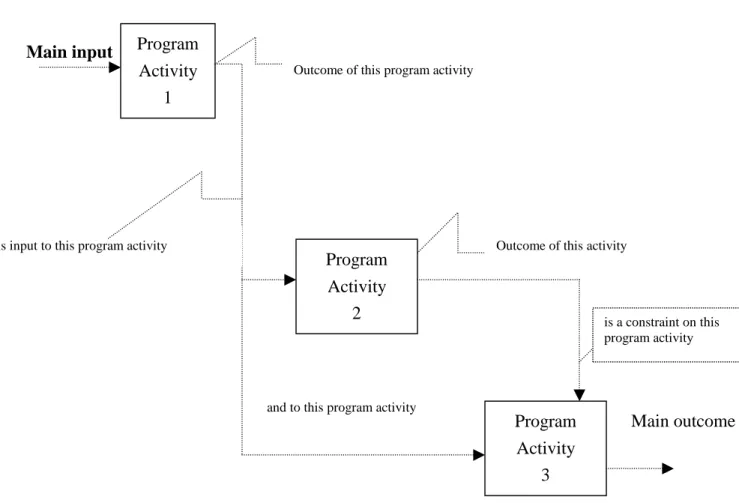
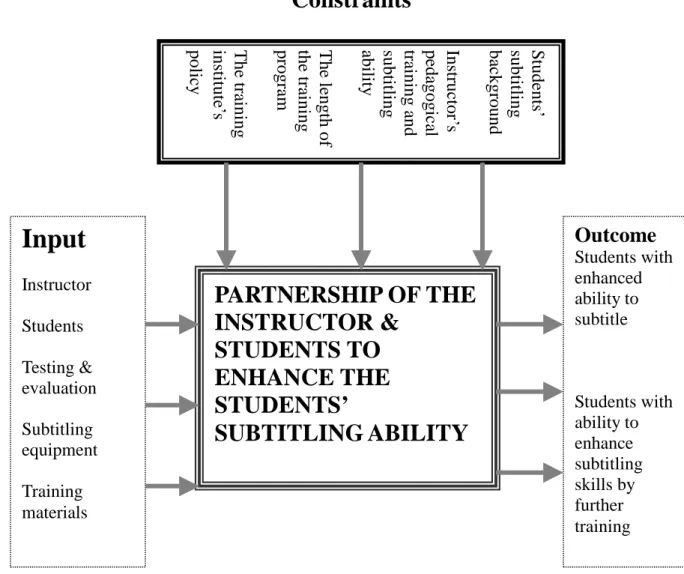
The concept of hierarchy is a basic approach in organizing complex activities that make up a training program (Borich & Jemelka, 1982). A program in the decomposition model is made up of the following components: input, constraints, learning activities (transactions), and outcome (Borich, 1998). Each component, represented by a box and arrows pointing either downward or rightward, represent the flow of the activities. In the subtitling course, these components are illustrated as follows: input, constraints, program activities, and outcome.
2. INPUT
Input, indicated by arrows pointing rightward, stands for raw data, which bring the transaction into action and are converted into outcome or transformed participants (Borich, 1998). In the subtitling course, the input consists of the students, the
instructor, tests, time, the classroom, multimedia computers, movie DVDs, and other
training facilities.
3. CONSTRAINTS
Constraints, indicated by arrows pointing downward from the top of the program model, may show many things, such as how input may be restricted by funding, policies, students’ backgrounds, and the instructor’s pedagogical background to produce desired outcome (Borich, 1998). In the subtitling course, the constraints consist of the students’ translation and language abilities, the instructor’s subtitling ability and pedagogical training, the length of the course, and the school’s policies.
4. PROGRAM ACTIVITIES
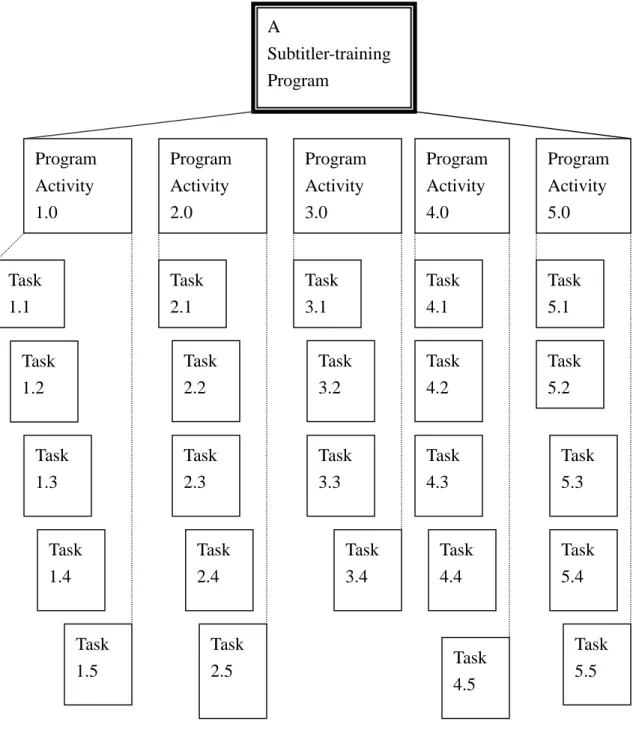
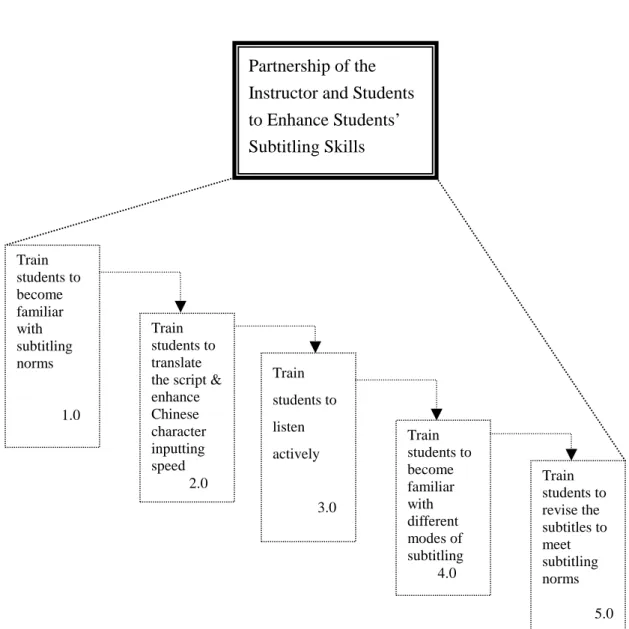
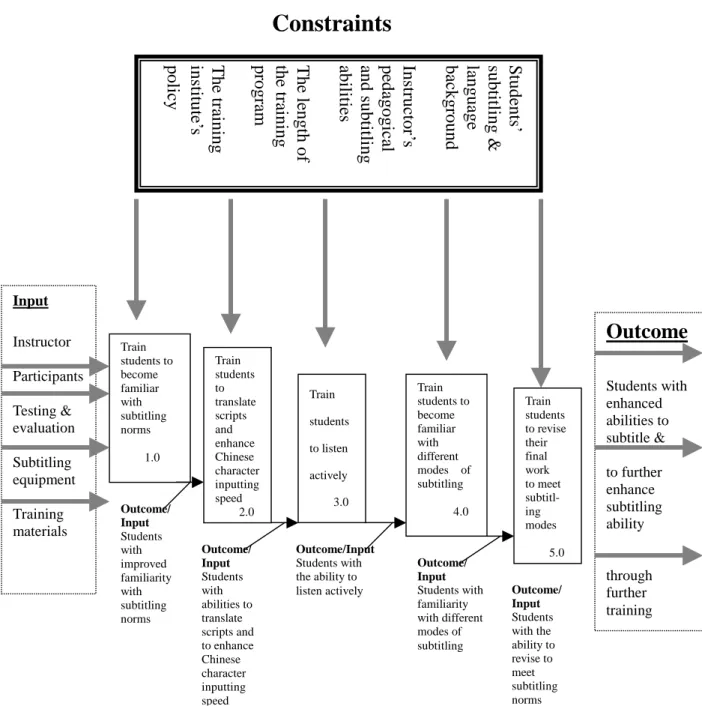
Borich and Jemelka (1982) indicated that program activities, indicated by boxes in the modeling process, represent the building blocks of the program. Each program activity can produce measurable outcome (Borich & Jemelka, 1982). In the subtitling course, the program activities include those for developing the following skills and subskills:
1.Become Familiar with Subtitling Norms (Chen, 2002), (see figure 7).
(1.1) Clarity and ease of comprehension.
(1.2) Conciseness and omission without disrupting the fluency and continuity.
(1.3) Synchronization with original information and using Chinese language syntactic structures without sounding like translation.
(1.4) Chunking with right timing and context, using double-lined subtitles appropriately, and economic use of punctuation marks.
(1.5) Other linguistic aspects, including registers, foreign languages, personal names, and swearwords.
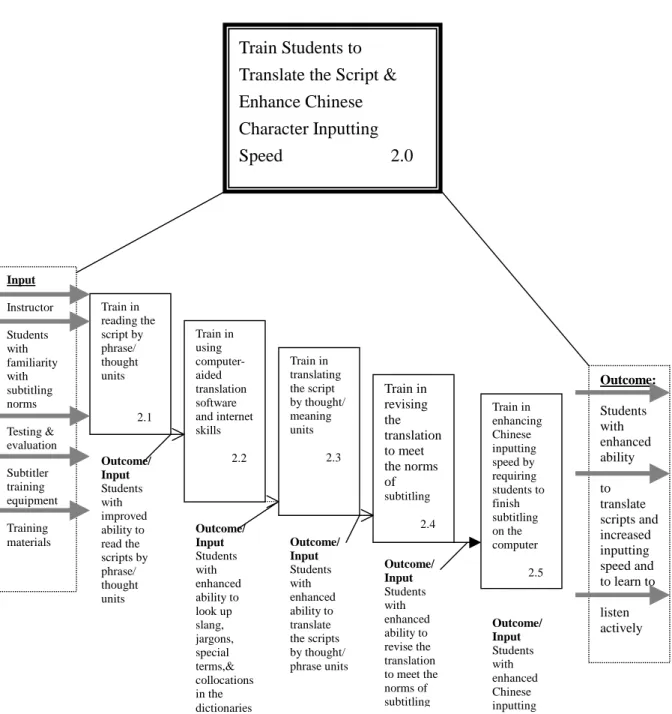
2. Translate the Script and enhance Chinese character inputting speed (see figure 8)
(2.1) Read the script by phrase/thought units.
(2.2) Using computer-aided translation software and searching on the Internet.
(2.3) Translate the script in subtitling units.
(2.4) Revise the translation to meet the norms of subtitling.
(2.5) Enhance Chinese character inputting speed by completing assignments on the computer.
3. Active Listening (see figure 9).
(3.1) Listen for details.
(3.2) Repeat by phrase/thought units after a message heard (listen to the movie DVD and pause at thought units).
(3.3) Repeat after the message heard by phrase units.
3.4 Repeat after the message heard by subtitle units.
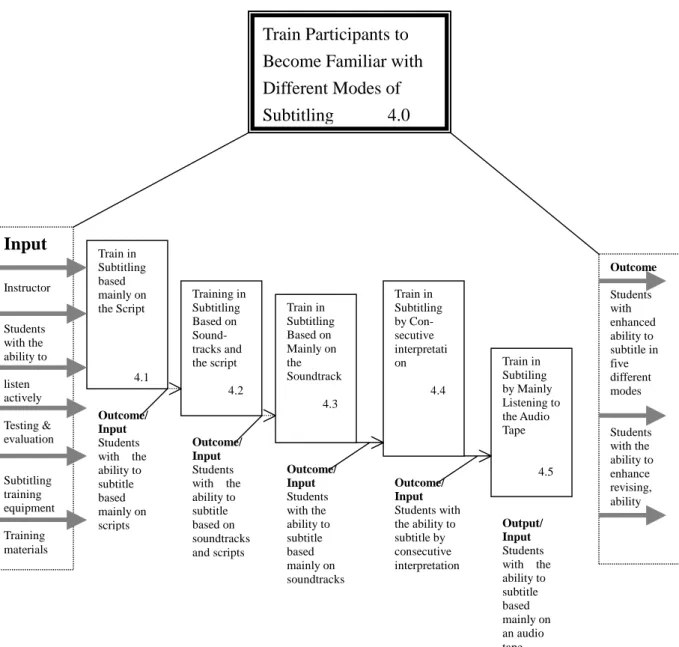
4. Different Modes of Subtitling (see figure 10).
(4.1) Subtitle based on the script, check the subtitles against the soundtrack for accuracy, and revise.
(4.2) Watch a movie played on a VCR and listen to the soundtrack, check the script against the soundtrack, identify the discrepancies between the script and the soundtrack, and then translate.
(4.3) Watch the movie played on a VCR, listen to the soundtrack, stop momentarily to consult the script, and then translate.
(4.4) Interpret consecutively.
(4.5) Listen to the soundtrack recorded on a tape played on a tape player and translate;
consult the script if available.
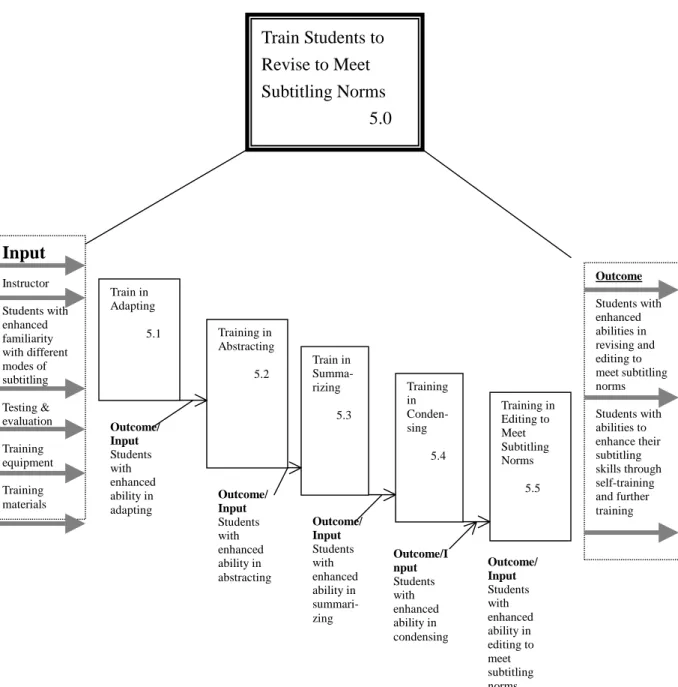
5. Revise to meet the norms of subtitling (see figure 11).
(5.1) Adapt.
(5.2) Abstract.
(5.3) Summarize.
(5.4) Condense.
(5.5) Edit.
6. OUTCOME
According to Borich (1998), outcome is indicated by arrows pointing rightward located at the right hand side of the program activities. In the subtitling course, the outcome represents the enhanced ability to subtitle and the ability to provide subtitles that are accurate and complete, that meet subtitling norms, and that deliver the same amount of impact as the source language does.
7. SKILL TRAINING
The tasks and subtasks introduced in this existing program were conceptualized while I observed the students learning to subtitle and translators subtitling. In addition, they were also derived from self-reflection of my own translation experience. Based on skill training theories, the overall skill of subtitling may be developed rooted on individual tasks involved. These tasks may be further divided into smaller, more manageable, tasks if learners experience difficulties in learning.
Notes:
This study is financed by ROC (Republic of China) National Science Council under grant number NSC 91-2516-S-011-002-. An earlier version of this paper
“Training the Next Generation of Subtitlers”was published at LISA Newsletter:
Globalization Insider XII/1.5. Another version of this paper was presented by Professor Fritz G. Hensey of the University of Texas at Austin at ATA's 44th Annual Conference, Phoenix, Arizona, November 5-8, 2003.
References
Borich, G.D., & Nance, D. D. (1986, January). Evaluation report: A conceptual model
of the San Antonio youth literacy program. A paper presented to the Board of
Directors of San Antonio Youth Literacy.
Borich, G. D. & Jemelka, R. P. (1982). Programs and systems: An evaluation
perspective. New York: Academic Press.
Borich, G.D. (1998). Program evaluation: Models and techniques. Unpublished course packet, Department of Educational Psychology at the University of Texas at Austin.
Article 23. (n.d.). Retrieved august 6, 2003 from the Film Law, ROC Government Information Office Website at http://www.gio.gov.tw/info/law/movie/index.htm
Chen, S.J. (1999). Teaching and learning in a non-language-specific interpreter
training course. Unpublished doctoral dissertation. The University of Texas at
Austin.Chen, S.J. (2002). Linguistic challenges of subtitling and coping solutions. Studies of
Translation and Interpretation, 7, 137-160.
Chen, Sheng-jie, & Hensey, Fritz. G. (2000). A structured decomposition model of a non-language-specific interpreter-training program. Studies of Translation and
Interpretation, 4, 81-120.
Klinzing, H. G. & Borich, G. D. (1984). The architecture of teacher education programmes. European Journal of Teacher Education, 7, 34-42.
Appendix B
Figure 1. Fundamental parts of a program model
Note: Adapted from Program evaluation: Models and techniques (p. 158) by G.D.
Borich, 1998. Unpublished course packet, Department of Educational Psychology at the University of Texas at Austin. Copyrighted 1998 by G.D. Borich. Adapted with permission.
Input
Constraints
A Specific Program Activity
Outcome
Figure 2. Illustration of a bird’s eye view of the subtitler-training program
A
Subtitler-training Program
Program Activity 1.0
Program Activity 2.0
Program Activity 3.0
Program Activity 4.0
Program Activity 5.0
Task 1.1
Task 1.2
Task 1.3
Task 1.4
Task 1.5
Task 2.1
Task 2.2
Task 2.3
Task 2.4
Task 2.5
Task 3.1
Task 3.2
Task 3.3
Task 3.4
Task 4.1
Task 4.2
Task 4.3
Task 4.4
Task 5.1
Task 5.2
Task 5.3
Task 5.4
Task Task 5.5
4.5
Main input
Figure 3 Relationship among program activities
Note: Adapted from Program evaluation: Models and techniques (p. 186) by G.D.
Borich, 1998. Unpublished course packet, Department of Educational Psychology at the University of Texas at Austin. Copyright, 1998 by G.D. Borich. Adapted with permission.
Program Activity
1
Program Activity
2
Program Activity
3
Outcome of this program activity
is input to this program activity
and to this program activity
Outcome of this activity
Main outcome
is a constraint on this program activity
Figure 4. The subtitler-training program: Overall purposes and five primary program activities
Partnership of the Instructor and Students to Enhance Students’
Subtitling Skills
Train students to become familiar with subtitling norms
1.0
Train students to translate the script &
enhance Chinese character inputting speed 2.0
Train students to listen actively
3.0
Train students to become familiar with different modes of subtitling 4.0
Train students to revise the subtitles to meet subtitling norms
5.0
Figure 5. The purpose of the subtitler-training program Constraints
S tudents’ subtitling background
Inst ruct or ’s pedagogical training and subtitling ab ility
The length of the training program
The training institute ’s
policy
PARTNERSHIP OF THE INSTRUCTOR &
STUDENTS TO ENHANCE THE STUDENTS’
SUBTITLING ABILITY
Input
Instructor Students Testing &
evaluation Subtitling equipment
Training materials
Outcome
Students with enhanced ability to subtitle
Students with ability to enhance subtitling skills by further training
Figure 6. The subtitler-training program---Five primary program activities and their input, constrictions, and outcome
S tudents’ subtitling & language background
Inst ruct or ’s pedagogical and subtitling ab ilitie s
The length of the training program
The training institute ’s policy
Input
Instructor
Participants
Testing &
evaluation
Subtitling equipment
Training materials
Train students to become familiar with subtitling norms
1.0
Train students to translate scripts and enhance Chinese character inputting speed
2.0
Train students to listen actively 3.0
Train students to become familiar with different modes of subtitling
4.0
Train students to revise their final work to meet subtitl- ing modes
5.0
Outcome
Students with enhanced abilities to subtitle &
to further enhance subtitling ability
through further training
Constraints
Outcome/
Input Students with improved familiarity with subtitling norms
Outcome/
Input Students with abilities to translate scripts and to enhance Chinese character inputting speed
Outcome/Input Students with the ability to listen actively
Outcome/
Input Students with familiarity with different modes of subtitling
Outcome/
Input Students with the ability to revise to meet subtitling norms
Train Students to Become Familiar with Subtitling Norms 1.0
Input
Instructor Students Testing &
evaluation Training materials Training equipment
Train in clarity and ease of under- standing
1.1
Train in conciseness
& omission without disrupting the fluency and continuity
1.2
Train in chunking with right timing , context, using appropriate double-lined subtitles, and punctuations
1.4
Outcome Students with enhanced familiarity with
subtitling norms and ability to translate scripts and enhance Chinese character inputting speed Outcome/
Input Students with abilities to create subtitles that are clear and easy to understand
Outcome/
Input Students with abilities to create subtitles that are concise and that omit without disrupting fluency and continuity
Outcome/
Input Students with abilities to create subtitles that
synchronize with the source language &
use Chinese language syntactic structures without sounding like translation
Outcome/
Input Students with abilities to chunk with right timing, context, using appropriate double-lined subtitles, and punctuation
Outcome/
Input Students with abilities to create subtitles that meet other linguistic norms, such as those for the use of registers, foreign languages, personal names, and swearwords Train in
synchroni- zation with the source language information
& in using Chinese language syntactic structures without sounding like translation 1.3
Train in following other linguistic norms, such as the use of registers, foreign languages, personal names, &
swearwords 1.5
Figure 7. The Subtitler Training Program: Activities of the program within “Becoming Familiar with Subtitling Norms”
Figure 8. Subtitling program: Activities of the program within
Train Students to Translate the Script &
Enhance Chinese Character Inputting Speed 2.0
Train in reading the script by phrase/
thought units
2.1
Train in using computer- aided translation software and internet skills
2.2
Train in translating the script by thought/
meaning units
2.3
Train in revising the translation to meet the norms of subtitling
2.4
Train in enhancing Chinese inputting speed by requiring students to finish subtitling on the computer
2.5
Outcome:
Students with enhanced ability
to translate scripts and increased inputting speed and to learn to
listen actively Input
Instructor Students with familiarity with subtitling norms Testing &
evaluation Subtitler training equipment Training materials
Outcome/
Input Students with improved ability to read the scripts by phrase/
thought units
Outcome/
Input Students with enhanced ability to look up slang, jargons, special terms,&
collocations in the dictionaries
Outcome/
Input Students with enhanced ability to translate the scripts by thought/
phrase units
Outcome/
Input Students with enhanced ability to revise the translation to meet the norms of subtitling
Outcome/
Input Students with enhanced Chinese inputting speed
“Script Translation and Chinese Inputting Speed Enhancement”
Figure 9. The Subtiter Training Program: Activities of the program within “Active Listening”
Train Students to Listen Actively
3.0
Train in listening for details
3.1
Train in repeating after a message heard by thought/phr ase units
3.2
Train in repeating after the messages heard by phrase /thought units
3.3
Train in repeating after a message heard by subtitle units
3.4
Outcome Students with enhanced ability to listen actively &
enhanced ability to become familiar with different modes of subtitling
Input
Instructor Students with enhanced ability to translate scripts and enhanced inputting speed Testing &
evaluation Training equipment Training materials
Outcome/
Input Students with enhanced ability to listen for details
Outcome/
Input Students with enhanced ability to listen to a message and repeat by thought/phrase units
Outcome/
Input Students\with enhanced ability to repeat after a message heard by
Outcome/
Input Students with enhanced ability to repeat after a message heard by subtitle units.
Figure 10. The subtitler-training program: Activities of the Program within “Familiarity with Different Modes of Subtitling”
Train Participants to Become Familiar with Different Modes of Subtitling 4.0
Input
Instructor
Students with the ability to listen actively Testing &
evaluation
Subtitling training equipment Training materials
Train in Subtitling based mainly on the Script
4.1
Training in Subtitling Based on Sound- tracks and the script
4.2
Train in Subtitling Based on Mainly on the Soundtrack
4.3
Train in Subtitling by Con- secutive interpretati on
4.4
Train in Subtiling by Mainly Listening to the Audio Tape
4.5
Outcome Students with enhanced ability to subtitle in five different modes
Students with the ability to enhance revising, ability Outcome/
Input Students with the ability to subtitle based mainly on scripts
Outcome/
Input Students with the ability to subtitle based on soundtracks and scripts
Outcome/
Input Students with the ability to subtitle based mainly on soundtracks
Outcome/
Input Students with the ability to subtitle by consecutive interpretation
Output/
Input Students with the ability to subtitle based mainly on an audio tape
Figure 11. The subtitler-training program: Activities of the program within “Revising to Meet the Norms of Subtitling”
Train Students to Revise to Meet Subtitling Norms
5.0
Input
Instructor Students with enhanced familiarity with different modes of subtitling Testing &
evaluation Training equipment Training materials
Train in Adapting
5.1 Training in
Abstracting 5.2
Train in Summa- rizing
5.3
Training in Conden- sing
5.4
Training in Editing to Meet Subtitling Norms
5.5
Outcome Students with enhanced abilities in revising and editing to meet subtitling norms Students with abilities to enhance their subtitling skills through self-training and further training Outcome/
Input Students with enhanced ability in adapting
Outcome/
Input Students with enhanced ability in abstracting
Outcome/
Input Students with enhanced ability in summari- zing
Outcome/I nput Students with enhanced ability in condensing
Outcome/
Input Students with enhanced ability in editing to meet subtitling norms