壹、緒論
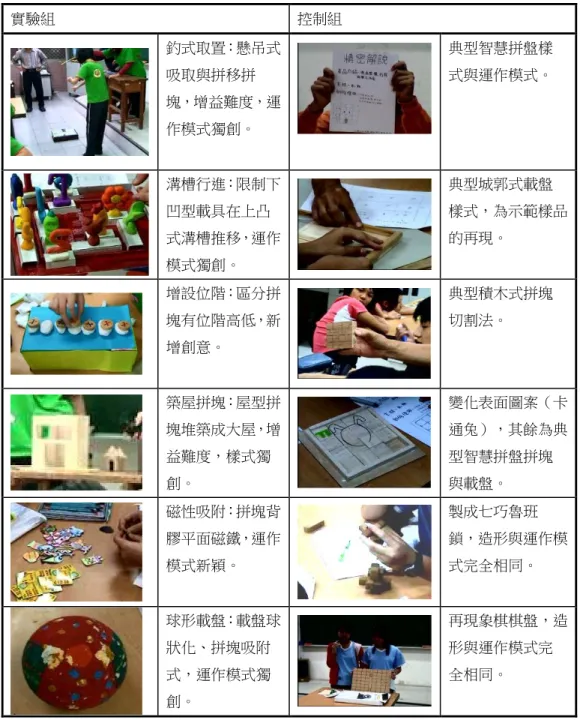
只有相鄰空缺處的拼塊有移動機會,每次僅能平移一片拼塊到唯一的空缺處,直到所 有的拼塊排序完成。
參考文獻
王保堤、游光昭、王鼎銘(2006)。設計導向課程對學生科技創造力影響之研究。新竹 教育大學學報,22,77-103。 朱益賢(2008)。從 Amabile 創造成份模式理論探討國小學童的實作技能與科技創造力 ──透過科技競賽策略。國科會專題研究計畫(編號:NSC 95-2511-S-003-021-MY3)。 李堅萍(2000)。國小美勞科的創造性教學策略。國教世紀,191,13-16 李堅萍(2006)。培育科技創造力應重視實作技能的教學與自我效能的激發。生活科技 教育月刊,39(8),頁 21-28。 李堅萍、游光昭、朱益賢(2008)。國中科技教育運用 Teresa M. Amabile 工作動機原則 與自我效能激發策略之研究。新竹教育大學教育學報,25(2),129-159。 李隆盛(1993)。技學面面觀。技術及職業教育雙月刊,31,18-20。 Amabile, T. M. (1996). Creativity in context. Boulder, Colorado: Westview Press. Cordes, C. (2005). Long-term tendencies in Technological creativity - a preference-basedapproach. Journal of Evolutionary Economics, 15(2), 149-149.
Csikszentmihalyi, M. (1996). Social, culture, and person: A system view of creativity. In R. J. Sternberg (Ed.), The Nature of Creativity (pp. 325-39). NY: Cambridge University Press.
Dudek, S. Z., Strobel, M. G., & Runco, M. A. (1993). Cumulative and proximal influences on the social environment and children’s creative potential. The Journal of Genetic Psychology, 154(4), 487-499.
Folkestad, J. E. & DeMiranda, M. A. (2000). Linking cognitive science theory and technology education practice:A powerful connection not fully realized. Journal of Industrial Teacher Education, 37(4), 5-23.
Howe, R. (1997, November). Creative problem solving approaches processes for teaching and doing creative activity. Paper presented at the seminar of Instruction for Creative Thinking. Taipei, Taiwan: National Taiwan Normal University.
Lewis, T. (1999). Research in technology education: Some areas of need. Journal of Technology Education, 10(2), 41-56.
Li, Y., Zhao, Y., & Liu, Y. (2006). The relationship between HRM, technology innovation and performance in China. International Journal of Manpower, 27(7), 679-697. Peterson, T. O., & Arnn, R. B. (2005). Self-efficacy: The foundation of human performance.
Performance Improvement Quarterly, 18(2), 5-18.
Redelinghuys, C., & A, T. B. (2006). A framework for the assessment of the creativity of product design teams. Journal of Engineering Design, 17(2), 121-141.
Thomson, C. J. (2001). Characteristics of technology education that are unique and essential for children's learning in the elementary school curriculum. Unpublished doctoral dissertation. University of Missouri – Columbia, U. S. A.