行政院國家科學委員會專題研究計畫 成果報告
以網路編碼提升無線網路傳輸效率 研究成果報告(精簡版)
計 畫 類 別 : 個別型
計 畫 編 號 : NSC 100-2221-E-011-158-
執 行 期 間 : 100 年 08 月 01 日至 101 年 07 月 31 日 執 行 單 位 : 國立臺灣科技大學資訊工程系
計 畫 主 持 人 : 金台齡
報 告 附 件 : 出席國際會議研究心得報告及發表論文
公 開 資 訊 : 本計畫可公開查詢
中 華 民 國 101 年 10 月 03 日
中 文 摘 要 : 本研究利用網路編碼來提升無線網路傳輸效率,並以車載網 路為對象,提出點對點的檔案分享機制,發揮網路編碼的特 性,使檔案分享的下載更有效率。點對點的檔案分享已被運 用於許多地方,近年來在無線網路的傳輸上,通常使用 3G 的 電話網路,隨著使用的人數增加,3G 的資料傳輸能力已不敷 使用,尤其車載網路的動態網路環境,讓檔案的分享在車載 網路上更加困難,本研究利用本實驗室開發之車載網路遶徑 方法 Movement-Forecasted Packet Delivery (MFPD),設計 以網路編碼來增進在車載網路下點對點檔案分享的傳輸效 率,提出 Network Coded File Sharing (NCFS)的網路點對 點檔案分享機制,模擬的結果可看出我們所提的方法可以有 效的提升車載網路的檔案分享下載效率。
中文關鍵詞: 網路編碼、車載隨意網路、遶徑、點對點網路、檔案分享 英 文 摘 要 : This project investigates the problem of improving
transmission efficieny using network coding and using vehicular ad-hoc network as an example to design file sharing mechanism with network coding. Mobile peer- to-peer (P2P) file sharing systems have been widely utilized in recent years. Currently, most file
sharing systems in wireless networks are implemented through 3G telecommunication technology. However, the rapid growing number of users and the limited
bandwidth in telecommunication systems cause the quality of communication prone to deteriorate. This paper develops a file sharing system in Vehicular Ad- Hoc Networks. To tackle the problem of frequent changes of network topologies, a novel routing
protocol, namely Movement-Forecasted Packet Delivery (MFPD) is proposed. In addition, to solve packet delivery problem, a new P2P scheme, namely Network Coded File Sharing (NCFS) is developed. NCFS is designed based on MFPD and integrated with network coding to enhance file delivery efficiency. Results of simulations show that the developed system
performs file sharing effectively in VANETs.
英文關鍵詞: Network coding, Vehicular ad-hoc network, Routing, Peer-to-peer network, File sharing
行政院國家科學委員會補助專題研究計畫 ■成果報告
□期中進度報告
以網路編碼提升無線網路傳輸效率
計畫類別: ■ 個別型計畫 □整合型計畫 計畫編號:NSC 100-2221-E-011-158-
執行期間: 2011 年 8 月 1 日至 2012 年 7 月 31 日 執行機構及系所:台灣科技大學 資訊工程系
計畫主持人:金台齡 共同主持人:
計畫參與人員:杜信昌、李育姍、莊婉甄
成果報告類型(依經費核定清單規定繳交): ■ 精簡報告 □完整報告 本計畫除繳交成果報告外,另須繳交以下出國心得報告:
□赴國外出差或研習心得報告
□赴大陸地區出差或研習心得報告
■ 出席國際學術會議心得報告
□國際合作研究計畫國外研究報告
處理方式:除列管計畫及下列情形者外,得立即公開查詢
□涉及專利或其他智慧財產權,□一年□二年後可公開查詢
中 華 民 國 101 年 7 月 31 日
Network Coded File Sharing in Vehicular Ad-Hoc Networks
†Tai-Lin Chin, ‡Yeong-Sheng Chen,†Hsing-Chang Du, †Yu-Shan Li, †Wan-Chen Chuang
†Dept. of Computer Science & Information Engineering, National Taiwan University of Science and Technology
‡Dept. of Computer Science, National Taipei University of Education Taipei, Taiwan
Email:{tchin,M9915052,M9915037,M9915030}@mail.ntust.edu.tw, [email protected]
Abstract—Mobile peer-to-peer (P2P) file sharing systems have been widely utilized in recent years. Currently, most file shar- ing systems in wireless networks are implemented through 3G telecommunication technology. However, the rapid growing number of users and the limited bandwidth in telecommunication systems cause the quality of communication prone to deteriorate.
This paper develops a file sharing system in Vehicular Ad-Hoc Networks. To tackle the problem of frequent changes of network topologies, a novel routing protocol, namely Movement-Forecasted Packet Delivery (MFPD) is proposed. In addition, to solve packet delivery problem, a new P2P scheme, namely Network Coded File Sharing (NCFS) is developed. NCFS is designed based on MFPD and integrated with network coding to enhance file delivery efficiency. Results of simulations show that the developed system performs file sharing effectively in VANETs.
I. INTRODUCTION
Packet delivery is one of the most challenging problems in VANETs. Different from traditional Mobile Ad-Hoc Networks (MANETs), topology changes more rapidly in VANETs be- cause modern vehicles can move in very high speed. Although telecommunication technologies can support communications in high speed, the limited bandwidth can cause serious prob- lems for file sharing. Many VANETs routing protocols pro- posed in the literature [1], [2], [3], [4] only modify traditional routing schemes in MANETs. However, those schemes may not be appropriate in vehicular environments. For instance, fixed routes created by AODV may be broken from time to time in VANETs. In addition, some VANETs routing schemes are developed based on certain assumptions which would increase overhead or need extra devices. For example, in some schemes, vehicles periodically broadcast Hello messages to maintain their neighbor tables, or collect certain traffic infor- mation by exchanging control packets. Some other schemes need to install roadside units to help route packets. Those additional control packets and devices can increase the load and cost of a wireless network.
Information sharing is a promising application in networks, especially in VANETs. People may want to download the map or direction to a new mall or share music during the way to their office. Peer-to-peer (P2P) technology has been used in many mobile network applications and can be an efficient file
This work was supported in part by the National Science Council of Taiwan under grant NSC 100-2221-E-011-158
sharing mechanism without maintaining a server. P2P model provides reliable services through peer collaborations and has the property of high level self-organization. However, quality of file sharing through P2P could be low in Vehicular Ad-Hoc Networks (VANETs) because of the frequent topology changes and dynamic transmission environments.
This paper proposes an efficient file sharing scheme in VANETs, called Network Coded File Sharing (NCFS), which is developed based on the proposed routing protocol, Move- ment Forecasted Packet Delivery (MFPD). The file sharing scheme is integrated with network coding technology to im- prove delivery efficiency. MFPD uses Movement-Forecasted Area (MFA) to predict the potential region for the destination vehicle’s current location. The source vehicle forwards packets to the MFA without the assistance of extra devices or control packets. It then finds the destination vehicle in the MFA for packet delivery. In addition, network coding is adopted to enhance file delivery performance with MFPD. According to the error-prone wireless channels and the dynamic topologies of vehicular networks, the probability of packet loss during packet forwarding is high. Network coding can improve file delivery performance such as reducing delivery delay without retransmitting duplicated packets [11].
The contributions of this paper are three folds: (1) Propose a new routing scheme, MFPD, to conquer the problems of inter- mittent connections and error-prone communications in vehic- ular networks. (2) Reduce network overheads by forwarding packets without redundant control messages. (3) Provide a file sharing scheme, NCFS, based on network coding to reduce the latency of transmitting a file in VANETs. Performance of the proposed file sharing scheme is demonstrated by simulations.
The results show that network coding is helpful and effective for file delivery in vehicular networks.
The rest of this paper is organized as follows. Section II presents the related work. Section III introduces the routing scheme MFPD. Section IV describes the proposed network coded file sharing scheme NCFS. Section V shows simulation results. Finally, Section VI concludes this paper.
II. RELATEDWORK
This section briefly reviews major work in the literature for file sharing in VANETs.
A. File sharing in VANETs
In the past decade, many peer-to-peer file sharing studies have been proposed for VANETs [7], [8], [9]. Lee et. al.
proposed CarTorrent as an extension of BitTorrent protocol [7].
The protocol performs broadcast by using a gossip mechanism with a forwarder selection scheme. Abuelela and Olariu pro- posed a non-infrastructure peer to peer system called ZIPPER to support multimedia streaming for movies and music [8].
The expected number of vehicles needed to download a file is calculated and used to improve the efficiency for the downloading. Nandan et. al. proposed a cooperative strategy for file delivery and sharing called SPAWN for vehicular ad- hoc networks [9]. An efficient swarming protocol that utilizes a gossip mechanism to reduce overhead is also proposed. Al- though all the above studies provide file sharing, transmission may incur long latency because of the dynamic environment in VANETs. In this paper, we use network coding to improve the efficiency for packet delivery.
B. File sharing with network coding
Network coding is a popular approach to maximize through- put and decrease download time since a user only needs to collect a sufficient number of coded blocks to recover the original file [11]. Many researchers have used network coding technology in different applications [5], [6]. Ahmed and Kanhere [5] proposed a novel network coding scheme for cooperative content distribution tailored for VANETs.
They use stationary gateways along freeways to distribute a file. These gateways split the original file into blocks and encode the blocks with random coefficients. The coded blocks are broadcasted through the gateways. Vehicles interested in the file would collect the corresponding encoded blocks and recover the file. In [6], a network coding scheme, called CodeTorrent, based on file swarming protocol for VANETs is proposed. The design of CodeTorrent utilizes single-hop com- munication. Assume that a seed node creates the description of a file to its one-hop neighbor. The file is divided inton frames and encoded by network coding. If one node is interested in the file, it broadcasts a request containing the description of the requested file. As receiving the request, a node which has original pieces or coded frames of the requested file responds with a newly generated coded frame. A node collecting n linearly independent coded frames can decode and recover the original file. The previous studies use similar concept of network coding. Nevertheless, using network coding in a dynamically changing topology is still a challenging problem.
III. MOVEMENT-FORECASTEDPACKETDELIVERY
Location-aided routing protocol has been designed for mo- bile ad-hoc networks [10]. The proposed routing protocol, namely Movement-Forecasted Packet Delivery (MFPD), is also a location-aided protocol but tailored for vehicular networks.
A. Packet Delivery
Assume that vehicles in the system are equipped with GPS devices and are aware of their own positions and speeds.
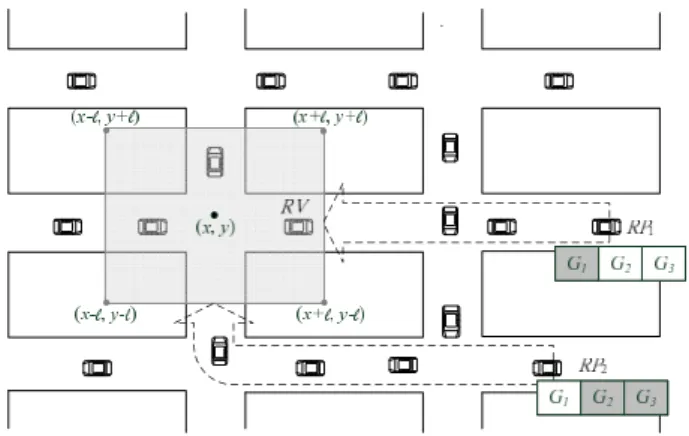
Fig. 1. Transmission from RP to RV
MFPD intends to deliver packets without control messages, like Hello. In addition, there is no extra location system to maintain and provide other vehicles’ location. Without loss of generality, assume that a particular vehicle, called Requesting Vehicle (RV ), needs a certain file and decides to download the file through P2P file sharing. Initially, theRV broadcasts a request, which contains its current position, a timestamp, and time-to-live (TTL) duration as well as the file signature. The purpose of setting TTL is to prevent packets from infinitely being re-forwarded over the network. A vehicle which has the file may receive the request and prepare to deliver the file to theRV . This vehicle is called Resource Provider (RP ). Since the RV may be moving during the interval of forwarding the request, a potential region of the RV ’s location, called Movement-Forecast Area (MFA), is calculated by the RP . Using the RV ’s position and the timestamp in the request message, the MFA is calculated as follows. Assume that the RV sends a request at location (x, y) at time Ti. The MFA is a2ℓ × 2ℓ square shown as the gray square in Fig. 1. If the request is received by aRP at time Tj, theℓ is calculated as follows:
ℓ = 2 × V × (Tj− Ti), (1) whereV is the speed of the RV . The MFA is used to predict the region where the RV may reside when the data packet reaches theRV .
After calculating the MFA, theRP transmits a data packet to the RV . The data packet carrying the MFA and the RV ’s ID is first forwarded to reach the MFA using the following location aided scheme. It is then forwarded to the RV by epidemic flooding within the MFA. Any intermediate vehicles which receive the data packet check whether they are in the MFA. If they are in the MFA, they forward the packet by epidemic flooding. Otherwise, a distributed arbitration is performed to decide who should forward the packet. They first start a back-off timer and wait until the timer expires. The duration of the back-off time is derived from the following score function:
score(v) = dv
R cos θv (2)
where dv is the distance from the sending vehicle to the
Fig. 2. Variables in the score function
receiving vehicle v, R is the transmission range and θv is the angle between the line from the sender to the receiver v and the line from the sender to the destination RV as shown in Fig.2. The back-off time of an intermediate vehicle is inversely proportional to its score. If a vehicle’s score is high, its back-off time is short. The vehicle with the highest score will forward the packet first. Other intermediate vehicles hearing the packet will stop their back-off timer and drop the packet. Note that only vehicles with positive score will join the forwarding competition.
If the sending vehicle hears other vehicle forwarding the packet, it broadcasts an ACK. The ACK is also used to terminate the back-off timer on the other intermediate vehicles in case they did not hear the previous data packet forwarding.
If the sender does not hear any other vehicles forwarding the packet within the maximum back-off duration, it will carry the packet and try to forward the packet again after a certain time duration t. A possible duration could be set as R/V , where the transmission range is R and the vehicle speed is V . The packet is dropped if the TTL expires.
The procedure is repeated until the data packet is received by an intermediate vehicle in the MFA of theRV . Then, the packet is turned to epidemic flooding mode within the MFA.
When theRV receives the packet, it sends out a notification message to notify its neighbors to stop further flooding.
IV. NETWORKCODEDFILESHARING
In this section, the developed peer-to-peer file sharing mechanism called Network Coded File Sharing (NCFS) in VANETs based on MFPD is presented.
A. Network Coding
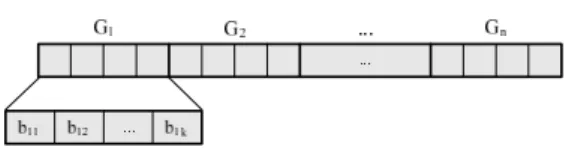
Assume that a RV in the network requests a certain file, for example an mp3 or jpeg file. When a RP receives the request, it prepares data packets as follows. The file is divided inton generations G1,G2, . . . ,Gn. Each generation is further divided into k blocks as shown in Fig. 3. Note that a RP may have one or more generations of the file, but is not necessary to have the whole file. Before transmitting data to theRV , the RP makes coded blocks first. The RP selects one generation from the file. Assumeb1, b2, ..., bkare the blocks in
Fig. 3. Block format
the selected generation. TheRP applies random linear coding to the blocks and generates a coded blockxi as follows:
xi=
k
X
j=1
cijbj (3)
where cij is a constant coefficient randomly chosen from a finite fieldF(2s). A typical field used in random linear coding is Galois field. The coded block is then sent to theRV using MFPD. Note that, in Galois field, modulo-2 multiplication is used. Therefore, the size of the coded block is the same as the original block. Denote ci= [ci1ci2...cik] as the coefficient vector. RP can send a sequence of coded blocks which are encoded by different random coefficient vectors.
To recover the original data, theRV just collects any coded blocks that it receives. Let x= [x1x2...xk]T be the vector of the collected coded blocks, b= [b1b2...bk]T be the vector of the original blocks, and
C=
c11 c12 ... c1k
c21 c22 c2k
... . .. ... ck1 ck2 ... ckk
.
The collected coded blocks can be expressed as the following linear system:
x= Cb.
Thus, as long as C is non-singular, RV can recover the original blocks by
b= C−1x.
A coefficient vector ci is linearly independent to another coefficient vector cj if ci 6= a × cj for any real number a.
Clearly, to recover the original blocks, RV needs to collect at least k coded blocks with linearly independent coefficient vectors. Note thatk is the number of blocks in one generation.
Clearly, it is more possible to generate linearly independent coefficient vectors from a large Galois field than from a small field. In general, a field F(2s) is large enough when s=8.
Further, the coded blocks can be sent from different RP s and thus multipleRP s can collaborate to accomplish the file transmission. Order of the coded blocks received by theRV is not important any more.
B. Peer-to-Peer File Sharing Mechanism
When moving on the road, a vehicle may want to retrieve certain information from the network. For instance, it may want to download the current traffic information from vehicles in the vicinity. Consider that aRV wants to download a certain file from the network while moving. The RV broadcasts a
request which is the same as that at the beginning in MFPD.
There may be more than one vehicles that receive the request and also carry part or full of the requested file. Obviously, these vehicles can be the RP s and collaborate to transfer the requested file using network coding. Each RP has to pick one generation in the file and starts sending coded blocks using MFPD to the RV . However, the generation that one RP picks can affect the efficiency of the file downloading process. If all theRP s choose the same generation, there may be too many redundant coded blocks in the network and the latency of the downloading could be longer. NCFS uses a demanding vector to guide the decision making at each RP . Recall that to recover the original data, RV has to collect k linearly independent coded blocks for each generation. Thus, when theRV sends the request, it includes a demanding vector d = [d1, d2, ..., dn] in the request. The demanding vector defines the number of coded blocks that theRV still needs for each generation. Specifically, ifRV has received mi linearly independent coded blocks for Gi, thendi= k − mi.
When aRP receives the request, it will check whether its own data can help theRV . Note that the RP may only have partial data of the file. LetF be the set of generations that the RP has the whole generation. Further, let S be a set defined as follows:
S = {Gi|di> 0 and Gi∈ F }.
The RP will pick one generation in S and the probability of pickingGi is proportional to the demand, i.e.,
P rob (Gi) = di
P
i∈I
di
,
where I = {i|Gi∈ S}. After choosing the generation, the RP starts making k coded blocks and sending them to the RV using MFPD.
Finally, the RV sends request messages periodically until the file is completely received. Since RV is moving, on the one hand, the request messages can find newRP s on the way, and on the other hand, the request messages can also keep the position of the RV updated to the old RP s.
Fig. 1 illustrates the process of data packet forwarding from RP s to RV . The scenario has one RV and two RP s.
The file is divided into three generations in this example.
Assume that RP1 has G1 and RP2 has G2 and G3. The RV broadcasts request periodically. In the first period, RV broadcasts a request for the whole file. After receiving the request, RP1 can only pickG1 andRP2 can pick G2 orG3 with equal probability. Say, RP2 picks G3. Then, they send coded blocks for the picked generations using MFPD. In the second period,RV broadcasts a request based on the current conditions of its collection. In this period, RP2 will pick G2
with higher probability if the RV has received some coded blocks for G3.RP2 can also update the location information of theRV . This is a simple example. Real conditions will be more complicated.
0 50 100 150 200 250
0 0.1 0.2 0.3 0.4 0.5 0.6 0.7 0.8 0.9 1
Vehicle distance [m]
Probability for receiving a packet
Fig. 4. Receiving probability based on shadowing model
TABLE I
SIMULATIONPARAMETERS
Parameter Value
Simulation Area 1500 m × 1500 m
File Size 1000 KB
Generation Size 10 KB
Block Size 1 KB
Number of Vehicles 50 - 150 vehicles
Vehicle Velocity 0 - 20 m/s
Transmission Range 250 m
Periodic Broadcast Time of RV 4 s
V. SIMULATIONS
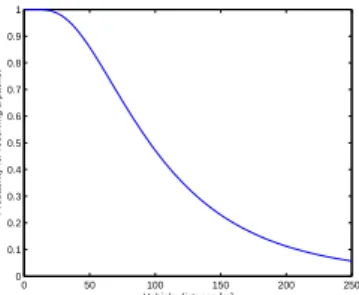
The performance of NCFS is evaluated by simulations using NS2. The simulation area is a 1500m× 1500m region and the map is a gird with roads equally distant by 500m. Traffic flows are generated by SUMO [13] and MOVE [12]. To simulate the dynamic transmission conditions in VANETs, a shadowing model shown in Fig. 4 is used for wireless communication in the simulations. Other parameters used in the simulations are listed in Table I.
Several RP s and one RV are randomly selected from the vehicles. The period for theRV to broadcast a request packet is four seconds. The requested file size is 1MB. The block size for network coding is 1KB and one generation contains ten blocks. The velocity of each vehicle is chosen randomly between 0 and 20 m/s. When a vehicle reaches an intersection, it randomly decides to move straight, turn right, or turn left.
The performance of file downloading using NCFS and not using NCFS is compared. When NCFS is not used, RP s just send raw data blocks in the selected generation to the RV without doing network coding. Therefore, the number of blocks sent after receiving a request is the same for both methods. Each sample point is an average of 30 runs.
Fig. 5 shows the average download time of the file that the RV spends with different number of vehicles in the simulation area. One RV and 20 RP s are randomly chosen in the simulations. At the beginning, we assume that ten of the RP s have the whole file and the other RP s may be still downloading the file and have only half of the generations, which are randomly selected, in the file. As shown in the figure, the average download time decreases as the number of vehicle increases. This is because if the density of vehicles increases, more vehicles can help forward packets, and hence
Fig. 5. Average downloading time v.s. the number of vehicles
Fig. 6. Average downloading time v.s. the number of RP s
both the carry time and forwarding time are very likely to be reduced. In addition, the download finishes faster in NCFS.
This can be reasoned as follows. In the case without using NCFS, theRV will receive raw blocks in the file. If one block is dropped during the transmission, the RV has to receive the exact lost block again. However, in NCFS, the RV only has to receive enough coded blocks with linearly independent coefficients, and the original generation can be recovered.
Fig. 6 shows the average downloading time that the RV needs for the file with different number of RP s. The total number of vehicles is 100. As shown in the figure, the average downloading time decreases as the number of RP s increases, because more vehicles share the file with theRV . In addition, the downloading time of NCFS is also less than that without using NCFS.
Fig. 7 illustrates the average latency versus the ratio of completeness of the file downloaded using NCFS. In this simulation, there are oneRV and 20 RP s. From the figure, we can observe that vehicle density is helpful to file downloading even when the number of source vehicles remain small. The reason is that if vehicle density is low, MFPD has a higher probability to enter the carry-and-forward mode and carry the file for a certain amount of time. The duration of the carry time is much higher compared with radio transmission time.
In addition, the probability that theRV moves out of the MFA becomes higher if vehicle density is low. This could cause the
Fig. 7. The latency v.s. completion ratio
RV spend more time on collecting enough coded blocks to recover the original file.
VI. CONCLUSION
In this paper, the Network Coded File Sharing (NCFS) sys- tem is developed based on a novel routing protocol, Movement- Forecasted Packet Delivery (MFPD). MFPD uses Movement- Forecasted Area (MFA) to predict the potential region of the destination vehicle’s current location and forwards packets to the MFA without extra control messages. In addition, network coding is integrated in NCFS to improve file delivery performance. The future work is to investigate the fairness of the P2P sharing scheme and develop appropriate incentive rules for coded block delivery.
REFERENCES
[1] W. Wang, F. Xie, and M. Chatterjee, ”Small-scale and large-scale routing in vehicular ad hoc networks,” in IEEE Trans. Veh. Technol., vol. 58, no.
9, pp. 5200-5213, Nov. 2009.
[2] M. Jerbi, S.-M. Senouci, T. Rasheed, and Y. Ghamri-Doudane, ”Towards efficient geographic routing in urban vehicular networks,” in IEEE Trans.
Veh. Technol., vol. 58, no. 9, pp. 5048-5059, Nov. 2009.
[3] J. Nzouonta, N. Rajgure; G. Wang, and C. Borcea, ”VANET routing on city roads using real-Time vehicular traffic information,” in IEEE Trans.
Veh. Technol., vol. 58, no. 7, pp. 3609-3626, Sept. 2009.
[4] Z. Niu, W. Yao, Q. Ni, and Y. Song, ”Study on QoS support in 802.11e- Based multi-hop vehicular wireless ad hoc networks,” in IEEE Int’l Conf.
on Networking, Sensing and Control, pp.705-710, Apr. 2007.
[5] S. Ahmed and S. S. Kanhere, ”VANETCODE: Network coding to enhance cooperative downloading in vehicular ad-hoc networks,” in Proc. IWSMS, 2006.
[6] U. Lee, J.-S Park, J. Yeh, G. Pau and M. Gerla, ”CodeTorrent: Content distribution using network coding in VANET,” in Proc. MobiShare, 2006.
[7] K. E. Lee, S.-H Lee, R. Cheung, U. Lee and M. Gerla, ”First experience with CarTorrent in a real vehicular ad-hoc network testbed,” in Proc.
MOVE, 2007.
[8] M. Abuelela and S. Olariu, ”ZIPPER: A zero-infrastructure peer-to -peer system for VANET,” in Proc. WMuNeP, Oct. 2007.
[9] A. Nandan, S. Das, G. Pau, M. Gerla and M. Y. Sanadidi, ”Co-operative downloading in vehicular ad-hoc wireless networks,” in Proc. WONS, Jan.
2005.
[10] Y. Ko and N. Vaidya, ”Location-aided routing (LAR) in mobile ad hoc networks,” in Proc. ACM Mobicom, pp.66 -75 1998.
[11] X. Shao and R. Wang, ”Review of network coding based routing algo- rithm for wireless mesh networks,” in Journal of Convergence Information Technology (JCIT), pp.146-153, December 2011.
[12] F. K. Karnadi, Z. H. Mo, and K.-C. Lan, ”Rapid generation of realistic mobility models for VANET,” in Proc. WCNC, 2007.
[13] SUMO, Simulation of Urban Mobility, http://sumo.sourceforge.net/.
1
國科會補助專題研究計畫項下出席國際學術會議心得報告
日期: 100 年 12 月 20 日
一、參加會議經過
今年的 Globecom 在美國德州休士頓舉行,此會議是由 IEEE 與 IEEE Communication Society 所主辦,每年發表在網路與統訊方面的尖端研究論文,會議包含技術論文發表、展覽與工業界的 領袖論壇,今年大會收錄了 1072 篇技術論文,並舉辦了 11 個不同的教學會議(tutorial),超過 20 個 workshop,另外還有業界的論壇,吸引了世界各地包含學者、研究人員、專業人士與政府官 員超過兩千人註冊參加,討論的問題包含了所有網路通訊相關議題。
我由於有一篇論文被大會接受,因此也需註冊參加會議並做論文發表,經過了一天的飛行與 轉機,終於到達目的地,到達時已是 12 月 5 日晚上 9 點多,來不及參加大會於傍晚舉辦的 Welcome reception,不過這只是個社交的場合,並不是太重要的聚會,晚餐吃過後就休息了。
第二天正式進入大會的議程,一早的 Keynote speech 是由 AT&T 的技術長 John Donovan 主講,講 題是 Mobile Innovation: Advancing the Mobile Broadband Experience,講述了一些目前網路 發展的趨勢,例如雲端運算、軟硬體的整合與使用者介面等等,並介紹了 AT&T 的技術發展目標與 近況。接下來就是各個主題的論文發表,由於收錄的論文涵蓋了網路與通訊的各項議題,所以也 區分在不同的研討室發表,同時也有一個 Executive Forum 邀請了業界的管理階層討論有關雲端 運算的發展,因為雲端運算是目前相當熱門的議題,且邀請的是業界的執行長級人物,如 NTT American 的執行長 Kazuhiro Gomi 與 Venture Partners LLC 的執行長 Hossein Eslambolchi 等,
因此我選擇了去參加這個 Executive Forum 的討論,聽聽業界對於雲端運算的看法,與學術界的 研究差異,業界普遍認為雲端運算是未來網路產業一個重要的發展方向,但目前還需要面對許多 挑戰,如安全問題與使用者需求與成本的考量。下午的議程只有各主題的論文發表,因之前計劃 有關車載網路,因此我參加了車載網路的議程,會議中發表的論文大都是利用感測網路收集資訊,
協助在動態網路中封包或資料的傳遞。
我的報告在 12 月 7 日早上 8:00,一大早並沒有什麼人來聽演講,大部分的聽眾都是同一時
計畫編號 NSC 100-2221-E-011-158-
計畫名稱 以網路編碼提升無線網路傳輸效率 出國人員
姓名 金台齡 服務機構
及職稱 台灣科技大學資工系助理教授 會議時間 100 年 12 月 5 日至
100 年 12 月 9 日 會議地點 美國德州休士頓 會議名稱
IEEE Global Communication Conference (Globecom)發表論文
題目
Optimal Detector Based on Data Fusion for Wireless Sensor Networks2
間發表的論文作者,我是第一個上台發表的人,因為台下聽眾不多,壓力也沒那麼大,二十分鐘 的演講,我的時間沒有掌握的很好,時間有點拖的太長了,台下主席一直給我打暗號,我也只好 加快一點速度,最後還是圓滿達成任務,以後可能要再練習一下,把時間控制的更好。同場還有 一組大陸的學生也來發表,可能是學生的關係,發表時是很流暢,不過一聽就知是在背稿,東方 學生在語言上還是比較需要努力的。接下來又是一場 Keynote speech 以及最佳論文的頒獎,
Keynote speech 是由加州大學聖地牙哥分校的教授 Laurence Milstein 主講,講題是 PHY-APP Cross-Layer Design for Mobile Video,我對 Physical layer 不是很熟悉,有些地方不是太了 解他的做法。接下來就到了最佳論文的頒獎,今年台大廖婉君教授與學生發表的論文:Cooperative Multicasting for Scalable Video in Wireless Networks 也獲得最佳論文獎,廖教授真的是非 常傑出的學者,能夠在這麼競爭的會議裡脫穎而出,相當不容易。下午又皆是論文的發表,我選 了有關 Network coding 的場次,這個題目目前也看到越來越多在無線網路的研究,期望以網路編 碼加快無線網路的傳輸。晚上大會有晚宴,不過由於計畫經費的關係,我並沒有報名參加晚宴,
雖也是社交的場合,不過若有經費參加,也許會碰上國際知名的學者,國內計畫經費的使用應更 有彈性才好。
大會的第三天,由於我已經報告完了,心情也特別輕鬆,一早是論文的發表,我又參加了有 關車載與行動隨意網路的場次,之前在車載方面的研究感覺在動態的網路中要建立一個可靠的傳 輸方式,技術上還是有待研究,許多文獻發表的方法都不太切合實際,要有實際上的應用還是相 當有挑戰的。中場休息時,大會還有辦摸彩,想必是要把大家留在會議議場,當然一向運氣沒那 麼好的我也沒有抽中。接下來還有一場 Keynote speech,是由 NSF 的 Directorate of Computer and Information Science and Engineering 的 Director Farnam Jahanian 演講,講題是 Innovating for Society: Realizing the Promise of Computing and Communications,講述了有關他們對 於寬頻無線傳輸與雲端運算發展等影響我們未來生活趨勢的看法,並對這些先進科技在環境保護、
教育、運輸、國家安全等等方面如何引導未來美國的發展,由於其來自 NSF,他的意見也許對美 國的研究人員申請計畫有很大的影響,應此參加的人也相當的踴躍。下午是大會論文發表的最後 一天,我參加了一場感測網路定位問題的研討,這個問題已在近幾年被廣泛的討論,不過針對各 種不同環境與器材的假設仍不斷的提出,也一直有新的論文在提出。最後趁著還沒天黑,到休士 頓的周邊逛了一圈,休士頓市中心並不大,不過街道很整齊,高樓也很多,城市裡的商業氣氛沒 有我想像的旺盛,沒想到一個這樣國際知名的城市,卻如此地平靜與緩和,也許大家知道休士頓 是因美國太空總署 NASA 位於此地,常常在電影裡看到太空人跟休士頓的通話場景,不過其實 NASA 距離休士頓市區還有一段距離,我沒有交通工具,也就沒有去了。在這 12 月初的天氣有點冷,但 太陽出來的時候感覺還滿溫暖的;城市中有一條輕軌捷運,往來城市的東西邊,西邊可至著名的 Rice University,我由於時間的關係並沒有過去,下次來休士頓也許該多留些時間,再到 NASA 與 Rice University 參觀一下。
最後一天一早退了房,在網路上訂的 Shuttle bus 也準時來接我,結束了我第一次到休士頓 的造訪,帶著從會議中得來的滿滿新知踏上了歸途。
二、與會心得
這次到休士頓參加 Globecom 可說是獲益不少,在網路與通訊科技領域,Globecom 是一個大 家關注的焦點,每年收錄的論文也都經過非常嚴格的審查,許多與我目前研究相關的主題在此也 都有論文發表,對於吸收新知很有幫助,最近這幾年國際研究發表的論文越來越多,研究的進程 感覺也越來越快,參加這類重要的會議能幫助我們更快的獲取新知,了解目前研究的主題與最新
3
發展的現況,對於一個從事科技方面研究的學者有相當大的幫助。
另外雲端運算也是今年來大家關注的焦點,對於雲端運算目前還存在許多的挑戰,如大量資 料的儲存與交換、寬頻網路技術與資訊安全及法規等等,都還有許多議題待研究,這是一個新興 的領域,充滿了研究機會與挑戰,未來是一個非常值得研究的領域。
此次會議種也遇到了幾位國內來的學者與研究生來這個會議發表論文,相信這樣的場合也幫 助了國內對這方面人才的培育;不過我們的腳步還需更加快,因為在這樣的國際會議中有越來越 多的東方面孔,很多來自大陸香港等地,看看對岸與香港近幾年飛快的進步,我們真的需要好好 加油,台灣以科技產業聞名,若我們有更堅強的基礎研究實力,相信可以幫助國內產業取得更好 的領先優勢。
三、建議
Globecom 是網路通訊領域中旗艦級的會議,每年皆會舉辦一次,收錄了許多重要的研究論文,但 由於舉辦地點在美國,國內學者鑑於差旅費的關係,投稿時多有顧忌,建議計畫經費的編列與使 用能更有彈性,讓國內學者也可從容的站上國際舞台,展現對學術研究的影響力。
四、攜回資料名稱及內容
會議論文集電子檔:包含今年會議所有收錄之論文。
國科會補助計畫衍生研發成果推廣資料表
日期:2011/10/24
國科會補助計畫
計畫名稱: 以網路編碼提升無線網路傳輸效率 計畫主持人: 金台齡
計畫編號: 100-2221-E-011-158- 學門領域: WEB 技術
無研發成果推廣資料
100 年度專題研究計畫研究成果彙整表
計畫主持人:金台齡 計畫編號:100-2221-E-011-158- 計畫名稱:以網路編碼提升無線網路傳輸效率
量化
成果項目 實際已達成
數(被接受 或已發表)
預期總達成 數(含實際已
達成數)
本計畫實 際貢獻百
分比
單位
備 註 ( 質 化 說 明:如 數 個 計 畫 共 同 成 果、成 果 列 為 該 期 刊 之 封 面 故 事 ...
等)
期刊論文 0 0 100%
研究報告/技術報告 0 0 100%
研討會論文 0 0 100%
論文著作 篇
專書 0 0 100%
申請中件數 0 0 100%
專利 已獲得件數 0 0 100% 件
件數 0 0 100% 件
技術移轉
權利金 0 0 100% 千元
碩士生 4 4 100%
博士生 0 0 100%
博士後研究員 0 0 100%
國內
參與計畫人力
(本國籍)
專任助理 0 0 100%
人次
期刊論文 0 0 100%
研究報告/技術報告 0 0 100%
研討會論文 1 1 100%
論文著作 篇
專書 0 0 100% 章/本
申請中件數 0 0 100%
專利 已獲得件數 0 0 100% 件
件數 0 0 100% 件
技術移轉
權利金 0 0 100% 千元
碩士生 0 0 100%
博士生 0 0 100%
博士後研究員 0 0 100%
國外
參與計畫人力
(外國籍)
專任助理 0 0 100%
人次
其他成果
(
無法以量化表達之成 果如辦理學術活動、獲 得獎項、重要國際合 作、研究成果國際影響 力及其他協助產業技 術發展之具體效益事 項等,請以文字敘述填 列。)無
成果項目 量化 名稱或內容性質簡述
測驗工具(含質性與量性) 0
課程/模組 0
電腦及網路系統或工具 0
教材 0
舉辦之活動/競賽 0
研討會/工作坊 0
電子報、網站 0
科 教 處 計 畫 加 填 項
目 計畫成果推廣之參與(閱聽)人數 0
國科會補助專題研究計畫成果報告自評表
請就研究內容與原計畫相符程度、達成預期目標情況、研究成果之學術或應用價 值(簡要敘述成果所代表之意義、價值、影響或進一步發展之可能性) 、是否適 合在學術期刊發表或申請專利、主要發現或其他有關價值等,作一綜合評估。
1. 請就研究內容與原計畫相符程度、達成預期目標情況作一綜合評估
■達成目標
□未達成目標(請說明,以 100 字為限)
□實驗失敗
□因故實驗中斷
□其他原因 說明:
2. 研究成果在學術期刊發表或申請專利等情形:
論文:■已發表 □未發表之文稿 □撰寫中 □無 專利:□已獲得 □申請中 ■無
技轉:□已技轉 □洽談中 ■無 其他:(以 100 字為限)
3. 請依學術成就、技術創新、社會影響等方面,評估研究成果之學術或應用價 值(簡要敘述成果所代表之意義、價值、影響或進一步發展之可能性)(以 500 字為限)
本計畫將網路編碼運用於車載網路的檔案分享,網路編碼技術可提升傳輸效率,在無線網 路因頻寬的限制下,能更提升網路傳輸的效率。而車載網路由於是動態的網路,對封包的 傳遞更為困難,因此利用網路編碼的技術,可更增加封包傳遞時的容錯能力,降低封包遺 失後需要重傳所花費的時間與網路資源,可使用的範圍與應用相當廣泛,因此此技術有很 高的未來發展價值。