行政院國家科學委員會專題研究計畫 成果報告
以階層式時空拆解法為基礎的高效能聯合參數估量法之進 一步研析探討和現實運作考量
研究成果報告(精簡版)
計 畫 類 別 : 個別型
計 畫 編 號 : NSC 98-2221-E-011-086-
執 行 期 間 : 98 年 08 月 01 日至 99 年 07 月 31 日 執 行 單 位 : 國立臺灣科技大學電子工程系
計 畫 主 持 人 : 方文賢
計畫參與人員: 碩士班研究生-兼任助理人員:陳宏修 碩士班研究生-兼任助理人員:黃聖嘉 碩士班研究生-兼任助理人員:章維正
報 告 附 件 : 出席國際會議研究心得報告及發表論文
處 理 方 式 : 本計畫涉及專利或其他智慧財產權,1 年後可公開查詢
中 華 民 國 99 年 10 月 27 日
行政院國家科學委員會專題研究計畫成果報告
以階層式時空拆解法為基礎的高效能聯合參數估量法之進一步研 析探討和現實運作考量
Hierarchical Space-Time Decomposition Approach for Efficient Joint Parameter Estimation: Further Analysis and Some Practical
Considerations 計畫類別:■個別型計畫 □ 整合型計畫
計畫編號: NSC 98-2221-E-011-086
執行期間: 98 年 08 月 01 日至 99 年 07 月 31 日 計畫主持人:方文賢
計畫參與人員:章維正、陳宏修、黃聖嘉
成果報告類型(依經費核定清單規定繳交):
■精簡報告
□完整報告
本成果報告包括以下應繳交之附件:
□赴國外出差或研習心得報告一份
□赴大陸地區出差或研習心得報告一份
□出席國際學術會議心得報告及發表之論文各一份
□國際合作研究計畫國外研究報告書一份
處理方式:除產學合作研究計畫、提升產業技術及人才培育研究計畫、
列管計畫及下列情形者外,得立即公開查詢
□涉及專利或其他智慧財產權,■一年 □二年後可公開查詢 執行單位:國立台灣科技大學電子工程系
中 華 民 國 99 年 10 月 1 日
一、 中文摘要
本計畫利用階層式時-空拆解之技巧,同時 估測正交分頻多工通訊系統中信號之入射方位 角及其頻率偏移等二重要參數。基於階層式樹 狀之架構下,此演算法交錯運用一連串一維信 號參數轉置恆定估測技術(ESPRIT)進行參數估 測,在每一 ESPRIT 運用前,並透過時域及空
間域濾波 將信號進行分群,藉以提高參數估
測之正確性,同時抑制雜訊對估測之干擾。此 外,各參數在估量的過程中,將可自動完成配 對,並無需額外的計算。模擬結果驗證,本計 畫所發展之演算法和既有演算法有類似性能,
但所需之計算複雜度卻大幅降低。
關鍵詞︰頻率偏移,方位估測,正交分頻多工 存取系統,快速演算法。
Abstract
In this project, we propose an efficient algorithm for joint estimation of carrier frequency offsets (CFOs) and directions of arrival (DOAs) in interleaved orthogonal frequency division multiple access/space division multiple access (OFDMA/SDMA) uplink systems. The algorithm utilizes the signal structure by estimating the CFOs and DOAs in a hierarchical tree structure in which two CFO estimations and one DOA estimation are performed alternately. Moreover, to enhance the estimation accuracy and reduce the computational overhead, a temporal filtering process and a spatial beamforming process are invoked in between the CFO and DOA estimations to progressively decompose the signals into subgroups containing a single interference-free signal. Simulations demonstrate that the proposed algorithm can achieve a satisfactory performance for both CFO and DOA estimation in OFDMA/SDMA uplink systems.
Keywords: frequency offset, DOA Estimation,
algorithm 二、計畫緣由與目的
Because of their high spectral efficiency and spatial multiplexing gain, OFDMA/SDMA systems have the potential to support flexible high-speed wireless communications [1].
However, in OFDMA systems, the CFOs induced by oscillator mismatch and/or Doppler shift destroy the orthogonality among subcarriers and incur inter-carrier interference (ICI) and inter-user interference (IUI), which seriously impact the system performance. On the other hand, by utilizing the SDMA information, i.e., the DOAs of all active users, it is possible to achieve efficient channel allocations in the media access control (MAC) layer, positioning/ranging, downlink beamforming, and diversity selection/combining to reduce the spatial multiple access interference (MAI), and thereby increase the data throughput.
Thus, estimating the CFOs and DOAs in OFDMA/SDMA uplink systems is important.
Several approaches for CFO estimation in OFDMA uplink systems have been proposed. For example, Lin et al. [2] presented a correlator-based approach to estimate CFOs;
however, the accuracy is not satisfactory in an interference-rich scenario. Sun et al. [3] proposed a pilot-aided CFO estimation scheme, but the pilot symbols reduce the spectral efficiency. Pun et al.
[4] utilized an alternating projection technique that replaces the multidimensional search with a sequence of mono-dimensional searches in the maximum-likelihood approach. However, it needs training blocks and the computational complexity of mono-dimensional searches is high. Cao et al.
[5] developed a blind CFO estimation method for interleaved OFDMA uplink systems based on the high resolution multiple signal Classification
(MUSIC) [6] algorithm, which was later replaced in [7] with the computationally more efficient Estimation of Signal Parameters via Rotational Invariance Technique (ESPRIT) [8] to reduce the number of computations required in the search process. The above CFO estimation algorithms are designed for systems in which users are allocated different subchannels. Hence, they are not suitable for OFDMA/SDMA systems because spatially separate users can be allocated the same subchannel to maximize the channel capacity [9].
A number of algorithms have also been proposed for DOA estimation, but they become inaccurate when the signals arrive from close directions. To solve this problem, the CFOs and DOAs in an OFDMA/SDMA uplink system should be estimated jointly. Although the two-dimensional (2-D) ESPRIT algorithm [10] can be used to estimate the two parameters simultaneously, it incurs a high computational overhead in higher-dimensional eigendecomposition.
In this project, we address the above problem by utilizing the inherent signal structure to develop an efficient algorithm for joint estimation of CFOs and DOAs in OFDMA/SDMA uplink systems. To reduce the computational complexity, the two parameters are estimated in a hierarchical structure, whereby two CFO estimations and one DOA estimation are made alternately to derive the parameters in a coarse-to-fine manner. In addition, a temporal filtering process and a spatial beamforming process are invoked in between the CFO and DOA estimations to progressively decompose signals allocated to the same subchannels or with close DOAs into different subgroups containing a single interference-free signal in which the CCI (co-channel interference) and spatial MAI are suppressed. Under this
hierarchical estimation scheme, the two parameters can still be estimated precisely even when users have close DOAs or they are allocated the same subchannels. Moreover, the parameters are paired automatically without extra overhead.
The proposed approach has several advantageous features. First, it does not require any training block [4] or pilot symbol arrangement [3]. Second, it is non-iterative and it only implements the one-dimensional (1-D) ESPRIT algorithm; thus, the computational load is lower than that under 2-D ESPRIT [10].
三、研究方法及成果 Data Model
Consider an interleaved OFDMA/SDMA uplink system in which there are K users and the base station is equipped with M uniformly spaced antennas; and assume there are V subcarriers divided into C subchannels, each of which has
/
S V C subcarriers. The subcarriers of different users are regularly interleaved over the whole bandwidth. In addition, assume the kth user is allocated to the subchannel comprisedk of S subcarriers with index set { k k C k (S 1) C}. After the cyclic prefix (CP) is removed, the received OFDMA block of the kth user in the time domain can be expressed as follows [5,7]:
2S k 1 1
j vw
kv kv
r d e k K v V (1)
where 2
1
S
S s s j vs
kv k k
s
d H D e
, in which {Hks}Ss1denotes the corresponding channel frequency responses of the kth user on the S subcarriers (it is assumed that the channel frequency responses remain unchanged during the entire OFDMA block); {Dks}Ss1 is a set of modulated
symbols of the kth user; and is the effectivek CFO of the kth user [5], i.e., k ,( k k) C where is the CFO of thek kth user normalized by the subcarrier spacing. Note that in interleaved OFDMA systems, the effective baseband signal of the kth user, d , is periodic with periodkv S, i.e.,
( )
k v mS kv
d d . Therefore, the received signals satisfy rk v mS( ) ej2 m krkv , where m is an integer [5]. In the uplink of a macrocell BS, the spatial signature is not parameterized by a discrete DOA due to the presence of scatterers. Here, we assume that the scatterers are positioned far from the antennas of the BS, such as in a rural macrocell environment or military radar applications, so the angular spread in the uplink is very small or close to zero [11]. Hence, for the kth user, the DOA of a signal cluster can be approximated by the main DOA, denoted by .k In addition,to simplify thealgorithm’sdescription, we assume each user has only one path and that it is uncorrelated with otherusers’paths.However, the algorithm can be easily extended to multipath and large angular spread scenarios. The correlated path problem can be avoided by using the well known spatial smoothing technique for the subspace-based algorithms. Consequently, the OFDMA block received at the mth antenna of the BS can be expressed as
2 ( 1) 2
1
,
k S k
K
j vw
j m u
mv kv mv
k
x d e e n
(2)where m 1 M v 1V , is the carrier wavelength; is the distance between the antennas;
and without loss of generality, it is assumed that
2
, and uk ( ) sin k. Assume that users can share the same subchannels or they have the same DOAs, but not both. Our objective is to jointly estimate the effective CFOs, {wk}, and DOA, { }k , of these K users.
PROPOSED FAST ALGORITHM:
The proposed algorithm begins by estimating the effective CFOs of the incoming signals, because, in general, there is more temporal data;
hence, we can derive a more precise effective CFO estimate. To achieve this, we stack the OFDMA blocks received at the base station into a
C MS matrix given by
11 1 1
[ ]
f S M MS
X x x x x
1
( )
K
T
k k k f
k
a d N (3) where2 2
2 ( 1)
[1 j C k] ;T [ 1 jSwk jSSwk]T
k e k d ek d ekS
d ;
2 ( 1)
[1 j M uk]T
k e
a is the steering vector; and
denotes the Kronecer product [13]. The noise matrix Nf is constructed by {nmv} in the same way that Xf is constructed from {xmv}.
Consider the CFO covariance matrix of Xf,
1 [ H]
f MSE f f
R X X . Based on (3), it can be represented as
2 ,
H
f
R W W I (4)
where we utilize the facts that [( k k) (T k k) ] ( [ ks 2])
E a d a d MS E d and that the noise nmv is white. W [1 K] is the
CFO signature matrix and
2 2 2
1 2
diag{( [E ds ]) ( [E d s ]) ( [E dKs ])}
. Note that Rf and W share the same column space; thus, the 1-D ESPRIT algorithm can be used to estimate the CFOs. More specifically, taking the eigendecomposition of Rf , we can obtain Ef , which contains the eigenvectors corresponding to the P largest eigenvalues of Rf, where P denotes the number of resolvable signals. Using the rotational invariance property, we have ˆ [f E EHf1 f1]1E EHf1 f2 , where
1 1
f f f
E J E and Ef2 J Ef2 f with
1 [ 1 0( 1) 1]
f C C
J I and Jf2 [0(C 1) 1IC1] [8].
The CFOs can then be determined by taking the
arc-tangent of the P largest eigenvalues of ˆf. However, 1-D ESPRIT can not resolve the parameters if they are close to each other because the data matrix will tend to be rank deficient [8].
To resolve the problem and suppress the CCI and spatial MAI in OFDMA/SDMA systems, we propose a hierarchical ESPRIT algorithm that decomposes the signals into groups based on the resolvable effective CFOs estimated above.
Specifically, based on the derived effective CFOs, say {w wˆ ˆ1 2 wˆP} , we construct a set of
temporal projection matrices
fi
P given by
( ) 1 1
i
H H
i i i i
f i P
P I W W W W (5)
where Wi [ˆ1 ˆ ˆi1 i1ˆP], in which ˆi
is obtained by replacing the effective CFO with the estimated one in . We can then obtainˆi
a set of filtered data matrices by
i i
f f f
X P X , 1
i P, which, based on the data model in (3), can be re-written as
1
( ) 1
i
i i
Q
T
f i j i j i j f
j
i P
X a d N (6)
where Qi is the number of signals in this ith signal group;
i j fii j
P ; and i j, ai j, and
i j
d denote the re-indexing of ,k a , andk dk respectively.
i i
f f f
N P N , and we use the fact that
i 0
fl j
P , l1P, li, i.e. the incoming signals, except those in the ith group, are approximately annihilated by the temporal filtering process. As a result, the signals can be decomposed into P groups, each containing signals with close effective CFOs but well-separated DOAs. Then, the signals with close DOAs are decomposed into different groups and can be resolved easily.
Next, we consider DOA estimation. To estimate u by 1-D ESPRIT we partition the filtered data
fi
X column-wise into M CS sub-block
matrices and then stack them in
ui
X as follows:
[vec{( (1 )) }
i i
T
u f S
X X
vec{( (( 1) 1 )) }] 1
i
T T
f M S MS i P
X (7)
where vec{}is the column stacking operator and A(i j) is a sub-block matrix containing the
ith and jth columns of A. Equation (7) can now be re-written as
1
( ) 1
i
i i
Q
T
u i j i j i j u
j
i P
X a d N (8)
where a( )i denotes the ith element of a and we have the fact that vec{i jdTi j}di ji j.
In addition, the (k p)th element of the covariance matrix of
ui
N ,
trace( ) 2
[ ] fi ( )
ui i i
H
n E u u CP kp
R N N , in which we
use the fact that
fi
P is a projection matrix; hence,
i i
H
f f
P P , ( )2
i i
f f
P P ,and trace( ) 1
fi C P
P [13],
Since the noise is white,
[ f(( 1) )( f(( 1) )) ]H 2 ( ) . E N s Mk N s M p kp I As a result, 1 [ ] 2
i i
H
u u i
CSE N N I , where
2 C P 1 2
i C
. This implies that the noise is still white with reduced power after the temporal filtering.
Based on (8), it is straightforward to show that the DOA covariance matrix of
ui
X , is
1 [ ] 2
i i i
H H
u CSE u u i i i i
R X X U U I (9)
where [ 1 ]
i ii Qi
U u u is the DOA signature matrix of the signals in the ith group and
2
diag{( [ 1 ])
i E ds
( [ ( ) 2])}
Q si
E d
, in which we use the fact that E[(di ji j) (T di ji j) ]
2 ( )
( [ i j s ])
CS E d
. Applying 1-D ESPRIT to each group again, we can obtain a set of estimates of u , say, {uˆi j}, i1 2P, j1 2 . Then,Qi to derive a more precise estimate of the effective CFOs and further suppress the spatial MAI after temporal filtering, we use the derived DOA estimates to construct a set of spatial projection
matrices given by
( ) 1
i j
H H
i j i j i j i j u
P I U U U U (10)
where Ui j[uˆi1uˆi j1 uˆi j1uˆi Qi] , in which ˆi j
u is obtained by replacing the true u with the estimated one in ui j. Pre-multiplying
ui
X by
ui j
P yields
i j i j i
uu u
X P X , which, based on (8), can be expressed as
1
( )
i
i j i j i j i
Q
T
u u i j i j i j u u
j
X P a d P N
( )
i j
T i j i j i j u
a d N (11)
where
i jP aui j i j
a . In addition, the signals in the ith group are further decomposed into subgroups, each containing an interference-free signal due to
i j 0
u i l
P u , l 1 Qi, lj.
To estimate the effective CFOs, we partition the filtered data matrix
ui j
X into C MS sub-block matrices and stack them as
[vec{( (1 )) }
i j i j
T
f u S
X X
vec{( (( 1) 1 )) }]
i j
T T
u C S CS
X (12)
which can be re-written as
( )
i j i j
T
i j i j
f i j f
X d a N (13)
where [vec{( (1 )) }
i j i
T
f u S
N N
vec{( (( 1) 1 )) }]
i
T T
u C S CS
N , and we use the
fact that vec{ai jdTi j}di jai j. The (k p)th element of the noise covariance matrix of
1 { } 2 ( )
i j fi j i j i j i j
H
f n MSE f f f k p
N R N N for
1
k p C , where 2 trace( ui j) trace( fi) 2
fi j CM
P P , and we use the facts that [ (( 1) )( (( 1) )) ] 2 ( )
i i
H
u u i
E N s Ck N s Cp kp I and trace( ) rank( ) 1.
i j i j
u u M Qi
P P Therefore,
the noise is still white and the power is reduced further after spatial beamforming. Based on (13), the refined CFO covariance matrix of
fi j
X ,
1 [ ]
i j i j i j
H
f MSE f f
R X X , can be re-written as
2 2
i j i j
H i j i j fij f
R I (14)
in which we use fact that
(di jai j) (T di jai j)MSij2. Here,
2 2
( )
[ ].
ij E di j s
is the power of the signal in the (i j)th subgroup. Note that
i j fii j
P in (14) does not possess the Vandermonde structure because i j was pre-multiplied by the projection matrix
fi
P ; thus, 1-D ESPRIT is not applicable? Nevertheless, i j in (13) is the eigenvector that corresponds to the largest eigenvalue of
fi j
R . As a result, i j is orthogonal to
i j i j
H f f
I e e , where fi j
i j fi j
f
e , or equivalently, ( ) 0.
i j i j i
H
f f fi j
I e e P . Therefore,
i j belongs to the subspace spanned by the
column space of ( )
i j i j i j i
H
f f f f
I I e e P . Denote [ i ]
i j i j
W W , where Wi is as defined in (5).
By using the matrix inversion lemma [13], it is straightforward to show that
( ) 1
i j
H H
i j i j i j i j f
W W W W (15)
Note that Wi is related to the previously estimated CFOs, but i j is related to the CFO of signal the (i j)th subgroup. Moreover, since
i j
W retains the Vandermonde structure and shares the same column space as
fi j
, 1-D ESPRIT can be applied on
fi j
to obtain
1 1 1
{ˆ ˆ ˆi i ˆ ˆP i j} , in which the last component is the desired precise estimate of the effective CFO.
Assume that the number of groups, P, and the number of signals in each group, Q , havei been properly determined, e.g., based on the AIC or MDL criterion. The steps of the algorithm are as follows: i) (Coarse effective CFO estimation):
Estimate the covariance matrix Rˆf X XMS1 f fH and invoke 1-D ESPRIT to obtain a set of coarse CFO estimates as
w wˆ ˆ1 2 wˆP
. ii) (Group decomposition with CCI suppression): Separate signals allocated to different subchannels into different groups with the temporal filtering matrixfi
P in (5), and generate the filtered data matrix
fi
X by (6). iii) (DOA estimation): Estimate the covariance matrix ˆ 1
i i
i
H
u u
u X XCS
R , and invoke
1-D ESPRIT to obtain a set of DOA estimates as
1 2
ˆ ˆ ˆ
{ }
i i i Qi
, i 1 P. iv) (Subgroup decomposition with spatial MAI suppression):
Separate signals with diverse DOAs that are allocated to the same subchannel into different subgroups, each containing an interference-free signal, by applying the spatial filtering matrix in (10), and generate the filtered data matrix
ui j
X by (11). v) (Precise effective CFO estimation):
Estimate the covariance matrix ˆ 1 i j i j
i j
H
f f
f XMS X
R and obtain wi j, which is the eigenvector corresponding to the largest eigenvalue of ˆ
fi j
R . Construct matrix
fi j
and invoke 1-D ESPRIT again to obtain the precise effective CFO estimates.
Next, we consider two performance related issues of the proposed algorithm, namely, identifiability and computational complexity.
With regard to identifiability, for subspace-based parameter estimation algorithms, the dimension of the covariance matrix of the received signal must be greater than the number of signals. Therefore, for 1-D DOA estimation using ESPRIT, the number of resolvable signals, L, must satisfy
( 1)
LM [8]; likewise, the number resolvable CFOs, L , must satisfy L (C 1) [7]. In contrast, the number of CFO-DOA resolvable signals, L , must satisfy L(CM 1) under 2-D ESPRIT [10] due to the stacking of data, and
( 1)( 1)
L C M under the proposed hierarchical ESPRIT because of its tree-structured estimation scheme. Therefore, the number of signals resolvable by the hierarchical ESPRIT algorithm is slightly smaller than that under 2-D ESPRIT, but significantly larger than that under 1-D ESPRIT.
Next, we evaluate the computational complexity of the proposed algorithm in terms of the number of multiplications required. Under 2-D ESPRIT, 12(CM)2S multiplications are required to determine the covariance matrix and
2 3
3(CM) are required for the associated eigendecomposition; therefore, the total number of multifications is 12(CM)2S23(CM)3. In the proposed algorithm, Step 1 requires
2 3
1 2
2C MS3C multiplications, comprised of
1 2
2C MS multiplications to determine Rˆf and
2 3
3C multiplications for the associated eigendecomposition, In Step 2, PC MS2 multiplications are needed for the temporal filtering process, which involves the multiplication of Xf m 1M , and
fi
P for all P groups. In Step 3, 12PM CS2 multiplications are required to determine ˆ 1 2
ui i P
R . As
each group needs to apply 1-D ESPRIT, the total number of multiplications is 23PM3. In Step 4, KM N2 multiplications are required for the multiplication of
ui j
X and
ui j
P in all K subgroups; and in Step 5, 12KC MS2 23KC3 multiplications are required to compute ˆ
fi j
R and execute 1-D ESPRIT. In total, the number of multiplications under the proposed algorithm is approximately
2 3 2 2
1 2 1 1
2 3 2 2
( P C MS) C PM CS KC MS. Therefore, the computational overhead of our algorithm is substantially lower than that of 2-D ESPRIT; and it could be reduced further if we deploy more antennas at the base station to improve the system performance.
四、計畫成果自評
Weevaluateouralgorithm’sperformancevia simulations. Assume that the number of antennas at the base station is M 8 and the total number
of subcarriers in the OFDMA system is N=1024, divided into C8 subchannels. There are 3 users, whose DOAs are chosen at random as [ 41o 39 37o o ], and they are allocated subchannels { 1 . Therefore,2 3} {3 5 5}
users 1 and 2 are allocated the same spatial channel but different frequency subchannels;
whereas, users 2 and 3 are allocated the same frequency subchannel but different spatial channels. Their CFOs are [0.15, -0.31,-0.21]
respectively. Only one OFDMA block is used to estimate the CFO and DOA covariance matrices and 300 Monte Carlo trials are conducted in the simulations. Note that the Cramer-Rao lower bound is also provided for reference.
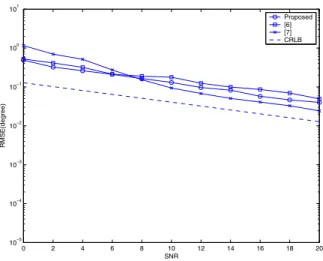
For CFO estimation, we compare the performance of four algorithms: 1-D ESPRIT (referred to as the 1-D C-ESPRIT) [7], alternating projection frequency estimation (APFE)[4], 2-D ESPRIT [10], and the proposed algorithm. Recall that 2-D ESPRIT and our algorithm determine the CFOs and DOAs simultaneously. The RMSEs of the CFO estimates versus the signal-to-noise ratio (SNR) based on the above algorithms are shown in Fig. 1. The results demonstrate that 1-D C-ESPRIT and APFE are not applicable here because they can not distinguish if users are allocated the same subchannel in the OFDMA/SDMA uplink. On the other hand, because of the group decomposition feature, the proposed algorithm’sperformanceiscloseto that of 2-D ESPRIT. The latter achieves a superior performance in the high-SNR region because it stacks the received 2-D data and then applies the ESPRIT algorithm, so the estimation accuracy improves more than that of the proposed algorithm as the SNR increases. Next, we compare the RMSEs of the CFO estimates versus
the total number of subcarriers when the SNR=5dB and the number of subchannels is fixed at C8, as shown in Fig. 2. We observe that as the total number of subcarriers increases, the performance also improves because the number of effective snapshots increases. However, the rate of improvement becomes less noticeable as the number of subcarriers become large.
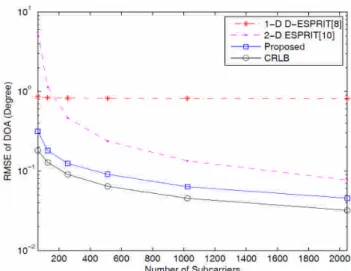
For DOA estimation, we compare three algorithms: 1-D ESPRIT (1-D D-ESPRIT) [8], 2-D ESPRIT [10], and the proposed algorithm Figure 3 shows the RMSEs of the DOA estimates versus the SNR. Once again, 1-D D-ESPRIT can not resolve the DOAs because users 1 and 2 share the same SDMA channel, but the proposed algorithm’s performance is close to that of 2-D ESPRIT. Figure 4 shows the RMSE of the DOAs versus the total number of subcarriers. As the total number of subcarriers increases, the DOA estimation accuracy also improves because the number of effective snapshots increases. However, the rate of improvement becomes less noticeable as the number of subcarriers becomes large.
In summary, we have proposed an efficient hierarchical ESPRIT for joint estimation of the CFOs and DOAs in interleaved OFDMA/SDMA uplink. Because the algorithm interweaves the parameter estimation and interference cancellation processes, and progressively decomposes signals into finer subgroups, it yields high estimation accuracy, low computational overhead, and automatic pairing of the two parameters.
Simulations show that the proposed approach can achieve a satisfactory performance even with close effective CFOs or DOAs.
五、參考文獻
[1] C.-F. Tsai, C.-J. Chang, F.-C. Ren, and C.-M Yen, “Adaptive radio resource allocation for downlink OFDMA/SDMA systems with multimedia traffic, ”IEEE Trans. Wireless Commun., vol. 7, no. 5, pp. 1734-1743, May 2008.
[2] J.-N. Lin, H.-Y. Chen, T.-C. Wei, and S.-J.
Jou, “Symbol and carrier frequency offset synchronization for IEEE802.16e,” in Proc.
IEEE International Symposium on Circuits and Systems, pp. 3082-3085, May 2008.
[3] P.Sun and L.Zhang,“Low complexity pilot aided frequency synchronization for OFDMA uplink transmission, ”IEEE Trans. Wireless Commun., vol. 8, no. 7, pp. 3758-3769, July 2009.
[4] M.-O. Pun, M. Morelli, and C.-C. Jay Kuo,
“Maximum-likelihood synchronization and channel estimation for OFDMA uplink transmissions,”IEEE Trans. on Commun., vol. 54, no. 4, pp. 726-736, Apr. 2006.
[5] Z. Cao, U. Tureli, and Y.-D. Yao,
“Deterministicmultiusercarrierfrequency offset estimation forinterleaved OFDMA uplink,”IEEE Trans. on Commun., vol. 52, no. 9, pp. 1585-1594, Sep. 2004.
[6] R.O. Schmidt, “Multiple emitter location and signal parameter estimation,”IEEE Trans. on Antennas and Propagation, vol, AP-34, pp.
276-280, Mar. 1986.
[7] J. Lee, S. Lee, K.-J. Bang, S. Cha, and D.
Hong,“Carrierfrequency offsetestimation using ESPRIT forinterleaved OFDMA uplink systems,” IEEE Trans. Vehicular Technology, vol. 56, no. 5, pp. 3227-3231, Sep. 2007.
[8] R.Roy and T.Kailath,“ESPRIT-Estimation of signal parameters via rotational invariance techniques,”IEEE Trans. on Acoust., Speech,
Signal Processing, vol. 37, no. 7, pp. 984-995, July 1989.
[9] K. Liu, W. Hamouda and A. Youssef,
“ESPRIT-based directional MAC protocol for mobile Ad Hoc networks,” in Proc. IEEE International Conference on Communications, pp. 3654-3659, June 2007.
[10] M.L.Burrows,“Two-dimensional ESPRIT with tracking for radar imaging and feature extraction,” IEEE Trans. on Antennas and Propagation, pp. 524-532, Feb. 2004.
[11] L. Schumacher and B. Raghothaman,
“Closed-form expressions for the correlation cofficient of directive antennas impinged by a multimodeal truncated Lapacian PAS," IEEE Trans. Wireless Communication., vol. 4, no. 4, pp.
1351-1359, July 2005.
[12] G.H. Golub and C.F. Van Loan, Matrix Computations. 3rd Ed.,Johns Hopkins, 1996.
六、圖表
Figure 1: Comparison of the RMSE of the CFOs versus the SNR
Figure 2: Comparison of the RMSE of the CF versus the total number of subcarriers
Figure 3: Comparison of the RMSE of the DOAs versus the SNR
Figure 4: Comparison of the RMSE of the DOAs versus the total number of subcarriers
計畫成果自評
國科會補助專題研究計畫成果報告自評表
請就研究內容與原計畫相符程度、達成預期目標情況、研究成果之學術或應 用價值(簡要敘述成果所代表之意義、價值、影響或進一步發展之可能性)、
是否適合在學術期刊發表或申請專利、主要發現或其他有關價值等,作一綜 合評估。
1. 請就研究內容與原計畫相符程度、達成預期目標情況作一綜合評估
達成目標
□ 未達成目標(請說明,以 100 字為限)
□ 實驗失敗
□ 因故實驗中斷
□ 其他原因 說明:
2. 研究成果在學術期刊發表或申請專利等情形:
論文:□已發表 □未發表之文稿■撰寫中 □無 專利:□已獲得 □申請中 ■無
技轉:□已技轉 □洽談中 ■無
其他: (以 100 字為限)
3. 請依學術成就、技術創新、社會影響等方面,評估研究成果之學術 或應用價值(簡要敘述成果所代表之意義、價值、影響或進一步發展之 可能性)(以 500 字為限)
頻率偏移在正交分頻多工通訊系統中扮演著重要的角色,有效估測該參數值可 對信號做適當補償以避免系統效能大幅降低,另一方面入射信號的方位角可提供基 地台定位及從事空間濾波進而提昇系統效能,因此如何有效的估測該二參數是正交 分頻多工系統中一重要主題。為克服同時估測該二參數所需的大量運算,在本計畫 中我們推廣之前提之階層式時-空拆解之技巧,同時估測該二參數。基於階層式樹 狀之架構下,此演算法交錯運用一連串一維信號參數轉置恆定估測技術(ESPRIT)
進行參數估測,在每一ESPRIT運用前,並透過時域及空間域濾波 將信號進行適
當分群,藉以提高參數估測之正確性,同時抑制雜訊對估測之干擾。此外,基於樹 狀架構,該估測出之參數,將可自動完成配對,並無需額外的計算。模擬結果驗證,
本計畫所發展之演算法和既有演算法有類似性能,但所需之計算複雜度卻大幅降 低,這有利該估測法之實際實現。
整 個 計 畫 的 執 行 , 已 經 大 致 完 成 。 其 先 期 成 果 已 發 表 於 IEEE Vehicular Technology Conference-Spring, 2010. 較完整的成果亦已投稿至IEEE Trans. Wireless Communications,目前尚在審稿中。
國科會計畫補助專家學者出席國際會議報告書
□ 赴國外出差或研習
□ 赴大陸地區出差或研習
■ 出席國際學術會議
□ 國際合作研究計畫出國
計畫名稱
以階層式時空拆解法為基礎的 高效能聯合參數估量法之進一 步研析探討和現實運作考量
計畫編號 NSC 98-2221-E-011-086
會議/訪問時
間地點 8-10 Dec. 2009, Macau
會議名稱 International Conference on Information, Communications and Signal Processing (ICICS)
發表論文題 目
Efficient Joint Two-dimensional Angle and Polarization Estimation With Crossed Dipoles
一、此次參加的國際會議名稱為 2009 International Conference on Information,
Communications and Signal Processing (ICICS), 會議在澳門舉行,從12月8日到12月10日為 期3天。在本次研討會中,我共發表了一篇論文(以演講方式發表),獲得與會專家學者許多 寶貴之建議。我在該會議中並受邀擔任其中一場議程(adaptive and array signal process)之主 持人,此外在會議期間,也在其他場次,聽取前來的學者做相關論文發表,並和多位國際 研究學者針對相關主題進行討論,受益良多,並對自身的研究視野有諸多的提升。
二、對計畫之效益: ICICS 會議是在信息理論、信號處理及無線通訊等相關領域之一重要的 國際會議,與會人士對該會議之各項議題都提出許多問題詢問報告人,有助於提升我們國 家在研究方面的國際形象。同時以論文報告的方式參與國際研討會,有助於瞭解國際上目 前在信號處理暨無線通訊相關領域的研究成果,藉此瞭解世界先進國家在此相關領域的研 究趨勢及發展,對本計畫帶來更新的研究想法,以使本計畫能夠更臻完善。
三、心得:ICICS為每兩年固定期在亞太地區所舉辦的一重要的國際學術會議。這種與國際人 士的交流互動的場合的確能夠使自己的眼界更為寬廣,對於相關領域的研究亦可藉由該會 分享交流彼此最新的研究成果,並更激發出新的想法及瞭解目前研究趨勢。
四、建議與結語:該國際會議主要在探討各類信號處理、無線通訊暨光纖與相關技術,這些主 題和我的研究範疇(無線通訊之信號處理)有相當的關聯,參與該項國際會議的確可獲得不 少新知,包括了各類信號處理的演算法及各類應用(語音、影像及無線通訊)、未來無線通 訊各種新的技術、觀念或是應用,在來自世界各國的專家學者齊聚一堂的環境,分享彼此 不同的觀念與想法,對未來研究提供不少助益。參與此次的國際性會議後,我深深覺得出 席國際會議對於研究人員以及國內研究風氣的提升,有非常大的幫助。
五、攜回資料 International Conference on Information, Communications and Signal Processing (ICICS) 會議論文集暨光碟片一片。