Research Express@NCKU - Articles Digest
Research Express@NCKU Volume 25 Issue 6 - December 20, 2013 [ http://research.ncku.edu.tw/re/articles/e/20131220/1.html ]
A ubiquitous English vocabulary learning system:
evidence of active/passive attitudes vs.
usefulness/ease-of-use
Yueh-Min Huang
*, Yong-Ming Huang, Shu-hsien Huang, Yen-Ting Lin
Department of Engineering Science, National Cheng Kung University [email protected]Computers & Education, Vol. 58, No. 1, 273–282 (2012)
1.
I
ntroductionEnglish is one of the most important languages. Many studies have indicated that vocabulary is the foundation of language learning (Sun et al., 2011; Wilkins, 1972). Previous studies have revealed the insufficiency of the provision of a systematic process by which to learn vocabulary. In this study, we developed a ubiquitous English vocabulary learning (UEVL) system to help students experience a systematic vocabulary learning (SVL) process (Hatch & Brown, 1995) in ubiquitous learning contexts.
2. Ubiquitous English vocabulary learning system
The UEVL system was developed to assist students in experiencing the SVL process in ubiquitous learning contexts. Once students are in the designated learning locations, the system displays guidance information to notify them that they can access learning materials to learn, as shown in Fig. 1(a). Afterward, the system presents context-aware learning material to the students. The learning material is in the form of a video clip, as shown in Fig. 1(b), and its subtitles provide students with an opportunity to learn vocabulary. Accordingly, students can experience the encountering phase of the SVL process.
Fig. 1. The encountering phase of the SVL process.
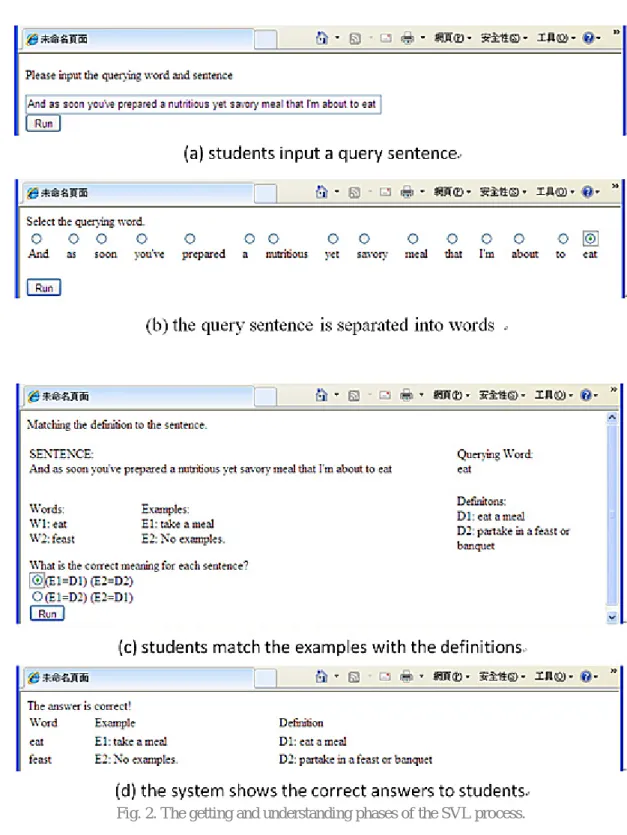
Once students have experienced the encountering phase, they can use the NSSL technology (Sun et al., 2011) to experience both the getting and understanding phases of the SVL process. This NSSL technology was developed to find NSSL words that would increase students’ awareness of vocabulary. An example is used to describe how to use the NSSL technology to achieve this, as shown in Fig. 2. First, students input a query sentence (i.e., the subtitle
Research Express@NCKU - Articles Digest
of the video clip), as shown in Fig. 2(a). Second, the system parses the query sentence into separate words. In the meantime, students choose a query word in order to get a clear image of its form and its meaning, as shown in Fig. 2(b). Third, the system presents both examples and definitions of the query word. At the same time, students must match examples with the definitions in order to increase their awareness of the query word, as shown in Fig. 2(c). Fourth, when students have finished the matching exercise, the system responds the correct answers to the students. Students can thus obtain a clear image of the form of the query word to further understand its meaning.
Fig. 2. The getting and understanding phases of the SVL process.
When students have experienced the getting and understanding phases, they can watch the video clip to
consolidate the connection between both the form and the meaning of the query word, namely, to experience the consolidating phase. When they are watching the video clip, students can learn how to use the query word through the dialogue in the video clip. Finally, students repeat the dialogue aloud in order to experience the using phase. As
Research Express@NCKU - Articles Digest
a result, students can use the UEVL system to experience the SVL process in ubiquitous learning contexts. 3. Research design
Fig. 3 shows the research model, which originates from technology acceptance model theory (Davis, 1989; Davis, Bagozzi, & Warshaw, 1989). In this study, system characteristics and material characteristics are used as the external variables. The model consists of seven hypotheses.
Fig. 3. Research model.
At the start of the experimental procedure, all the participants (40 students) executed a learning activity through the UEVL system. In the activity, the participants used the system to learn English. Here, the activity was not only executed in indoor contexts, but also in outdoor contexts. When the activity was completed, the participants were asked to fill out the questionnaire to examine the proposed research model.
4. Results and conclusions
The results indicate that (1) both the system characteristics and the material characteristics of the UEVL system positively and significantly influence the perspectives of all students on the system; (2) the active students are interested in perceived usefulness; (3) the passive students are interested in perceived ease of use.
One practical implication drawn from this study may extend to instructional software designers. The results indicate that active students care about the perceived usefulness of the system, while passive students care about the perceived ease of use of the system. This implies that active students and passive students have different requirements for instructional software, especially in the case of both the perceived usefulness and the perceived ease of use of such software. Accordingly, instructional software designers may design the instructional software according to the types of students in order to help students learn efficiently and effectively.
References
1. Sun, K. T., Huang, Y. M. & Liu, M. C. (2011). A WordNet-based near-synonyms and similar-looking word learning system. Educational Technology & Society, 14(1), 121-134.
2. Wilkins, D. A. (1972). Linguistics in language teaching. London: Edward Arnold.
3. Hatch, E., & Brown, C. (1995). Vocabulary, semantics and language education. Cambridge, UK: Cambridge University Press.
4. Davis, F. D. (1989). Perceived usefulness, perceived ease of use and user acceptance of information technology. MIS Quarterly, 13(3), 319-340.
5. Davis, F. D., Bagozzi, R. P., & Warshaw, P. R. (1989). User acceptance of computer technology: a comparison of two theoretical models. Management Science, 35(8), 982-1003.
Research Express@NCKU - Articles Digest