國立臺灣大學社會科學院經濟學系 博士論文
Department of Economics College of Social Sciences
National Taiwan University Doctoral Dissertation
應用個體經濟之三篇研究
Three Essays on Applied Microeconomics
施琇涵 Hsiu-Han Shih
指導教授﹕林明仁 博士 Advisor: Ming-Jen Lin, Ph.D.
中華民國 105 年 7 月
July, 2016
Acknowledgements
I would like to gratefully and sincerely thank my advisor, Professor Ming-Jen Lin, for his instructive advice, immense knowledge, and tirelessly supporting me in every possible way. Without his guidance and continuous support, this PhD would not have been achievable. I am also grateful to my dissertation committee, Professor Chun-Fang Chiang, Elliott Fan, Jin-Tan Liu, and Ming-Ching Luoh, for their insightful suggestions and comments.
Furthermore, I would like to thank Porfessor Stacey H. Chen, Shiu-Sheng Chen, Yoko Ibuka, Kamhon Kan, Hsien-Ming Lien, Albert Francis Park, Mark Rosenzweig, Sujata Visaria, Tsong-Min Wu, as well as the participants at various seminars and conferences for their beneficial comments and continuous encouragement.
I gratefully acknowledge the abundant data provided by the Department of Statis- tics at the Ministry of Health and Welfare in Taiwan (H103006). Financial support from the Ministry of Science and Technology, Taiwan (101-2410-H-002-029-MY2, 101-2410-H-004-020-MY2, 103-2420-H-002-030-DR) is also appreciated.
My thanks go to all the faculty and staff members in the Department of Economics at National Taiwan University, for their helpful suggestions and assistance throughout my studies. I am also grateful to my classmates and friends at school for inspirational discussions during the class, for completing the coursework together, and for all the fun we have had during the past few years. They made my school life more abundant and enjoyable.
Last, but certainly not least, I deeply thank my beloved family and friends for their support, accompany, and encouragement throughout the doctoral studies and my entire life. I could not accomplish anything without their unconditional love and support.
Finally, thank you for being always with me.
摘要
本論文包含了三篇應用個體經濟之研究。 第一篇文章為政治經濟學之研究, 第二與第 三篇文章則為健康經濟學之研究。
第一篇文章使用台灣2004-2008年之各區每周收視率資料, 檢視新聞節目之政治傾 向和正確度對消費者選擇新聞節目的重要性。 我們發現,泛藍之新聞節目在泛藍比例較 高地區的收視率較高。 此外, 我們發現在特殊政治事件發生時, 收視觀眾的政治偏好組 成更為極端化。 這個結果除了並非來自於反向的因果關係,更顯示出消費者傾向收看與 自己政治意識形態相近之新聞節目。 最後, 本文使用兩個假新聞事件, 探討消費者對新 聞正確度的敏感度。 我們發現假新聞事件對收視率的影響極小,甚或不顯著。
第二篇文章利用台灣1950年代瘧疾根除計畫, 探討早期(胚胎與嬰兒時期) 暴露於 瘧疾風險之長期影響。 我們合併1992-2012年台灣社會變遷調查所提供之個人資料,與 其出生時間和地點之瘧疾嚴重度資料。 透過差異中之差異法(difference-in-differences), 本文發現瘧疾根除計畫對男性的教育程度與家庭所得具有正向的影響。 我們亦使用台 灣1980年戶口普查資料進行分析, 同樣發現瘧疾根除計畫之後, 教育程度有了顯著的 增加。 此外,我們發現瘧疾根除計畫對男性其配偶的教育程度亦產生正向的影響。 最後, 分量迴歸分析結果顯示,瘧疾根除計畫之影響主要集中於低所得者。 本文結果顯示早期 暴露於瘧疾風險將對個人產生負面的影響。
最後一篇文章探討胚胎時期暴露於空氣汙染風險對台灣新生兒健康之影響。 我們使
用2001-2011年之出生通報資料與2000-2011年之空氣品質資料,並透過工具變數法以
減輕內生性所造成的估計偏誤,來檢視胚胎時期健康狀況之影響。 利用大氣溫度, 濕度, 以及雨量作為空氣汙染之工具變數,我們發現胚胎時期暴露於懸浮微粒(PM10)使得新 生兒早產,體重過輕,以及出生健康狀況不佳之機率皆提高。 此外,二氧化硫(SO2)與二
氧化氮 (NO2)亦使得新生兒早產與體重過輕 (懷孕週數限於37至44週) 之機率增加。
本文結果顯示胚胎時期暴露於空氣汙染風險將對新生兒健康造成不利的影響。
關鍵詞:消費者偏好,新聞政治傾向,瘧疾根除計畫,胚胎起源假說,空氣汙染,新生兒健 康
Abstract
This dissertation consists of three essays on Applied Microeconomics. The first essay contributes to political economics, and the second and third essays contribute to health economics.
The first chapter (with Chun-Fang Chiang) investigates the role of news slant and news accuracy in consumers’ choices of TV news programs in Taiwan. Using weekly audience ratings data from different regions in Taiwan between 2004 and 2008, we find that news programs leaning toward the Pan-Blue parties had more viewers from areas with more Pan-Blue supporters. Moreover, we find that consumers were more polit- ically segregated in choosing news programs during political events than on ordinary days. The finding cannot be explained by reverse causality and suggests that consumers are inclined to watch news programs with a political ideology that approximates their own. Regarding consumer preferences for news accuracy, we examine changes in viewership caused by two well-known false news scandals involving reports that pro- vided erroneous information. We find that the effects of these two incidents were either small or insignificant.
The second chapter (with Ming-Jen Lin) utilizes the eradication campaign in Tai- wan in the 1950s to estimate the long-term impacts of early-life (in utero and postna- tal) exposure to malaria. Matching adults in the 1992 – 2012 Taiwan Social Change Survey to the malaria intensity in their individual place and year of birth, difference-in- difference estimation shows strong evidence that the eradication increased men’s own educational attainment as well as their family income in adulthood. We also use the 1980 census data to show there was a sharp education increase after the eradication.
Furthermore, the eradication increased the educational attainment of married men’s spouses. Finally, quantile regressions show that the effect concentrated on the lower percentile of the income distribution. Overall, our results suggest negative effects of early-life exposure to malaria.
The last chapter (with Ming-Jen Lin) examines the health effects of air pollution during pregnancy on newborn babies in Taiwan. Using the birth data from 2001 to
2011 and data on atmospheric condition from 2000 to 2011, we examine the effects of in utero health conditions through the instrumental-variable (IV) method to address potential endogeneity problems. We use variation in temperature, humidity, and rain- fall to instrument for in utero exposure to air pollution. We find that the increase in exposure to PM10 during pregnancy resulted in prematurity, low birth weight, and be- ing born in bad health. Moreover, exposure to SO2 and NO2 during pregnancy led to prematurity and low birth weight for those born between 37 and 44 weeks of gestation.
Our results suggest that air pollution had negative health effects on newborn babies.
Keywords: consumer preferences; news slant; malaria eradication; fetal origins hy- pothesis; air pollution; infant health
Contents
Verification Letter from the Oral Examination Committee
Acknowledgements . . . i
Chinese Abstract . . . ii
English Abstract . . . iii
1 Consumer Preferences Regarding News Slant and Accuracy in News Program 1
1.1 Introduction . . . 11.2 Background . . . 4
1.2.1 News Channel Overview . . . 4
1.2.2 Consumer Choices of News Programs . . . 6
1.3 Data: Viewership and Consumer Ideology . . . 7
1.3.1 Viewership . . . 7
1.3.2 Consumer Political Ideology . . . 8
1.4 Market Demand for News . . . 9
1.4.1 Consumer Preferences . . . 9
1.4.2 Market Demand . . . 10
1.5 Empirical Strategy and Estimation Results . . . 10
1.5.1 Viewership Patterns During Political Events . . . 13
1.5.2 Robustness Checks . . . 16
1.5.3 Accuracy of News . . . 17
1.5.3.1 TVBS’s Chou Cheng-Pao Videotape Incident . . . 17
1.5.3.2 SET’s 228 False Footage Incident . . . 17
1.5.3.3 Empirical Results . . . 17
1.6 Conclusions . . . 19
2 Long-Term Impacts of Early-life Exposure to Malaria: Evidence
from Taiwan’s 1950 Eradication Campaign 32
2.1 Introduction . . . 322.2 Literature Review . . . 35
2.3 Background and Data . . . 39
2.3.1 Background . . . 39
2.3.2 Data . . . 41
2.3.2.1 Malaria Intensity . . . 41
2.3.2.2 Adult Outcomes . . . 42
2.4 Empirical Strategy . . . 45
2.5 Estimation Results . . . 47
2.5.1 Descriptive Statistics . . . 47
2.5.2 Results . . . 47
2.5.2.1 Education . . . 47
2.5.2.2 Marriage and Income . . . 49
2.5.3 Robustness Checks . . . 51
2.5.4 Discussion . . . 53
2.6 Conclusions . . . 55
3 The Impact of Air Pollution on Infant Health in Taiwan 72
3.1 Introduction . . . 723.2 Literature Review . . . 75
3.3 Data . . . 78
3.3.1 Pollution and Weather . . . 78
3.3.2 Birth Data . . . 79
3.3.3 Township’s Characteristics . . . 80
3.4 Empirical Strategy . . . 80
3.4.1 OLS . . . 80
3.4.2 IV . . . 81
3.4.3 Relevance of the Instrumental Variables . . . 82
3.4.4 Exogeneity of the Instrumental Variables . . . 83
3.5 Estimation Results . . . 84
3.5.1 Descriptive Statistics . . . 84
3.5.2 First Stage Estimates . . . 84 3.5.3 Results . . . 85 3.6 Conclusions . . . 86
References 100
List of Figures
Figure 2.1 Four-year Malaria Control Program, 1952-1955 . . . 57
Figure 2.2 The Number of Malaria Cases of Preschool Children Nationwide, 1951- 1960 . . . 58
Figure 2.3 Spleen Rate in 1953 and 1955 (County-Level) . . . 59
Figure 2.4 Level of Spleen Rate in 1953 and 1955 (Township-Level) . . . 60
Figure 2.5 Discontinuity on Own Educational Attainment . . . 61
List of Tables
Table 1.1 24-hour Television News Channels in Taiwan . . . 21
Table 1.2 Summary Statistics of the TEDS Survey Sample . . . 22
Table 1.3 Choices of TV News Channels . . . 23
Table 1.4 Choices of TV News Channels (Average Partial effects) . . . 24
Table 1.5 Consumer Political Preference in Taiwan . . . 25
Table 1.6 Weekly Average Ratings For the News Channels . . . 26
Table 1.7 Viewership Patterns During Political Events . . . 27
Table 1.8 Robustness Checks I . . . 28
Table 1.9 Robustness Checks II . . . 29
Table 1.10 Robustness Checks III (Reduced Form Estimation) . . . 30
Table 1.11 Consumers’ Sensitivity to News Accuracy . . . 31
Table 2.1 Literature on Malaria: Summary . . . 62
Table 2.2 Difference in Means . . . 63
Table 2.3 Effects of Malaria Eradication on Own Educational Attainment . . . 64
Table 2.4 Effects of Malaria Eradication on Spouse’s Educational Attainment . . . . 65
Table 2.5 Effects of Malaria Eradication on Income . . . 66
Table 2.6 Effects of Malaria Eradication on Income: Quantile Regression . . . 67
Table 2.7 Robustness Check I: Effects of Malaria Eradication on Own and Spouse’s Educational Attainment (Sample: 1951-1955) . . . 68
Table 2.8 Robustness Check I: Effects of Malaria Eradication on Income (Sample: 1951-1955) . . . 69
Table 2.9 Robustness Check II: Further Checks on Own Educational Attainment . 70 Table 2.10 Robustness Check III: Further Checks on Own Educational Attainment (Reduced Form of Fuzzy RD) . . . 71
Table 3.1 Descriptive Statistics . . . 88
Table 3.2 First-Stage Weak IV Test . . . 89
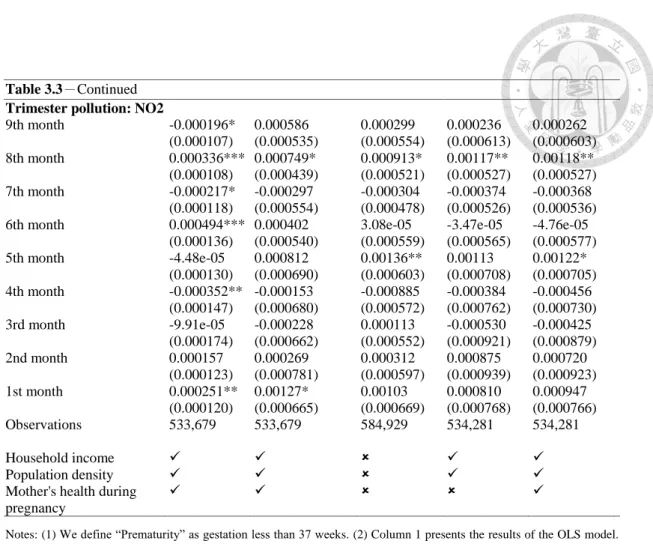
Table 3.3 Effects of Air Pollution on Prematurity . . . 90
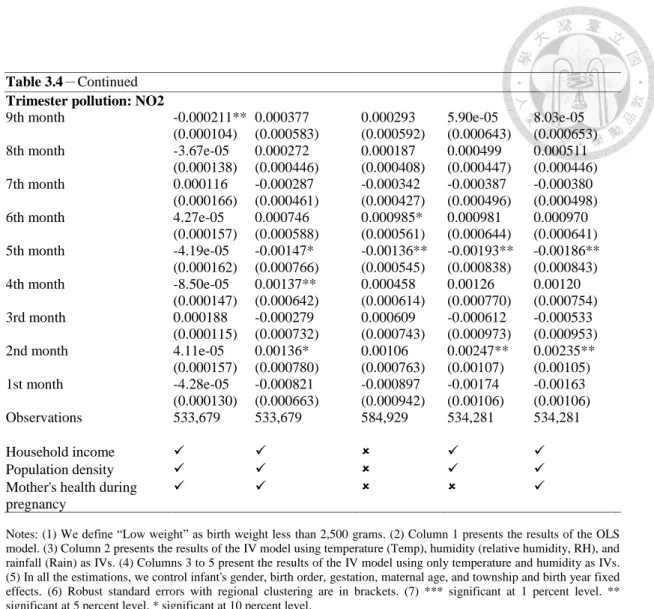
Table 3.4 Effects of Air Pollution on Low Weight . . . 92
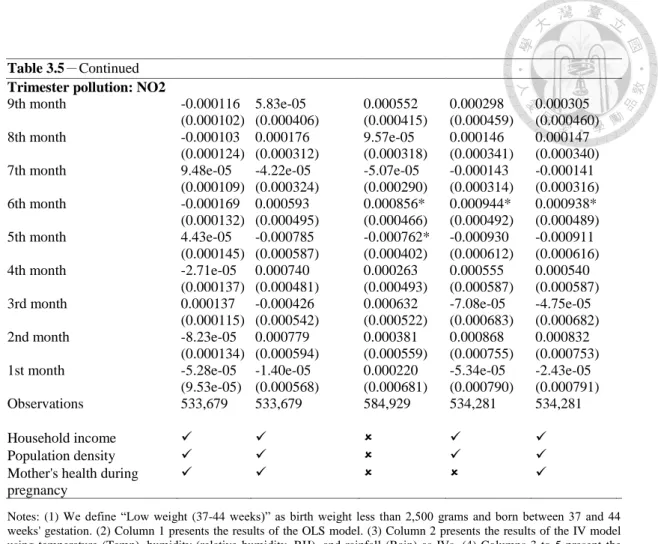
Table 3.5 Effects of Air Pollution on Low Weight (37-44 weeks) . . . 94
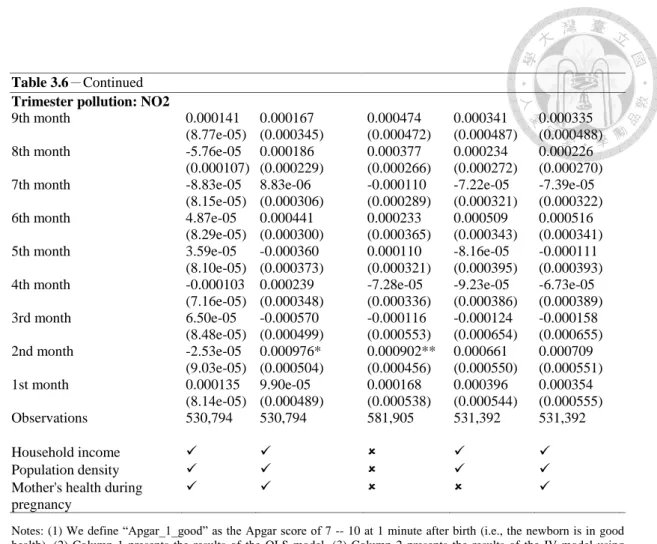
Table 3.6 Effects of Air Pollution on Apgar Score at 1 Minute After Birth . . . 96
Table 3.7 Effects of Air Pollution on Apgar Score at 5 Minutes After Birth . . . 98
Chapter 1
Consumer Preferences Regarding News Slant and Accuracy in News Program
1.1 Introduction
The TV news market in Taiwan is competitive. There are seven news exclusive chan- nels and many other channels also air news programs. However, the credibility of the TV news in Taiwan ranked lowest among 48 countries in the world value surveys (Chiu, 2011). This low credibility could result from consumer judgments based on the following two elements: (1) objective inaccuracy, which involves the distortion of news content or the provision of erroneous information and (2) news slant, which in- volves focusing on either the favorable or the unfavorable portions of an incident or selecting information that is favorable to particular groups. In the Taiwanese TV news market, it is believed that news channels present news reports in ways that apparently favor different political parties, and numerous false news incidents have occurred. In this paper, we investigate how consumers respond to news slant and news accuracy in their choice of TV news programs in Taiwan.
First, we use the survey data from Taiwan’s Election and Democratization Study (TEDS) to examine whether consumers are more likely to watch news programs with news that is slanted toward the political parties that they support. Previous studies have presented evidence that Formosa Television (FTV) and Sanlih E-Television News (SET) significantly favor the Democratic Progressive Party (DPP) and that Television
Broadcasts Satellite (TVBS) tends to downplay negative news regarding the Kuom- intang Party (KMT) (Lo et al. 2004; Liu 2009; Tsai 2008; Li 2008; and Huang 2009).
Using survey data, we find that the consumers who support the KMT are more likely to select TVBS than FTV, supporting the idea that consumers prefer to watch news that approximates their own beliefs.
The link between the media’s political ideology and consumer preferences may vary between media markets. Gentzkow and Shapiro(2011) develope a ideological segregation index for consumers in a media market, and find that ideological seg- regation on the Internet is low in magnitude but higher than offline media outlets.
Based on the survey data from TEDS, we calculate the segregation index for consumer political-ideology segregation derived by Gentzkow and Shapiro (2011) and find that, consumers in the TV news market in Taiwan are more politically segregated than con- sumers in the US media markets.
The TEDS survey data confirm a significant correlation between the political ide- ology of consumers and their choice of TV channels in Taiwan. However, this phe- nomenon could be caused by the effect of news stories on the political preferences of viewers. We then compare viewers’ selection of TV news programs during political events with their selection on ordinary days using the weekly audience ratings of news channels. If consumers prefer news programs that favor the political parties that they support, then more political news will result in greater extremes in the segregation of consumers by political ideology through their choice of various news sources. We combine data from the weekly audience ratings of news channels with the political preferences of regional consumers between 2004 and 2008, and we find that during the 2008 presidential election and the Chen Yunlin incident (i.e., a unique political inci- dent), the increase in ratings for TVBS was greater than that for FTV in regions with greater proportions of Pan-Blue supporters. This finding indicates that during polit- ical incidents, consumers are more inclined to watch news programs with a political ideology that approximates their own. In contrast to the findings using TEDS data,
the phenomenon observed from the weekly viewership data cannot be explained by reverse causality. Our findings suggest that consumers are aware of the slant in news programs and prefer programs that favor the political parties that they support.
Our findings are consistent with the results of previous empirical studies that ad- dress reader responses to political slant in news reports. For instance, Gentzkow and Shapiro (2010) used data from contemporary U.S. newspapers in their analyses and find that the primary source of media bias in the U.S. is the tendency to cater to con- sumers. In contrast, the political ideology of a newspaper company’s owner has nearly no influence on the newspaper’s bias. Durante and Knight (2010) analyzed Italy’s TV media and found that news reports on public TV became more rightist after a center- right party was elected to succeed a center-left ruling party in 2001. Furthermore, the authors employed election questionnaire data to show that the number of rightist view- ers of public TV channels increased and that the leftist viewers who originally watched public TV shifted to other TV channels that were more leftist.
Finally, we examine whether consumers are sensitive to news accuracy in news program. Theories of media bias provide various explanations regarding the origin of media under different assumptions regarding consumer preferences with respect to news slant and accuracy (Simeon Djankov et al., 2003; Besley and Prat, 2006; and Baron, 2006). It is natural to assume that consumers prefer to watch news stories that slant towards their own ideologies and to infer that greater competitiveness in the me- dia market results in greater media bias (Mullainathan and Shleifer, 2005; Stone, 2011;
and Sobbrio, 2012). It is also natural to assume that people appreciate news accuracy because the primary demand for news is related to the acquisition of information. The model proposed in Gentzkow and Shapiro (2006) assumes that consumers prefer to re- ceive accurate information while maintaining biased beliefs, predicting that media bias decreases when the probability of consumers learning the actual facts increases. The existing empirical studies on media bias, however, are primarily focused on news slant rather than news accuracy. In this paper, aside from news slant, we also examine the
role of news accuracy in the choice of news programs. We use two false news events, TVBS’s Chou Cheng-Pao videotape incident and SET’s 228 false footage incident, to estimate the effect of news accuracy on viewership. We analyze ratings fluctuations for TVBS and SET after the disclosure that these reports were false. We find that compared with other news channels, SET and TVBS did not experience significant decreases in ratings as a result of false news incidents. These findings indicate that consumers are not very sensitive to accuracy in news programs.
The remainder of this paper is organized as follows. Section 1.2 describes the back- ground of the news channels and examines the correlation between consumer ideology and the selection of TV channels. Section 1.3 introduces the audience rating data.
Section 1.4 presents a demand model for news. Section 1.5 presents the empirical specifications and estimation results. Section 1.6 concludes the paper.
1.2 Background
This section contains the following content: (1) an overview of various news channels and their possible political ideologies and (2) an examination of the correlation be- tween consumer ideology and choices of TV channels based on survey data from the TEDS.
1.2.1 News Channel Overview
Prior to 1990, the market structure of Taiwan’s wireless TV industry was characterized by a long-term oligopoly of three channels, primarily because of government control.
The operation of cable TV systems was not legalized until 1993. Since then, Taiwan’s TV market structure has undergone extensive changes. On average, clients of Taiwan’s cable TV system can watch between 74 and 108 basic channels, of which TVBS, FTV, SET, Eastern Television News (ETT), Eastern Television Today (ETTO), Chung T’ien Television News (CTI), and Era Television News (ERA) are exclusively news channels.
Table 1.1 contains an overview of Taiwan’s major news channels.
Regarding the political ideology of news channel reports in Taiwan, previous stud- ies that have adopted the quantitative content analysis method to examine news con- tent have indicated that different news channels process political news using various methods. Lo et al. (2004) asserted that during the 2004 presidential election, FTV sig- nificantly favored DPP candidates compared with other TV channels (e.g., TTV, CTV, TVBS, and CTI). In addition, 43.9% of FTV’s information sources were DPP support- ers, known as Pan-Green supporters (the average for all news channels was 33.5%).
The duration of news reports on the DPP and coverage of DPP candidate speeches ex- ceeded that of candidates from other parties (i.e., 71.1% for former DPP presidential candidate Chen Shui-bian’s speeches compared with an average of 55% for all news channels). This fact suggests an overall impression that was more beneficial for DPP candidates. Tsai (2008) examined 100 episodes of news programs from ETT, FTV, SET, and CTI between April 15 and May 9, 2007. The results show that in terms of the number of reports and the language used, ETT and CTI both showed preferences for the KMT, whereas FTV and SET favored the DPP. In another study, Liu (2009) examined various news channel reports on the 312 Wei-xin incident during the 2008 presidential election. The results showed that TVBS reported only 8 relevant news stories during the 7 p.m. hourly news, whereas SET provided 34 reports. Furthermore, the news titles used by TVBS tended to be more supportive of the KMT, and negative reports on the KMT were understated. Conversely, SET had a more critical attitude toward the KMT. In other works, Li (2008) and Huang (2009) analyzed the news con- tent of various channels during the 2008 presidential election. Li (2008) asserted that FTV, compared with other news channels, referenced the most information from the DPP and that their reporting content was more beneficial to the DPP. However, TVBS’s reports were found to be more supportive of the KMT. Huang (2009) found that the proportion of election news involving KMT candidates was significantly greater for TVBS and CTI. Conversely, FTV’s reporting durations were significantly longer for DPP candidates than for KMT candidates, and its information sources were primarily
Pan-Green.
In summary, during the analysis period for this study (2004 to 2008), empirical evidence indicates that TVBS, CTI, and ETT news reports were beneficial to Pan- Blue politicians, whereas FTV and SET news reports were favorable to Pan-Green politicians.
1.2.2 Consumer Choices of News Programs
Prior to conducting our primary analysis, we use TEDS survey data for 2004, 2005, 2006, and 2008 to examine consumer choices of news programs.1 The survey provides information regarding the choices of news channels, political party preferences, and demographic characteristics of the respondents. We use a multinomial logistic model to estimate the consumer selection of news programs. One key variable is the Pan-Blue dummy variable, with 1 indicating that the viewer supports the Pan-Blue Coalition.
Descriptive statistics of the variables in the sample are reported in Table 1.2; Table 1.3 presents the estimation results, and Table 1.4 presents the average marginal effects of some key variables. The results suggest that Pan-Blue Coalition supporters are more likely to watch news on TVBS, CTI, and ETT and less likely to watch news programs on FTV and SET. In addition, viewers who are more educated are more likely to watch TVBS and less likely to choose FTV. Viewers with a higher income showed a greater probability of choosing TVBS, CTI, and ETT compared with lower- income individuals. Viewers above the age of 50 had a greater probability of choosing FTV than those between 20 and 29 years old.
We also use the survey data to calculate the ideological segregation index as defined
1Data analyzed in this section were from TEDS, 2004-2008: The Survey of Legislative Election in 2004 (TEDS 2004L) (NSC 94-2420-H004-008-SSS), the Survey of County Magistrate/City Mayoral Elections in 2005 (TEDS 2005M) (NSC 94-2420-H004-008-SSS), the Survey of Taipei City/Kaohsiung City Mayoral Elections in 2006 (TEDS 2006C) (NSC 94-2420-H004-008-SSS), and the Survey of Leg- islative Election in 2008 (TEDS 2008L) (NSC 94-2420-H004-008-SSS). The coordinator and principal investigators of above projects include Chi Huang, I-Chou Liu, Shiow-duan Hawang, and Yun-han Chu.
More information is on TEDS website (http://www.tedsnet.org). The authors appreciate the assistance in providing data by the institute and individuals aforementioned. The authors are alone responsible for
by Gentzkow and Shapiro (2011) and find that the ideological segregation of the TV news market in Taiwan was much higher than that of the media markets in the U.S.
The segregation index ranges from 0 to 1; an index with a higher value denotes a more segregated readership, meaning that some news outlets have more conservative readers while others have more liberal readers. In the work of Gentzkow and Shapiro (2011), the segregation index was found to be 0.033 in the cable TV market and between 0.018 and 0.104 for broadcast news, magazines, local newspapers, the Internet, and national newspapers in the U.S. The segregation index of Taiwan’s TV media market was 0.31, which is greater than that for the U.S. media markets. This result could mean that the TV news programs are more politically polarized in Taiwan than in the U.S. or that consumers in Taiwan care more about the ideology of news stories.
The above results from the TEDS survey data indicate a strong correlation between the political ideologies of consumers in Taiwan and their choices of TV channels. This correlation may result from the tendency of consumers to watch news that has a politi- cal ideology similar to their own. Alternatively, the political preferences of consumers could be influenced by their viewing of TV channels with a specific ideology. In Sec- tion 1.4, we rely on fluctuations in program ratings by region during periods in which there are more political news to examine consumer preferences in relation to news slant and news accuracy. In the next section, we begin introducing our data.
1.3 Data: Viewership and Consumer Ideology
1.3.1 Viewership
In this study, we use audience ratings data from AGB Nielsen to examine consumer sensitivity to the political ideology and accuracy of news programs. The ratings were measured and collected through people meters that were installed in households for gathering individual ratings records. The sample examined in this study consists of the weekly average ratings data for the 8 p.m. news programs on TVBS, SET, ETT, ETTO, FTV, CTI, and ERA in the four regions of Taiwan from the beginning of 2004 to the
end of 2008. The four regions are the greater Taipei region, the northern region, the central region, and the southern region.2 All of the news channels analyzed broadcast news reports (either hourly news or news features) at 8 p.m. during the sampling period. After combining the ratings data with consumer political ideology by region, we obtained a total of 6,073 observations.3
1.3.2 Consumer Political Ideology
The public opinion surveys conducted by TVBS from April 2004 to 2006 and by Global Views between May 2006 and 2008 provide us with information regarding the political preferences of people in each region by month.4 We classify people who support the KMT and the People First Party as Pan-Blue supporters. Supporters of the DPP and the Taiwan Solidarity Union are classified as Pan-Green supporters.
The descriptive statistics for consumers’ political ideology by region are shown in Table 1.5, demonstrating that although the proportion of Pan-Blue supporters was greater than that of Pan-Green supporters in the four major regions, the greater Taipei region and the northern region possessed a significantly greater proportion of Pan-Blue supporters, whereas the disparity between these proportions was less in the southern region.
Table 1.6 presents the descriptive statistics for the weekly average ratings of the news channels. The greater Taipei region had the highest ratings for all news channels.
In addition, the ratings for TVBS in the northern region were significantly higher than
2The greater Taipei region includes Taipei City and the following 10 towns in Taipei County: Xin- dian, Sinjhuang, Yonghe, Zhonghe, Banciao, Sanchong, Tucheng, Lujhou, Sijhih, and Shulin. The northern region includes Taipei County (excluding the above 10 towns in the greater Taipei region), Taoyuan County, Hsinchu County, Yilan County, and Keelung City. The central region includes Taichung County, Miaoli County, Changhua County, Nantou County, Yunlin County, and Hualien County. The southern region includes Chiayi County, Tainan County, Kaohsiung County, Pingtung County, and Taitung County.
3ETTO was off-air between August 7, 2005, and June 25, 2006; thus, no ratings data were available during this period.
4The surveys were collected by TVBS in May, June, July, August, September, and December 2004 and from January 2005 (excluding August and October) to April 2006 (excluding February).
in the southern region, whereas the ratings for FTV and SET exhibited a smaller gap in the northern and southern regions.
1.4 Market Demand for News
In this section, we provide a simple model with settings similar to the model presented in Gentzkow and Shapiro (2010) to infer market demand for TV news programs.
1.4.1 Consumer Preferences
First, we assume that when consumers watch political news, they are aware of news slant and prefer news reports with ideologies that are closer to their own. Second, consumers always prefer more accurate news. The utility of individual i in region r at time t from watching news channel j can be expressed as follows:
uir jt = δjt− γ1Pt(xrt− njt)2+ γ2Qjt+ εir jt, (1.1)
where xrtrepresents the preferred slant in region r at time t, and njt is the slant of news channel j, with higher values indicating more pro-Pan-Blue parties. Ptis the proportion of political news coverage in the news program at time t. The term −γ1Pt(xrt− njt)2 represents the disutility for watching a news program whose slant njt deviates from the preferred slant xrt. Qjt is the news accuracy of news channel j. εir jt represents taste shocks. Finally, the term δjt is the average utility for consumers from watching news channel j at time t, derived from other unobservable characteristics of program j at time t.
In each region, the preferred slant in news reporting, xrt, is assumed to be related to the the ideological position of region r at time t, Brt.
xrt= α + β Brt, (1.2)
Brt represents the ideological position of region r at time t. In our estimation, we use the proportion of people who support Pan-Blue coalition to proximate the ideological
position of region r. Under the hypothesis that the preferred news slant is positively correlated with the ideological position of region r, β is greater than 0.
1.4.2 Market Demand
All consumers are utility maximizers. A consumer can choose to watch a news pro- gram or to not watch any news program if the utility from the news channels is lower than the utility of the outside options. We assume that the utility of the outside options is zero for all consumers. Let yr jt be the market share of news channel j in region r at time t, and yrot be the share of consumers who are not watching any news channel in region r at time t:
yrot = 1 −
J
∑
j=1
yr jt. (1.3)
According to Berry (1994), under the assumption that the error term εir jt has an extreme value type I distribution, the market share of news channel j can be derived as follows:
ln(yr jt) − ln(yrot) = δjt− γ1Pt(xrt− njt)2+ γ2Qjt+ υr jt, (1.4) The derivation from the individual utility to market share enables us to infer consumer preferences using aggregate data at market level. Substituting equation (1.2) into equa- tion (1.4), we obtain the following:
ln(yr jt) − ln(yrot) = δjt− α2γ1Pt+ 2αγ1Ptnjt− γ1Ptnjt2− 2αβ γ1PtBrt− β2γ1PtBrt2 + 2β γ1njtPtBrt+ γ2Qjt+ υr jt (1.5) Under the hypothesis that consumers care for news slants and that preferred news slant is related to consumer ideology, the parameters γ1 and β should be greater than 0. In the next section, we will test this hypothesis using weekly viewership data.
1.5 Empirical Strategy and Estimation Results
We are interested in estimating the parameters in the news demand model. The esti-
logical position for each news channel or other program characteristics. Second, the estimation could suffer from the endogenous problem due to omitted variables, the si- multaneous problem (reverse causality), and measurement errors. Here, we present our empirical strategies to address these difficulties and derive our empirical specifications.
The first difficulty we have is that many program characteristics that would influ- ence overall program viewership are not observable. We therefore include channel- week fixed effects in our estimation to control for unobserved program characteristics over time. Let kjt be the channel-week fixed effects that absorb all observed and unob- served variation at the channel-week level:
kjt = δjt− α2γ1Pt+ 2αγ1Ptnjt− γ1Ptnjt2+ γ2Qjt. (1.6)
Equation (1.5) derived from section 1.4 can be rewritten as follows:
ln(yr jt) − ln(yrot) = kjt− 2αβ γ1PtBrt− β2γ1PtBrt2+ 2β γ1njtPtBrt+ υr jt (1.7)
The week-channel fixed effects kjt (terms of interaction between the week dum- mies and the news channel dummies) capture the influence from unobservable charac- teristics of news channel j and of week t. The variation of viewership that we rely on, therefore, comes from the regional variation of viewership for the same channel at the same time.
The second difficulty we have is that we do not observe the ideological position for each news channel. Without news program ideologies, njt, we cannot estimate β γ1 directly. However, assuming that the news slant of a news channel does not vary significantly during our sample period, we can use FTV news as a reference group and rewrite the term 2β γ1njtPtBrt as 2β γ1(nj− nFTV)PtBrt+ 2β γ1nFTVPtBrt. For any news channel j with an ideology that significantly differs from the ideology of FTV, the coefficient of PtBrt will significantly differ from zero if β γ1 differs from zero.
Therefore, instead of estimating of the value of β γ1, we are going to estimate β γ1(nj− nFTV), the coefficient of PtBrt.
Considering that the demand for news may vary by regions, we include regional fixed effects, φr, in our estimation. We thus change the notation of taste shocks from υr jt to ζr jt (ζr jt= υr jt− φr).
We can express the estimation equation as follows:
ln(yr jt) − ln(yrot) = kjt− 2αβ γ1PtBrt− β2γ1PtBrt2+
J j6=FTV
∑
2β γ1(nj− nFTV)PtBrtIj +2β γ1nFTVPtBrt+ φr+ ζr jt, (1.8)
where Ij represents a dummy variable for news channel j, kjt represents week- channel fixed effects, and φr represents regional fixed effects. 5 We use the proportion of people who support the Pan-Blue party coalition from the monthly survey as a mea- sure of the ideological preferences of consumers, Brt. In our baseline specification, we assume that the amount of political news does not vary over time, Pt = ¯P. The baseline specification can be expressed as follows:
ln(yr jt) − ln(yrot) = kjt+ λ1Brt+ λ2Brt2+
J j6=FTV
∑
λ3 jBrtIj+ φr+ ζr jt, (1.9)
where λ1 = −2αβ γ1P¯+ 2β γ1nFTVP, λ¯ 2 = −β2γ1P, and λ¯ 3 j = 2β γ1(nj− nFTV) ¯P.
Our coefficient of interest in the baseline specification, λ3 j = 2β γ1(nj− nFTV) ¯P, is the coefficient of BrtIj, the interaction term between the region’s ideology and the dummy variable of news channel j. Under the hypothesis that consumers prefer a news channel that is slanted toward their own ideology, the coefficient λ3 j, should be larger if the ideology for news channel j is much more pro-Pan-Blue than FTV;
thus, a pro-Pan-Blue news channel should gain more viewership in regions with more Pan-Blue supporters.
Column 1 of Table 1.7 presents the results using audience ratings data for FTV and TVBS. As noted in Section 1.2, previous studies suggest that FTV news leans toward
5We express the term 2β γ1(nj− nFTV)PtBrt as ∑Jj6=FTV2β γ1(nj− nFTV)PtBrtIj in equation (1.8).
These two terms are equivalent. For example, for news channel TVBS, the term ∑Jj6=FTV2β γ1(nj− nFTV)PtBrtIjin equation (1.8) is equal to 2β γ1(nT BV S− nFTV)PtBrt, which is the same as the expression of 2β γ (n − n )PB when j is equal to TVBS.
the Pan-Green parties and that TVBS leans toward the Pan-Blue parties. Therefore, we expected the coefficient of the interaction term between the region’s ideology and TVBS to be positive. As expected, our coefficient of interest is positive and statistically significant, implying that consumers may prefer a news channel whose slant is closer to their own ideology.
Third, the estimation of our baseline specification could suffer from reverse causal- ity. If the viewers’ political preferences can be influenced by political slant in the news stories, then when more people watch news programs with a Pan-Blue ideological po- sition, there will be also more people who support the Pan-Blue coalition parties. In this case, even when we observe that the viewership of channel j of region r is larger when the correlation between the ideology of news channel j and consumer ideology of region r is stronger, we cannot infer that the viewership segregation pattern is driven by the influence of the news programs or the choices of consumers.
Our empirical strategy to address the reverse causality issue is to use the variation in political news caused by political events. If the correlation that we observe is com- pletely driven by the influence of news programs, rather than consumers’ choices, then the viewership segregation should not vary significantly over a short period of time.
In other words, the viewership segregation pattern will be more significant during po- litical events only when the viewership pattern is driven by consumers’ choices rather than the influence of news stories. Next, we present specifications and empirical results using the variation caused by political events.
1.5.1 Viewership Patterns During Political Events
Theoretically, if consumers prefer news channels that lean toward their favored parties, then news channels with Pan-Blue leanings will gain relatively greater viewership in areas with more Pan-blue supporters when more political coverage is presented. In other words, viewers of news programs should be more politically segregated when there is more political news. From an empirical perspective, because the political
preferences of consumers were unlikely to be influenced in a short period of time, any change in viewership pattern that we observe in the data is unlikely to be driven by reverse causality.
Given the variation in the amount of political news over time, Pt = P + dtEt, our estimating equation becomes the following:
ln(yr jt) − ln(yrot) = kjt+ φr+ λ1Brt+ λ2Brt2+
J j6=FTV
∑
λ3 jBrtIj+ λ4EtBrt+ λ5EtBrt2
+
J j6=FTV
∑
λ6 jEtBrtIj+ ζr jt, (1.10)
where Et is a dummy variable indicating political events that raised the proportion of political news coverage. The coefficient of interest in this specification is λ6 j = 2β γ1dt(njt− nFTV,t), the coefficient of EtBrtIj. We expect the coefficient to be positive for channels with ideologies that are more pro-Pan-Blue than FTV because during political events, consumers are more likely to choose news programs that cater to their political ideologies. We also expect λ3 j to be positive for channels with ideologies that are more pro-Pan-Blue than FTV, as in our baseline specifications.
The political events in our study include the 2008 presidential election and the Chen Yunlin incident during the Second Chen-Chiang summit in 2008. The summit occurred from November 3 to 7 and was part of a series of cross-strait meetings. On the night before the first day of the summit, the representative from China, Chen Yun- lin, was trapped by protesters at the Grand Formosa Regent Taipei Hotel. Hundreds of protesters surrounded the hotel, chanting, throwing eggs, and burning Chinese flags.
The riot police clashed with the protesters, and dozens of people were injured. An- other protest occurred when President Ma met with Chen Yun-lin at the Taipei Guest House on November 6. The protest quickly snowballed until thousands of people had joined the demonstration rally. During the event, the DPP criticized the government for mobilizing all its resources to suppress public opinion, whereas the KMT blamed the DPP for unruly protests. In this paper, we use the week between November 2 and
election as the 2008 presidential election period.
The second and fourth columns of Table 1.7 report the results from examining the change in viewing patterns during political events. During political events, the ratings of TVBS are expected to increase more than those of FTV in regions with more Pan-Blue supporters if the consumers prefer slanted news programs when watching political news. As a result, we expect the coefficient of EtBrtITV BS to be positive.
Column 2 presents the results using data from FTV and TVBS. These results show that in addition to the coefficient of BrtITV BSremaining positive and statistically significant, the coefficient of EtBrtITV BSis also positive and statistically significant. The magnitude of these coefficients is large. For example, the coefficient of EChenBrtITV BS is 3.04, which implies that in the region with full of Pan-Blue supporters, the ratings of TVBS during the event would be three times larger than its ratings on ordinary days provided that the ratings of FTV and the outside options had not changed during the event. This finding implies that consumers do prefer news channels whose slant is close to their own ideology, especially when exceptional political events are occurring.
The third and fourth columns of Table 1.7 show the results with the inclusion of all news channels. The results of using data from all news channels are similar to the results of using data from FTV and TVBS only. Furthermore, the results for other news channels are consistent with the findings of previous studies regarding the slant of news channels. For example, our coefficients of interest that are related to CTI and ETT, λ6,CT I and λ6,ET T are positive, which is consistent with the assertion that the news content of both CTI and ETT is more Pan-Blue than the content of FTV, as documented by Tsai (2008) and Huang (2009). In addition, our results show that the coefficients related to SET are insignificant. This finding is fairly consistent with the previous finding that both FTV and SET favored the Pan-Green coalition.
Finally, our estimation could suffer from measurement errors. In our estimation, the measurement of consumers’ ideologies, and thus the inferred ideologies of pre- ferred slants, could be measured with errors due to the limited sample size of the sur-
veys. In this case, the measurement errors will cause the estimation to be biased toward zero. The measurement errors could also come from consumer misreporting because it is believed that people who support the Pan-Green parties are less likely to reveal their political preferences. In this case, the variation in political preferences that we observed will be smaller than the true variation, which will also cause the estimation to be biased toward zero. Therefore, while our estimates may be biased downward, the interpretation of the results is still valid.
1.5.2 Robustness Checks
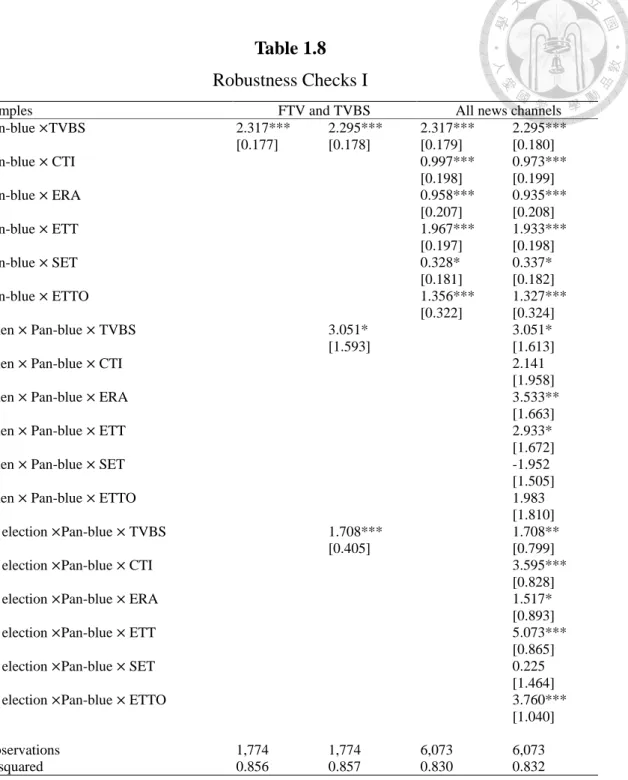
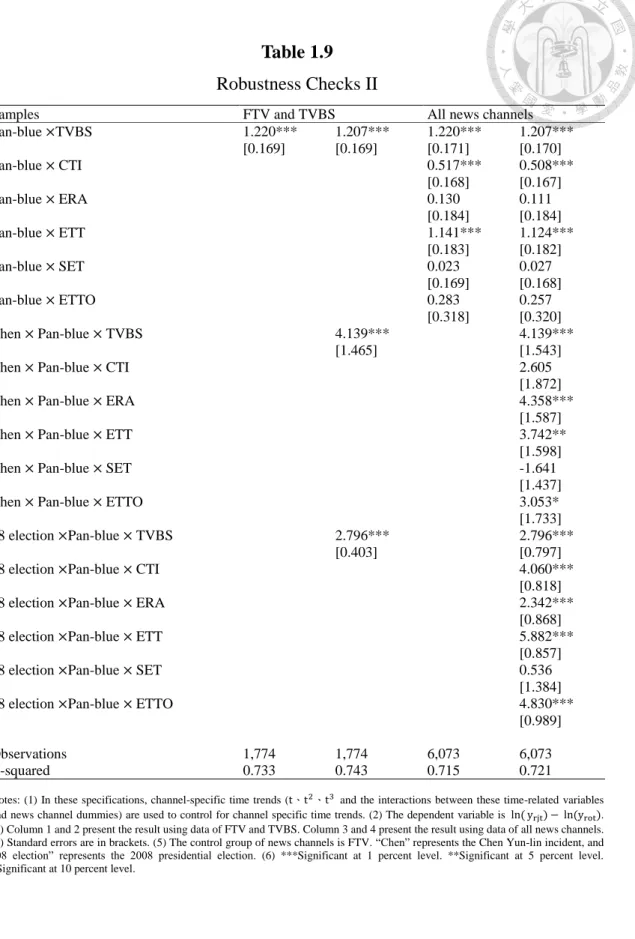
In this section, we present three sets of robustness checks. First, we use month-channel fixed effects instead of week-channel fixed effects to reduce the number of variables to be estimated in the model. Because the characteristics of news channels may vary across months but are unlikely to vary substantially within a month, using the interac- tions between month dummies and news channel dummies should allow us to control for unobservable program characteristics varying over time. The results are reported in Table 1.8. Second, we include channel specific time trend variables instead of week- channel or month channel fixed effects. The channel specific time trend variables include t, t2, and t3as well as the interactions between these time-related variables and the news channel dummy Ij. Table 1.9 presents the estimation results. As shown in Table 1.8 and Table 1.9, while some of the coefficients are more significant than in the previous results, the results are generally consistent with the previous findings.
The derivation of market demand from individual utility in section 1.4 requires the assumption that the individual unobservable taste shock, εir jt, is distributed as an extreme value type I distribution; thus, our dependent variable is ln(yr jt) − ln(yrot) in all of the specifications above. In our third set of robustness checks, we present results with the ratings of news channels, yr jt , as the dependent variable in a linear regression model. As shown in Table 1.10, the results are qualitatively consistent with the previous findings.
1.5.3 Accuracy of News
In this section, we investigate consumer sensitivity to the accuracy of news programs.
We use two false news events, TVBS’s Chou Cheng-pao videotape incident and SET’s 228 false footage incident, to estimate the effect of news accuracy on viewership. We introduce these two events below.
1.5.3.1 TVBS’s Chou Cheng-Pao Videotape Incident
On March 25, 2007, TVBS aired a shocking video in which a wanted gangster sat next to a number of pistols and rifles, claimed that he was behind three shooting incidents in the Taichung area, and threatened to shoot his former gangster boss. When airing the video in the news program, TVBS claimed that the video had been received by mail.
On March 27, however, it was revealed that Chou’s video was shot by a TVBS reporter.
TVBS subsequently fired the reporter and his superior. On March 30, the National Communications Commission (NCC) fined TVBS NT$2 million and required TVBS to replace the general manager. Lee Tao subsequently announced his resignation as general manager of TVBS News on April 2.
1.5.3.2 SET’s 228 False Footage Incident
SET broadcasted a series of special reports on the 228 Incident between March 3 and March 7 in 2007. On May 8, it was revealed that SET had misrepresented an image of KMT soldiers publicly executing a person in Shanghai in 1948 as occurred during the 228 Incident. SET apologized for its misuse of the footage on May 9, and the NCC fined SET NT$1 million for misleading the public.
1.5.3.3 Empirical Results
These two false news events attracted a substantial amount of public criticism and should thus be expected to hurt the viewership of these channels if consumers are concerned about accuracy. We use the week from March 25 to March 31, 2007, as the period of the Chou Cheng-Pao videotape incident to examine the effect of this incident.
Furthermore, to explore how long the effect of this incident persisted, we also analyze the effect one, two, and more weeks after the incident. We use the week from May 6 to May 12, 2007, as the period in which the SET’s 228-related false footage was exposed.
Under the assumption that consumers care about accuracy, these two false news events should have harmed the viewership of TVBS or SET. Therefore, we expected that ratings fluctuations for TVBS and SET after the disclosure of false news would be negative relative to that of other news channels. Rather than use channel-week fixed effects, we use two different methods to estimate the effects of false news. In the first method, we include week fixed effects and channel fixed effects. In the second method, we include the channel-specific time trend (t, t2, t3, and their interactions with channel dummies) in our baseline specifications to estimate the effects of Qjt.
Table 1.11 shows the estimation results for consumer sensitivity to the accuracy of news: Columns 1 and 2 are the results of using only data from 2007, and Columns 3 and 4 are the results of using the full set of data from 2004 to 2008. In Columns 1 and 3, we include week fixed effects and channel fixed effects, and in Columns 2 and 4, we include the channel-specific time trend. Columns 1 and 2 show that when using data that are exclusively from 2007, the effect of TVBS’s Chou Cheng-Oao videotape incident for TVBS is negative one or two weeks after the disclosure of false news.
However, the effect of SET’s 228 false footage incident for SET is positive during the week in which the false footage was exposed, but the effect becomes negative between one week and three weeks after the disclosure.
Using the full set of data in Columns 3 and 4, we find that the results are various in different specifications. Column 3 shows that when we include week fixed effects, only the effect of SET’s false footage incident for SET is significant and positive during the week in which the false footage was exposed, and furthermore, there is no significant effect for TVBS. However, when we include the channel-specific time trend in Column 4, the effect of TVBS’s incident is negative for TVBS two weeks after the disclosure of false news, and the effect of SET’s incident for SET is also negative between one week
and three weeks after the disclosure. Together, these results show that the changes in the ratings for TVBS and SET during incidents of false reports are either small or insignificant.
1.6 Conclusions
This study investigates consumer political ideology preferences regarding TV news programs in Taiwan’s environment of open and competitive contemporary media. We use audience ratings data for Taiwan’s news channels between 2004 and 2008 to ex- amine the sensitivity of consumers to the political ideology and accuracy of news pro- grams. The survey data and regional viewership data considered in this study suggest that consumers may prefer news channels whose slant is close to their own ideology.
However, the estimation results above may suffer from endogeneity problems re- sulting from reverse causality. Thus, we also explore changes in viewership patterns during periods with more political news to further examine consumer preferences re- garding the slant of news channels. We find that during the 2008 presidential election and the Chen Yunlin incident, the increase in ratings for TVBS was greater than that for FTV in regions with greater proportions of Pan-Blue supporters. This finding indicates that during political events, consumers are more inclined to watch news programs with a political ideology approximating their own.
Moreover, the results for other news channels are consistent with previous studies regarding the slant of each news channel. Our results show that the increase in ratings for CTI and ETT was greater than that for FTV in regions with a greater proportion of Pan-Blue supporters; in contrast, there was no significant difference between changes in ratings for FTV and SET. These findings are in accordance with the results of pre- vious studies indicating that the news content of CTI and ETT are more Pan-Blue than FTV and that both FTV and SET are Pan-Green.
After examining consumer sensitivity to political ideology, we explore the sen- sitivity of consumers to the accuracy of news programs. We employ TVBS’s Chou
Cheng-Pao videotape incident and SET’s 228 false footage incident as examples of sudden changes in news accuracy for these two news channels. We find that changes in ratings for TVBS and SET during incidents in which false reports were exposed are small or insignificant.
This paper shows that consumers tend to watch news that reflects a political ide- ology that is similar to their own in Taiwan’s current environment of open and com- petitive contemporary media. Furthermore, compared to the tendency to watch news that approximates self-beliefs, consumers are not very sensitive to accuracy in news programs.
Tables
Table 1.1
24-hour Television News Channels in Taiwan Name Abbreviation in
the paper
Company Year of
establishment TVBS
NEWS
TVBS TVBI Company Limited (a subsidiary of Television Broadcasts Limite in Hong Kong) ERA Group of Taiwan (2004-2005)
TVBI Company Limited (2005--)
1995
FTV News
FTV Formosa Television Inc. 1997
CTi News
CTI China Times Group (2004- Nov. 2008) Want Want China Times Group (Nov.
2008--)
1997
SET News
SET Sanlih E-Television Inc. 1998
Era News ERA ERA Communications Inc. 1996
ETTV News
ETT Eastern Broadcasting Co. 1997
ETtoday ETTO Eastern Broadcasting Co. 1999
Note: ETtoday was off-air between August 7, 2005, and June 25, 2006. It changed its name to EBC Financial News on mid-December, 2008.
Table 1.2
Summary Statistics of the TEDS Survey Sample
Observations Mean S.D
Choice of TV channels:
FTV 3,584 0.182 0.386
TVBS 3,584 0.252 0.434
SET 3,584 0.112 0.315
ETT 3,584 0.099 0.299
CTI 3,584 0.096 0.295
Political ideology:
Pan-blue 3,584 0.571 0.495
Gender:
Male 3,584 0.516 0.500
Level of education:
Junior high school 3,584 0.116 0.320
High school 3,584 0.292 0.455
Junior college 3,584 0.157 0.364
Above university 3,584 0.293 0.455
Ethnic Group:
Minnanese 3,584 0.733 0.442
Mainlander 3,584 0.166 0.372
Aborigine 3,584 0.009 0.097
Notes: (1) The data samples comprise TEDS survey data from the 2004 and 2008 legislative elections, the 2005 county governor and city mayor elections, and the 2006 Taipei and Kaohsiung City mayor elections. (2) S.D. represents the standard deviation of the variable.
Table 1.3
Choices of TV News Channels
Choice of TV channels TVBS SET ETT CTI Others
Pan-Blue 2.842*** 0.400** 2.366*** 2.410*** 2.065***
[0.149] [0.175] [0.171] [0.177] [0.137]
Male 0.127 0.265* -0.014 0.091 -0.088
[0.128] [0.140] [0.151] [0.154] [0.122]
Level of education:
Junior high school 0.363 0.175 0.399 -0.037 0.047
[0.262] [0.234] [0.349] [0.308] [0.204]
High school 1.381*** 0.269 0.977*** 0.640** 0.463**
[0.235] [0.232] [0.322] [0.284] [0.192]
Junior college 1.543*** 0.321 0.748** 0.587* 0.660***
[0.267] [0.284] [0.363] [0.324] [0.231]
Above university 1.648*** 0.420 0.549 0.805** 0.675***
[0.264] [0.270] [0.369] [0.314] [0.225]
Ethnic Group:
Minnanese -0.321 0.161 0.076 -0.025 -0.330
[0.307] [0.356] [0.363] [0.380] [0.290]
Mainlander 0.639 0.320 0.871* 0.832* 0.615
[0.419] [0.515] [0.479] [0.486] [0.406]
Aborigine 1.006 -13.077*** 1.583 0.926 0.772
[1.076] [1.209] [1.132] [1.282] [0.977]
Year of interview:
2005 -0.248 -0.278 -0.441** -0.409* -0.322*
[0.186] [0.213] [0.207] [0.227] [0.168]
2006 -0.124 0.479** -0.530** 0.016 -0.124
[0.195] [0.218] [0.225] [0.233] [0.182]
2008 0.099 0.908*** -0.691** 0.219 -0.537**
[0.218] [0.237] [0.277] [0.261] [0.209]
Constants -2.256*** -0.970* -1.023* -2.487*** -0.209
[0.488] [0.523] [0.607] [0.581] [0.431]
Observations 3,584 3,584 3,584 3,584 3,584
Notes: (1) Coefficients from the multinomial logit model are presented in this table. The reference group is FTV. (2) Standard errors are in brackets. (3) The control group of “level of education” is “below elementary school.” The control group of “Ethnic Group” is “Hakka.” The control group of “year of interview” is “2004.” (4) Other control variables not presented in this table include: age, income categories, occupation, regions, and mother’s ethnicity. (5) ***Significant at 1 percent level. **Significant at 5 percent level. *Significant at 10 percent level.
Table 1.4
Choices of TV News Channels (Average Partial effects)
Choice of TV channels FTV TVBS SET ETT CTI
Pan-Blue -0.216*** 0.188*** -0.108*** 0.041*** 0.040***
[0.013] [0.014] [0.011] [0.009] [0.010]
Male -0.008 0.020 0.023** -0.006 0.004
[0.012] [0.014] [0.011] [0.010] [0.010]
Level of education:
Junior high school -0.020 0.044 0.005 0.022 -0.021
[0.020] [0.038] [0.020] [0.028] [0.024]
High school -0.077*** 0.146*** -0.027 0.024 -0.010
[0.019] [0.032] [0.019] [0.025] [0.021]
Junior college -0.087*** 0.167*** -0.027 -0.005 -0.023
[0.024] [0.035] [0.022] [0.027] [0.023]
Above university -0.093*** 0.181*** -0.021 -0.029 -0.006
[0.023] [0.034] [0.021] [0.028] [0.023]
Ethnic Group:
Minnanese 0.015 -0.035 0.028 0.023 0.014
[0.031] [0.031] [0.026] [0.023] [0.025]
Mainlander -0.069 0.010 -0.013 0.029 0.024
[0.045] [0.035] [0.036] [0.026] [0.027]
Aborigine 0.308*** 0.290*** -1.232*** 0.190*** 0.125
[0.109] [0.108] [0.105] [0.063] [0.079]
Year of interview:
2005 0.037** 0.010 -0.005 -0.016 -0.012
[0.017] [0.022] [0.017] [0.014] [0.016]
2006 -0.000 -0.007 0.053*** -0.043*** 0.010
[0.018] [0.022] [0.017] [0.015] [0.016]
2008 -0.001 0.048** 0.097*** -0.058*** 0.029*
[0.021] [0.024] [0.018] [0.019] [0.017]
Observations 3,584 3,584 3,584 3,584 3,584
Notes: (1) Average partial effects are presented in this table. The reference group is FTV. (2) Standard errors are in brackets.
(3) The control group of “level of education” is “below elementary school.” The control group of “Ethnic Group” is
“Hakka.” The control group of “year of interview” is “2004.” (4) Other control variables not presented in this table include:
age, income categories, occupation, regions, and mother’s ethnicity. (5) ***Significant at 1 percent level. **Significant at 5 percent level. *Significant at 10 percent level.